Proceedings of the
Second International Workshop on
Graph and Model Transformation
(GraMoT 2006)
Realizing QVT with Graph Rewriting-Based Model Transformation
L´aszl´o Lengyel, Tiham´er Levendovszky, Tam´as Vajk and Hassan Charaf
12 pages
Guest Editors: Gabor Karsai, Gabriele Taentzer
Managing Editors: Tiziana Margaria, Julia Padberg, Gabriele Taentzer
Realizing QVT with Graph Rewriting-Based Model Transformation
L´aszl´o Lengyel1, Tiham´er Levendovszky2, Tam´as Vajk3and Hassan Charaf4
1
2
3
3
Budapest University of Technology and Economics Goldmann Gy¨orgy t´er 3., Hungary 1111, Budapest
Abstract: Model-based development is an increasingly applied method in produc-ing software artifacts that is driven by model transformation. For instance, OMG’s Model-Driven Architecture as a model-based approach to software development facilitates the synthesis of application programs from models created using cus-tomized, domain-specific model processors. Meta Object Facility 2.0 Query/ Views/ Transformation (QVT) is the OMG’s standard for specifying model queries, views, and transformations. Extensive research of graph transformation provides a strong formal background for model transformation. The main contribution of this paper is to show how high-level constraint constructs facilitate to realize transformations specified in QVT with metamodel-based model transformation. As a result we can reuse the graph transformation constructs, and its formal background, which facili-tates to make QVT transformations validated.
Keywords: Graph Rewriting, Model Transformation, QVT Realization, High-Level Constraints
1
Introduction
OMG’s Model-Driven Architecture (MDA) [OMGc] emphasizes the use of models at all stages of system development. It has placed model-based approaches to software development into focus. MDA offers a standardized framework to separate the essential, platform-independent information from the platform-dependent constructs and assumptions. A complete MDA appli-cation consists of a definitive platform-independent model (PIM), one or more platform-specific models (PSM) including complete implementations, one on each platform that the application developer decides to support. The platform-independent artifacts are mainly written in UML and other software models containing enough specification to generate the platform-dependent artifacts automatically by model compilers.
One may conclude that transformations in general play an essential role in model-based de-velopment, thus, there is a need for highly configurable model transformation tools. These tools must make the model transformation flexible and expressive. Furthermore, they should support control flow, constraints, parameter passing between sequential rules, and conditional branching. The Model-Driven Architecture offers a standard interface to implement model transforma-tion tools. The transformatransforma-tion related part of MDA is the Query/View/Transformatransforma-tion (QVT) for MOF 2.0 [OMGb]. Three types of operations are provided: queries on models, views on metamodels and transformations on models. In model transformation area QVT is one possible solution for defining transformations. But there are several different approaches and languages that offer similar constructs with minor/major differences in features.
With the hope that QVT become a wide-spread standard for model transformation, the goal of the current work is to introduce the realization of QVT Relations with graph rewriting-based model transformation, namely, with the Visual Modeling and Transformation System (VMTS) approach [VMT]. VMTS supports validated online transformation, therefore, using the results presented in the current paper we can transform model transformations defined in QVT to VMTS constructs, which means that they can also be validated. Furthermore, the results can be applied to transformations that are specified using a language whose artifacts can be transformed to QVT language. This means that there exists an implemented transformation, which maps the transformation specifications to QVT transformations.
There are several graph rewriting-based model transformation tool (e.g. GReAT [KASS03], PROGRES [RS97], FUJABA [KNNZ00], VIATRA [VP03], AGG [Tae03], and AToM3[LVA04]), therefore, the mapping presented in this paper facilitates the reuse of the transformations that supports QVT as a common platform.
If QVT can be realized by graph rewriting-based model transformation, there is a hope that the results originating from the strong background of graph transformation can be reused on the QVT level. Furthermore, high-level constraint constructs provided by VMTS [LLC05] facilitates the online validated model transformation that also can be applied in QVT domain.
The rest of this paper is organized as follows. Section2provides the background information including a graph rewriting-based model transformation system (Visual Modeling and Transfor-mation System, VMTS). Using the features of this system, the principles of metamodel-based model transformation are presented. Section 3 gives an overview on OMG’s QVT language. Section4discusses the relation between QVT and VMTS constructs. Section5presents the re-alization of the QVT constructs with VMTS approach, thus, with a graph rewriting-based model transformation framework. Finally, conclusions are provided.
2
Backgrounds
Graph rewriting [Roz97] [EEKR99] is a powerful technique for graph transformation with a strong mathematical background. The atoms of graph transformations are rewriting rules, each rule consists of a left-hand side graph (LHS) and right-hand side graph (RHS). Applying a graph rewriting rule means finding an isomorphic occurrence (match) of LHS in the graph to witch the rule being applied, and replacing this subgraph with RHS.
Constraint Language (OCL) constraints. Models are formalized as directed, labeled graphs. VMTS uses a simplified class diagram for its root metamodel (”visual vocabulary”).
Also, VMTS is a model transformation system, which transforms models using graph rewrit-ing techniques. Moreover, the tool facilitates the verification of the constraints specified in the transformation rule during the model transformation process.
In VMTS, LHS and RHS of the transformation rules are built from metamodel elements. This means that an instantiation of LHS must be found in the input graph instead of the isomorphic subgraph of LHS.
Rewriting rules can be made more relevant to software engineering models if the metamodel-based specification of the transformations allows assigning OCL constraints to the individual transformation rules. This technique facilitates a natural representation for multiplicities, multi-objects and assignments of OCL constraints to the rules with a syntax close to the UML notation. VMTS facilitates a refined description of the transformation rules. When the transformation is performed, the changes are specified by the RHS and internal causality relationships defined between the LHS and the RHS elements of a transformation rule. Internal causalities can express the modification or removal of an LHS element, and the creation of an RHS element. XSLT or Imperative OCL [OMGb] scripts can access to the attributes of the objects matched to the LHS elements, and produce a set of attributes for the RHS element to which the causality points.
Classical graph grammars apply any production that is feasible. This technique is appropriate for generating and matching languages but model-to-model transformations often need to follow an algorithm that requires a stricter control over the execution sequence of the rules, with the additional benefit of making the implementation more efficient.
The VMTS approach is a visual approach, thus, it also uses graphical notation for control flow: stereotyped UML activity diagrams. VMTS Visual Control Flow Language (VCFL) is a visual language for controlled graph rewriting and transformation, which supports the following constructs: sequencing transformation rules, branching with OCL constraints, hierarchical rules, parallel execution of the rules, and iteration.
The VMTS transformation rules have two specific properties: Exhaustive and MultipleMatch. Applying a model transformation rule means finding a match of LHS in the input model and replacing this subgraph with RHS. An exhaustive transformation rule is executed repeatedly, as long as LHS of the rule can be matched to the input model. The MultipleMatch property of a rule allows that the matching process finds not only one but all occurrence of LHS in the input model, and the replacement is executed on all the found places.
The interface of the transformation rules allows the output of one rule to be the input of another rule (parameter passing), in a dataflow-like manner. In VCFL, this construction is referred to as
external causality. An external causality creates a linkage between a node contained by RHS of
the rule i and a node contained by LHS of the rule i+1. Since rule i provides partial match to rule i+1 this feature accelerates the matching and reduces the complexity.
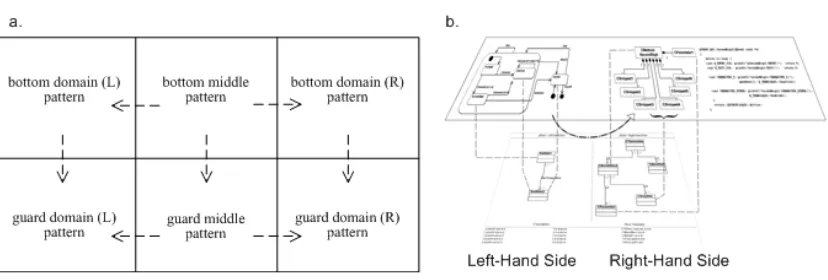
Figure 1: (a) QVT Core domain and pattern dependencies, (b) VMTS metamodel-based trans-formation rule with input and output models
fails, and the next element in the control flow is a decision object, then it could provide the next branch based on the constraints. This VMTS construct accelerates and makes the transformation more efficient, and the control flow model simpler, because, for example, there is no need to define test rules as in GReAT or PROGRES.
3
MOF 2.0 Query/Views/Transformation Overview
The QVT specification has a both declarative and imperative nature, with the declarative part split into a two-level architecture that forms the framework for the execution semantics of the imperative part [OMGb].
The layers of the declarative part are the following: (i) The user-friendly Relations metamodel and language which supports complex object pattern matching and object template creation. (ii) A Core metamodel and language is defined using minimal extensions to EMOF [OMGa] and OCL [OMGd].
The Relations language supports complex object pattern matching, and implicitly creates trace classes and their instances to record what occurred during the execution of the transformation. Relations can assert that other relations also hold between particular model elements matched by their patterns.
The Core language supports pattern matching over a flat set of variables by checking condi-tions over those variables against a set of models. It treats all of the model elements of source, target and trace models symmetrically (Figure1a). It is equally powerful to the Relations lan-guage, and, because of its relative simplicity, its semantics can be defined more simply, although transformation descriptions provided using the Core are therefore more verbose. In Core, trans-formation classes and patterns over them are an essential part of the mapping specifications.
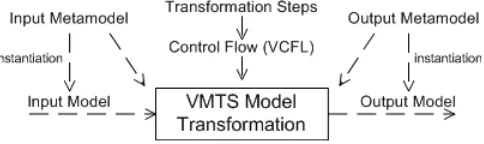
Figure 2: Principles of VMTS metamodel-based validated model transformation
is changed after an initial execution, and finally, (vi) the ability to create or delete objects and values, while also being able to specify which objects and values must not be modified.
4
Relation between QVT and VMTS Constructs
This section summarizes the relation between the QVT and metamodel-based model transfor-mation. Table1compares the model transformation related basic constructs of the QVT and the VMTS .
QVT Construct VMTS Construct
Type information MOF metamodels metamodels - instantiation relation is based on the relation between MOF layers 0 and 1
Instances MOF models (instance) models
Preconditions OCL, patterns OCL, LHS
Postconditions OCL, patterns OCL, RHS
Actions Patterns of enforced domains Internal causalities based on LHS→RHS
Control Context (when) and post-effect (where) clauses Stereotyped activity diagrams (VCFL) Correctness Patterns of checked domains Preservation of OCL constraints
Table 1: Comparison of QVT and VMTS constructs
Figure1b introduces the principle of the metamodel-based model transformation rules. The constructs that form a metamodel-based LHS specification are inheritance and multiplicity sup-port (Figure1b). Inheritance support is analogous to the natural type compatibility of object-oriented languages: the derived class can always be passed where the ancestor class is expected. This means that a class element in LHS always matches its descendant types in the input model. That facilitates generalization in the rules as well as abstract types. Multiplicity support is ac-complished by allowing multiplicity values on the association ends. In VMTS, the match found for LHS is maximal in a sense that the actual matched multiplicity is the greatest possible value from the specified multiplicity interval, which does not contradict any other part of the match.
metamodels have an effect on the transformation.
LHS and RHS can use different metamodels. Transformation rules contain OCL constraints. The transformation uses matches found by the matching process and the compiled binary gen-erated by the OCL compiler to check the constraints on the matched parts of the input model. The transformation produces the transformation result if and only if a match satisfies the pre-conditions. Moreover, the rule is successful if and only if the transformation result satisfies the postconditions.
Transformations, Model Types and Mappings. Figure1presents the correspondence between QVT Core language transformation and VMTS metamodel-based transformation rules. To em-phasize the similarity, we have swapped the Guard and Bottom rows in Figure1a. In the Core language, a transformation is specified as a set of mappings that declare constraints that must hold between the model elements belonging to a set of candidate models and the trace model. The candidate models are named, and the types of elements that they can contain are restricted by a model type. Figure1a depicts the structure of a QVT mapping with two domains, where each rectangle of a mapping represents a pattern. The columns are called areas. Each area consists of two patterns, the guard pattern and the bottom pattern. A mapping consists of one area for the trace (the middle area) and one area (a domain) for each model type. The domain areas consist of patterns that match the candidate models, the middle area consists of patterns that match the trace model.
A VMTS transformation is a VCFL model that is built from single metamodel-based model transformation rules. Transformation rules match the input models based on the defined struc-ture, metatypes, and other constraints. The constraints are expressed in OCL. The transformation creates the output based on RHS and internal causalities.
Patterns and Binding. A QVT pattern is specified as a set of variables, predicates and assign-ments. Patterns can be matched and enforced. Matching a pattern can result in value bindings of the variables, and enforcing a pattern can result in model changes causing new value bindings for the variables during matching. In a mapping, the bottom patterns depend on guard patterns (in the same column) and middle patterns depend on domain patterns (in the same row).
In VMTS, the matched pattern corresponds to the match found for LHS of a rule, and the enforced pattern is the resulted model that is an instance of RHS. VMTS provides a unique constraint management mechanism that facilitates to reuse transformation rules with different constraint sets [VMT].
Guards and Checking. Guards of a mapping narrow the selection of model elements to be considered for the mapping. Matching the bottom patterns takes place in the context of a valid combination of valid bindings of all the guard patterns. In such a combination, for each depen-dency between two guard patterns, there must be exactly one dependepen-dency between two valid bindings of those two guard patterns.
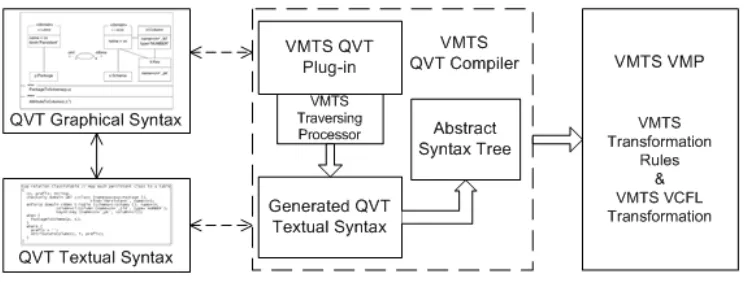
Figure 3: Overview of the QVT realization with VMTS
In VMTS, guards are the metamodel-based model transformation rules. Checking can be expressed with transformation rules that contain only LHS. LHS expresses the required structure with metatypes and the necessary conditions defined by the propagated OCL constraints. If there is no proper match in the input model, then the rule fails.
Enforcement and Trace. At execution time, one model type of the transformation can be chosen as the enforcement direction. The target model and trace model may be changed to fulfil the constraints of the mappings. The models are only changed when the constraints of a mapping are not fulfilled. The changes will lead either to the creation of new valid bindings or the removal of existing valid bindings of the target bottom patterns and the trace bottom patterns to enforce the constraints of a mapping.
VMTS stores model elements (nodes and edges) in database tables. Each node is contained in the table NODE and each edge by the table EDGE. Each model related operation uses these tables to select, create or update elements. The VMTS database, among others, contains two tables (TRACE NODE and TRACE EDGE) in order to support tracing and to store the trace information separately from model elements. This means that trace information is created and used only by transformations and not by the presentation framework. Therefore, at modeling time trace information is not visible and does not confuse the source and target models.
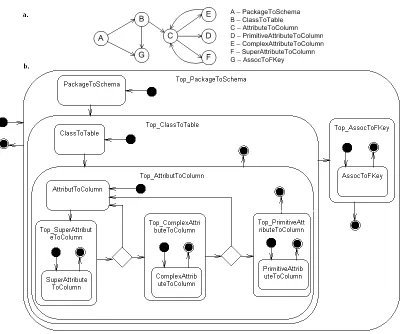
Figure 4: (a) Control Flow (CF) graph of the transformation ClassToRDBMS created by trans-formation QVTConstructToVMTSConstruct, (b) Generated VCFL model of the VMTS version of the transformation ClassToRDBMS
It can be stated that design and dependency information must be preserved for software evo-lution in order to be automated. The MDA-based approaches define design information in high-level instances, while dependency information is provided in transformations. Therefore, the software evolution support can be solved with metamodel-based model transformations and re-fined with adequate constraint management.
Bi-directional transformations. The QVT operational mapping and black-box approaches re-strict the scenarios by allowing specification of transformations in a single direction only. Bi-directional transformations are only possible if an inverse operational implementation is provided separately.
the source model. Therefore, it is not possible to correctly produce the source model from the target model with an inverse transformation. In summary, general inverse transformation should contain totally new internal causalities that perform attribute modifications.
Bi-directional transformations form the basis of real roundtrip engineering. Forward engineer-ing is the basic model-to-code transformation and reverse engineerengineer-ing is the inverse transforma-tion (code-to-model). Bi-directransforma-tional transformatransforma-tions support incremental software development, where the changes achieved either in the models or in the code should be synchronized with the other artifacts.
5
Transforming QVT Constructs to VMTS
The transformation that generates VMTS Visual Model Processor from QVT transformation specification is illustrated on the ”class model to relational database management system (RDBMS) model” transformation (also referred to as object-relational mapping). The complete QVT solu-tion for the basic version of the model transformasolu-tion example can be found in [OMGb]. The current section introduces the methods that we use to process QVT relations and examples are provided based on the ClassToRDBMS transformation.
In Figure 3, the overview of the QVT realization with VMTS is depicted. We use VMTS Presentation Framework (VPF) [VMT] as a basis for the QVT visualization. VPF provides a flexible plug-in-based architecture and offers individual metamodel-dependent visualization and editing features. This facilitates to edit QVT transformations visually in VMTS environment using VMTS QVT plug-in. VMTS Traversing Processor (TP) makes it possible to process the visual QVT transformation specification and produce its textual syntax. Finally, the VMTS QVT compiler is used to generate a VMTS Visual Model Processor (VMP), including the transforma-tion rules and the control flow model from a QVT transformatransforma-tion specificatransforma-tion.
Based on the when and where clauses of the QVT relations, a Control Flow (CF) graph is built to support the creation of the VMTS control flow model (VCFL model). Figure4a depicts the CF graph created from the relations of the QVT transformation ClassToRDBMS. The CF graph de-scribes that model processing should start with the relation PackageToSchema, the secondly executed relation must be the relation ClassToTable, furthermore, the relations AttributeToColumn
-ComplexAttributeToColumn and AttributeToColumn - SuperAttributeToColumn can be executed
in loop.
QVT transformations differentiate top-level and non-top-level relations. The execution of a transformation requires all its top-level relations to hold, whereas non-top-level relations are re-quired to hold only when they are invoked from the where clause of another relation. In the transformation ClassToRDBMS, relations PackageToSchema, ClassToTable and AssocToFKey are top-level relations. In Figure 4b, the generated VMTS VCFL model is depicted, where we utilized the hierarchical rule construct of the VMTS approach.
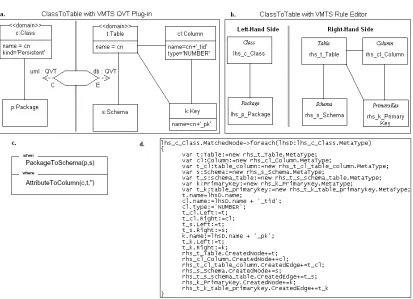
Figure5a introduces the graphical version of QVT relation ClassToTable edited with VMTS QVT plug-in. In VMTS QVT plug-in, when and where clauses are properties of the transforma-tion rules, they are not shown below LHS and RHS of the rule, because it is not required by the QVT specification, they can be edited separately via a property control (Figure5c).
com-Figure 5: (a) ClassToTable with VMTS QVT plug-in, (b) Generated VMTS rewriting rule
ClassToTable, (c) When and Where clauses of the rule ClassToTable, and (d) Generated
Im-perative OCL code
piler. The inputs are the VMTS QVT plug-in-based relations, and the outputs are the VMTS metamodel-based model transformation rules with a control flow model. Both model elements created with QVT plug-in and the VMTS transformation rule elements refer to the appropri-ate UML Class (Package, Class, Attribute, PrimitiveDataType, and Association) and RDBMS metamodel elements (Schema, Table, Column, Key, and ForeignKey).
The main steps achieved by VMTS QVT compiler are as follows: (i) the compiler processes the QVT graphical representation and generates QVT textual representation using the Relations language. (ii) From the textual representation abstract syntax tree (AST) is generated, from which the control flow (CF) graph is created. (iii) With the help of the AST and CF graph the compiler generates the VCFL model. (iv) Using the AST the compiler produces VMTS rewriting rules. The generated rules contains LHS and RHS graphs with metatype information (Figure5b), internal causalities with Imperative OCL codes (Figure5d), and constraints.
generated to require that LHS match only persistent classes:
context Class inv Class_const1: kind = ’Persistent’
For more details please refer to [VMT].
6
Conclusions
This paper has demonstrated the realization of the OMG QVT with metamodel-based model transformation constructs. Not all, but the main QVT constructs have been analyzed from the point of metamodel-based model transformation, and the appropriate VMTS constructs have been introduced that provide the same functionality. The relations between QVT and VMTS constructs have been discussed. Furthermore, the method that we use to create VMTS transfor-mation rules from QVT Relations and VMTS control flow (VCFL) model based on the QVT
when and where clauses have been presented.
Unfortunately, QVT does not have a visual control flow support. Moreover, the branching mechanism provided by the when-where clauses is a bit difficult to use. Often model-to-model and model-to-code transformations need to follow an algorithm that requires a stricter control over the execution sequence of the rules, therefore, VCFL models provide a more comfortable way to build transformations from individual rules.
Several open questions remain related to the QVT that should be examined and discussed, for example, the attribute modification in bi-directional or in-place transformations. In general, the inverse transformations cannot be automatically created from the original transformations. Furthermore, a transformation may be considered in-place when its source and target models are both bound to the same model at runtime. In this case the trace objects connect the actual model element with itself, and this means that the original attribute values are lost, since they cannot be queried with the help of the trace objects.
The transformation QVTConstructToVMTSConstruct is a QVT compiler implemented in VMTS. We have placed emphasis on the processing of the QVT constructs of the presented approach. The VMTS QVT plug-in can be used to define QVT relations with the necessary attributes and
when and where clauses [VMT].
In summary, we can conclude that QVT can be realized by graph rewriting-based model transformation; furthermore, transformations can be validated with VMTS high-level constructs. Therefore, QVT can utilize the results originating from metamodel-based model transformation and the formal background of graph rewriting.
Bibliography
[EEKR99] H. Ehrig, G. Engels, H.-J. Kreowski, G. Rozenberg. Handbook on Graph
Gram-mars and Computing by Graph Transformation: Application, Languages and Tools.
Volume 2. World Scientific, Singapore, 1999.
[KASS03] G. Karsai, A. Agrawal, F. Shi, J. Sprinkle. On the Use of Graph Transformation in the Formal Specification of Model Interpreters. 9(11):1296–1321, 2003.
[KNNZ00] H. J. K¨ohler, U. Nickel, J. Niere, A. Z¨undorf. Integrating UML diagrams for produc-tion control systems. In ICSE ’00: 22nd int. conf. on SE. Pp. 241–251. ACM Press, New York, NY, USA, 2000.
[LLC05] L. Lengyel, T. Levendovszky, H. Charaf. Constraint Validation Support in Visual Model Transformation Systems. Acta Cybernetica 17(2):339–357, 2005.
[LVA04] J. de Lara, H. Vangheluwe, M. Alfonseca. Meta-modelling and graph grammars for multi-paradigm modelling in AToM3. Journal of Software and Systems Modeling 3(3):194–209, May 2004.
[OMGa] OMG. Meta Object Facility.
[OMGb] OMG. Meta Object Facility 2.0 Query/Views/Transformation.
[OMGc] OMG. Model-Driven Architecture.
[OMGd] OMG. Object Constraint Language.
[Roz97] G. Rozenberg. Handbook on Graph Grammars and Computing by Graph
Transfor-mation: Foundations. Volume 1. World Scientific, Singapore, 1997.
[RS97] J. Rekers, A. Sch¨urr. Defining and Parsing Visual Languages with Layered Graph Grammars. Journal of Visual Languages and Computing 8(1):27–55, 1997.
[Tae03] G. Taentzer. AGG: A Graph Transformation Environment for System Modeling and Validation. In Proc. Tool Exihibition at Formal Methods 2003. September 2003.
[VMT] VMTS. Visual Modeling and Transformation System.