Electronic Communications of the EASST
Volume 3 (2006)
Guest Editors: Jean-Marie Favre, Reiko Heckel, Tom Mens
Managing Editors: Tiziana Margaria, Julia Padberg, Gabriele Taentzer
Proceedings of the
Third Workshop on Software Evolution
through Transformations:
Embracing the Change
(SeTra 2006)
A MDE-Based Approach for Developing Multi-Agent Systems
Viviane Torres da Silva, Beatriz de Maria, Carlos J. P. de Lucena
ECEASST
A MDE-Based Approach for Developing Multi-Agent Systems
Viviane Torres da Silva Silva*, Beatriz de Maria**, Carlos J. P. de Lucena**
*Departamento de Sistemas Informáticos y Programación, UCM, Spain
**Departamento de Informática, PUC-Rio, Brazil [email protected], {biamar, lucena}@inf.puc-rio.br
Abstract: This paper focuses on the development of multi-agent systems based on a model driven engineering approach. Our goal is to cope with the traceability between design and implementation models and with the always changing characteristics of such systems.
Keywords: model driven architecture, multi-agent systems, transformation, evolution
1
Introduction
The development of multi-agent systems (MAS) has rapidly increased in the last few years. Modeling languages [13][17][22], platforms [16][18], methodologies [2][4][15] and some other MAS modeling and implementing techniques have been proposed with the purpose of helping the developers in building such systems. Although several approaches are concerned with modeling and implementing MAS, only few accomplish the tracking between design models and implementation code.
While dealing with MAS, the refinement of design models into implementation code becomes especially difficult since it is necessary to deal with different paradigms during the system development. The agent-oriented paradigm is used while modeling the systems but, frequently, those systems are implemented by using the object-oriented paradigm (OO). Since agents and objects have different properties and characteristics (for instance, agents are autonomous and goal-oriented entities that execute plans in order to achieve their goals and, different from objects, do not need external stimulus to execute and can ignore requests), the transformation from agent-oriented design models into OO code is not simple. To try to assist the implementation of MAS, several OO platforms, architectures and frameworks such as [18][16] have been proposed. Although such approaches satisfactory provide satisfactory support for the implementation of the MAS, they fail to provide the tracing between the design models and the implementations. The numerous MAS modeling language, methodologies and platforms deal with different agent properties and characteristics what directly impact in the traceability.
Another important concern that mostly affects the development of MAS is the always changing characteristic of MAS applications and techniques. Since a number of fundamental questions about the nature and the use of the agent-oriented approach are still being answered, important techniques’ features and also applications’ requirements are still evolving.
Short Article Title
source and target models, (ii) both models, (iii) the transformations, and (iv) some guidelines to cope with models evolution [11].
The traceability between MAS design models and OO implementation models will be illustrated by the use of the multi-agent system modeling language called MAS-ML [17][19] (the source modeling language), the agent society framework called ASF [18] and the UML modeling language [14] (the target modeling language). The MAS-ML design models (the source models) will be transformed into UML implementation models (the target models) by instantiating the ASF framework according to the application characteristics.
Our second goal is accomplished by demonstrating that the transformation rules can be adapted to the evolution of both applications and techniques being used in the transformation. Such adaptation is facilitated due to the low coupling between design and implementation models. Design models are independent of the platform / framework being used to implement the system, i.e., design models are not concerned with any characteristic of the implementation technique. In addition, the framework is also defined completely independent of the modeling language being used in the design models.
The paper is organized as follows. In Section 2 we present the MAS techniques being used in the paper: MAS-ML and ASF. Section 3 introduces the transformation process and Section 4 provides some guidelines to embrace the evolution of applications and techniques. Section 5 describes some related work and Section 6 draws the conclusions and discusses future work.
2
Multi-Agent System Techniques
The development process of complex and large-scale systems, such as MAS, involves the construction of different models based on a variety of requirements. The transformation of a system specification into models and of these models into code is usually accomplished in a non-organized way that is not easily adaptable to technology changes. In fact, it is possible to find different modeling languages, methodologies and platforms for modeling and implementing MAS but it is hard to find in the literature approaches that trace the design models into code. Therefore, we propose in this paper a top-down MDE approach that traces MAS-ML design models into ASF object-oriented code.
The MAS-ML Modeling Language
MAS-ML is a platform independent modeling language that extends UML incorporating agent-oriented abstractions (such as agents, organizations, environments and roles), their properties (such as goals, plans, actions, beliefs and protocols) and relationships (such as play, inhabit and ownership). Although MAS-ML uses agent and object-oriented abstractions, MAS-ML does not restrict the implementation of its models to a specific implementation platform.
ECEASST Class AgentClass OrganizationClass AgentRoleClass EnvironmentClass play 1 1..* 0..* define 1 sub-org play 1..* 1 playin 0..* 1..* 1..* 1 inhabit 1 0..* inhabit inhabit 1 0..* 1 sub-org 0..* 1
play in playin
0..*
0..*
Metaclass of the UML metamodel Metaclasses introduced by MAS-ML Legend
Figure 1. Part of the MAS-ML metamodel
The ASF Framework
The goal of ASF is to help designers implementing MAS by using the object-oriented paradigm. The framework defines a set of OO models where each model represents a MAS entity type. The set of OO classes and relationships defined in each module makes possible the implementation of the structural aspects of MAS entities (its properties and relationships with other entities) and also the dynamic ones (their behavior).
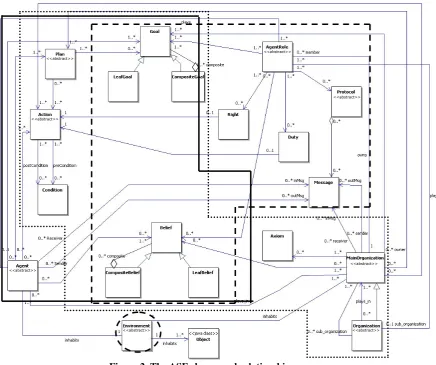
Figure 2 shows a UML class diagram modeling all ASF classes grouped by modules. The modules that are used to instantiate agents (delimited by a continuous rectangle), organizations (defined by the dotted enlace) and agent roles (marked by the hatched rectangle) are complex modules since they group several classes to represent all the properties of these entity types. The module that corresponds to environments (hatched circle) is simple represented by one class because the properties of this entity can be directly represented as attributes and methods.
In order to use ASF to implement a MAS application, it is necesary to instantiate the framework by extending the defined modules. The extentions should be made according to the entities characteristics defined in the application being implemented. For instance, to implement application agents by using ASF it is necessary (i) to create an OO class extending the Agent abstract class defined in the ASF agent module to be used to instantiate the agents,
(ii) to create OO classes by extending the Plan and Action classes to implement the plans and
actions of the agents, (iii) to implementing the constructor method of the new agent class to create the (instances of the) beliefs, goals and plans and also (iv) to relate the agent instances to the roles that they will play, the organizations where they will play such roles and also to the environments that they will inhabit. Similar steps could be followed in order to implement the organizations, roles and environments defined in the MAS application.
3
The Transformation Process
Short Article Title
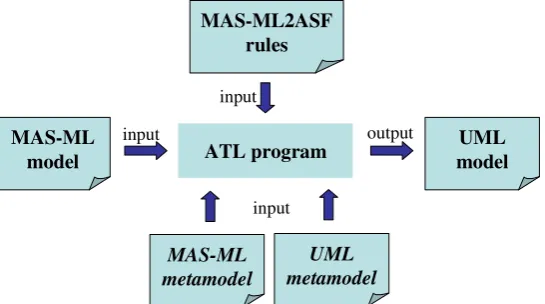
by using the transformation rules (MAS-ML2ASF rules), transforms the source model into the output target model (UML model) that is compliant with the target metamodel. In MDE [11],
transformation processes based on the translations between metamodels are called language
translations. Figure 3 illustrates the inputs and the output of the ATL program that transforms MAS-ML models into UML models by using the MAS-ML2ASF rules.
<<abstract>>
<<abstract>>
<<abstract>>
<<abstract>>
<<abstract>>
<<abstract>>
<<abstract>> <<abstract>>
Figure 2. The ASF classes and relationships
The set of rules used by the ATL program to transform a MAS-ML model into a UML model instantiates the ASF framework according to the application features modeled in MAS-ML. The set of MAS-ML2ASF rules is composed of (i) one general rule that generates all the classes defined in ASF (and illustrated in Figure 2); (ii) five rules to transform the five entity types found in MAS-ML models (and defined in the MAS-ML metamodel depicted in Figure 1); and (iii) three other rules to generate the concrete plans, actions and protocols that extends
ECEASST
ATL program
UML metamodel MAS-ML
metamodel MAS-ML
model
UML model MAS-ML2ASF
rules
input
output input
input
Figure 3. The ATL transformation process
The Transformation Rules
Due to page limitation, we concentrate on demonstrating the transformation of agents modeled using MAS-ML into OO classes by instantiating ASF. The following sections describe the MASML2ASF rules used by the ATL program that contemplates such transformation.
The creation of the concrete agent class
For each distinguished agent class modeled in a MAS-ML structural diagram, one
object-oriented agent class that extends the abstract ASF class called Agent must be created.
Therefore, we have implemented a rule that is executed for each agent defined in MAS-ML. Such rule, illustrated in the box below, is responsible for creating the agent class and for implementing the constructor method (detailed in Section 0).
The new classes are created with the same name of the agent classes modeled in MAS-ML models. Associated with each agent class, we define a generalization relationship in order
to model the new agent class extending the abstract Agent class defined in ASF. Due to such
generalization, the new agent class inherits all the attributes (and relationships) defined in the abstract class.
The set of features of the new class is composed of (i) the constructor method, (ii) methods for instantiating goals, beliefs, plans and actions, and (iii) methods for creating the associations between agent instances and the role instances to be played, and the associations between the agent instances and the environment instances.
rule Agent {
from
c : masml!AgentClass to
--- -- Creating the agent class outAgent : uml!Class (
name <- c.name, --the name of the new class is equal to the name of the agent isAbstract <- false, --the new class is not an abstract one
generalization <- genAbstractAgent, --creating the generalization relationship feature <- Set{constMethod, createBeliefs, createGoals, createPlans,
createActions, createInhab, createPlays}), –-creating the set of structural and behavioral features
--- -- Creating the generalization relationship between Agent and UserAgent genAbstractAgent : uml!Generalization (
Short Article Title
),...}
The implementation of the constructor method
The constructor method of agent classes invokes other methods that are used to instantiate the agent properties (goals, beliefs, plans and actions) and to set the relationships between the agents instances, their roles, and environments. Therefore, the body of this method is very simple.
--- -- Constructor Method constMethod : uml!Method (
specification <- operationAgent,
body <- 'createBeliefs(); createGoals(); createPlans(); createActions(); createPlays();
createEnv(); createPlays();' ),
operationAgent : uml!Operation ( isAbstract <- false,
specification <- 'UserAgent()' ),
The instantiation of the agent properties are exemplified by describing the instantiation of beliefs and plans. The beliefs and goals of an agent are created by instantiating the ASF
classes Belief and Goal, respectively. Therefore, the body of the method responsible for
generating the beliefs creates one new belief instance from the Belief class for each belief
defined by the agent classes of the MAS-ML model being transformed.
The plans and actions of an agent are created by instantiating the classes that
correspond to the plans and actions themselves. Those classes are extensions of the Plan and
Action classes as demonstrated in Section 0.
--- -- Instantiating the agent beliefs createBeliefs : uml!Method (
specification <- operationCreateBeliefs,
body <- c.beliefs -> iterate (e; body : String = '' | body+' Belief newBelief = null;
beliefs = new Vector();
newBelief = new Belief('+e.type+','+e.value+'); -- instantiating a belief
beliefs.add(newBelief);') ),
operationCreateBeliefs : uml!Operation ( isAbstract <- false,
specification <- 'void createBeliefs()' ),
--- -- Instantiating the agent plans createPlans : uml!Method (
specification <- operationCreatePlans,
body <- c.plans -> iterate (e; body : String = '' | body+' Plan newPlan = null;
plans = new Vector();
newPlan = new '+e.name+'(); -- instantiating a plan
plans.add(newPlan);') ),
operationCreatePlans : uml!Operation ( isAbstract <- false,
specification <- 'void createPlans()' ),
After instantiating the agent properties, it is necessary to relate the agent instances with the roles to be played, the organization where the roles will be played and the environments that they will inhabit. In order to do so, two methods were created. Both methods are called by the agent constructor method every time an agent instance is created.
ECEASST
-- Environment
createInhab : uml!Method (
specification <- operationInhab,
body <- c.inhRel -> iterate (e; body : String = '' | body+'
this.environment = new '+e.env.name+'();') --environment
),
operationInhab : uml!Operation ( isAbstract <- false,
specification <- 'void createEnv()' ),
--- -- Roles being played createPlays : uml!Method (
specification <- operationPlays,
body <- c.playRelAg -> iterate (e; body : String = '' | body+' //roles being played
AgentRole newRole = null;
rolesBeingPlayed = new Vector();
newRole = new '+e.role.name+'();-- instantiating the role
newRole.setAgent(this);
newRole.setOrganization(\''+e.org.name+'\');-- associating with the organization
rolesBeingPlayed.add(newRole);
// organizations where is playng roles MainOrganization newOrg = null; organizations = new Vector(); newOrg = new '+e.org.name+'();
newOrg.setAgentRole(\''+e.role.name+'\'); organizations.add(newOrg);')
),
operationPlays : uml!Operation ( isAbstract <- false,
specification <- 'void createPlays()' )
The creation of the plans and actions classes
Each agent defines its set of plans and their correspondent actions. In the MAS-ML structural diagrams, the plans and actions are named and associated with the agent. The execution of plans and actions are therefore modeled in MAS-ML dynamic diagrams.
In order to create the correspondent plans and actions by using ASF, it is necessary to create the classes that will represent these agent properties by extending the abstract ASF
classes Plan and Action. Those classes receive the name of the plans and actions defined in the
MAS-ML structural diagrams and also the implementation described in the MAS-ML dynamic diagrams. Note that plans are related to the goals that they achieve and to the actions that they execute. Therefore, the constructor method of a plan executes methods to relate the plan instance being created to its goals and actions.
rule Plan {
from
c : masml!Plan to
outPlan : uml!Class ( name <- c.name, isAbstract <- false,
feature <- Set{constMethod, createActions, createGoals} ),
constMethod : uml!Method (
specification <- operationPlan,
body <- 'createActions(); createGoals()' ),
operationPlan : uml!Operation ( isAbstract <- false, specification <- c.name+'()'
),
Short Article Title
-- Relating actions to the plan createActions : uml!Method (
specification <- operationActions,
body <- c.actions -> iterate (e; body : String = '' | body+' Action newAction = null;
actions = new Vector(); newAction = new '+e.name+'(); actions.add(newAction);') ),
operationActions : uml!Operation ( isAbstract <- false,
specification <- 'void createActions()' ),
--- -- Relating goals to the plan createGoals : uml!Method (
specification <- operationGoals, body <- 'Goal newGoal = null;
newGoal= new
Goal('+c.goal.value+','+c.goal.valueType+','+c.goal.goalType+'); goals.add(newGoal);'
),
operationGoals : uml!Operation ( isAbstract <- false,
specification <- 'void createGoals()' )}
Applying the Transformations in a Simple Example
The UML model generated by the transformation is a UML class diagram that contains the ASF framework classes and the classes related to the application that instantiate the framework. Since this paper does not concern the MAS-ML dynamic diagrams during the transformation, UML dynamic diagrams are not part of the target model and, therefore, details about the execution of the agents were not transformed. All application entities, properties and relationships modeled on the three MAS-ML structural diagrams are represented in the target
UML class model. Figure 4 depicts the transformation of the agent class UserAgent modeled
in a MAS-ML organization diagram into a set of three classes (and its corresponding methods) modeled in a UML class diagram instantiating ASF.
4
Embracing the Evolution of Applications and Techniques
The evolution of the applications’ requirements is easily handled by our MDE approach. After changing the design models according to the updated requirements, the implementation models can be regenerated by using the same set of rules already available. Changes in the requirements of an application do not require adaptations of our approach.
User Agent <<goal>> Boolean : buyItem = false →
negotiation
<<belief>> Book : itemToBuy ...
{priceAgreement} paying {paymentSent} ...
negotiation {bargaining, paying} → buyItem ...
User Agent <<goal>> Boolean : buyItem = false →
negotiation
<<belief>> Book : itemToBuy ...
{priceAgreement} paying {paymentSent} ...
ECEASST
<<abstract>>
<<abstract>>
<<abstract>>
<<abstract>>
<<abstract>>
<<abstract>>
<<abstract>> <<abstract>>
<<abstract>>
<<abstract>>
<<abstract>>
<<abstract>>
<<abstract>>
<<abstract>>
<<abstract>> <<abstract>>
Negotiation
Paying Paying Negotiation() createActions() createGoals()
UserAgent UserAgent() createBeliefs() createPlans() createEnv() createPlays()
UserAgent UserAgent() createBeliefs() createPlans() createEnv() createPlays()
…
Figure 4. Transformation of a MAS-ML model into a UML model by instantiating ASF
Besides the evolution of applications, the techniques being used in our approach may also evolve. It may occur adaptations in the MAS-ML metamodel, the ASF framework and also in the UML metamodel. These three different technology adaptations influence the transformation rules. The evolution of the MAS-ML and UML metamodel influence the transformation rules since the rules are defined to receive well-formed models according to the source metamodels and to generate well-formed models according to the target metamodel. Adaptation of the ASF framework clearly influence the transformation rules since the generated target models are instances of the framework and, therefore, conforms to its specification. If the framework changes its instances also change.
Since the design and implementation models are low coupling, changes in the MAS-ML metamodel do not influence in the ASF specification or in the UML metamodel, and vice-versa. Besides, the rules were defined to try to minimize the effort of changing them due to technique evolution, as detailed below:
• There is one rule for creating all the classes defined in ASF. Therefore, if the ASF
Short Article Title
other rules, depending on the adaptation. For instance, if the abstract Agent class is
modified it may be necessary to modify the Agent rule that generates the specializations of
the abstract Agent class.
• There is one rule for each entity type defined in MAS-ML. If the MAS-ML metamodel
evolves, it will be necessary to adapt the correspondent rule(s) that deal(s) with the modified part. Fortunately, each transformation rule deals with the transformation of one entity type defined in the MAS-ML metamodel. For instance, if the part of the metamodel
that specifies the entity type agent is adapted, it will only be necessary to modify the
Agent rule.
• There is one rule for generating the plans, actions and protocols. Since there is a need
for creating OO classes for implementing plans, actions and protocols, we have defined a rule for transforming such properties. Thus, if an adaptation occurs in MAS-ML that affects how such properties are modeled or in ASF that affects how such properties are implemented, these rules must also be adapted.
• It is easy to find out the part of the UML metamodel being used in the rules. Each rule
identifies the part of source model that the rule is able to transform and the part of the target model that it can generate. Such identification is done by point out the metaclasses of the source and target metamodels. Therefore, if the UML metamodel is modified, it will be necessary to search in all transformation rules the rules that deal with the modified part.
For instance, if the specification of Method is changed, it will be necessary to search in all
rules the part of the rules that generate methods, i.e., the part of the rules where the
sentence uml!Method is stated.
5
Related Work
Although, some MAS methodologies such as Prometheus [15], Tropos [2] and MaSE [4] have not used an MDA approach, they have already proposed the mapping between the design models into implementation code and have also provided some tools for supporting both the design and the implementation of MAS. However, they do not clearly demonstrate the mapping from design models into code by presenting the rules used in the transformation. Therefore, it is extremely difficult to use the design models created by using the methodologies to generate code to another platform or framework that has not been addressed by them.
In addition, they do not separate the models into platform independent models and platform specific models. By using some of these methodologies, it is possible to describe platform specific details during the design of the application. In such cases, the high-level design models are platform dependent and, consequently, are not easily portable to any other platform.
ECEASST
not completely automated. It requires manual intervention. Moreover, such an approach does not deal with the transformation from Malaca models into code.
Novikay [12] analyzes how GR [3] based on the Tropos visual model can be related to MDA. The author interprets the MDA approach as a visual modeling activity where more abstract models are refined in more detailed models, using transformation techniques. This work covers only the requirement stage existent in Tropos. The difference between our approach and this approach is that ours contemplates the PIM, PSM and code stages.
In Kazakov et al. [10], the authors recommended a methodology based on a model-driven approach for the development of distributed mobile agent systems. They define a mobile agent conceptual model for distributed environments and describe a set of components, represented by a collection of intelligent mobile agents. While such an approach focuses on a specific application domain, our approach is a domain-independent development process.
6
Conclusion and Future Work
The MAS development process presented in this paper intends to provide an approach for
modeling and implementing MAS by using MDE. We presented a language translation
approach that is based on the translations between the source metamodel and the target metamodel. We have implemented a set of transformation rules by using the ATL transformation languages and to several MAS such as a supply chain management system [7][8] as well as web-based paper submission and reviewing system [5][23].
The proposed MDE based development process was illustrated by the use of MAS-ML and ASF. Our intention while using such techniques was to demonstrate how complex it is for transforming design models into implementation code due to the use of different paradigms while modeling the applications and while implementing them. Although MAS-ML and ASF are founded in the same agent’s properties and characteristics, it is still not an easy task to manually instantiate ASF to implement MAS-ML design models. Therefore, the use of an (semi-)automatic transformer tool that could generate implementation code from design models is especially important while dealing with modeling language and platforms that do not share the same set of properties and characteristics. Although some times it may be very difficult to define transformation rules, once those rules are defined the implementation of any design model can easily be generated.
A prototyping developing tool [6] was created in order to demonstrate the feasibility of our approach. The tool allows the designers to graphically model MAS systems by using MAS-ML and to implement them while generating Java code by using the ASF framework. With the aim of enhancing the tool, several important improvements should be made. First, the transformer that generates code from MAS-ML models should also consider the MAS-ML dynamic diagrams. Second, the tool should make the visualization and also the modification of the UML models that represent the system implementation feasible. In addition, the tool should provide a model checker to analyze and verify the consistency of the different models (MAS-ML models and UML models).
References
[1]Amor, M.; Fuentes, L.; Troya, J. A Component-Based Approach for Interoperability Across
Short Article Title
[2] Bresciani, P. Tropos: An Agent-Oriented Software Development Methodology. Int.
Journal of Autonomous Agents and Multi-Agents Systems, 8(3):203-236, 2004.
[3] Corradini, A., Montanari, U., Rossi, F., Ehrig, H., Heckel, R. and Lowe M. Algebraic
Approaches to Graph Transformation. Handbook of Graph Grammars and Computing by Graph Transformation, 1997.
[4] DeLoach, S. A. Multiagent Systems Engineering: a Methodology and Language for
Designing Agent Systems. In: Proc. of Agent Oriented Information Systems, 1999.
[5] DeLoach, S. A. Analysis and Design using MaSE and agentTool. In Proc. 12th Midwest
Artificial Intelligence and Cognitive Science Conference, 2001.
[6] DeMaria, B.; Silva, V.; Chore, R.; Lucena, C. VisualAgent: A Software Development
Environment for Multi-Agent Systems. In: Tool Track of Brazilian Symposium on Software Engineering, 2005.
[7] Fox, M. S.; Barbuceanu, M., Teigen, R. Agent-oriented Supply-chain Management. The
International Journal of Flexible Manufacturing, v.12, p.165-188. 2000.
[8] Huget, M. Agent UML Class Diagrams Revisited. In: Proc. of Agent Technology and
Software Engineering (AgeS), 2002.
[9]Jouault, F, and Kurtev, I. On the Architectural Alignment of ATL and QVT. In: Proc. of
ACM Symposium on Applied Computing, model transformation track, Dijon, France, 2006.
[10] Kazakov, M., Abdulrab, H., Debarbouille, G. A Model Driven Approach for Design of
Mobile Agent Systems for Concurrent Engineering: MAD4CE Project 2002.
[11] Kent, S. Model Driven Engineering. In Proceedings of Third Internations Conference of
Integrated Formal Methods, Springer, LNCS 2335, pp. 286-298, 2002.
[12] Novikay, A. Model Driven Architecture approach in Tropos. Technical Report
T04-06-03, Istituto Trentino di Cultura, 2004.
[13] Odell, J., Parunak, H. Bauer, B. Extending UML for Agents. In Proceedings of
Agent-Oriented Information System Workshop at AAAI, pp. 3-17, 2000.
[14] OMG, UML: Unified Modeling Language Specification. Version 2.0. Available at:
http://www.omg.org/uml/. Accessed in: 02/2005.
[15] Padgham, L, Winikoff, M. Prometheus: A Methodology for Developing Intelligent
Agents, In Proc. of the 1st Int. Joint Conf. on Autonomous Agents and MAS, 2002.
[16] Pokahr, A. Braubach, L., Lamerdorf, W. Jadex: Implementing a BDI-Infrastructure for
Jade Agents. Research of Innovation, 3(3):76-85, 2004.
[17] Silva, V., Lucena, C. From a Conceptual Framework for Agents and Objects to a
Multi-Agent System Modeling Language. Journal of Autonomous Multi-Agents and MAS, Kluwer, 9(1-2), 2004.
[18] Silva, V., Cortes, M., Lucena, C. An Object-Oriented Framework for Implementing
Agent Societies. Technical Report MCC32/04, PUC-Rio. Rio de Janeiro, Brazil, 2004.
[19] Silva, V., Choren, R., Lucena, C. Using the MAS-ML to Model a Multi-Agent System.
Software Engineering for Large-Scale Multi-Agent Systems II, Springer, 2004.
[20] Sycara, K., Paolucci, M., Van Velsen, M., Criampapa, J. The Retsina MAS
Infrastructure. Special joint issue of Autonomous Agents and MAS, 7(1-2):29-48, 2003.
[21] Vallecillo, A., Amor, M., Fuentes, L. Bridging the Gap Between Agent-Oriented Design
and Implementation Using MDA. Autonomous Agents and MAS Workshop, pp.93-108, 2004.
[22] Wagner, G. The Agent-Object-Relationship Metamodel. In: Second International
ECEASST
[23] Zambonelli, F.; Parunak, H. From design to intention: signs of a revolution. In: Proc. of