Problems in Testing Digital Protective Relays for Immunity
to Intentional Destructive Electromagnetic Impacts
Vladimir Gurevich
Israel Electric Corporation,Israel, Haifa
ABSTRACT
The article describes the set of technical requirements for types and parameters for testing digital protective relays for immunity to intentional destructive electromagnetic impacts and an analysis of the testing equipment suitable for use in laboratory conditions.
Keywords
- High Power Electromagnetic Threats, High-altitude Electromagnetic Pulse, Intentional Electromagnetic Interference, Digital Protective Relays1.
INTRODUCTION
We begin by examining the role of power system relay protection in the state infrastructure. It is significant, since the protective relays controlling the circuit breakers positions allow remote access to change the electric network configuration and to intentionally shutdown the normally operating power system. Old relay protection built on electromechanical elements did not provide such access. The special research conducted by US specialists has shown that electromechanical protective relays are resistant even to the electromagnetic pulse of high-altitude nuclear explosion [1]. Wide usage of microprocessor-based relay protection (or digital relay protection - DPR) conditioned has sharply (by tens times) increased the vulnerability of relay protection to remote destructive impacts: both cybernetic and electromagnetic [2]. Today, this has become crystal clear to organizations planning possible strategies. Dozens of the world‘s largest corporations from different developed countries are working for such organizations trying to develop special devices capable of destroying high-sensitive electronic equipment of modern power systems.
Modern military doctrine of the USA combines intentional cybernetic and electromagnetic impacts in a single ―Cyber Electromagnetic Activities‖ (CEMA) system [3], however this article is devoted only to the problems of DPR immunity to intentional destructive electromagnetic impacts (IDEI).
While the high-altitude nuclear explosion electromagnetic pulse was considered as the main way to destroy electronic apparatus in the middle of last century, but in the end of the twentieth century a new weapon for destroying electronic equipment based on other principles was developed, for more details see [2].
The requirements for relay protection immunity (including DPRs) to electromagnetic impacts are detailed in IEC Standards series 60255. The general requirements for electromagnetic compatibility (EMC) are described in IEC Standards series 61000. Standards identical to 61000 are implemented also in other countries. Unfortunately, all such requirements relate to the so called unintentional electromagnetic interferences, i.e., impacts generated by natural sources. However, intentional electromagnetic interferences specifically generated for destroying electronic equipment (IDEI) have a much higher impact on equipment than described in common EMC standards.
Due to this, we need to address the following four tasks:
1.
Classify IDEI types and generalize their technical parameters3.
Formulate technical requirements for the equipment necessary to simulate IDEI and test the DPR for immunity to IDEI based on analysis of current standards.4.
Analyze the market of testing equipment.This article details the challenges mentioned above.
2.
CLASSIFICATION OF IDEI TYPES
In English-language literature intentional destructive electromagnetic impacts (IDEI) are known as High Power Electromagnetic Threats (HPEM) and divided into two classes: High-Altitude Electromagnetic Pulse (HEMP) and Intentional Electromagnetic Interferences (IEMI). The first is generated upon an explosion of a nuclear weapon tens or hundreds of kilometers above the ground. The second is generated by special powerful electronic or electro-physical device.
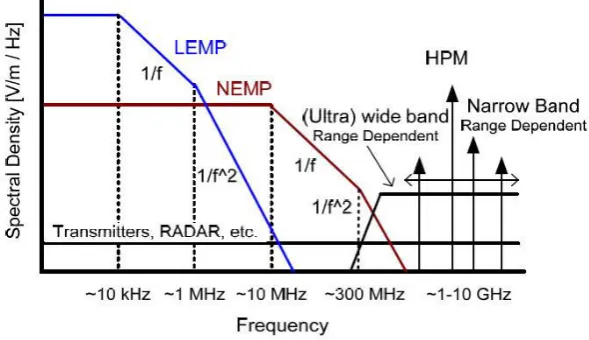
Fig. 1. Spectral density of radiation generated by different IDEI sources according to IEC 61000-2-13 standard
As we see in Fig.1, the lightning has a much higher spectral density than even such powerful radiation sources like nuclear explosions. However, all energy of the lightning is concentrated in the so called stepped leader stroke and has a point-like hitting zone, while HEMP covers a large global area, see Fig. 2.
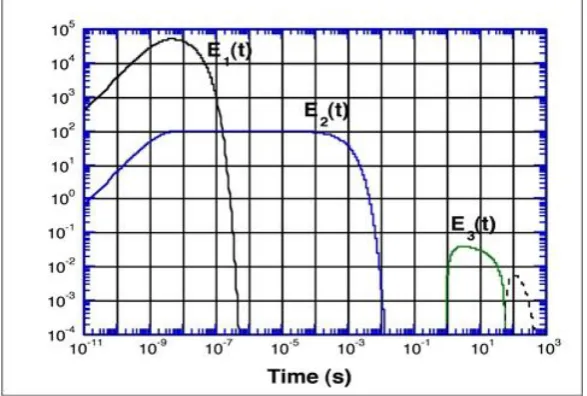
Each IDEI class consists of different impact types. HEMP includes three different types of impacts corresponding to the three components of electromagnetic pulse: Е1 (early-time), Е2 (intermediate-time), Е3 (late-time), see Fig. 3.
Fig. 3. Parameters of high-altitude nuclear explosion components (IEC 61000-2-9)
E1 – is the fastest and the shortest (early-time) component of HEMP generated by the powerful flow of so called high-energy Compton electrons (the product of interaction between γ-rays of the nuclear explosion instantaneous radiation and air gas atoms) in the magnetic field of the Earth under the speed close to the speed of the light. Such interaction of very fast negative electrons with magnetic field results in electromagnetic energy pulse further concentrated by the magnetic field of the Earth and directed to the ground from the above-ground point. Generally, pulse amplitude rises to peak value within 5 nanoseconds and twofold falls within 200 nanoseconds. According to the IEC definition, the full length of the E1 pulse may go up to 1 microsecond (1000 nanoseconds). The E1 component is conditioned by the most intense electromagnetic field generating a very high voltage in electric chains (it generates pulse voltages up to 50 kV/m under power density of 6.6 MW per square meter in the proximity to the ground). The E1 component delivers the most damages to the electronic equipment due to overvoltage and voltage failure on p-n transitions of semiconducting elements and isolation. Regular arresters providing effective protection from atmospheric overvoltage can be too slow to protect the equipment against E1, while the power dissipating by the arresters can be too small to absorb the pulse E1 component energy, thus destroying the arrester itself. E2 – is the intermediate (intermediate-time) HEMP component in terms of rise speed and length. According to IEC it lasts from 100 microseconds to 1 msec. This component has considerable resemblance to the electromagnetic pulse generated in the atmosphere (by lightning). The field voltage can reach 100 kV/m. Due to the resemblance of the E2 parameters to lightning and availability of proven lightning protection technologies it is deemed that protection against E2 is not a problem. However, a combined impact of E1 and E2 raises another challenge: when E1 destroys protection elements, E2 can easily penetrate the apparatus.
E3 – is significantly different from the two other HEMP components. It is very slow, late-time pulse lasting for tens and hundreds of seconds resulting from the shifting and subsequent recovering of the Earth‘s magnetic field. E3 is similar to geomagnetic storms generated by very intensive solar bursts, that is, induced geomagnetic currents – the currents flowing in the ground and generated by geomagnetic disturbance in the Earth‘s magnetosphere. Such currents are induced in underground long metal structures, i.e., pipelines, railway rails, cables. Induced field voltage can reach 1 V/km.
In terms of electronic apparatus testing only the E1 component is considered in what follows, since it is the most powerful and dangerous component for electronic apparatus.
1. Directed narrowband and ultra wideband electromagnetic radiation (High Power Microwave). This type of radiation can be generated by:
- Continuously operating generators with fixed frequencies
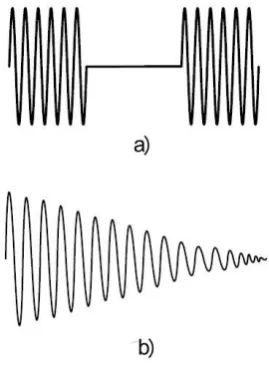
- Generators radiating packets of high-frequency pulses with the frequency of the packets from hundreds of Hz to tens of kHz (see Fig. 4)
- Generators radiating pulses in ultra wideband frequencies from tens MHz to hundreds GHz - Generators radiating damped amplitude high-frequency signals (see Fig. 4)
- Pulse generators with radiated peak power from tens of MegaWatts to several GigaWatts. Such generators send very short pulses in nano- and sub-nanosecond range (singular to tens of nanoseconds) and sub-nano range (pulses lasting tens to hundreds of picoseconds) under the frequency of 0.1 – 10 kHz and above.
Fig. 4. Several types of signals generated by the sources of Intentional Electromagnetic Interferences: a – packets of high-frequency pulses with equal amplitude; b – damped amplitude high-frequency pulses repeated under the
frequency of several kHz
2. Pulsed electromagnetic radiation generated by explosive sources of radiofrequency electromagnetic radiation (RFER), most of these are built on explosively pumped flux compression generators generating powerful (1 GW) short pulses lasting less than 1 nanosecond with the frequency of received radiation from hundreds MHz to hundreds GHz in single pulse.
In distinction to the above classifications NATO AECTP 250 Ed 2.0: 2011 Leaflet 257 – High Power Microwave standard divides Intentional Electromagnetic Interferences into four types based on another principle:
а) Mobile/platform RFER source – An RFER source generally radiates fields toward targeted infrastructure facility equipment from an area that is not controlled by the targeted infrastructure facility, such as outside a fenced area. A truck-mounted source is, in this situation, more likely than a man-pack source because the power required to produce effective field levels at the intended target from a standoff distance translates into a large heavy device. Airborne sources are also possible.
c) Conducted RFER source – An RFER source could directly inject energy into a conductor leading into the infrastructure facility, such as power or communications lines. This may be done either through the exterior or interior of the facility.
d) Projectile-based RFER source – A projectile-based RFER source radiates the entire facility with an electromagnetic pulse. This also causes large electrical surge currents passing into the facility through external conductors, such as power or communications lines, water pipes, etc.
For the above sources of RFER the NATO standard indicates maximum antenna radiated power of 1 GW per square meter limited by the air dielectric strength of 1 MW per meter. It should be noted that many other literature sources indicate other values of the air dielectric strength under normal climatic conditions: 2 – 3 MW per meter. Besides, air discharge pulse voltage is further increased and exceeds the value nominal for alternating voltage under 50 Hz even in nonhomogeneous electric fields. The relation of the pulse breakdown voltage amplitude to the voltage under 50 Hz is called ‗pulse coefficient ki’. For nonhomogeneous electric fields ki = 1.1 – 1.3. However, it should be considered that under low air pressure (in
high-altitude areas) or if the air contains dust and vapors (fog) the air dielectric strength can be significantly lower. Reduction of air dielectric strength can also result from the air ionization under high-frequency discharge. However, in 2008 the Institute of High-Current Electronics of the Siberian division of the Russian Academy of Science built a super wideband pulse generator, see Fig. 5, with an output peak power of 3.4 GW, which significantly exceeds the radiation power limit indicated in the NATO standard. This generator works under the voltages of -205 …+157 kV and generates pulses of 1 nanosecond under the pulse frequency of 100 Hz.
Fig. 5. Generator of ultra wideband pulses with peak radiating power of 3.4 GW developed by Institute of High-Current Electronics of Siberian division of the Russian Academy of Science
3.
SOURCES OF INFORMATION FOR IDEI PARAMETERS
Today, there are numerous standards describing a large number of IDEI parameters, norms and methods on testing apparatus for IDEI immunity. However, until now the IEC standards for IDEI have been used basically for HEMP only:
A IEC TR 61000-1-3 Electromagnetic compatibility (EMC) — Part 1–3: General—The effects of high-altitude EMP (HEMP) on civil equipment and systems.
B IEC 61000-1-5 High power electromagnetic (HPEM) effects on civil systems.
C IEC 61000-2-9 Electromagnetic compatibility (EMC)—Part 2: Environment—Section 9: Description of HEMP environment—Radiated disturbance. Basic EMC publication.
D IEC 61000-2-10 Electromagnetic compatibility (EMC)—Part 2–10: Environment—Description of HEMP environment—Conducted disturbance.
E IEC 61000-2-11 Electromagnetic compatibility (EMC)—Part 2–11: Environment—Classification of HEMP environments.
F IEC 61000-2-13 Electromagnetic compatibility (EMC)—Part 2–13: Environment—High-power electromagnetic (HPEM) environments—Radiated and conducted.
G IEC 61000-4-23 Electromagnetic compatibility (EMC) - Part 4-23: Testing and measurement techniques - Test methods for protective devices for HEMP and other radiated disturbances.
H IEC 61000-4-24 Electromagnetic compatibility (EMC) - Part 4: Testing and measurement techniques - Section 24: Test methods for protective devices for HEMP conducted disturbance - Basic EMC Publication.
I IEC 61000-4-25 Electromagnetic compatibility (EMC) - Part 4-25: Testing and measurement techniques - HEMP immunity test methods for equipment and systems.
J IEC 61000-4-32 Electromagnetic compatibility (EMC) – Part 4-32: Testing and measurement techniques – High-altitude electromagnetic pulse (HEMP) simulator compendium.
K IEC61000-4-33Electromagnetic compatibility (EMC) – Part 4-33: Testing and measurement techniques – Measurement methods for high-power transient parameters.
L IEC 61000-4-35 Electromagnetic compatibility (EMC) - Part 4-35: Testing and measurement techniques - HPEM simulator compendium.
M IEC 61000-4-36 Electromagnetic compatibility (EMC) - Testing and measurement techniques - IEMI Immunity Test Methods for Equipment and Systems.
N IEC/TR 61000-5-3 Electromagnetic compatibility (EMC)—Part 5–3: Installation and mitigation guidelines—HEMP protection concepts.
O IEC/TS 61000-5-4 Electromagnetic compatibility (EMC)—Part 5: Installation and mitigation guidelines—Section 4: Immunity to HEMP—Specifications for protective devices against HEMP radiated disturbance. Basic EMC Publication.
P IEC 61000-5-5 Electromagnetic compatibility (EMC)—Part 5: Installation and mitigation guidelines—Section 5: Specification of protective devices for HEMP conducted disturbance. Basic EMC Publication.
Q IEC 61000-5-6 Electromagnetic compatibility (EMC) – Part 5-6: Installation and mitigation guidelines – Mitigation of external EM influences.
R IEC 61000-5-7 Electromagnetic compatibility (EMC) - Part 5-7: Installation and mitigation guidelines - Degrees of protection provided by enclosures against electromagnetic disturbances (EM code).
S IEC 61000-5-8 Electromagnetic compatibility (EMC) - Part 5-8: Installation and mitigation guidelines - HEMP protection methods for the distributed infrastructure.
T IEC 61000-5-9 Electromagnetic compatibility (EMC) - Part 5-9: Installation and mitigation guidelines - System-level susceptibility assessments for HEMP and HPEM.
It is expected that a special IEMI standard: IEC 61000-4-36 Electromagnetic compatibility (EMC) - Testing and measurement techniques - IEMI Immunity Test Methods for Equipment and Systems and standard IEEE P1642 – Recommended Practice for Protecting Public Accessible Computer Systems from Intentional EMI will be published by the end of 2014 earliest.
- MIL-STD-2169B High –Altitude Electromagnetic Pulse (HEMP) Environmental, 2012.
- MIL-STD-188-125-1 High –Altitude Electromagnetic Pulse (HEMP) Protection for Ground Based C41 Facilities Performing Critical. Time-Urgent Mission. Part 1 Fixed Facilities, 2005.
- MIL-STD-188-125-2 High –Altitude Electromagnetic Pulse (HEMP) Protection for Ground Based C41 Facilities Performing Critical. Time-Urgent Mission. Part 2 Transportable Systems, 1999.
- MIL-STD-461F Requirements for the Control of Electromagnetic Interference Characteristics of Subsystems and Equipment, 2007.
- MIL-STD-464C Electromagnetic Environmental Effects. Requirements for Systems, 2010.
- Test Operations Procedure Report No. 01-2-620 High-Altitude Electromagnetic Pulse (HEMP) Testing
- MIL-STD-1377 Effectiveness of Cable, Connector, and Weapon Enclosure Shielding and Filters in Precluding Hazards of Electromagnetic Radiation to Ordnance (HERO), 1971.
- MIL-HDBK-240 Hazards of Electromagnetic Radiation to Ordnance (HERO) Test Guide, 2002. - NATO AECTP-500 Ed. 4. Electromagnetic Environmental Effects Test and Verification, 2011. - NATO AECTP-250 Ed.2 – Electrical and Electromagnetic Environmental Conditions, 2011.
In Russia there are only a few official documents publically available in this context: - GOST R 53111-2008 Stability of public communication system operation.
- RD 45.083-99 Recommendations on wire electric communication apparatus immunity to destabilizing factors.
- GOST R 52863-2007 Protection of information. Automated protected systems testing for immunity to intentional power electromagnetic impacts. General requirements.
The first two documents cover the narrow range of the technics – communication systems. They are based on requirements of general (not special) standards on electromagnetic compatibility (EMC). The last one can be more widely used, but it was also developed based on general standard requirements to EMC. All special requirements (which are IDEI requirements) are marked with ―X‖ in this standard and show no technical parameters (though it seems strange in the context of this standard name).
Certainly, there are non-publically available materials, such as Norms of Apparatus, Instrument and Device Immunity to Nuclear Radiation and HEMP – Decision of State Committee on Electromagnetic Compatibility of Ministry of Communications of Russia # 143 dated January 31, 1996, and also restricted (despite Western standards) military standards. Nevertheless, as we can see from the above list of standards, the immunity norms and methods for HEMP testing of apparatus (both for general and military use) are not secret anymore and publically available in Western countries (with rare exception, e.g., MIL-STD-2169B). Such an approach of Russia to a purely technical problem is hardly logical or reasonable, since it results in situations where most Russian specialists in the field of civil engineering (e.g., power engineering) have no idea about such standards despite the fact that they also face the problems of IDEI immunity.
Over the last few years, Russian specialists have prepared a number of thesis researches on this subject [6 - 9]. While all of them were devoted to IDEI impact on communication systems, the substance of the matter still exists.
4.
PARAMETERS OF TESTING FOR HEMP IMMUNITY
According to the 61000-4-25 standard the testing for electronic apparatus immunity to HEMP should be consist of two steps: radiated immunity test and conducted immunity test. The last one can be separated in two types: pulse voltages applied to apparatus inputs and pulse currents induced to long wires and cables.
.
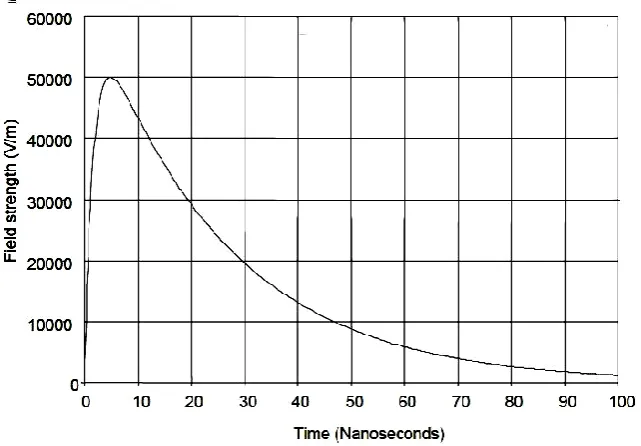
Fig. 6. The shape of electromagnetic radiation component according to standards IEC 2-9, IEC 2-10, IEC 61000-2-11 and MIL-STD-461F.
The concept 2b can be chosen for DPR located in armored concrete or brick constructions equipped with lightning protection and having no special protection filters. This concept provides attenuation of electromagnetic radiation with building structure per 20 dB within the frequency range of 100 kHz – 30 MHz.
For the selected concept and E1 component, the voltage of radiation electrical field influencing the tested object is set to 5 kV/m (level R4) and magnetic field voltage is set to 13.3 A/m. For reference: in wooden buildings not attenuating the electromagnetic radiation the voltage of electric field is 50 kV/m (level R7). For the same concept and E2 component the voltage of electric field is set to 10 V/m and voltage of magnetic field is set to 0.08 A/m. The parameters of electromagnetic radiation pulse are described in standards 61000-2-9, 61000-2-10, 61000-2-11, MIL-STD-461F: pulse rise time (rising edge) is 2.5 nanoseconds, pulse width is 25 nanoseconds, and pulse shape corresponds to the shown in Fig. 6.
In the next step, we choose the level of testing action for conducted immunity test according to standard 61000-4-25. For the chosen concept, 2b, if there are available non-buried wires connected to the tested object, we chose the level of testing action E8 (to provide for normal 50% probability of the object immunity) or E9 (to provide for 99% probability). E8 level provides for immunity of tested object to the pulse voltage of 8 kV, and E9 level – 16 kV. The probability of 50% is deemed as normal within the standard and can be used for civil apparatus.
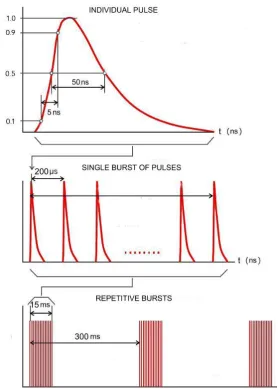
Fig. 7. Electrical Fast Transient (EFT) – fast pulse (IEC 61000-4-4). In Table 1 of this standard the amplitude of test voltage for HEMP (listed as Special) is indicated with ―X‖ and corresponds to the levels E8 and E9.
5.
PARAMETERS OF TESTING FOR IMMUNITY TO IMEI
As mentioned above, IEC standard (IEC 61000-4-36) describing parameters of testing for IMEI is not available yet. However, there are other standards and research results characterizing the parameters of IMEI [6 – 18]. Today, there are several different methods of generating powerful RFER which can be used for remote hitting of electronic and computer-based systems and give a very wide range of radiation parameters:
- electric field voltage in the range of 1 kV/m – 100 kV/m - pulse rise time – from 100 picoseconds to 500 picoseconds - pulse time – from hundreds of picoseconds to nanosecond units - pulse frequency – from 0.1 Hz to 1000 Hz.
the leading specialist in this area, it is safe to consider the wideband pulsed radiation with the pulse rise time of 100 picoseconds, the pulse width 1 nanoseconds, the pulse frequency of 1 MHz and the field voltage of 10 kV/m [10]. As far as I know, the same parameters should be included into IEC 61000-4-36 standard.
6.
EQUIPMENT USED FOR TESTING FOR IDEI IMMUNITY
Many organizations from different countries of the world are involved in the development of sources of powerful
pulses and RFER.
However, the products of most of them are designed for local use only and are not
available on the market as electromagnetic radiation or IDEI simulators for the testing of electronic
apparatus. Most of large manufacturers of military equipment have their own test stands for the testing of
samples of manufactured products, see Fig. 8, and such stands are also not for sale.
Fig. 8. Test stand for simulating HEMP impact on military machinery
are offered in Test Complex ―Allur‖ of High-voltage Scientific Research Center of Federal State Unitary Enterprise ―All-Russian Electrotechnical Institute named after V. I. Lenin‖ (FGUP VEI) in Istra, Moscow region, see Fig. 9.
Fig. 9. Stationary HEMP simulator in Test Complex Allur of High-voltage Scientific Research Center of Federal State Unitary Enterprise ―All-Russian Electrotechnical Institute‖ (Istra, Moscow region). Dimensions of simulator: 100 х 35 х 13.5 m, work
volume: 10 x 10 x 10 m, pulse shape: 2.5/25 nanoseconds, maximum pulse voltage of electrical field: 70 kV/m.
However, there are only a few companies in the world manufacturing the IDEI immunity test equipment for the market according to the standards. Large units designed for simulating electromagnetic radiation are manufactured by Dayton T. Brown (USA), Aero-Rad Technology Co., Ltd (China) and some other companies. Small test units suitable for laboratory testing of DPR and other types of electronic apparatus for immunity to electromagnetic radiation are manufactured only by two companies: Swiss company Montena Technology and Applied Physical Electronics from USA, see Fig. 10.
a b
Fig. 10. Compact stands for testing electronic apparatus for immunity to electromagnetic radiation. a- Montena Technology, b - Applied Physical Electronics.
Fig. 11. Test stand available on the market manufactured by Montena Technology (USA) for laboratory testing of large objects, such as relay protection cabinets, for HEMP immunity. On the left – pulse generator, on the right – antenna system.
Fig. 12. Compact powerful Marx generators MG10-1C-2700PFF (300 kV, 1 GW); MG17-1C-500PF (510 kV, 400 MW); MG30-3C-100NF (600 kV, 6 GW) and RFER equipped with directed parabolic antenna
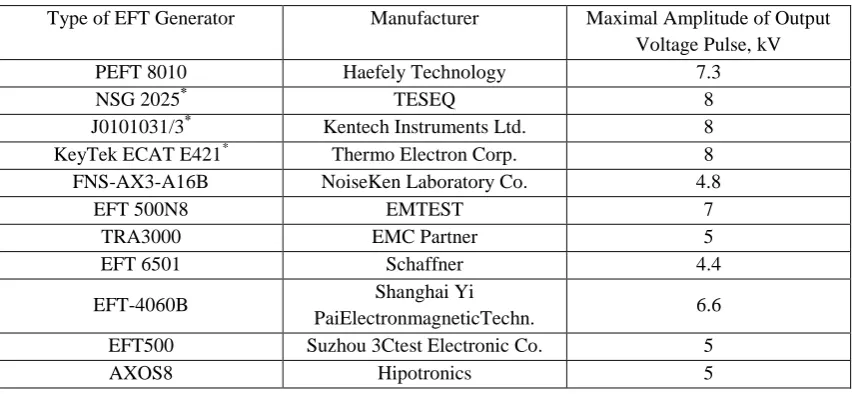
For conducted immunity test equipment (Electrical Fast Transient - EFT), the situation is more complicated, see Fig. 7. Previously, EFT generators of the needed input voltage level of 8 kV were manufactured by companies TESEQ, Kentech Instruments Ltd. and Thermo Electron Corp. (see Table 1) based on vacuum or gas filled spark gap. After the invention of powerful semiconductor switching elements (IGBT transistors) the manufacturing of generators, based on spark gap, was stopped by the three companies in that pulses generated by IGBT transistors were much more stable than pulses generated by spark gap. Unfortunately, the increase of generated pulse stability was accompanied by amplitude decrease.
Table1 Maximal Amplitude of Output Voltage Pulse with waveform 5/50 ns for Some Types of EFT Generators
Type of EFT Generator Manufacturer Maximal Amplitude of Output Voltage Pulse, kV
PEFT 8010 Haefely Technology 7.3
NSG 2025* TESEQ 8
J0101031/3* Kentech Instruments Ltd. 8
KeyTek ECAT E421* Thermo Electron Corp. 8
FNS-AX3-A16B NoiseKen Laboratory Co. 4.8
EFT 500N8 EMTEST 7
TRA3000 EMC Partner 5
EFT 6501 Schaffner 4.4
EFT-4060B Shanghai Yi
PaiElectronmagneticTechn. 6.6
EFT500 Suzhou 3Ctest Electronic Co. 5
AXOS8 Hipotronics 5
*obsolete
Our research has confirmed that today there are no EFT generators satisfying pulse amplitude standard requirements (8 kV) available on the market. Generators of the PEFT 8010 type manufactured by Haefely EMC Technology, in Sweden, has the pulse amplitude closest to the required value, see Fig. 13.
7.
CONCLUSION
In addition to the full set of ordinary EMC tests the three types of impacts are required to test DPR for immunity to IDEI [19]: 1) Pulsed electromagnetic radiation with the pulse rise time of 2 nanoseconds, the pulse width of 25 nanoseconds and the
field voltage of 5 kV/m – 50 kV/m.
2) Pulsed electromagnetic radiation with the pulse rise time of 100 picoseconds, the pulse width of 1nanosecond, the pulse frequency of 1 MHz and the field voltage of 10 kV/m.
3) Fast pulse 5/50 nanoseconds (EFT) with the pulse amplitude of 8 kV for conducted immunity test, applied to DPR inputs.
Compact test devices with parameters close enough to that required are available on the market. They enable organizing special laboratories for testing modern relay protection devices and other types of so-called industrial critical electronic apparatus for immunity to intentional destructive electromagnetic impacts. The cost of the set of equipment for such laboratory may come to 500,000 USD.
8.
REFERENCES
1. Barnes P. R., McConnell B. W., Van Dyke J. W. Electromagnetic Pulse Research on Electric Power Systems: Program Summary and Recommendations. – Oak Ridge National Laboratory, No. ORNL-6708, 1993.
2. Gurevich V. I. Vulnerability of microprocessor protection relay. Problems and Solutions. Moscow, Infra-Ingenerija, 2014, 256 p.
3. FM 3-38 Cyber Electromagnetic Activities – Headquarters Department of the Army Washington, DC, 12 February 2014.
4. Platt R., Anderson B., Christofferson J., Enns J., Haworth M., Metz J., Pelletier P., Rupp R., Voss D. Low-frequency multigigawatt microwave pulses generated by a virtual cathode oscillator. - Applied Physics Letters 27.03. 1989, Vol. 54 Issue 13, p. 1215.
5. Counter-Electronics High Power Microwave Advanced Missile Project (CHAMP) Joint Capability Technology Demonstration (JCTD). Solicitation Number: BAA-08-RD-04, 16 October 2008 (Restricted Data).
6. Methods for ensuring immunity of prospecting radio-relay, troposphere and satellite communication systems to powerful pulsed electromagnetic interferences - Ph. D. thesis. Voskobovich V.V., 05.12.13, Moscow 2002.
7. Development of methods for assessing telecommunication systems immunity to super wideband electromagnetic pulses - Ph. D. thesis. Vedmidskiy A. A., 05.12.13, Moscow, 2003.
8. Theoretical and experimental methods for assessing immunity of terminals to super wideband electromagnetic pulses - Ph. D. thesis. Ackbashev B. B., 05.12.13, Moscow, 2005.
9. Methods and tools for assessing impact of high-power electromagnetic pulse on telecommunication network - Ph. D. thesis. Yakushin S. P., 05.12.13, Moscow, 2004.
10. Radasky W., Savage E., Intentional Electromagnetic Interference (IEMI) and Its Impact on the U.S. Power Grid - Meta-R-323. Metatech report for Oak Ridge National Laboratory, 2010.
11. NATO AECTP-250 Leaflet 257 – High Power Microwave (HPM).
12. MIL-STD-461F Requirements for the Control of Electromagnetic Interference Characteristics of Subsystems and Equipment, 2007.
13. Staines G. Compact Sources for Tactical RF Weapons Application. - DIEHL Munitionssyteme. Amerem-2002, Maastricht, Nederlands, 2002.
15. W. Prather, C. Baum et al. Ultra-wideband Source and Antenna Research‖. IEEE Trans. Plasma Sci., Vol.28, pp. 1624-1630, Oct. 2000.
16. Super power multiwave microwave generators - Ph. D. thesis. Koshelev V.I., 01.04.04, Tomsk, 1990.
17. Powerful pulsed microwave generators built on backward-wave tube in the super-radiance mode - Ph. D. thesis. Yelchaninov A.A., 01.04.04, Tomsk, 1990.
18. Generation of powerful microwave radiation built on high-current nanosecond electronic beams - Ph. D. thesis. Korovin S.D., 01.04.04, Tomsk, 1990.