ISSN: 2347-7474
International Journal Advances in Social Science and Humanities
Available online at: www.ijassh.com
RESEARCH ARTICLE
Garba Muddaha & Yeoh Khar Kheng |Sep. 2016 | Vol.4 | Issue 09 |08-15 8
The Moderating Effect of Environmental Dynamism on the
Relationship between Business Process Management and
Marketing Innovation Performance: A Perspective of Nigerian
SMES in Manufacturing and Service Industries
Garba Muddaha, Yeoh Khar Kheng*
College of Business, Universiti Utara Malaysia.
Abstract
As the wave of competition among enterprises is becoming more intense due to raise in search for customers and high business returns, managers were left with no option than to face a challenging task of improving and integrating the manufacturing as well as service delivery processes. At the crucial moment, the level of innovativeness of business enterprise becomes more important than any other factor, since the growth and survival of Small and Medium Enterprises (SMEs) could no longer be guaranteed. This study tries to fill this research gap by trying to investigate the relationship between business process management and marketing innovation performance of Nigerian SMEs in manufacturing and service industries, the adoption of environmental dynamism as moderator could further the strengthen the relationship. The study is undergoing a validation process and when validated will benefit the regulatory bodies and business managers.
Keywords: Business process management (BPM), Environmental dynamism (ED), marketing innovation performance (MIP), SMEs, Nigeria.
Introduction
In order to surmount the daunting challenge arising from the ongoing global intense competitiveness, SMEs managers need to integrate process management practices as order qualifier criteria if they are to achieve optimum marketing innovation performance being the order winner criteria [1].
Innovation Performance (IP) was identified as a vital tool that will enhance SMEs competitiveness [2]. However, actualization of IP by SMEs in Nigeria becomes a problem, due to poor management practices and other challenges posed by the dynamic business environment [3].Business Process Management (BPM) and Environmental
Dynamism (ED) were identified as
important predictors of SMEs IP [4,5]. From theoretical point of view, rarely BPM is treated as an independent construct on its relationship with IP [6].
More often is considered as a mere dimension of Total Quality Management
(TQM) [7,8] or Quality Management (QM) (Kafetzopoulos, Gotzamani, & Gkana, 2015). According to the literature, results on the relationship between BPM and IP are mixed [6].
Additionally, marketing innovation
The general objective of the study is to view process management beyond a dimension lens, examine the relationship between BPM and MIP in both the manufacturing and servicing sectors of Nigerian SMEs, with particular emphasis to process management practices integration. And finally, introduce ED to moderate the relationship between BPM and MIP.
Apart from the introductory aspect, the paper is structured in the following format. Part 2 deals with literature review, hypothesis development and presentation of conceptual framework. While Part 3 presents an overview of the paper`s general objective and intension to validate the framework.
Literature Review
Marketing Innovation Performance
According to Gunday, Ulusoy, Kilic, and Alpkan [11], innovation could be classified into four distinct types, as product innovation which involves launching an entirely new or improved product or services into the market; process innovation which involves changing the way products are produced and or services are rendered. It also involves changing or modifying physical facilities used in the production process or service delivery; marketing innovation entails coming up with a new or improved marketing method through new product design, packaging, promotional activities or pricing formula. While, organizational innovation involves introduction of improved practice of managing internal organizational resources and identification and utilization of external opportunities.
Radical innovation combines elements of product and process innovation. It implies that a complete and revolutionary change in an organizations activities is undertaken to bring about new products, services, processes and technological discoveries to
replace existing products, services,
processes, and technology that not only affect the organization, but the entire industry and also the society positively. While incremental innovation can be referred as the introduction of changes of production process or method of service delivery in gradual manner. The overall objective is to improve the existing processes
or methods, without necessarily effecting radical changes [12].
Innovation provide firms with opportunities to have efficient production method or system of services delivery, reduce cost of production, improve management practices, record more sales, increase business returns and have competitive edge Kafetzopoulos et al. [13] .
Therefore, businesses of all sizes need to
pursue innovation as a goal considering that, it encompasses all aspect of the organization and could be termed as products, process, administrative, organizational/management, marketing, radical, incremental, service, exploitative, explorative, technical or non-technical.
However, the absence of universally accepted type or dimension of innovation made researchers to adopt different
typologies in the discourse and
measurement of innovation performance. While some considered it from the perspective of incremental and radical innovation [12], others viewed it from the perspective of product, process, marketing and organizational innovation. Some also adopted technical and non-technical or management innovation Jyoti, Gupta, &
Kotwal, [14] and technical and
administrative innovation Yazhou & Jian, [15] . There are even cases were innovation is measured in the form of explorative and
exploitative innovation Kohlbacher,
Weitlaner, Hollosi, Grünwald, & Grahsl, [16]
Considering the focus of this study,
marketing innovation performance
measured based on another different five
item scale which involves market
performance, customers demand for
products, customers satisfaction with
products, increase in market share and increase in profit [17]. Process management was reported as an important predictor of all types of innovation, therefore marketing innovation performance inclusive. Similarly, environmental dynamism was reported as a predictor of innovation performance and by extension marketing innovation performance [5].
Business Process Management
According to Kim et al. [4], process management is defined as the identification and application of critical processes and best practices to different types of innovation activities. Even though, the definition has embodied aspect of process integration and
element of applicability in the
manufacturing as well as the service sectors. However, Tang, Pee, and Iijima [18] defined process management as the degree of business process evaluation and control for improved and efficient production process. This definition specifically focused on different aspects of process management in the manufacturing sector, thereby ignoring other aspects that concern the servicing sector. More often researchers considered process management as a mere dimension of TQM and is usually measured as unidimensional construct. A recent empirical study by Kim et al. [4] based on a sample of 242 ISO 9001 certified manufacturing and service companies in Canada, examined the relationship between process management as a dimension of QM and radical, incremental and administrative innovation. Using structural equation
modelling revealed that, process
management has direct positive relationship with all types of innovation.
A similar study by Zeng et al. [1] based on sample of 283 plants located in eight
countries, examined the relationship
between process management as a
dimension of Hard QM and innovation performance. Using structural equation modelling reported that, hard QM has direct relationship with innovation performance. In a different empirical study by Moreno-Luzon et al. [12] based on sample of 72 Spanish furniture and textiles firms,
examined the relationship between process management as a dimension of TQM and incremental and radical innovation. Using partial least square structural equation
modelling reported that, process
management negatively affected radical innovation, but relates with incremental innovation positively. The results of these studies seem to support Key Success Factors (KSFs) to innovation performance notion.
In contrast with the KSFs notion, Cheng et al. [2] came up with Key Success Paths (KSPs) notion and based on a sample of R&D managers and employees of Taiwanese
high-tech, examined the relationship
between antecedents and product
innovation. Using fuzzy-set qualitative comparative analysis (fs QCA) reported that, process-related antecedent is insufficient for high performance. While advancing BPO view, Tang et al. [18] based on 127 sample
of senior managers of Japanese
organizations, examined the relationship
between process management as a
dimension of BPO and organizational innovation performance. Using partial least
square structural equation modelling
reported that, process management only
influenced organizational innovation
performance through a mediator.
However, a unique empirical study that examined the relationship between the three dimensions of process management and innovation performance, using a sample of 238 plants and ordinary least squares L. Sanders Jones and Linderman [6] reported
that, process design and process
improvement dimensions have positive relationship with innovation performance, but process control dimension has no
positive relationship with innovation
performance. Nevertheless, process
management when investigated exerts
different relationships on various
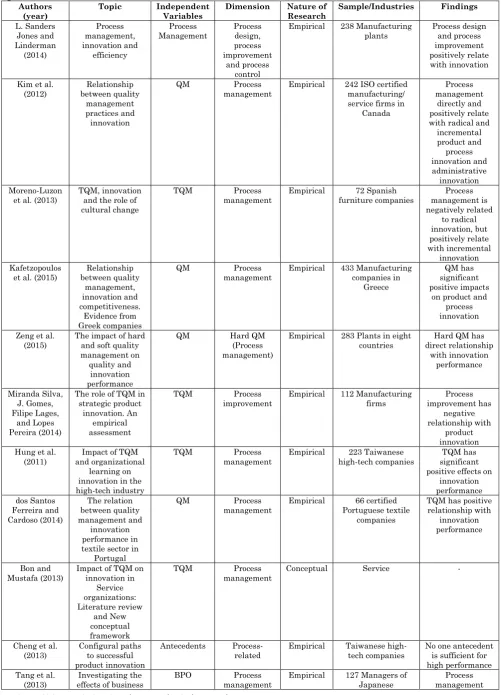
dimensions of innovation performance. Considering the empirical analysis and findings of the previous researches on the relationship between process management and innovation performance in SMEs, there is element of inconsistency. See table 1 for details.
the following ways: (1) L. Sanders Jones
and Linderman [6] examined the
relationship between process management
and innovation performance in the
manufacturing sector, while this study
examines the relationship in both
manufacturing and service sectors; (2) L. Sanders Jones and Linderman [6] examined
the relationship between process
management and innovation performance, while this study examines the relationship
between process management and
marketing innovation performance (3) L. Sanders Jones and Linderman [6] used competitive intensity as a moderator, while
this study introduces environmental
dynamism as a moderator. Another distinction between the two researches is that, this study emphasizes on process
management practices integration as
predictor of optimum marketing innovation performance in SMEs, just as emphasis was placed on cross-sectional integration and KSPs [18]. According to the findings of Kim et al. [4] , process management has direct positive relationship with all types of innovation. Therefore, it will be fair to propose the following,
H1: There is a positive relationship between process design and marketing innovation performance
H2: There is a positive relationship between
process improvement and marketing
innovation performance
H3: There is a positive relationship between process control and marketing innovation performance
Environmental Dynamism
According to Pérez-Luño, Wiklund, and Cabrera [19] , environmental dynamism is referred as uncertain and unpredictable condition surrounding an organization in its constant interaction with the external environmental factors. However, Jiao, Alon, Koo, and Cui [20] defined environmental dynamism as firm`s inability to predict business situation due to rapid changes that are taking place within the external environment. These definitions have highlighted that, SMEs are bound to face serious challenge due to high level of uncertainty and unpredictability of the surrounding external business environment
within which they operate. This has therefore called for the integration of process management practices, in order to meet numerous preference of customers and aid
marketing innovation performance
realization. In an empirical study, using a first sample of 87 team leaders and second sample of 336 team members, Lee [5] examined the relationship between the two dimensions of environmental dynamism and product innovation. The results indicated that, technology dynamism has affected product innovation negatively, but market dynamism has affected product innovation positively.
Additionally, environmental dynamism as moderator exerts different effects on different types of innovation performance. R. A. Baron and Tang [21], relying on a sample of 99 Entrepreneurs in the USA, empirically examined the moderating effect of environmental dynamism on the relationship between creativity and firm-level innovation. Using Hierarchical
regression model reported that,
environmental dynamism has positively moderated the relationship. In a similar empirical study Pérez-Luño et al. [19] , relying on 400 sample of Spanish firms,
examined the moderating effect of
environmental dynamism on the
relationship between entrepreneurial
orientation and innovative tendency. Using Hierarchical binomial regression model reported that, environmental dynamism positively moderated the relationship between risk taking and innovative tendency, and negatively moderated the
relationship between proactivity and
innovative tendency.
In a different empirical study Kohlbacher et al. [16] , relying on a sample of 12 business clusters in six European countries, examined the moderating effect of environmental dynamism on the relationship between absorptive capacity and exploitative and explorative innovation. Using multivariate data analysis technique reported that,
environmental dynamism positively
moderated the relationship between
absorptive capacity and explorative
innovation, and negatively moderated the relationship between absorptive capacity and exploitative innovation. Therefore, environmental dynamism could relate
performance and at the same time moderate the relationship between business process management practices and marketing innovation performance. Thus, this study put forward the following propositions,
H4: There is a positive relationship between environmental dynamism and marketing innovation performance
H5: Environmental dynamism moderates the relationship between process design and marketing innovation performance
H6: Environmental dynamism moderates
the relationship between process
improvement and marketing innovation performance
H7: Environmental dynamism moderates the relationship between process control and marketing innovation performance
Conceptual Framework
In line with the proposed hypothesis, the
following conceptual framework is
developed.
The study is backed by two theories, namely Resource Base View (RBV) and Contingency Theory. Considering that, RBV dwelled on different aspects of resources that are inherently embedded in the organization, while the contingency theory perspective created a balance between the internal and external factors of an organization. The combination of the two theories in the study provided a platform for investigating the
moderating effect of environmental
dynamism being an external organizational factor on the relationship between process
management being an internal
organizational factor and marketing
innovation performance [22].
Conclusion
The general objective of the study is to view process management beyond a dimension lens and examine the moderating effect of ED on the relationship between BPM and MIP in both manufacturing and servicing sectors of Nigerian SMEs. And at the same time, the study argues that, optimum marketing innovation performance could only be achieved with an integration of business process management practices. Therefore, a conceptual framework for the realization of the research objective is developed. The study is undergoing a validation process and when validated will benefits policy makers, regulatory bodies and managers of SMEs.
Fig. 1: Conceptual framework
References
1 Zeng Jing, Phan Chi Anh, Matsui Yoshiki (2015) The impact of hard and soft quality management on quality and innovation performance: An empirical study. International Journal of Production Economics, 162:216-226. 2 Cheng Cheng-Feng, Chang Man-Ling, Li Chu-Shiu (2013) Configural paths to successful product innovation. Journal of Business Research, 66(12):2561-2573.
3 Masari, Bature Umar (2013) Keynot Address by Hon. Bature Umar Masari, Director General/CEO, Smedan at the 2nd Niger Delta Development Forum. Abuja, Nigeria: Smedan. 4 Kim Dong-Young, Kumar Vinod, Kumar Uma
(2012) Relationship between quality
management practices and innovation. Journal of Operations Management, 30(4):295-315. 5 Lee Les Tien-Shang (2011) The effects of
environmental dynamism and team strain on product innovation: The moderating role of perceived diversity climate. African Journal of Business Management, 5(22):8740.
6 L Sanders Jones Janine, Linderman, Kevin (2014) Process management, innovation and efficiency performance: The moderating effect of competitive intensity. Business Process Management Journal, 20(2):335-358.
7 Dos Santos Ferreira, Vitor Hugo, Cardoso Rita (2014) The Relation between Quality Management and Innovation Performance in
Environmental Dynamism Business Process
Management
. Process design
. Process improvement
. Process control
the Textile Sector in Portugal. Journal of Global Business and Technology, 10(2):13. 8 Hung, Richard Yu Yuan, Lien, Bella Ya-Hui,
Yang, Baiyin, Wu, Chi-Min, & Kuo, Yu-Ming. (2011). Impact of TQM and organizational learning on innovation performance in the high-tech industry. International business review, 20(2), 213-225.
9 Baron Reuben M, Kenny David A (1986) The moderator-mediator variable distinction in social psychological research: Conceptual, strategic, and statistical considerations. Journal of personality and social psychology, 51(6):1173.
10 Bon Abdul Talib Mustafa, Esam MA (2013) Impact of total quality management on innovation in service organizations: Literature review and new conceptual framework. Procedia Engineering, 53: 516-529.
11 Gunday Gurhan, Ulusoy, Gunduz Kilic Kemal, Alpkan Lutfihak. (2011) Effects of innovation types on firm performance. International Journal of production economics, 133(2):662-676.
12 Moreno-Luzon, Maria D, Gil-Marques, Maria, & Valls-Pasola, Jaume. (2013). TQM, innovation and the role of cultural change. Industrial Management & Data Systems, 113(8), 1149-1168.
13 Kafetzopoulos Dimitrios, Gotzamani Katerina, Gkana Vasiliki (2015) Relationship between quality management, innovation and competitiveness. Evidence from Greek companies. Journal of Manufacturing Technology Management, 26(8):1177-1200. 14 Jyoti Jeevan, Gupta Pooja, Kotwal Sindhu
(2011) Impact of Knowledge Management Practices on Innovative Capacity A Study of Telecommunication Sector. Vision: The Journal of Business Perspective, 15(4):315-330.
15 Yazhou Wang, Jian LIN (2013) An empirical research on knowledge management orientation and organizational performance:
The mediating role of organizational innovation. African Journal of Business Management, 7(8):604.
16 Kohlbacher Markus, Weitlaner Doris, Hollosi Arno, Grünwald Stefan, Grahsl Hans-Peter (2013) Innovation in clusters: effects of absorptive capacity and environmental moderators. Competitiveness Review: An International Business Journal, 23(3):199-217. 17 Lai Yung-Lung, Hsu Maw-Shin, Lin Feng-Jyh,
Chen Yi-Min, Lin Yi-Hsin (2014) The effects of industry cluster knowledge management on innovation performance. Journal of Business Research, 67(5):734-739.
18 Tang Jing, Pee Loo Geok, Iijima Junichi (2013) Investigating the effects of business process orientation on organizational innovation performance. Information & Management, 50(8):650-660.
19 Pérez-Luño, Ana, Yazhou Wang, Jian LIN (2013) An empirical research on knowledge management orientation and organizational performance: The mediating role of organizational innovation. African Journal of Business Management, 7(8):604.
20 Jiao Hao, Alon Ilan, Koo Chun Kwong, Cui Yu (2013) When should organizational change be implemented? The moderating effect of environmental dynamism between dynamic capabilities and new venture performance. Journal of Engineering and Technology Management, 30(2):188-205.
21 Baron Robert A, Tang Jintong (2011) The role of entrepreneurs in firm-level innovation: Joint effects of positive affect, creativity, and environmental dynamism. Journal of Business Venturing, 26(1):49-60.
Appendix
Table 1: A review of recent studies on process management and SMEs innovation performance
Authors
(year) Topic Independent Variables Dimension Nature of Research Sample/Industries Findings
L. Sanders Jones and Linderman (2014) Process management, innovation and efficiency Process Management Process design, process improvement and process control
Empirical 238 Manufacturing plants Process design and process improvement positively relate with innovation
Kim et al.
(2012) between quality Relationship management practices and innovation
QM Process
management Empirical 242 ISO certified manufacturing/ service firms in
Canada
Process management
directly and positively relate with radical and incremental product and process innovation and administrative innovation Moreno-Luzon
et al. (2013)
TQM, innovation and the role of cultural change
TQM Process
management
Empirical 72 Spanish furniture companies Process management is negatively related to radical innovation, but positively relate with incremental innovation Kafetzopoulos
et al. (2015)
Relationship between quality management, innovation and competitiveness. Evidence from Greek companies
QM Process
management
Empirical 433 Manufacturing companies in
Greece
QM has significant positive impacts
on product and process innovation
Zeng et al.
(2015) The impact of hard and soft quality management on
quality and innovation performance
QM Hard QM
(Process management)
Empirical 283 Plants in eight
countries direct relationship Hard QM has with innovation performance Miranda Silva, J. Gomes, Filipe Lages, and Lopes Pereira (2014)
The role of TQM in strategic product
innovation. An empirical assessment
TQM Process
improvement
Empirical 112 Manufacturing firms Process improvement has negative relationship with product innovation Hung et al.
(2011) and organizational Impact of TQM learning on innovation in the high-tech industry
TQM Process
management Empirical high-tech companies 223 Taiwanese significant TQM has positive effects on
innovation performance dos Santos Ferreira and Cardoso (2014) The relation between quality management and innovation performance in textile sector in
Portugal
QM Process
management Empirical Portuguese textile 66 certified companies
TQM has positive relationship with
innovation performance
Bon and Mustafa (2013)
Impact of TQM on innovation in Service organizations: Literature review and New conceptual framework
TQM Process
management
Conceptual Service -
Cheng et al.
(2013) Configural paths to successful product innovation
Antecedents
Process-related Empirical Taiwanese high-tech companies No one antecedent is sufficient for high performance Tang et al.
process orientation on organizational
innovation performance
and
measurement organizations exert influence on organizational innovation performance