A foundation monograph of
Convolvulus
L.
(Convolvulaceae)
John R.I. Wood1,5, Bethany R.M. Williams1,2, Thomas C. Mitchell3,
Mark A. Carine2, David J. Harris4, Robert W. Scotland1
1 Department of Plant Sciences, South Parks Road, University of Oxford, OX1 3RB, UK 2 Department of Life Sciences, Natural History Museum, Cromwell Road, London SW7 5BD, UK 3 Plant Biodiversity Research, Technische Universität München, Maximus-von-Imhof Forum 2, 85354 Freising, Germany 4 Royal Botanic Garden Edinburgh, 20A Inverleith Row, Edinburgh EH3 5LR, UK 5 Honorary Research Associate, Royal Botanic Gardens, Kew
Corresponding author: Robert W. Scotland ([email protected])
Academic editor: Sandra Knapp | Received 20 January 2014 | Accepted 25 March 2015 | Published 18 June 2015
Citation: Wood JRI, Williams BRM, Mitchell TC, Carine MA, Harris DJ, Scotland RW (2015) A foundation monograph of Convolvulus L. (Convolvulaceae). PhytoKeys 51: 1–282. doi: 10.3897/phytokeys.51.7104
Abstract
A global revision of Convolvulus L. is presented, Calystegia R.Br. being excluded on pragmatic grounds. One hundred and ninety species are recognised with the greatest diversity in the Irano-Turanian region. All recognised species are described and the majority are illustrated. Distribution details, keys to species iden-tification and taxonomic notes are provided. Four new species, Convolvulus austroafricanus J.R.I.Wood & R.W.Scotland, sp. nov.,Convolvulus iranicus J.R.I.Wood & R.W.Scotland, sp. nov., Convolvulus peninsularis
J.R.I.Wood & R.W.Scotland, sp. nov. and Convolvulus xanthopotamicus J.R.I.Wood & R.W.Scotland, sp. nov., one new subspecies Convolvulus chinensis subsp. triangularis J.R.I.Wood & R.W.Scotland, subsp. nov., and two new varieties Convolvulus equitans var. lindheimeri J.R.I.Wood & R.W.Scotland, var. nov., Convol-vulus glomeratus var. sachalitarum J.R.I.Wood & R.W.Scotland, var. nov. are described. Convolvulus incisoden-tatus J.R.I.Wood & R.W.Scotland, nom. nov., is provided as a replacement name for the illegitimate Convol-vulus incisus Choisy. Several species treated as synonyms of other species in recent publications are reinstated including C. chinensis Ker-Gawl., C. spinifer M.Popov., C. randii Rendle and C. aschersonii Engl. Ten taxa are given new status and recognised at new ranks: Convolvulus namaquensis (Schltr. ex. A.Meeuse) J.R.I.Wood & R.W.Scotland, stat. nov., Convolvulus hermanniae subsp. erosus (Desr.) J.R.I.Wood & R.W.Scotland, stat. nov., Convolvulus crenatifolius subsp. montevidensis (Spreng.) J.R.I.Wood & R.W.Scotland, stat. nov., Convol-vulus fruticulosus subsp. glandulosus (Webb) J.R.I.Wood & R.W.Scotland, stat. nov., Convolvulus capituliferus
subsp. foliaceus (Verdc.) J.R.I.Wood & R.W.Scotland, stat. nov., Convolvulus hystrix subsp. ruspolii (Dammer
http://phytokeys.pensoft.net
Copyright John R.I. Wood et al. This is an open access article distributed under the terms of the Creative Commons Attribution License (CC BY 4.0), which permits unrestricted use, distribution, and reproduction in any medium, provided the original author and source are credited.
ex Hallier f.) J.R.I.Wood & R.W.Scotland, stat. nov., Convolvulus hystrix subsp. inermis (Chiov.) J.R.I.Wood & R.W.Scotland, stat. nov., Convolvulus rottlerianus subsp. stocksii (Boiss.) J.R.I.Wood & R.W.Scotland, comb. et stat. nov., Convolvulus calvertii subsp. ruprechtii (Boiss.) J.R.I.Wood & R.W.Scotland, stat. nov.,
Convolvulus cephalopodus subsp. bushiricus (Bornm.) J.R.I.Wood & R.W.Scotland, stat. nov. The status of various infraspecific taxa is clarified and numerous taxa are lectotypified. This account represents a new ini-tiative in terms of taxonomic monography, being an attempt to bring together the global approach of the traditional monograph with the more pragmatic and identification-focussed approach of most current floras while at the same time being informed by insights from molecular systematics.
Keywords
Convolvulaceae, global revision, lectotypification, monograph, morning glories, new species, new taxa
Table of contents
Introduction ... 9
Our methodology and its implications ... 10
Generic delimitation ... 11
Geographical distribution ... 12
Discovery ... 13
Economic importance ... 13
Molecular systematics ... 14
Species concept ... 17
Morphological characters and their use in species delimitation ... 19
Dichotomous keys ... 28
Key to species in South America ... 29
Key to species in North America ... 30
Key to species in Australia ... 30
Key to species in New Zealand ... 31
Key to species in Southern Africa ... 32
Key to species in Tropical Africa ... 33
Key to species in North Africa ... 35
Key to species in the Atlantic Islands ... 38
Key to species in Europe... 39
Key to species in the Levant ... 41
Key to species in the Arabian Peninsula (including Socotra) ... 44
Key to species in the Indo-Iranian region ... 47
Key to species in the Former Soviet Union ... 51
Key to species in East Asia ... 54
Taxonomic treatment of Convolvulus ...55
Names ... 55
Specimen citations ... 55
Literature citations ... 56
Species 1–22. Eurasian and North African species with leaves abruptly narrowed
into a distinct petiole. ... 57
1. Convolvulus scammonia ... 57
2. Convolvulus pseudoscammonia ... 59
3. Convolvulus durandoi ... 59
4. Convolvulus arvensis ... 60
5. Convolvulus chinensis ... 62
5a. Convolvulus chinensis subsp. chinensis ...63
5b. Convolvulus chinensis subsp. triangularis ... 64
6. Convolvulus mairei... 64
7. Convolvulus fatmensis ... 65
8. Convolvulus steppicola ... 65
9. Convolvulus sinuatodentatus ... 66
10. Convolvulus rufescens ... 66
11. Convolvulus betonicifolius ... 67
12. Convolvulus longipedicellatus ... 70
13. Convolvulus cassius ... 71
14. Convolvulus stachydifolius ... 71
14a. Convolvulus stachydifolius var. stachydifolius ...72
14b. Convolvulus stachydifolius var. villosus ... 72
15. Convolvulus palaestinus ... 72
16. Convolvulus galaticus ... 73
17. Convolvulus germaniciae ... 75
18. Convolvulus coelesyriacus ... 75
19. Convolvulus pitardii ... 76
19a. Convolvulus pitardii var. pitardii ...77
19b. Convolvulus pitardii var. leucochnous ... 77
20. Convolvulus glaouorum ... 77
21. Convolvulus vidalii ... 78
22. Convolvulus althaeoides ... 79
22a. Convolvulus althaeoides subsp. althaeoides ...79
22b. Convolvulus althaeoides subsp. tenuissimus ... 81
Species 23–41. Southern African species... 82
23. Convolvulus kilimandschari ... 83
24. Convolvulus capensis ... 85
25. Convolvulus bidentatus ... 86
26. Convolvulus namaquensis ... 87
27. Convolvulus thunbergii ... 87
28. Convolvulus dregeanus ... 88
29. Convolvulus boedeckerianus ... 89
30. Convolvulus multifidus ... 90
31. Convolvulus argillicola ... 90
33. Convolvulus randii ... 91
34. Convolvulus austroafricanus ... 93
35. Convolvulus aschersonii ... 94
36. Convolvulus farinosus ... 96
37. Convolvulus sagittatus ... 97
38. Convolvulus thomsonii ... 100
39. Convolvulus galpinii ... 101
40. Convolvulus natalensis ... 102
41. Convolvulus bullerianus ... 102
Species 42–55. American species ... 103
42. Convolvulus equitans ... 103
42a. Convolvulus equitans var. equitans ...104
42b.Convolvulus equitans var. lindheimeri ... 104
43. Convolvulus carrii ... 106
44. Convolvulus chilensis. ... 106
45. Convolvulus bonariensis ... 107
46. Convolvulus demissus ... 108
47. Convolvulus schulzei ... 110
48. Convolvulus laciniatus ... 110
49. Convolvulus hermanniae ... 112
49a. Convolvulus hermanniae subsp. hermanniae ...112
49b. Convolvulus hermanniae subsp. erosus ... 113
50. Convolvulus montanus ... 114
51. Convolvulus incisodentatus ... 114
52. Convolvulus crenatifolius ... 115
52a. Convolvulus crenatifolius subsp. crenatifolius ...115
52b. Convolvulus crenatifolius subsp. montevidensis ... 116
53. Convolvulus lilloi ... 117
54. Convolvulus ensifolius ... 118
55. Convolvulus hasslerianus ... 118
Species 56–69. Australasian species ... 119
56. Convolvulus microsepalus ... 119
57. Convolvulus graminetinus ... 120
58. Convolvulus remotus ... 120
59. Convolvulus crispifolius ... 121
60. Convolvulus eyreanus ... 122
61. Convolvulus clementii ... 122
62. Convolvulus tedmoorei ... 123
63. Convolvulus recurvatus ... 123
63a. Convolvulus recurvatus subsp. recurvatus ...124
63b. Convolvulus recurvatus subsp. nullarborensis ... 124
64. Convolvulus wimmerensis ... 124
65. Convolvulus erubescens ... 125
67. Convolvulus fractosaxosus ... 127
68. Convolvulus verecundus ... 128
69. Convolvulus waitaha ... 128
Species 70–85. Old World species with petiolate leaves not markedly hastate or sagittate at base ... 128
70. Convolvulusleiocalycinus ... 129
70a. Convolvulusleiocalycinus Boiss. var. leiocalycinus ...129
70b. Convolvulusleiocalycinus var. retrosepalus ... 131
71. Convolvulus dryadum ... 132
72. Convolvulus persicus ... 132
73. Convolvulus maireanus ... 133
74. Convolvulus lanjouwii ... 133
75. Convolvulus rectangularis ... 135
76. Convolvulus massonii ... 135
77. Convolvulus canariensis ... 136
78. Convolvulus volubilis ... 137
79. Convolvulus lopezsocasii ... 138
80. Convolvulus sp. A ... 138
81. Convolvulus fruticulosus ... 138
81a. Convolvulus fruticulosus subsp. fruticulosus ...139
81b. Convolvulus fruticulosus subsp. glandulosus ... 140
82. Convolvulus fernandesii ... 140
83. Convolvulus valentinus ... 141
84. Convolvulus sabatius ... 142
84a. Convolvulus sabatius subsp. sabatius ...142
84b. Convolvulus sabatius subsp. mauritanicus ... 143
85. Convolvulus supinus ... 143
85a. Convolvulus supinus var. supinus ...145
85b. Convolvulus supinus var. melliflorus ... 145
Species 86–92. Annuals with blue or bluish flowers ... 146
86. Convolvulus gharbensis ... 146
87. Convolvulus siculus ... 147
87a. Convolvulus siculus subsp. siculus ...147
87b. Convolvulus siculus subsp. elongatus ... 149
87a × 91. Convolvulus × beguinotii ... 150
88. Convolvulus pentapetaloides ... 150
89. Convolvulus meonanthus ... 151
90. Convolvulus tricolor ... 152
90a. Convolvulus tricolor subsp. tricolor. ... 152
90b. Convolvulus tricolor subsp. cupanianus ... 153
91. Convolvulus humilis ... 154
92. Convolvulus simulans. ... 155
Species 93–107. Red Sea group ... 155
94. Convolvulus capituliferus ... 158
94a. Convolvulus capituliferus subsp. capituliferus ...158
94b. Convolvulus capituliferus subsp. foliaceus ... 159
95. Convolvulus jefferyi . ... 159
96. Convolvulus stenocladus ...160
97. Convolvulus bidrensis ... 160
98. Convolvulus vollesenii ... 161
99. Convolvulus subspathulatus ... 161
100. Convolvulus virgatus ... 161
100a. Convolvulus virgatus var. virgatus ...162
100b. Convolvulus virgatus var. subaphyllus ... 162
101. Convolvulus glomeratus ... 162
101a. Convolvulus glomeratus var. glomeratus. ... 163
101b. Convolvulus glomeratus var. sachalitarum ... 164
102. Convolvulus oppositifolius ... 165
103. Convolvulus scopulatus ... 165
104. Convolvulus hystrix ... 166
104a. Convolvulus hystrix subsp. hystrix ...166
104b. Convolvulus hystrix subsp. ruspolii ... 167
104c. Convolvulus hystrix subsp. inermis ... 167
105. Convolvulus socotranus ... 168
106. Convolvulus kossmatii ... 168
107. Convolvulus semhaensis ... 169
Species 108–131. Mostly Middle Eastern species with a fastigiate habit ... 169
108. Convolvulus verdcourtianus ... 170
109. Convolvulus trabutianus. ... 170
110. Convolvulus rottlerianus ... 172
110a. Convolvulus rottlerianus subsp. rottlerianus ...172
110b. Convolvulus rottlerianus subsp. stocksii ... 173
111. Convolvulus prostratus ... 173
112. Convolvulus pilosellifolius ... 176
112a. Convolvulus pilosellifolius var. pilosellifolius ...177
112b. Convolvulus pilosellifolius var. linearifolius ... 178
113. Convolvulus chondrilloides ... 178
113a. Convolvulus chondrilloides var. chondrilloides ...179
113b. Convolvulus chondrilloides var. burzianus ... 179
114. Convolvulus sericophyllus ... 179
115. Convolvulus grantii ... 180
116. Convolvulus sarmentosus ... 180
117. Convolvulus hildebrandtii ... 181
118. Convolvulus peninsularis ... 182
119. Convolvulus leptocladus ... 182
120. Convolvulus erinaceus ... 184
122. Convolvulus subsericeus ... 186
123. Convolvulus divaricatus ... 187
124. Convolvulus tujuntauensis ... 187
125. Convolvulus eremophilus ... 189
126. Convolvulus lindbergii. ... 191
127. Convolvulus sarothrocladus ... 191
128. Convolvulus kurdistanicus ... 192
129. Convolvulus koieanus ... 192
130. Convolvulus gracillimus ... 192
131. Convolvulus pseudocantabrica ... 193
131a. Convolvulus pseudocantabrica subsp. pseudocantabrica ...193
131b. Convolvulus pseudocantabrica subsp. askabadensis ... 194
Species 132–171. Old World undershrubs with sericeous leaves ... 194
132. Convolvulus ammannii ... 195
133. Convolvulus xanthopotamicus ... 195
134. Convolvulus grigorjevii. ... 196
135. Convolvulus krauseanus. ... 196
136. Convolvulus tragacanthoides ... 197
137. Convolvulus spinifer . ... 197
138. Convolvulus fruticosus ... 199
139. Convolvulus gortschakovii. ... 200
140. Convolvulus spinosus ... 201
141. Convolvulus argyracanthus ... 201
142. Convolvulus acanthocladus ... 202
143. Convolvulus iranicus ... 202
144. Convolvulus urosepalus ... 204
145. Convolvulus turrillianus ... 205
146. Convolvulus cantabrica ... 205
147. Convolvulus aucheri ... 207
148. Convolvulus schirazianus ... 207
149. Convolvulus commutatus ... 209
150. Convolvulus elymaiticus ... 209
151. Convolvulus calvertii ... 210
151a. Convolvulus calvertii subsp. calvertii ...210
151b. Convolvulus calvertii subsp. ruprechtii ... 211
152. Convolvulus sericocephalus ... 212
153. Convolvulus holosericeus ... 213
153a. Convolvulus holosericeus subsp. holosericeus ...213
153b. Convolvulus holosericeus subsp. macrocalycinus ... 213
154. Convolvulus boissieri ... 214
154a. Convolvulus boissieri subsp. boissieri ...214
154b. Convolvulus boissieri subsp. compactus ... 214
154b × 153a. Convolvulus × turcicus ... 215
154b × 157c. Convolvulus × pseudocompactus ... 216
155. Convolvulus suendermannii ... 216
156. Convolvulus lineatus ... 217
157 × 158a. Convolvulus × cyprius ... 218
157. Convolvulus oleifolius ... 219
157a. Convolvulus oleifolius var. oleifolius ...219
157b. Convolvulus oleifolius var. pumilus ... 220
157c. Convolvulus oleifolius var. angustifolius ... 220
158. Convolvulus argyrothamnos ... 220
159. Convolvulus mazicum ... 221
160. Convolvulus phrygius ... 221
161. Convolvulus libanoticus ... 223
162. Convolvulus assyricus ... 224
163. Convolvulus cataonicus ... 224
164. Convolvulus carduchorum ... 226
165. Convolvulus lanuginosus ... 227
166. Convolvulus cneorum ... 228
166a. Convolvulus cneorum var. cneorum ...228
166b. Convolvulus cneorum var. latifolius ... 229
167. Convolvulus dorycnium ... 229
167a. Convolvulus dorycnium subsp. dorycnium ...229
167b. Convolvulus dorycnium subsp. oxysepalus ... 230
167c. Convolvulus dorycnium subsp. subhirsutus ... 230
168. Convolvulus tschimganicus ... 231
169. Convolvulus caput-medusae ... 231
170. Convolvulus scoparius ... 231
170 ×171. Convolvulus × despreauxii ... 232
171. Convolvulus floridus ... 233
Species 172–190. Mostly villous undershrubs with flowers in capitulae ... 234
172. Convolvulus oxyphyllus ... 234
172a. Convolvulus oxyphyllus subsp. oxyphyllus. ... 234
172b. Convolvulus oxyphyllus subsp. oxycladus ... 235
173. Convolvulus hamrinensis ... 235
174. Convolvulus kotschyanus ... 236
175. Convolvulus pyrrotrichus ... 237
176. Convolvulus lanatus ... 238
177. Convolvulus secundus ... 239
178. Convolvulus spicatus ... 241
179. Convolvulus jordanensis ... 241
180. Convolvulus schimperi ... 244
181. Convolvulus cephalopodus ... 244
181a. Convolvulus cephalopodus subsp. cephalopodus ...245
181b. Convolvulus cephalopodus subsp. bushiricus ...245
183. Convolvulus asyrensis ... 246
184. Convolvulus aitchisonii ... 247
185. Convolvulus reticulatus ... 248
185a. Convolvulus reticulatus subsp. reticulatus...248
185b. Convolvulus reticulatus subsp. waltherioides ... 248
186. Convolvulus stapfii ... 249
187. Convolvulus cephalophorus ... 249
188. Convolvulus oxysepalus ... 250
189. Convolvulus ulicinus... 250
190. Convolvulus scindicus ... 251
Excluded and poorly understood species ... 251
Acknowledgements ... 254
References ... 255
Index of names ... 273
Introduction
The approach adopted in this study arises from a consideration of what taxonomists should be focussed on in the 21st century. Our knowledge of flowering plant diver-sity comes primarily from taxonomy that has accumulated piecemeal through studies that are geographically restricted. A limitation of this approach to the taxonomy of any widespread or sizeable group is that species usually comprise a combination of restricted endemic species, just over half of all species of flowering plant are single country endemics (WCSP 2014) and widespread species, and accurately delimit-ing and distdelimit-inguishdelimit-ing species in these two categories demands a global perspective (Thomas et al. 2012). Extensive sampling across the entire range of a taxon’s geo-graphical distribution is also important if substantial and existing levels of synonymy are to be accurately detected (Govaerts 2003; Scotland and Wortley 2003; Wortley and Scotland 2004).
In contrast to the geographical focus of floristic projects, monographic studies at a global level have been undertaken by individual botanists or teams of botanists (Thomas 1999; Thomas et al. 2012) and these studies are viewed as the ‘gold standard’ for achiev-ing accurate species delimitation, effective identification keys and the optimal treatment of variation. Such monographs are usually associated with intensive studies of many aspects of plant systematics including phylogeny, conservation and anatomy, and in consequence tend to be few in number and mostly deal with relatively small plant groups. A potential way to make more rapid taxonomic progress with species-rich groups of plants is to com-bine the accuracy that comes from a global monographic treatment of plant variation with the more focused and practical aims of regional floristic projects.
other words, for many groups we can rapidly assess specimen level variation, write keys and delimit species without devoting large amounts of time to infra-specific levels of variation and hybridisation and similar issues. Our approach, however, is quite differ-ent from many traditional flora projects as we have made full use of electronic tools and technologies, DNA sequencing and basic phylogeny estimates for the group. We use the term “Foundation Monograph” for our approach.
This monograph of Convolvulus represents what can be achieved in a 12 month period with an experienced botanist working 75 per cent of the time on the taxonomy, a 3 month DNA barcoding project plus additional student input, and a team of four people meeting to discuss relevant issues and progress along the way.
Our methodology and its implications
We faced two severe constraints in preparing the Convolvulus monograph: time and money. This meant that there was no opportunity for field work during the research for the monograph, no possibility of obtaining extensive loan material from a large number of herbaria and limited funds to visit other institutions. There was no time to carry out intensive studies into infraspecific taxa or study variation in populations of individual species over and above that evident from the herbarium samples available. However, we did have some advantages. The first was the proximity of the two major collections in London at Kew (K) and the Natural History Museum (BM), and the second rapid communication through e-mail and the sending of digital images from all over the world. Once the project was underway it became possible to make deci-sions which allowed us to maximise the benefits of the few visits and loans we required to see type material and a sufficient range of specimens of individual species to make taxonomic decisions. Thus visits were made to Edinburgh (E) and Vienna (W) because of their rich holdings in Middle Eastern material, to St Petersburg (LE) for its holdings from former Soviet Central Asia and to Paris for its collections from North Africa. All four institutions were additionally rich in type material. It would have been desirable to visit other herbaria, particularly Montpellier (MPU) and Geneva (G), but we had to work within budget and time constraints and nearly all the type material in these herbaria was duplicated elsewhere or could be viewed online. Small loans of up to six specimens in each case totalling about twenty five specimens were received from European herbaria (B, E, GOET, M, P, URT, W). Digital images from many herbaria (B, C, E, FI, FT, G, GOET, LISE, KW, M, MA, MPU, PRE, UPS) enabled us to see almost all type material. Australia and North America presented particular difficulties in species delimitation but we were able to receive more substantial loans of sufficient material from AD, BRI and TEX to facilitate more informed taxonomic decisions.
we gave additional weight to authors who had extensive experience in the genus and knowledge of the species in the field as we were acutely aware that our field knowledge was limited to certain geographical areas. Thus, we have followed the treatment of (Johnson 2001) for Convolvulus in Australia in most particulars despite having some doubts about the characterisation of several species. However, in general we have made our own decisions based on the evidence of the material we have seen and believe that our broader approach from looking at the genus worldwide will provide useful insights. We would nevertheless emphasise that we do not believe in reinventing the wheel and we have made use of any insight available to us whether in the literature, on herbarium sheets, by personal observation or any other source, and, with permission, we have also made use of the illustrations that accompanied (Sa’ad 1967), which we believe will add to the utility of this work.
Our desire to produce a concise account of the genus in a limited time has of neces-sity resulted in the exclusion of certain elements common to many monographs. We have accepted subspecies and the more significant varieties but have accounted for all the recognised infraspecific taxa scattered through the literature down to the level of variety. Forms and subvarieties are not accounted for and are only cited when also treated as the basionym of a taxon of higher rank. For reasons of budget and time we have only seen and cited representative specimens of each species. To cite and map all known collections of each species would be an impossible task within our constraints. A glance at the Flora of Iran (Nowroozi 2002) or the Flora of Southern Africa (Meeuse and Welman 2000) will give an idea of how many records there are of each species in these two countries and how daunting a task comprehensive global distribution details would be. All that we would claim is the level of information we provide is at least comparable to that of Flora Europaea
and similar to regional Floras and not much less than in most national floras.
Generic delimitation
The use of the name Convolvulus predates Linnaeus by well over a century but the first formal description of the genus was in Species Plantarum (Linnaeus 1753) where 31 species were accepted. However, Linnaeus’ concept of the genus was very broad and contained elements which were early removed to other genera, namely
Argyreia Lour., Ipomoea L. and Evolvulus L. The modern definition of the genus was essentially established by the end of the 18th century based on the filiform stigmas, axillary flowers subtended by small bracteoles and the bilocular ovary. Webb and Berthelot (1844) separated off some species from the Canary Islands as Rhodorhiza
followed by most subsequent authors (Choisy 1845; O’Donell 1959; Sa’ad 1967) on the grounds of its large bracteoles, which are adjacent to the calyx, and different pollen grains (Hallier 1893). However, many North American authors never ac-cepted this division and molecular studies do not support it.
Prior to beginning this monograph of Convolvulus we were aware that Calystegia
was nested within Convolvulus and, therefore, Convolvulus as treated in this monograph is paraphyletic (Carine et al. 2004; Stefanovic et al. 2002). Molecular work completed as part of the monograph encompassed broader sampling of both genera and the data support the hypothesis that Calystegia is a monophyletic group nested within Convol-vulus (Williams et al. 2014). Calystegia may be distinguished from Convolvulus by its pollen (polypantoaperturate versus equatorially triaperturate), stigmas (globose versus linear/clavate) and bracteoles that are large and inflated and enclose the calyx in Calys-tegia whereas in Convolvulus they are typically small and often remote, large bracteoles only occurring in Convolvulus scammonia and C. pseudoscammonia. Taxonomically, the European species of Calystegia have been treated by (Brummitt 1972) with mo-lecular data supporting taxon circumscriptions proposed therein (Brown et al. 2009). Most of the diversity in Calystegia is distributed in North America and the taxa in this region have been treated by (Brummitt submitted) for the Flora of North America. Thus, Calystegia is a clearly defined subgroup within Convolvulus that has been treated at a more or less global-level by a single author. For these reasons we decided to pursue a pragmatic approach excluding Calystegia from this monograph of Convolvulus. For those who would consider all taxonomy should be based on monophyletic taxa, this issue is readily resolved by re-naming all species of Calystegia as Convolvulus. The neces-sary combinations are already available for most of the taxa concerned.
Geographical distribution
Discovery
The European species of Convolvulus were largely known by the end of the 18th century and only a few, very localised species, not all generally accepted, have been described sub-sequently, the most recent being C. mairei (Halacsy 1907),C. suendermanii (Bornmüller 1938), C. sericocephalus (Juzepczuk 1950), C. argyrothamnos (Greuter 1967) and C. fer-nandesii (Silva and Teles 1980). Most American and South African species were known by the middle of the 19th century and only a trickle of new species has been found subsequently in these areas, the most recent being C. ensifolius (Ferreira et al. 2013) in South America and C. carrii (Turner 2009) in North America. The travels and collec-tions of Boissier, Kotschy and Aucher-Eloy showed that the Middle East was especially rich in Convolvulus and Boissier’s monumental Flora Orientalis (Boissier 1875) summa-rises their achievement by listing 66 species. Further exploration has confirmed that this region is the main centre of diversity in Convolvulus and the travels and publications of Bornműller, Davis and Rechinger amongst others have resulted in a steady increment to the number of species known from this region. The 50 years before the First World War revealed the presence of considerable Convolvulus diversity in North Africa and Central Asia. Outstanding among a number of important French collectors was Rene Maire, who during the course of a long career found new species of Convolvulus across North Africa from Libya to Morocco. At the same time the species of Central Asia were being discov-ered, with M.Popov completing the work begun by Schrenk, Regel and Schmalhausen. South Africa was known as a centre of diversity in Convolvulus in the early 19th century but only since the end of the 19th century has botanical exploration shown the Horn of Africa and the island of Socotra to be the only truly tropical centre of diversity in the ge-nus. Recent publications (Sebsebe 1993; 1999; Thulin 2005) have added considerably to species numbers from this region. Very recently (Johnson 2001) has made considerable progress in unravelling the complex group of species found in Australia. It now seems unlikely that any new centres of diversity in the genus will be discovered.
We have treated 190 species of Convolvulus worldwide and do not believe that the final number of species is likely to much exceed 200 even after more intensive study. During the course of preparing this monograph only four new species have been de-scribed and only two of these were, in fact, first found in the last thirty years.
Economic importance
Convolvulus is of relatively little economic importance. Several species are reported to be of importance for grazing in desert conditions including C. oxyphyllus and C. pilosellifolius in Arabia (Dickson 1955) and C. hamadae, C. eremophilus, C. divaricatus
former. Both species are the source of a fragrant oil obtained from the distillation of their roots and stem, known as Rhodium (oil) or rosewood (bois de rose). C. scammo-nia has roots that produce a pale brown exude used as a laxative, known as scammony. On the negative side, C. arvensis is a widespread and persistent weed, which is difficult to eradicate once established and has a considerable negative economic impact. Other species are occasionally reported as weeds, such as C. pilosellifolius, which can occur amongst cotton (Grigoriev 1953).
Molecular systematics
Molecular data formed an integral component of our approach. Silica gel dried (10%) and herbarium (90%) material were used to sample 130 species of Convolvulus and 18 species of Calystegia for the plant barcoding regions matK and rbcL (CBOL Plant Working Group 2009), together with the nuclear ribosomal Internal Transcribed Spacer region (ITS) that has been proposed as a third barcoding marker (China Plant BOL Group 2011). For fifty-one taxa, data was obtained from one or more of the markers for two or more accessions. Whilst a high level of sampling was achieved over-all, sampling of taxa in central Asia was limited, reflecting the lack of suitable material for molecular work for many of the species endemic to this region.
Molecular data were used in conjunction with morphology to resolve species de-limitation in a number of complexes and to inform decisions regarding infrageneric classification and the systematic order used in the taxonomic treatment (Williams et al. 2014).
At the species level, molecular data supports the distinction of a number of geo-graphically separate but morphologically similar species pairs such as C. althaeoides
(Mediterranean) and C. capensis (South African) and C. demissus (South American) and C. sagittatus (African). Molecular data also support the separation of C. chinensis
from C. arvensis and of C. aschersonii and C. namaquensis from C. sagittatus (Williams et al. 2014). Distinct clades were resolved within C. lineatus and C. oxysepalus by DNA sequence data. However, we were unable to correlate these infraspecific groupings with morphology or geography. Further work may be necessary to accurately delimit these widespread and morphologically variable taxa. We have discussed this in the text under each individual species.
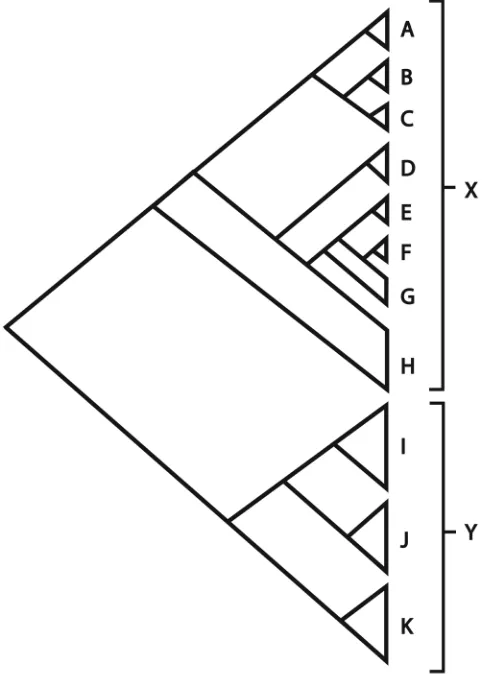
Within Clade X, there is a strong geographical signal with Australasian (Clade E) and South American (Clade F) clades of Convolvulus resolved within a paraphyletic tropical African grade G. Other groups resolved within Clade X include subclade C, comprising blue-flowered annuals that are largely Mediterranean in distribution but include also C. simulans from North America. Taxa in this clade do not exhibit the distinctly petiolate leaves typical of Clade X more generally. Subclade B, comprises western Mediterranean and Macaronesian taxa (the latter exhibiting a woody habit), many of which have blue flowers, and clade A, centred on the Red Sea, is a morpho-logically diverse assemblage of species including taxa with dense capitulate inflores-cences, blue flowers and/or clavate stigmas. Three species of Convolvulus (C. kossmatii,
number of members of the group. The remaining taxa in Clade X constitute a grade of Eurasian taxa (H) that includes C. arvensis.
Clade Y is restricted to the Eurosiberian region and three major subgroups are resolved within it. The first (Clade I) comprises species that are often fastigiate in habit and have flowers that are not aggregated into heads. The second (Clade J) comprises species that are typically subshrubs with sericeous leaves, pubescent seeds and often a spiny habit. The third clade (Clade K) comprises species with leaves that are typically tomentose and flowers that are borne in heads.
Whilst some attempt has been made above to correlate morphological traits with the clades resolved in the molecular analysis, it should be noted that the fit is imperfect. We have been unable to identify unique, un-reversed morphological synapomorphies for any of the groups highlighted in Figure 1 with the notable exception of Calystegia, a situation that reflects a more widespread problem in Convolvulaceae wherein high lev-els of homoplasy have rendered super-specific classification problematic (Austin 1998; Manos et al. 2001). Given the nature of the morphological variation, we are unable to propose an adequate infrageneric classification (Carine and Scotland 2002).
As noted above, there were pragmatic grounds for excluding Calystegia from this treatment. Nevertheless, the molecular data do support the inclusion of Calystegia
within Convolvulus, in agreement with Carine et al. (2004) and Stefanovic et al. (2002). The molecular results have been used to establish a framework for the linear se-quence of species adopted in the taxonomic account. Efforts have been made to estab-lish an order that maximises morphological similarity between adjacent species within the constraints of relationships inferred using molecular data. Species that are not sampled for molecular data were placed on the basis of their morphology. Within major groups, the molecular sequence has occasionally been abandoned so as to place species which are known to hybridise next to each other or to place species with close morphological similarity together. The sequence used is as follows:
Old world species with petiolate leaves and mostly twining/trailing stems (Grade H) Southern African species (Grade G)
New world species (Clade F) Australasian species (Clade E)
North west African (mostly) and Canary Island species (Clade B) Annual mostly blue-flowered species (Clade C)
Red Sea group, often with bluish flowers and/or clavate stigmas but very diverse in habit (Clade A)
Old world species with mostly separate flowers, often fastigiate in habit, not spiny (Clade I)
Old world species with sericeous leaves, often undershrubs, sometimes spiny (Clade J)
Species concept
The species concept is problematic in Convolvulus. While there are a small number of species that are outstandingly distinct (C. persicus from the Caspian and Black Seas,
C. floridus from the Canary Islands, C. assyricus from Turkey and C. kilimandschari
from East Africa are good examples) and many that are perfectly adequately delim-ited although having close relatives, there are a large number of species clusters where the boundaries of individual species are far from satisfactory. This will be apparent in any region where Convolvulus is reasonably diverse, whether South America, Australia, Central Asia, the Canary Islands, Southern Africa, the Horn of Africa, Arabia, Turkey or elsewhere. It is apparent in the long synonomies of several species such as C. althae-oides, C. sagittatus and C. prostratus. It is also apparent in the many species that histori-cally have been subsumed in other species such as C. libanoticus, C. mazicum and C. subsericeus in C. cantabrica or the inclusion of all Australian species in C. erubescens. It can also be seen in the placement of a number of infraspecific taxa which have been moved by different authors from one species to another, such as var. melliflorus which has moved between C. valentinus and C. supinus.
Notes are provided to indicate where plants intermediate between two species are known to occur. The status of these intermediates is rarely known with certainty. Hy-brids are only well documented in a few cases (Carine et al. 2007, Aykurt and Sümbül 2011b, for example) and may be common, but this cannot be confirmed at the present time. Clearly detailed population studies and experimental work may clarify uncertain-ties over the years, but quite obviously evolution of species is taking place both in the island context of the Canaries and Socotra and across continents. We have tried to provide solutions to these problems on a consistent and pragmatic basis and the notes indicate where we have had difficulties. We have accepted as a ‘good’ species any that is distinct over most of its range and have indicated when intermediates are known. A very strict species concept could result in a series of species collapsing into each other ending in a counter-intuitive and uninformative taxonomy. In any case it is not clear in most cases whether these intermediates are hybrids or not. We have tried to avoid excessive resort to subspecies and varieties, but these ranks are necessary in quite a few cases.
An important and perhaps surprising problem in species delimitation is that a considerable number of species are only known from a handful of collections and in several cases from the type only. Moreover, many specimens are inadequate. Only in a few cases do we know what the rootstock is like and in many species the capsule and seeds are unknown. This makes any taxonomy based on capsule and seed characters difficult to formulate and, where it has been attempted, difficult to use or evaluate, as in the case of the Australian species. Good field observations are also lacking in many cases. We do not know the flower colour or the potential height of many species as these details are often not recorded.
well-studied over the years. We have avoided describing new species based on single collections, however odd, which belong to a species complex. Santos 544 from Angola is unmatched by any other collection but is clearly part of a complex group of spe-cies centred on C. sagittatus, so has been noted but not described. The same is true of Bramwell & Humphries 3448 from the Canary Islands. Conversely three species,
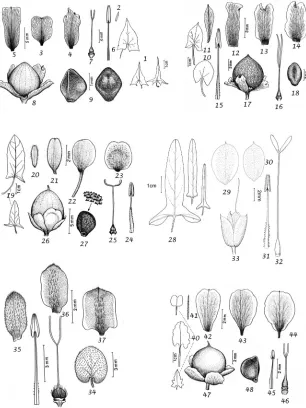
C. iranicus, C. xanthopotamicus and C. peninsularis have been described because their relationships are clear and they separate from related species by one or more ‘strong, Figure 2. Habits of the four new species described in this treatment. AC. austroafricanusBC. peninsu-larisCC. xanthopotamicusDC. iranicusA from Fanshawe 6566 (K) B from Whitcombe 807 (E) C from
qualitative’ characters. We have, however, described one new species from a species complex, C. austroafricanus, but in this case there are a good number of specimens and it has a distinct geographical range (Figure 2).
For the reasons expressed in the previous paragraphs it should be emphasised that the status of a number of species remains uncertain until further collections and more detailed study in the field is possible. We are not completely convinced that C. lindbergii is distinct from C. eremophilus or C. rectangularis from C. lanjouwii or C. semhaensis from C. kossmatii
or that C. jordanensis, C. spicatus, C. schimperi and C. cephalopodus merit recognition as separate species. Other examples could be found from Australia, America and elsewhere. In contrast, C. sagittatus is so variable that it is quite possible that some populations merit recognition as separate species but intensive genetic studies are clearly needed within this complex to explain the variation and introgression between species and forms.
At the infraspecific level, we have utilised the ranks of subspecies and variety:
The rank of subspecies is used to separate two closely related and usually intergrading taxa which are geographically separated but may have an overlapping range. Usu-ally they are separated by one or two characters. CharacteristicUsu-ally they behave as distinct species through much of their range.
The rank of variety is used for a distinct infraspecific taxon which is either known from a single location or group of close-by locations within the broader range of the species or occurs sporadically over the whole or, at least, most of the range of the species but with no obvious geographical patterning.
Morphological characters and their use in species delimitation
During our studies we have noted a range of characters of use in species delimitation. Their value is discussed below and we have provided lists of distinctive features, which may be of use in identification. It should be noted that the lists are not always exhaustive as information is not available for all species and not all useful characters are clearly defined.
Habit. Species of Convolvulus may be herbs or undershrubs. Herbs may be per-ennial or annual, entirely herbaceous or somewhat woody below, twining, trailing or more or less erect. Undershrubs may be cushion-forming, fastigiate, liana-like, erect and unarmed; or low compact and spiny; or low, compact and unarmed. Habit is therefore of great use in species delimitation and some of these distinctive habits are geographically restricted.
All southern hemisphere species are perennial trailing or twining herbs with cor-date, hastate or sagittate, petiolate leaves with the partial exceptions of C. hasslerianus
Annual herbs: C. fatmensis, C. coelesyriacus, C. siculus, C. pentapetaloides,
C. sim-ulans, C. gharbensis, C. humilis, C. tricolor, C. meonanthus, C. rhyniospermus,
C. rottlerianus. Convolvulus rhyniospermus may occasionally perenniate. Several Australian species regarded as perennials may be (at least sometimes) annual. These include C. crispifolius, C. eyreanus and C. recurvatus. C. capituliferus and
C. grantii have been interpreted as annuals but appear always to be perennial. None of the annuals are obviously twiners. They are characteristically slender, entirely herbaceous and with a poorly developed rootstock. Many have recurved fruiting peduncles.
Erect (or at least ascending) herbs: Convolvulus pseudoscammonia, C. hasslerianus
(apparently sometimes twining), C. randii (sometimes twining).
Trailing or twining herbaceous perennials, which may be woody below, with
hastate, sagittate or truncate leaves: C. scammonia, C. durandoi, C. arvensis, C. mairei, C. chinensis, C. fatmensis, C. steppicola, C. sinuatodentatus, C. rufescens, C. galaticus, C. germaniciae, C. cassius, C. betonicifolius, C. longipedicellatus,
C. stachydifolius, C. althaeoides, C. palaestinus, C. maireanus, C. pitardii, C. glaouorum, C. vidalii, C. lanjouwii, C. rectangularis, C. dryadum, C. supinus, C. sabatius, C. valentinus, C. vollesenii, C. bidrensis, C. jefferyi, C. capituliferus, C. stenocladus, C. subspathulatus, C. grantii, C. sarmentosus (perhaps), all American and southern hemisphere species except C. simulans (annual), C. kilimandschari
(liana), C. hasslerianus and C. randii (both usually erect herbs). Most of these species seem to be normally trailing herbs but a few show strong evidence of usually being twiners although this might be an artifice of their preferred habi-tat. Common twining species include C. farinosus from Africa and C. remotus
from Australia.
Lianas: C. canariensis, C. massonii, C. volubilis, C. lopezsocasii, C. fernandesii, C.
kilimandschari.
Unarmed non-twining, non-fastigiate shrubs: C. persicus, C. floridus, C. scindicus,
C. fruticulosus. The first three are commonly erect whereas the last is more or less prostrate in form.
Erect unarmed undershrubs with stiff, thin, woody, subfastigiate branches and
(usually) few, relatively small leaves: C. scoparius, C. scopulatus, C. socotranus, C. sericophyllus, C. hildebrandtii, C. peninsularis, C. leptocladus, C. eremophilus, C. lindbergii, C. hamadae, C. erinaceus, C. divaricatus, C. tujuntauensis, C. subsericeus,
C. chondrilloides, C. gracillimus, C. kurdistanicus, C. koieanus, C. sarothrocladus, C. pseudocantabrica, C. dorycnium.
Low cushion plants with branched woody rootstock: C. assyricus, C. mazicum,
C. boissieri, C. suendermannii, C. libanoticus, C. carduchorum, C. cataonicus, C. phrygius, C. aitchisonii, C. asyrensis, C. ammannii, C. tragacanthoides. These inter-grade with species like C. lineatus, C. calvertii and C. holosericeus, which may be cushion-like in form but with erect stems.
a) Only the old lower branchlets spinescent: C. lanatus, C. tragacanthoides, C. grigorjevii.
b) All (or most) branches spinescent: C. kossmatii, C. semhaensis, C. caput-me-dusae, C. oxyphyllus, C. ulicinus, C. spinifer, C. virgatus. In all of these except
C. virgatus the flowers are sessile. A few other species have sometimes been interpreted as having spinescent branches including C. turrillianus, C. oxyse-palus, C. erinaceus, C. hamadae and C. sericophyllus and a few others are rarely subspinescent, such as some forms of C. prostratus.
c) Branches and peduncles (where present) spinescent, sterile lateral spines (formed from abnormal sterile peduncles?) also present: C. fruticosus, C. gortschakovii, C. spinosus, C. argyracanthus, C. acanthocladus, C. iranicus, C. leiocalycinus, C. verdcourtianus, C. trabutianus.
Underground parts. These are poorly known. Convolvulus arvensis is well-known for producing extensive underground rhizomes, which explain its persistence as a weed of cultivation. Many herbaceous species put down a shallow tap root, from which thin ad-ventitious side roots develop. The perennial species of desert and semi desert regions com-monly have a thickened woody rootstock which allows survival in the long periods between rain and from which annual, herbaceous or near herbaceous stems arise. C. hasslerianus and perhaps C. randii have a xylopodium which allows them to survive savannah fires.
Leaf and stem indumentum. There is much variation in indumentum, with the majority of species hairy in some form. Sa’ad (1967: 25 ff.) drew attention to different hair structures in Convolvulus but she did not make use of this in species delimitation and we have made no use of it either. Instead, we have indicated below some indumen-tum features which we have found of taxonomic importance. In the majority of species the indumentum of the leaves, stem, bracts, bracteoles and sepals is similar although varying somewhat in density. However, in a few species the indumentum of the sepals (and occasionally also that of the bracteoles) is strikingly different to that of the leaves. Reference in this part is consequently to the indumentum of the leaves and stem unless otherwise indicated. It should also be noted that some species are glabrescent, the older parts glabrous while the younger parts are hirsute to some degree.
Leaves velvety-tomentose: C. galaticus, C. germaniciae, C. althaeoides subsp. tenuis-simus, C. eyreanus, C. crispifolius, C. thomsonii. The distinction between this and the next category is not very clear.
Leaves densely sericeous/canescent: C.lanuginosus, C. cneorum, C. krauseanus, C.
lineatus, C. oleifolius, C. argyrothamnos, C. holosericeus, C. calvertii, C. ammannii,
C. xanthopotamicus, S. tragacanthoides, C. spinifer, C. grigorjevii, C. fruticosus, C. hermanniae, C. carrii, C. randii, C. lindbergii, C. boissieri, C. suendermannii, C. caput-medusae, C. mazicum.
Very finely sericeous and often somewhat glabrescent: C. sericophyllus, C. kossmatii,
Villous-tomentose perennials (dense longish hairs), characteristically woody at the
base but with more or less herbaceous branches (always associated with flowers in heads): C. aitchisonii, C. asyrensis, C. lanatus, C. secundus, C. spicatus, C. schimperi,
C. jordanensis, C. cephalopodus, C. euphraticus, C. reticulatus, C. cephalophorus, C. stapfii, C. kotschyanus, C. pyrrotrichus, C. prostratus, C. pilosellifolius, C. calvertii, C. elymaiticus, C. commutatus, C. schirazianus.
Plants glabrous or nearly so (several of these are sometimes partially puberulent):
C. scammonia, C. pseudoscammonia, C. durandoi, C. arvensis, C. chinensis, C. lopezsocasii, C. demissus, C. laciniatus, C. montanus, C. ensifolius, C. microsepalus, C. remotus, C. angustissimus, C. waitaha, C. dregeanus, C. bidentatus, C. namaquensis.
Sepal indumentum strikingly different from that of stem and leaves: C.
acanthocla-dus, C. hamrinensis, C. oxyphyllus, C. ulicinus, C. urosepalus, C. iranicus, C. oxyse-palus, C. turrillianus, C. virgatus, C. glomeratus, C.scopulatus, C. sericocephalus, C. boissieri subsp. compactus, C. cephalopodus (not as strongly as in other species).
Leaves and bracts. In this treatment, no great distinction is generally made be-tween bracts and leaves. In the great majority of cases the leaves which subtend flower-ing peduncles (i.e. bracts) are almost identical to the lower stem leaves and differ only in their progressively smaller size towards the apex of the stem. Only in a few cases, principally those species where the inflorescence appears terminal, have we made a clear distinction between leaves and bracts.
In terms of leaf shape and molecular phylogeny the genus can be divided into two main natural groups, which are mostly easily separated apart from a few So-mali or Socotran species. The first group (Species 1–106) has leaves with cordate, truncate, sagittate or hastate leaf bases and clearly demarcated petioles; basal leaf auricles are frequent. Leaves may be entire, undulate, crenate, dentate or sinuate-lobed. Included are a small number of petiolate species with rounded to broadly cuneate leaf bases, which include C. persicus and a few species from East Africa including C. oppositifolius, C. rhyniospermus, C. capituliferus, C. stenocladus, C. jefferyi, C. bidrensis. All trailing and twining species belong to this first group. The second group (Species 107–190) have leaves that are gradually narrowed at base and lack a distinct petiole. This group is most diverse in Central Asia and does not occur in the southern hemisphere or the Americas. It includes all cushion plants, most spiny species, most species with a sericeous or canescent indumentum and all species of a fastigiate habit. Leaves are usually linear, oblanceolate, oblong or elliptic and are usually entire, although undulate leaves occur in some fastigiate species and especially in the herbaceous C. grantii.
Amongst unusual leaf features are
Leaves abruptly contracted to a subsessile base: C. hasslerianus, C. ensifolius, C.
Twining/trailing plants with strongly dimorphic leaves include most Australasian
species and the following but the list is not exhaustive: C. althaeoides, C. palaestinus,
C.glaouorum, C. vidalii, C. dregeanus, C. sagittatus (sometimes), C. capensis (?), C. chilensis, C. equitans, C. maireanus, C. assyricus, C. grantii.
Leaf auricles bifurcate or otherwise divided: C. chilensis, C. bonariensis, C. equitans,
C. aschersonii, C. steppicola, C. chinensis.
Leaves equilaterally triangular in form: C. scammonia, C. chinensis subsp.
triangu-laris, C. dryadum, C. farinosus (commonly).
Inflorescence. Inflorescence structure is quite diverse in the genus and is of taxo-nomic importance. Flowers are arranged in axillary cymes but this structure is not always obvious. Most commonly, cymes are clearly pedunculate with paired bracteoles at the branching point(s). In this account the peduncle is measured from the base where it arises from the main stem to this branching point. The term pedicel is used above this point. Pedicels are often very variable in length on a single inflorescence especially when the cyme has a clearly monochasial structure. Bracteoles are mostly small, sometimes caducous and relatively unimportant in distinguishing species.
Inflorescence terminal: C. turrillianus, C. oxysepalus, C. scindicus, C. maireanus,
C. calvertii, C. commutatus, C. schirazianus, C. elymaiticus, C. lineatus, C. xan-thopotamicus, C. spinifer, C. grigorjevii, C. krauseanus, C. oleifolius, C. cneorum,
C. lanuginosus, C. gharbensis, C. humilis.
Axillary pedicellate flowers with peduncle absent or very short: C. vidalii, C. pitardii,
C. glaouorum (somewhat so), C. fruticulosus, C. boedeckerianus, C. ocellatus, C. randii.
Flowers sessile, solitary or paired: C. hamrinensis, C. oxyphyllus, C. socotranus, C.
hystrix (subsp. ruspolii only), C. kossmatii, C. semhaensis, C. caput-medusae, C. seri-cophyllus (near sessile), C.argillicola.
Inflorescence paniculate in form: C. floridus. Several other species could sometimes be interpreted as having a paniculate inflorescence including C. aucheri, C. canta-brica, C. pilosellifolius and C. prostratus.
Inflorescence racemose in form: C. sericophyllus, C. hildebrandtii, C. peninsularis,
C. leptocladus.
Peduncles paired (at least sometimes): C. rufescens, C. thomsonii.
sepal shape, texture and indumentum are all of taxonomic importance. Unusual sepal structures include:
Outer sepals noticeably shorter than inner sepals: C. scammonia, C.
pseudoscam-monia, C. spinosus.
Outer sepals conspicuously larger than inner sepals: C. gortschakovii. Sepals conspicuously accrescent: C. argillicola.
Sepals very lax (not appressed to base of corolla): C. leiocalycinus.
Sepals spathulate (and reflexed): C. durandoi. Sepals rectangular: C. rectangularis, C. lanjouwii.
Sepals with a conspicuously different coloured apex: C. prostratus, C. pilosellifolius,
C. cantabrica, C. aucheri, C. betonicifolius, C. tricolor, C. cataonicus, C. carducho-rum, C. germaniciae, C. volubilis, C. massonii, C. oppositifolius, C. lineatus.
Sepals mostly > 10 mm long: C. lilloi, C. hasslerianus (South America), C. carrii
(North America), C. bidrensis, C. thomsonii, C. kilimandschari, C. thunbergii,
C. capensis, C. natalensis, C. argillicola, C. bullerianus (Africa), C. massonii,
C. lopezsocasii (Atlantic Islands), C. scammonia (inner sepals), C. glomeratus var.
sachalitarum, C. holosericeus, C. sericocephalus, C. fruticosus, C. gortschakovii,
C. betonicifolius, C. supinus, C. persicus, C. phrygius, C. kotschyanus, C. commutatus,
C. lanatus, C. secundus, C. schimperi, C. pyrrotrichus, C. aitchisonii, C. oxysepalus, C. cephalopodus, C. reticulatus, C. stapfii, C. cephalophorus, C. urosepalus.
Sepals all very short, < 5 mm long: C. arvensis, C. mairei, C. durandoi, C. fatmensis,
C. vidalii, C. coelesyriacus, C. humilis, C. floridus, C. microsepalus, C. crispifolius, C. recurvatus, C. clementii, C. verecundus, C. waitaha, C. assyricus, C. dorycnium, C. sericophyllus, C. sarmentosus, C. grantii, C. hildebrandtii, C. peninsularis, C. lepto-cladus, C. eremophilus, C. erinaceus, C. chondrilloides, C. gracillimus, C. iranicus, C. verdcourtianus.
Corolla. The corolla of all Convolvulus species is funnel-shaped. The short basal tube is usually more or less included in the calyx while the expanded part is strongly exserted and usually conspicuous. It is undulate to 5–lobed, although it is not com-pletely certain how constant this distinction is. On the exterior, there are 5 darker coloured and usually hirsute bands which terminate at the apex of each corolla lobe. These are referred to as midpetaline bands. They do not extend to the basal, cylin-drical portion of the corolla. Corolla colour is sometimes of taxonomic importance but it is difficult to assess from dried specimens and so has been used with caution. Some species apparently always have a white corolla such as Convolvulus persicus and
C. erinaceus and its allies whereas others such as C. chinensis and C. dorycnium seem always to be pink-flowered but there is uncertainty about how constant this character is in many species.
Corolla often or always deeply lobed: C. rufescens, C. crenatifolius, C. bonariensis,
C. rhyniospermus, C. erinaceus, C. fatmensis, C. siculus, C. simulans, C. volubilis, C. scoparius.
Corolla yellow (or cream): C. scammonia, C. pseudoscammonia, C. supinus, C. pa-laestinus, C. natalensis, C. bullerianus.
Corolla blue or bluish: C. sabatius, C. valentinus (?), C. siculus, C. pentapetaloides,
C. humilis, C. gharbensis, C. simulans, C. tricolor, C. meonanthus, C. subspathulatus,
C. jefferyi, C. capituliferus, C. canariensis, C. fruticulosus.
Midpetaline bands glabrous: C. scammonia, C. pseudoscammonia, C. durandoi, C. siculus, C. simulans, C. dregeanus, C. montanus, C. laciniatus (sometimes), C. wait-aha, C. rhyniospermus, C. capituliferus (almost).
Stamens. Stamens are unequal in length. The main taxonomic character of inter-est is in the filaments. Sessile or very shortly stipitate glands are present on the lower expanded part of the filaments in all annual species, and trailing and twining species from the Mediterranean and Central Asian regions. They are absent from species with cuneate or attenuate leaf bases and apparently from the twining and trailing species from the southern hemisphere.
Style and stigma. The length of the undivided portion of the style is provided in the descriptions but this may well be more variable than the dimensions given as we have not generally examined the style of many examples of each species. More signifi-cant is the relative length of the undivided portion of the style to that of the stigmas. In a number of species, the stigmas are almost as long as the undivided style although they are usually much shorter. The stigmas are weakly exserted from the corolla in a number of species (C. crenatifolius subsp. montevidensis, C. equitans), possibly because the corolla is somewhat wider than in most other species. These species are also unusual for the persistence of the style on the ripening capsule.
In most species the stigmas are linear-filiform and co-extensive with the style arm. In a small group of Socotran species previously placed in Seddera (Convolvulus koss-matii, C. socotranus, C. semhaensis) the stigmas are clavate and shorter than the style arm (Luna et al.2014). Ellipsoid stigmas are found in a number of species in the same clade (C. glomeratus, C. hystrix etc.) and upwardly thickened stigmas occur in various other species, notably C. leiocalycinus and several South African species. Several South American species also have short, rather thick stigmas (C. demissus, C. chilensis). This last species is unusual in exhibiting rather different stigmas on different plants, linear stigmas 3.5 mm long occurring on some plants while oblong stigmas c. 1.5 mm long occur on others. The frequency or significance of this variation is unknown. In most plants both stigmas in each pair are equal but occasional specimens have been observed where they are asymmetric. This does not seem to be species specific.
Stigmas 3: C. maireanus.
Stigmas not coequal with style arm: C. kossmatii, C. socotranus, C. semhaensis. Stigmas thickened, oblong to ellipsoid in form, much shorter than style:
C. subspathulatus, C. scopulatus, C. capensis, C. namaquensis, C. bidentatus, C. chil-ensis (sometimes).
Stigmas equalling or longer than style: C. ulicinus, C. aschersonii, C. chondrilloides,
C. oxysepalus, C. koieanus, C. leptocladus, C. peninsularis, C. hildebrandtii, C. trabutianus, C. sarmentosus, C. grantii, C. prostratus, C. pilosellifolius, C. aucheri,
C. cantabrica, C. gracillimus, C. scoparius, C. floridus, C. lanuginosus, C. cneorum.
C. calvertii, C. ammannii, C. oleifolius, C. holosericeus, C. assyricus, C. libanoticus,
C. phrygius, C. cephalopodus, C. jordanensis, C. spicatus, C. secundus, C. lanatus, C. schimperi, C. kotschyanus, C. reticulatus, C. pyrrotrichus, C. fruticulosus, C. sabatius,
C. valentinus, C. durandoi, C. pentapetaloides, C. humilis, C. massonii, C. volubilis,
C. lopezsocasii (?). C. canariensis.
Style and ovary indumentum. The indumentum of the ovary, ripening cap-sule and style is of considerable taxonomic importance. Style indumentum correlates closely with that of the ovary but there are cases where the ovary is hirsute and the style glabrous (Convolvulus hermanniae subsp. erosus). However, we know of no cases where the lower part of the style is hirsute but the ovary is glabrous. Two North Ameri-can species (Convolvulus equitans, C. carrii) are unique in that the upper part of the style, immediately below its division into two arms, is pilose but only in some of the specimens we have seen. In both these cases the ovary is glabrous and the character, although interesting, appears not to be of taxonomic significance.
Ovary indumentum has been used extensively in species delimitation by Sa’ad, Rech-inger and others. Indeed (RechRech-inger 1963) uses the presence or absence of ovary hairs as one of the first dichotomies in the key to species in Flora Iranica. It has been noted as the principal but not the only character to distinguish several pairs of species including Con-volvulus lanuginosus/C. calvertii and C. oxysepalus/C. turrillianus. However, others have discounted its importance (O’Donell 1957: 169) or ignored it altogether (Meeuse 1958). Our own studies suggest that it is often species specific but there are many cases where the presence or absence of ovary hairs does not correlate either with other morphological differences or with geographical distribution. This is certainly the case with C. ocellatus
from Southern Africa, C. hildebrandtii from Somalia and Socotra and C. leiocalycinus
from the Iranian region as well as with a number of species from Madeira and the Ca-nary Islands. More controversially, we have adduced that indumentum differences are not significant in separating several hitherto recognised species, which we have included within C. eremophilus. Where some geographical patterning is obvious, we have accepted existing taxonomic decisions (as in the separation of C. spicatus from C. cephalopodus) or recognised subspecies (as in the South American C. hermanniae subsp. hermanniae and subsp. erosus), although no additional characters seem to separate these taxa
Style sometimes hirsute immediately below stigmas: C. equitans, C. carrii.
Ovary (and usually the capsule) hirsute at least at apex: Convolvulus hermanniae