Spiradiclis pengshuiensis
(Ophiorrhizeae, Rubioideae),
a new species from Chongqing, China
Bo Pan1, Hu-Sheng Ma1, Rui-Jiang Wang2
1 Guangxi Institute of Botany, Guangxi Zhuangzu Autonomous Region and Chinese Academy of Sciences, Gui-lin 541006, China 2 Key Laboratory of Plant Resources Conservation and Sustainable Utilization, Guangdong Provincial Key Laboratory of Applied Botany, South China Botanical Garden, Chinese Academy of Sciences, Guangzhou 510650, China
Corresponding author: Rui-Jiang Wang ([email protected])
Academic editor: Pavel Stoev | Received 3 February 2016 | Accepted 14 May 2016 | Published 18 May 2016 Citation: Pan B, Ma H-S, Wang R-J (2016) Spiradiclis pengshuiensis (Ophiorrhizeae, Rubioideae), a new species from Chongqing, China. PhytoKeys 63: 41–45. doi: 10.3897/phytokeys.63.8016
Abstract
Spiradiclis pengshuiensis Bo Pan & R. J. Wang (Rubiaceae) is described as a new species from Chongqing in SW China. It is morphologically compared with S. pauciflora L. Wu & Q. R. Liu because of their similarities in habit, pubescent surface, small leaf laminas and subglobose capsules. Its conservation status is evaluated as “VU” according to the IUCN categories and criteria.
Keywords
China, New taxon, Rubiaceae, Spiradiclis
Introduction
The genus Spiradiclis Blume (Rubiaceae) mainly distributed in the tropical and sub-tropical limestone areas of Southern China and Northern Vietnam. Geographically, the localities of Spiradiclis species can extend northward to Mt. Emei (29°33'N) in Sichuan province of China and southward to Central Java (ca. 7°10'S) of Indonesia. The genus comprise about 50 species and ca. 91% species can be found in China, the center of species diversity (Chen and Taylor 2011, Deng et al. 2014, Wang et al. 2015, Wen et al. 2015, Wu et al. 2015, Wang 2016). Spiradiclis species are usually similar to Ophiorrhiza L. because of their similar inflorescence and flower characters,
http://phytokeys.pensoft.net
Copyright Bo Pan et al. This is an open access article distributed under the terms of the Creative Commons Attribution License (CC BY 4.0), which permits unrestricted use, distribution, and reproduction in any medium, provided the original author and source are credited.
but the former is characterized by globose or ovoid (vs. strongly laterally compressed
in Ophiorrhiza) capsules.
During a botanical inventory in Pengshui County, the east of Chongqing Munici-pality, in 2013, the senior author found a striking Spiradiclis species growing on the dry cliffs. In order to get enough materials for morphological observation and compar-ison, we successively collected the vouchers during the flowering and fruiting seasons in recent years. This new species can be readily distinguished from other Spiradiclis
species in habit and flowers and herein described and illustrated.
Material and methods
All materials were collected by ourselves and deposited at the herbarium of South China Botanical Garden, Chinese Academy of Sciences (IBSC). The morphological data were collected by a Digimatic Caliper (Mitutoyo, Japan).
Taxonomy
Spiradiclispengshuiensis B. Pan & R. J. Wang, sp. nov. urn:lsid:ipni.org:names:77154905-1
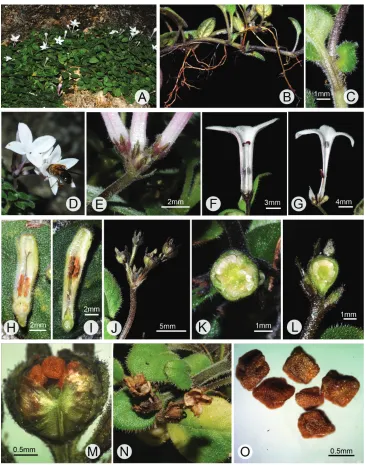
Figure 1
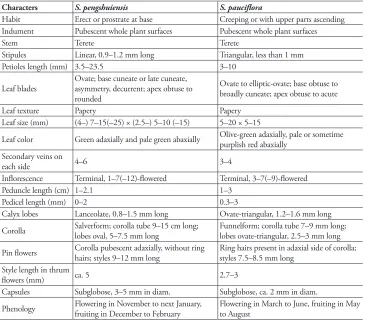
Diagnosis. Spiradiclis pengshuiensis is similar to S. pauciflora L. Wu & Q. R. Liu, from which it differs in having linear (vs. triangular) stipules, 4–6 (vs. 3–4) secondary veins each side of the leaf laminas, salverform (vs. funnelform) corolla with 9–15 mm (vs. 7–9 mm) long tubes (Table 1).
Type. CHINA. Chongqing Municipality: Pengshui County, Hanxia Town, Baix-iang Village, 29°8'N, 108°6'E, 360 m alt., 29 Nov 2014, Rui-JBaix-iang Wang 2931, long-styled flower (holotype IBSC; isotypes IBSC).
Table 1. Morphological comparison of Spiradiclis pengshuiensis and S. pauciflora.
Characters S. pengshuiensis S. pauciflora
Habit Erect or prostrate at base Creeping or with upper parts ascending Indument Pubescent whole plant surfaces Pubescent whole plant surfaces
Stem Terete Terete
Stipules Linear, 0.9–1.2 mm long Triangular, less than 1 mm
Petioles length (mm) 3.5–23.5 3–10
Leaf blades Ovate; base cuneate or late cuneate, asymmetry, decurrent; apex obtuse to rounded
Ovate to elliptic-ovate; base obtuse to broadly cuneate; apex obtuse to acute
Leaf texture Papery Papery
Leaf size (mm) (4–) 7–15(–25) × (2.5–) 5–10 (–15) 5–20 × 5–15
Leaf color Green adaxially and pale green abaxially Olive-green adaxially, pale or sometime purplish red abaxially Secondary veins on
each side 4–6 3–4
Inflorescence Terminal, 1–7(–12)-flowered Terminal, 3–7(–9)-flowered
Peduncle length (cm) 1–2.1 1–3
Pedicel length (mm) 0–2 0.3–3
Calyx lobes Lanceolate, 0.8–1.5 mm long Ovate-triangular, 1.2–1.6 mm long Corolla Salverform; corolla tube 9–15 cm long; lobes oval, 5–7.5 mm long Funnelform; corolla tube 7–9 mm long; lobes ovate-triangular, 2.5–3 mm long
Pin flowers Corolla pubescent adaxially, without ring hairs; styles 9–12 mm long Ring hairs present in adaxial side of corolla; styles 7.5–8.5 mm long Style length in thrum
flowers (mm) ca. 5 2.7–3
Capsules Subglobose, 3–5 mm in diam. Subglobose, ca. 2 mm in diam.
Phenology Flowering in November to next January, fruiting in December to February Flowering in March to June, fruiting in May to August
stamens included; filaments adnate to the lower corolla tube, ca. 1.5 mm long; styles 9–12 mm long; stigma ca. 0.5 mm long, red to brown, extended to corolla throat, not exserted. Short-styled flowers: stamens extended to corolla throat, not exserted; fila-ments adnate to upper corolla tube, ca. 0.5 mm long; styles ca. 5 mm long; stigmas ca. 1.5 mm long, included. Capsules subglobose, 3–5 mm in diam., with persistent calyx lobes, dehiscent septicidally and loculicidally; valves 4, ovate, 3–5 mm long. Seeds 15–20 per capsule, ca. 0.5 mm long, brown, irregular pyramid to cuboid, foveolate on surface.
Phenology. Flowers from November to next January; fruits from December to next February.
Distribution and habitat. Spiradiclis pengshuiensis is known only from the type lo-cality. Its habitat is on the cliffs nearby the A-Yi-He river but with very poor conditions.
Conservation status. Only three small populations and less than 500 individuals
of Spiradiclis pengshuiensis within 5 km2 were found in the A-Yi-He Scenic Area. The
plants always grow on the cliffs with little soil and insufficient water, which limited the development and dispersal of the species. Therefore we assign a preliminary IUCN threat status of Vulnerable [VU, B2ab(ii, iii, iv)] to S. pengshuiensis (IUCN 2001).
Specimens examined. CHINA. Chongqing Municipality: Pengshui County, Hanxia Town, Baixiang Village, 29°8'N, 108°6'E, 350 m alt., 29 Nov 2014, short-styled flowers, Rui-Jiang Wang 2932, 2937 (IBSC); same locality, 12 Jan 2016, fruit-ing, Rui-Jiang Wang 3095, 3099 (IBSC).
Acknowledgements
This work was supported by National Natural Science Foundation of China (31070177) and Natural Science Foundation of Guangxi (2013GXNSFBA019078).
References
Chen T, Taylor CM (2011) Spiradiclis Blume. In: Wu ZY, Raven PH (Eds) Flora of China, vol. 19. Science Press, Beijing & Missouri Botanical Garden Press, St. Louis, 330–339. Deng SJ, Wen HZ, Huang XX, Wang RJ (2014) Spiradiclis coriaceifolia and S. tonglingensis
spp. nov. (Rubiaceae, Ophiorrhizeae) from Guangxi, China. Nordic Journal of Botany 32: 594–601. doi: 10.1111/njb.00461
IUCN (2001) IUCN Red List Categories and Criteria (Version 3.1). IUCN Species Survival Commission, Gland, Switzerland and Cambridge. http://www.iucnredlist.org/info/cat-egories_criteria2001
Wang RJ, Wen HZ, Deng SJ, Zhou LX (2015) Spiradiclisdanxiashanensis (Rubiaceae), a new species from South China. Phytotaxa 206(1): 30–36. doi: 10.11646/phytotaxa.206.1.5 Wang RJ (2016) Spiradiclis yangchunensis (Rubiaceae), a new species from Guangdong, China.
Plant Science Journal 34(1): 13–17. doi: 10.11913/PSJ.2095–0837.2016.10013
Wen HZ, Wang RJ, Deng SJ (2015) Spiradiclis longanensis, a new species of Rubiaceae from China. PhytoKeys 55: 113–117. doi: 10.3897/phytokeys.55.4975