The Didactic Treatment of English as a Medium
of Instruction in Ivorian Universities: A Case
Study
Jérôme Kouassi
Université Félix Houphouët-Boigny, Cocody-Abidjan, Côte d’Ivoire
Abstract—In Côte-d’Ivoire French is used as the language of instruction at all levels of education except the foreign language departments in our universities. Today, the idea is to use EMI1 in higher education. This requires full year training in intensive English. As the current conditions are not appropriate, the situation calls for reflection on an alternative solution: Training our students without necessarily resorting to a full academic year of intensive English. Considering the difficulties relating to the mobilization of human and material resources indispensable for a successful implementation of intensive English learning and taking account of the current teaching practices in our different departments, what didactic choices can allow the much needed training in our context? In order to answer this question I investigated the situation at the UFR-SEG2 using a questionnaire and an interview guide. The conclusions of this study carried out in a constructivist and socio-constructivist perspective indicate that the majority of our trained students are unable to use English for instruction. My suggestions are threefold: Triangulation of didactic situations (didactic, a-didactic and non a-didactic situations), use of a multi-dimensional differentiated approach to instruction, and instruction based on learning strategies.
Index Terms—didactics, constructivism, socio-constructivism, English language of instruction, strategy, differentiation
I. INTRODUCTION
In Côte-d’Ivoire French is used as the language of instruction at all levels of education except the foreign language departments in our universities. Today, because of its undeniable role as the language for international communication and development, our educational authorities advocate the idea of using EMI3in higher education. In this perspective, they think that all the students enrolled in our universities must have full year training in intensive English before beginning their studies in their respective faculties or departments. The aim is to provide them with the training which might allow them to use English not only for oral communication and writing but also to attend classes, listen and take notes, participate in debates and discussions, intervene during colloquia and seminars, read and understand written texts, produce texts, and do research. Unfortunately, the requirements of such an endeavor (sufficient and qualified human resources for the training of the large number of students, enough language laboratories for all tutorial groups, specialized rooms, language libraries, etc.) contrast with the realities in our universities. This situation calls for reflection on an alternative solution: Training our students to use EMI despite the inappropriateness of the current conditions. Elsewhere, such authors as Hengsadeekul (2010), Harrop (2012), Dearden (2014), Bollevan (2014), and Pozo (2015) carried out some researches on the implementation of EMI in diverse contexts, with a stress, in some cases, on the use of the CLIL4 approach. Unfortunately, as far as I know, no scientific reflection has addressed the issue in our context. This study which has a constructivist and socio-constructivist perspective is an innovation in this field. The theory of constructivism was born in the middle of the twentieth century. The forerunner of this theory, in its developmental approach, is Jean Piaget. Piaget believes that the learner constructs his knowledge through his personal actions. He considers intellectual development as an internal and autonomous process which is not influenced by external effects. He goes further as to add that the learner cannot assimilate knew knowledge unless he possesses the mental structures which allow it. In its interactional approach constructivism, according to Jerome Bruner, sustains that knowledge construction is a dynamic process in which the learner resorts to his previous knowledge in order to construct new knowledge while developing new representations of the world. Socio-constructivism, advocated by Lev Vygotski, derives partly from constructivism. It emphasizes the relational dimension of learning (Co-construction of knowledge by confronting one’s representations to others) which occurs in a social framework. Vygotski introduces the parameter of mediation ignored by Piaget (influence of the external world on the development of abilities). He uses the
1
English as a medium of instruction
2 Faculty of Economic and Management Sciences 3
English as a medium of instruction
4 Le CLIL (Content and Language Integrated Learning) is born in Europe in 1995. This approach is based on constructivist principles which integrate
notion of ZPD (Zone of Proximal Development) which represents the gap between what the individual is capable of achieving intellectually at a given moment of the learning process and what he could achieve with the mediation of another person. Socio-constructivism is a teaching and learning approach in which the following three didactic elements cannot be separated: reference to the subject who learns (constructivist dimension), reference to the other students (socio-constructivist dimension), and reference to the learning environment. My work is concerned with the didactic treatment of EMI. According to Meirieu (1991), didactics aims at “… reaching the intelligence of the material conditions and the mental mechanisms which allow a given individual to construct some specific knowledge” (p.87)5. The relevance of the constructivist and socio-constructivist perspective for this study is therefore justified. Such an approach might allow me to show how, in our context, one can help the learners construct and organize their knowledge through their personal actions and co-construct their knowledge with the help of others while being actively involved in the completion of the tasks suggested by the learning situations. My main preoccupation is as follows: Given the difficulties relating to the mobilization of human and material resources for a successful implementation of the idea of a full academic year of intensive training in English and taking account of the current practices in our universities in terms of TEFL6, what didactic choices can allow the much needed training in our context? Two subsidiary questions derive from this main preoccupation: What makes the training conditions in our classrooms inadequate for a successful implementation of EMI? How can EMI be effectively implemented in our classrooms despite these inappropriate conditions? In order to answer these questions, I will investigate the current situation in the classrooms of UFR-SEG7focusing on the teaching practices in use and their limitations before making some suggestions essentially rooted in the theoretical framework of this study and my own experience as a teacher of English as a foreign language.
II. CONTEXT OF THE STUDY AND METHODOLOGICAL FRAMEWORK A. Context of the Study
This study was carried out at the Université Félix Houphouët-Boigny8 where I am currently working as a teacher and researcher at the department of English. The faculty involved in the investigation was the faculty of Economic and Management Sciences9 with a particular interest in third year level10. The classes in this faculty take place in tutorial rooms which shelter sixty (60) students. No language laboratories and specialized rooms are available for the intensive training of the students in English. Moreover, the fact that English is considered as a subsidiary subject in the faculty and the poor human resources (04 teachers of English for the whole faculty) add to the inappropriateness of the training conditions.
My choice of UFR-SEG was justified by the fact that like in the other faculties of our university English is taught from Licence 1 to Licence 3. Licence 3 students I chose to investigate have been learning English for three years at university. At this stage, they should be able not only to use English for oral communication and writing but also to attend classes, listen and take notes, participate in debates and discussions, intervene in colloquia and seminars, read and understand written texts, produce texts, and do research. Unfortunately, the inadequate working conditions mentioned earlier in this paper makes the implementation of intensive training in English particularly challenging. I therefore felt the necessity to carry out this study in order to help overcome this challenge.
B. Methodological Framework
My intention in this study was to reflect on the didactic choices which can help train our students to use EMI. Prior to this endeavor was the necessity to investigate the UFR-SEG in order to provide evidence that the teaching practices in the faculty did not allow the appropriate training of our students. Therefore, this study was carried out within the paradigm of action research. This type of research consists in diagnosing a specific problem in a specific context and trying to solve it. The target population in this investigation is the students in Licence 3 and their teachers.
For the sake of consistency of the information I adopted the technique of triangulation for data collection. This technique allows data collection from different perspectives: data from the teachers and data from the students. A questionnaire and an interview guide were used respectively to collect data from the students and the teachers. The questionnaire (see appendix A) consisted of qualitative variables. For the interview I used a semi-structured interview guide consisting of three (03) questions: What activities do you involve your students in during the training sessions? Do you think this training allows your students to use EMI? (Attend economics and management classes in English; participate in seminars and colloquia in English, etc.). What do you suggest for the improvement of the situation? The responses to these three questions called for some secondary questions which helped me collect the information needed.
5 « …parvenir à l’intelligence des conditions matérielles et des mécanismes mentaux grâce auxquels un sujet donné c onstruit des connaissances
déterminées ».
6Teaching English as a Foreign Language 7
Faculty of Economics and Management
8Located in Cocody-Abidjan, it is the biggest and oldest university in Côte-d’Ivoire. 9
This faculty, in our context, is known as UFR-SEG.
10 In our university the following labels are given to the different levels: LICENCE 1 for first year level, LICENCE 2 for secon d year level, LICENCE
With this flexible approach the teachers interviewed had the opportunity to express themselves as freely as possible while providing extra information which helped best perceive the reality.
For this study I adopted stage sampling technique with random choices. This consisted in selecting the sample in stages and taking samples from samples. As the size of the sample is without importance for a target population which is more or less homogeneous (same initial training, same interests, etc.), I worked on a relatively small sample which consisted of one (01) faculty (UFR-SEG), one (01) level of UFR-SEG (Licence 3), two (02) teachers of English out of the four (04) teachers of the faculty, and one hundred (100) students out of the one thousand seven hundred and fifty students (1750) of licence 3.
III. RESULTS AND ANALYSIS
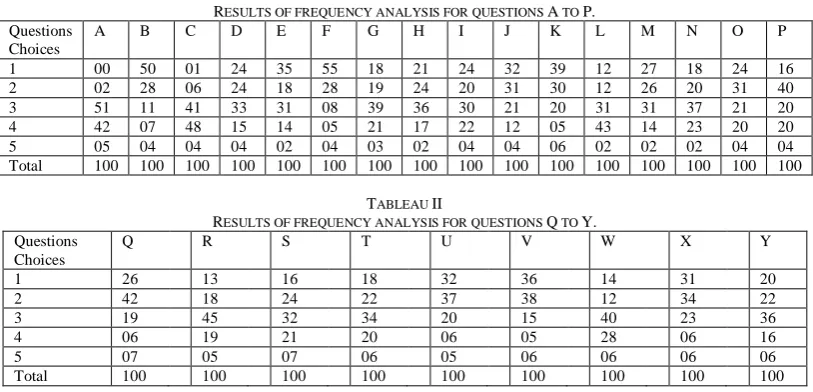
The analysis of the frequency of occurrence of the responses to the questionnaire gave the results presented in the frequency tables I and II. In these tables the letters A to P represent respectively questions from 2a to 2p. The letters from Q to Y represent respectively questions from 3a to 3i. For each choice the respondent had to select the number (1, 2, 3, or 4) corresponding to his choice (1= Totally disagree, 2= Disagree, 3= Agree, 4= Totally agree). During the analysis I admitted that the choices 1 and 2 mean that the respondent does not agree, while the choices 3 and 4 mean that the respondent agrees. (1 and 2= Disagree, 3 and 4= Agree, 5= Non response)
TABLE I
RESULTS OF FREQUENCY ANALYSIS FOR QUESTIONS A TO P. Questions
Choices
A B C D E F G H I J K L M N O P
1 00 50 01 24 35 55 18 21 24 32 39 12 27 18 24 16
2 02 28 06 24 18 28 19 24 20 31 30 12 26 20 31 40
3 51 11 41 33 31 08 39 36 30 21 20 31 31 37 21 20
4 42 07 48 15 14 05 21 17 22 12 05 43 14 23 20 20
5 05 04 04 04 02 04 03 02 04 04 06 02 02 02 04 04
Total 100 100 100 100 100 100 100 100 100 100 100 100 100 100 100 100
TABLEAU II
RESULTS OF FREQUENCY ANALYSIS FOR QUESTIONS Q TO Y. Questions
Choices
Q R S T U V W X Y
1 26 13 16 18 32 36 14 31 20
2 42 18 24 22 37 38 12 34 22
3 19 45 32 34 20 15 40 23 36
4 06 19 21 20 06 05 28 06 16
5 07 05 07 06 05 06 06 06 06
Total 100 100 100 100 100 100 100 100 100
Table I shows that 93% of the respondents recognize that the activities used in their classroom are suggested by their teacher, 89% sustain the use of activities suggested in their imposed text-books while 78% assert that they do not work on activities based on materials provided by the students. This indicates that the students are not involved in the choice of the materials used for classroom activities. 48% of the respondents share the view that they are not involved in research activities outside the classroom while 48% sustain the contrary. There is a balance between the two views. 53% of the respondents affirm that they do not participate in debates and discussions based on themes suggested by their teacher while 45% think the contrary. 83% of the respondents agree that they do not participate in debates and discussions based on themes suggested by the students while 13% sustain the contrary. The remark is that a significant percentage of the students complain about their participation in debates and discussions in general, and particularly the ones based on themes suggested by the students. 60% of the respondents recognize that they participate in activities which allow their personal involvement while 37% sustain the contrary. This indicates that a significant percentage of the students are not satisfied with their personal involvement in the activities. 53% of the respondents say that the activities suggested require collaboration between the students while 45% assert the contrary. This indicates that an important number of the students would like to have more opportunities to collaborate with the other students. 52% of the respondents share the view that the needs of their class in English are taken into account during classroom activities while 63% complain that their personal needs are ignored. This seems to suggest that the students expect classroom activities to take account of their needs in English. 69% of the respondents complain about the lack of opportunities for the students to provide feedback in plenary. This indicates that the students are not trained to stand before an audience in order to present, explain and sustain their ideas. 74%, 45%, 60% and 41% of the respondents declare respectively that they do activities in Reading, Listening, Writing and Speaking. One can see that none of the four main language skills is ignored even though there is more stress on Reading and writing to the detriment of Listening and Speaking. Moreover, the fact that 56% of the respondents indicate that they do not work on activities which integrate the four main language skills is some evidence that the language skills are often addressed in an isolated way.
respondents sustain that they cannot use English to intervene during seminars and colloquia. 63% assert that they are not able to produce texts in English. These results corroborate the ones from table I concerning questions E, F, K, M, N, O and P. 64% of the respondents affirm that they cannot communicate in English through writing. This is in harmony with the result in tableau I concerning question N. 53% sustain that they are not able to attend classes in English while 39% recognize the contrary. 54% of the respondents affirm that they are able to listen and take notes in English while 40% sustain the contrary. These last two results show that though a significant percentage of the students express their satisfaction, there is still something left to be done. 68% of the respondents assert that they are able to read and understand written texts in English. This corroborates the result in table I concerning question L. 52% sustain that they can use English to do research. The former result explains the latter. 65% of the respondents recognize that they are not able to produce texts in English. This result is a bit surprising for 60% declare that they do writing activities during classroom sessions.
The results of the qualitative analysis of the content of the section of the questionnaire devoted to the students’ suggestions come under three different categories. The first concerns the didactic practices. At this stage, the students suggest intensive learning of English, feedback in plenary, more listening and speaking activities, the organization of debates and discussions, the use of a variety of teaching aids (CD, OHP, etc.), the organization of presentation sessions in plenary, constant evaluation and self-evaluation, the use of a variety of activities together with the ones in the imposed text-book, the organization of activities which involve them in doing research outside the classroom, and the opportunity to do a lot of practice exercises. The second category is concerned with pedagogical relation. At this level, the students suggest pedagogical innovations through the organization of workshops and group activities, making choices corresponding to their needs in English so that every student will have a chance to participate actively in classroom activities while collaborating with the others. The third category of suggestions relates to the creation of English clubs and English libraries in the faculty, linguistic immersion, the organization of cultural activities in English, e-learning in English, and an increase of the amount of time allotted to English.
The content analysis of the data from the teachers’ interview calls for the following remarks. The stress in Licence 1 is on speaking and listening even though there is no adequate material for the latter. The students are invited to do vocabulary (definition and explanation of words) and grammar (construction of sentences) activities and language function exercises (e.g. introductions, telephoning, arrangements, etc.) in their text-book, which includes topics relating to economics and management. In Licence 2 the emphasis is on listening, reading and writing. Classroom activities are essentially concerned with “Correspondence writing (Business letters, Memorandum)”, “Visits and Travels” and “Computer”. In Licence 3 the reading techniques (skimming and scanning) are implemented with some relatively short texts. The students have to do research activities on vocabulary before reacting to some questions relating to the text. Moreover, they are sometimes involved in debates and discussions in their different groups. For the teachers interviewed, this training does not allow their students to use EMI. They think that their students enter university with serious limitations in the four main language skills (Speaking, writing, listening, and reading) and the micro-skills (Vocabulary, grammar, spelling, and pronunciation). Their suggestions for the improvement of the situation stand in three main points: Updating the syllabus in use, increasing the amount of time allotted to English, and improving the material conditions.
IV. DISCUSSIONS AND CONCLUSIONS
The investigation involving the students reveals two facts. On the one hand, the majority of the students are unable to use English for oral communication, to participate in debates and discussions, intervene during colloquia and seminars, and produce written texts. Most of them complain about the lack of collaboration between the students themselves during classroom activities, the ignorance of their needs, the absence of debates and discussions and feedback (in plenary) sessions, added to the fact that very often the activities do not take account of their needs in English. It is then clear that the weaknesses mentioned earlier are caused by the limitations of the training provided. On the other hand, one can see that even though they do represent the majority, a significant number of the students recognize that they are unable to use English to communicate through writing, attend classes, listen and take notes, read and understand written texts, and do research in English. This corroborates the fact that a significant number of the students complain about the activities in listening, writing, speaking, and the lack of activities which integrate the four main language skills. Moreover, the majority of the students indicates that the activities used are either suggested by their teacher or imposed in the text-books while an important number recognize that they do not work on activities which involve them in doing research outside the classroom. This might explain their complaint concerning their personal involvement in classroom activities. The results of the qualitative analysis of the suggestions made by the students provide evidence about the relevance of the realities revealed and show the extent to which the students expect the improvement of their training in English.
These conclusions indicate that the teaching practices in use in the faculty have some limitations as regard the current idea of training the students to use EMI. This situation calls for reflection on innovative practices which might allow the students to acquire the language skills indispensable for such an endeavor. In this perspective, I draw from the conclusions of this research, my theoretical knowledge in language didactics and my personal experience as a teacher of English as a foreign language to make some suggestions.
V. ENGLISH AS A MEDIUM OF INSTRUCTION:DIDACTIC TREATMENT A. Triangulation of Situations
A didactic situation is a situation which allows the teaching of some given knowledge to another person. It consists in guiding learners in their act of appropriation of knowledge. Didactic situation provides them with the methodological means to construct their own knowledge (Valenzuela, 2010, p.73). Therefore, the success of learning largely depends on the way the learner is placed in a situation which allows him to exercise his responsibility on learning. However, the problem is to know how to place learners in a suitable situation and if, in our case, didactic situation is sufficient.
Didactic situation suggests the existence of a didactic triangle whose summits represent respectively content, teacher, and learner. Each side of the triangle represents a relation. Pedagogical relation corresponds to the side teacher-learner, curricular relation corresponds to the side teacher-content, and didactic relation corresponds to the side learner-content. The stress in modern approaches to teaching and learning is on the last relation. Didactic relation suggests involving learners in acting on content in order to first construct knowledge before appropriating it. This entails appropriate working conditions (suitable teaching materials and learning activities, appropriate equipment, more opportunities to use the language, etc.); the ones which offer them more chance to operate. Unfortunately, the practical conditions in our context contrast with these requirements. What does one do to improve didactic relation in our classrooms despite this uncomfortable situation? The best approach is, in my view, triangulation of situations. This consists of a complementary use of situations (didactic, a-didactic and non didactic) during which the last two (a-didactic and non didactic situations) will add to the didactic situations implemented in the classroom. The stress in a-didactic situations is on the relation between learner and his environment. The intention of teaching is not explicit as regard learners; it is hidden to them. They have to take a certain number of decisions concerning learning. Carrying out projects in the framework of experiential learning, for example, is a context of implementation of a-didactic situations. At this level, the act of learning occurs in the learners’ environment and involves their responsibility. In his explanation of teacher’s role in a-didactic situations Brousseau11 refers to devolution which corresponds to the act through which the teacher has his learners accept responsibility of a learning situation. In non didactic situations there is no intention of learning. Nevertheless, the learners might be led to take advantage of this type of situation to train. Encouraging the learners to listen to English in a variety of situations outside the classroom, for example, is an additional source of instruction which adds to didactic situations. It is a voluntary activity which allows them to share their experiences with the others in terms of linguistic and cultural appropriation.
Triangulation of situations is a powerful tool for intensive learning of English. It involves the learners in autonomous activities and interaction with the others for more or less important periods of time in an environment which allows the development and reinforcement of the different language skills (Listening, reading, speaking and writing). One way of implementing triangulation of situations in our context is to first encourage our students to collect personal data (Listening passages, written texts, etc.) and then exploit it personally (autonomous learning) before sharing its content with the members of their group (Intra-group exchange). This first phase allows the students to learn outside the classroom while listening and reading in English, and using English for oral expression and writing. The second phase which takes place in the classroom involves each group in sharing what they have done with the other groups (Inter -group exchange) before presentation in plenary (exchange in plenary). The learners have another opportunity to use English to express themselves orally (debates and discussions in plenary) and in writing (texts production on an important aspect of the debates).
B. Survival Strategic Skills
With the advent of learner-centeredness and learning-centeredness, more attention is given to strategic training. The aim is to allow learners’ familiarity with different learning strategies so that they will be able to assume more responsibility in learning. Learning strategies, according to O’Malley and Chamot (1990), come under three main categories: Cognitive strategies (coping with language in conscious ways), meta-cognitive strategies (thinking of one’s own learning and taking control of learning process), and social strategies (learning through interaction with others). For strategic training, Wenden (1991) suggests the use of classroom activities which involve knowledge on the use of strategies and learning process and autonomous use of strategies and knowledge (p.163). The idea is that learners, even motivated, cannot achieve unless they use appropriate strategies. Therefore, the relevance of strategic training clearly stands out. Strategic training can be either explicit or through an integration of strategies to learning activities. It is implemented according to three different approaches: explicit or direct training, integrated approach, and a combination of the first two.
11
Strategic training might be an asset in our context where the working conditions call for more self-reliance on the part of the students. Training them to appropriate survival strategic skills might allow them to make more use of their potentialities in the learning process. Survival strategic training includes three complementary aspects: Strategy awareness, strategy generating, and strategy integrating. Strategy awareness consists in involving our students in activities whose contents and internal organizations might cause their awareness of the strategies that have helped them achieve. By the end of such activities, individual learners are expected to share these strategies with the whole class. It is true that some students might fail to find the right words to describe them. Equally true is the fact that others might not have a clear-cut idea of the strategies they have used. The teacher’s task is to help them externalize their strategies through the use of some adapted strategic questions. Strategy generating will involve the teacher in exposing the learners to activities which might allow them to generate some strategies that will then be labeled and categorized. Strategy integrating consists in having the students complete some tasks which require the use of some identified strategies so that by the end of the tasks he/she will receive feedback on their successful integration.
C. Multi-dimensional Differentiated Approach to Instruction
Individual differences are a reality in all classrooms and particularly in large classes. The presence of learners with different characteristics (cognitive styles, knowledge, learning styles, etc.) requires an identification and knowledge of those differences so that didactic choices will be made accordingly. Unfortunately, the number of learners in most classrooms makes any intention of individualized instruction (choosing material and designing course for individual learner in the classroom) unrealistic. The question then is to know how to take account of individual differences while all learners in a classroom have to work on the same content. Reflections made by such authors as Gregory and Kuzmich (2004), and Boyd-Batstone (2006) suggest differentiated instruction, an approach which consists in adjusting teaching and learning through a variety of materials and learning modes so that all learners with heterogeneous needs and common goals can be reached. The use of diverse activities, they think, increases the chances of integration of preferences, interests and needs. This approach draws from Vygotski’s socio-constructivist theory which posits that the promotion of interaction and mediation cannot be effective unless the material used integrates individual learner’s needs and interests.
At the UFR-SEG every tutorial group consists of about 60 students. It is clear that the approach of differentiated instruction is a didactic tool which can facilitate the learning process. Such a socio-constructivist perspective might allow more involvement on the part of our students who would work in an environment of collaboration, exchange and reciprocal learning (among the members of the classroom). The conclusions of the investigation concerning the students showed some weaknesses relating to their involvement in classroom activities, the choice of materials, the integration of their needs and interests, and that of the main language skills. The use of differentiated instruction might help compensate for such deficiencies and be a source of motivation for the students who might take advantage of this environment to improve the quality of their training. However, for more involvement of our students in learning I suggest a multi-dimensional approach to differentiation. This approach might include democratic pedagogical, individualized pedagogical and critical curricular relations. Democratic pedagogical relations refer to setting the field for all individual students to feel indispensable to the whole class and eager to contribute to all classroom activities. Individualized pedagogical relations relate to the teacher’s personal knowledge of all individual students and his/her effort to integrate their expectations into learning activities. Though this sounds unrealistic in our large classes, I feel that the students’ responses to some questionnaires might allow the teacher to have some instructive information concerning individual students. Critical curricular relations might involve the teacher in constantly questioning the content his/her students have to work on so that the chances of integration of the individual needs, preferences and interests of his/her students might be increased.
D. Implications of the Conclusions and Suggestions for Training in Ivorian Universities
Before entering university all our students had at least seven (07) years of training in English in secondary schools. At university they receive some training in English in their different faculties and departments. The practical conditions and the resources (human and materials) are more or less the same. The sole differences reside in the students’ specializations which vary according to the faculties and the departments they belong to. Though this specialization requires training the students in English for Specific Purposes (ESP), this does not fundamentally influence the set objectives in terms of training for the use of EMI. Each student’s domain of specialization is integrated to the global training in English.
Taken separately my three suggestions might provide an undeniable contribution to a successful training the students in our universities. Nevertheless, for more effective training an integrated use of these suggestions might add to the achievement. No matter the approach used for implementation the following threefold consideration deserves attention: Teachers’ adhesion to the suggested innovative didactic treatment, their willingness to effectively use the new treatment, and their effort to fully integrate it as a positive response to their ambition to train their students to use EMI.
The situation in our local universities is not fundamentally different from that of most Sub-Saharan African universities. I therefore think that the higher education institutions in this region of the continent where EMI is applicable might draw from the conclusions of this study and the suggestions made for more effective training of their students.
E. The Gap between Ambition and Reality: The Task before Us
By the end of this reflection I do not pretend to have filled the gap between my ambitious suggestions and the realities in our context mentioned earlier in this paper. This gap, I feel, still remains the task before us. However, my suggestions might help reduce it provided that one draw from the worries deriving from their implementation to make the necessary adjustments.
The current appraisal of EMI worldwide and the needs of many educational institutions including ours make EMI a fertile soil that researchers in the field of applied linguistics and language didactics are invited to till. The uncomfortable conditions in the different contexts including ours should not be a pretext to encourage pessimistic views but rather a catalyst for the mobilization of the ‘intellectual energy’ which might help all the stakeholders (researchers and practitioners) in their quest for better ideas for a successful implementation of EMI.
VI. CONCLUSION
The aim of this study was to show how in our current context the students of the UFR-SEG can be trained to use English not only for oral communication and writing but also to attend classes, listen and take notes, participate in debates and discussions, intervene in colloquia and seminars, read and understand written texts, produce texts, and do research. The main question was as follows: Given the difficulties relating to the mobilization of human and material resources for a successful implementation of the idea of full year intensive training in English and taking account of the teaching practices in use in all our faculties in terms of English as a foreign language, what didactic choices can allow the much needed training in our current context? The study which had a constructivist and socio-constructivist perspective was based on an investigation involving the teachers and the students of the UFR-SEG. The results obtained from the analysis of the data collected through a questionnaire and an interview guide allowed me to conclude that the majority of the students are unable to use EMI. My suggestions to improve the situation stand in three main points: triangulation of learning situations (didactic, a-didactic and non didactic situations), use of a multi-dimensional differentiated approach, and instruction based on learning strategies. Other studies might focus on the implementation of my suggestions. This might on the one hand allow more insight into the contribution of these suggestions to the improvement of the students’ training, and help provide innovative ideas in light of the limitations revealed, on the other hand.
APPENDIX. QUESTIONNAIRE FOR THE STUDENTS
The aim of this questionnaire is to collect data on the teaching practices and the learning activities in your faculty. I would be grateful to you for your sincere responses which will only be used for a study.
1. Teaching material(s) in use. (Please, circle the letter corresponding to your choice) a. Text-book(s).
b. Other materials and teaching aids in use. (Please, list them in the space provided).
……… ……….
………. ………. (For questions 2 and 3, circle the letter corresponding to your choice)
1 corresponds to ‘Totally disagree’ 2 corresponds to ‘Disagree’ 3 corresponds to ‘Agree’ 4 corresponds to ’Totally agree’
2. During our training in English in Licence 1, Licence 2 and Licence 3 our teacher had us do the following activities: a. activities based on materials (texts, documents, etc.) suggested by himself. 1 2 3 4
m. activities based on listening for comprehension (Listening). 1 2 3 4 n. activities based on text production (Writing). 1 2 3 4 o. activities based on oral practice (Speaking). 1 2 3 4 p. activities which integrate the four main language skills
(Reading, Listening, Writing, Speaking). 1 2 3 4 q. Others (Please, list them in the space provided)
………...1 2 3 4 ………...1 2 3 4 3. My training in English allows me to:
a. communicate orally. 1 2 3 4 b. write texts. 1 2 3 4 c. follow classes in English. 1 2 3 4 d. listen and take notes. 1 2 3 4 e. participate in debates and discussions. 1 2 3 4 f. intervene in colloquia and seminars. 1 2 3 4 g. read and understand written texts. 1 2 3 4 h. produce texts. 1 2 3 4 i. do research. 1 2 3 4 j. Others (Please, list them in the space provided) 1 2 3 4 ………... 1 2 3 4 ………... 1 2 3 4 ………... 1 2 3 4
4. What kind of activities would you like your teacher to use for your training so that you will be able to use English as a medium of communication and instruction? (Please, write your suggestions in the space provided)
……… ……… ……… ……… ……… ……… ………
REFERENCES
[1] Bovellan, E. (2014). Teachers’ Beliefs about Learning and Language as Reflected in their Views of teaching Materials for Content and Language Integrated Learning (CLIL). Humanities 231. Jyvaskyla Studies. ISBN: 978-951-39-5809-1.
https://jgx.fi/dspace/bitstream/handle/123456789/44277/978-951-39-5809-1_vaitos20092014.pdf?sequence=1 (accessed
18/08/2015).
[2] Boyd-Batstone, P. (2006). Differentiated Early Literacy for English Language Learners: Practical strategies. Boston, MA: Pearson, Allyn and Bacon. ISBN: 0205418066.
[3] Dearden, J. (2014). English as a Medium of Instruction-A growing global phenomenon. The British Council. ISBN: 978-0-86355-76-13. http://esol.britishcouncil.org (accessed 18/08/ 2015).
[4] El-Fiki, H.A. (2012). Teaching English as a foreign language and using English as a medium of instruction in Egypt: Teachers’
perceptions of teaching approaches and sources of change. PhD Thesis, University of Toronto.
http://tspace.library.utoronto.ca/bitstrem/1807/32705/3/El_Fiki_Hana_A_201206_phD_thesis.pdf1654-2029 (accessed
18/08/2015).
[5] Gregory, G. and Kuzmich, L. (2004). Data Driven Differentiation in the Standards-based Classroom. London: SAGE
PUBLICATIONS. ISBN-10: 148-148333-2499.
[6] Harrop, E. (2012). Content and language integrated learning (CLIL): Limitations and possibilities. Encuentro 21, 57-70. ISSN: 1989-0796. www.encuentrojournal.org/textos/7.Harrop.pdf (accessed 18/08/2015).
[7] Hengsadeekul, C., Hengsadeekul, C., Koul, R., & Kaewkuekool, S. (2010). English as a medium of instruction in Thai Universities: A review of literature. Selected Topics in Education and Educational Technology, 89-94. ISSN: 1792-50-61. www.wseas.us/e-library/conferences/2010/Japan/EDU/EDU-12.pdf (accessed 18/08/2015).
[8] Houssaye, J. (2012). La gestion pédagogiques entre les élèves: Variations françaises. Carrefours de l’éducation, Armand Collin 2.34, 227-245, DOI: 10.3917/cdle.034.0227. http://www.cairn.info/revue-carrefours-de-l-education-2012-2-page-227.htm (accessed 17/08/2015).
[9] Kagwesage, A.M. (2013). Coping with learning through a foreign language in Higher education in Rwanda. Linköping Studies
in Behavioural Science 173.1, 1-97. ISSN: 1654-2029. www.diva-portal.org/smash/get/diva2:612253/FULLTEXT01.pdf (accessed 18/08/2015).
[10] Meirieu, P. (1991). Le choix d’éduquer: Ethique et pédagogie. Paris: ESF éditeur, Issy-les-Moulineaux cedex. ISBN-13:
978-2710113804.
[11] O’Malley, J.M. and Chamot, A.U. (1990). Learning Strategies in Second Language Acquisition. Cambridge: CUP. ISBN:
[12] Pozo, M.A and Estebanez, D.R. (2015). Textbooks for content and language integrated learning: Policy, market and appropriate
didactics. Foro de Educacion 13.18, 123-141. ISSN: 1698-7802.
<forodeeducacion.com/ojs/index.php/article/viewFile/353/284> (accessed 18/08/2015).
[13] Richards, J.C. and Rodgers, T.S. (2001). Approaches and Methods in Language Teaching. Second Edition. Cambridge: CUP, ISBN: 9780521008433.
[14] Skehan, P. (1989). Individual Differences in Second-Language Learning. London, New York, Melbourne, and Auckland: Edward Arnold. ISBN: 0-7131-6602-9.
[15] Valenzuela, O. (2010). La didactique des langues étrangères et les processus d’enseignement/apprentissage. Synergies Chili 6, 71-86. ISSN: 2260-6017. <gerflint/base/chili6/Oscar_valenzuela.pdf> (accessed 18/08/2015).
[16] Wenden, A. (1991). Learner Strategies for Learner Autonomy: Planning and implementing learner training for language learners. London, UK: Prentice Hall International. ISBN-13: 978-0135296035.
Jérôme Kouassi, Born in Katiola (Côte-d’Ivoire), November 14, 1955. BA in English language, English and American studies, Université Félix Houphouët-Boigny, Cocody-Abidjan, Côte-d’Ivoire, 1987; English Language Teaching Certificate (CAPES), Teacher Training School (ENS), Abidjan, Côte-d’Ivoire, 1989; Master in Foreign Language Didactics, Université Félix Houphouët-Boigny, Cocody-Abidjan, Côte-d’Ivoire, 1991; Doctorate in Foreign Language Didactics (Teaching English in Large Classes), Université Félix Houphouët-Boigny, Cocody-Abidjan, Côte-d’Ivoire, 1996; Doctorate in Foreign Language Didactics (Implementing the Philosophy of Education for Democracy in the Language Classroom), Université Félix Houphouët-Boigny, Cocody-Abidjan, Côte-d’Ivoire, 2009; Visiting scholar at the University of Massachusetts (School of Education), Ahrmerst, USA, 1991; PhD short term course at Leeds University, Leeds, UK, 1993; Visiting scholar at the New school University, New York, USA, 1998. Major field of study: Applied Linguistics and Foreign Language Didactics.
He worked as a primary school teacher from 1977 to 1980, a secondary school English language teacher from 1983 to 1996, a university teacher from 1997 to 2015, deputy head of department from 2001 to 2012, responsible for the English Language Unit from 2006 to 2012. He is currently Senior Lecturer in Applied Linguistics and Language Didactics at the Université Félix Houphouët-Boigny, Cocody-Abidjan, Côte-d’Ivoire and responsible for the Applied Linguistics and language Didactics Unit. He published a book entitled ‘Evaluation et didactique de l’anglais langue étrangère: les fondements d’une inévitable union’, Chicoutimi, Québec, Les Classiques des Sciences Sociales, University of Québec, 2010, http://bibliotheque.ucac.ca/; an article entitled ‘Didactic treatment of education for sustainability in the context of ESP’, Volgograd, Russia, Conference on ‘Changing Communication in the Changing World’: collection of articles, Publishing House of Volgograd branch of RANEPA, 2015, ISBN 978-5-7786-0556-5; an article entitled ‘Symbolism and reading comprehension in English as a foreign language: The case of water symbolism in Negro-African literature’, Lomé, Togo, Particip’Action, 2012, ISSSN: 2071-1964. His research interests include Language learning in Large Classes, ESP, English as a Medium of Instruction, and Competency-Based language teaching (CBLT).