Research Article
a
November
2018
Computer Science and Software Engineering
ISSN: 2277-128X (Volume-8, Issue-11)
Intercell Interference Mitigation Techniques in Downlink
LTE-A Network
Aamir Nazir Beigh M-Tech, SSCET
India
Arjimand Ashraf M-Tech, SRM University
India
Prabhjot Kaur Assistant Professor, SSCET
India
Abstract—The cellular TDMA system can be structured as for all intents and purposes, interference free by arranging the frequency-reuse distance, which makes a similar frequency channels reused adequately far separated. With the end goal to keep up an adequate frequency-reuse distance, any cell site inside a similar group can't utilize a similar frequency direct in the TDMA cellular system. In the interim, the cellular CDMA system is likewise essentially sans interference because of its interference-averaging ability with a wide spreading bandwidth. For whatever length of time that its spreading factor is adequately vast, the cellular CDMA system can be powerful against co-channel interference, notwithstanding when a similar frequency channels are doled out to all neighbour cell locales, that is, frequencies are completely reused. Not at all like the cellular CDMA system which has the interference-vigorous capacity, the OFDMA based cellular system experiences cell interference at the cell limit, particularly when all frequency channels are completely reused. In this paper we discussed the main intercell interference mitigation techniques to overcome the issues of signal losses due to statistical degradations of the channel. We presented coordinated, non-coordinated and DCBS schemes of intercell interference mitigation through approach of maintaining orthogonality between the adjacent symbols. The results verify that DCBS scheme proves better than the other mentioned schemes
Keywords— CoMP, Non- CoMP, DCBS, OFDMA, ICI
I. INTRODUCTION
Wireless communication is developing step by step because of which new technologies emerge, the interest for network applications extended and the demand for services has additionally been expanded. By the improvement of innovation notwithstanding data service market, it is vital for the forthcoming cellular system to convey higher and higher data access ability to the users along with improved Quality of Service (QoS). Former Generations of Wireless Cellular Communication services could not take care of the demand of client that solicits for wide bandwidth and high-speed applications [19].
The convergence among mobile and data access services has started an expansion in the demand for wireless high-speed data. The accessibility of moderate note books, tablet computers, smart phones and so forth. And in addition an extensive variety of services including web browsing, streaming and interactive file transfer has brought about a huge development in the mobile traffic as of late [4]. This development is proceeding with quickly to such an extent that a common supporter is normal to consume 1 gb of data for every month while the present normal figure is around a few hundred mbs for each month.
ISSN(E): 2277-128X, ISSN(P): 2277-6451, pp. 28-34
LTE CoMP or Coordinated Multipoint is a technique that is being produced for LTE Advanced - a considerable lot of the facilities are still being worked on and may change as the standards characterize the distinctive components of CoMP more particularly [20].LTE Coordinated Multipoint is basically a scope of various methods that empower the dynamic coordination of transmission and reception over a wide range of base stations. The point is to enhance by and large quality for the client and in addition enhancing the use of the network. [4] Interference in cellular systems is a typical issue that affects higher data delivery and reliable QoS. To diminish such performance limiting interference, multicell coordination and cooperation over transmission is utilized. As of late Coordinated Multi-Point (CoMP) transmission and reception has been considered as a promising technique to either coordinate or employ the interference to enhance the system throughput and the user fairness. It has been incorporated in the 3GPP Long-Term Evolution Advanced (LTE-A) system to enhance cell edge coverage and spectrum efficiency so as to give better QoS [1, 2]. The CoMP performs dynamic coordination among multiple geographically separated transmission nodes and its operations are categorized into coordinated beamforming and scheduling (CB/CS) and joint processing (JP) [1]. For CB/CS, the data are transmitted to single user equipment (UE) from only one BS, whereas user scheduling and beamforming decisions are coordinated among BSs belonging to the CoMP cluster set. In JP, the data is transmitted simultaneously to a single UE from at least two BSs in the cooperating set by spatial multiplexing. Since in JP at least two BSs coordinately transmit signals, the signal quality at the UE is enhanced significantly to the detriment of radio asset [2]. The JP operation is all the more challenging one, since it employs the abundant spatial assets given by the cooperating BSs, where data, channel state information (CSI), scheduling decisions, and precoding vectors should be shared among BS [3] through central units (CU). In contrast, CB/CS diminishes interference by using individual precoding at each BS where only CSI is shared [4]. Since CSI sharing requires a much lower spectrum than sharing data [4], CB/CS needs much lower backhaul (BH) capacity than JP.
Basically, LTE Advanced CoMP turns the inter-cell interference, ICI, into helpful signal, particularly at the cell edges where performance might be corrupted. Throughout the years the importance of Inter-Cell Interference has been perceived, and different methods utilized from the times of GSM to mitigate its effects [20]. Anyway as technology has advanced, significantly more tightly and more successful techniques for battling and using the interference have picked up support.
The DCBS algorithm dynamically chooses the basic wide assortment of Cooperative BS with the goal that it will reduce the backhaul trouble while safeguarding required QOS for Active clients in coordinating cells. The determination govern is in closed form, which has a particular seeking with the normal channel gains of each client and different gadget Parameters [3].
As indicated by Mr. Raheem [1]Fixed Femtocells and Mobile Femtocells are introduced in LTE-A system to mitigate the interference issues and furthermore to guarantee the better system execution as far as clients' Throughput, SINR, SNR, Spectral Efficiency and Handover execution. Mr. Bertrand proposes a coordination strategy to mitigate the inter-cell interference for cell edge clients. Because of vehicle's fast speed, significant execution marker is spectral efficiency in the coverage area of modern cellular network [2].Muhammad Umair Ghori in [3] centers around synchronization between the Base stations utilizing DCBS. Here, SINR and Capacity of the framework are assessed when coordination is connected between the Cells. Three distinct circumstances; Coordinated Multipoint Transmission and Reception (COMP), Non-COMP and DCBS have been compared.
II. SYSTEM MODEL
The simulation parameters as shown in the table have been simulated using MATLAB;
A. Non-CoMP
In first situation, the clients are served from single cell, as the clients are served from a solitary cell so there will be no interference and the SINR is processed from the following equation;
Where Pds (t) = Power received by serving BS, Pnoise (t) = Power of AWGN, Piui (t) = Power of Orthogonal Frequency (Intracell Interference), Pici(t) = Power of Inter cell interference.
If there should arise an occurrence of single cell, there will be no neighboring cells so there will be no Intercell interference and furthermore there will be no intracell interference, so the main thing which will influence the signal is noise known as white Gaussian noise, so the equation of SINR for solitary cell is given as;
ISSN(E): 2277-128X, ISSN(P): 2277-6451, pp. 28-34 Table 1. Parameters used in Matlab
Carrier Frequency 2Ghz Layout of Cell Hexagonal
TTI 1ms
Received Figure noise 8db BS to BS distance 3km
Nr 2
Nb 2
Number of users 4 Number of cells 15
Environment Shadowing, Path Loss Path Loss 35.7+38log(d) UE Antenna Gain 0dbi
Bandwidth 10Mhz Backhaul Capacity 10b/s/Hz
B. CoMP
In second situation, the users are served from multiple eNBs (base stations) and there is coordination among the eNBs (base stations) utilizing COMP , so for this situation there will be interference from neighboring eNBs (base stations) as users are served from in excess of one eNB (base station). Along these lines, the signal is influenced by Intercell interference, the factor PIUI is zero since OFDMA is employed, so the equation of SINR in this situation is as per the following;
C. DCBS
In third situation, the users are again served from multiple eNBs (base stations) and in this case, there is coordination among the eNBs (base stations), so for this situation there will be no interference from neighboring eNBs (base stations) as the coordination is responsible of the decrease of intercell interference. Along these lines, the signal isn't influenced by intercell interference so the factor PICI is zero and in the meantime the factor PIUI is likewise zero since OFDMA is employed, so the expression of SINR in this situation is as ;
D. Capacity Calculation
In all the three situations capacity can be calculated using Shannon’s Capacity Formula; C = BW Log2 (1+SINR UE non-COMP)
C = BW Log2 (1+SINR UE COM) C = BW Log2 (1+SINR UE DCBS)
III. SIMULATION AND RESULTS A. Non-CoMP:
ISSN(E): 2277-128X, ISSN(P): 2277-6451, pp. 28-34
Figure I shows the variation of SINR with the Received power when Non-CoMP technique is employed. As is evident from the graph with increase in AWGN, Pintra and Pinter , the SINR in case of Non-CoMP decreases. So in order to achieve High SINR all the three parameters need to be reduced considerably.
Figure II
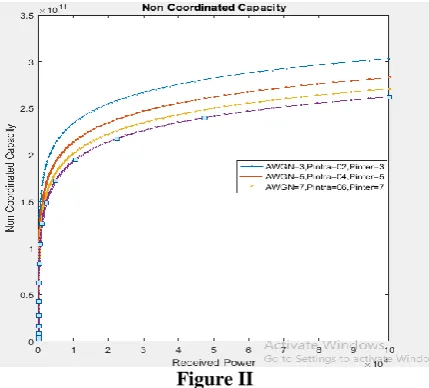
The variation of Capacity against Received power is depicted in the figure II. Capacity in Non-CoMP system decreases with increase in AWGN, Pintra and Pinter.All the three parameters contribute to reduced capacity leading to low spectral efficiency and latency complications.
Figure III
The SINR available at the user end is denoted by SINRUE (SINR user equipment). Contaminated with AWGN and interference from adjacent cells the user receives a distorted signal. Since, intra-cell interference in case of UE is less pronounced because of the orthogonality among the subcarriers that is therefore kept constant.
ISSN(E): 2277-128X, ISSN(P): 2277-6451, pp. 28-34
The Non-Coordinated capacity at the receiver end is reduced as compared to that at the transmitter end due to the channel effects.
Figure V
The non coordinated capacity while considering the case of Channel interference between the BS and UE is maximum when power received by thr UE is zero and then becomes constant for while the signal is being transmitted.
Figure VI
The Non Coordinated SINR varies linearly with change in the power received by the UE.
B. CoMP
ISSN(E): 2277-128X, ISSN(P): 2277-6451, pp. 28-34
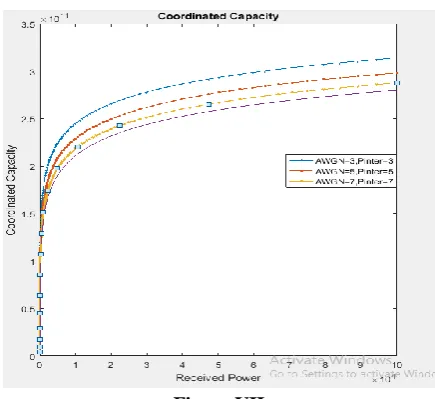
As is evident from figure VII the coordinated capacity is higher in this case as compared to that in the Non-CoMP technique. Same is the case with SINR.
C. DCBS
Figure VIII
DCBS technique shows high capacity and spectral efficiency as compared to other schemes of transmission since the mode selection of BS is done at each TTI (transmit time interval).
IV. CONCLUSIONS
In this paper we qualitatively evaluated the simulation results in Matlab. The results include the schemes for the intercell mitigation like Coordinated, Non-coordinated and DCBS. The results reveals that the DCBS technique out-performs the coordinated and non-coordinated schemes in SINR and capacity improvements..
REFERENCES
[1] Raheem, A., Rand, K., Lasebae, A., Aiash, M., & Loo, J. (2016). Performance evaluation of mobileusers served by fixed and mobile femtocells in LTE networks. Journal of Networking Technology, 7(1),17–23.
[2] Bertrand, K., Deflandre, M., & Yu, C. Y. (2016). Base station coordination towards an effective Intercell interference mitigation. International Journal of Future Generation Communication and Networking, 8(2), 45– 58.
[3] Comparative Analysis of Intercell Interference Mitigation Techniques in LTE-A Network Muhammad Umair Ghori1, Bushra Naeem, Faizullah Khan Kakar.
[4] 4G LTE CoMP, Coordinated Multipoint Tutorial, https://www.radio electronics.com/info/cellulartelecomms/lte-long-term-evolution/4g-lte-advanced-comp-coordinated-multipoint.php
[5] Ijemaru Gerald Kelechi et.al,(2014) “Inter-Cell Interference Mitigation Techniques in a Heterogeneous LTE-Advanced Access Network”.
[6] A. Daeinabi et.al,(2012) “Survey of Intercell Interference Mitigation Techniques in LTE Downlink Networks”. [7] Frederic Lehmann,(2012),”Iterative Mitigation of Intercell Interference inCellular Networks Based on Gaussian
Belief Propagation”.
[8] “MIMO-OFDM Wireless Communications with MATLAB; Intercell Interference Mitigation Techniques” Volume 2, Chapter 8.
[9] Bosisio and U. Spagnolini,(2008),”Interference Coordination vs. Interference Randomization in Multicell 3GPP LTE System”.
[10] MohamedA.AboulHassan,(2015),”Classification and Comparative Analysis of Inter-Cell Interference
Coordination Techniques in LTE Networks”.
[11] Afroz F, Sandrasegaran K, Kim H A. “Interference Management InLte Downlink Networks” International Journal of Wireless and Mobile Networks (IJWMN). 2015; 7(1):91–106.
[12] Novlan TD, Ganti RK, Andrews JG, Ghosh A. “Comparison of Fractional Frequency Reuse Approaches in the OFDMA Cellular Downlink” Conference: Global Telecommunications. 2011 Jan. p. 1–5.
[13] 4G++“Advanced Performance Boosting Techniques in 4th Generation Wireless Systems” Available from:
ISSN(E): 2277-128X, ISSN(P): 2277-6451, pp. 28-34
[14] Kwan R, Leung C. A Survey of Scheduling and Interference Mitigation in LTE Journal of Electrical and Computer Engineering. Journal of Electrical and Computer Engineering.
[15] Selim MM, Khamy ME, Sharkawy ME. “Enhanced Frequency Reuse Schemes for Interference Management in LTE Femtocell Networks” International Symposium on Wireless Communication Systems (ISWCS), Paris. 2012.
[16] M. C. Necker. Interference Coordination in Cellular OFDMA Networks. IEEE Network 22(6):12, December 2008.
[17] S. Shukry, K. Elsayed, A. Elmoghazy, and A.Nassar.” Adaptive Fractional Frequency Reuse (AFFR) scheme for multi-cell” IEEE 802.16 systems. In Proceedings of IEEE HONET, December 2009.
[18] V. Rekha, (2016),”Inter-Cell Interference Mitigation Techniques in Long Term Evolution Networks: A Survey”. [19] Dynamic Cooperative Base Station Selection Scheme for Downlink CoMP in LTE-Advanced
NetworksRamachandran Vijayarani, Lakshmanan Nithyanandan.
[20] Inter-cell Interference Mitigation and Coordinationin CoMP Systems, Norshidah Katiran,et.al UTM-MIMOS CoE Telecommunication Technology.