© 2019 by the Serbian Biological Society How to cite this article: Grbović F, Gajić G, Branković S, Simić Z, Ćirić A, Rakonjac 83 Lj, Pavlović P, Topuzović M. Allelopathic potential of selected woody species
growing on fly-ash deposits. Arch Biol Sci. 2019;71(1):83-94.
Allelopathic potential of selected woody species growing on fly-ash deposits
Filip Grbović1,*, Gordana Gajić3, Snežana Branković1, Zoran Simić2, Andrija Ćirić2, Ljubinko Rakonjac4,
Pavle Pavlović3 and Marina Topuzović1
1University of Kragujevac, Faculty of Science, Department of Biology and Ecology, Radoja Domanovića 12, 34000 Kragujevac, Serbia
2University of Kragujevac, Faculty of Science, Department of Chemistry, Radoja Domanovića 12, 34000 Kragujevac, Serbia 3University of Belgrade, Institute for Biological Research “Siniša Stanković”, Department of Ecology, Bulevar despota Stefana 142, 11060 Belgrade, Serbia
4Institute of Forestry Belgrade, Kneza Višeslava 3, 11030 Belgrade, Serbia
*Corresponding author: [email protected]
Received: August 23, 2018; Revised: October 12, 2018; Accepted: October 17, 2018; Published online: November 7, 2018
Abstract: The objective of this study was to determine the allelopathic potential of Robinia pseudoacacia L., Ailanthus altissima (Mill.) Swingle and Amorpha fruticosa L. that grow on the fly-ash deposits at the “Nikola Tesla – A” thermoelec-tric power plant in Obrenovac. The chemical characteristics of fly ash, such as pH, electhermoelec-trical conductivity (EC), content of carbon (C) and nitrogen (N), contents of available phosphorus (P2O5) and potassium (K2O), the contents of total and available Fe, Cu, Mn, Ni and Zn as well as of phenolic acids (3,5 dihydroxybenzoic acid (3,5-DHBA) and ferulic acid) and flavonoids (rutin and quercetin) were analyzed in control fly ash (bare zones without vegetation cover) and plant rhizo-spheric fly ash. In order to determine the allelopathic activity of phenolic compounds in fly ash, modified soil sandwich allelopathic biotests were performed, and Trifolium pratense L. (red clover) was used as the indicator species. A. fruticosa
showed the highest allelopathic activity, followed by A. altissima whereas R. pseudoacacia showed the lowest allelopathic potential. Negative correlation was noted between radicle and hypocotyl growth inhibition of red clover and the pH of fly ash. Positive correlations were found between radicle growth inhibition and the content of C, P2O5, total concentrations of Cu, available concentrations of Mn and Ni, the contents of ferulic acid, 3,5-DHBA, and rutin. Our results indicate that A. fruticosa and A. altissima increased the content of phenolics in fly ash, which can act as allelochemicals leading to radicle growth inhibition of red clover in the pioneer plant community on fly-ash deposits. These woody species that colonized fly-ash deposits can initiate the beginning of pedogenetic processes altering the ecosystem processes at degraded sites. Keywords: allelopathy; flavonoids; fly ash; invasive plant species; phenolic acids; radicle growth inhibition
INTRODUCTION
Allelopathy presents both inhibitory and stimulatory interactions between plants through the action of secondary plant metabolites – allelochemicals [1,2]. Allelochemicals are often investigated as compounds that potentially allow the invasion of plant species in new habitats due to the lack of adaptive potential of native species to new allelochemicals originating from introduced species [3]. One of the most studied groups of allelochemicals are phenolic compounds, which in plant tissue can be found in soluble form or bound to the cell wall polysaccharides [4,5].
These compounds have a short lifetime and they are susceptible to degradation by microorganisms, so their detection and identification in soil is much more difficult than in plant tissues [10].
Through allelopathic activity, phenolic compounds have significant effects on the structure and composition of plant communities [11,12]. The phenolic compounds may have direct harmful effects due to their release by donor species or can be degraded or transformed by soil microorganisms. Furthermore, these compounds can have an effect on the physical, chemical and bio-logical soil characteristics or can induce the release of biologically active substances in third plant species [13]. Phenolic compounds in the soil can lead to root and hypocotyl growth inhibition, the limitation of water and mineral uptake, and inhibition of photosynthesis and enzymatic activity in acceptor plants [5,14,15].
Blum et al. [16] indicated that the focus in alle-lopathic research should be shifted to the soil system since the phytotoxic activity of allelochemicals is a function of the characteristics of plant allelochemicals and soil [17]. Additionally, adsorption and desorption of allelochemicals in soil is a dynamic process and is influenced by various physicochemical factors, such as soil moisture, pH and organic matter content [18,19]. Furthermore, phenolic compounds represent an im-portant link in the dynamics of mineral and organic compounds in the soil due to their effect on the chemi-cal properties of the soil, availability of certain metals and the microorganism community [5,8,15,20,21].
The process of plant colonization on fly-ash de-posits (revegetation) is very slow due to unfavorable conditions of substrates [22]. The plants growing on the fly-ash deposits are exposed to a combination of several stress factors, such as high temperatures, increased irradiation, drought and elevated concentrations of some metal(loid)s [23-25]. Woody plants that have a large cover and great biomass play a prominent role in the process of fly-ash revegetation. Organic matter originating from these plants is of great importance in the process of soil humus formation, which represents a mixture of various organic compounds among which phenolic compounds are very important.
In the majority of studies, the effect of phenolic compounds on vegetation is emphasized, while their effects on substrate characteristics are not fully addressed
[26]. In this study, we hypothesized that woody plant
species, Robinia pseudoacacia L., Ailanthus altissima
(Mill.) Swingle and Amorpha fruticosa L., show a great
allelopathic potential due to the production of high amounts of phenolics that are released from these plants in fly ash. It is also assumed that these allelochemicals contribute to the increased availability of certain metals, which can additionally lead to inhibition of seedling (radicle and hypocotyl) growth of the indicator plant
species, Trifolium pratense L. (red clover). Therefore, the
objectives of this study were (i) to compare the chemical characteristics of control and rhizospheric fly ash; (ii) to analyze the total and available metal contents (Fe, Cu, Mn, Ni, Zn) in control and rhizospheric fly ash; (iii) to evaluate the contents of phenolic compounds in control and rhizospheric fly ash; (iv) to determine the allelo-pathic potential of the selected woody species through screening of seedling (radicle and hypocotyl) growth inhibition of red clover as an indicator plant species.
MATERIALS AND METHODS
Study area
The study was performed on the fly-ash deposit at the “Nikola Tesla – A” thermoelectric power plant (TENT-A) in Obrenovac (N 44º30‘, E 19º58‘), which is located on the right bank of the Sava River 40 km upstream from Belgrade (Serbia) (Supplementary Fig. S1). The climate is semi-continental with local mean annual rainfall and temperature of 647 mm and 11ºC, respectively. As the largest producer of electricity in Serbia, southeastern Europe and the Balkans, the six blocks of TENT-A with a total power of 1820 MW annually produce about 8 billion kWh of electricity. Annually, TENT-A burns 12-14 Mt of lignite, which is supplied by the Kolubara-Tamnava surface pits. The chemical analysis of electrofilter ash at TENT-A showed that it consists of SiO2 (54.21%), Al2O3 (24.98%), Fe2O3
(6.13%), CaO (5.89%), MgO (3.15%), K2O (1.12%),
Na2O (0.29%), TiO2 (0.69%), P2O5 (0.07%) and SO3
(0.96%) (data obtained from the Vinča Institute for Nuclear Sciences, Belgrade, Serbia).
or 1:20. The disposal of fly ash is carried out in three
lagoons, one is active (L2), and the other two are in a
temporary mode for the technical consolidation of fly
ash and drainage (L1 and L3) (Fig. S1C). To reduce the
negative impact of fly ash on the environment, TENT-A has provided biological recultivation, i.e. the sowing of
legumes (Medicago sativa L., Lotus corniculatus L., Vicia
villosa Roth., Trifolium pratense L.) and grasses (Secale
cereale L., Lolium multiflorum Lam., Festuca rubra L.,
Dactylisglomerata L.), as well as planting of trees (
Rob-inia pseudoacacia L., Ailanthus altissima (Mill.) Swingle)
and shrubs (Tamarix sp.). The established herbaceous
and woody vegetation cover on fly-ash deposits over time promote natural succession and revegetation. In
the flat part of L1, some spontaneous herbaceous plant
species, shrubs and trees were noted: Calamagrostis
epigejos L., Oenothera biennis L., Sorghum halepense (L.)
Pers., Erigeron canadensis L.and Amorpha fruticosa L.
Sampling of fly ash
The field research into fly-ash deposits on L1 was carried
out during August 2016. The fly ash was collected at a depth of 0-30 cm on bare zones without vegetation
cover represented control fly ash (CFA), whereas the
fly ash taken up in the root zone of R. pseudoacacia,
A. altissima and A. fruticosa was marked as plant
rhi-zospheric fly ash (RPFA, AAFA, and AFFA, respectively).
Fly-ash samples were collected in the range of 5-10
m from the embankment of L1. Collected fly ash was
packed into plastic bags and brought to the laboratory for analysis. After the removal of visible plant remains, samples were dried at room temperature (25ºC) and sifted through a sieve (0.5 mm mesh). For chemical, elemental and biochemical analyses, five composite samples of fly ash were used (n=5).
Chemical analysis of fly ash
Fly-ash pH was measured in water (pHH2O) and 0.1 M
KCl solution (pHKCl) with a pH meter (PHT-026
Multi-function meter). Electrical conductivity (EC[dSm-1]
in the extract (fly ash:water=1:5) was measured with a conductometer (PHT-026 Multi-function meter). Organic carbon (C) was measured by the method of Tyurin [27], and the total nitrogen content (N) was determined by Kjeldahl digestion [28]. The C/N ratio
was calculated. Available forms of phosphorus (P2O5)
and potassium (K2O) were analyzed using the standard
AL-method [29].
Elemental analysis of fly ash
Total concentrations of chemical elements (Cu, Fe, Mn, Ni, Zn) in fly ash were determined according to the modified method 3051A (EPA SW-846 test methods) [30] as follows: 2-3 g of fly-ash sample were oven-dried for 1 h at 105ºC. The sample was dissolved
in a mixture of 25 mL of HNO3 and HClO4 for 12 h at
40ºC. Concentrations of available chemical elements in the fly ash were determined according to Zemberyova et al. [31]. Extraction was performed with 0.05 mol/
dm3 EDTA at pH 7. The sample of dried fly ash (2-3
g) was added in 25 mL of 0.05 M EDTA and mixed on a magnetic stirrer for 1 h at room temperature (20±4ºC). Flam atomic absorption spectrophotometer (FAAS, “Perkin Elmer 3300”) was used for analyzing the concentrations of chemical elements. Standard solutions were used for the preparation of calibrated diagrams. The range of concentrations of test elements
of the standard solutions was 0.5-2.0 mg/dm3 for Cu,
Zn and Ni, and 1.0-5.0 mg/dm3 for Mn and Fe. The
measured values of the element contents in fly ash are expressed in µg/g dry matter.
Determination of phenolic acids and flavonoids by HPLC
Phenolic acids and flavonoids were extracted by dis-solving 10 g of dry fly ash in 30 mL of pure methanol (99.8%) in an ultrasonic bath for 15 min and then left to dissolve another 24 h. Subsequently, samples were centrifugated 20 min at 10000×g and supernatants were filtered through 0.2-μm cellulose filters (Agilent Technologies, Santa Clara, CA, USA) and stored at 4°C until use.
chromatographic data were processed using LC Solu-tion computer software (Shimadzu). Gradient eluSolu-tion was used (5% B 0-5 min, gradient 5-60% B during 5-30 min, 60% B held for 5 min, then ramped from 60% to 90% B for 2-3 min and equilibrated for a further 5 min; mobile phases: A, water acidified with formic acid, pH=3; B, acetonitrile). The identity of compounds was determined by comparing the retention times and absorption maxima of known peaks with pure standards (Sigma) at 290 and 245 nm. Two phenolic acids were used as phenolic acid standards: ferulic and 3,5-dihy-droxybenzoic acid (3,5-DHBA); for identification of flavonoids, two different standards were used: rutin and quercetin. The concentrations of phenolic acids and flavonoids are expressed in μg/g of extracts.
Growth inhibition test
The allelopathic activity of selected plant species grown on fly ash was assessed by a modified “soil sandwich method” [32]. In the experiment, 5 mL of agar (0.5%) cooled to 42ºC were added into a multi-dish (6 dishes) plate containing 3 g of dried fly ash. After solidifica-tion, 3.2 mL of agar (0.5%) was added on a fly ash-agar
layer. After 1 h, 5 seeds of T. pratense L. were added
to the gelled agar culture medium in one dish (30 seeds per multi-dish plate). Control plates contained only agar medium (without fly ash). The multi-dishes were incubated at 25ºC in the dark. After 7 days, the lengths of the radicle and hypocotyl were measured and the percentage of growth inhibition was calculated (compared to control). The bioassays were done in 5 replicates (30 seeds per replicate, n=150).
Statistical analyses
Statistical analyses included determination of the mean (M) and standard deviation (SD) for each of the analyzed parameters. Differences between groups in terms of chemical properties of fly ash, total and available concentrations of chemical elements, content of phenolic acids and flavonoids in fly ash as well as the inhibition of radicle and hypocotyl growth of indicator species, were determined by multivariate variance analysis (MANOVA) and Scheffé’s post-hoc test. Pearson’s correlation coefficients (r) between the allelopathic activity of selected plant species growing on fly ash and the chemical characteristics, total and
available concentrations of elements and content of phenolics in fly ash were determined. Statistical analy-sis was performed using the package Statistica 10.0.
RESULTS
Chemical properties of fly ash
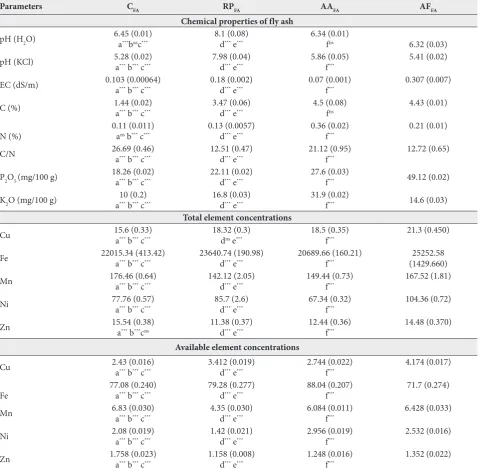
The chemical properties of the control (CFA) and
rhi-zospheric fly ash (RPFA, AAFA, and AFFA) are shown
in Table 1. The results showed that the pH (H2O)
and pH (KCl) in RPFA had higher values than the CFA
(p<0.001), AAFA(p<0.001) and AFFA(p<0.001). EC
values were higher in AFFAcompared to CFA (p<0.001),
RPFA (p<0.001) and AAFA(p<0.001). In comparison to
CFA the results showed statistically significant higher
values of C, N and C/N in RPFA (p<0.01), AAFA(p<0.01)
and AFFA(p<0.01), except for the values of N in the
RPFAand the C/N values in the AAFA. The highest values
of C and N were detected in AAFA. Also, statistically
significantly higher values (p<0.001) for both P2O5
and K2O were detected in all rhizospheric fly ash in
comparison to control fly ash. The highest values of
P2O5 were detected in AAFA, while the highest values
of K2O were detected in the RPFA.
Total and available elements in fly ash
Total and available concentrations of Cu, Fe, Mn, Ni
and Zn in CFA, RPFA, AAFA and AFFA are shown in Table
1. The results showed statistically significantly lower
concentrations of Cu, Fe and Ni in the CFA compared
to all plant rhizospheric fly ash (p<0.001), except for
Fe and Ni in the AAFA. However, statistically
signifi-cantly higher concentrations of both Mn and Zn were
found in the CFA (p<0.001) compared to all other plant
rhizospheric fly ash, except for Zn in the AFFA. In the
control fly ash and all other rhizospheric fly ash,total
metal concentrations decreased in the following order: Fe>Mn>Ni>Cu>Zn.
The available Cu, Fe and Ni concentrations in the
CFA were lower in comparison to all plant rhizospheric
fly ash (p<0.001), except for Fe in the AAFAand Ni in
the RPFA. However, the available concentrations of Mn
and Zn in the CFA were higher versus all the plant
elements in the CFA, RPFA and AFFA showed the same decreasing order: Fe>Mn>Cu>Ni>Zn, whereas the
content of available elements in the AAFA decreased
in a slightly different order: Fe>Mn>Ni>Cu>Zn. Fur-thermore, the percentage of available concentrations of Fe, Mn and Ni in fly ash relative to the total content
of the elements was the highest in the AAFA (0.42%,
4.07%, 4.39%, respectively). The percentage of available Zn in fly ash relative to the total metal content was
the highest in the CFA (11.31%), whereas the highest
percentage of available Cu concentrations was detected
in AFFA(19.6%).
Table 1. Chemical properties (pH; EC – electrical conductivity, dS/m; C – carbon content, %; N – nitrogen content, %; C/N – ratio of
C/N; P2O5 – available concentrations of phosphate, mg/100g; K2O – available concentrations of potassium, mg/100g; total and available
element concentrations, µg/g) in control (CFA) and plant rhizospheric fly ash (RPFA – Robinia pseudoacacia; AAFA – Ailanthus altissima;
AFFA – Amorpha fruticosa).
Parameters CFA RPFA AAFA AFFA
Chemical properties of fly ash
pH (H2O) 6.45 (0.01)a***bnsc*** 8.1 (0.08)d*** e*** 6.34 (0.01)fns 6.32 (0.03)
pH (KCl) 5.28 (0.02)a*** b*** c*** 7.98 (0.04)d*** e*** 5.86 (0.05)f*** 5.41 (0.02)
EC (dS/m) 0.103 (0.00064)a*** b*** c*** 0.18 (0.002)d*** e*** 0.07 (0.001)f*** 0.307 (0.007)
C (%) 1.44 (0.02)a*** b*** c*** 3.47 (0.06)d*** e*** 4.5 (0.08)fns 4.43 (0.01)
N (%) 0.11 (0.011)ans b*** c*** 0.13 (0.0057)d*** e*** 0.36 (0.02)f*** 0.21 (0.01)
C/N 26.69 (0.46)a*** b*** c*** 12.51 (0.47)d*** e*** 21.12 (0.95)f*** 12.72 (0.65)
P2O5 (mg/100 g) 18.26 (0.02)a*** b*** c*** 22.11 (0.02)d*** e*** 27.6 (0.03)f*** 49.12 (0.02)
K2O (mg/100 g) a10 (0.2)*** b*** c*** 16.8 (0.03)d*** e*** 31.9 (0.02)f*** 14.6 (0.03)
Total element concentrations
Cu 15.6 (0.33)a*** b*** c*** 18.32 (0.3)dns e*** 18.5 (0.35)f*** 21.3 (0.450)
Fe 22015.34 (413.42)a*** b*** c*** 23640.74 (190.98)d*** e*** 20689.66 (160.21)f*** (1429.660)25252.58
Mn 176.46 (0.64)a*** b*** c*** 142.12 (2.05)d*** e*** 149.44 (0.73)f*** 167.52 (1.81)
Ni 77.76 (0.57)a*** b*** c*** 85.7 (2.6)d*** e*** 67.34 (0.32)f*** 104.36 (0.72)
Zn 15.54 (0.38)a*** b***cns 11.38 (0.37)d*** e*** 12.44 (0.36)f*** 14.48 (0.370)
Available element concentrations
Cu 2.43 (0.016)a*** b*** c*** 3.412 (0.019)d*** e*** 2.744 (0.022)f*** 4.174 (0.017)
Fe 77.08 (0.240)a*** b*** c*** 79.28 (0.277)d*** e*** 88.04 (0.207)f*** 71.7 (0.274)
Mn 6.83 (0.030)a*** b*** c*** 4.35 (0.030)d*** e*** 6.084 (0.011)f*** 6.428 (0.033)
Ni 2.08 (0.019)a*** b*** c*** 1.42 (0.021)d*** e*** 2.956 (0.019)f*** 2.532 (0.016)
Zn 1.758 (0.023)a*** b*** c*** 1.158 (0.008)d*** e*** 1.248 (0.016)f*** 1.352 (0.022)
Phenolic content in fly ash
The content of phenolic acids and flavonoids in CFA,
RPFA, AAFA,and AFFA is presented in Table 2. The
content of 3,5-DHBA in CFA was higher, whereas the
content of ferulic acids was lower compared to the RPFA
and AAFA(p<0.001). Results in this study showed the
highest content of these phenolic acids in the AAFA.
The rutin content in CFA was lower in relation to the
RPFA and AFFA(p<0.001), while the quercetin content
in CFA was lower in comparison to the AAFA (p<0.001).
The highest content of rutin was noted in the AFFA,
whereas the highest content of quercetin was found
in the AAFA. The phenolic acid and flavonoid contents
in the CFA showed the following decreasing order:
quercetin>3,5-DHBA>rutin>ferulic acid. In the RPFA
and AAFA, the order of phenolic content was as follows:
quercetin>ferulic acid>rutin>3,5-DHBA. However, the
content of phenolic acids and flavonoids in the AFFA
showed a different decreasing order: quercetin>3,5-DHBA>ferulic acid>rutin.
Table 2. Phenolic acid and flavonoid contents (μg/g) in control (CFA) and plant rhizospheric fly ash (RPFA – Robinia pseudoacacia; AAFA – Ailanthus altissima; AFFA – Amorpha fruticosa) and radicle and hypocotyl growth inhibition of red clover (%).
Parameters CFA RPFA AAFA AFFA
Phenolic acids
3,5-DHBA 0.67 (0.03)a*** b*** c*** 0.19 (0.04)dns e*** 0.18 (0.04)f*** 4.12 (0.08)
Ferulic acid 0.02 (0.001)a*** b*** c*** 0.46 (0.02)d*** e*** 0.7 (0.2)f*** 4.11 (0.08)
Flavonoids
Rutin 0.09 (0.01)a*** b*** c*** 0.33(0.02)d*** e*** 0.08 (0.02)f*** 3.3 (0.2) Quercetin 54.4 (0.5)ans b***cns 55 (7)d***ens 60 (10)f*** 55 (7)
Seedling growth inhibition
Radicle growth inhibition of red clover
31.07 (10.87) ansbns c**
23.79 (9.28)
d** e*** 40.93(6.26)fns 50.45 (8.89) Hypocotyl
growth inhibition of red clover
32.83 (7.703) a***b**c***
3.11 (0.903) d** ens
17.99 (1.585) fns
4.90 (0.983)
ANOVA, data represent the means±SD (n=5 for phenolic compounds; n=150 for growth inhibition test); (a) CFA-RPFA; (b) CFA-AAFA; (c) CFA-AFFA; (d) RPFA-AAFA; (e)
RPFA-AFFA; (f) AAFA-AFFA; **p<0.01; ***p<0.001, ns=not significant.
Table 3. Pearson’s correlation coefficients (r) among the contents of phenolic acids (3,5-DHBA and ferulic acid) and flavonoids (rutin and quercetin) in fly ash and chemical parameters, total and available concentration of elements in fly ash.
Parameters 3,5-DHBA Ferulic acid Rutin Quercetin
pH (H2O) r = - 0.414 ns r = - 0.346 ns r = - 0.299 ns r = - 0.378 ns
pH (KCl) r = - 0.452 ns r = - 0.324 ns r = - 0.315 ns r = - 0.157 ns
EC r = + 0.787 ** r = + 0.875 *** r = + 0.877 *** r = + 0.239 ns
C r = + 0.348 ns r = + 0.585 * r = + 0.462 ns r = - 0.580 *
N r = - 0.029 ns r = + 0.161 ns r = + 0.004 ns r = + 0.945 ***
C/N r = + 0.219 ns r = + 0.296 ns r = + 0.345 ns r = - 0.489 ns
P2O5 r = + 0.925 *** r = + 0.990 *** r = + 0.955 *** r = + .0470 ns
K2O r = - 0.346 ns r = - 0.121 ns r = - 0.277 ns r = - 0.953 ***
Cutotal r = + 0.706 * r = + 0.864 *** r = + 0.798 ** r = + 0.199 ns
Fetotal r = + 0.717 ** r = + 0.705 * r = + 0.777 ** r = - 0.639 *
Mntotal r = + 0.467 ns r = + 0.232 ns r = + 0.316 ns r = - 0.405 ns
Nitotal r = + 0.855 *** r = + 0.818 ** r = + 0.888 *** r = - 0.603 *
Zntotal r = + 0.519 ns r = + 0.304 ns r = + 0.372 ns r = - 0.331 ns
Cuavailable r = + 0.791 ** r = + 0.872 *** r = + 0.878 *** r = - 0.267 ns
Feavailable r = - 0.768 ** r = - 0.614 * r = - 0.733 ** r = + 0.818 **
Mnavailable r = + 0.387 ns r = + 0.235 ns r = + 0.239 ns r = + 0.092 ns
Ni available r = + 0.276 ns r = + 0.349 ns r = + 0.231 ns r = + 0.755 **
Zn available r = + 0.046 ns r = - 0.206 ns r = - 0.116 ns r = - 0.372 ns
3,5-DHBA r = + 1.000 ns r = + 0.963 *** r = + 0.986 *** r = - 0.275 ns
Ferulic acid r = + 0.963 *** r = + 1.000 ns r = + 0.987 *** r = - 0.091 ns
Rutin r = + 0.986 *** r = + 0.987 *** r = + 1.000 ns r = - 0.246 ns
Quercetin r = - 0.275 ns r = - 0.091 ns r = - 0.246 ns r = + 1.000 ns
In this study, the relationship between chemi-cal properties and the phenolic content in fly ash is presented in Table 3. Positive correlations were noted
between EC, the P2O5 content, the total and available
concentrations of Cu, total concentrations of Feand Ni
and 3,5-DHBA, ferulic acid and rutin (p<0.05, p<0.01, p<0.001), and between the C content and ferulic acid (p<0.001), the N content, the available concentrations of Fe and Ni and quercetin (p<0.01). However,
nega-tive correlations were found between the C and K2O
contents, the total concentrations of Fe, the available concentrations of Ni and quercetin in fly ash (0<0.05, p<0.01, p<0.001).
Allelopathic effects of plants growing on fly ash deposits
Higher inhibition of radicle growth of red clover was
noted in AFFAin comparison to the CFA and RPFA
(p<0.01) (Fig. 1). Higher inhibition of red clover radicle
growth was found in the AAFAversus RPFA (p<0.001).
The inhibition of radicle elongation decreased in the following order: AFFA>AAFA>CFA>RPFA. Hypocotyl
growth inhibition in red cloverwas significantly lower
in the rhizospheric fly ash of all plant species compared
to the CFA (p<0.01, p<0.001), as well as in RPFA
com-pared to AAFA(p<0.01) (Fig. 2). The inhibition of red
clover hypocotyl growth decreased in the following order: CFA>AAFA>AFFA>RPFA.
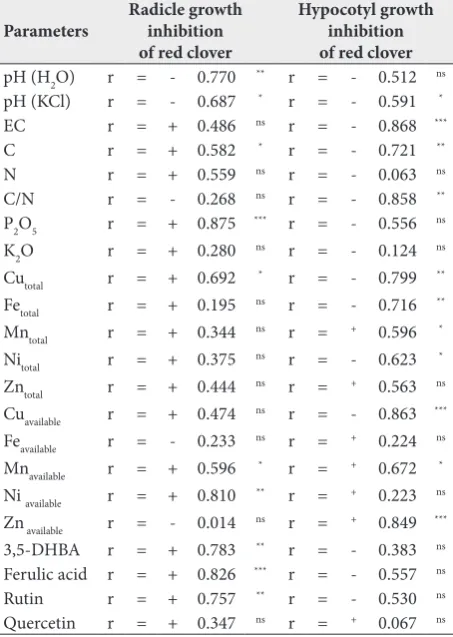
Negative correlations were detected between radicle
growth inhibition in red clover and fly ash pH (H2O)
(p<0.01) and pH (KCl) (p<0.05) (Table 4). Positive correlations were found between radicle growth
inhibi-tion in red clover and C content (p<0.05), P2O5 content
(p<0.001), the total concentrations of Cu (p<0.05), available concentrations of Mn (p<0.05), available concentrations of Ni (p<0.01), 3,5-DHBA content (p<0.01), ferulic acid (p<0.001) and rutin (p<0.01) in fly ash (Table 4). However, red clover hypocotyl growth inhibition was negatively correlated with pH (KCl), EC, C contents, C/N ratio, total concentrations of Cu, Fe, Mn, the available concentrations of Cu (p<0.05, p<0.01, p<0.001) in fly ash, whereas it positively cor-related with available concentrations of Mn (p<0.05) and Zn (p<0.001) (Table 4).
DISCUSSION
The phytotoxic activity of allelochemicals in soils is a function of the interaction of the allelochemicals from plants and soil characteristics [17]. Allelochemicals primarily affect the soil pH, aggregation and aeration, content of N and C, plant-water relations, nutrient ion uptake, degree of decomposition, composition and ac-tivity of soil microbiocenosis [5]. Phenolic compounds
Fig. 1. Radicle growth inhibition of red clover in control (CFA)
and plant rhizospheric fly ash (RPFA – Robinia pseudoacacia; AAFA
– Ailanthus altissima; AFFA – Amorpha fruticosa). ANOVA; data
represent the means±SD (n=150); (c) CFA-AFFA; (d) RPFA-AAFA;
(e) RPFA-AFFA; **p<0.01; ***p<0.001.
Fig. 2. Hypocotyl growth inhibition of red clover in control (CFA)
and plant rhizospheric fly ash (RPFA – Robinia pseudoacacia; AAFA
– Ailanthus altissima; AFFA – Amorpha fruticosa). ANOVA; data
represent the means±SD (n=150); (a) CFA-RPFA; (b) CFA-AAFA; (c)
have an effect on the accumulation and availability of soil nutrients, which in turn have a great influence on plant growth [17]. However, phenolics can also play an important role in inhibiting the nitrification that affects a plant’s nutrient status [1]. Recent stud-ies are more focused on the environmental impact of allelochemicals on ecosystems than on plant-plant interactions [11], indicating a great influence of al-lelochemicals on the turnover of inorganic and organic compounds in soil [33].
In this study, the pH values of fly ash ranged from 6.32-8.1, which is similar to results obtained by other authors (8.85 [34], 7.95 [25]). According to White-head et al. [35], soil pH can affect the concentration of phenolic compounds in the soil solution. Our re-search showed that as the pH of fly ash increases, the inhibition of radicle and hypocotyl growth of red clover is less pronounced. A high pH value (8.1) and low
nitrogen content (0.13%) in the rhizospheric fly ash
of R. pseudoacacia (RPFA) was noted, although this is a
nitrogen-fixing species. The cause of this phenomenon may be the detrimental effect of high pH on the micro-organisms involved in nitrogen fixation [36]. Generally, microorganisms can reduce the allelochemical activity of phenolics in the rhizosphere and reduce the inhi-bition of plant growth due to rapid mineralization of phenolic compounds [15]. The limitation of phytotoxic activity of active substances released from the donor plants could occur through sorption to organic mat-ter which is greatest under neutral to slightly alkaline conditions [21]. However, high inhibition of red clover radicle and hypocotyl growth could be attributed to the
lower pH values of the AAFA and AFFA (6.34 and 6.32,
respectively), which can modify the nutrient status and element availability in fly ash [21].
In the present study, the C content in plant
rhi-zospheric fly ash (RPFA, AAFA and AFFA) was greater
than in the control fly ash (CFA) (2.41, 3.12 and 3.07
times, respectively), and this might be due to its origin from humus that contains humic acids, peptides and carbohydrates as compared to control fly ash where the C is derived from coal [37]. Our findings show that
phenolics in the AAFA and AFFAhad a more negative
impact on red clover radicle growth with an increas-ing C content in fly ash compared to phenolics in the
RPFA and CFA. The C pool in soils depends on its input
through leaf and root litter and root exudates and decomposition of organic matter by microorganisms
[38]. The high inhibitory effect of A. altissima and A.
fruticosa on red clover radicle growth could be related
to the high content of phenolics in fly ash which, being C-rich compounds, are released from plants to fly ash and contribute to the C-stock in fly ash. The positive correlation between ferulic acids and carbon content in fly ash (r=+0.585) points to their high content in
the AFFA (4.11 µg/g, 4.43%) and AAFA(0.7 µg/g, 4.5%).
Hence, it was assumed that some phenolics from these plants were less susceptible to microbial decomposition and had a high allelopathic effect.
The N content in the AAFA and AFFAwas higher
than in CFA (3.27 and 1.90 times, respectively) and in
RPFA (2.77 and 1.61 times, respectively). The high N
content in rhizospheric fly ash reveals the ability of these plant species to increase the amount of nitrate in the soil where the net nitrification rate in N-deficient
Table 4. Pearson’s correlation coefficients (r) between red clover radicle and hypocotyl growth inhibition and chemical param-eters, total and available concentration of elements and phenolic contents in fly ash.
Parameters Radicle growth inhibition of red clover
Hypocotyl growth inhibition of red clover
pH (H2O) r = - 0.770 ** r = - 0.512 ns
pH (KCl) r = - 0.687 * r = - 0.591 *
EC r = + 0.486 ns r = - 0.868 ***
C r = + 0.582 * r = - 0.721 **
N r = + 0.559 ns r = - 0.063 ns
C/N r = - 0.268 ns r = - 0.858 **
P2O5 r = + 0.875 *** r = - 0.556 ns
K2O r = + 0.280 ns r = - 0.124 ns
Cutotal r = + 0.692 * r = - 0.799 **
Fetotal r = + 0.195 ns r = - 0.716 **
Mntotal r = + 0.344 ns r = + 0.596 *
Nitotal r = + 0.375 ns r = - 0.623 *
Zntotal r = + 0.444 ns r = + 0.563 ns
Cuavailable r = + 0.474 ns r = - 0.863 ***
Feavailable r = - 0.233 ns r = + 0.224 ns
Mnavailable r = + 0.596 * r = + 0.672 *
Ni available r = + 0.810 ** r = + 0.223 ns
Zn available r = - 0.014 ns r = + 0.849 ***
3,5-DHBA r = + 0.783 ** r = - 0.383 ns
Ferulic acid r = + 0.826 *** r = - 0.557 ns
Rutin r = + 0.757 ** r = - 0.530 ns
Quercetin r = + 0.347 ns r = + 0.067 ns
substrates, such as fly ash, depends on the quality of litter [39]. Furthermore, in N-limited soils, the high content of phenolics inhibits N mineralization, leads to the release of dissolved organic N from leaf litter and reduces overall ecosystem N loss [40]. In our study, the highest content of quercetin (60 μg/g) and
N (0.36%) in the AAFA and the positive correlation
between quercetin content and N in fly ash (r =+0.945) suggest that the high polyphenol production from this plant species may present an advantage to increased plant uptake of organic N [40].
The content of available P was significantly higher
in plant rhizospheric fly ash (RPFA, AAFA and AFFA) than
in the CFA (1.21, 1.51 and 2.69 times, respectively). Herr
et al. [41] noted that the rhizospheric soil of Solidago
gigantea had a lower pH value and a higher content of
available P than surrounding soils without this species,
which is similar to our observations in A. altissima and
A. fruticosa. Our results showed significant inhibition
of red clover radicle growth in response to the high available content of P in fly ash. According to Kafkafi et al. [42], phenolic compounds can compete with P for sorption sites on mineral surfaces and may form complexes with Al and Fe. The high content of phenolic allelochemicals (3.5-DHBA, ferulic acids and rutin) that are released from plants can increase P availability (r=+0.925, r=+0.990, r=+0.955, respectively), desorb-ing previously bound P, which might be related to our
results obtained for A. fruticosa. The low content of P
in the RPFA can be related to the inhibition of N fixation
[43] as well as with the low content of phenolic acids, which can reduce solubility and availability of P [5].
The concentration of Cu, Mn, Ni, and Zn in fly ash can be 30 times higher than in coal, making fly ash the main threat for the surrounding environment and human health [44]. In our study, the total con-centrations of Ni in all rhizospheric fly ash samples were toxic (12-34 μg/g, [45]), the concentrations of Cu were within the normal range (13-24 μg/g, [45]) whereas the concentrations of Mn and Zn were deficient (270-525 μg/g and 45-100 μg/g, respectively [45]). The availability of Cu, Fe, Mn, Ni and Zn in control and plant rhizospheric fly ash samples was relatively low. In addition, the concentrations of total and available Mn and Zn in the rhizospheric fly ash of all woody species were lower than in control fly ash. Higher Cu
availability in AFFAin relation to the CFA can be due
to low pH values (6.3), as in slightly acidic conditions Cu is more available [46]. However, red clover radicle growth inhibition is positively correlated with total concentrations of Cu and the available content of Mn and Ni in fly ash. The content of heavy metals in soil can be crucial for the persistence and activity of al-lelochemicals [47] and may affect the production and release of secondary metabolites from the plant roots, which in turn increase the availability of nutrients or form chelates with toxic metal in the soil [48].
Phenolic compounds can increase the availability of Cu, Fe and Mn by forming organic complexes that enhance the uptake of these elements by plants [5,21]. The high concentrations of 3.5-DHBA, ferulic acid and rutin in fly ash were related to the high total content of Cu (r=+0.706, r=+0.863, r=+0.798, respectively), Fe (r=+0.717, r=+0.705, r=+0.777, respectively) and Ni (r=+0.8555, r=+0.818, r=+0.888, respectively), which coincides mostly with the results obtained in
A. fruticosa. The available content of Cu increased and
the available content of Fe decreased with the higher contents of 3.5-DHBA (r=+0.791, r=-0.768, respec-tively), ferulic acid (r=+0.872, r=-0.616, respectively) and rutin (r=+0.878, r=-0.733, respectively) in fly ash
mostly found in A. fruticosa, whereas the highest
con-tent of quercetin in fly ash coincided with the highest
available content of Ni (r=+0.755) in the AAFA. The
decrease of hypocotyl growth of red clover was lower with increasing total concentrations of Cu, Fe, Mn and Ni and with decreasing available concentrations of Mn and Zn in fly ash. Since there are no significant correlations between hypocotyl growth inhibition of red clover and phenolic compounds in fly ash, it can be assumed that these phenolics do not express an allelopathic effect on red clover hypocotyl growth.
The results of this study showed that the contents of 3,5-DHBA, ferulic acid and rutin were greatest in
the AFFA where they expressed the strongest inhibitory
plant [5,8]. Csizar [50] showed that A. fruticosa had
stronger allelopathic potential than A. altissima and R.
pseudoacacia, which is in line with our results.
Gener-ally, different allelopathic compounds were found in R.
pseudoacacia and A. altissima [51,52], but the data on
the allelopathic activity of these woody species grown on fly-ash deposits are still lacking.
In this study, the presence of phenolic compounds in all plant rhizospheric fly ash samples indicates that
R. pseudoacacia, A. altissima and A. fruticosa can
af-fect the beginning of pedogenetic processes of a sterile substrate, such as fly ash. Phenolic compounds, as the most prevalent allelochemicals in plants, enter the soil by leaching from the surface of the plant body, decomposition of litter and active secretion from roots [6,53]. Free phenolics are very important in the interactions between donor and acceptor plants be-cause they are first available to the acceptor plant when they reach the litter and the soil [23]. Therefore, the detection of allelochemicals in the rhizosphere of the donor species is very important for allelopathy [54]. Further studies will determine the seasonal dynamics of phenolic compounds in rhizospheric fly ash and leaf litter of investigated plant species, the contents of these allelochemicals in roots and aboveground plant parts, as well as the effects of these compounds on germination and the seedling growth of the other herbaceous plant species that grow on fly-ash deposits.
CONCLUSIONS
The allelopathic activity of phenolic compounds in rhizospheric fly ash is strongly influenced by pH, con-tent of C and available P, as well as the total concon-tent of Cu and the available contents of Mn and Ni in fly ash. In addition, the unfavorable conditions that prevail on fly-ash deposits promote the high production of phenolic acids and flavonoids in woody plant species
such as A. fruticosa, A. altissima and R. pseudoacacia.
These phenolic compounds have the properties of al-lelochemicals in fly ash and can lead to the inhibition
of growth of T. pratense as the understory herbaceous
species present in the fly-ash plant community. These woody species that colonized the fly-ash deposits may act as promotors of pedogenetic processes on fly ash, altering the ecosystem processes in anthropogenically degraded sites.
Funding: This work was supported by the Ministry of Educa-tion, Science and Technological Development, Grants III41010, OI173018 and TR31070.
Acknowledgments: We would like to thank Zoran Bajić and Isidora Glišić from the Service for Environmental Control and Protection of the of “Nikola Tesla – A” thermal power plant, for their assistance during field work, the possibility to access the fly ash deposits and for the expert information they provided to us.
Author contributions: Filip Grbović was the main contributor who performed the work; he was responsible for field work, conducting the experiments and for writing the manuscript. Gordana Gajić helped with the data analysis, data interpretation and explana-tion, and manuscript writing. Snežana Branković helped with the allelopathic bioassays and data interpretation. Zoran Simić performed the determination of total and available elements on FAAS. Andrija Ćirić conducted the HPLC analysis. Ljubinko Rakonjac contributed to the evaluation of chemical analysis of fly ash. Pavle Pavlović and Marina Topuzović contributed to the evaluation and interpretation of the results, participated in design-ing the experiments and supervised the data interpretation and manuscript writing.
Conflict of interest disclosure: All authors confirm no actual or potential conflicts of interest.
REFERENCES
1. Rice EL. Allelopathy. 2nd ed. New York: Academic Press; 1984. 422 p.
2. Khan AL, Hamayun M, Hussain J, Khan H, Gilani SA, Kiku-chi A, Watanabe KN, Jung EH, Lee I. Assessment of allelo-pathic potential of selected medicinal plants of Pakistan. Afr J Biotechnol. 2009;8(6):1024-29.
3. Callaway RM, Ridenour WM. Novel weapons: invasive suc-cess and the evolution of increased competitive ability. Front Ecol Environ. 2004;2(8):436-43.
4. Djurdjević L, Mitrović M, Dinić A, Pavlović P, Bojović S,
Gajić G, Kostić O. Allelopathic investigations of Quercus
conferta and Quercus cerris domination in oak forest at Avala Mt. (Serbia). In: Haper JDI, An M, Kent JH, editors. Pro-ceedings of the 4th World Congress on Allelopathy: Estab-lishing the Scientific Base. 2005 Aug 21-26; Wagga, New South Wales, Australia..Centre for Rural Social Research, Charles Sturt University; 2005 p. 328-331.
5. Djurdjević L, Pavlović P, Mitrović M. The effect of phenolic compounds on soil properties. In: Musculo A, Sidari M, edi-tors. Soil Phenols. New York, USA: Nova Science Publishers, Inc; 2010. p. 31-62.
6. Rice EL. Allelopathy. 1st ed. New York: Academic Press; 1974. 353 p.
7. Chou CH, Leu LL. Allelopathic substances and interactions of Delonix regia (Boj) Raf. J Chem Ecol. . 1992;18(12):2285-303.
Allelo-pathic and environmental implications of plant phenolic compounds. Allelopathy J. 2012;29(2):177-97.
9. Inderjit. Plant phenolics in allelopathy. Bot Rev. 1996;62(2):186-202.
10. Weir TL, Park SW, Vivanco JM. Biochemical and physi-ological mechanisms mediated by allelochemicals. Curr Opin Plant Biol. 2004;7(4):472-9.
11. Wardle DA, Nilsson MC, Gallet C, Zackrisson O. An ecosystem-level perspective of allelopathy. Biol Rev. 1998;73(3):305-19.
12. Djurdjević L, Dinić A, Pavlović P, Mitrović M, Karadžić B,
Tešević V. Allelopathic potential of Allium ursinum L.
Bio-chem Syst Ecol. 2004;32(6):533-44.
13. Inderjit, Weiner J. Plant allelochemical interference or soil chemical ecology? Perspect Plant Ecol Syst. 2001;4(1):3-12. 14. Djurdjević L, Popović Z, Mitrović M, Pavlović P, Jarić S,
Oberan L, Gajić G. Dynamics of bioavailable rhizosphere
soil phenolics and photosynthesis of Arum maculatum L. in
a lime-beech forest. Flora-Morphology, Distribution, Func-tional Ecology of Plants. 2008;203(7):590-601.
15. Pedrol N, González L, Reigosa, MJ. Allelopathy and abiotic stress. In: Reigosa MJ, Pedrol N, González L, editors. Alle-lopathy: A Physiological Process with Ecological Implica-tions. Netherlands: Kluwer Academic Publishers; 2005. p. 171-209.
16. Blum U, Shafer SR, Lehman ME. Evidence for inhibi-tory allelopathic interactions involving phenolic acids in field soils: concepts vs. an experimental model. CRC Crit Rev Plant Sci. 1999;18(5):673-93.
17. Inderjit, Dakshini KMM. Allelopathic effect of Pluchea
lanceolata (Asteraceae) on characteristics of four soils and tomato and mustard growth. Am J Bot. 1994;81(7):799-804. 18. Dalton BR, Blum U, Weed SB. Differential sorption of exog-enously applied ferulic, p-coumaric, p-hydroxybenzoic, and vanillic acids in soil. Soil Sci Soc Am J. 1989;53(3):757-62.
19. Vogel CS, Dawson JO. Effect of juglone on growth in vitro
of Frankia isolates and nodulation of Alnus glutinosa in soil. Plant Soil. 1985;87(1):79-89.
20. Morris C, Grossl PR, Call CA. Elemental allelopathy: pro-cesses, progres, and pitfalls. Plant Ecol. 2009;202(1):1-11. 21. Makoi JHRJ, Ndakidemi PA. Allelopathy as protectant,
defense and growth stimulans in legume cereal mixed cul-ture system. N Z J Crop Hortic Sci. 2012;40(3):161-86. 22. Pandey VC, Singh B. Rehabilitation of coal fly ash
basins: current need to use ecological engineering. Ecol Eng. 2012;49:190-2.
23. Djurdjević L, Mitrović M, Pavlović P, Gajić G, Kostić O. Phe-nolic acids as bioindicators of fly ash deposit revegetation. Arch Environ Contam Toxicol. 2006;50(4):488-95. 24. Mitrović M, Pavlović P, Lakušić D, Djurdjević L, Stevanović
B, Kostić O, Gajić G. The potential of Festuca rubra and
Cal-amagrostis epigejos for the revegetation of fly ash deposits. Sci Total Environ. 2008;407(1):338-47.
25. Gajić G, Djurdjević L, Kostić O, Jarić S, Mitrović M, Stevanović B, Pavlović P. Assessment of the
phytoremedia-tion potential and an adaptive response of Festuca rubra L.
sown on fly ash deposits: Native grass has a pivotal role in ecorestoration management. Ecol Eng. 2016;93:250-61.
26. Blum U. The value of model plant—microbe—soil systems for understanding processes associated with allelopathic interaction. In: Inderjit, Dakshini KM, Einhellig FA, editors. Allelopathy: organisms, processes, and applications. USA: American Chemical Society (ACS symposium series); 1995. p. 127-131.
27. Tyurin IV. Agrochemical methods of soil analysis. Moskva: Nauka; 1965. Russian.
28. Jones JB Jr. Laboratory guide for conducting soil tests and plant analysis. CRC press; 2001. 384 p.
29. Egner H, Riehm H, Domingo WR. Investigations on the chemical soil analysis as a basis for assessing the soil nutrient status. II: Chemical extraction methods for phosphorus and potassium determination. Kungliga Lantbrukshügskolans Annaler. 1960;26:199-215.
30. U.S. Environmental Protection Agency (USEPA). Method 3051A (SW-846): Microwave assisted acid digestion of sedi-ments, sludges, and oils. Revision 1. Washington DC; 2007. 30 p.
31. Žemberyová M, Bartekova J, Hagarova I. The utilization of modified BCR three-step sequential extraction procedure for the fractionation of Cd, Cr, Cu, Ni, Pb and Zn in soil refer-ence materials of different origins. Talanta. 2006;70(5):973-8. 32. Fujii Y, Furubayashi A, Hiradate S. Rhizosphere soil method:
a new bioassay to evaluate allelopathy in the field. In: Haper JDI, An M, Kent JH, editors. Proceedings of the 4th World Congress on Allelopathy: Establishing the Scientific Base. 2005 Aug 21-26; Wagga, New South Wales, Australia..Centre for Rural Social Research, Charles Sturt University; 2005 p. 490-2.
33. Hättenschwiler S, Vitousek PM. The role of polyphenols in terrestrial ecosystem nutrient cycling. Trends Ecol Evol. 2000;15(6):238-43.
34. Pandey VC, Singh N. Fast green capping on coal fly ash basins through ecological engineering. Ecol Eng. 2014;73:671-5.
35. Whitehead DC, Dibb H, Hartley RD. Phenolic compounds in soil as influenced by the growth of different plant species. J Appl Ecol. 1982;19(2)579-88.
36. Gupta DK, Rai UN, Tripathi RD, Inouhe M. Impact of fly-ash on soil and plant responses. J Plant Res. 2002;115(6):401-9. 37. Haworth RD. The chemical nature of humic acid. Soil Sci.
1971;111(1):71-9.
38. Ekschmitt K, Kandeler E, Poll C, Brune A, Buscot, F, Fried-rich M, Gleiner, G, Hartmann A, Kästner M, Marhan K, Miltner A, Scheu S and Wolters V. Soi-carbon preservation through habitat constraints and biological limitations on decomposer activity. J Plant Nutr Soil Sci. 2008;171(1):27-35. 39. Gómez-Aparicio L, Canham CD. Neighbourhood
analy-ses of the allelopathic effects of the invasive tree Ailanthus
altissima in temperate forests. J Ecol. 2008;96(3):447-58. 40. Northup RR, Yu Z, Dahlgren RA, Vogt KA.
Polyphe-nol control of nitrogen release from pine litter. Nature. 1995;377(6546):227-229.
41. Herr C, Chapuis-Lardy L, Dassonville N, Vanderhoeven S,
Meerts P. Seasonal effect of the exotic invasive plant Solidago
42. Kafkafi U, Bar-Yosef B, Rosenberg R, Sposito G. Phospho-rus adsorption by kaolinite and montmorillonite: II. Organic anion competition. Soil Sci Soc Am J. 1988;52(6):1585-9. 43. Liu G, Deng T. Mathematical model of the relationship
between nitrogen-fixation by black locust and soil condi-tions. Soil Biol Biochem. 1991;23(1):1-7.
44. Gieré R, Carleton LE, Lumpkin GR. Micro-and nanochem-istry of fly ash from a coal-fired power plant. Am Mineral. 2003;88(11-12):1853-65.
45. Kabata-Pendias A. Trace Elements in Soils and Plants. 3rd ed. CRC Press; 2011. 548 p.
46. Kumpiene J, Lagerkvist A, Maurice C. Stabilization of As, Cr, Cu, Pb and Zn in soil using amendments–a review. Waste Manag. 2008;28(1):215-25.
47. Pollock JL, Callaway RM, Thelen GC, Holben WE. Cat-echin–metal interactions as a mechanism for conditional
allelopathy by the invasive plant Centaurea maculosa. J Ecol.
2009;97(6):1234-42.
48. Li L, Li SM, Sun JH, Zhou LL, Bao XG, Zhang HG, Zhang FS. Diversity enhances agricultural productivity via rhizo-sphere phosphorus facilitation on phosphorus-deficient soils. Proc Natl Acad Sci U S A. 2007;104(27):11192-6.
49. Djurdjević L, Mitrović M, Pavlović P. Methodology of allelopathy research: 2. Forest ecosystems. Allelopathy J. 2007;20(1):79-102.
50. Csiszár Á. Allelopathic effects of invasive woody plant spe-cies in Hungary. Acta Silv Lign Hung. 2009;5:9-17. 51. Kowarik I, Säumel I. Biological flora of central Europe:
Ailanthus altissima (Mill.) Swingle. Perspect Plant Ecol Syst. 2007;8(4):207-37.
52. Cierjacks A, Kowarik I, Joshi J, Hempel S, Ristow M, Lippe
M, Weber E. Biological flora of the British Isles: Robinia
pseudoacacia. J Ecol. 2013;101(6):1623-40.
53. Tang CS, Young CC. Collection and identification of alle-lopathic compounds from the undisturbed root system of
bigalta limpograss (Hemarthria altissima). Plant Physiol.
1982;69(1):155-60.
54. Gallet C, Pellissier F. Phenolic compounds in natural solutions of a coniferous forest. J Chem Ecol. 1997;23(10):2401-12.
Supplementary Data
Supplementary Fig. S1.