ARTIGO ORIGINAL
AMP
STUDENT
Autism and Early Neurodevelopmental Milestones
Autismo e Marcadores Precoces do
Neurodesenvolvimento
1. Faculdade de Medicina. Universidade de Coimbra. Portugal.
2. Unidade de Neurodesenvolvimento e Autismo. Serviço do Centro de Desenvolvimento da Criança. Centro de Investigação e Formação Clínica. Hospital Pediátrico. Centro Hospitalar e Universitário de Coimbra. Coimbra. Portugal
3. Clínica Universitária de Pediatria e Instituto de Imagem Biomédica e Ciências da Vida. Faculdade de Medicina. Universidade de Coimbra. Coimbra. Portugal. Autor correspondente: Guiomar Oliveira: [email protected]
Recebido: 09 de julho de 2015 - Aceite: 26 de outubro de 2015 | Copyright © Ordem dos Médicos 2016 Xavier Ferreira1, Guiomar Oliveira2,3
Acta Med Port 2016 Mar;29(3):168-175 ▪ http://dx.doi.org/10.20344/amp.6790
RESUMO
Introdução: A perturbação do espectro do autismo, neste texto também designada por autismo, é uma patologia crónica do neurod-esenvolvimento, que se manifesta precocemente na infância por alterações da interação social, comunicação e comportamento re-petitivo. Não estando disponíveis biomarcadores específicos, o diagnóstico baseia-se exclusivamente na avaliação clínica. O objetivo deste estudo é verificar quais os marcadores precoces do desenvolvimento psicomotor ou neurodesenvolvimento, que se correlac-ionam significativamente com a gravidade da clínica central do autismo, quocientes de desenvolvimento e com a função adaptativa. Material e Métodos: Procedemos ao estudo retrospetivo de uma população de 1 572 indivíduos com o diagnóstico de autismo se-guidos na Unidade de Neurodesenvolvimento e Autismo do Centro de Desenvolvimento da Criança do Hospital Pediátrico do Centro Hospitalar e Universitário de Coimbra. Analisámos seis marcadores precoces do desenvolvimento psicomotor: idades de aquisição ‘da marcha’, ‘das primeiras palavras’, ‘das primeiras frases’, ‘do controlo de esfíncter vesical diurno’, ‘do controlo de esfíncter vesical noturno’ e de início das primeiras queixas. Posteriormente dividimos a amostra em três subgrupos de gravidade clínica segundo a escala Childhood Autism Rating Scale e pesquisamos diferenças significativas entre os três subgrupos relativamente aos seis marca-dores definidos.
Resultados: O marcador ‘idade de aquisição das primeiras frases’ foi, de entre os seis, aquele que se correlacionou mais fortemente com as variáveis da clínica de autismo, quocientes de desenvolvimento/inteligência e comportamento ou função adaptativa. Na divisão da amostra em subgrupos de gravidade clínica, foi o de maior gravidade que mostrou idades de aquisição dos marcadores do neurod-esenvolvimento mais tardias e idades mais precoces de manifestação das primeiras queixas.
Discussão: Este estudo vem demonstrar a utilidade clinica dos marcadores precoces do desenvolvimento psicomotor nos primeiros anos de vida, como preditores da gravidade da clinica de autismo, cognição e função adaptativa duma vasta população com autismo. Deste modo, estes dados vêm contribuir, em associação com outros, para o prognóstico e previsão da história natural do autismo. Conclusão: Tendo em conta os resultados deste estudo, recomenda-se fortemente o registo da ´idade de aquisição das primeiras frases´ a todos os clínicos que tenham contacto com crianças com autismo.
Palavras-chave: Desenvolvimento da Criança; Perturbação Autística; Perturbações do Desenvolvimento; Prognóstico. ABSTRACT
Introduction: Autism spectrum disorder, also referred to in this study as autism, is a neurodevelopmental chronic disease that manifests early in childhood by impairment in social interaction, communication and repetitive behavior. Since there are no specific biomarkers available, the diagnosis is based exclusively on clinical criteria. The purpose of the present study is to determine which are the early psychomotor development or neurodevelopmental milestones that present a significant correlation with the severity of the main symptoms of autism, development quotients, and adaptive function.
Material and Methods: We performed a retrospective study on a sample of 1572 individuals with a diagnosis of autism that were monitored at Hospital Pediátrico do Centro Hospitalar e Universitário de Coimbra, in the Neurodevelopment and Autism Unit. We analyzed six early psychomotor developmental milestones: age of acquisition of ‘walking’, ‘first words’, ‘first phrases’, ‘daytime control of bladder sphincter’, ‘night-time control of bladder sphincter’, and age of first complaints. Afterwards, we divided the sample in three subgroups regarding clinical severity, according to the Childhood Autism Rating Scale, and we analyzed significant differences among each other concerning the six milestones established beforehand.
Results: The milestone ‘age of first phrases’ was, from the six milestones, the one with a stronger correlation with the variables of clinical manifestations of autism, development/intelligence quotients, and adaptive function. In division of the sample into subgroups of clinical severity, it was the most severe that showed later ages of acquisition of the neurodevelopmental milestones and earlier ages of first complaints.
Discussion: This study proves the clinical utility to know the age of achievement of early psychomotor developmental skills, since they act as predictors of clinical severity of autism, cognition, and adaptive function of a wide population with autism. Therefore, this data contribute for prognostic and prediction of autism progression.
Conclusion: Taking into account the results of this study, it is strongly recommended to all clinicians who have contact with autistic children, to record the ´age of acquisition of first phrases´.
Keywords: Autistic Disorder; Child Development; Developmental Disabilities; Prognosis.
INTRODUCTION
The concept of autism was for the first time used by
ARTIGO ORIGINAL
AMP
STUDENT
‘self or by oneself,’3 involving social interaction deficits as major signs in autism. Autism was subsequently described as a childhood-presentation clinical/nosological entity, by Leo Kanner in 19434 and by Hans Asperger, one year later.2,5 It is currently considered as a chronic and complex neurodevelopmental disorder, related to a multifactorial brain disorder which is undetermined in approximately 80% of cases.6 Typical semiology of autism includes social interaction, verbal and non-verbal communication deficits, as well as restricted, repetitive patterns of behaviour, interests or activities. It has variable clinical severity and was therefore identified in the 5th Edition of Diagnostic and Statistical Manual of Mental Disorders(DSM-5) (American Psychiatric Association 2013)7 as autism spectrum disorder (ASD). Other symptoms of neurological disorder, such as intellectual disability (68%)8, epilepsy (up to 26%)9, sensory processing dysfunctions (95%)10 and disruptive behaviour (23.3%)7,11,12, among other comorbidities, are frequently associated to primary presentation.13 Presentation usually occurs within the first years of life and is considered as one of the most frequent neurodevelopmental disorders, with an estimated prevalence of around one per 1,000 school-age children in Portugal.14,15
Autism has a relevant impact on individual’s daily functioning and its current therapy is based on tailored and intensive educational and behavioural approach.5,16,17 Diagnosis remains strictly based on clinical evaluation as there no biomarkers; regardless of the underlying severity of each case, outcome18 also depends on an early and high-quality intervention.14,19-21 The identification of a neurodevelopmental model in early ages has a very relevant clinical role in order to adapt the intervention and future expectations to each patient, allowing for an estimated outcome18,22 in terms of severity and therefore the needs of each child and his/her family.
Our study aimed to determine whether early neurodevelopmental milestones (brain maturity) and early signs of autism are associated to severity, to global development as well as to adaptive functioning. The analysis of longitudinal follow-up of a large group of patients with autism attending the Children’s Hospital of the Centro
Hospitalar e Universitário de Coimbra was carried out.
MATERIAL AND METHODS
In total, 1,572 patients diagnosed with autism and attending the Neurodevelopment and Autism Unit of the
Serviço do Centro de Desenvolvimento da Criança do
Hospital Pediátrico (a tertiary referral hospital) at the
Centro Hospitalar e Universitário de Coimbra were included
in the study. Diagnosis was confirmed by a specialized neurodevelopmental multidisciplinary team and was based on gold standard instruments in this area (Portuguese version of the semi-structured interview - Autism Diagnostic Interview™-Revised [ADI-R])14 and on clinical evaluation. Social interaction deficits were analysed using the score of social interaction area of the ADI-R (0-30 range) and the higher the score, the higher the social interaction
impairment.
Global clinical severity of autism was assessed using the Portuguese version of the Childhood Autism Rating Scale (CARS)14 (15-60 range) and the higher the score, the more severe the autism. Three subgroups of severity of autism global clinical presentation were developed, according to CARS score (mild: < 30, moderate: ≥ 30 ≤ 36, severe: ≥ 37). Global developmental quotient (GDQ) and subquotients in different dimensions (hearing and language [QDL], eye and hand coordination [QDOM], personal-social [QDPS] and performance [QDR]) were obtained using the Ruth Griffiths developmental scale23 and was applied by psychologists experienced in autism and in other neurodevelopmental disorders. A subgroup of 227 patients were assessed regarding these parameters at pre-school and at school age. Normal GDQ and subquotients is 100 ± 15; the higher the score, the better the level of child’s global development. Adaptive behaviour (daily life activities) was assessed by Vineland Adaptive Behaviour Scale24 and standard global score and domains (communication, socialization and daily living skills) were used. Normal score is 100 ± 15; the higher the score, the better the individual adaptive level.
Apart from this multimodal assessment usually carried out for every patient, a comprehensive and systematic clinical history was obtained by a paediatrician specialized in neurodevelopment and recorded on a digital database (authorized by the Portuguese Comissão Nacional de
Proteção de Dados).
Apart from the variables related to diagnosis and clinical severity, as well as to the different sub-domains of GDQ and adaptive behaviour, information regarding patient’s age of onset (in months of age) of early neurodevelopmental milestones, described by caregivers, such as: walking (first unsupported gait), first meaningful words apart from ‘mom’ and ‘dad’, first phrases (composed of two or more words, one word being a verb, routinely used), daytime and night-time bladder control. Early clinical manifestations of autism were also analysed through age of onset (in months) of the first signs detected by caregivers or by healthcare or education professionals.
Statistical Package for the Social Sciences (SPSS, Chicago, IL, EUA), Microsoft Windows® version was used in statistical analysis.
Kolmogorov-Smirnov-Lilliefors test was used to test for the normal distribution of the different variables and, as most patients showed deviation from normality, non-parametric statistical tests were used. Spearman’s correlation coefficient was used for the analysis of linear association between two quantitative variables and a significance level (α) = 0.05 (p < 0.05) was considered. Finally, Kruskall-Wallis test, followed by Mann-Whitney’s test, were used for the analysis of significant differences between the three subgroups of clinical severity.
RESULTS
ARTIGO ORIGINAL
AMP
STUDENT Table 1 - Clinical characteristics of the group of patients with autism (n = 1,572)
n Median Interquartile range (IQR)
Age for onset of the first signs (months) 1,341 24 12
Age for onset of walking (months) 1,77 14 6
Age for onset of the first words (months) 1,309 24 22
Age for onset of the first phrases (months) 1,007 40 18
Age for onset of daytime bladder control (months) 949 36 18
Age for onset of night-time bladder control (months) 750 36 12
CARS assessment age (years) 1,169 2.5 1
CARS score 1,162 34 10
ADI-R assessment age (years) 1,224 4.8 4
ADI-R score – Social interaction 1,367 20 11
ADI-R: Autism Diagnostic Interview™-Revised; CARS: Childhood Autism Rating Scale; IQR-Interquartile range.
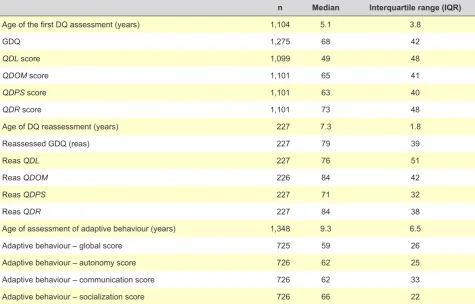
Table 2 - Psychomotor development of patients with autism (n = 1,572)
n Median Interquartile range (IQR)
Age of the first DQ assessment (years) 1,104 5.1 3.8
GDQ 1,275 68 42
QDL score 1,099 49 48
QDOM score 1,101 65 41
QDPS score 1,101 63 40
QDR score 1,101 73 48
Age of DQ reassessment (years) 227 7.3 1.8
Reassessed GDQ (reas) 227 79 39
Reas QDL 227 76 51
Reas QDOM 226 84 42
Reas QDPS 227 71 32
Reas QDR 227 84 38
Age of assessment of adaptive behaviour (years) 1,348 9.3 6.5
Adaptive behaviour – global score 725 59 26
Adaptive behaviour – autonomy score 726 62 25
Adaptive behaviour – communication score 726 62 33
Adaptive behaviour – socialization score 726 66 22
IQR: Interquartile range; DQ: Developmental quotient; GDQ: Global development quotient; QDL: Language development quotient; QDOM: Eye and hand coordination development quotient; QDPS: Personal-social development quotient; QDR: Performance development quotient; Reas: reassessment.
in Table 1 and functional characteristics in Table 2.
Correlations
Spearman’s correlation coefficient was used for the analysis of the correlation between two quantitative variables. Only Spearman’s coefficient values (S coef) of 0.30 and above were presented, regardless of whether the sign is positive or negative, based on Cohen’s criteria.25 According to these criteria, S coef between 0.30 and 0.49 show a moderate correlation and those between 0.5 and 1 a
strong correlation. The sign of S coef does not interfere with its value, only showing the direction of correlation as direct (+) or reverse (-).
The early neurodevelopmental milestone ‘age for onset of walking’ significantly correlated (p < 0.05) with all the variables for clinical assessment of autism, developmental quotient (DQ) and level of adaptive function, although the highest values of S coef were obtained for GDQ (-0.33),
ARTIGO ORIGINAL
AMP
STUDENT
The ‘age for onset of the first words’ significantly correlated (p < 0.05) with all the variables for clinical assessment of autism, DQ and adaptive function, even though never beyond a 0.3 S coef.
Instead, the ‘age for onset of first phrases’ significantly correlated with (p < 0.05) all the variables for clinical assessment of autism, DQ and adaptive function. The values of S coef were over 0.3 and a negative association with GDQ (-0.35), QDL (-0.42) and adaptive function (communication [-0.41], socialization [-0.31] and global [-0.38]) was found. A positive association with clinical severity assessed by social interaction impairment in ADI-R (+0.33) and CARS total score (+0.30) was found.
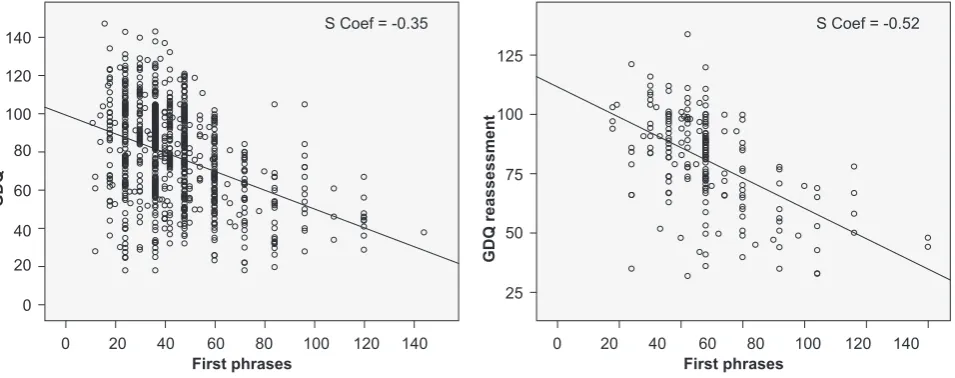
Moderate and strong negative associations between the age for onset of first phrases and DQ at school age were found in the subgroup with reassessed DQ at school age, namely: reassessed (reas) GDQ (-0.52), reas QDL (-0.61), reas QDOM (-0.42), reas QDPS (-0.47) and reas QDR
(-0.38).
The ‘age for onset of daytime bladder control’ significantly correlated (p < 0.05) with all the variables for clinical assessment of autism, DQ and the level of adaptive function, even though the highest values of S coef were obtained in a negative association with QDOM (-0.31) and
QDPS (-0.31).
The ‘age for onset of night-time bladder control’ significantly correlated (p < 0.05) with all the variables for clinical assessment of autism, DQ and the level of adaptive function, except with reas QDOM (p = 0.08), reas QDPS (p
= 0.06) and reas QDR (p = 0.15). Nevertheless, no value of S coef above 0.3 was found.
The ‘age for onset of the first signs’, significantly correlated (p < 0.05) with all the variables of clinical assessment of autism, DQ and adaptive function, except with reas GDQ (p = 0.05), reas QDOM (p = 0.12), reas
QDPS (p = 0.06) and reas QDR (p = 0.10). Values of S coef over 0.3 were obtained in a negative association with CARS (-0.38) and positive with QDG (+0.34), QDL (+0.31), QDOM
(+0.32) and QDPS (+0.30).
Subgroups of clinical severity of autism
Kruskall-Wallis test was used for the analysis of six early neurodevelopmental milestones in the three subgroups of autism according to total CARS (mild, moderate and severe autism). The analysis of the results allowed for the conclusion that at least one subgroup of severity was significantly different from the other two (Table 3).
As Kruskall-Wallis test rejected the null hypothesis, Mann-Whitney’s test was used between the three
subgroups of severity regarding the age for onset of each early neurodevelopmental milestone, in order to determine whether only one subgroup is significantly different from the remaining two or all subgroups show significant differences between them.
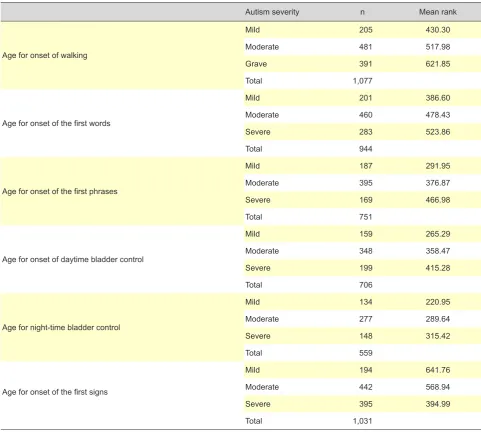
As regards ‘age for onset of walking’, ‘age for onset of the first phrases’ and ‘age for onset of daytime bladder control’, the subgroups showed significant differences between them (p = 0.00, for all the subgroups). Mean ranks for the subgroups are shown in Table 4 and allows for the conclusion that severe autism subgroup showed delayed onset of neurodevelopmental milestones, followed by moderate-severity subgroup and then by mild-severity subgroup showing earlier onset of milestones for brain maturity.
As regards the ‘age for onset of the first words’, the subgroups showed significant differences between them (p
= 0.00 between mild and moderate-severity subgroups and between mild and severe subgroups; p = 0.022 between moderate and severe subgroups). Mean ranks are shown in Table 4 and allow for the conclusion that severe subgroup showed delayed onset of the first words, followed by moderate and by mild-severity subgroup showing earlier onset of this neurodevelopmental milestone.
Regarding the ‘age for onset of night-time bladder control’, mild and moderate-severity and mild and severe subgroups showed to be significantly different (p = 0.00). Instead, moderate and severe subgroups did not show significant differences (p = 0.087). Mean ranks are shown in Table 4 and allow for the conclusion that severe, moderate and mild-severity subgroups show progressively lower ages for onset of night-time bladder control.
The ‘age for onset of the first signs’, the comparisons between mild and moderate, mild and severe, moderate and severe subgroups showed to be significantly different (p = 0.00, for all comparisons). Mean ranks showed earlier onset of the first signs in the severe subgroup, followed by moderate and by mild-severity subgroups.
DISCUSSION
Autism or ASD is a neurodevelopmental chronic disorder with early clinical manifestations mostly presenting before the age of two.
Onset of motor skills, which classically did not associate with cognitive development, has proved to be affected in patients with autism.22 In fact, onset of independent walking was delayed in toddlers with autism when compared to those with the same age and a typical development, in whom onset of walking occurs at the age of 12 months, on Table 3 - Early neurodevelopmental milestones in the three severity subgroups of autism
Age for onset of
walking Age for onset of the first words Age for onset of the first phrases Age for onset of daytime bladder
control
Age for onset of night-time bladder
control
Age for onset of the first signs
χ2 55.588 30.745 58.876 50.988 27.056 125.687
ARTIGO ORIGINAL
AMP
STUDENT
average.26
An approximately 13-month (12.59) average age for onset of walking was found in toddlers with autism, according to the study by Iverson and Wozniak,27 compared to 11.61 months in the control group. The onset of this milestone occurred at a median 14 months of age in our group of patients with autism. In fact, we may reach the conclusion that delayed onset of walking is associated with lower non-verbal intellectual skills, shown by the development of ‘performance’ and ‘eye and hand coordination’ sub-dimensions in our study, where a negative -0.35 and-0.33 S coef were found, respectively.
The age for onset of the first words in our group of patients showed scarce clinical relevance, unlike the age for onset of the first phrases, according to caregivers, that significantly correlated with all clinical variables of autism, psychomotor development and adaptive function. In fact, the delayed onset of first phrases was associated with higher autism severity, when assessed either by ADI-R’s social interaction area (0.33) or by CARS score (0.30).
Delayed talking showed as a moderate predictor of lower functioning in global adaptive behaviour (-0.37), autonomy (-0.30), communication (-0.41) and socialization (-0.31). In line with our results, Yang and Jong28 found that lack of speech in children with autism and six years of age predicts a severe restriction in adaptive function in adulthood. These authors also found that cognitive and communication skills in children with autism at school age are the most valuable outcome variables. In a follow-up study with a population of patients with autism, Howlin et al.29 found that the association of autism with language impairment showed worse outcome in adulthood.
The age for onset of first phrases was also shown as an early milestone of intellectual skill in pre-school age. In fact, the association between the age at which children use two-word sentences and the future verbal and non-verbal intellectual skills, assessed through GDQ and sub-dimensions of language, eye and hand coordination, personal-social and performance, showed moderate negative correlations in pre-school age and strong
Table 4 - Mean ranks of ages for onset of each milestone within each subgroup
Autism severity n Mean rank
Age for onset of walking
Mild 205 430.30
Moderate 481 517.98
Grave 391 621.85
Total 1,077
Age for onset of the first words
Mild 201 386.60
Moderate 460 478.43
Severe 283 523.86
Total 944
Age for onset of the first phrases
Mild 187 291.95
Moderate 395 376.87
Severe 169 466.98
Total 751
Age for onset of daytime bladder control
Mild 159 265.29
Moderate 348 358.47
Severe 199 415.28
Total 706
Age for night-time bladder control
Mild 134 220.95
Moderate 277 289.64
Severe 148 315.42
Total 559
Age for onset of the first signs
Mild 194 641.76
Moderate 442 568.94
Severe 395 394.99
ARTIGO ORIGINAL
AMP
STUDENT
Figure 2 - Linear relationship between the age for onset of the first
phrases and GDQ reassessment at school age.
0 20 40 60 80
First phrases
GDQ reassessment
100 120 140
S Coef = -0.52
25 50 75 100 125
Figure 1 - Linear relationship between the age for onset of the first
phrases and GDQ assessment in pre-school age. 0
0 20 40 60 80
First phrases
GDQ
100 120 140
S Coef = -0.35
20 40 60 80 100 120 140
correlations in school age. The conclusion that delayed onset of first phrases is associated with lower verbal and non-verbal intellectual skills in pre-school and mainly in school age became a very relevant information in clinical history (Fig. 1 and 2). Johnson et al.30 found similar results in a group of 244 patients, where delayed onset of talking in early ages were associated with cognitive impairment in adulthood.
The age for onset of daytime bladder control showed to be a clinically useful milestone. We found that delayed onset of daytime bladder control is associated with lower intellectual skills. Some studies31,32 in children with autism associated the successful onset of sphincter control (daytime and night-time bowel and bladder control) with the intellectual skills and reached similar conclusions.
Unlike the previous milestone, the age for onset of night-time bladder control, even though significantly correlated with almost all studied variables, did not show as a clinical data with outcome value. Dalrymple and Ruble32 compared the age for onset of night-time bladder control by dividing the group of patients into subgroups based on cognitive and language skills and found that patients with lower cognitive levels and lower verbal skills had significantly delayed onset of this milestone.
In autism, as in other neurodevelopmental disorders, the more severe forms have earlier onset. The age for onset of the first signs showed a moderate negative correlation with global severity of autism, showing that the more severe presentations have earlier onset, allowing for an easy identification by patient’s caregivers.
The age in which autism presentation is obvious for caregivers relates with child’s cognitive skills. In fact, we found a positive correlation between the age for onset of the first signs and the GDQ values (0.34) and sub-dimensions of language (0.31), eye and hand coordination (0.32) and personal-social (0.30), showing that the earlier the onset, the lower the cognitive skills. De Giacomo and Fombonne33 reached the same conclusion in a study showing that
cognitive skills strongly correlates with the age for onset of first signs. Baghdadli et al.34 also found a statistically significant correlation between cognitive skills and the age for onset of the first signs.
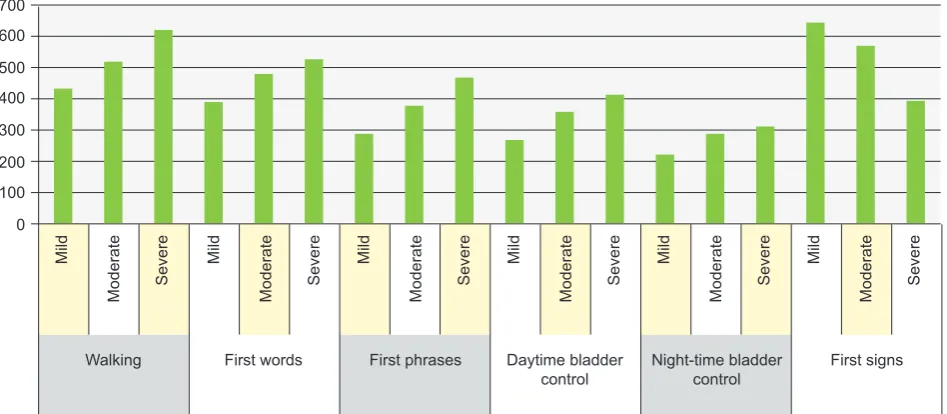
Based on CARS scores of clinical severity, the three subgroups in which we divided our group of patients were significantly different as regards the age for onset of psychomotor basic developmental skills, as well as regarding early onset of the disease. Children in the higher severity subgroup had delayed onset of walking, talking and sphincter control, unlike those in mild severity subgroup; those in moderate severity subgroup were between these two extreme ranges (Fig. 3).
As expected, the ‘age for onset of first signs’ occurred earlier in the severe subgroup (15-month median age) and was delayed in the mild subgroup (24-month median age). These results are in line with the study by Baghdadli et al.34 in which the group of patients with autism was split into two subgroups (first signs before and after the age of 18 months) and found that those with the onset of the first signs before the age of 18 months were associated with lower cognitive skills and adaptive behaviour and higher clinical severity of autism.
CONCLUSION
ARTIGO ORIGINAL
AMP
STUDENT
Figure 3 - Mean ranks of ages for onset of each milestone within each subgroup (based on global clinical severity of autism, assessed by
CARS). 0 100
Walking First words First phrases Daytime bladder
control Night-time bladder control First signs
Mild Mild Mild Mild Mild Mild
Moderate Severe Moderate Severe Moderate Severe Moderate Severe Moderate Severe Moderate Severe 200
300 400 500 600 700
its early presentation is associated to best intellectual skills and adaptive functioning in school age and to lower specific clinical severity of autism.
One of the major limitations of our study was the fact that the information regarding the presentation of early neurodevelopmental milestones was obtained by caregivers based on their memory and therefore eventually inaccurate. However, the large number of patients in the study and data systematically obtained by experienced physicians will reduce this inaccuracy.
Clinical accuracy of diagnosis and assessment, the dimension of our group of patients and the significant results with relevant clinical association between language skills, clinical severity of autism and intelligence in school age may be considered as strengths of the study.
HUMAN AND ANIMAL PROTECTION
The authors declare that the followed procedures were according to regulations established by the Ethics and Clinical Research Committee and according to the Helsinki Declaration of the World Medical Association.
DATA CONFIDENTIALITY
The authors declare that they have followed the protocols of their work centre on the publication of patient data.
CONFLICTS OF INTEREST
The authors declare that there were no conflicts of interest in writing this manuscript.
FINANCIAL SUPPORT
The authors declare that there was no financial support in writing this manuscript.
REFERENCES
1. Parnas J, Bovet P, Zahavi D. Schizophrenic autism: clinical phenomenology and pathogenetic implications. World psychiatry: official journal of the World Psychiatric Association (WPA). 2002;p.131–6. 2. Hans A translated and annotated by FU. ‘Autistic psychopathy’ in
childhood. In: Frith U, ed Autism and Asperger SyndromeCambridge: Cambridge University press. 1991;37–92.
3. Dicionário da Língua Portuguesa. Porto Editora; 2003.
4. Kanner. L. Autistic Disturbances of Affective Contact. Nerv Child. 1943;2:217–50.
5. Oliveira G. Autismo: diagnóstico e orientação Parte I - Vigilância, rastreio e orientação nos cuidados primários de saúde. Acta Pediátrica Port. 2009;40:278–87.
6. Carter M, Scherer S. Autism spectrum disorder in the genetics clinic: a review. Clin Genet. 2013;399–407.
7. American Psychiatric Association. Diagnostic and Statistical Manual of Mental Disorders. Fifth Edit. Arlington, VA: Am Psychiatr Publishing; 2013.
8. Polyak A, Kubina RM, Girirajan S. Comorbidity of intellectual disability confounds ascertainment of autism: implications for genetic diagnosis. Am J Med Genet Part B Neuropsychiatr Genet. 2015;168:600–8. 9. Viscidi EW, Triche EW, Pescosolido MF, McLean RL, Joseph RM,
Spence SJ, et al. Clinical characteristics of children with autism
spectrum disorder and co-occurring epilepsy. PLoS One. 2013;8:1–11. 10. Tomchek SD, Dunn W. Sensory processing in children with and without
autism: a comparative study using the short sensory profile. Am J Occup Ther. 2007;61:190–200.
11. Amr M, Raddad D, El-Mehesh F, Bakr A, Sallam K, Amin T. Comorbid psychiatric disorders in Arab children with Autism spectrum disorders. Res Autism Spectr Disord. 2012;6:240–8.
12. Tarroso MJ, Almeida J, Lontro R, Marques C, Miguel TS, Lobo C, et al. Os efeitos da risperidona nos níveis de prolactina numa amostra de crianças e adolescentes com autismo. Acta Pediátrica Port. 2010;41:111–6.
13. Mannion A, Brahm M, Leader G. Comorbid Psychopathology in Autism Spectrum Disorder. Rev J Autism Dev Disord. 2014;1:124–34. 14. Oliveira G. Epidemiologia do autismo em Portugal: um estudo de
prevalência da perturbação do espectro do autismo e de caracterização de uma amostra populacional de idade escolar. Universidade de Coimbra; 2005;p.27,28,113,229.
15. Oliveira G. Epidemiology of autism spectrum disorder in Portugal: prevalence , clinical characterization , and medical conditions. Dev Med Child Neurol. 2007;49:726–33.
ARTIGO ORIGINAL
AMP
STUDENT
17. Crowe B, Salt A. Children and young people on the autism spectrum (NICE Clinical Guideline 170). Arch Dis Child Educ Pract Ed. 2014;1–4. 18. Sutera S, Pandey J, Esser EL, Rosenthal MA, Wilson LB, Barton M, et al. Predictors of optimal outcome in toddlers diagnosed with autism spectrum disorders. J Autism Dev Disord. 2007;37:98–107.
19. Webb S, Jones E. Early identification of autism. Infants Young Child. 2009;22(2):100–18.
20. Zwaigenbaum L, Bryson S, Garon N. Early identification of autism spectrum disorders. Behav Brain Res. 2013;251:133–46.
21. Schreibman L. Intensive behavioral/psychoeducational treatments for autism: research needs and future directions. J Autism Dev Disord. 2000;30:373–8.
22. Esposito G, Paşca SP. Motor abnormalities as a putative endophenotype for Autism Spectrum Disorders. Front Integr Neurosci. 2013;7:1–5. 23. Borges P, Pessoa e Costa I, Ferreira C, Gil I, Carvalhão I, Fernandes S,
et al. Escalas de Desenvolvimento Mental de Ruth Griffiths – adaptação para a população portuguesa.2012:922–32.
24. Sparrow S, Balla D, Cicchetti D. Vineland adaptative Behaviour Scales: Interview edition: Survey form. Circle Pines, MN: American Guidance Service; 1984.
25. Pallant J. SPSS Survival Manual: A step by step guide to data analysis using SPSS. 4th ed. Midland Typesetters, Austrália; 2011.
26. Lissauer T, Clayden G. Illustrated textbook of paediatrics. 4th ed. Elsevier
Health Sciences; 2011.
27. Wozniak R, Iverson J. Variation in vocal-motor development in infant siblings of children with autism. J Autism Dev Disord. 2012;37:158–70. 28. Yang P, Jong Y-J, Hsu H-Y, Chen C-S. Preschool children with autism
spectrum disorders in Taiwan: follow-up of cognitive assessment to early school age. Brain Dev. 2003;25:549–54.
29. Howlin P, Savage S, Moss P, Tempier A, Rutter M. Cognitive and language skills in adults with autism: a 40-year follow-up. J child Psychol psychiatry. 2014;55:49–58.
30. Johnson CJ, Beitchman JH, Brownlie EB. Twenty-year follow-up of children with and without speech-language impairments: family, educational, occupational, and quality of life outcomes. Am J Speech-Language Pathol. 2010;19:51–65.
31. Kroeger KA, Sorensen-Burnworth R. Toilet training individuals with autism and other developmental disabilities: a critical review. Res Autism Spectr Disord. 2009;3:607–18.
32. Dalrymple N, Ruble L. Toilet training and behaviors of people with autism: parent views. J Autism Dev Disord. 1992;22:265–75. 33. De Giacomo A, Fombonne E. Parental recognition of developmental
abnormalities in autism. Eur Child Adolesc Psychiatry. 1998;7:131–6. 34. Baghdadli A, Picot MC, Pascal C, Pry R, Aussilloux C. Relationship