ARTIGO ORIGINAL
RESUMO
Introdução: A versão Portuguesa do Children’s Sleep Habits Questionnaire mostrou propriedades psicométricas adequadas numa amostra comunitária mas o ponto de corte americano pareceu desadequado. O objetivo deste estudo foi validar este questionário em populações clínicas de crianças com distúrbios do sono e com perturbação de hiperatividade/ défice de atenção.
Material e Métodos: Participaram no estudo 148 crianças Portuguesas com idades entre os 2 e os 10 anos, divididas em três grupos: 1. Grupo clínico com perturbação do sono (insónia comportamental, parassónias ou perturbação respiratória do sono); 2. Grupo clínico com perturbação de hiperatividade/ défice de atenção; 3. Grupo controlo. Os hábitos e problemas do sono foram avaliados através do
Children’s Sleep Habits Questionnaire. A perturbação respiratória do sono foi confirmada por polissonografia.
Resultados: A coerência interna do questionário (α de Cronbach) na amostra clínica (perturbações do sono e perturbação de hipera
-tividade/ défice de atenção) foi de 0,75 e variou de 0,55 a 0,85 nas subescalas. As crianças com perturbações do sono e com pertur
-bação de hiperatividade/ défice de atenção apresentaram um índice de pertur-bação do sono mais elevado do que o grupo controlo. As subescalas apresentaram diferenças significativas nos subgrupos de perturbações do sono revelando validade discriminante. A
análise receiver operating characteristic do índice de perturbação do sono do grupo com perturbação do sono versus grupo controlo
determinou um ponto de corte de 48.
Discussão: As crianças com perturbações do sono e com perturbação de hiperatividade/ défice de atenção apresentaram um Índice de Perturbação do Sono mais elevado do que o grupo controlo. As subescalas apresentaram diferenças significativas nos subgrupos de perturbações do sono revelando validade discriminante.
Conclusão: A versão Portuguesa do Children’s Sleep Habits Questionnaire mostrou propriedades psicométricas adequadas em crian -ças com perturbações do sono e/ou perturbação de hiperatividade/ défice de atenção. O ponto de corte de 48 é mais adequado para a população Portuguesa.
Palavras-chave: Criança; Distúrbios da Iniciação e Manutenção do Sono; Inquéritos e Questionários Sono; Perturbação de Hiperati -vidade e Défice de Atenção; Portugal
Clinical Validation of The Portuguese Version of the
Children Sleep Habits Questionnaire (CSHQ-PT) in Children
with Sleep Disorder and ADHD
Validação Clínica da Versão Portuguesa do Questionário de
Hábitos de Sono das Crianças (CSHQ-PT) em Crianças com
Perturbações do Sono e PHDA
1. Unidade de Neurodesenvolvimento. Centro da Criança e do Adolescente. CUF Descobertas Hospital. Lisboa. Portugal. 2. Laboratório de Neurofisiologia. CUF Descobertas Hospital. Lisboa. Portugal.
3. Centro de Investigação Interdisciplinar em Saúde. Universidade Católica Portuguesa. Lisboa. Portugal.
Autor correspondente: Filipe Glória Silva. [email protected]
Recebido: 10 de julho de 2018 - Aceite: 02 de novembro de 2018 | Copyright © Ordem dos Médicos 2019
Ana Filipa PARREIRA1, António MARTINS2, Filipa RIBEIRO3, Filipe Glória SILVA1 Acta Med Port 2019 Mar;32(3):195-201 ▪ https://doi.org/10.20344/amp.10906
ABSTRACT
Introduction: The Portuguese version of the Children’s Sleep Habits Questionnaire showed adequate psychometric properties in a community sample but the American cut-off seemed inadequate. This study aimed to validate this questionnaire in clinical populations of children with sleep disorders and with attention deficit/ hyperactivity disorder.
Material and Methods: The study sample included 148 Portuguese children aged 2 to 10 years old that where divided in 3 groups: 1. Clinical group with sleep disorders (behavioral insomnias, parasomnias or sleep-related breathing disorders); 2. Clinical group with attention deficit/ hyperactivity disorder; 3. Control group. The sleep habits and sleep problems were evaluated using the Children’s Sleep Habits Questionnaire. Sleep-related disorders were confirmed by polysomnography.
Results: The questionnaire’s internal consistency (Cronbach α) in the clinical sample (sleep disorders and attention deficit/ hyperactivity disorder) was 0.75 and ranged from 0.55 to 0.85 for the subscales. Children with sleep disorders and attention deficit/ hyperactivity disorder had a higher sleep disturbance index (full scale score) compared to the control group. The subscales presented significant differences between the subgroups with different sleep disorders showing discriminative validity. The receiver operating characteristic analysis of the sleep disturbance index comparing the sleep disorder and control sample determined a cut-off of 48 (sensibility 0.83; specificity 0.69).
Discussion: Children with sleep disorders and attention deficit/ hyperactivity disorder evidenced higher Sleep Disturbance Index (full scale score) comparing to the control group. The subscales presented significative differences between the subgroups with different sleep disorders showing discriminative validity
Conclusion: The Portuguese version of the Children’s Sleep Habits Questionnaire showed adequate psychometric properties for children with sleep disorders and/or attention deficit/ hyperactivity disorder. The cut-off value 48 is better adjusted for the Portuguese population.
ARTIGO ORIGINAL INTRODUCTIONSleep is a natural process in humans and these spend around one third of their lifespan sleeping.1 Approximately 25% of children are affected by sleep disorders at some time in their lives and still these could be underdiagnosed.2-4 Higher prevalence of sleep disorders when compared to the general population was found in some populations, such as in children with attention deficit – hyperactivity disorder (ADHD).5 These can have a significant impact on children’s cognitive and school performance, on emotional regulation and behaviour, as well as on the risk of accidental falls and obesity.4,6 Therefore, a screening for sleep disorders is quite relevant in order to allow for an early intervention leading to healthier and happier children with improved learning skills.7 Children’s Sleep Habits Questionnaire was developed in the United States and was aimed at the assessment of sleep habits and disorders in children and is one of the most widely used worldwide.3,6,7 The Portuguese version (CSHQ-PT) was validated in a community sample of children aged 2 to 10 and adequate psychometric properties were shown. However, the suggested total CSHQ cut-off score of 41 for the original questionnaire would not seem appropriate for the Portuguese population, as cultural-related behavioural patterns were involved, corresponding to higher average scores in the Portuguese population.3,4
This study was aimed at the validity of the CSHQ-PT in a clinical sample of children diagnosed with sleep disorders and in children with ADHD.
MATERIAL AND METHODS
Children aged 2 to 10 were included in our group of patients and were recruited from a private healthcare unit in Lisbon offering private and subsystem health insurance coverage. A first group of patients (sleep disorders clinical group) were recruited: a) from a sleep disorder outpatient clinic, diagnosed in compliance with the International Clas -sification of Sleep Disorders, 3rd edition (ICSD-3) criteria and divided into subgroups of behavioural insomnia, para -somnias and sleep-disordered breathing (SDB), involv -ing a medical examination carried out by an experienced physician;8 b) from a neurophysiology laboratory, involving children referred for polysomnography, presenting with an apnoea-hypopnoea index (AHI) of one event per hour and above, in line with the original validity study by Owens et al.3 The following were the parameters used for the identifica -tion of SDB in children: an apnoea event corresponding to a reduction of at least 90% in the range measured by the ther -mistor; hypopnoea corresponding to a reduction of at least 30% in the range of the nasal cannula pressure recording and related to ≥ 3% desaturation or followed by awaken -ing; at least one obstructive event of at least two breath cycles’ duration; respiratory inductance plethysmography (RIP) for event classification. Patients with suspected SDB underwent a polysomnography following the initial clinical evaluation. Children with parasomnias and AHI ≥ 1 were included in the SDB clinical subgroup, while the remaining patients diagnosed with parasomnias were included in the
parasomnias clinical subgroup, presenting with comorbid behavioural insomnia.
A second group of patients diagnosed with ADHD ac -cording to the DSM-5 criteria (ADHD group)9 were recruited from the developmental paediatrics outpatient clinic and recently diagnosed patients (on the second or third consul -tation) were included, in whom no behavioural or pharma -cological treatment with a possible influence on the sleep pattern had still been started, in addition to the absence of chronic roncopathy that would suggest the presence of SDB. The form of presentation of ADHD has been specified (DSM-5).9
A control group was recruited from the paediatrics out -patient clinic (routine monitoring of healthy children), while children presenting with a sleep problem according to car -egiver’s evaluation or previously diagnosed with some con -dition that could have an influence on the patient’s sleep pattern were excluded from the study.
Sleep was assessed by use of the Children’s Sleep Habits Questionnaire [Questionário de Hábitos do Sono das Crianças (CSHQ-PT)], a previously validated 33-item ques -tionnaire which was completed by parents/caregivers.3,10 Sleep-related behaviours within the past week or within a recent typical week were assessed by this instrument and responses were measured on a three-point scale: ‘Habit-ualmente’ (‘Usually’), when any behaviour took place five to seven times a week; ‘Às vezes’ (‘Sometimes’), two to four times a week; ‘Raramente’ (‘Rarely’), once a week or never. A score was assigned to each response and the higher the score the more problematic a behaviour was. The whole set of 33 items was used to obtain the total score or respiratory disturbance index (RDI) and scoring of 8 various subscales of sleep problems: ‘Bedtime resistance’ (‘Resistência em ir para a cama’), ‘Sleep onset delay’(‘Início do sono’), ‘Sleep duration’ (‘Duração do sono’), ‘Sleep Anxiety’ (‘Ansiedade associada ao sono’), ‘Night wakings’ (‘Despertares no-turnos’), Parasomnias (‘Parassónias’), ‘Sleep-disordered breathing’ (‘Perturbação respiratória do sono’) and ‘Daytime sleepiness’ (‘Sonolência diurna’). Therefore, the higher the scores in these subscales the more sleep problems existed. Items on demographic data and on health problems and regular medication were also included. Health problems were inquired with the following question: “Was your child ever diagnosed with some of the following problems by any physician, psychologist or speech therapist?” (“Algum méd-ico, psicólogo ou terapeuta da fala diagnosticou algum dos seguintes problemas no seu filho?”) and with different re -sponse options: rhinitis, asthma, eczema, epilepsy, ADHD, autism spectrum disorder (ASD) / Asperger syndrome, lan -guage disorder with an indication for speech therapy, read -ing disorder / dyslexia, other / specify __.
ARTIGO ORIGINAL Differences in demographic characteristics between the
clinical groups and the control group, such as the patient’s age group or parents/caregivers’ education, were examined by use of a frequency analysis with chi-square test. Scores in the CSHQ subscales were compared according to the clinical profile, by use of nonparametric Mann-Whitney U test for two groups, while Kruskal-Wallis test was used for more than two groups. A significance level of 0.05 was con -sidered. The questionnaire’s internal consistency was also examined with the use of Cronbach’s alpha. Sensitivity and specificity of the questionnaire’s cut-off values for sleep dis -order screening was shown by the analysis of the receiver operating characteristic (ROC) curves.11
RESULTS
A total of 248 questionnaires were sent and 175 were returned (70.9%). From these, 27 were excluded (ten complied with the exclusion criteria, six presented with a polysomnography with AHI < 1/h, eight due to having ex -ceeded the age limit and three due to less than 80% valid responses) and 148 questionnaires were finally considered for analysis.
Subgroups had the following composition: 85 children were included in the sleep disorders clinical group (31 diag -nosed with behavioural insomnia, 19 with parasomnias and 35 with SDB), 27 in the ADHD clinical group (16 diagnosed with the combined subtype, 10 with the predominantly inat -tentive subtype, one with the predominantly hyperactive/im -pulsive subtype) and 36 patients in the control group. Eight patients in the Parasomnias subgroup (42%) presented with comorbid behavioural insomnia.
A 5.82 years (SD = 2.61) mean age has been found in our group of patients and younger patients were found in the sleep disorders clinical group when compared to the other groups, in addition to statistically significant differenc -es regarding age distribution between the three subgroups of patients (χ2(2) = 29.33; p < 0.001).
A 55% male predominance has been found in the con -trol group (56.4% in the sleep disorders clinical group and
74% in the ADHD clinical group). High education level was predominantly found in parents/caregivers, with significant -ly different distribution between the three groups (χ2(2) = 9.711; p < 0.001) and with higher education level found in the sleep disorders clinical group. Patients mostly (90.5%) lived within Lisbon and Setubal municipalities.
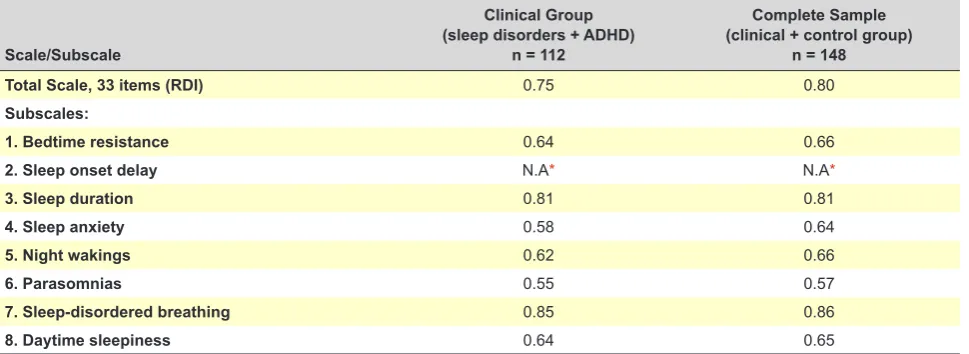
Scale and subscale internal consistency was assessed by use of Cronbach’s alpha (Table 1). A 0.75 alpha value in both clinical groups (sleep disorders and ADHD group) and 0.80 in the whole group of patients has been found by use of the full-scale CSHQ-PT. As regards internal consistency of CSHQ-PT subscales, alpha coefficient ranged between 0.55 and 0.85 in clinical groups and between 0.57 and 0.86 in the whole group of patients.
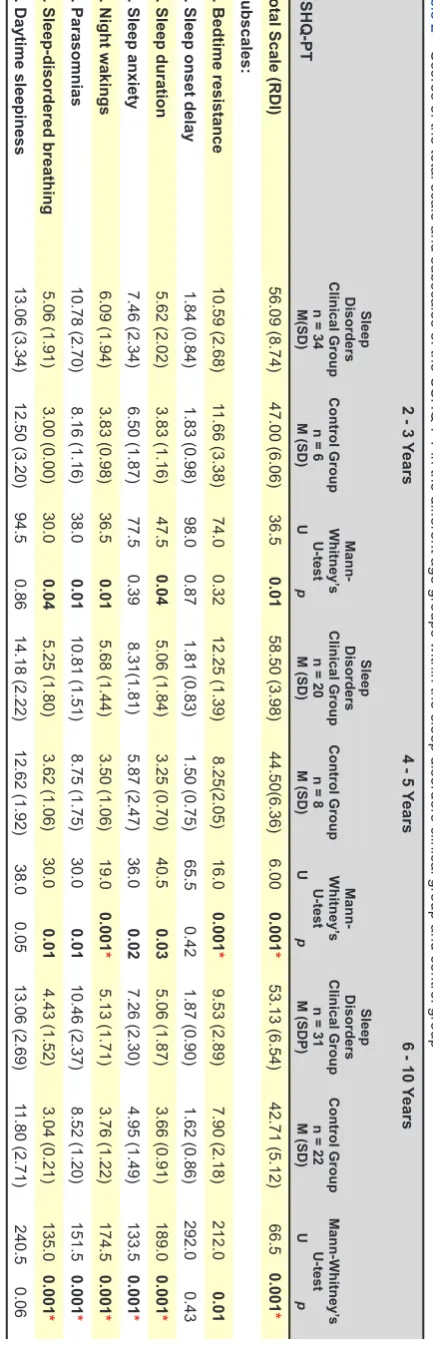
CSHQ-PT scores were compared by age group (2-3, 4-5 and 6-10 years), as a different age distribution has been found between sleep disorders clinical and control groups (a lower mean age was found in the sleep disorders clinical group). Higher RDI values were found in the sleep disorders clinical group in all age groups, when compared to the other groups. Higher scores have been found in ‘Sleep dura -tion’, ‘Night wakings’, ‘Parasomnias’ and ‘Sleep-disordered breathing’ subscales in 2-3 age group in the sleep disorders clinical group, while more problems in ‘Bedtime resistance’, ‘Sleep duration’, ‘Sleep anxiety’, ‘Night wakings’, ‘Parasom -nias’ and ‘Sleep-disordered breathing’ subscales have been found in the 4-5 and 6-10 age groups in the sleep disorders clinical group. Therefore, no significant differences were found in ‘Sleep onset delay’ and ‘Daytime sleepiness’ sub -scales (Table 2).
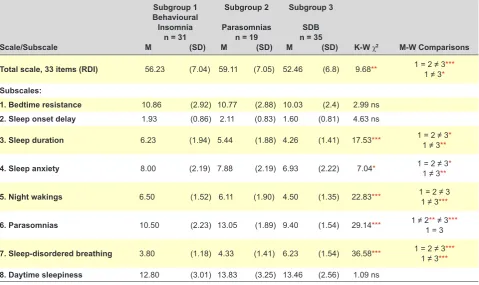
Significant differences in total score and in most sub -scales were found when the -scales of the three diagnostic subgroups of the sleep disorders clinical group were com -pared (Table 3).
Similar results were found between Behavioural insom -nia and Parasom-nias subgroups, except regarding the Par -asomnias´ subscale (MW U = 110.0; p < 0.01). A trend to -wards more problems regarding sleep duration were found in the Behavioural insomnia subgroup, even though no
Table 1 – Internal Consistency (Cronbach’s alpha) of the total scale and subscales of the CSHQ –PT
Scale/Subscale
Clinical Group (sleep disorders + ADHD)
n = 112
Complete Sample (clinical + control group)
n = 148
Total Scale, 33 items (RDI) 0.75 0.80
Subscales:
1. Bedtime resistance 0.64 0.66
2. Sleep onset delay N.A* N.A*
3. Sleep duration 0.81 0.81
4. Sleep anxiety 0.58 0.64
5. Night wakings 0.62 0.66
6. Parasomnias 0.55 0.57
7. Sleep-disordered breathing 0.85 0.86
8. Daytime sleepiness 0.64 0.65
ARTIGO ORIGINAL statistical significance has been reached (MW U = 225.00, p = 0.15). As expected, a higher score in the corresponding subscale has been found in children diagnosed with para -somnias.
Most differences were found in the subgroup of patients with SDB (Table 3) when compared to the two remaining subgroups. As expected, a significantly higher score in the corresponding ‘SDB’ subscale was found in the SDB sub -group, with lower scores (less problems) in ‘Sleep duration’, ‘Sleep anxiety’ and ‘Night wakings’ subscales.
No statistically significant differences were found be -tween the three groups in ‘Bedtime resistance’, ‘Sleep on -set delay’ and ‘Daytime sleepiness’ subscales.
Higher RDI values were found in the ADHD group, when compared to the control group. Higher values in ‘Sleep anxi -ety’ and ‘Parasomnias’ subscales were found in this group (Table 4).
Patients in sleep disorders clinical group and in the con -trol group were considered for the analysis of the ROC and a 0.89 (95% CI 0.830 – 0.949) estimated value has been obtained, corresponding to a good discriminatory power.11 An RDI cut-off level of ≥48 has been defined as allowing for the identification of patients with sleep disorders, with a 0.83 sensitivity and 0.69 specificity. This cut-off index cor -responds to 30.6% of the highest scores within the control group. Considering the 4-10 age group only, the same cut-off index has been found in line with the original validity study3 with a 0.87 sensitivity and 0.76 specificity. With the application of this cut-off index to the ADHD group, 11 pa -tients (40.7%) are classified as presenting with significant symptoms of sleep disorder.
DISCUSSION
This study aimed at the clinical validity of the CSHQ-PT questionnaire and 148 Portuguese patients aged 2 to 10 were included, divided into three groups: 1. Patients diagnosed with sleep disorder; 2. Patients diagnosed with ADHD; 3. Control group. In line with the American ques -tionnaire validity study, three of the most frequent diagno -ses (behavioural insomnia of childhood, parasomnias and sleep-disordered breathing) were included in the sleep dis -orders clinical group.
A 0.75 Cronbach’s alpha value for the internal consist -ency of the questionnaire has been found regarding the full-scale questionnaire in both clinical groups of patients (sleep disorders and ADHD), above the minimum recommended value (0.70) and slightly below the value found in the group of patients within the original validity study (0.78) and in the community group of patients within the Portuguese version validity study (0.78).3,10,12 A slightly higher value has been found (0.80) when the entire group of patients (n = 148) was considered. Internal consistency values ranging between 0.44 and 0.83 were obtained in subscales, in line with what was found in the study by Owens et al. (0.44-0.83).3 The lowest internal consistency (0.55) has been found in ´Para -somnias’ subscale, in line with other studies.3,10,13,14 This fact was probably due to the heterogeneous behaviours that are
Table 2
– Scores of the total scale and subscales of the CSHQ-PT
in the dif
ferent age groups within the sleep disorders clinical group and control group
CSHQ-PT
2 - 3
Years
4 - 5
Years
6 - 10
Years
Sleep
Disorders
Clinical Group
n = 34
M(SD)
Control Group
n = 6
M (SD) Mann-Whitney’ s U-test U p Sleep Disorders Clinical Group
n = 20
M (SD)
Control Group
n = 8
M (SD) Mann-Whitney’ s U-test U p Sleep Disorders Clinical Group
n = 31
M (SDP)
Control Group
n = 22
M (SD) Mann-Whitney’ s U-test U p
Total Scale (RDI)
56.09 (8.74) 47.00 (6.06) 36.5 0.01 58.50 (3.98) 44.50(6.36) 6.00 0.001 * 53.13 (6.54) 42.71 (5.12) 66.5 0.001 * Subscales:
1. Bedtime resistance
10.59 (2.68)
11.66 (3.38)
74.0 0.32
12.25 (1.39) 8.25(2.05) 16.0 0.001 * 9.53 (2.89) 7.90 (2.18) 212.0 0.01
2. Sleep onset delay
1.84 (0.84)
1.83 (0.98)
98.0 0.87
1.81 (0.83)
1.50 (0.75)
65.5 0.42
1.87 (0.90)
1.62 (0.86)
292.0 0.43
3. Sleep duration
5.62 (2.02) 3.83 (1.16) 47.5 0.04 5.06 (1.84) 3.25 (0.70) 40.5 0.03 5.06 (1.87) 3.66 (0.91) 189.0 0.001 *
4. Sleep anxiety
7.46 (2.34)
6.50 (1.87)
77.5 0.39
8.31(1.81) 5.87 (2.47) 36.0 0.02 7.26 (2.30) 4.95 (1.49) 133.5 0.001 *
5. Night wakings
6.09 (1.94) 3.83 (0.98) 36.5 0.01 5.68 (1.44) 3.50 (1.06) 19.0 0.001 * 5.13 (1.71) 3.76 (1.22) 174.5 0.001 * 6. Parasomnias 10.78 (2.70) 8.16 (1.16) 38.0 0.01 10.81 (1.51) 8.75 (1.75) 30.0 0.01 10.46 (2.37) 8.52 (1.20) 151.5 0.001 *
7. Sleep-disordered breathing
5.06 (1.91) 3.00 (0.00) 30.0 0.04 5.25 (1.80) 3.62 (1.06) 30.0 0.01 4.43 (1.52) 3.04 (0.21) 135.0 0.001 *
8. Daytime sleepiness
13.06 (3.34)
12.50 (3.20)
94.5 0.86
14.18 (2.22)
12.62 (1.92)
38.0 0.05
13.06 (2.69)
11.80 (2.71)
240.5 0.06
*
p
ARTIGO ORIGINAL
included within this scale, which are not necessarily found in combination (nocturnal enuresis, sleep-related bruxism and nightmare disorder, for instance). Therefore, we have reached the conclusion that the CSHQ-PT presents with psychometric properties within the clinical context that are similar to those that were described in the original question -naire and adequate to the context of research and screen -ing of sleep disorders.
Tendentially higher scores have been found in ‘Sleep duration’ (insufficient), ‘Sleep anxiety’ (refusal to sleep inde -pendently) and ‘Night wakings’ (more frequent) subscales in the behavioural insomnia of childhood clinical subgroup (most frequent sleep disorder in children).15 Higher scores in these subscales have been found when compared to the
SDB subgroup, which were not found when compared to the Parasomnias subgroup, with no statistically significant differences. This finding could be explained by the fact that patients in the Parasomnias subgroup frequently present with comorbid behavioural insomnia (42% of our group of patients). In fact, the presentation of more than one sleep disorder in the same patient is a frequent occurrence and this makes more difficult the composition of homogeneous groups.4,16
Higher scores in ‘Parasomnias’ and ‘Sleep-disordered breathing’ subscales have been found within each clinical subgroup. More problems were found in ‘Night wakings’ subscale at this level within the Behavioural Insomnia and Parasomnias subgroups (in which partial arousals occur).
Table 3 – Scores of the total scale and subscales of the CSHQ-PT in the sleep disorders clinical group
Scale/Subscale
Subgroup 1 Behavioural
Insomnia n = 31 M (SD)
Subgroup 2 Parasomnias
n = 19 M (SD)
Subgroup 3 SDB n = 35
M (SD) K-W χ2 M-W Comparisons Total scale, 33 items (RDI) 56.23 (7.04) 59.11 (7.05) 52.46 (6.8) 9.68** 1 = 2 ≠ 31 ≠ 3****
Subscales:
1. Bedtime resistance 10.86 (2.92) 10.77 (2.88) 10.03 (2.4) 2.99 ns 2. Sleep onset delay 1.93 (0.86) 2.11 (0.83) 1.60 (0.81) 4.63 ns
3. Sleep duration 6.23 (1.94) 5.44 (1.88) 4.26 (1.41) 17.53*** 1 = 2 ≠ 31 ≠ 3***
4. Sleep anxiety 8.00 (2.19) 7.88 (2.19) 6.93 (2.22) 7.04* 1 = 2 ≠ 31 ≠ 3***
5. Night wakings 6.50 (1.52) 6.11 (1.90) 4.50 (1.35) 22.83*** 1 = 2 ≠ 31 ≠ 3***
6. Parasomnias 10.50 (2.23) 13.05 (1.89) 9.40 (1.54) 29.14*** 1 ≠ 21 = 3** ≠ 3***
7. Sleep-disordered breathing 3.80 (1.18) 4.33 (1.41) 6.23 (1.54) 36.58*** 1 = 2 ≠ 31 ≠ 3******
8. Daytime sleepiness 12.80 (3.01) 13.83 (3.25) 13.46 (2.56) 1.09 ns
*p < 0.05; ** p < 0.01; ***p < 0,001; ns: non-significant; SDB: sleep-disordered breathing; K-W: Kruskal-Wallis; M-W: Mann-Whitney
Table 4 – Scores of the total scale and subscales of the CSHQ-PT in ADHD clinical group and control group
Scale/Subscale
ADHD Clinical Group n = 27
M (SD)
Control Group n = 36 M (SD)
Mann-Whitney’s U-test U p
Total Scale, 33 items (RDI) 47.70 (7.41) 43.85 (5.64) 334.5 0.04 Subscales:
ARTIGO ORIGINAL Globally, the differences in CSHQ-PT subscales between the clinical subgroups have shown discriminatory validity for the evaluation of the most frequently found sleep disor -ders. As expected, a higher RDI was found in clinical groups when compared to the control group.
The analysis of the ROC curve of the RDI allowed for the identification of a 48 cut-off index for the screening of sleep disorders, which presents as more appropriate for the Portuguese population than what has been recommended by the original validity study (41).3 This value was in line with what was recommended by Silva et al. based on the assessment of a non-clinical group of Portuguese children.4 The assessment of the RDI does not replace the analysis of subscales and individual items/symptoms, given to the predominance of behavioural items. In addition, it is worth mentioning that a positive screening does not correspond to a diagnosis, rather requiring the integration of the results with the patient’s medical history, medical examination and possible diagnostic testing within a clinical setting.
A higher RDI value was found in the clinical ADHD group when compared to the other groups, as well as in ‘Sleep anxiety’ and ‘Parasomnias’ subscales. A higher incidence of sleep disorders in children with ADHD has also been de -scribed in other studies using the CSHQ.5,17-21 In fact, the application of the 48 RDI cut-off in the ADHD group corre -sponds to a positive screening of sleep disorders in 40.7% of the patients, in line with what has been found in our study (44.8% of the patients with moderate sleep problems).22 As a group, children with ADHD present with more sleep-relat -ed problems. For this reason, the screening of sleep dis -orders is crucial in this population, even more so because sleep disorders could trigger similar symptoms or worsen ADHD clinical characteristics.21
We are aware of some limitations of this study. In line with other previous validity studies, convenience samples have been used, which could not represent the study popu -lation. Still, no significant differences in sleep disorders re -lated to parents/caregivers education, population density of the place of residence and with the recruiting location (public vs. private schools) were found in a previous study with Portuguese children.6 In addition, the systematic clini -cal assessment of sleep disorders in the control group be
-yond the filling out of the questionnaire was not ensured, in line with the American validity study.3 The response rate (70.9%) was quite reasonable, when compared to the origi -nal validity study (46.9%) and with the validity study by Silva et al. (74%).10 The small sample size of the ADHD clinical group was another limitation of the study and therefore any relationship between sleep problems and the form of pres -entation was not allowed.
Questionnaire validity is an ongoing task. The identifica -tion of the characteristics of sleep problems associated with other populations within clinical settings and the efficacy of prevention programs or treatment of sleep disorders will be made possible in further studies by use of this instrument.
CONCLUSION
Adequate psychometric properties in children with sleep disorders and ADHD were shown by the Portuguese ver -sion of the Children’s Sleep Habits Questionnaire. A 48 RDI cut-off value is more appropriate for the Portuguese popula -tion than the one recommended by the American validity study. This is therefore a useful instrument for screening and research of these disorders in Portuguese children.
HUMAN AND ANIMAL PROTECTION
The authors declare that the followed procedures were according to regulations established by the Ethics and Clini -cal Research Committee and according to the Helsinki Dec -laration of the World Medical Association.
DATA CONFIDENTIALITY
The authors declare that they have followed the proto -cols of their work centre on the publication of patient data.
Informed consents were obtained.
CONFLICTS OF INTEREST
The authors declare that there were no conflicts of inter -est in writing this manuscript.
FINANCIAL SUPPORT
The authors declare that there was no financial support in writing this manuscript.
REFERENCES
1. Moszczynski A, Murray JB. Neurobiological aspects of sleep physiology. Neurol Clin. 2012;30:963-85.
2. Ferreira C, Ferreira H, Vieira MJ, Costeira M, Branco L, Dias Â, et al. Epidemiologia do uso de internet numa população adolescente e sua relação com hábitos de sono. Acta Med Port. 2017;30:524-33. 3. Owens JA, Spirito A, McGuinn M. The Children’s Sleep Habits
Questionnaire (CSHQ): psychometric properties of a survey instrument for school-aged children. Sleep. 2000;23:1043-51.
4. Silva FG, Silva CR, Braga LB, Neto AS. Hábitos e problemas do sono dos dois aos dez anos: estudo populacional. Acta Pediatr Port. 2013;44:196-202.
5. Gruber R, Fontil L, Bergmame L, Wiebe TS, Amsel R, Frenette S, et al. Contributions of circadian tendencies and behavioral problems to sleep onset problems of children with ADHD. BMC Psychiatry. 2012;12:212. 6. Silva FG. Hábitos e problemas do sono das crianças dos 2 a 10 anos.
Lisboa: Nova Medical School, Universidade Nova de Lisboa; 2014. p. 52-60, 106, 171-4.
7. Spruyt K, Gozal D. Pediatric sleep questionnaires as diagnostic or epidemiological tools: A review of currently available instruments. Sleep Med Rev. 2011;15:19-32.
8. American Academy of Sleep Medicine. International classification of Sleep Disorders. 3rd ed. Darien: AASM; 2014.
9. American Psychiatric Association. Diagnostic and statistical manual of mental disorders 5th ed. Washington: APA; 2013.
10. Silva FG, Silva CR, Braga LB, Neto AS. Portuguese Children’s Sleep Habits Questionnaire - validation and cross-cultural comparison. J Pediatr. 2014;90:78-84.
11. Marôco J. Análise estatística, com o SPSS Statistics. 6ª ed. Lisboa: ReportNumber; 2014.
ARTIGO ORIGINAL
Graw-Hill; 1994.
13. Tzchishinsky O, Lufi D, Shochat T. Reliability of the Children’s Sleep Habits Questionnaire Hebrew translation and cross cultural comparison of the psychometric properties. Sleep Diagnosis and Therapy. 2008;3:30–4.
14. Schlarb A, Schwerdtle B, Hautzinger M. Validation and psychometric properties of the German version of the Children’s Sleep Habits Questionnaire (CSHQ-DE). Somnologie. 2010;14:260–6.
15. Nunes JM, Bruni O. Insomnia in childhood and adolescence: clinical aspects, diagnosis, and therapeutic approach. J Pediatr. 2015; 91:26-35.
16. Moore M, Allison D, Rosen CL. A review of pediatric nonrespiratory sleep disorders. Chest. 2006;130:1252-62.
17. Abou-Khadra MK, Amin OR, Shaker OG, Rabah TM. Parent reported sleep problems, symptom ratings, and serum ferritin levels in children with attention-deficit/hyperactivity disorder: a case control study. BMC Pediatrics. 2013;13:217.
18. Yürümez E, Kılıç BG. Relationship between sleep problems and quality of life in children aith ADHD. J Atten Disord. 2016;20:34-40.
19. Vaidyanathan S, Shah H, Gayal T. Sleep disturbances in children with attention deficit/ hyperactivity disorder (ADHD): comparative study with healthy siblings. J Can Acad Child Adolesc Psychiatry. 2016;25:3. 20. Gomes AA, Parchão C, Almeida A, Clemente V, Pinto de Azevedo
MH. Sleep-wake patterns reported by parents in hyperactive children diagnosed according to ICD-10, as compared to paired controls. Child Psychiatry Hum Dev. 2014;45:533-43.
21. Chamorro M, Lara PJ, Inmaculada I, Espadas M, Alda-Díez, JA. Evaluación y tratamiento de los problemas de sueño en niños diagnosticados de trastorno por déficit de atención/ hiperactividad: actualización de la evidencia. Rev Neurol. 2017; 64:413-21.