CORROSION INHIBITION BY TRYPTOPHAN- Zn
2+SYSTEM
FOR CARBON STEEL IN SEA WATER
S. Gowri
[a*],J. Sathiyabama
[a]S. Rajendran
[a, b]and J. Angelin Thangakani
[c]Keywords: Corrosion inhibition, amino acids, carbon steel, tryptophan, FTIR, AFM
The inhibitive effect of Tryptophan- Zn2+ system in controlling the corrosion of carbon steel in sea water was investigated by weight loss
method. Results of weight loss method indicated inhibition efficiency increased with increasing the inhibitor concentration. The corrosion inhibition was observed due to the formation of more stable and compact protective film on the metal surface. The surface morphology of the protective film on the metal surface was analyzed by FTIR and AFM analysis.
*Corresponding Authors
*E-mail: [email protected]
[a] PG and Research Department of Chemistry, Corrosion Research Centre, GTN Arts College, Dindigul-624 005, India. Email: [email protected]
[b] Department of Chemistry, RVS School of Engineering and Technology, Dindigul, India. Email: [email protected] [c] CEOA Matriculation Higher Secondary School, A
Kosakulam, Madurai, India.
INTRODUCTION
The corrosion process in deep seawaters occurs under very specific conditions and is characterized mainly by low temperature, high chloride contents, low oxygen content, the presence of CO2 and H2S, microorganisms and high contents
of dissolved salts.1-4 Seawater systems are used by many
industries such as shipping, offshore oil and gas production, power plants and coastal industrial plants. The main use of seawater is for cooling purposes but it is also used for fire fighting, oil field water injection and for desalination plants.
Tryptophan is a non-toxic, relatively cheap amino acid that is easy to produce in purity greater than 99%.Amino acids are nontoxic, relatively cheap, and easy to produce with purities greater than 99%. Recently, with respect to amino acid as corrosion inhibitor, many achievements have been gained in laboratory studies.5-10 Furthermore, as
environmental and non-phosphorus corrosion and scale inhibitors, poly (aspartic acid) and poly (epoxy succinic acid), which are the amino acid derivatives, have been widely used in industrial recirculating cooling water systems, showing an excellent performances.11, 12
Tryptophan is a derivative of indole ring. Based on the analysis of molecule structure of tryptophan Figure 1, it has the potential to become an excellent corrosion inhibitor. Ashassi-Sorkhabi et al.13 reported that compared with the
other amino acids, including alanine, leucine, valine, proline, and methionine, tryptophan exhibited the best inhibition efficiency toward the corrosion of aluminum in 1 M HCl + 1 M H2SO4, which was attributed to the excess nitrogen atoms
in molecule structure and the relatively large molecule volume.
Molecular structure of tryptophan is shown in scheme 1. Space filling model of tryptophan is shown in scheme 2.
Scheme 1. Tryptophan or (2S)-2-amino-3-(1H-indol-3-yl)propanoic acid
Scheme 2. Space filling model of tryptophan
The present work is under taken to evaluate the inhibition efficiency of tryptophan- Zn2+ system in controlling
corrosion of carbon steel immersed in the absence and presence of Zn2+ by weight loss method and to analyse the
MATERIALS AND METHODS
Preparation of specimen
Carbon steel specimens [0.0267 % S, 0.06 % P, 0.4 % Mn, 0.1 % C and the rest iron] of dimensions 1.0 cm x 4.0 cm x 0.2 cm were polished to a mirror finish and degreased with trichloroethylene.
Weight-loss method
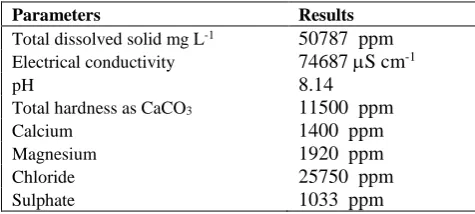
Carbon steel specimens in triplicate were immersed in 100 mL of the sea water (Table 1) containing various concentrations of the inhibitor in the presence and absence of Zn2+ for one day. The weight of the specimens before and
after immersion was determined using a Shimadzu balance, model AY62. The corrosion products were cleansed with Clarke’s solution.14 The inhibition efficiency (IE) was then
calculated using the equation:
where
W1 corrosion rate in the absence of the inhibitor,
W2 corrosion rate in the presence of the inhibitor.
Corrosion rate (CR, in mm year-1) was calculated using
the formula.
where
W weight loss in milligram
D density of specimen g cm-3
A area of specimen in square cm T exposure time in hours
Surface examination study
The carbon steel specimens were immersed in various test solutions for a period of 1 day. After 1 day, the specimens were taken out and dried. The nature of the film formed on the surface of the metal specimen was analyzed by surface analysis techniques.
FTIR spectra
The film formed on the metal surface was carefully removed and mixed thoroughly with KBr. The FTIR spectra were recorded in a perkin elmer 1600 spectrophotometer.
Atomic Force Microscopy characterization (AFM)
The carbon steel specimen immersed in blank and in the inhibitor solution for a period of one day was removed, rinsed with double distilled water, dried and subjected to the
surface examination. Atomic force microscopy (Veeco Dinnova model) was used to observe the samples’ surface in tapping mode, using cantilever with linear tips. The scanning area in the images was 5 μm × 5 μm and the scan rate was 0.6 Hz s-1.
RESULTS AND DISCUSSION
Analysis of Weight loss Study
The corrosion inhibition efficiencies of tryptophan-Zn2+
systems are given in the Table 2.
Table 1. Physicochemical parameters of sea water (Ramnad, Tamil Nadu, India)
Parameters Results
Total dissolved solid mg L-1 50787 ppm
Electrical conductivity 74687 S cm-1
pH 8.14
Total hardness as CaCO3 11500 ppm
Calcium 1400 ppm
Magnesium 1920 ppm
Chloride 25750 ppm
Sulphate 1033 ppm
The calculated corrosion inhibition efficiency (IE) and corrosion rate (CR) of tryptophan in controlling corrosion of carbon steel in sea water, for a period of one day in absence and presence of zinc ion are given in Table 2.
It is observed from the Table 2 the calculated value indicates the ability of Tryp to be a good inhibitor. The IE is found to be enhanced in the presence of Zn2+ ion. tryp alone
shows some inhibition efficiency. For example 250 ppm of tryptophan shows 48% of IE. The concentration of tryptophan increases, the IE also increases. Similarly for a given concentration of tryptophan, the IE increases as the concentration of Zn2+ increases. A synergistic effect exists
between tryp and Zn2+. For example, 20 ppm of Zn2+ has 41
percent of IE; 250 ppm of tryptophan has 48 percent IE. Interestingly their combination has High IE, namely, 79 %.15-17
Therefore the mixture of inhibitors shows better IE than individual inhibitors. In the presence of Zn2+, more amount
of tryp is transported towards the metal surface. Fe2+-tryp
complex is formed on the anodic sites of the metal surface. Thus the anodic reaction is
Fe --- Fe2+ + 2e
-controlled. The cathodic reaction is the generation of OH-
O2 + 2H2O + 4e- 4OH-
which is controlled by the formation of Zn(OH)2 on the
cathodic sites of the metal surface. Thus the anodic reaction and cathodic reaction are controlled effectively. This accounts for the synergistic effect existing between Zn2+ and
tryptophan.18, 19
Synergism parameter
2
100 1 (1)
1
W IE
W
87.6 W (2)
CR
Synergism parameters (SI) have been used to known the
synergistic effect existing between two inhibitors. SI value is
found to be greater than one suggesting that the existence of synergistic effect between the inhibitors. 20, 21
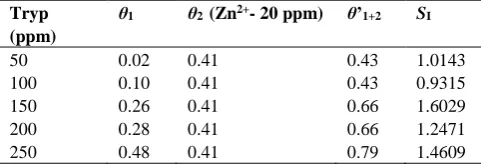
In Table 3 synergism parameters were calculated using the relation
where
1+2 is equal with (1+2) - (12)
1 is the surface coverage of inhibitor (tryp)
2 is the surface coverage of inhibitor (Zn2+)
’1+2 is the combined surface coverage of inhibitors
(tryptophan) and (Zn2+)
The surface coverage is:
From the Table 3 it can be seen that the values of SI
greater than unity, suggesting that the phenomenon of synergism existing between tryp- Zn2+ .
Table 2. Inhibition efficiencies (IE) and corrosion rates (CR) obtained from tryp - Zn2+ systems, when the carbon steel immersed
in sea water. Inhibitor system: - tryptophan- Zn2+
Table 3. Synergism parameter (SI) for carbon steel immersed in
Sea water in the absence and presence of inhibitors.
Tryp (ppm)
θ1 θ2 (Zn2+- 20 ppm) θ’1+2 SI
50 0.02 0.41 0.43 1.0143
100 0.10 0.41 0.43 0.9315 150 0.26 0.41 0.66 1.6029 200 0.28 0.41 0.66 1.2471 250 0.48 0.41 0.79 1.4609
Analysis of FTIR Spectra
FTIR spectrometer is a power instrument that is used to determine the formation of bonds for organic inhibitors adsorbed on the metal surface. FTIR spectra have been used to analyze the protective film formed on metal surface. The structure of tryptophan is shown in scheme 1. The space filling model of tryptophan is shown in scheme 2. FTIR
spectrum of pure tryp is given in (Figure 1.) The CN stretching frequency appears at 1237 cm-1. The C=O
stretching frequency of carboxyl group appears at 1661 cm-1.
The NH stretching frequency appears at 3402 cm-1.The
aromatic ring appears at 1410 cm-1.
The FTIR spectrum of the film formed on the metal surface after immersion in the sea water for 1 day containing 250 ppm of tryp and 20 ppm of Zn2+ is shown in (Fig 2.)
The CN stretching frequency has shifted from 1237 to 1229 cm-1. The C=O stretching frequency shifted from 1661 to
1637 cm-1. The NH stretching frequency shifted from 3402
to 3429 cm-1. This indicates that the nitrogen atom of Tryp
has coordinated with Fe2+ formed on the metal surface
resulting in the formation of Fe2+- Tryp complex on the
anodic sites of the metal surface. The peak at 1366 cm-1 is
due to Zn-O stretching. The stretching frequency due to – OH appears at 3033 cm-1. Thus FITR study leads to the
conclusion that the protective film consist of Fe2+-tryp
complex and Zn (OH)2 on the metal surface.22- 26
Atomic Force Microscopy Characterization
Atomic force microscopy (AFM) or scanning force microscopy (SFM) is a very high-resolution type of scanning probe microscopy, with demonstrated resolution Tryptophan
(ppm)
Zn2+ ( 0 ppm) Zn2+ (20 ppm) IE % CR mm y-1 IE% CR, mm y-1
0 - 0.1809 41 0.1067
50 2 0.1773 43 0.1031
100 10 0.1628 53 0.0796 150 26 0.1339 66 0.0615 200 28 0.1302 66 0.0615 250 48 0.0941 79 0.0379
1 1 2
(3)
I '
1 1 2
S
(%)
(4) 100
IE S
Figure 1. FTIR spectrum of pure tryptophan
on the order of fractions of a nanometer, more than 1000 times better than the optical diffraction limit.
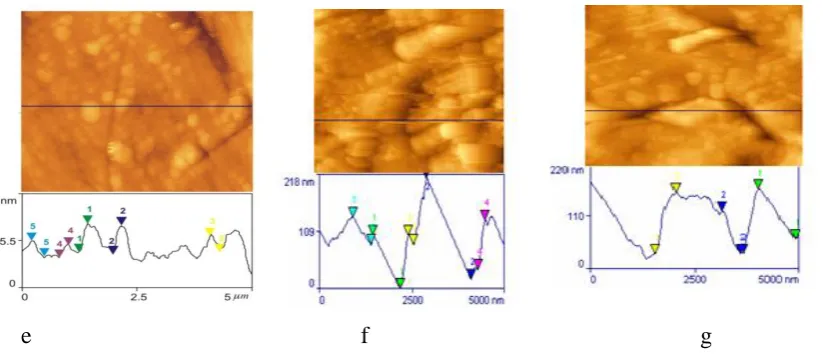
The three dimensional (3D) AFM morphologies and the AFM cross-sectional profile for polished carbon steel surface (reference sample), carbon steel surface immersed in sea water (blank sample) and carbon steel surface immersed in sea water containing the formulation of 250 ppm of tryptophan and 20 ppm of Zn2+ are shown as Fig. 3a and 3d,
Fig. 3b and 3e and Fig. 3c and 3f respectively.
Root–mean-square roughness, average roughness and peak-to-valley value AFM image analysis was performed to obtain the average roughness, Ra (the average deviation of
all points roughness profile from a mean line over the evaluation length), root-mean-square roughness, Rq (the
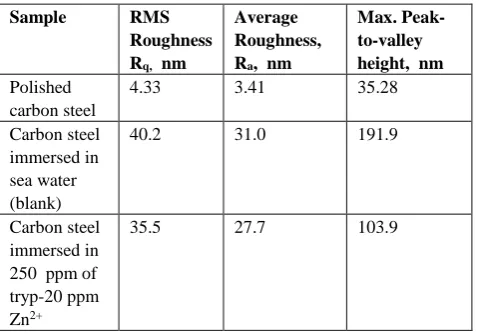
average of the measured height deviations taken within the evaluation length and measured from the mean line) and the maximum peak-to-valley (P-V) height values (largest single peak-to-valley height in five adjoining sampling heights). Table 4.is a summary of Rq, Ra, and P-V value for carbon
steel surface immersed in different environment.
Fig. 3a and 3d displays the surface topography of un-corroded metal surface. The value of Rq, Ra and P-V height
for the polished carbon steel surface (reference sample) are 4.3 nm, 3.41 nm and 35.28 nm respectively. The slight roughness observed on the polished carbon steel surface is
due to atmospheric corrosion. Fig. 3b and 3e displays the corroded metal surface with few pits in the absence of the
inhibitor immersed in sea water. The Rq, Ra and P-V height
values for the carbon steel surface are 40.2 nm, 31.0 nm and 191.9 nm respectively. These data suggests that carbon steel surface immersed in sea water has a greater surface roughness than the polished metal surface, which shows that the unprotected carbon steel surface is rougher and was due to the corrosion of the carbon steel in sea water environment.
Fig. 3c and 3f displays the steel surface after immersion in sea water containing 250 ppm of tryp and 20 ppm of Zn2+.
The Rq, Ra and P-V height values for the carbon steel surface
are 25.8 nm, 19.7 nm and 71.53 nm respectively The Rq, Ra
and P-V height values are considerably less in the inhibited environment compared to the uninhibited environment. These parameters confirm that the surface is smoother. The smoothness of the surface is due to the formation of a
compact protective film of Fe2+-tryptophan complex and
Zn(OH)2 on the metal surface thereby inhibiting the
corrosion of carbon steel.27-30
Mechanism of Corrosion inhibition
The results of the weight-loss study show that the formulation consisting of 250 ppm of tryptophan and 20 ppm of Zn2+ has 79% IE in controlling corrosion of carbon
steel in sea water. A synergistic effect exists between Zn2+
a
b
cFigure 3. Three dimensional AFM images of the surface of: a) As polished carbon steel (control); b) carbon steel immersed in sea water (blank); c) carbon steel immersed in sea water containing tryp (250 ppm) + Zn2+ (20 ppm)
e
f
g
and Tryp. FTIR spectra reveal that the protective film consists of Fe2+–Tryp complex and Zn(OH)
2. In order to
explain these facts the following mechanism of corrosion inhibition is proposed.
Table 4. AFM data for carbon steel surface immersed in inhibited and uninhibited environment.
When the solution containing sea water, 20 ppm Zn2+ and
250 ppm of tryp is prepared, there is formation of Zn2+–Tryp
complex in solution.
When carbon steel is immersed in this solution, the Zn2+
-Tryp complex diffuses from the bulk of the solution towards metal surface.
Zn2+- tryp complex diffuses from the bulk solution to the
surface of the metal and is converted into a Fe2+-Tryp
complex, which is more stable than Zn2+- tryp.
On the metal surface Zn2+-Tryp complex is converted in to
Fe2+-Tryp on the anodic sites. Zn2+ is released
Zn2+ - tryp + Fe2+ →Fe2+ - tryp + Zn2+
The released Zn2+ combines with OH- to form Zn(OH) 2 on
the cathodic sites
Zn2+ + 2OH- → Zn(OH) 2 ↓
Thus the protective film consists of Fe2+-Tryp complex
and Zn (OH)2. The FTIR and AFM images confirm the
formation of protective layer on the metal surface.
CONCLUSIONS
The present study leads to the following conclusions.
The formulation consisting of 250 ppm tryp and 20 ppm Zn2+ has 79% inhibition efficiency to carbon steel immersed
in sea water.
FTIR spectra reveal that the protective film consists of tryp- Fe2+ complex.
The AFM analysis reveals that the protective film is formed on the metal surface.
ACKNOWLEDGEMENT
The authors are thankful to DRDO India for their help and encouragement
REFERENCES
1Alsenmo, N., May, J. E., Mariano, N. A., Nascente, P. A. P., Kuri,
S. E., Mater. Sci. Eng., 2006, 428, 73–79.
2Baorong, H., Jinglei, Z., Yanhu, L., Fangying, Y., Study on effect
seawater saliniyu on electrochemical performance of Al anode. Department of Marine Corrosion, Institute of Oceonology, Chinese Academy of Sciences, Chine, 2001.
3Bethencourt, M., Botana, F. J., Cauqui, M. A., Marcos, M.,
Rodriguez, M. A., J. Alloys. Compd, 1997, 250, 455-460.
4Wharton, J. A., Barik, R. C., Kear, G., Wood, R. J. K., Stokes, K.
R., Walsh, F.C., Corros. Sci., 2005, 47, 3336–3367.
5Badawy, W. A., Ismail, K. M., Fathi, A. M., Electrochim. Acta,
2006, 51(20), 4182.
6Morad, M. S., J. Appl. Electrochem., 2008, 38(11), 1509. 7Olivares, O., Likhanova, NV, Gómez, B., Navarrete, J.,
Llanos-Serrano, M. E., Arce, E., Hallen, J. M., Appl. Surf. Sci., 2006, 252(8), 2894.
8Olivares-Xometl, O., Likhanova, NV., Domínguez-Aguilar, MA.,
Arce, E., Dorantes, H., Arellanes- Lozada, P., Mater. Chem. Phys., 2008, 110(2–3), 344.
9Barouni, K., Bazzi, L., Salghi, R., Mihit, M., Hammouti, B.,
Albourine, A., El Issami, S., Mater. Lett., 2008, 62(19), 3325.
10Ismail, K. M., Electrochim. Acta., 2007, 52(28), 7811.
11Liu, GH., Xi, DL., Li, Y., Lu, Z., Corros. Prot, 2003, 24(11), 480. 12Silverman, D. C., Kalota, D. J., Stover, F. S., Corros., 1995,
51(11), 818.
13 El-Rabiee, M. M., Helal, N. H., Gh, M. A., El-Hafez, W. A.,
Badawy., J. Alloys Compd., 2008, 459 (1-2), 466-471.
14Wranglen, G., Introduction to Corrosion and Protection of
Metals, Chapman & Hall, London., 1985, 236.
15Abdel-Fatah, H. T. M., Anti-Corros. Methods. Mat., 2012, 59,
23-31.
16Abdel Rahman, H. H., Moustafa, A. H. E., Awad, M. K., Int. J.
Electrochem. Sci., 2012, 7, 1266-1287.
17Johnsirani, V., Sathiyabama, J., Rajendran, S., Shanthi, T.,
Muthumegala, T. S., Krishnaveni, A., Bulg. Chem. Commun., 2012, 44, 41-51.
18Wilson Sahayaraj, J., John Amal Raj, A., Rajendran, S., and
Vijaya, N., E. J. Chem., 2012, l (9), 1746-1752.
19Johnsirani, V., Sathiyabama, J., Rajendran, S., and Suriya Prabha,
A., ISRN Corros., 2012, 2012, 1.
20Rajendran, S., Shanmugapriya, S., Rajalakshmi, T. and Raj, A. J.
A., Corros., 2005, 61(7), 685–692.
21Anuradha, K., Vimala, R., Narayanaswamy, B., Selvi, J. A., and
Raji, S., Chem. Eng. Commun., 2008, 195(3), 352–366.
22Silverstein, R. M., Bassler, G. C., Moril, T., Spectrometric
Identification of Organic Compound, John Wiley and Sons, New York., 1981, 95.
23Sathiyabama, J., Rajendran, S., Selvi, J. A. and Jeyasundari, J.,
The Open Corros. J., 2009, 2, 77-82.
24Cross, A. D., Introduction to practical infrared spectroscopy,
Butterworths, Scientific Publication, London, 1990, 73.
25Nakamoto, K., Infrared and Raman spectra of inorganic
coordination compound, Willey Interscience, New York, 1986.
26Sekine, I., and Hirakawa, V., Corros., 1986, 42, 272-277. 27Gowri, S., Sathiyabama, J., Rajendran, S., Robert Kennedy, Z.,
and Agila Devi, S., Chem. Sci. Trans, 2013, 2(1), 275-281. Sample RMS
Roughness Rq, nm
Average Roughness, Ra, nm
Max. Peak-to-valley height, nm Polished
carbon steel
4.33 3.41 35.28
Carbon steel immersed in sea water (blank)
40.2 31.0 191.9
Carbon steel immersed in 250 ppm of tryp-20 ppm Zn2+
28Mary anbarasi, C., and Rajendran, S., J. Electrochem. Sci. Engg,
2012, 2, 1-18.
29Anthony Samy Sahayaraja, and Rajendran., S., J. Electrochem.
Sci. Eng., 2012, 2, 91-104.
30Gowri, S., Sathiyabama, J., Rajendran, S., Angelin Thangakani,
J., Eur. Chem. Bull, 2013, 2(4), 214-219.