COMPOSITION OF HYDROCARBON TYPE FUELS FORMED IN
THERMAL DECOMPOSITION OF MUNICIPAL SOLID WASTE
PLASTICS AND CALCIUM CARBONATE
Moinuddin Sarker
[a]*, Mohammad Mamunor Rashid
[a], Muhammad Sadikur
Rahman
[a]Keywords: waste plastics, thermal degradation, hydrocarbon, fuel, municipal, conversion, calcium carbonate, GC/MS
Random mixtures of waste plastics raw materials were thermolysed into liquid hydrocarbons at laboratory scales in a batch process by using a stainless steel reactor. Two series of experiments were carried out with random mixtures of waste plastics such as low and high density polyethylene, polypropylene, and polystyrene in the presence of 10 and 20 % calcium carbonate, respectively, at temperatures between 100 and 430 ºC. Four types of randomly mixed waste plastics were used in each series of experiments. The hydrocarbon oils formed were analyzed by using a gas chromatography and mass spectrometer (GC/MS) to determine the amounts and types of hydrocarbons. By using 10% calcium carbonate, the formed hydrocarbon mixture contained C4 to C40compounds while, in the presence of
20% calcium carbonate, the product consists of C3 to C27 hydrocarbons determined by GC/MS analysis. Due to the high number of
hydrocarbons in the oils formed in each series of thermal decomposition experiment, the oily products can be used as fuels for internal combustion engines or electric power plants.
* Corresponding Authors Fax: (203) 406-9852
E-Mail: [email protected]
[a] Natural State Research, Inc., Department of Research and Development, 37 Brown House Road (2nd Floor),
Stamford, CT-06902, USA
Introduction
In 1993, waste plastics accounted for roughly 10% of
all municipal solid waste (MSW) in the USA
1with
percentages in land filled MSW ranging from 15 to 25%
depending upon location. The energy demand
continuously increases and market structures evolve
2as
well, thus utilization of renewable energy sources such as
wind and solar power has gained considerable importance
since the oil crisis in the 1970s.
3Europe’s total energy
consumption is expected to be covered by renewable
energy sources in up to 10% by 2020
2, the remaining 90%
still being dependent on fossil energy sources. Total
waste production increased by about 10% in Europe
between 1990 and 1995, with the annual amount
estimated at 1.3 billion tons in 1995. The annual amount
of hazardous waste was about 36 million tons.
4In 2010,
the amount of paper, glass, and plastic waste was
expected to
be about 60% higher than the 1990 levels,
and the number of scrapped cars was expected to have
grown 35% higher.
4Landfill and incineration are
common modes of waste treatment in most European
countries
4and co-incineration is commonly used
particularly in the cement industry.
5,6The European waste directive called for a 30%
reduction of waste amount land filled by 2010. Land
filling of plastic wastes is undesirable due to poor
biodegradability
7of polymer materials and, on the other
hand, these plastic wastes can be regarded as a potentially
cheap source of chemicals and energy. The destruction of
waste plastics by incineration, however, often generates
problems with unacceptable emissions.
Chemical recycling proved to be a possible alternative
strategy, when waste plastics are used as feedstock in
various technologies, e.g. in converting them into basic
petrochemicals used as chemical feedstock or fuels in a
variety of downstream processes. There are two main
chemical recycling routes, namely the thermal and the
catalytic degradation.
8Thermal cracking is a well-known
technique and is often used in petrochemical processes.
Thermal decomposition of waste plastics in the absence
of oxygen can be carried out in various types of reactors
such as shaft kilns, rotary kilns, screw conveyors,
autoclaves, or fluidized beds.
9-12Including waste-to-energy (WTE) methods, only about
20% of all MSW was recovered in various recycling
technologies, and only 15% of the plastics occurred in
MSW were recovered in melting (“primary”) and
feedstock (“secondary” and “tertiary”) type recycling
methods. Secondary recycling can be defined as
conversion to monomers or other building blocks,
whereas, tertiary recycling means conversion to other
chemical feedstock or fuels. Waste-to-energy methods
(sometimes referred to as “quaternary recycling”) are
relatively cheap. Recently, another 20% of plastics
occurred in MSW have been utilized in this way,
however, it requires burning a large amount of
non-renewable resources as well. Public perceptions regarding
safety of incineration techniques prompted us and other
researchers to collaborate under the auspices of the
Consortium for Fossil Fuel Liquefaction Science
(CFFLS), to investigate the feasibility of coal/waste
plastics processing to liquid fuels or chemical feedstock.
Obviously, dominant components of MSW-type waste
plastics (mainly polyethylene, polystyrene, polyethylene
terephthalate and polypropylene) are rich in carbon and
hydrogen – basic building elements of petroleum – thus,
searching possibilities to convert the waste plastics into
liquid fuels seems to be a logical alternative of plastic
Eur. Chem. Bull. 2012, 1(3-4), 114-123 DOI: 10.17628/ecb.2012.1.114-123
115
Experiments
Materials
Random mixtures of waste plastic samples were
collected in a local grocery store at Stamford City which
consisted of low and high density polyethylene (HDPE
and LDPE), polypropylene (PP) and polystyrene (PS).
The samples were contaminated with foreign materials
such as food particles, paper, dust, sand. Foreign
components were separated out manually and the samples
were washed with periodical adding of liquid soap into
the washing water. Washing of plastics is not an essential
step in our plastic-to-fuel process developed, but the
laboratory scale process was performed with washed
samples. Random mixtures of waste plastics containing
both hard and soft plastic components were prepared by
cutting the soft plastics and grinding the hard ones into
pieces down to size 2-3 mm. Reagent grade anhydrous
calcium carbonate powder was provided by AMRESCO
Co.
Process Description
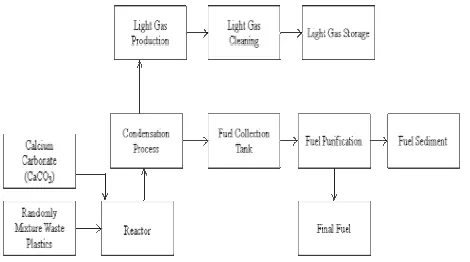
Grounded random mixtures of waste plastics were
transferred into the reactor chamber together with calcium
carbonate additive in amount of 10% or 20 % in each
experiment, respectively. The weight of every mixture
was controlled to be 1000 g. The reactor chamber and its
cover were tightened with a screw system to prevent from
gas leaking. A condensation unit and a fuel purification
device were connected to the reactor and the fuel
collection tanks, respectively. The upper outlet of the
condensation unit was connected to a gas cleaning system.
Light gases formed were transferred into a storage system
and the sediment separated by the fuel purification device
was recycled to the reactor as raw material. The heating
temperature was controlled between 100 and 430 °C,
respectively.
Figure 1: Random mixtures of waste plastics and calcium carbonate in the fuel production process
Calcium carbonate was used as additive in the reaction,
but some acceleration effect was also observed. Waste
plastics start to melt at 100 ºC and their melting was
completed below 300 ºC. Long hydrocarbon chains
broke down into short chain hydrocarbon due to heat
treatment. The liquid slurry turned into vapour which
condensed into a liquid hydrocarbon mixture. The
reaction was not completed even at 300 °C, therefore,
heating was continued until 430 ºC. The liquid
hydrocarbon mixture formed was purified with an RCI
fuel filter. Sediment was removed and reused in the next
experiment as raw material. The light gas generated
contained methane, ethane, propane, and butanes. The
light gas formed was washed with sodium hydroxide
solution. The density of the liquid formed with using
10 % calcium carbonate additive was determined as 0.78
g cm
-3. Yields of the products formed in the
decomposition process carried out with 10 and 20 %
calcium carbonate additive and 1 kg of plastics waste are
shown in Table 1. When using 10% or 20 % calcium
carbonate, 716.8 and 683.8 g liquid fuel, 155.1 and 98 g
gas, and 128.1 and 218.2 g of solid residue were formed,
respectively. It means that yields of liquid hydrocarbons,
gases, and solid residues are 71,68 and 68.38 %, 15.51
and 9.8 %, 12.81 and 21.82 % in the experiments carried
out with 10 and 20 % CaCO
3content, respectively. The
volumes of liquid phases were 922 ml and 870 ml starting
form 1 kg of mixture, with 10 and 20 % of CaCO
3content,
respectively. Both experiments left back a black solid
residue whose composition is under investigation.
Instrument
GC-MS analyses were performed on a Perkin-Elmer
Clarus 500 instrument supplied with auto-sampler system.
Elite-5 capillary column (30 meter length) and He as
carrier gas were used. The injected volume was adjusted
to be 5.0 µL, the sample split flow and the initial set point
were 101.0 mL min
-1and 1.00 ml min
-1, respectively. The
sample injector port temperature was adjusted to be 280
ºC, with 40 °C initial value. The temperature holding and
equilibration times were 1 and 0.5 minutes, respectively.
The temperature ramping was 10 ºC/ min up to 325 ºC
and there was a holding for 15 minute at 325 ºC. The
mass spectrometer was operated in EI+ mode, between
35.00 and 528.00 m/z units with 0.25 s scan and 0.15 s
interscan times.
Results
and Disc
ussion
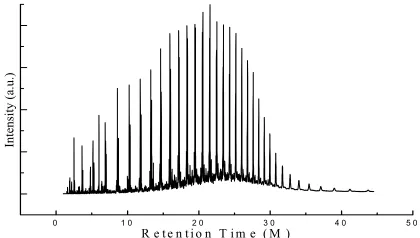
GC-MS analyses of liquids formed in the reaction of
randomly mixed waste plastics and 10% calcium
carbonate (Fig. 2 and Table 2) showed the occurrence of a
variety of components. Many compounds detected
contained carbon atoms within the range between C
3and
C
27.
Based on the retention times and fragmentation
patterns, different types of compounds such as
hydrocarbons, halogen compounds, oxygenated
compounds, and nitrogen containing compounds were
identified. The GC-MS analyses showed presence of such
characteristic compounds as 3-butene-1-ol (C
4H
8O)
(t=1.50, m/z=41), cis-1,2-dimethylcyclopropane (C5H10)
(t=2.02, m/z=55), cis-1-ethyl-2-methylcyclopropane
(C
6H
12) (t=2.50, m/z=41), Z,Z-2,4-hexadiene (C
6H
10) (t=
2.96, m/z= 67), 4-methyl-1,4-hexadiene (C
7H
12) (t=3.77,
m/z=81), 2-methyl-1,4-hexadiene (C
7H
12) (t=3.95,
m/z=81), norbornane (C
7H
12) (t=4.44, m/z=81),
-1,3,5-trimethylcyclohexane (C
9H
18) (t= 5.92, m/z= 69),
styrene (C
8H
8) (t=6.95, m/z=104), 3-decyn-2-ol
(C
10H
18O) (t=7.92, m/z=57), 4-methyldecane (C
11H
24)
(t=8.85, m/z=43), cis-1,4-dimethylcyclooctane (C
10H
20)
Figure 2: GC/MS chromatogram of the liquid product formed in the presence of 10 % CaCO3 containing random waste plastics in the mixture
(t=9.99, m/z=41),
1R-cis-1-(1,2,2,3-tetramethylcyclo-pentyl)-ethanone (C
11H
20O) (t=10.74, m/z=43), dodecane
(C
12H
26) (t=11.91, m/z=57),
N-[4-bromo-n-butyl]-2-piperidinone (C
9H
16BrN) (t=12.50, m/z=41),
4,6,8-trimethyl-1-nonene (C
12H
24) (t=13.63, m/z=43),
7-tetradecene (C
14H
28) (t=14.78, m/z=41), 1-hexadecene
(C
16H
32) (t=15.93, m/z=41). Different kinds of
hydrocarbons were formed containing aliphatic and
aromatic rings, single and double bonds such as
octadecane (C
18H
38) (t=20.56, m/z=85), octadecene
(C
18H
38) (t=23.44, m/z=85), isomeric octadecanes
(C
18H
38) (t=24.33, 25.19, 26.83, 28.41, m/z=57),
heptacosanes (C
27H
56) (t=30.82, 32.87, m/z=57, and
t=35.56, m/z=44), benzene (C
6H
6), toluene (C
7H
8),
styrene (C
8H
8), 1-methylethylbenzene (C
9H
12),
1-ethyl-3-methylbenzene (C
9H
12),
α
-methylstyrene (C
9H
10),
1-ethenyl-2-methylbenzene (C
9H
10) etc..
Some alcoholic groups containing products such as
1-eicosanol (C
20H
42O) (t= 21.75, m/z=55) could also be
detected. Dyes and additives occurring in the raw waste
plastics had no influence on quality of the produced
fuel-like liquid products.
The experiments were carried out without
evacuation of the reactor space, thus the humidity as
oxygen source might be responsible for the formation of
some oxygen–containing products.
Table 1: Product yields in thermal decomposition of waste plastics in the presence of calcium carbonate
Sample weight (g.)
CaCO3 %
(m/m)
Fuel weight (g)
Fuel volume (ml)
Residue weight (g.)
Sample as light gas weight (g.)
Fuel Yield % (m/m)
Light gas Yield % (m/m)
Residue Yield % (m/m)
1000 10 716.8 922 128.1 155.1 71.68 15.51 12.81
1000 20 683.8 870 218.2 98 68.38 9.8 21.82
Table 2: GC/MS chromatogram compound list of liquid product formed in thermal decomposition of random waste plastics and 10% calcium carbonate mixture
No. of Peak
Retention Time (min.)
Trace Mass (m/z)
Compound Name
Compound Formula
Molecular Weight
Probability %
NIST Library Number
1 1.50 41 3-Buten-1-ol C4H8O 72 17.7 114446
2 1.60 41 2-Butene C4H8 56 23.4 61292
3 1.64 41 1-Propene, 2-methyl- C4H8 56 19.3 61293
4 1.87 42 Cyclopropane, ethyl- C5H10 70 23.2 19072
5 1.91 43 Pentane C5H12 72 88.0 114462
6 1.96 55 2-Pentene C5H10 70 15.0 19079
7 2.02 55 cis-1,2-dimethyl
Cyclopropane C5H10
70 25.0 19070
8 2.06 67 1,3-Pentadiene C5H8 68 17.1 61941
9 2.13 67 1,4-Pentadiene C5H8 68 13.1 209
10 2.25 67 Cyclopentene C5H8 68 19.7 19032
11 2.32 43 Pentane, 2-methyl- C6H14 86 42.7 61279
12 2.50 41 cis-1-ethyl-2-methyl
Cyclopropane C6H12
84 18.9 113658
13 2.58 57 Hexane C6H14 86 67.2 61280
14 2.64 69 2-Pentene, 3-methyl-,
(Z)- C6H12 84
13.8 114483
15 2.68 41 3-Hexen-1-ol, (Z)- C6H12O 100 6.68 114154
16 2.72 67 4-Penten-1-ol, 3-methyl- C6H12O 100 15.5 113673
17 2.84 67 2,4-Hexadiene, (Z,Z)- C6H10 82 7.79 113646
0 5 1 0 1 5 2 0 2 5 3 0 3 5 4 0 4 5 5 0
In
te
ns
it
y (
a.u.
)
Eur. Chem. Bull. 2012, 1(3-4), 114-123 DOI: 10.17628/ecb.2012.1.114-123
117
18 2.90 56 Cyclopentane, methyl- C6H12 84 59.9 114428
19 2.96 67 2,4-Hexadiene, (Z,Z)- C6H10 82 13.1 113646
20 3.06 56 1-Pentene, 2,4-dimethyl- C7H14 98 49.4 114435
21 3.14 67 Cyclopentene, 3-methyl- C6H10 82 25.1 114408
22 3.27 78 Benzene C6H6 78 66.3 114388
23 3.38 79 1,3-Cyclohexadiene C6H8 80 23.0 118700
24 3.52 67 Cyclohexene C6H10 82 31.6 114431
25 3.57 56 1-Hexene, 2-methyl- C7H14 98 35.9 114433
26 3.62 41 cis-1,2-dimethyl-
Cyclopentane C7H14
98 26.8 114027
27 3.73 43 Heptane C7H16 100 47.6 61276
28 3.77 81 1,4-Hexadiene,
4-methyl- C7H12
96 14.4 113135
29 3.95 81 1,4-Hexadiene,
2-methyl- C7H12
96 7.17 840
30 4.07 81 Cyclobutane,
(1-methylethylidene)- C7H12
96 6.41 150272
31 4.16 83 Cyclohexane, methyl- C7H14 98 54.1 118503
32 4.30 69 Cyclopentane, ethyl- C7H14 98 28.7 940
33 4.38 79
1-Cyclohexene-1-methanol C7H12O
112 16.9 52048
34 4.44 81 Norbornane C7H12 96 7.51 114371
35 4.51 56 2,4-Dimethyl-1-hexene C8H16 112 31.6 113443
36 4.55 81 Cyclobutane,
(1-methylethylidene)- C7H12 96
13.8 150272
37 4.60 67 3-Heptene, 4-methyl- C8H16 112 7.60 114150
38 4.75 43 Heptane, 4-methyl- C8H18 114 62.3 113916
39 4.80 91 Toluene C7H8 92 41.5 291301
40 4.86 81 Cyclohexene, 3-methyl- C7H12 96 9.86 236066
41 5.06 56 1-Heptene, 2-methyl- C8H16 112 45.1 113675
42 5.15 41 1-Octene C8H16 112 16.9 1604
43 5.23 95 Cyclopropane,
(2,2-dimethylpropylidene)- C8H14
110 8.35 60981
44 5.29 43 Octane C8H18 114 36.7 229407
45 5.39 55 3-Octene, (Z)- C8H16 112 11.5 113895
46 5.46 41 4-Methyl-1,4-heptadiene C8H14 110 7.53 113473
47 5.55 69 cis-1,1,3,4-tetramethyl-
Cyclopentane C9H18
126 14.6 34789
48 5.65 43 Hexane, 3-ethyl- C8H18 114 15.8 113940
49 5.80 67
1-Methyl-2-methylenecyclohexane C8H14
110 26.7 113437
50 5.92 69 Cyclohexane,
1,3,5-trimethyl-, (1α,3α,5α)- C9H18
126 24.4 114126
51 6.01 70 2,4-Dimethyl-1-heptene C9H18 126 49.5 113516
52 6.35 69 Cyclohexane,
1,3,5-trimethyl-, (1α,3α,5β)- C9H18 126
37.2 2480
53 6.40 91 Ethylbenzene C8H10 106 66.0 114918
54 6.55 91 Cyclohexanol,
1-ethynyl-, carbamate C9H13NO2
167 35.5 313023
55 6.71 67
cis-1,4-Dimethyl-2-methylenecyclohexane C9H16
124 12.2 113533
56 6.88 41 1-Nonene C9H18 126 10.5 107756
57 6.95 104 Styrene C8H8 104 33.8 291542
58 7.02 43 Nonane C9H20 128 31.3 228006
59 7.10 55 4-Nonene C9H18 126 8.07 113904
60 7.24 55 3-Octyne, 2-methyl- C9H16 124 4.17 62452
61 7.44 67 Ethylidenecycloheptane C9H16 124 5.69 113500
62 7.49 105 Benzene,
(1-methylethyl)- C9H12
120 22.7 228742
63 7.52 67 1-Cyclohexyl-1-pentyne C11H18 150 5.42 114866
64 7.66 55 Cyclopentane, butyl- C9H18 126 9.72 114172
65 7.86 67 Cyclopentene, 1-butyl- C9H16 124 9.34 113491
67 8.01 91 Benzene, propyl- C9H12 120 56.2 113930
68 8.07 57 Octane, 2,3-dimethyl- C10H22 142 17.3 114135
69 8.13 105 Benzene,
1-ethyl-3-methyl- C9H12 120
10.7 228743
70 8.43 41 E-1,6-Undecadiene C11H20 152 11.7 245712
71 8.49 118 α-Methylstyrene C9H10 118 31.4 30236
72 8.59 41 1-Decene C10H20 140 16.6 118883
73 8.73 57 Decane C10H22 142 49.6 114147
74 8.85 43 Decane, 4-methyl- C11H24 156 15.8 113875
75 8.92 43 Octane, 3,3-dimethyl- C10H22 142 11.1 61706
76 9.27 117 Benzene,
1-ethenyl-2-methyl- C9H10
118 10.6 118193
77 9.64 41 2-Undecanethiol,
2-methyl- C12H26S
202 4.45 9094
78 9.74 91 2-Cyclohexen-1-ol,
2- methyl-5-(1-methylethenyl)-
C10H16O 152 16.3 114684
79 9.99 41 cis-1,4-dimethyl-
Cyclooctane C10H20 140
3.73 61409
80 10.06 41 Diisoamylene C10H20 140 4.19 3659
81 10.24 41 2-Undecene, (Z)- C11H22 154 6.19 142596
82 10.37 43 Undecane C11H24 156 42.5 114185
83 10.43 55 5-Undecene, (E)- C11H22 154 10.0 114227
84 10.74 43 1R-cis- 1-(1,2,2,3-tetramethylcyclopentyl)- Ethanone
C11H20O 168 5.54 186082
85 11.06 91 9-Hexadecenoic acid,
phenylmethyl ester, (Z)- C23H36O2
344 6.61 67839
86 11.12 69 1,12-Tridecadiene C13H24 180 6.65 7380
87 11.16 41 Z-10-Pentadecen-1-ol C15H30O 226 5.48 245485
88 11.67 41 6-Dodecene, (Z)- C12H24 168 5.06 142611
89 11.78 41 3-Dodecene, (E)- C12H24 168 9.21 113960
90 11.91 57 Dodecane C12H26 170 25.2 291499
91 12.38 43 Dodecane,
2,6,10-trimethyl- C15H32
212 6.60 68892
92 12.50 41 2-Piperidinone,
N-[4-bromo-n-butyl]- C9H16BrNO 233
5.17 251632
93 13.14 41 Z-10-Pentadecen-1-ol C15H30O 226 15.4 245485
94 13.25 41 2-Tridecene, (E)- C13H26 182 8.35 142614
95 13.37 43 Hexadecane C16H34 226 9.77 114191
96 13.40 41 3-Tridecene, (Z)- C13H26 182 2.47 142615
97 13.51 43 Trifluoroacetic acid,
n-heptadecyl ester C17H31F3O2 324
2.78 216792
98 13.63 43 1-Nonene,
4,6,8-trimethyl- C12H24
168 2.61 6413
99 13.99 43 1-Tetracosanol C24H50O 354 2.76 16001
100 14.36 55 1,12-Tridecadiene C13H24 180 7.61 7380
101 14.52 41 Z-10-Pentadecen-1-ol C15H30O 226 22.9 245485
102 14.63 41 1-Tetradecene C14H28 196 5.12 34720
103 14.74 43 Tetradecane C14H30 198 19.5 113925
104 14.78 41 7-Tetradecene C14H28 196 4.34 70643
105 15.47 43 2-Piperidinone,
N-[4-bromo-n-butyl]- C9H16BrNO 233
4.48 251632
106 15.70 43 7-Hexadecenal, (Z)- C16H30O 238 6.85 293051
107 15.83 41 Z-10-Pentadecen-1-ol C15H30O 226 22.7 245485
108 15.93 41 1-Hexadecene C16H32 224 5.58 118882
109 16.02 43 Hexadecane C16H34 226 22.0 114191
110 16.07 41 10-Heneicosene (c,t) C21H42 294 3.04 113073
111 16.25 43 Trichloroacetic acid,
hexadecyl ester C18H33Cl3O2
386 3.59 280518
112 16.71 43 2-Piperidinone,
N-[4-bromo-n-butyl]- C9H16BrNO 233
3.16 251632
Eur. Chem. Bull. 2012, 1(3-4), 114-123 DOI: 10.17628/ecb.2012.1.114-123
119
114 17.16 55 1-Hexadecene C16H32 224 6.90 118882
115 17.25 43 Hexadecane C16H34 226 18.3 114191
116 17.29 41 10-Heneicosene (c,t) C21H42 294 3.40 113073
117 17.44 41 E-2-Octadecadecen-1-ol C18H36O 268 4.70 131102
118 18.24 41 Z-10-Pentadecen-1-ol C15H30O 226 14.8 245485
119 18.33 55 1-Nonadecene C19H38 266 5.66 113626
120 18.41 71 Nonadecane C19H40 268 12.6 114098
121 19.44 41 1-Nonadecene C19H38 266 6.60 113626
122 19.51 43 Heneicosane C21H44 296 9.78 107569
123 20.43 55 1-Docosanol C22H46O 326 5.85 23377
124 20.56 85 Octadecane C18H38 254 9.09 57273
125 21.50 55 1-Docosene C22H44 308 9.78 113878
126 21.56 43 Octadecane C18H38 254 7.19 57273
127 21.70 43 Hexadecane,
1,1-bis(dodecyloxy)- C40H82O2
594 6.93 36104
128 21.75 55 1-Eicosanol C20H42O 298 3.91 113075
129 22.46 43 1-Docosene C22H44 308 17.5 113878
130 23.39 55 1-Docosene C22H44 308 18.6 113878
131 23.44 85 Octadecane C18H38 254 8.86 57273
132 24.28 55 1-Docosene C22H44 308 12.0 113878
133 24.33 57 Octadecane C18H38 254 7.39 57273
134 25.14 55 1-Docosene C22H44 308 9.40 113878
135 25.19 57 Octadecane C18H38 254 4.95 57273
136 26.01 57 Hexacosane C26H54 366 4.48 107147
137 26.83 57 Octadecane C18H38 254 5.08 57273
138 27.62 57 Heptacosane C27H56 380 5.54 150574
139 28.41 57 Octadecane C18H38 254 4.59 57273
140 29.19 57 Heptacosane C27H56 380 4.94 150574
141 29.72 306 1,1':3',1''-Terphenyl,
5'-phenyl- C24H18
306 50.4 57402
142 29.98 57 Heneicosane,
11-(1-ethylpropyl)- C26H54
366 4.62 16318
143 30.82 57 Heptacosane C27H56 380 7.17 79427
144 31.77 57 Heptacosane C27H56 380 7.88 79427
145 32.87 57 Heptacosane C27H56 380 9.78 79427
146 34.12 57 Heptacosane C27H56 380 10.9 79427
147 35.56 44 Heptacosane C27H56 380 8.06 79427
Table 3: GC/MS chromatogram compound list of liquid product formed in thermal decomposition of random waste plastics and 20% calcium carbonate mixture
No. of Peak
Retention Time (M)
Trace Mass (m/z)
Compounds Name
Compounds Formula
Molecular Weight
Probability % NIST Library Number
1 1.49 41 Cyclopropane C3H6 42 50.1 18854
2 1.60 41 1-Propene, 2-methyl- C4H8 56 23.3 61293
3 1.61 43 Butane C4H10 58 18.2 61290
4 1.63 41 2-Butene C4H8 56 20.5 61292
5 1.83 67 1,4-Pentadiene C5H8 68 21.5 114494
6 1.87 42 2-Pentene, (E)- C5H10 70 21.1 291780
7 1.91 43 Pentane C5H12 72 85.8 114462
8 1.95 55 cis-1,2-dimethyl-
Cyclopropane C5H10
70 23.8 19070
9 2.07 67 1,4-Pentadiene C5H8 68 19.4 114494
10 2.26 67 Cyclopentene C5H8 68 15.8 19032
11 2.32 43 Butane, 2,3-dimethyl- C6H14 86 13.9 291518
12 2.50 41 1-Hexene C6H12 84 15.3 500
13 2.58 57 Hexane C6H14 86 68.7 61280
14 2.64 41 2-Pentene, 3-methyl-,
(Z)- C6H12 84 12.5
114483
15 2.72 67 1,3-Butadiene, 2-ethyl- C6H10 82 18.8 118159
17 2.90 56 Cyclopentane, methyl- C6H12 84 69.2 114428
18 2.96 67 1,3-Pentadiene,
2-methyl-, (E)- C6H10 82 12.1
113652
19 3.01 79 3-Vinyl-1-cyclobutene C6H8 80 13.3 214892
20 3.06 79 1,3-Cyclopentadiene,
5-methyl- C6H8 80 13.9 419
21 3.15 67 Cyclopentene, 3-methyl- C6H10 82 18.8 114408
22 3.20 41 1-Hexene, 5-methyl- C7H14 98 9.13 918
23 3.27 78 Benzene C6H6 78 69.0 114388
24 3.32 67 Cyclobutene,
3,3-dimethyl- C6H10 82 7.04
62288
25 3.38 79 1,4-Cyclohexadiene C6H8 80 16.5 114497
26 3.42 43 Hexane, 3-methyl- C7H16 100 62.7 113081
27 3.45 81 Dihydromyrcene C10H18 138 5.24 292831
28 3.52 67 Cyclohexene C6H10 82 27.0 114431
29 3.58 56 1-Hexene, 2-methyl- C7H14 98 34.5 114433
30 3.62 41 1-Heptene C7H14 98 28.1 107734
31 3.74 43 Heptane C7H16 100 46.5 61276
32 3.78 81 Cyclopropane,
trimethylmethylene- C7H12 96 9.46
63085
33 3.84 55 2-Heptene C7H14 98 33.7 113119
34 3.89 41 2-Hexene, 3-methyl-,
(Z)- C7H14 98 7.85
114046
35 3.96 81
2,3-Dimethyl-1,4-pentadiene C7H12 96 8.68
113670
36 4.07 81 Cyclopentane,
1-methyl-2-methylene- C7H12 96 12.6
62523
37 4.17 83 Cyclohexane, methyl- C7H14 98 60.0 118503
38 4.31 69 Cyclopentane, ethyl- C7H14 98 49.6 940
39 4.39 79
1-Cyclohexene-1-methanol C7H12O 112 18.5
52048
40 4.44 81 Norbornane C7H12 96 6.07 114371
41 4.50 79 1,3,5-Heptatriene, (E,E)- C7H10 94 15.3 118126
42 4.55 81 Cyclopentene,
4,4-dimethyl- C7H12 96 14.4
38642
43 4.61 67 Cyclopentane,
ethylidene- C7H12 96 22.5
151340
44 4.76 43 Heptane, 4-methyl- C8H18 114 59.6 113916
45 4.81 91 Toluene C7H8 92 37.6 291301
46 4.87 81 Cyclohexene, 3-methyl- C7H12 96 10.6 236066
47 4.96 67 Cyclopropane,
(2-methylenebutyl)- C8H14 110 6.19
62733
48 5.01 41 1,4-Octadiene C8H14 110 26.5 113431
49 5.07 56 1-Heptene, 2-methyl- C8H16 112 27.3 113675
50 5.15 41 1-Octene C8H16 112 27.6 1604
51 5.23 55 2-Octyn-1-ol C8H14O 126 12.2 113247
52 5.30 43 Octane C8H18 114 35.6 229407
53 5.39 55 3-Octene, (Z)- C8H16 112 12.3 113895
54 5.55 83 cis-1,1,3,4-tetramethyl-
Cyclopentane C9H18 126 12.4
34789
55 5.92 69 Cyclohexane,
1,3,5-trimethyl-, (1α,3α,5β)- C9H18
126 20.1 2480
56 6.00 43 2,4-Dimethyl-1-heptene C9H18 126 55.7 113516
57 6.35 69 Cyclohexane,
1,3,5-trimethyl-, (1α,3α,5β)- C9H18 126 31.6
2480
58 6.40 91 Ethylbenzene C8H10 106 70.8 114918
59 6.55 91 Cyclohexanol,
1-ethynyl-, carbamate C9H13NO2 167
29.4 313023
60 6.70 41 Cyclohexane,
1-propenyl- C9H16 124 11.0
26935
61 6.78 70 Heptane, 3-methylene- C8H16 112 6.46 60836
62 6.88 41 cis-2-Nonene C9H18 126 11.0 113508
Eur. Chem. Bull. 2012, 1(3-4), 114-123 DOI: 10.17628/ecb.2012.1.114-123
121
64 7.02 43 Nonane C9H20 128 29.7 228006
65 7.10 55 4-Nonene C9H18 126 11.6 113904
66 7.24 55 2-Octyn-1-ol C8H14O 126 10.5 113247
67 7.66 55 Cyclopentane, butyl- C9H18 126 16.1 114172
68 7.87 67 Cyclopentene, 1-butyl- C9H16 124 41.1 113491
69 8.43 41 1,9-Decadiene C10H18 138 14.3 118291
70 8.49 118 Azetidine,
3-methyl-3-phenyl- C10H13N
147 32.0 4393
71 8.59 41 1-Decene C10H20 140 13.7 118883
72 8.73 57 Decane C10H22 142 52.8 114147
73 8.81 55 2-Decene, (Z)- C10H20 140 11.6 114151
74 8.85 43 Decane, 4-methyl- C11H24 156 10.8 5261
75 8.92 43 Octane, 3,5-dimethyl- C10H22 142 9.96 114062
76 9.39 41 2,4-Pentadien-1-ol,
3-pentyl-, (2Z)- C10H18O 154 6.46
142197
77 9.75 91
Bicyclo[3.1.1]heptan-3-ol, 6,6-dimethyl-2-methylene-, [1S-(1α,3α,5α)]-
C10H16O 152 15.3 151861
78 9.99 41 1-Octene, 3,7-dimethyl- C10H20 140 3.22 3653
79 10.06 41 5-Tridecene, (Z)- C13H26 182 5.28 142618
80 10.24 41 1-Undecene C11H22 154 7.34 5022
81 10.30 41 E-10-Pentadecenol C15H30O 226 4.48 245484
82 10.37 43 Undecane C11H24 156 48.2 114185
83 10.43 41 3-Undecene, (Z)- C11H22 154 9.86 142598
84 10.58 41 2-Decyn-1-ol C10H18O 154 9.00 53366
85 11.06 41
4-Chloro-3-n-hexyltetrahydropyran C11H21ClO 204
13.2 216835
86 11.12 69
2-Isopropenyl-5-methylhex-4-enal C10H16O 152 6.71
191046
87 11.16 41 1b,5,5,6a-Tetramethyl- octahydro-1-oxa- cyclopropa[a]inden-6-one
C13H20O2 208 6.62 194131
88 11.66 41 Z-1,8-Dodecadiene C12H22 166 7.63 245715
89 11.79 41 3-Dodecene, (E)- C12H24 168 9.43 113960
90 11.91 43 Dodecane C12H26 170 22.1 291499
91 12.38 41 2-Piperidinone,
N-[4-bromo-n-butyl]- C9H16BrNO 233
3.98 251632
92 12.49 41 Z-10-Pentadecen-1-ol C15H30O 226 6.62 245485
93 12.62 41 1-Nonadecanol C19H40O 284 4.45 13666
94 13.14 41 Z-10-Pentadecen-1-ol C15H30O 226 8.47 245485
95 13.26 41 2-Tridecene, (E)- C13H26 182 7.28 142614
96 13.37 43 Tetradecane C14H30 198 13.6 113925
97 13.51 43
4-Trifluoroacetoxytridecan e
C15H27F3O2 296 2.38 245473
98 13.63 43 1-Octanol, 2-butyl- C12H26O 186 3.49 114639
99 14.36 41 1,12-Tridecadiene C13H24 180 6.25 7380
100 14.53 41 Z-10-Pentadecen-1-ol C15H30O 226 11.8 245485
101 14.64 41 7-Tetradecene, (E)- C14H28 196 4.90 142631
102 14.74 43 Tetradecane C14H30 198 18.4 113925
103 14.79 41 7-Tetradecene C14H28 196 5.46 70643
104 15.48 41 1-Nonadecanol C19H40O 284 8.74 13666
105 15.94 55 1-Hexadecene C16H32 224 6.29 118882
106 16.03 43 Hexadecane C16H34 226 21.5 114191
107 16.08 41 E-2-Hexadecacen-1-ol C16H32O 240 4.99 131101
108 17.17 41 1-Hexadecene C16H32 224 5.93 118882
109 17.26 41 Hexadecane C16H34 226 17.8 114191
110 17.29 41 1-Hexadecene C16H32 224 4.10 118882
111 17.45 41 10-Heneicosene (c,t) C21H42 294 3.10 113073
112 18.25 41 Z-10-Pentadecen-1-ol C15H30O 226 13.1 245485
114 18.42 43 Octadecane C18H38 254 11.2 57273
115 18.45 55 10-Heneicosene (c,t) C21H42 294 5.31 113073
116 18.76 43 Trichloroacetic acid,
hexadecyl ester C18H33Cl3O2
386 5.30 280518
117 19.07 43 1-Docosanol C22H46O 326 5.25 23377
118 19.44 55 1-Nonadecene C19H38 266 6.65 113626
119 19.52 43 Nonadecane C19H40 268 12.2 114098
120 19.70 43 1-Decanol, 2-hexyl- C16H34O 242 9.73 114709
121 20.43 55 E-2-Octadecadecen-1-ol C18H36O 268 13.1 131102
122 20.50 55 1-Nonadecene C19H38 266 10.1 113626
123 20.57 85 Heptadecane C17H36 240 9.96 107308
124 21.50 55 1-Docosene C22H44 308 9.51 113878
125 21.57 57 Nonadecane C19H40 268 10.3 114098
126 22.47 83 1-Docosene C22H44 308 11.8 113878
127 22.52 57 Nonadecane C19H40 268 7.43 114098
128 23.39 55 1-Docosene C22H44 308 18.1 113878
129 23.44 43 Nonadecane C19H40 268 5.88 114098
130 24.29 55 1-Docosene C22H44 308 14.8 113878
131 24.33 43 Eicosane C20H42 282 6.10 290513
132 25.14 43 1-Docosene C22H44 308 12.0 113878
133 25.19 57 Octadecane C18H38 254 5.34 57273
134 26.02 57 Hexacosane C26H54 366 5.27 107147
135 26.83 57 Nonadecane C19H40 268 4.38 114098
136 27.62 57 Eicosane, 2-methyl- C21H44 296 5.46 113884
137 28.40 57 Octadecane C18H38 254 5.41 57273
138 29.17 57 Heneicosane,
11-(1-ethylpropyl)- C26H54 366 4.02
16318
139 29.95 57 Heptacosane C27H56 380 4.35 79427
140 30.78 57 1-Decanol, 2-hexyl- C16H34O 242 3.96 113815
141 31.72 57 1-Heptacosanol C27H56O 396 4.82 16909
142 32.79 57 Heptacosane C27H56 380 6.95 79427
143 34.02 57 1-Heptacosanol C27H56O 396 8.96 16909
144 35.45 57 10-Octadecenal C18H34O 266 4.84 36160
145 37.09 57 1-Heptacosanol C27H56O 396 9.81 16909
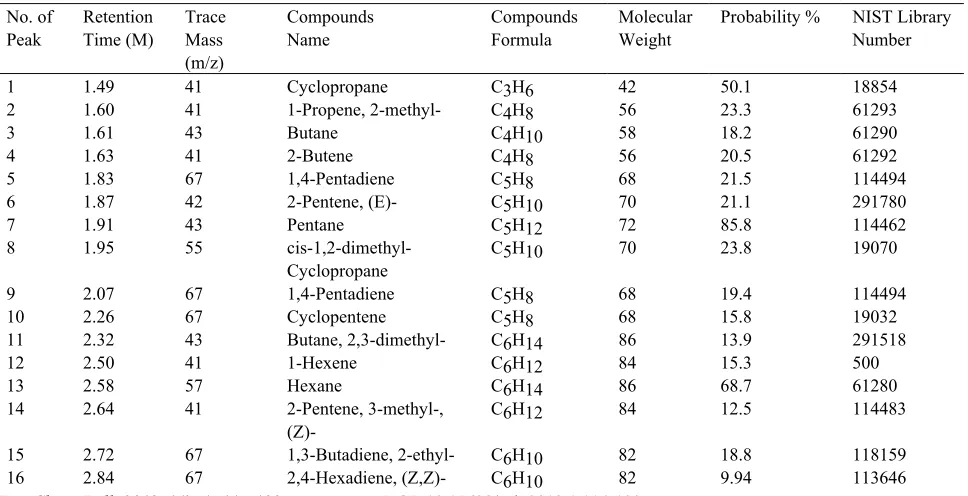
GC-MS results of the liquid product formed in thermal
decomposition of the mixture containing 20 % CaCO
3and waste plastics can be seen in Fig. 3 and Table 3.
0 1 0 2 0 3 0 4 0 5 0
In
te
ns
it
y (a
.u
.)
R e t e n t i o n T i m e ( M )
Figure 3: GC/MS chromatogram of liquid product formed in thermal decomposition of the mixture containing 10 % CaCO3
and random waste plastics
The analysis showed the presence of a variety of
compounds formed with carbon atoms between C
3and
C
27.Based on the retention times and fragmentation
patterns, hydrocarbons, as well as halogen, oxygen, or
nitrogen containing organic compounds were detected.
The most important hydrocarbon constituents found were
cyclopropane (C3H6) (t=1.49, m/z=41), 2-butene (C4H8)
(t= 1.63, m/z=41), cis-1,2-dimethylcyclopropane
(C5H10) (t=1.95, m/z=55), hexane (C6H14) (t=2.58,
m/z= 57), methylcyclopentane (C6H12) (t=2.90, m/z=56),
2-methyl-1-hexene (C7H14) (t=3.58, m/z=56),
methylcyclohexane (C7H14) (t=4.17, m/z=83), 1-octene
(C8H16) (t=5.15, m/z=41), 1
α
,3
α
,5
β
Eur. Chem. Bull. 2012, 1(3-4), 114-123 DOI: 10.17628/ecb.2012.1.114-123
123
be detected. Some halogen containing products such as
N-[4-bromo-n-butyl]-2-piperidinone (C9H16BrNO)
(t=12.38, m/z=41) were probably formed due to presence
of additives or dyes in the waste plastics.
Conclusion
Thermal degradation of random mixtures of waste
plastics containing low and high density polyethylene,
polypropylene, and polystyrene, and 10% or 20%
calcium carbonate in a steel reactor at temperatures
100-430 °C resulted in a fuel-like liquid decomposition
product. GC/MS studies showed that, in the presence of
10% or 20 % calcium carbonate, the fuel-like
hydrocarbon ranges were found to be C
4-C
40or C
3-C
27,
respectively. Both liquid fractions contain mainly
aromatic and aliphatic hydrocarbons such as benzene
(C
6H
6), toluene(C
7H
8), ethylbenzene (C
8H
10),
propylbenzene (C
9H
12),
α
-methylstyrene (C
9H
10), and
1-ethenyl-2-methylbenzene (C
9H
10). When using a higher
amount (20 %) of CaCO
3, the amount of residue
increased and the amount of light gas and liquid products
decreased, with the liquid seeming to be thicker.
Acknowledgements
The authors acknowledge for the support of Dr.
Karin Kaufman, the founder and sole owner of
Natural State Research, Inc. The authors also
acknowledge for the valuable contribution of
NSR laboratory team members during
preparation of this manuscript.
References
1 Characterization of Municipal Solid Waste in the United States,
1994, Update, EPA Report 530-R-94-042.
2 Bailey, R. (ed.), European Energy to 2020, European
Communities, Luxembourg, 1996, Report No. 92/827/ 5226/7. Part 3.
3 Pereia, M. Energias renovaveis (Renewable energies),
Sociedade Portuguesa de Energia Solar, Lisbon, 1998.
4 European Topic Center on Waste, Waste Generation and
Management, European Environment Agency, Copenhagen, 1999, Chapter 3.
5 European Union’s Framework Program-ENERGIE, The Use
of Industrial Waste as Alternative Fuels in the Cement Industry, Institute for the Diversification and Saving of Energy, Madrid, 2000, Report No. DIS- 1289-97-ES.
6 Kikuchi, r., Sato, H., Matsukura, Y., Yamamoto, T. Fuel
Process. Technol., 2005, 86, 1279.
7 Scott, G. Polymers and the environment. London: Royal
Society of Chemistry, 1999.
8 Brandrup, J., Bittner, M., Michaeli, W., Menges, G. Recycling
and recovery of plastics. Munich, New York: Carl Hanser Verlag, 1996.
9 Kaminsky, W., Schlesselmann, B., Simon, C. J Anal Appl
Pyrolysis 1995, 32, 19.
10 Sodero S. F, Berruti F., Behie L. A. Chem. Eng. Sci. 1996, 51,
2805.
11 Mastellone, M. L., Perugini, F., Ponte, M., Arena, U.. Polym.
Degrad. Stab., 2002, 76(3), 479.
12 Yeuh-Hui Lin, Polym. Degrad. Stab., 2009, 94, 1924.
13 Huffman, G. P., Feng, Z., Mahajan, V., Sivakumar, P., Jung,
H., Tiemey J. W. and Wender I. Am. Chem. Sot., Div. Fuel Chem., Prepr., 1995, 40(l), 34.
14 Liu, K., Meuzelaar, H. L. C. Fuel Process. Technol. 1996, 49,
1.