Improving Reliability for Real-Time Systems
through Dynamic Recovery
Yue Ma1, Thidapat Chantem2, Robert P. Dick3, and X. Sharon Hu1
1Department of CSE, University of Notre Dame, Notre Dame, IN 46656, USA,{yma1,shu}@nd.edu 2Department of ECE, Virginia Polytechnic Institute and State University, Arlington, VA, 22203, [email protected]
3Department of EECS, University of Michigan, Ann Arbor, MI 48109, [email protected]
Abstract—Technology scaling has increased concerns about transient faults due to soft errors and permanent faults due to lifetime wear processes. Although researchers have investigated related problems, they have either considered only one of the two reliability concerns or presented simple recovery allocation algorithms that cannot effectively use available time slack to improve soft-error reliability. This paper introduces a framework for improving soft-error reliability while satisfying lifetime relia-bility and real-time constraints. We present a dynamic recovery allocation technique that guarantees to recover any failed task if the remaining slack is adequate. Based on this technique, we propose two scheduling algorithms for task sets with differ-ent characteristics to improve system-level soft-error reliability. Lifetime reliability requirements are satisfied by reducing core frequencies for appropriate tasks, thereby reducing wear due to temperature and thermal cycling. Simulation results show that the proposed framework reduces the probability of failure by at least 8% and 73% on average compared to existing approaches.
Keywords—Soft-error reliability; Lifetime reliability; Dynamic recovery; Real-time embedded system.
I. INTRODUCTION
Since many real-time embedded systems are used in safety critical applications and may be expensive as well as difficult to replace, soft-error reliability (SER) due to transient faults as well as lifetime reliability (LTR) due to permanent faults are important design considerations. Techniques for reducing power, energy, and/or temperature through reducing core fre-quency to improve LTR, however, reduce SER, and vice versa. Motivated by applications such as infotainment systems [1], we focus on improving system-level SER while satisfying some pre-defined LTR and deadline requirements.
Although most existing work either targets SER or LTR [2]– [8], a few recent papers have examined both [9]–[11]. Das et al. aimed to maximize the minimum of SER and LTR by mapping tasks and increasing core frequencies [9]. Ma et al. proposed to maximize SER subject to LTR constraints on “big-little” architectures [11]. Both work improve SER while considering LTR for systems running real-time tasks, but neither leverages recovery techniques, which are effective methods to further improve SER. Zhou et al. proposed a technique to maximize system availability by allowing failed tasks to re-execute and
This work was supported in part by NSF under awards 1319904, CNS-1319718, and CNS-1319784.
increasing core frequencies to improve SER [10]. However, this greedy approach allocates recovery statically, which is less effective than dynamically allocate recoveries.
In this paper, we are interested in maximizing SER while satisfying real-time and LTR constraints. In order to maximize SER, we introduce a novel dynamic recovery technique where slack is shared and all failed tasks can be recovered if there is sufficient remaining slack for executing the tasks. A task is recovered by executing again from the beginning, and we assume all tasks are allowed to re-execute. We also assume faults are detected at the end of each task and that detection overhead can be ignored [12]. Compared to existing approaches that limit the number of recoveries [4] or assign redundancies to tasks statically [7], our technique provides the highest level of slack sharing flexibility, as will be shown in Section V. Since the effectiveness of the dynamic recovery technique depends on the task execution order, we explore how task scheduling can affect system-level SER and present two scheduling algorithms to improve the system-level SER for tasks with different characteristics.
We have developed a soft-error reliability improvement framework, referred to asRIF, to solve the problem identified above. RIF is composed of two components. The first one aims at increasing SER through task scheduling (i.e., deter-mining the task priorities) and dynamic recovery. If LTR is lower than a predefined limit, the second component of RIF is used to increase LTR subject to real-time constraints by reducing core frequencies for appropriate tasks. We make three main contributions. (i) We propose a new dynamic recovery allocation technique and derive the corresponding system-level SER. (ii) We introduce two scheduling algorithms for task sets with different characteristics to improve system-level SER. The first algorithm is computationally efficient and supports the special case where the execution times of tasks in a task set are similar and the amount of available slack is small. The second algorithm is more powerful and handles general task sets but at a higher time complexity. (iii) We devise a less costly method to obtain system-level SER if a task set belongs to the special case in (ii).
We evaluatedRIFin a simulator, which is constructed based on the Nvidia Jetson TK1 board [13] with tasks from the MiBench benchmark suite [14]. RIF reduces the probability of failure by at least 8% and 73% on average when compared
to existing approaches.
II. SYSTEM MODELS AND PROBLEM FORMULATION
In this section, we first introduce the system models. We then outline the problem of interest and present an overview of our framework.
A. Task model
We consider a frame-based task set composed of indepen-dent tasks. Tasks are executed on a DVFS-enabled multicore processor where each core supports L frequency levels. The frequency levels are sorted in increasing order such that the Lthlevel,lL, has the highest frequency. We assume that tasks are allocated to cores at design time (similar to partitioned scheduling [15]) and task migration between cores is not allowed [4], [11], [15], [16]. We also assume a task and its recovery should execute on the same core.
A task, τi, is associated with a tuple {fi(li), ci(li), pi}
wherefi(li)andci(li)are the core frequency and worst-case
execution time ofτi if the core is running at frequency level
li, respectively.piisτispriority (a large value forpidenotes a
higher priority), and tasks’ priorities determine their execution order. Since we aim to guarantee the real-time constraint for each task, any changes to priorities are acceptable as long as they do not violate timing requirements. Tasks should complete their executions by a common deadline,D. The slack is used to re-execute failed tasks and a core’s slack,s, is defined as D−Πi=1ci(li)whereΠis the tasks executing on the core.
Since tasks have the same period, we do not need to distinguish instances (i.e., jobs) of a task.
B. Soft-error and lifetime reliability
The soft-error reliability of a task is the probability that this task successfully completes. For taskτi executing at the core
frequency level li, rit(li) is the probability that no soft error
occurs during its normal execution.rti(li)depends on the core frequency level and the execution time ofτi [2], [9], [10],
rt
i(li) =e−λ(li) ci(li)
fi(li), (1)
whereλ(li)is the fault arrival rate and
λ(li) =λL10
d×(1−fi(li))
1−fi(l1) , (2)
where l1 is the lowest core frequency level and λL is the average fault arrival rate when executing at the highest fre-quency level.d is a hardware specific constant that indicates the sensitivity of fault rates on frequency scaling.
Lifetime reliability depends on multiple wear-out effects. Wear due to electromigration, stress migration, and time-dependent dielectric breakdown is exponentially time-dependent on operating temperature. Wear due to thermal cycling depends on the amplitude (e.g., the difference between the peak and valley temperature), period, and cycle maximum temperature [17]. To improve LTR, both the operating temperature and the effects of thermal cycling should be reduced. We use a Monte Carlo simulation based modeling tool [17] to obtain system-level LTR and evaluate our framework, but our work is independent on the underlying reliability modeling tool.
C. Problem formulation
Given the importance of SER, LTR, and real-time require-ments, we aim to solve the problem of maximizing system-level SER for each core,Rsys, while satisfying real-time and
LTR (measured by the mean-time-to-failure (MTTF) [5], [17]) constraints:
τi∈Π
ci(li) ≤ D, (3)
M T T F ≥ M T T FT H, (4) whereM T T FT His the minimum MTTF that the system must
achieve [16] andΠis the tasks executing on the core.Rsys is defined as the probability that all tasks complete successfully. A task is considered to be successful if it encounters no soft error during its first execution or successfully completes in the second execution (where the second execution is the recovery). Hence, Rsys is not only determined by the SER of each task, but also the recovery technique. We will discuss how to obtainRsyswith our proposed dynamic recovery technique in
Section III-A. Note that we assume task migration between cores is not allowed and tasks execute on the same core with their recoveries. Since the solutions are independent on different cores, we propose to solve the problem for one core, and the solution can be applied to other cores.
D. Overview of framework
We propose a soft-error reliability improvement framework (RIF) to solve the problem defined above.RIFconsists of two components. One focuses on improving system-level SER and the other on satisfying LTR and real-time constraints. In order to maximize system-level SER, the first component allows tasks to run at the highest core frequency and improves system-level SER through dynamic recovery and task scheduling. We first derive how to calculate system-level SER with our dynamic recovery technique and discuss how task scheduling affects the system-level SER. Then, we describe an efficient scheduling algorithm for task sets with some special properties and a more powerful scheduling algorithm for general task sets. The second component ofRIFchecks whether the LTR constraint (in (4)) is satisfied. If not, core frequencies of lower priority and power-hungry tasks are iteratively reduced until both the LTR and real-time constraints are satisfied. In the subsequent sections, we will discuss the details.
III. IMPROVING SOFT-ERROR RELIABILITY
In this section, we first introduce our dynamic recovery technique and discuss how task scheduling affects system-level SER. We allow all tasks to run at the highest core frequency, and then schedule tasks to improve the system-level SER. A. Dynamic recovery technique
We propose a new approach to dynamically allocate recov-eries to failed tasks. In our technique, available slack is shared by all tasks and dynamically assigned on a come, first-serve basis. A recovery is allocated to taskτi if the remaining
slack is no smaller thanci(lL). The recoveries are required to
still fail due to the occurrence of soft errors, the probability that both a task and its recovery fail is very low. Therefore, we only allocate one recovery for each task to prevent a task from consuming too much slack1. Since a recovery is allocated
only when the remaining slack is adequate, the recovery itself will not violate the real-time requirement. At the same time, whether a high priority task consumes slack affects recovery allocation of a lower priority task since the higher priority task is executed first. Hence, task scheduling directly impacts system-level SER.
We now discuss how to obtain the system-level SER with a given scheduleS. For a schedule,ris(S)denotes the probability
thatτihas a recovery and the recovery completes successfully.
Hence, the probability that a task completes successfully is
ri(S) = 1−(1−rit)×(1−rsi(S)). (5) It follows that the system-level SER is
Rsys(S) = n
i=1
{1−(1−rt
i)(1−ris(S))}. (6) Rsys(S)denotes the system-level SER is determined byS.
The variablersi(S)is the key to obtain theRsys(S). We use
a concept called execution pattern to calculateris(S). Suppose
S={τ1, . . . , τn}where taskτihas a higher priority thanτi+1.
We use the execution pattern,Pi, to indicate the successful and
failed tasks beforeτi. Inside an execution pattern,τk+denotes
the successful completion ofτk andτk− indicates thatτk has
failed. Since one execution pattern is composed ofi−1tasks, there are2i−1patterns for τi, and we usePi,j to indicate the
jthpattern. The value ofrsi(S)can be determined if we know the time used by the recovered tasks in each pattern, denoted by T(Pi,j), and the probability that each pattern appears, denoted
byP rob(Pi,j). Suppose there arempatterns satisfying
T(Pi,j) +ci(lL)≤s, (7) wheresis the shared slack. Thenrsi(S)can be calculated by
rs i(S) =
rt
i×mj=1P rob(Pi,j), ifm >0,
0, otherwise, (8)
wherem= 0 means thatτi can never be recovered.
The key to obtain ris(S) is to calculate T(Pi,j) and
P rob(Pi,j)for each pattern.T(Pi,j)can be obtained as
fol-lows. A taskτiuses slack to recover only when the remaining slack is larger thanci(lL), so it is possible that a failed task
with large execution time does not use the slack. We search each failed task inPi,j and calculate T(Pi,j)iteratively. We
first initialize T(Pi,j) = 0. Then, for each failed task τk in
Pi,j, if ck(lL)≤ s, update T(Pi,j) = T(Pi,j) +ck(lL) and s= s−ck(lL). For P rob(Pi,j), note that it simply depends on the SER of each task included in the pattern. That is,
P rob(Pi,j) =
τk+∈Pi,j
rkt×
τk−∈Pi,j
(1−rkt). (9) Based on Eq. (6), task scheduling affects the system-level SER. We next introduce two scheduling algorithms for task sets with different characteristics to improve the system-level SER.
1The presented technique can be extended to allow some critical tasks to receive more than one recovery. The details are left to future work.
B. An efficient scheduling algorithm
We propose an efficient soft-error reliability improvement scheduling algorithm (ERIS) to improve system-level SER if the task sets satisfy certain conditions.
The algorithm is built on an observation that a schedule allowing more tasks to recover does not always leads to a higher system-level SER. For a given slack, allowing tasks with short execution time to recover may prevent tasks with long execution time to re-execute and finally reduce the overall system-level SER. Only when task sets satisfy the following conditions, allowing more tasks to recover leads to a higher system-level SER.
Theorem 1: If a core hasntasks, and the slack,s, satisfies the following conditions,
(i) s < cmax,
(ii) (n−1)cmin≥2cmax,
then a schedule allowing more tasks to recover always leads to a higher system-level SER.cmin andcmax are shortest and
longest execution time when the core frequency at the highest level, respectively. We omit the proof due to page limit.
Theorem 1 provides some intuition on how to schedule tasks. That is, the schedule that maximizes the number of tasks capable of being recovered would maximize the system-level SER. Observe that a task with a high priority and which executes earlier has a larger probability of recovering because less slack is consumed by prior tasks. In order to preserve slack for later tasks, high priority tasks should have short execution times. Hence, we propose an efficient scheduling algorithm (ERIS) that assigns the priority to tasks according to their execution times. Given a task set that satisfies the conditions in Theorem 1 and is scheduled according toERIS, i.e.,pi< pj
ifci(lL)> cj(lL), then the system-level SER is maximized. Since obtaining the system-level SER is useful not only for evaluating our proposed framework, but also in other work, e.g., reliability-aware energy management [4], we develop a method to obtain the system-level SER in pseudo-polynomial time for task sets that satisfy Theorem 1 and which are scheduled by ERIS. This method reduces the overhead in finding the execution patterns satisfying (7). We simplifyris(S) torsi whenever doing so does not introduce ambiguity.
Suppose a schedule ofntasks isS ={τ1, . . . , τn}, where
pi > pi+1 and ci(lL) < ci+1(lL). For τi, we introduce two concepts: i) heavy set, Ω+i , is a subset of tasks in
{τ1, . . . , τi−1}where if all tasks inΩ+i fail, the slack needed
to recover all tasks in Ω+i is larger than s−ci(lL); ii) light
set, Ω−i, is a subset of tasks in {τ1, . . . , τi−1} where if all tasks inΩ−i fail, the slack needed to recover is smaller than or equal tos−ci(lL). Tasks in bothΩ+i andΩ−i are sorted by
decreasing priority. LetΩ−i,j be thejth light set for taskτi. If
Ω−
i,j ={τ1, τ2}, it means that the combined slack needed by τ1 and τ2 to recover is smaller than or equal to s−ci(lL).
Based on this definition, one light set coincides with one execution pattern satisfying (7). Hence, finding all the light sets is equivalent to finding all the execution patterns satisfying (7), which can then be used to compute the system-level SER. We state three lemmas used to find light sets. The proofs are omitted due to page limit.
Lemma 1: WithERIS, a setΩi is a heavy set forτi only
whenτ
j∈Ωicj(lL)> s−ci(lL).
Lemma 2: IfΩ+i,j is a heavy set ofτi,Ω+i,kis also a heavy set ifΩ+i,kis a super set of Ω+i,j, i.e.,Ω+i,j ⊂Ω+i,k.
Lemma 3: WithERIS, ifΩ+i,j is a heavy set ofτi, it is also
a heavy set ofτi+1.
For a taskτi, we divide all its light sets into groups.Gi,k,
thekthgroup of τi’s light sets, consists of light sets in which
each set has exactlyk tasks. Based on this definition, for task τi, there areigroups, i.e.,Gi,0toGi,i−1. Based on Lemmas 1–
3 and the definition ofGi,k, we provide a guideline on how
to find light sets for each task, which will, in turn, help to maximize system-level SER.
Theorem 2: For task sets that satisfy Theorem 1 and which are scheduled byERIS, if a light set,Ω−, inGi−1,ksatisfies
τj∈Ω−cj(lL)≤s−ci(lL),Ω
−is also a light set inGi,k. If
Ω− is a light set inG
i−1,k−1, it is also a light set inGi,k if
ci−1(lL) +τj∈Ω−(cj(lL))≤s−ci(lL).
We omit the proof of Theorem 2 due to page limit. Based on Theorem 2, we find all light sets for each task iteratively following a dynamic programming strategy.
The details of our method is shown in Alg. 1. We initialize Gi,0 for each task in Lines 2–8. Gi,0 is initialized to {∅}if ci(lL)≤ s, which means τi can be recovered if the slack is
not consumed by other tasks. Gi,0 = ∅ means τi can never be recovered. We constructGi,kfor each task in Lines 9–28. Based on Theorem 2, Gi,k is first set to ∅ (in Line 11) and
then additional light sets are added to Gi,k in Lines 12–22.
For each light set inGi−1,k, if it is still a light set forτi, it is
added intoGi,k(in Lines 12–16). Similarly, for each light set
inGi−1,k−1, we determine whether the set remains light ifτi−1
is added (in Lines 17–22). Based on Lemma 2, ifGi,k =∅, groups fromGi,k+1toGi,i−1are also equal to∅(in Lines 23–
26). Finally we return groups of light sets{Gi,0, . . . , Gi,i−1}
(in Line 29). The complexity of Alg. 1 isO(n×K) where K(K ≤2n)is the number of returned light sets.
C. A general scheduling algorithm
AlthoughERISis more efficient and effective in scheduling tasks satisfying the conditions in Theorem 1, for general task sets, it may lead to suboptimal schedule. In this subsection, we present a general soft-error reliability improvement scheduling algorithm (GRIS) for general task sets where a task’s execu-tion time can be any arbitrary value. GRIS guarantees the system-level SER is always higher than the static recovery techniques [4], [10].GRISfirst finds the optimal solution, set
Φ, for the static recovery allocation problem. It then elevates the priority of tasks inΦto further improve SER.
It can be seen that solving the static recovery allocation problem is the key to GRIS. This static recovery allocation problem is a variation of the knapsack problem, which can be solved using dynamic programming. LetΦ{i, s}be a set of tasks that achieves the maximum system-level SER where some tasks in {τ1, τ2, . . . , τi} can be recovered under the constraint that the slack is less than or equal to s. Given this construction, a dynamic program for solving the knapsack
Algorithm 1Find Light Sets
1: procedureFIND SET(S={τ1, τ2, . . . , τn})
2: fortaskτi in{τ1, τ2, . . . , τn}do 3: ifci(lL)≤sthen
4: Gi,0={∅}
5: else
6: Gi,0=∅
7: end if
8: end for
9: fortaskτi in{τ2, τ3, . . . , τn}do 10: forkin{1,2, . . . , i−1}do
11: Gi,k=∅
12: forlight setΩ−inGi−1,kdo
13: ifτ
j∈Ω−(cj(lL))≤s−ci(lL)then 14: Gi,k={Gi,k∪Ω−}
15: end if
16: end for
17: forlight setΩ−inGi−1,k−1 do
18: ifci−1(lL) +τj∈Ω−(cj(lL))≤s−ci(lL)then 19: Ω−={Ω−∪τi−1}
20: Gi,k={Gi,k∪Ω−}
21: end if
22: end for
23: ifGi,k=∅then
24: Gi,k+1=· · ·=Gi,i−1=∅
25: break
26: end if
27: end for
28: end for
29: return{Gi,0, . . . , Gi,i−1}foriin{1,2, . . . , n}
30: end procedure
problem can be leveraged to find the optimal solution,Φ{n, s}. We omit the details due to space limit.
Based on the solution to the static allocation problem, tasks inΦhave a higher priority than tasks not inΦ. The priority is assigned in such a way that ifci(lL)> cj(lL)thenpi< pj for
both τi andτj in Φ. With dynamic recovery allocation, this scheduling algorithm guarantees that tasks in Φ can always be recovered. Tasks not inΦcan still have a recovery if some tasks inΦsuccessfully complete their execution. Hence,GRIS achieves a higher system-level SER than the optimal solution to the static recovery allocation problem. Since GRIS is a variation of knapsack problem, it can be completed inO(n× K)whereK is the number of tasks inΦ{n, s}. Compared to ERIS, althoughGRISis more complicated, simulation results in Section V show that GRISis more effective at improving system-level SER thanERISin some cases.
IV. SATISFYING LIFETIME RELIABILITY
To improve SER, it is desirable to execute tasks at the highest core frequency. However, this core frequency may violate the LTR constraint in (4). To address this problem, we propose to drop tasks’ core frequencies to guarantee the LTR requirement. Dropping a task’s core frequency reduces the power and operating temperature, but in turn may violate tasks’ timing requirements and increase the arrival rate of transient faults (in Eq. (2)). In order to solve this trade-off problem, we propose a heuristic to reduce core frequencies for appropriate tasks. Note that although we reduce core frequencies of tasks,
recoveries always execute at the highest core frequency. Since the probability that a task fails is very low, running a recovery at the highest core frequency does not significantly impact long-term LTR.
We consider the LTR due to both operating temperature and thermal cycling. Reducing core frequencies for tasks is effective in reducing the operating temperature but may introduce thermal cycles. For the task model and dynamic recovery allocation technique under consideration, a core is only active in the earlier part of a period. Hence, if all tasks are running at the same frequency, there is only one thermal cycle in each period. However, if the frequency of taskτi is lower or higher than both τi−1 andτi+1, more thermal cycles may
be introduced. Hence, we aim to reduce the core frequencies of tasks while avoiding additional thermal cycles.
Reducing a task’s core frequency increases its execution time and reduces both its SER and available slack. This task, in the end, has a higher failure probability and is more likely to consume slack for recovery. Since a high-priority task first consumes slack to recover, and may affect the reliability of low-priority tasks, we adopt the general principle that high-priority tasks execute at the highest frequency while lowering the core frequency of low-priority tasks. We present a method to choose a task to reduce its core frequency in such a way that doing so maximizes the power saving and minimizes the in-fluence on other tasks’ reliability. We definei(li=j, li=k)
as the power-time ratio of τi when reducing core frequency
from thejth to thekthlevel,
i(li=j, li=k) =ρci(li=j)−ρi(li=k)
i(li=k)−ci(li=j), (10) where ρi(li =j)andci(li =j)are power consumption and worst-case execution time, respectively, when τi running at
thejthfrequency level. For a given scheduleS={τ1, . . . , τn}
whereτ1has the highest priority andτnhas the lowest one, we
reduce the core frequencies of appropriate tasks (see Alg. 2). We iteratively reduce tasks’ core frequencies until the MTTF is larger than a given threshold (in Lines 3–11). In each iteration, we select the task such that reducing one level of this task’s core frequency achieves the largestand does not violate the deadline constraint. Meanwhile, in order to avoid introducing more thermal cycles, we only select the task that has a higher core frequency than low-priority tasks, i.e., fi > fi+1 (in
Line 5). After reducing the selected task’s (i.e., τt’s) core
frequency level, lt, a new MTTF and slacks are calculated (in Line 10). This algorithm costs at mostn×Literations to find appropriate frequencies for tasks.
V. EVALUATION
We evaluate the proposed RIF by conducting simulations and comparing it with existing approaches.
A. Simulation setup
We compared RIF with two representative approaches: generalized shared recovery approach (GSR) [4] and partial replication and speedup approach (PRS) [10]. GSR is com-posed of two modules; one allocates recovery and the other reduces core frequency to minimize power consumption. We
Algorithm 2Frequency Reduction
1: procedureFREQ RED(S)
2: max= 0,τt=τn
3: whileMT T Fsys< MT T FT H do 4: forτi∈ {τ1, . . . , τn−1}do
5: ifs > ci(li−1)−ci(li)andi(li, li−1)>max
andfi> fi+1 then
6: max=i(li, li−1)
7: τt=τi
8: end if
9: end for
10: ft(lt) =ft(lt−1)and updatesandMT T Fsys 11: end while
12: end procedure
kept the firstGSRmodule but replaced the second module with Alg. 2 to satisfy the LTR constraint.PRSis a greedy algorithm based approach to maximize the minimum of LTR and SER by allocating recoveries offline. We evaluatedRIFwithERIS in Section III-B (RIF-ERIS) and withGRISin Section III-C (RIF-GRIS). The probability of failure (PoF), which is de-fined as1−Rsys, is used as a metric for comparison. We also
setλL= 10−6 andd= 3(in Eq. (2)) [10]. Note thatλLand
dmay have different values for different hardware platforms, but the improvement ofRIFis independent of their values.
The comparisons were conducted on a simulator, which is constructed based on a Nvidia’s Jetson TK1 board [13]. The operating temperature is calculated using an resistance-capacitance thermal modeling tool and thermal parameters are extracted from the TK1 board [16]. We specified two different configurations for the task set. In the first configuration, a task set is composed of randomly generated tasks whose execution time is random in the range of 0.75–1.25 seconds. The second configuration is same as in an existing work [16] where the task set is composed of tasks from the MiBench [14]. B. Simulation results
We first compared RIF to GSR and PRS when the task set is composed of 5 randomly generated tasks (see Fig. 1). RIF-ERIS and RIF-GRIS have similar performance, and both of them achieve a lower PoF than GSR and PRS in all cases. Compared toPRS,RIF, either withERIS or with GRIS, allocates more recoveries to tasks and the average PoF of RIF is about of 83%, 0.0009%, 0.0007%, 0.0003%, and 0.0002% ofPRS for slack lengths of 1.0 s, 1.5 s, 2.0 s, 2.5 s, and 3.0 s. Compared toGSR, the average PoF ofRIFis about 71%, 0.0007%, 0.0005%, 0.0008%, 48%. This simulation shows that although very short slack weakens the benefits of RIF, it achieves a lowest PoF in all cases butGSRis effective only when the slack is large.
We extended our evaluation of RIFwhen the workload is heavy (see Fig. 2(a)) and when a task’s execution time does not follow any distributions (see Fig. 2(b)). In Fig. 2(a), the average PoF of RIFis only 75%, 0.005%, 0.004%, 0.001%, and 19% of GSR, and 91%, 0.006%, 0.005%, 0.002%, and 0.001% of PRS, respectively. In Fig. 2(b), RIF and PRS achieve similar PoFs since the execution times of some tasks are very short and bothRIFandPRScan allocate recoveries. Thanks to the dynamic recovery allocation technique,RIFcan
1E+0 1E+1 1E+2 1E+3 1E+4 1E+5 1E+6 1E+7
1000 1500 2000 2500 3000
PoF
(x10
-1
1)
Length of Slack (ms)
RIF-ERIS RIF-GRIS GSR PRS
Fig. 1. PoFs when the task set has 5 randomly generated tasks.
1E+0 1E+2 1E+4 1E+6
1000 1500 2000 2500 3000
PoF
(x10
-10)
Length of Slack (ms) RIF-FRIS RIF-GRIS GSR PRS
(a)
1E+0 1E+1 1E+2 1E+3
1000 1500 2000 2500 3000
PoF
(x10
-5)
Length of Slack (ms) RIF-FRIS RIF-GRIS GSR PRS
(b)
Fig. 2. PoFs when task set is composed of (a) 10 randomly generated tasks; (b) tasks from MiBench benchmark suite.
allocate recovery to tasks that have longer execution times. Both Figs. 1 and 2 showRIFis better thanGSRandPRSin terms of SER improvement.
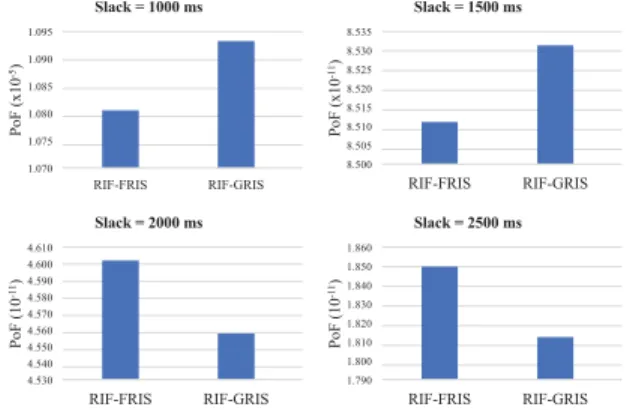
In Fig. 3, we compared RIF-ERISandRIF-GRISwhen the task set has 5 tasks and the average fault rate is large, λL = 10−3 [16]. Based on the conditions in Theorem 1, RIF-ERIS could perform better thanRIF-GRIS when the slack is small, and the PoF is reduced by about 1.15% and 0.24% when the slack is 1 s and 1.5 s, respectively. However, RIF-GRIS is better when the slack is 2 s, and 2.5 s, as RIF-GRIS reduces the PoF by about 0.98% and 2.02%, respectively. Such a difference can lead the system running without transient fault for more than 20 days. This comparison shows that althoughGRISis more complicated thanERIS, it is sometime necessary and can achieve a higher SER.
VI. CONCLUSIONS
We proposed a framework to improve the system-level SER under LTR and hard real-time constraints. The SER is improved by statistically scheduling tasks and dynamically allocating recoveries. LTR is satisfied by reducing core fre-quencies for low priority and power-hungry tasks. Simulation results show that our approach is effective in improving SER compared to existing static recovery allocation and shared recovery allocation approaches without violating real-time and LTR constraints. As future work, we plan to extend our approach to more general task models and allowing task migration between cores.
REFERENCES
[1] G. Macario, M. Torchiano, and M. Violante, “An in-vehicle infotainment software architecture based on Google Android,” in Proc. Int. Symp.
Industrial Embedded Systems, Jul. 2009, pp. 257–260.
[2] B. Zhao, H. Aydin, and D. Zhu, “Enhanced reliability-aware power management through shared recovery technology,” inProc. Int. Conf.
Computer-Aided Design, Nov. 2009, pp. 63–70.
[3] L. Huang, F. Yuan, and Q. Xu, “Lifetime reliability-aware task alloca-tion and scheduling on MPSoC platform,” inProc. Design, Automation
and Test in Europe, Mar. 2009, pp. 51–56.
1.070 1.075 1.080 1.085 1.090 1.095
RIF-FRIS RIF-GRIS
PoF
(x10
-5)
Slack = 1000 ms
8.500 8.505 8.510 8.515 8.520 8.525 8.530 8.535
RIF-FRIS RIF-GRIS
PoF
(x10
-1
1)
Slack = 1500 ms
4.530 4.540 4.550 4.560 4.570 4.580 4.590 4.600 4.610
RIF-FRIS RIF-GRIS
PoF
(10
-1
1)
Slack = 2000 ms
1.790 1.800 1.810 1.820 1.830 1.840 1.850 1.860
RIF-FRIS RIF-GRIS
PoF
(10
-1
1)
Slack = 2500 ms
Fig. 3. Comparison ofRIF-ERISandRIF-GRISwith different lengths of slack and high fault rate.
[4] B. Zhao, H. Aydin, and D. Zhu, “Generalized reliability-oriented energy management for real-time embedded applications,” inProc. Design,
Automation Conf., Jun. 2011, pp. 381–386.
[5] T. Chantem, Y. Xiang, X. S. Hu, and R. P. Dick, “Enhancing multicore reliability through wear compensation in online assignment and schedul-ing,” inProc. Design, Automation and Test in Europe, Mar. 2013, pp. 1373–1378.
[6] B. Zhao, H. Aydin, and D. Zhu, “Energy management under general task-level reliability constraints,” inProc. Int. Conf. the Real-Time and
Embedded Technology and Application Symp., Apr. 2012, pp. 285–294.
[7] B. Nahar and B. Meyer, “Rotr: Rotational redundant task mapping for fail-operational MPSoCs,” inProc. Defect and Fault Tolerance in VLSI
and Nanotechnology Systems, Oct. 2015, pp. 21–28.
[8] Z. Al-bayati, B. Meyer, and H. Zeng, “Fault-tolerant scheduling of multicore mixed-criticality systems under permanent failures,” inProc.
Defect and Fault Tolerance in VLSI and Nanotechnology Systems, Sep.
2016, pp. 57–62.
[9] A. Das, A. Kumar, B. Veeravalli, C. Bolchini, and A. Miele, “Combined DVFS and mapping exploration for lifetime and soft-error susceptibility improvement in MPSoCs,” inProc. Design, Automation and Test in
Europe, Mar. 2014, pp. 1–6.
[10] J. Zhou, X. S. Hu, Y. Ma, and T. Wei, “Balancing lifetime and soft-error reliability to improve system availability,” inProc. Asia and South
Pacific Design Automation Conf., Jan. 2016, pp. 685–690.
[11] Y. Ma, T. Chantem, R. Dick, S. Wang, and S. Hu, “An on-line framework for improving reliability of real-time systems on big-little type MPSoCs,” inProc. Design, Automation and Test in Europe, Mar. 2017, pp. 446–451.
[12] Q. Han, M. Fan, and G. Quan, “Energy minimization for fault tolerant real-time applications on multiprocessor platforms using checkpoint-ing,” inProc. Int. Symp. Low Power Electronics and Design, Aug. 2013, pp. 76–81.
[13] Nvidia, “Jetson Tegra K1.” [Online]. Available: http://www.nvidia.com/ object/jetson-tk1-embedded-dev-kit.html
[14] Electrical Engineering and Computer Science Department, University of Michigan, “Mibench.” [Online]. Available: http://vhosts.eecs.umich. edu/mibench//
[15] Y. Fu, N. Kottenstette, C. Lu, and X. D. Koutsoukos, “Feedback thermal control of real-time systems on multicore processors,” inProc. Int. Conf.
Embedded Software, Oct. 2012, pp. 113–122.
[16] Y, Ma, et. al, “Improving system-level lifetime reliability of multicore soft real-time systems,”IEEE Trans. VLSI Systems, vol. 25, no. 6, pp. 1895–1905, Jun. 2017.
[17] Y. Xiang, et al., “System-level reliability modeling for MPSoCs,” in
Proc. Int. Conf. Hardware/Software Codesign and System Synthesis,