ABSTRACT
Psoriasis commonly affects children and adolescents, and the need for safe, effective therapy is a special consideration in the pediatric population. Recently, the use of biologic agents has been extensively studied for the treatment of psoriasis in
adults. Of these, etanercept, a tumor necrosis factor-α antagonist, which FDA has approved for the treatment of psoriasis and psoriatic arthritis in adults, and while it is approved for use in juvenile rheumatoid arthritis, it is the closest to achieve
the approval for the treatment of moderately severe plaque psoriasis in children. We present our experience of treating
eighteen pediatric patients with generalized, recalcitrant stable plaque psoriasis with etanercept therapy.
Etanercept in childhood psoriasis: An experience from Kuwait
Nawaf Al-Mutairi, MD, FRCP, Azari Al-Dhouki, MD, Mazen Al-Shiltawi, MD Department of Dermatology, Farwaniya Hospital, Kuwait
Correspondence: Dr. Nawaf Al-Mutairi MD, FRCP, Head, Department of Dermatology, Farwaniya Hospital, Kuwait
INTRODUCTION
Psoriasis is a skin disease characterized by ac -celerated proliferation and abnormal
differentia-tion of epidermal keratinocytes,1 vascular dilata-tion and inflammatory infiltradilata-tion of the affected dermis and epidermis with polymorphonuclear leucocytes, macrophages and activated T cells.2 Previously psoriasis was thought to be primarily a disorder of aberrant keratinocyte formation with secondary inflammation. The classic antipsoriatic
therapy has therefore focused on agents being
an-tiproliferative (and anti-inflammatory), for exam
-ple vitamin D3 analogues, retinoids, corticoster -oids, anthralin, tar and UV therapy. But then the
importance of activated T cells in the pathogene
-sis of psoria-sis was recognized; they express high levels of CD25 [an interleukin-2 (IL-2) receptor] and major histocompatibility complex (MCH)
class II molecules,3,4 in contrast to T cells, which
circulate.5 Psoriasis is therefore now recognized as a primarily inflammatory disorder induced and sustained by skin infiltrating lymphocytes with a
secondary striking proliferation of keratinocytes. The initiation and persistence of the characteristic
inflammatory processes in psoriasis, such as ad
-hesion to endothelial cells, migration towards in
-flammatory sites in the epidermis and dermis and
their functional activities,3 seem to be triggered by a special cytokine pattern, belonging to the
Th1 type, which predominantly mediates auto
-immune and antimicrobial defence mechanisms.6 This pattern consists of signalling molecules such as interferon-γ (INF-γ), tumour necrosis factor-α (TNF-α), IL-1, -2, -3, -6, -8, granulocyte–mac
-rophage colony-stimulating factor (GM-CSF), epidermal growth factor (EGF), Fibroblast growth factor (FGF) and transforming growth factor-α (TGF-α).7,8 Many newer biologic agents are avail -able now to treat psoriasis which target specific
steps in the autoimmune cascade.9-13
No systemic therapy for psoriasis in children and
adolescents is currently approved by the Food and Drug Administration; phototherapy and systemic
-ability in children, cumulative adverse effects, and teratogenicity.10-13 Etanercept, a soluble tu -mor necrosis factor (TNF) receptor fusion pro
-tein that antagonizes the effects of endogenous TNF, is widely used to treat adult patients who
have moderate-to-severe plaque psoriasis and is indicated for patients as young as 4 years of age
with polyarticular juvenile rheumatoid arthritis.14 Previous clinical trials of etanercept have shown significantly reduced disease severity, fatigue, and symptoms of depression, and significantly
improved overall health related quality of life in
adult patients with psoriasis.15-18 The aim of the present project was to assess the efficacy and
safety of etanercept in the treatment of children
and adolescents with moderate to severe plaque
psoriasis.
PATIENTS AND METHODS
This study was carried out at the Department of Dermatology, Farwaniya Hospital, Kuwait over a period of 3 years (August 2007 to August 2010). The institutional ethics committee of our hospital
approved the protocol. Written informed consent
was obtained from the parents or legal guardians
of all patients.
All the patients of moderate to severe psoriasis vulgaris of ages between 4 to 17 years, attending the dermatology OPD at Farwaniya hospital were enrolled in this study. All the patients had psoria
-sis area-and-severity index (PASI) score of at least 12 (PASI scores range from 0 to 72), with higher scores indicating worse condition; PASI 50, PASI 75, and PASI 90 denote improvement in the PASI
of 50%, 75%, and 90% over baseline, respective
-ly). The patients had a history of psoriasis for at least 6 months; and previous or current treatment with phototherapy or systemic psoriasis therapy
(e.g., methotrexate, cyclosporine, or retinoids). Patients with guttate, erythrodermic, or pustular psoriasis at the time of screening were excluded, as were those with other active skin conditions that would interfere with evaluations. Patients were
permitted to use topical medications as emollients
and low or moderate potency corticosteroids dur
-ing the study.
Etanercept (Enbrel–Wyeth), at a dose of 0.8 mg per kilogram of body weight up to a maximum
intended dose of 50 mg was dispensed to the pa
-tients in syringes for once-weekly subcutaneous injections.
All the demographic details of the patients; severity and location of the lesions; past treatments history; family history were recorded on a Performa. All base line investigations including CBC, General health profile, PPD, were done in all the patients. Baseline PASI scores and PGA scores were also
recorded. The patients were then followed up ev
-ery 4 weeks until 24 weeks of active treatment, and thereafter they were followed up every 12 weeks until week 48. And, on every visits the complete
physical examination, and investigations were re
-peated. Improvement in the PASI and PGA scores, and any side effects found were also recorded. The primary efficacy end point was PASI 75 at week 12. The secondary efficacy end points were PASI 50, PASI 90, Physician’s Global Assessment of clear or almost clear (score of 0 or 1) at week 12.
RESULT
A total of 18 cases were enrolled in this study.
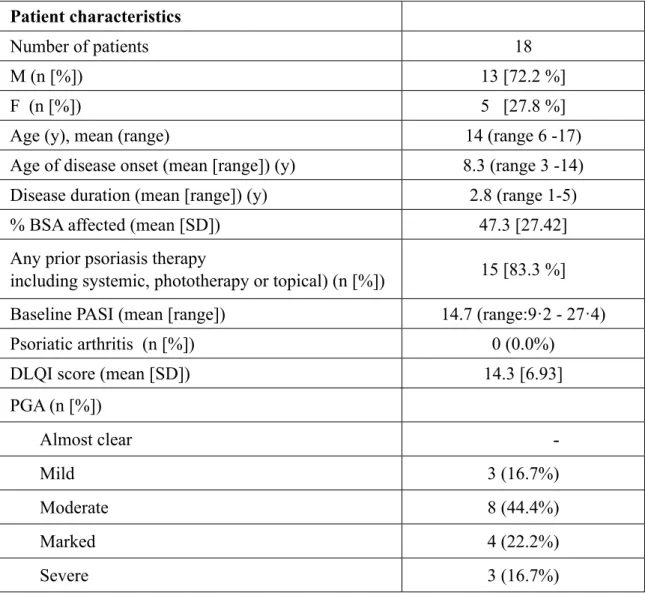
Patient Demographics and Baseline Characteris
-tic are summarized in (Table 1). The majority of patients in this study were males with male to fe
-male ratio of 12/18 (66.7 %). The age ranged be
Patient characteristics
Number of patients 18
M (n [%]) 13 [72.2 %]
F (n [%]) 5 [27.8 %]
Age (y), mean (range) 14 (range 6 -17)
Age of disease onset (mean [range]) (y) 8.3 (range 3 -14)
Disease duration (mean [range]) (y) 2.8 (range 1-5)
% BSA affected (mean [SD]) 47.3 [27.42]
Any prior psoriasis therapy
including systemic, phototherapy or topical) (n [%]) 15 [83.3 %]
Baseline PASI (mean [range]) 14.7 (range:9·2 - 27·4)
Psoriatic arthritis (n [%]) 0 (0.0%)
DLQI score (mean [SD]) 14.3 [6.93]
Table 1 Demographic profile and baseline characteristics of our patients
PGA (n [%]) Almost clear -Mild 3 (16.7%) Moderate 8 (44.4%) Marked 4 (22.2%) Severe 3 (16.7%)
SD = Standard Deviation; y = years; n = number
The mean duration of psoriasis was 2.8 years, and none of the patients had psoriatic arthritis. All the
patients had previously received topical
corticos-teroids, and 15 patients (83.3 %) had previously
received systemic therapy or phototherapy for
psoriasis. The mean affected body-surface area was 26% (range: 19-46), and the mean base-line psoriasis area-and-severity index was 14.7. All
the patients completed 24 weeks of active treat
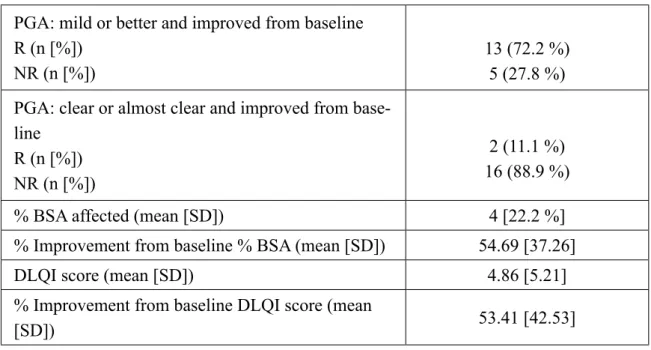
-ment, and another 24 weeks of follow up. Efficacy end point was evaluated after 12 week of therapy
(Table 2). At the end of week 12, 55% (10 out of 18 patients) achieved PASI 75. Four out of these
10(25%) patients had achieved PASI 90. The re
-maining 8 patients achieved a PASI 50 score at 12 weeks and efficacy continued to improve with longer treatment. At week 24, all 18 patients achieved PASI 75, and 10 out of these 18 patients had PASI 90. During the follow up period at week 36 and week 48, response to treatment was lost in 8 and 12 patients respectively. No serious side effects were noted in any of our patients, 3 pa
-Table 2 PGA, % BSA affected, and DLQI score at Week 12
Table 3 Adverse events
Adverse events n (%) Injection-site reaction 3 (16.6%) Skin infections 3 (16.6%) Headache 1 (5.6%) Weight gain 1 (5.6%) n = number of patients
PGA: mild or better and improved from baseline R (n [%])
NR (n [%])
13 (72.2 %) 5 (27.8 %)
PGA: clear or almost clear and improved from base
-line
R (n [%]) NR (n [%])
2 (11.1 %) 16 (88.9 %)
% BSA affected (mean [SD]) 4 [22.2 %]
% Improvement from baseline % BSA (mean [SD]) 54.69 [37.26]
DLQI score (mean [SD]) 4.86 [5.21]
% Improvement from baseline DLQI score (mean
[SD]) 53.41 [42.53]
R = Responder; NR = Non-Responder; SD = Standard Deviation tients developed superficial skin infections and were treated appropriately without effecting the
management of psoriasis, and all of them resolved
completely without any sequel (Table 3). Three patients reported mild local reaction at injection site at some point during the 24 week treatment
period.
DISCUSSION
Psoriasis can involve people of all ages. Child
-hood onset is not uncommon. The true incidence in the pediatric population is unknown, but it is estimated that 30% to 45% of affected patients de -velop signs of their disease before adolescence.19
Within the spectrum of clinical manifestations in children,20 the most common presentation is
generalized plaque psoriasis, followed by guttate psoriasis and juvenile psoriatic arthritis.21 Many
patients suffer more from the psychosocial than from the physical consequences of the disease.
The primary treatment objective for psoriasis in
children is to improve the physical and
psycho-logic symptoms, thus minimizing adverse effects
on future health and psychosocial development.
However, the risk to benefit ratio of available
treatment options is a particularly important
con-sideration when choosing appropriate therapy for a child. Topical agents are the first line of therapy
usually. However, more extensive forms of pso
-riasis often make topical therapy impractical.22
In such instances, and/or recalcitrant or relapsing cases, phototherapy or systemic therapy is often
deemed necessary. However, systemic therapies may be associated with long-term safety concerns. Recently, there has been growing interest in the therapeutic potential of ‘biologics’ for psoriasis in adults and, more recently, in children. These
are selective immunomodulatory drugs that com-prise biologically generated fusion proteins and chimeric, humanised and fully humanised
mono-clonal antibodies which target pro-inflammatory cytokines. While a number of these agents have
been used in the treatment of individual
paediat-ric patients with psoriasis on an open-label basis, etanercept was recently23 studied in a randomized
double blind fashion in 211 pediatric cases of
sta-ble moderate to severe psoriasis, and was found to be effective with no major adverse effects. Etaner
-cept has the most significant published literature,
and the fact that the drug has received FDA ap
-proval for use in children for other indications like ankylosing spondylitis and psoriatic arthropathy for children aged 2 years and older, and juvenile
rheumatoid arthritis in children aged 4 years and
older, substantiates recommendations for its use in
the pediatric psoriasis population. It is well placed to be the first biological agent to be approved for
such use.
CONCLUSION
Etanercept is likely to offer a further treatment op
-tion for children with moderate to severe plaque psoriasis when topical and systemic therapies have failed or are unsuitable. As is also the case with adults, vaccination schedules will need to be
updated before beginning treatment and children
will need to be screened before and during treat
-ment to identify infection. Given the lack of
long-term experience, regular monitoring for adverse
effects will be essential.
REFERENCES
Weinstein GD, Krueger JG. An overview of psoriasis.
1.
In: Weinstein GD, Gottlieb AB, eds. Therapy of Mod
-erate-to-Severe Psoriasis. Portland National Psoriasis Foundation, Portland, Oregon, 1993:1-22.
Christophers E, Kiene P. Guttate and plaque psoriasis.
2.
Dermatol Clin 1995; 13:751-6.
Christophers E. Psoriasis – epidemiology and clinical 3.
spectrum. Clin Exp Dermatol 2001; 26:314-20. Strange P, Cooper KD, Hansen ER et al. T-lymphocyte
4.
clones initiated from lesional psoriatic skin release growth factors that induce keratinocyte proliferation. J Invest Dermatol 1993; 101:695-700.
De Rie MA, Bos JD. Immunological aspects of psoria
-5.
sis. Neth J Med 1998; 53:143-4.
Gottlieb AB, Krueger JG. Role of T-lymphocytes (in
6.
psoriasis pathogenesis). In: Dubertret L, ed. Psoriasis. ISED, 1994:63-71.
Griffiths TW, Griffiths CEM, Voorhees JJ. Immunop -7.
athogenesis and immunotherapy of psoriasis. Dermatol Clin 1995; 13:739-49.
Baker BS, Griffiths CEM, Lambert S et al. The ef
-8.
fects of cyclosporine A on T lymphocytes and dendritic cell sub-populations in psoriasis. Br J Dermatol 1987; 116:503-10.
Bos JD, Meinardi MM, van Joost T et al. Use of cy -9.
closporine in psoriasis. Lancet 1989; 2:1500-2.
Lewkowicz D, Gottlieb AB. Pediatric psoriasis and
10.
psoriatic arthritis. Dermatol Ther 2004; 17:364-75. Brecher AR, Orlow SJ. Oral retinoid therapy for der -11.
matologic conditions in children and adolescents. J Am Acad Dermatol 2003; 49:171-82.
Lebwohl M, Ellis C, Gottlieb A, et al. Cyclosporine
12.
consensus conference: with emphasis on the treatment of psoriasis. J Am Acad Dermatol 1998; 39:464-75. Stern RS, Nichols KT. Therapy with orally adminis
-13.
tered methoxsalen and ultraviolet A radiation during childhood increases the risk of basal cell carcinoma: the PUVA Follow-up Study. J Pediatr 1996; 129:915-7. Enbrel (etanercept) prescribing information. Thousand
14.
Oaks, CA: Immunex (package nsert).
Gottlieb AB, Matheson RT, Lowe N, et al. A random
-15.
ized trial of etanercept as monotherapy for psoriasis. Arch Dermatol 2003; 139:1627-32.
Leonardi CL, Powers JL, Matheson RT, et al. Etaner -16.
cept as monotherapy in patients with psoriasis. N Engl J Med 2003; 349:2014-22.
Papp KA, Tyring S, Lahfa M, et al. A global phase III
17.
randomized controlled trial of etanercept in psoriasis: safety, efficacy, and effect of dose reduction. Br J Der
-matol 2005; 152:1304-12.
Tyring S, Gottlieb A, Papp K, et al. Etanercept and 18.
clinical outcomes, fatigue, and depression in psoriasis: double-blind placebo-controlled randomised phase III
trial. Lancet 2006; 367:29-35.
Chaudhuri SP, Gross J. A comparative study of pediat -19.
ric onset psoriasis with adult onset psoriasis. Pediatric Dermatol 2000; 17:174-8.
Morris A, Rogers M, Fischer G et al. Childhood psoria -20.
sis: a clinical review of 1262 cases. Pediatr Dermatol 2001; 18:188-98.
Farber EM, Nall L. Childhood psoriasis. Cutis 1999;
21.
64:309-14.
Richards HL, Fortune DG, O’Sullivan TM et al. Pa -22.
tients with psoriasis and their compliance with medica
-tion. J Am Acad Dermatol 1999; 41:581-3.
Paller AS, Siegfried EC, Langley RG et al. Etanercept 23.
treatment for children and adolescents with plaque pso