WHO Library Cataloguing-in-Publication Data
Strengthening health systems for treating tobacco dependence in primary care.
Contents: Part I: Training for policy-makers: developing and implementing health systems policy to improve the delivery of brief tobacco interventions; Part II: Training for primary care service managers: planning and implementing system changes to support the delivery of brief tobacco interventions; Part III: Training for primary care providers: brief tobacco interventions; Part IV: Training for future trainers: applying adult education skills to training.
1.Tobacco use disorder - prevention and control. 2.Smoking - prevention and control. 3.Smoking cessation. 4.Primary health care. 5.Delivery of health care. 6.Capacity building. 7.Teaching materials. I.World Health Organization.
ISBN 978 92 4 150541 3 (NLM classification: HD 9130.6)
© World Health Organization 2013
All rights reserved. Publications of the World Health Organization are available on the WHO web site (www.who.int) or can be purchased from WHO Press, World Health Organization, 20 Avenue Appia, 1211 Geneva 27, Switzerland (tel.: +41 22 791 3264; fax: +41 22 791 4857; e-mail: [email protected]).
Requests for permission to reproduce or translate WHO publications –whether for sale or for non-commercial distribution– should be addressed to WHO Press through the WHO web site (www.who.int/about/licensing/copyright_form/en/index.html).
The designations employed and the presentation of the material in this publication do not imply the expression of any opinion whatsoever on the part of the World Health Organization concerning the legal status of any country, territory, city or area or of its authorities, or concerning the delimitation of its frontiers or boundaries. Dotted lines on maps represent approximate border lines for which there may not yet be full agreement.
The mention of specific companies or of certain manufacturers’ products does not imply that they are endorsed or recommended by the World Health Organization in preference to others of a similar nature that are not mentioned. Errors and omissions excepted, the names of proprietary products are distinguished by initial capital letters.
All reasonable precautions have been taken by the World Health Organization to verify the information contained in this publication. However, the published material is being distributed without warranty of any kind, either expressed or implied. The responsibility for the interpretation and use of the material lies with the reader. In no event shall the World Health Organization be liable for damages arising from its use. Printed in France
Strengthening health systems for treating
tobacco dependence in primary care
Part IV: Training for future trainers:
Applying adult education skills to training
3 Strengthening health systems for treating tobacco dependence in primary care / Part IV Contents
CONTENTS
Part IV: Training for future trainers: Applying adult education skills to training
... 4
Introduction... 4
Facilitators’ guide
... 6
Participants’ workbook
... 9
References and resources
... 15
Appendix 1: Teaching methods ... 16
INTRODUCTION
Part IV is designed to train future trainers who will be able to implement the WHO training package
and provide further training to policy-makers, primary care service managers and primary care
providers. The purpose of Part IV is to equip potential trainers with the basic knowledge, skills and tools
in adult education, and to build their confidence to provide training on strengthening health systems for
treating tobacco dependence in primary care.
LEARNING OBJECTIVES, SKILL DEVELOPMENT AND OUTCOMES
Learning objectives
Upon completion of this training participants will be able to:
− describe and apply principles of adult education;
− describe and apply common adult teaching methods;
− list the roles, characteristics and skills required to become an effective trainer;
− develop and present a four-step lesson plan on a specific topic of strengthening health systems
for treating tobacco dependence.
Skills developed
1. Ability to apply principles of adult education in training.
2. Ability to apply common adult teaching methods in training.
3. Ability to develop four-step lesson plans to organize training activities.
Outcomes
A group of competent trainers are available to provide further training on strengthening health systems
for treating tobacco dependence in primary care.
STRUCTURE AND CONTENT
The training for future trainers is designed as one module and consists of five topics on: the principles
of adult education; learning style and adult teaching methods; skills and characteristics of effective
trainers; preparation for training delivery; and effectively delivering training to adults. This training
module is presented in a four-step format: preparation, presentation, practice and evaluation.
The training workshop duration is around four hours. A sample agenda for the training workshop in
half a day is provided below.
PART VI:
TRAINING FOR FUTURE TRAINERS:
5 Strengthening health systems for treating tobacco dependence in primary care / Part IV Training for future trainers
PREPARING FOR THE TRAINING
The train-the-trainer workshop should ideally be delivered by two facilitators with detailed expertise
in adult education and tobacco control. This workshop can be organized separately or in conjunction
with any training for policy-makers, primary care service managers or primary care providers.
The workshop should target those who have basic knowledge of adult education and medical education.
They could be faculties of existing medical education institutions such as primary care providers’ field
centres and on-the-job training centres at national or subnational level. It is recommended that the
workshop should be conducted with a maximum of 20 participants.
The workshop requires standard meeting/training tools and facilities, namely:
− one main meeting room, with participants seated around small tables in small groups;
− one or two additional break-out rooms if the large room cannot accommodate small group discussions;
− flipcharts and markers (one for each small group);
− projector and screen for presentations;
− laptop computer with speakers for presentations;
− presenter’s microphone;
− portable microphones for discussions (optional).
All the workshop training and background materials are provided online by WHO. These include:
− the Facilitators’ guide;
− presentations;
− the Participants’ workbook;
− workshop evaluation forms (see Appendix 2 for sample evaluation form).
The References and Resources section contains hyperlinks to the relevant materials needed throughout
the workshop. In addition to online materials, each participant should receive a binder or folder with key
printed materials, particularly:
− handouts of presentations;
− key resource documents for each theme.
The facilitators should ensure that key materials are available in the language of the participants.
Day 1
8:00 – 8:30 Welcome and Workshop Overview Participant introductions 8:30 – 9:00 Principles of adult education
9:00 − 9:30 Learning style and adult teaching methods 9:30 − 9:45 Characteristics and skills of effective trainers 9:45 − 10:00 Coffee break
10:00 − 10:30 Preparation for training delivery: the four-step lesson plan 10:30 − 10:45 How to effectively deliver training to adults
10:45 − 11:30 Develop a four-step lesson plan on one selected topic in small groups 11:30 − 12:30 Small group presentations
12:30 − 13:00 Closing session Workshop evaluation
FACILITATORS’ GUIDE
Duration 4 hours
Topic Applying adult education skills to training
Objectives Upon completion of this module, participants will be able to: − describe and apply principles of adult education; − describe and apply common adult teaching methods;
− list the roles, characteristics and skills required to become an effective trainer;
− develop and present a lesson plan on one topic of strengthening health systems for treating tobacco dependence.
Time Facilitator activity Participant activity Audiovisual
Preparation
30 minutes Ask participants to brainstorm:
Compared to children and teens, what are the special characteristics of adult learners?
Write the responses on flipchart or whiteboard. Reinforce the responses and add to the list. Summarize the characteristics of adult learners: • Adults are autonomousand self-directed. • Adults are goal-oriented.
• Adults are relevancy-oriented. • Adults are practical.
• Adults have rich life experienceand knowledge. • Adults need to be shown respect.
State that, for each characteristic, there are implications for trainers. Use slides to present these implications/strategies that can be incorporated into effective training.
Emphasize that, according to the special characteristics of adult learners, it is always best to actively involve adult learners in the educational process when they conduct training.
Use slides to demonstrate the rates of retention for different teaching methods and conclude that the more actively engaged the learner is, the more learning takes place.
Volunteers share ideas about special characteristics of adult learners. Workbook, flipchart or whiteboard, PowerPoint presentation Part VI- A Presentation
30 minutes Explain that different people have different learning styles. We shall need to use a variety of teaching methods and a variety of teaching materials to accommodate different learners and learning styles.
Ask participants to think about teaching methods that were used during this course and brainstorm a list of different instructional methods. Write responses on a flipchart or whiteboard. Reinforce the responses, elaborate on them, and add to the list if needed.
Ask: what are the advantages and limitations of each method? Use slides to show the advantages and limitations of each adult teaching method. Participate in the discussion. Anticipated list: – lecture; – independent work; – brainstorming; – demonstration; – small group discussion or working in pairs; – role plays; – story-telling; – case study; – simulations. Participate in the discussion.
Refer to the workbook.
Workbook, flipchart or whiteboard, PowerPoint presentation Part VI- B
7 Strengthening health systems for treating tobacco dependence in primary care / Part IV Facilitators’ guide
Time Facilitator activity Participant activity Audiovisual
Presentation
20 minutes Ask participants to brainstorm:
In addition to understanding the characteristics of adult learners and using a variety of adult teaching methods, what other skills, qualities and characteristics should an effective trainer have?
Write the responses on flipchart or whiteboard
Use slides to summarize the characteristics and skills of an effective trainer (the five E’s):
– expertise; – eloquence; – empathy; – energy;
– environmental engineering.
Assign participants to review a checklist that includes these skills and qualities and place a check mark next to the items they feel they have mastered.
Ask volunteers to share skill or qualities they have mastered.
Share ideas and participate in discussion. Volunteers share examples of skills mastered. Workbook, flipchart or whiteboard, PowerPoint presentation Part VI- C
20 minutes Point out that organizing an actual training course requires addressing many practical considerations. One key thing that a trainer needs to work on is to develop a lesson plan for each specific topic/module. Refer participants to the Facilitators’ guides for training policy-makers, primary care service managers or primary care providers, and emphasize that the most effective method for organizing learning activities is to use four-step lesson plan:
• Preparation:make participants ready to learn, reduce resistance and guarantee a foundation for the rest of the lesson.
• Presentation:provide the content the learners need to understand: concepts and practice skills.
• Practice and application: complete understanding has taken place only when the learner is able to apply or transfer the learning to new problems or situations.
• Evaluation:the best way to predict whether the learners can perform the task that they have been taught. Testing can be informal, for example by observing the learners while they practise role plays, or formal by using tools such as a quiz.
Demonstrate the structure of the lesson by asking participants to review one module in the Facilitators’ guideas an example of how a lesson is designed.
State that participants will have an opportunity to use this structure to practise how to design a lesson plan.
Listen and ask questions.
Workbook, PowerPoint presentation Part VI- D
20 minutes Present ways to effectively deliver trainings to adults.
Explain that, when we actually delivering the training, in addition to applying principles of adult education and using a variety of adult teaching methods, it is the trainer’s responsibility to:
– define the purpose, objectives and time frames; – establish norms;
– listen, guide the discussion, manage time and keep discussion on track;
– maintain interest and encourage participation (motivating participants).
Learners listen and ask questions.
Workbook, PowerPoint presentation Part VI- E
Strengthening health systems for treating tobacco dependence in primary care / Part IV Facilitators’ guide
Time Facilitator activity Participant activity Audiovisual
Practice
60 minutes Assign participants to small groups to:
• Develop a lesson plan on one selected topic using the above mentioned lesson plan structure of:
– preparation; – presentation; – practice; – evaluation.
• Prepare a 10−15 minute presentation to present the group’s lesson plan.
Check in with groups during this planning stage to support and answer questions.
Work in a small group to develop a lesson plan and prepare a presentation on their lesson plan. Workbook, PowerPoint presentation Part VI- F Evaluation
60 minutes Ask participants to share presentations. Everyone gives feedback. Participants deliver presentations and give feedback.
9
Objectives
Upon completion of this module participants will be able to:
− describe and apply principles of adult education;
− describe and apply common adult teaching methods;
− −list the roles, characteristics, skills required to become an effective trainer;
− develop and present a four-step lesson plan on a specific topic of strengthening health systems
for treating tobacco dependence.
Agenda
1. Principles of adult education (30 minutes).
2. Learning styles and adult teaching methods (30 minutes).
3. Skills and characteristics of effective trainers (20 minutes).
4. Preparation for training delivery (20 minutes).
5. Effectively deliver trainings to adults (20 minutes).
6. Developing a four-step lesson plan (60 minutes).
7. Presenting the lesson plan (60 minutes).
Preparation
1. Principles of adult education (30 minutes)
Brainstorming
Compared to children and teens, what are special characteristics of adult learners?
Special characteristics of adult learners:
• Adults are autonomous and self-directed.
• Adults have accumulated a foundation of life experience and knowledge.
• Adults are goal-oriented.
• Adults are relevancy-oriented.
• Adults are practical.
• Adults need to be shown respect.
For each characteristic, there are implications for you, the trainer (Table 1).
Strengthening health systems for treating tobacco dependence in primary care / Part IV Participants’ workbook
Table 1. How the characteristics of learners influence teaching strategies
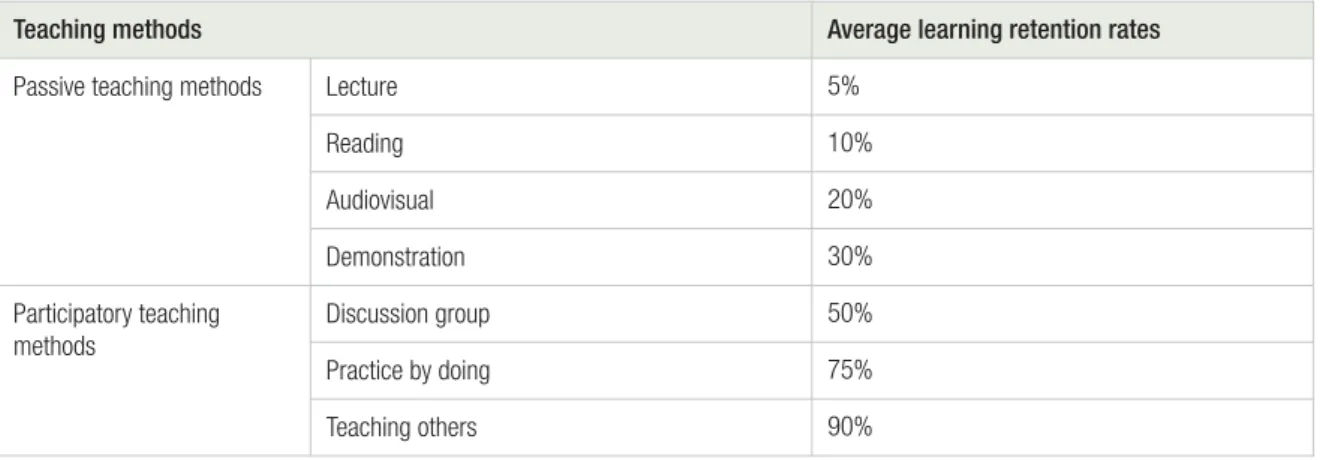
The special characteristics of adult learners suggest that we should actively engage learners in the
learning process using various participatory teaching methods. The average learning retention rates of
the different teaching methods shown below (Table 2) imply that the more actively engaged the learner
is, the more learning takes place.
Table 2. Learning retention rates of teaching methods
Presentation
2. Learning styles and adult teaching methods (30 minutes)
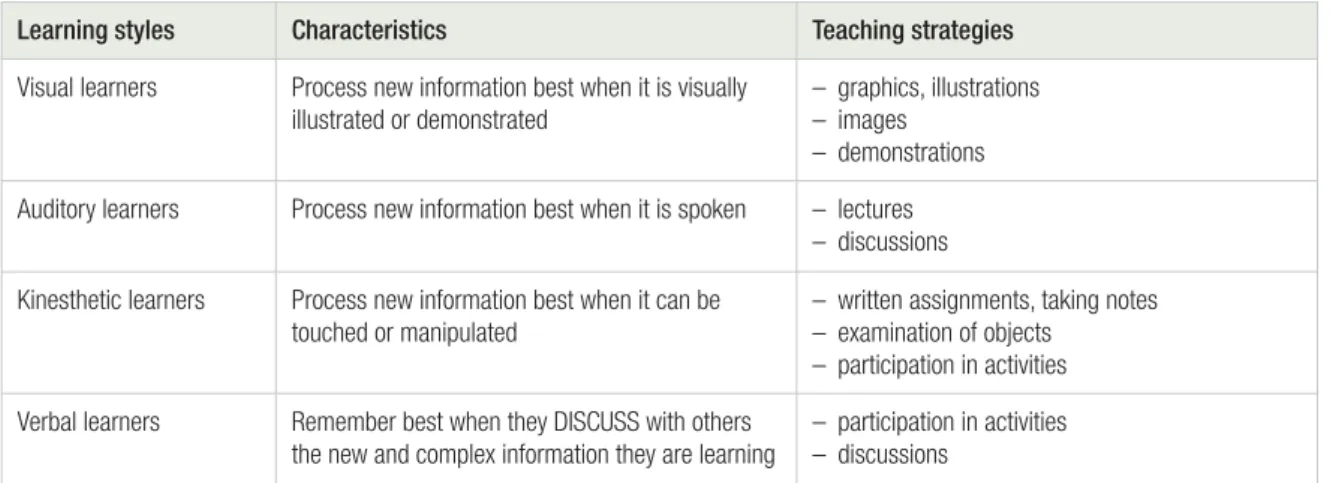
While different people think and learn differently, there are four basic learning styles (Table 3).
Most people are predominantly one type of learner, but usually they can adapt to another style.
Characteristics of adult learners Teaching strategies
1. Adult learners are autonomous and self-directed • Involve participants. • Serve as facilitator.
• Determine the interests of learners. 2. Adult learners have a foundation of life experience and
knowledge
• Recognize expertise of participants.
• Encourage participants to share their experience and knowledge. 3. Adult learners are goal-oriented • Have clear objectives.
• Explain how training objectives relate to training activities. 4. Adult learners are relevancy-oriented • Let participants choose topics that reflect their own interests.
• Show the relevance of training to their jobs. 5. Adult learners are practical • Give them opportunity to practise the new skills.
• Focus on teaching practical skills/tools, methods. 6. Adult learners need to be respected • Acknowledge the wealth of knowledge and experience
the participants bring to the training.
• Treat the participants as equals rather than subordinates. • Allow participants to voice their opinions freely in class.
Teaching methods Average learning retention rates
Passive teaching methods Lecture 5%
Reading 10% Audiovisual 20% Demonstration 30% Participatory teaching methods Discussion group 50% Practice by doing 75% Teaching others 90%
11 Strengthening health systems for treating tobacco dependence in primary care / Part IV Participants’ workbook
Table 3. Teaching strategies for learning styles
A training course that uses a variety of teaching methods to accommodate different learning styles
will increase the likelihood of learner success in the course.
Brainstorming
What are common adult teaching methods?
What are the advantages and limitations of each method?
(See details in Appendix 1)
Learning styles Characteristics Teaching strategies
Visual learners Process new information best when it is visually illustrated or demonstrated
– graphics, illustrations – images
– demonstrations Auditory learners Process new information best when it is spoken – lectures
– discussions Kinesthetic learners Process new information best when it can be
touched or manipulated
– written assignments, taking notes – examination of objects
– participation in activities Verbal learners Remember best when they DISCUSS with others
the new and complex information they are learning
– participation in activities – discussions
Method Advantages Limitations
Lecture
Socratic questioning Independent work Brainstorming Demonstration
Small group discussion or working in pairs Role plays
Story-telling Case study Simulations
3. Skills and characteristics of effective trainers (20 minutes)
Brainstorming
What skills, qualities and characteristics an effective trainer should have?
The characteristics and skills of an effective trainer can be summarized as five Es (expertise, eloquence,
empathy, energy and environmental engineering).
Exercise:
Please review the checklist for the five Es and place a check mark next to the items you feel you have
mastered.
Skills/characteristics
Expertise The power of knowledge and learning
Involve participants.
Understands and uses adult learning principles to facilitate learning
Creates a big picture “container” before getting involved in details
Integrates and summarizes key learning points
Debriefs to verify understanding and ensure embedding of learning
Responds to questions and comments appropriately.
Eloquence The power of language and organization
Adapts speech to the needs of multilingual learners
Provide clear, easy-to-follow instructions
Presents information in clear, concrete and colourful language
Transitions skillfully from one topic to another
Encourages participation by using appropriate questions.
Empathy The power of understanding and consideration
Understands and manages personal preferences and style
Understands learners’ needs and expectations
Adapts instruction to the learner’s level of experience and skill
Gives participants positive reinforcement and constructive feedback.
Energy The power of commitment and animation
Shows passion and interest for the subject
Is animated and uses appropriate tempo and voice volume
Energizes the group and makes learning enjoyable. Environmental engineering The power of managing the learning environment
Creates a brain-affirming atmosphere
Ensures good space, light and working areas
Manages time and prioritizes content effectively
Uses all equipment and tools skillfully.
13
4. Preparation for training delivery (20 minutes)
A good trainer has to thoroughly prepare beforehand. Generally the professional advice given states that
for every hour that you are training you should have completed 10 hours of study and preparation
.
Before training delivery, many practical considerations need to be addressed. One of the key things is
for trainers to develop a lesson plan to organize learning activities on each training module. The content,
process and teaching methods will be specified in the lesson plan to guide the training delivery.
The most effective method for organizing learning activities is to use a
four-step lesson plan
, which is
also the most effective format for ensuring that you provide sufficient opportunity for your participants
to practise their newly learned skills. The four steps are:
•
Preparation
(help your learners be prepared to learn):
− list the objectives to be learned;
− reduce resistance;
− ask challenging or engaging questions;
− administer a pretest;
− begin with an exercise or management game;
− tell a story or set up a mystery;
− ask participants for their objectives.
•
Presentation
(provide the content the learners need to understand: concepts and practice skills):
− use a variety of teaching methods and teaching aids.
•
Practice
(complete understanding has taken place only when the learner is able to apply or transfer
the learning to new problems or situations):
− Socratic review;
− written exams;
− oral tests;
− role-playing;
− problem-solving exercises;
− case studies;
− simulations.
•
Evaluation
(the best way to predict whether the learners can perform the task that they have been
taught):
− Socratic dialogue;
− written or oral responses to projects;
− tests;
− problem-solving projects;
− practice in simulated circumstances;
− role-playing and other performances.
Examples of a four-step lesson plan:
Please refer to any module contained in the Facilitators’ guides for training policy-makers, primary care
service managers, or primary care providers and review how a lesson is designed.
5. Effectively deliver training to adults (20 minutes)
In addition to using a variety of teaching methods and teaching aids, it is the trainer’s responsibility to:
− define the purpose, objectives, and time frames;
− establish norms;
− listen, guide the discussion, manage time and keep the discussion on track;
− maintain interest and encourage participation (motivating participants).
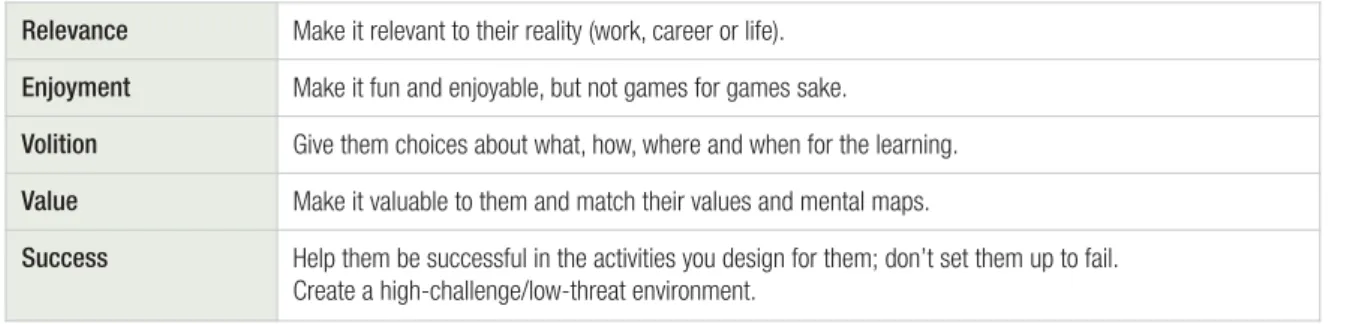
Table 4 provides a model for promoting the motivation of participants.
Table 4. A model for promoting participants’ motivationPractice
6. Developing a four-step lesson plan (60 minutes)
Work in small groups to:
• Develop a lesson plan on one selected topic using the above-mentioned lesson plan structure of:
− preparation;
− presentation;
− practice;
− evaluation.
• Prepare a 10−15 minute presentation to present your lesson plan.
Your lesson should include a preparation activity, a brief presentation, a period of practice and
evaluation. Be prepared to present your lesson plan to the large group in 10−15 minutes.
Evaluation
7. Presenting the lesson plan (60 minutes)
Each group shares its lesson plan.
Everyone adds to the discussion and gives feedback.
Relevance Make it relevant to their reality (work, career or life). Enjoyment Make it fun and enjoyable, but not games for games sake.
Volition Give them choices about what, how, where and when for the learning. Value Make it valuable to them and match their values and mental maps.
Success Help them be successful in the activities you design for them; don’t set them up to fail. Create a high-challenge/low-threat environment.
15 1. Rusell SS. An overview of adult learning processes. Urologic Nursing, 2006, 26(5):349−370.
2. Effective teaching strategies
(http://www.cdc.gov/healthyyouth/foodsafety/pdf/effec-tive_teaching_strategies.pdf, accessed 8 November 2011). 3. Adult learners (http://online.rit.edu/faculty/teaching_strategies/adult_learners.cfm, accessed 8 November 2011). 4. Mitchell C. The trainer’s handbook. The AMA guide to effective training. New York, NY, American Management
Association, 1997.
5. Choosing and using the right instructional methods and training activities
(http://www.thetrainingworld.com/faq/indexmethods.htm, accessed 8 November 2011).
6. Babcock DE, Miller MA. (1994). Client education: theory and practice. St. Louis, MO, Mosby, 1994. 7. Methods of instruction (http://www.drillpad.net/DP_IRL_MOI.htm, accessed 8 November 2011). 8. Facilitating learning: teaching and learning methods
(http://www.faculty.londondeanery.ac.uk/e-learning/small-group-teaching/Facilitating_learning_ teaching_-_learning_methods.pdf, accessed 8 November 2011).
9. Techniques (http://www.inquiry.net/adult/trainer/techniques.htm, accessed 8 November 2011). 10.Designing effective learning programmes: a brain based approach to motivate and engage learners.
Geneva, PLB Consulting Ltd., 2007.
REFERENCES
AND RESOURCES
APPENDIX 1: TEACHING METHODS
Method Advantages Limitations Rules and tips
Lecture • Can accommodate a large group of students. • Provides new or complex
information that may be difficult for participants to find quickly on their own. • Can be fully prepared ahead
of time.
• Trainer-focused, not learner-focused.
• Does not tap into learner’s higher thinking or problem-solving.
• Participants may not remember and/or understand the content.
• Give a clear introduction and summary. • Include examples, analogies. • Use visuals when needed to enhance
meaning.
• Be prepared for questions and prepare responses in advance.
Socratic questioning
• Encourages active participation.
• Provides an opportunity for learners to articulate facts, thoughts and feelings. • Provides an opportunity for
problem-solving
• Requires trainer to manage discussion to keep learners on task to meet objectives. • Requires learners to have
enough to knowledge to participate.
• May be difficult for quiet/shy learners or learners who lack knowledge.
• Learners who are not prepared may go unnoticed.
• Prepare learners in advance so they can participate in the discussion.
• Requires question outline and prompts to stimulate responses.
• Trainer should prepare anticipated answers to questions.
• Keep objectives in mind so that you can keep discussion productive.
• Provide positive feedback during the discussion.
• Paraphrase/repeat main points to reinforce learning.
• Manage interactions during the discussion. Independent
work
• Active learner participation. • Encourages higher thinking
and problem-solving. • Learners can work at their
own pace and focus on specific learning needs.
• Not all learners understand the assignment, actively participate and achieve learning objectives. • Limits collaboration and
mixing of ideas.
• Set goals and objectives for independent work.
• Ensure that the problem is related to the learner’s specific needs.
• Ensure that learners are prepared with information and resources and get support. • Provide opportunity for learners to share
their work to get feedback. Brainstorming • Creativity and generation
of new ideas.
• Friendly competition and mutual help.
• Encourages all learners to participate because all ideas are equally accepted.
• Not all learners may feel comfortable or safe. • Requires experienced
facilitators, otherwise the activity can become messy, chaotic and may cause conflict.
• Two facilitators work in pairs. One reads the question and invites participants to offer ideas. The other writes down the ideas. • All ideas are accepted and NO criticism,
discussion or questions are allowed until after the brainstorm is over.
• The wilder the better. Have fun. Be creative. Demonstration • Makes the explanation of the
complex information or a skill more concrete.
• Sets the standard of performance expected of the trainee.
• Trainer can serve as a role model.
• Learners can see practical application of concepts.
• May require additional resources to perform. • Requires a high degree of
trainer skill.
• Restricted to small groups.
• Clearly state the objectives of the demonstration.
• Use the actual equipment whenever it is practical.
• Always demonstrate the skill correctly and determine whether it will be a better learning experience to show the whole activity/skill at once or in parts.
• Ensure that all learners can see and hear all the steps.
• Provide the opportunity for learners to practise the skill.
17 Strengthening health systems for treating tobacco dependence in primary care / Part IV Appendix 1: Teaching methods
Method Advantages Limitations Rules and tips
Small group discussion or working in pairs.
• Promotes collaboration. • Trainees are often more
comfortable in small groups, even quiet/shy learners can actively participate and share ideas.
• Learners can share ideas in a more deep and profound way.
• Some learners may dominate the discussion.
• Some learners may be unprepared to participate actively, and may get off track without good facilitation. • Requires more classroom
time than large group discussion.
• Prepare a task that can benefit from team-work in the classroom and the real setting. • Ask each group to select a moderator/leader
(to guide discussion) and a recorder. • Provide a warm, supportive and
non-threatening environment. • Circulate to support small groups.
• Provide opportunity for small groups to share their work to get feedback and learn from each other.
Role plays • Provides safe opportunity to practise.
• Provides opportunity for learners to assume roles of others and thus appreciate another point of view. • Can clarify complex
information.
• May be uncomfortable for some learners.
• Not appropriate for large groups.
• Requires debriefing afterwards to ensure objectives were met. This can be time-consuming.
• Provide detailed information for the learner to understand the scenario and to: – set the scene and conditions; – describe characters, or ask learners
to build characters;
– describe the challenge or the problem. • Ask 2−3 volunteers to do a role play of
no more than 10 minutes. • Thank the role-players.
• Invite feedback, summarize the experience and link with learning objectives. Story-telling • More engaging than lecture.
• Illustrates practical application of concepts.
• Effective for cognitive or affective objectives. • Effective for relaying new
or complex information. • Can be combined with other
teaching methods.
• Not effective for communicating deep, skills-based knowledge. • Trainer must make a clear
connection between story and objectives.
• Build stories, either real case studies or fictional, that are relevant to the audience. • Build a story that fits one or more of the
following situations:
– describe what happens to create a change; – describe the consequences, and the
resolution;
– show how to perform action steps; – show how concepts can be operationalized. Case study • Provides a safe opportunity
to practise skills and build confidence.
• Learners see practical application of concepts. • Promotes problem solving. • Can clarify complex
information.
• Some learners may not see relevance to own situation. • Insufficient information can lead to inappropriate results. • Requires debriefing
after-wards to ensure objectives were met. This can be time-consuming.
• Define the case clearly for the learner. • Create case studies based on realistic
situations.
• Act as a mediator for the discussion, provide guidance on the process.
• Show how the case study illustrates application of knowledge or skills. Simulations • Learners get a clear
understanding about what is expected of them. • Allows learners to see
the practical application of concepts.
• Can clarify complex information. • Allows learners the
opportunity to practise skills in a safe environment.
• May be uncomfortable for some learners.
• Requires trainer to take the time to ensure that learners understand the assignment and perform the skill cor-rectly.
• Requires debriefing after-wards to ensure objectives were met. This can be time-consuming.
• May require additional resources to perform.
• Ensure learners understand the purpose of the simulation.
• Simulation exercises need to be easily recreated and be the same experience for each learner.
• Provide learners with feedback about their performance.
APPENDIX 2: SAMPLE EVALUATION FORM
Please select the answer you most agree with.
Please also give your written feedback in the space provided.
1. Overall I found the training workshop useful for my work
Strongly agree
Agree
Neither agree nor disagree
Disagree
Strongly disagree
2. Which part of the training workshop did you find the most useful?
3. Which part of the training workshop did you find the least useful?
4. The workshop facilitator had a good knowledge of the subject
Strongly agree
Agree
Neither agree nor disagree
Disagree
Strongly disagree
5. The workshop facilitator’s skills in conveying the subject matter were good
Strongly agree
Agree
Neither agree nor disagree
Disagree
Strongly disagree
6. As a result of my participation in the training workshop, I feel more confident to provide training
on strengthening health systems for treating tobacco dependence in primary care
Strongly agree
Agree
Neither agree nor disagree
Disagree
19 Strengthening health systems for treating tobacco dependence in primary care / Part IV Appendix 2: Sample evaluation form
7. How difficult did you find the training workshop?
Too difficult
Difficult
Just right
Easy
Too easy
8. How could the workshop implementation be improved?
9. How could the training materials be improved?
10. Overall, how would you rate the workshop?
Very good
Good
Average
Poor
Very poor
11. Any other comment, suggestion, criticism:
For further information, kindly contact PNDas follows: Prevention of Noncommunicable Diseases (PND) World Health Organization
20, Avenue Appia CH-1211 Geneva 27 Switzerland
Tel.: + 41 22 791 21 11 Fax: + 41 22 791 48 32