Will China Eat Our Lunch or Take Us to Dinner?
– Simulating the Transition Paths of the U.S., EU, Japan, and China
by Hans Fehr University of Wuerzburg Sabine Jokisch University of Wuerzburg and Laurence J. Kotlikoff Boston University
National Bureau of Economic Research
September 2005
We thank Charles Horioka, Bernd Raffelhuschen, and Reinhold Schnabel for providing key
data. Research support by the U.S. Social Security Administration, Boston University, the
Deutsche Forschungsgemeinschaft, and the Universitatsbund Wuerzburg is gratefully acknowl-edged.
Abstract
This paper develops a dynamic, life-cycle, general equilibrium model to study the interde-pendent demographic, fiscal, and economic transition paths of China, Japan, the U.S.,and the EU. Each of these countries/regions is entering a period of rapid and significant aging that will require major fiscal adjustments. But the aging of these societies may be a cloud with a silver lining coming, in this case, in the form of capital deepening that will raise real wages.
In a previous model that excluded China we predicted that tax hikes needed to pay benefits along the developed world’s demographic transition would lead to a major capital shortage, re-ducing real wages per unit of human capital over time by one fifth. A recalibration of our original model that treats government purchases of capital goods as investment rather than current con-sumption suggests this concern was overstated. With government investment included, we find much less crowding out over the course of the century and only a 4 percent long-run decline in real wages.
Adding China to the model further alters, indeed, dramatically alters, the model’s predic-tions. Even though China is aging rapidly, its saving behavior, growth rate, and fiscal policies are currently very different from those of developed countries. If successive cohorts of Chinese con-tinue to save like current cohorts, if the Chinese government can restrain growth in expenditures, and if Chinese technology and education levels ultimately catch up with those of the West and Japan, the model’s long run looks much brighter. China eventually becomes the world’s saver and, thereby, the developed world’s savoir with respect to its long-run supply of capital and long-run general equilibrium prospects. And, rather than seeing the real wage per unit of human capital fall, the West and Japan see it rise by one fifth percent by 2030 and by three fifths by 2100. These wage increases are over and above those associated with technical progress, which we model as increasing the human capital endowments of successive cohorts.
Even if the Chinese saving behavior (captured by its time preference rate) gradually ap-proaches that of Americans, developed world real wages per unit of human capital are roughly 17 percent higher in 2030 and 4 percent higher at the end of the century. Without China they’d be only 2 percent higher in 2030 and, as mentioned, 4 percent lower at Century’s end.
What’s more, the major short-run outflow of the developed world’s capital to China predicted by our model does not come at the cost of lower wages in the developed world. The reason is that the knowledge that their future wages will be higher (thanks to China’s future capital accumulation) leads our model’s workers to cut back on their current labor supply. So the short-run outflow of capital to China is met with a commensurate short-short-run reduction in developed world labor supply, leaving the short-run ratio of physical capital to human capital, on which wages positively depend, actually somewhat higher than would otherwise be the case.
Our model does not capture the endogenous determination of skill premiums studied by Heckman and Taber (1996). Doing so could well show that trade with China, at least in the short run, explains much of the relative decline in the wages of low-skilled workers in the developed world. Hence, we don’t mean to suggest here that all US, EU, and Japanese workers are being helped by trade with China, but rather that trade with China is, on average, raising the wages of developed world workers and will continue to do so.
The notion that China, India, and other developing countries will alleviate the developed world’s demographic problems has been stressed by Siegel (2005). Our paper, although it includes only one developing country – China – supports Siegel’s optimistic long-term macroeconomic view. On the other hand, our findings about the developed world’s fiscal condition are quite troubling. Even under the most favorable macroeconomic scenario, tax rates will rise dramatically over time in the developed world to pay baby boomers their government-promised pension and health benefits. As Argentina has so recently shown, countries can grow quite well for years even with unsustainable fiscal policies. But if they wait too long to address those policies, the financial markets will do it for them, with often quite ruinous consequences.
I. Introduction
This paper develops a dynamic, life-cycle, general equilibrium model to study the interde-pendent demographic, fiscal, and economic transition paths of China, Japan, the U.S., and the EU. Each of these countries/regions is entering a period of rapid and significant aging that will require major fiscal adjustments. Understanding how national aging and the fiscal reaction to na-tional aging will affect the macro economies of these regions is important. If the macroeconomic response is favorable, governments can do less and take more time to deal with what’s coming. If the opposite is true, governments must do more and do it more quickly.
Our past research (Fehr, Jokisch, and Kotlikoff (2004a,b, 2005) suggested an unfavorable macroeconomic response to national aging arising from a growing shortage of physical capital relative to human capital. This long-term capital shortage sufficed to reduce the model’s real wage per unit of human capital by 20 percent over the course of the century. The model’s predicted major decline in capital per unit of human capital connects to the model’s predicted major rise in payroll and income tax rates. These tax hikes, in turn, reflect the need to pay pension and health care benefits to increasingly older populations. As originally stressed by Feldstein (1974), raising taxes on workers to make transfers to the elderly reduces the amount of capital workers individually and collectively can and will accumulate.
But our earlier studies, with their dismal forecasts that the interaction of aging and huge fiscal commitments to the elderly will undermine the macro economies of the developed world, omitted two issues. Both of these issues are taken up here, and both militate against a severe capital shortage.
The first is government investment. In our prior studies we treated all government purchases as current consumption. There is some logic for doing so, since many so-called government in-vestment goods (e.g., tanks, office buildings to house bureaucrats, space vehicles) may make little or no contribution to the nation’s output and productivity and, indeed, may do the opposite. On the other hand,the lion’s share of government investment, be it in constructing roads, erecting schools, building research labs, does seem to be productive.
elim-inate the predicted long-term capital shortage, but it does significantly mitigate it. Compared with its 2004 value, the model’s real wage per unit of human capital in 2100 is reduced by only 4 percent rather than by 20 percent.
The second omission is China. As everyone knows, China is already a major producer of world output. Its GDP now equals roughly one ninth of U.S. output. China is also absorbing Western and Japanese technology at a rapid clip. This acquisition of technology, in combination with improved education, holds the prospect for ongoing real income growth in China. But, given China’s exceptionally high saving rate, more income growth in China means more Chinese saving that can be invested in the developed world as well as in China.
The potential for China and other developing countries to bail out the developed world, at least in terms of its capital needs, has recently been advanced by Jeremy Siegel (2005). But China has a long way to go if it is to play such a role. China’s per capita income and wealth levels are currently only a small fraction - probably less than 15 percent - of the developed world’s levels. Of course, China has lots of capitas - its population is 2.6 times the combined populations of the U.S., Japan, and the EU. Still, China’s current total holdings of wealth appear to be less than one quarter and could be easily be less than one tenth of total wealth holdings across the four regions. Moreover, Chinese saving behavior may change. It’s certainly far from what one would expect to see. One would think that having low current income, but the prospect of much higher future income, would lead the Chinese to spend most of what they now produce. But, if official statistics are to be believed, nothing could be further from the truth. According to OECD (2002) data, the Chinese private sector appears to be saving 40.0 percent of private available output, defined as net national income minus government purchases of goods and services. This extraordinarily high Chinese private-sector saving rate explains why the Chinese are currently exporting more capital to the rest of the world than they are importing. Based on European Commission (2005) data, the comparable private-sector saving rates in the U.S., Japan, and EU are only 4.0 percent, 11.5 percent, and 11.1 percent, respectively.
China is also remarkable when it comes to aging. Like the developed world, China is getting older. But it’s projected over the next half century to age much more rapidly than the U.S.,
Japan, or the EU. This doesn’t mean that China will end up older than these regions. It just means it will make the transformation from a relatively young to a very old society much more rapidly than its trading partners in the developed world.
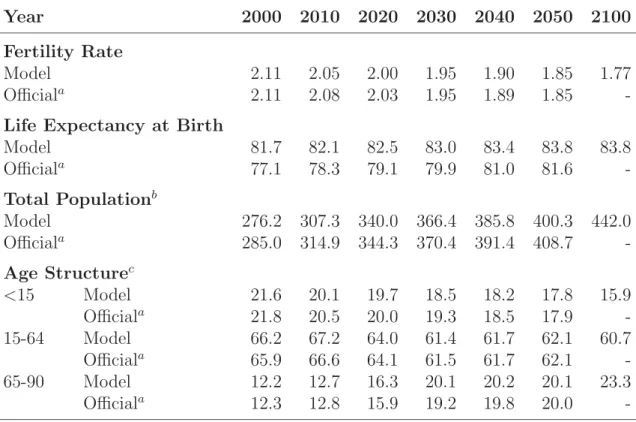
As Table 1 details, only 6.8 percent of today’s Chinese are 65 and older compared with 17.2 percent in Japan, 16.4 percent in the EU, and 12.3 percent in the U.S. In 2050, 23.6 percent of the Chinese population will be 65 plus. This is larger than the 20.6 percent elderly share projected for the U.S., but smaller than the 28.6 and 35.9 percent shares projected in the EU and Japan, respectively. So the rapidity of China’s aging doesn’t reflect where it will end up, but where it is starting.
The fact that China, like Japan and the West,is aging and faces significant fiscal obligations associated with that process suggests that China’s inclusion in our model would make little differ-ence to the model’s unpleasant prediction of a looming capital shortage. But because of China’s much higher rates of growth and saving and because its population is so large, adding China can, as documented below, transform a capital shortage into a capital glut. Whether or not this occurs depends on how China’s fiscal policy and saving behavior evolve. If, over the course of the next 50 years, China adopts fiscal arrangements and saving propensities that are similar to those of developing nations, China will make only a modest contribution to the world’s supply of capital, leaving real wages per unit of human capital at the end of this century only about 4 percent higher than they are today. If, on the other hand, China limits growth in public expenditures and the Chinese people continue to eschew consumption, China will save enough for its own capital needs as well as those of the developed world, leaving real wages per unit of human capital at the end of this century roughly 60 percent above the current level.
The usefulness of these findings depends, of course, on the realism of our model. Our life-cycle model’s features are a mouthful. The model includes age-, region-, and year-specific fertility and mortality rates, lifespan uncertainty, age-, region-, and year-specific pension, disability, health care, and other government transfer policies, region- and year-specific government purchases of goods and services, region-specific levels of debt, high, middle, and low earners within each cohort in each region, region-specific personal wage income, capital income, corporate income, and
pay-roll taxes, international capital mobility, technological change, quadratic costs of adjusting each region’s capital stock, age-specific inheritances, age-specific and unintended bequests, intertem-porally separable CES utility functions in consumption and leisure, region-specific Cobb-Douglas production functions, the presence of children’s utility in parents’ utility functions when the chil-dren are young, exogenously specified age-, earnings class-, region-, and year-specific immigration, and region- and cohort-specific time preference rates.
As with our other three regions, to accommodate Chinese saving behavior, we’ve set the Chinese time preference rate to match the current observed saving rate for China. And we’ve calibrated the multifactor productivity coefficient in the Chinese production function to match the current observed Chinese relative wage. The big questions with respect to China’s calibration, however, are not how to treat current saving preferences and technology, but rather how to model future saving preferences and technology.
Consider first the issue of technology. It seems reasonable to believe that the level of Chinese technology will converge to that of the West. The unknown is the rate of convergence. In this study we assume that the Chinese multi-factor productivity coefficient rises gradually, reaching the U.S., Japanese, and EU rates by mid century. But we also consider slower and faster rates of technological convergence.
Now consider modelling future Chinese saving behavior. Here we examine two alternative assumptions. The first is that the Chinese time preference rate remains fixed through time at the very low rate needed to calibrate the current Chinese saving rate. The second is that successive cohorts of Chinese gradually adopt Western saving behavior such that the Chinese born in 2050 and thereafter have the same time preference rate as Americans in 2004.
II. Our Model and Its Predecessors
The development of dynamic life-cycle simulation models was stimulated by Feldstein’s (1974) article contending that government pension systems lower national saving. Early dynamic analysis of government pension programs and other policies include Kotlikoff (1979), Summers (1981), Auerbach and Kotlikoff (1983, 1987), and Seidman (1986). More recent papers have con-sidered the importance of land, earnings uncertainty, political economy considerations, liquidity
constraints, different options for funding Social Security, and human capital decisions. These studies include Hubbard and Judd (1987), Imrohoroglu, Imrohoroglu, and Joines (1995, 1999), Kotlikoff (1996), Huang, Imrohoroglu, and Sargent (1997), Huggett and Ventura (1998), Cooley and Soares (1999a, 1999b), De Nardi, Imrohoroglu, and Sargent (1999), Kotlikoff, Smetters and
Walliser (1998a, 1998b, 1999, and 2002), Raffelh¨uschen (1989, 1993), Heckman, Lochner, and
Taber (1998), Bohn (2001), Smetters and Walliser (2004), Nishiyama and Smetters (2004), and Fehr and Habermann (2005).
This model, like our previous ones, builds on Auerbach-Kotlikoff’s (1987) overlapping gen-eration (OLG) model. Auerbach and Kotlikoff also simulated demographic transitions, but their model assumed that all agents gave birth at a fixed age, died and bequeathed at a fixed age, and received inheritances at a fixed age. Kotlikoff, Smetters, and Walliser (2001) advanced the Auerbach-Kotlikoff model by incorporating age-specific fertility and inheritance, lifespan exten-sion, intragenerational earnings heterogeneity, and additional fiscal institutions. Fehr, Jokisch, and Kotlikoff (2004a,b, 2005) included lifespan uncertainty as well as bequests arising from in-complete annuitization. They also introduced multiple regions with international capital mobility and immigration.
As in Kotlikoff, Smetters, and Walliser (2001), our model features monozygotic reproduction with agents in their child-bearing years giving birth each year to fractions of children. This means of finessing marriage and family formation permits us to incorporate changes through time in age-specific fertility rates and to closely line up our model’s age-age-specific population shares to those forecast for the four regions.
We assume that agents care about their children’s utility when they are young and, as a con-sequence, make consumption expenditures on behalf of their children (pay for their consumption), but only when the children are young. We also assume that agents die with realistic mortal-ity probabilities starting at age 68. Agents fully appreciate the uncertainty of their longevities and maximize, at any point in time, their expected remaining lifetime utilities. The inclusion of lifespan uncertainty permits a realistic modelling of bequests and inheritances.
when they die, they leave undesired bequests to their children. Since agents die at different ages and have children of different ages, their heirs also inherit at different ages. Agents who were born when their parents were young receive inheritances later in their life than do their younger siblings. Finally, uninsurable lifespan uncertainty leads agents to gradually reduce their consumption in old age.
Our model also includes capital adjustment costs. As is well known, these costs can drive temporary wedges between the marginal products of capital in different regions and lead the market values of capital assets to temporarily differ from their replacement costs. Thus inclusion of adjustment costs in the model generates what amounts to regional stock markets and permits us to explore how population aging affects world stock prices through time.
A final, but very important, feature of our framework is its intra-cohort disaggregation. As in Kotlikoff, Smetters and Walliser (2001), we consider three income classes within each generation each with its own earnings ability. Immigrants are also split into these income classes permitting us to simulate the arrival of immigrants with different stocks of human and physical capital.
The following sections present the general structure of our model. A more detailed descrip-tion of the three-country model is provided in Fehr, et al. (2003).
1. Demographics
Each region is populated by households who live at most to age 90. Consequently, there are 91 generations with surviving members at any point in time. The individual life cycle of a representative agent is described in Figure 1. Between ages 0 and 20 our agents are children who earn no money and are supported by their parents. At age 21 our agents leave their parents and go to work. Between ages 23 and 45 our agents give birth to fractions of children at the beginning of each year, i.e. the first (fraction of) children are born when the agents are 23 and the last are born when they are age 45. An agent’s first-born children (fractions of children) leave home when the parents are age 43, while the last-born leave when the agents are age 66. Our agents die between ages 68 and 90. The probability of death is 1 at age 91. Children always outlive their parents, meaning that parents always outlive grandparents. To see this note that if a parent reaches age 90, his or her oldest children will be 67. These are children who were born when the
parent was age 23.
In each year new immigrants in each skill and age group arrive with the same number and age distribution of children and the same level of assets as natives of the identical skill and age. Since the demographic structure has the same general form in all four regions, it suffices to discuss a representative region and omit region indices.
To specify the current and future demographic structure of each region we start with
year-20001age-specific population [N(a,2000)] and age-specific net-immigration [NM(a,2000)] counts.
In constructing existing as well as future age-population counts, we have to link each initial cohort between the ages of 1 and 68 to those of their parents who are still alive. The reason is that children receive bequests from their parents, and the levels and timing of these inheritances depend on the ages of their parents. This linkage is achieved by applying past fertility rates to each cohort under age 69 in year 2000. If, for example, 15 percent of the parents of newborns in 1980 were 25 years old, then 15 percent of the 20-year-old’s in year 2000 are assigned to parents age 45.
In addition, each cohort is split into three income classes k. Specifically, we assume that 35
percent of each cohort belong to the lowest income class, 10 percent to the top income class, and the remaining 55 percent to the middle income class. We denote the population vector for year t as N(a, t, s, k) where a = 1, . . . , s = 23, . . . ,45, k = 1,2,3. The term s references the age of the
parent at the time of birth of agents age a in 2000.
To determine the evolution of the population in each region over time, we applied region-, age-, and year-specific mortality and fertility rates to the cohorts alive in year 2000 as well as to their children as they reach their ages of fertility and mortality. In the baseline path the exogenous current and future mortality and fertility rates follow the medium variant of the United Nations population projection (UNPD, 2003 for the U.S., EU and Japan; UNPD, 2005 for China).
According to this projection, mortality rates will decline in all three regions over time. Consider the Japanese, whose 2000 life expectancy equaled 81.6. According to official projections,
1Although the economic model starts in year 2004, we chose year 2000 as the initial year for the population
Japan’s life expectancy in 2050 will reach 88.1. The Japanese, who now have a 4.5 year higher life expectancy than Americans and a 3.0 higher life expectancy than EU citizens, will continue to maintain their longevity lead through time. Indeed, projected 2050 U.S. life expectancy doesn’t even exceed current Japanese life expectancy! In China life expectancy is now a full 10 years lower than life expectancy in Japan. And this 10 year gap is projected to continue for the next half decade.
Table 1 shows our agent’s life expectancies at birth in the baseline path, which is kept constant after year 2050. The respective numbers are higher than the actual values, since our model’s agents don’t die prior to age 68. However, the model’s life expectancies conditional on reaching age 60 are close to those reported by the UNPD (2005).
Total fertility rates currently equal 2.1, 1.3, 1.6 and 1.5 in the U.S., Japan, China, and the EU, respectively. Nevertheless the United Nations expects fertility rates in all three regions to converge to 1.85 children by 2050. This path of fertility rates is also shown in Table 1. In the baseline path, we assume annual net immigration of 1 million per year in the U.S., 450,000 in the EU, and 54,000 in Japan. Net immigration into China is negative. The number of net emigrants is fixed at its current value of 390,000 people per year. Given the population age structure in year 2000 as well as projected future fertility, mortality, and net immigration rates, we compute the
population vector N(a, t, s, k) for the years t between 2001 and 2050. After year 2050, fertility
rates are endogenously adjusted in order to achieve zero population growth and a stable population age structure. Since net immigration is positive in the U.S., the EU, and Japan, the population-stabilizing post-2050 fertility rates are below 2.0. Equivalently, the fertility rates in China are set above 2.0 after 2050 due to net emigration.
Table 1 also shows projected changes over time in total populations and population age structures. Due to high fertility and net immigration rates, the U.S. population is projected to increase from 275 million in 2000 to 442 million in 2100. In Europe, the population falls over the century from 375 to 340 million, and in Japan, the population falls from 126 million to 85 million. The Chinese population decreases by even more – from 1.3 billion to 1.2 billion.
There are, however, big differences in the aging process across the four regions. First, in the U.S. and China the absolute decrease of the shares of the young population through 2050 are almost the same as for the working age population. In contrast, the EU and Japan experience much larger absolute declines in the share of the population that is of working age. Second, the share of elderly increases to a much larger extent in Japan and China compared to the U.S. and the EU.
Table 1 indicates that our model’s demographic machinery does a remarkably good job matching official projections for the four regions both with respect to the absolute number and age compositions of their respective populations. We now describe this machinery in more detail.
The total number of children of an agent agea in income classk in year tis recorded by the
following function KID(a, t, k) = m j=u N(j, t, a−j, k) 45 s=23N(a, t, s, k) 23≤a ≤65, k = 1,2,3, (1)
where u = max(0;a−45) and m = min(20, a−23). Recall that agents younger than 23 have
no children and those over 65 have only adult children, i.e. KID(a, t, k) = 0 for 0 ≤ a≤ 22 and
66 ≤ a ≤ 90. Agents between these ages have children. Take, for example, a 30 year-old agent.
Such an agent has children who were born in the years (a−j) since she/he was 23. In year t,
these children are between age 0≤j ≤7. The KID-function (1) sums the total number of kids of
the respective parent-income class generation and divides it by the total number of parents of age
a in year t who belong to income class k. This function takes into account that the family’s age
structure will change over time due to changing fertility. This approach permits the distribution of births by the ages of parents to change over time – an important improvement relative to the birthing process stipulated in Kotlikoff, Smetters and Walliser (2001).
2. The Household Sector
As previously mentioned, we do not distinguish between natives and immigrants once the immigrants have joined the native earnings- and age-specific cohorts. The model’s preference structure is represented by a time-separable, nested, CES utility function. Remaining lifetime
who belongs to income class k takes the form
U(j, t, s, k) =V(j, t, s, k) +H(j, t, s, k), (2)
where V(j, t, s, k) records the agent’s utility from her/his own goods and leisure consumption
and H(j, t, s, k) denotes the agent’s utility from the consumption of her/his children. The two sub-utility functions are defined as follows:
V(j, t, s, k) = 1 1− 1 γ 90 a=j 1 1 +θ a−j P(a, i) c(a, i, s, k)1−1ρ +α(a, i, s, k)1−1ρ 1−1γ 1−1ρ (3) H(j, t, s, k) = 1 1−γ1 90 a=j 1 1 +θ a−j P(a, i)KID(a, i, k)cK(a, i, s, k)1−1γ, (4)
where c(a, i, s, k) and (a, i, s, k) denote consumption and leisure, respectively, and i is defined as
i = t+a−j. The children’s consumption of income class k parents who are age a in period i
and whose parents were age s at the time of their birth is defined as cK(a, i, s, k). Note that the
number of children is independent of the grandparent’s age at the time of the birth of the parents. Since lifespan is uncertain, the utility of consumption in future periods is weighted by the
survival probability of reaching age a in yeari
P(a, i) =
a
u=j
[1−d(u, u−a+i)], (5)
which is determined by multiplying the conditional survival probabilities from year t (when the
agent’s age isj) up to yeari. Note thatd(j, t) is the mortality probability of an agent agej in year
t. The parameters θ, ρ, α and γ represent the “pure” rate of time preference, the intratemporal
elasticity of substitution between consumption and leisure at each age a, the leisure preference
parameter, and the intertemporal elasticity of substitution between consumption and leisure in different years, respectively.
In maximizing utility, agents choose their demand for leisure subject to the constraint that leisure in each period not exceed 1, which is the time endowment. The determination of the shadow values of these leisure constraints, when these constraints are binding, is included as part of the maximization. To ensure that agents retire by a designated maximum retirement age, we set the net wage at that age and thereafter to zero.
Given the asset endowment a(j, t, s, k) of the agent in yeart, maximization of (2) is subject to a lifetime budget constraint defined by the sequence:
a(j+ 1, t+ 1, s, k) = a(j, t, s, k) +I(j, t, s, k) (1 +r(t)) +w(t)E(a, k)[h(a, t)−(a, t, s, k)] −T(j, t, s, k)−c(j, t, s, k)−KID(j, t, k)cK(j, t, s, k), (6)
where r(t) is the pre-tax return on savings and I(j, t, s, k) denotes the inheritance the agent
receives in year t. When the parents die between age 68 and 90, their remaining assets are split
between their children. Consequently, inheritances of agents who are age j in year t and whose
parents were age s at their birth are defined by:
I(j, t, s, k) = 45d(j+s) ¯A(j+s, t, k)
u=23N(j +s−u, t, u, k)
. (7)
The numerator defines the aggregate assets of income class k parents who die in year t at
age j+s. The denominator defines these parents’ total number of children who are between ages
j+s−45 andj+s−23 in yeart. The receipt of inheritances requires us to distinguish members of
each cohort according to the ages of their parents at birth. The parents’ ages at death determine when the children receive their inheritances. While the oldest children (born when their parents are age 23) receive their inheritances between ages 45 and 67, the youngest children (born when their parents are age 45) receive their inheritances earlier in life, between ages 23 and 45.
As in Altig et al. (2001) and Kotlikoff, Smetters and Walliser (2001), we assume that
technical progress causes the time endowment h(·) of each successive generation to grow at the
rate λ, i.e.
h(a, i) = (1 +λ)h(a, i−1). (8)
The proposition here is not that time, per se, expands for successive generations, but rather that each successive generation is more effective in using time to either preform work or enjoy leisure. Treating technical change in this manner is essential to ensure that the economy achieves a long-run steady state. The assumption of labor-augmenting technical change would not, for example, be compatible with a long-run steady state given the nature of the model’s preferences. And having the economy achieve a long-run steady state provides, in effect, the terminal conditions needed by our algorithm to solve for the model’s equilibrium transition path.
Gross labor income of the agent in year t is derived as the product of her/his labor supply
and her/his wage rate. The latter is the product of the gross wage rate w(t) in period t and the
age- and class-specific earnings ability.
E(a, k) = ξ(k)e4.47+0.033(a−20)−0.00067(a−20)2(1 +λ)a−21 with
ξ(1) = 0.2, ξ(2) = 1.0, ξ(3) = 5.0 (9)
The middle-income class profile is taken from Auerbach and Kotlikoff (1987). The shift parameters
ξ(k) are then applied to derive income class-specific profiles. Moreover, since technological change
is an important determinant of secular growth over the life cycle, we multiply the age-specific
longitudinal earnings ability profile by the term involving λ. Hence, the longitudinal age-wage
profile is steeper the greater is the rate of technological change.
The net taxes T(j, t, s, k) of an agent in year t consist of consumption, capital income,
and progressive wage taxes as well as social security contributions net of pension and disability benefits received. Due to our assumed ceiling on payroll tax contributions, pension, disability insurance, and health-care average and marginal payroll tax rates differ across agents. Each agent’s pension benefits depend on her/his pre-retirement earnings history, while health care and disability transfers are provided on a per capita basis to all eligible age groups.
Given individual consumption, leisure, and asset levels of all agents, we can compute
ag-gregate variables. For example, the agag-gregate value of assets A(t + 1) in period t is computed
from A(t+ 1) = 3 k=1 90 a=21 45 s=23 a(a+ 1, t+ 1, s, k)N(a, t, s, k) ¯ A(a+1,t+1,k) (10)
Since households die at the beginning of each period, we have to aggregate across all agents who
lived in the previous period in order to compute ¯A(a+1, t+1, k), which we need for the calculation
of bequests, see (7). If we aggregate across agents who live in period t+ 1, i.e.,
A(t+ 1) = 3 k=1 90 a=21 45 s=23 a(a, t+ 1, s, k)N(a, t+ 1, s, k) (11)
Finally, aggregate labor supply of agents in year t, L(t), is computed from the individual labor supplies, i.e.
L(t) = 3 k=1 90 a=21 45 s=23 E(a, k) [h(a, t)−(a, t, s, k)]N(a, t, s, k). (12)
3. The Production Sector
The economy is populated by a large number of identical firms, the total number of which is normalized to unity. Aggregate output (net of depreciation) is produced using Cobb-Douglas production technology, i.e.
F(K(t), L(t)) =φK(t)εL(t)1−ε (13)
whereK(t) is aggregate capital in periodt,εis capital’s share in production, andφis a technology
parameter. Since we posit convex capital adjustment cost, the firms’ marketable output in year
t, Y(t), is given by the difference between gross output and adjustment costs, i.e.
Y(t) =F(K(t), L(t))−0.5ψ ∆K(t)2/K(t) (14)
where ∆K(t) measures investment in yeart. The termψ is the adjustment cost coefficient. Larger
values of ψ imply higher marginal costs of new capital goods for a given rate of investment. The
installation technology is linear homogeneous and shows increasing marginal cost of investment (or, symmetrically, disinvestment): faster adjustment requires a greater than proportional rise in adjustment costs.
Corporate taxes, Tk(t), are given by
Tk(t) = τk(t)[Y(t)−w(t)L(t)−(t)∆K(t)] (15)
whereτk(t) and(t) define the corporate tax rate and the immediate write-off share of investment
expenditures, respectively. Since adjustment costs are fully, and investment expenditures are partly, deductible from the tax base, arbitrage between new and existing capital implies that the latter has a price per unit of
Similarly, the arbitrage condition arising from profit maximization requires identical returns to financial and real investments:
r(t)q(t) = [1−τk(t)]{FK(t)+ 0.5ψ (∆K(t)/K(t))2}+q(t+ 1)−q(t). (17)
The left side gives the return on a financial investment of amount q(t), while the return on one
unit of real capital investment is the net return to capital (which includes the marginal product
of capital FK(t) plus the reduction in marginal adjustment costs) and capital gains.
4. The Government Sector
The consolidated government issues new debt ∆B(t) and collects corporate taxes and
net-taxes from households in order to finance general government expenditures G(t) as well as interest
payments on its debt:
∆B(t) +Tk(t) + 3 k=1 90 a=21 45 s=23 T(a, t, s, k)N(a, t, s, k) = G(t) +r(t)B(t). (18) With respect to public debt, we assume that the government maintains an exogenously fixed ratio of debt to output. The progressivity of the wage tax system is modelled as in Auerbach and Kotlikoff (1987). Specifically, marginal wage tax rates rise linearly with the tax base.
P Y(t) defines the aggregate payroll tax base, which differs from total labor earnings due to
the ceiling on taxable wages. This ceiling is fixed at 250, 200, 168, and 300 percent of average income in the U.S., EU, Japan, and China, respectively. Aggregate average social security payroll
tax rates ˆτp,τˆh and ˆτd are computed each period from the relevant budget constraint for the
program and region in question, i.e. ˆ
τp(t)P Y(t) =P B(t) τˆh(t)P Y(t) = HB(t) and ˆτd(t)P Y(t) = DB(t), (19)
where P B(t), HB(t) and DB(t) are total outlays of the pension, health care, and disability
sys-tems, respectively. For China we assume that disability insurance is part of the state pension system. Hence, we do not calculate separate disability insurance payroll tax rates for this country. Due to contribution ceilings, individual pension, disability and health insurance payroll tax rates can differ from the payroll tax rate. Above the contribution ceiling, marginal social security
contributions are zero and average social security contributions fall with the agent’s income. To accommodate this non-convexity of the budget constraint, we assume that the highest earnings class in each region pays pension and, in the EU, Japan and China, health insurance payroll taxes, up to the relevant ceilings, but faces no pension and no health care payroll taxes at the margin. The other earnings classes are assumed to face the full statutory tax rate on all earnings. The disability payroll taxes in the U.S., the EU and Japan are modelled in an equivalent manner. However, since there is no ceiling on U.S. Medicare taxes, all earnings groups are assumed to face the health insurance payroll tax at the margin.
If ak-income class agent,whose parents were syears old at his birth, retires in year z at the
exogenously set retirement age ¯a(z), her/his pension benefits P en(a, i, s, k) in years i ≥ z when
he is age a≥¯a(z) depend linearly on her/his average earnings during his working time ¯W(z, s, k):
P en(a, i, s, k) = ω0+ω1 ×W¯(z, s, k). (20)
The region-specific parameters ω0, ω1 in the U.S., the EU and Japan were chosen in order to
approximate replacement rates relative to individual lifetime earnings as reported in Whitehouse (2002). In China, we assumed a pension-replacement rate of 50 percent of average pre-retirement earnings. There is little reliable data to assess the accuracy of this replacement rate assumption. But the assumption seems reasonable given the Chinese government’s recent decision to recognize the unfunded liabilities of state-owned enterprize.
General government expendituresG(t) consist of government purchases of goods and services,
including educational expenditures and health outlays. Over the transition, general government purchases of goods and services are held fixed as a percent of national income. Age-specific education and disability outlays are held fixed per capita over the transition with an adjustment for technological change. Age-specific health outlays are also held fixed per capita, but are assumed to grow at twice the rate of technological change during the first 25 years of the transition. Afterwards, the age-specific levels of these outlays grow at the same rate as technological change. Note that while the outlays of the health care systems are treated as government expenditures, disability benefits are modelled as direct transfers to the households. The government’s budget (18) is balanced each year by adjusting the intercept in our linear equation determining the average
wage tax rate.
5. World Equilibrium
Up to now we’ve described the model for the representative economy. The four regions of the model are, however, connected through the world capital market. A condition of this market is that the value of aggregate world assets equals the market value of the world-wide capital stock plus the value of all outstanding government bonds; i.e.,
x∈W
A(t, x) =
x∈W
q(t, x)K(t, x) +B(t, x) , with W ={U.S., EU, Japan, China}. (21)
6. Solving the Model
To simulate the model we need, of course, to specify preference, technology, and policy pa-rameters. Table 2 reports these values, which, in the case of preference and technology parameters, are mostly taken from Kotlikoff, Smetters and Walliser (2001).
The multi-factor technology coefficient in the U.S. Cobb-Douglas function was set to generate a U.S. marginal product of labor of 1.0 in the initial year 2004. For the EU and Japan we simply adopted this technology level. For China the technology level was set to achieve a 2004 real wage equal to 15 percent of the U.S. level. During the transition we gradually adjust China’s technology level such that it reaches the developed world level in 2050.
The time-preference rates in the four regions were set to match the model’s 2004 ratios of private consumption to national income to the region-specific values reported in European Commission (2005). The U.S., EU, and Japanese time-preferences rates are held fixed through tim. But in line with our baseline assumption that the Chinese public will eventually adopt American spending habits, we gradually raise the time preference rate of successive Chinese cohorts so that the cohorts that reach adulthood (age 21) in 2030 and thereafter have the time-invariant U.S. time preference rate.
The model’s debt levels in the four regions were chosen to accord with real government interest payments reported in European Commission (2005) for the year 2004. The maximum ages of retirement are taken from Bloendal and Scarpetta (1999) for the U.S. and the EU, from
Whitehouse (2002) for Japan and from OECD (2002) for China. We set the consumption tax rate, personal capital income tax rate, corporate income tax rate, and expensing rate for the U.S., the EU, and Japan in line with the structure of indirect and direct tax revenues reported in European Commission (2005). We use OECD (2002) data to determine China’s consumption tax rate, but assume China has no personal capital income or corporate income taxes. It may well be that such taxes exist in China, but we have no reliable information to understand their magnitudes.
Our wage tax systems are assumed to be progressive, with the parameters of these tax systems in each region set so as to generate what seem to be realistic average and marginal tax rates, which are reported below.
In calibrating health expenditures in our model, we apply the Japanese age-specific govern-ment healthcare expenditure profile for Japan as well as China. In the case of the EU, we use the German profile. For the U.S., the Medicare program applies only to households 65 and older. We assume uniform Medicare expenditures by age. We make the same uniform age-distribution assumption with respect to the disability insurance systems in the U.S., the EU, and Japan, which we assume applies only to those older than 20 and younger than 65.
In the case of the U.S., EU, and Japan, total social insurance outlays for pensions, disability, and health, measured as a share of national income, are set to accord with the values of these totals reported in European Commission (2005). But we determined the composition of these expenditures as between the three types of benefits using data reported in Docteur and Oxley (2003), European Commission (2003), and OECD (2001) and invoking the assumption for the EU and Japan that their ratios of disability expenditures to pension expenditures is the same as prevails in the U.S. Note that our baseline path assumes a gradual 20 percent cut in Japanese pension replacement rates through 2017, which was recently legislated by the Japanese govern-ment. For China our division of social insurance outlays is restricted to pensions plus disability payments, on the one hand, and health expenditures, on the other. Calibration here is based on OECD (2002).
We use the German age-specific education profile for all regions in the model and rescale it to get realistic education outlays in year 2004 in each region (see below). In addition to these
parameter values, our model requires an initial distribution of assets by age and income class for
each region. These profiles are region-specific.2
To run our model as an open world economy, we also need to specify total world assets and how these assets are distributed across regions. The model’s level of total world assets was set to generate a capital-output ratio of 3.0 in our model in the absence of China. Our additional assumption that per capita wealth in China equals 10 percent of per capital wealth in the developed countries sufficed to pin down the capital-output ratio in the four-region model, namely 2.3.
In our simulations with adjustment costs, we also need to specify, for 2004, the base year, the shares of wealth in each country owned by citizens of each region. The reason is that the endogenous determination of capital prices in each region will differentially affect wealth holdings of each region’s nationals depending on where they hold their wealth. The data needed to determine the region-specific allocation of each region’s wealth holdings are not available. Consequently, we make the following, admittedly crude, assumption. We assume that each U.S., EU, Japanese, and Chinese nationals own 70 percent of the capital installed in their region and that the remaining 30 percent is owned equally by foreigners from the other three regions. In the case of the U.S., for example, we assume that the Japanese, European Unioners, and Chinese each own 10 percent of the U.S. capital stock, where these holdings include government claims.
The initial (year 2004) world capital stock, the allocation of this capital stock across regions, the regional ratios of government debt to national income, and the international, intergenerational, and intragenerational distributions of assets constitute the initial conditions needed to solve for the perfect foresight general equilibrium transition path of the economy. The algorithm we use to solve the model employs Gauss-Seidel iteration.
Specifically, our algorithm starts with initial guesses for capital stocks and labor supplies in each region for the post-2004 years of the transition. Next we compute from equation (16) the path of the q’s – the region-specific market prices of capital. The path for the world interest
2The profile of Japanese average net wealth by age was provided by Charles Horioka, while the European
age-specific average wealth profiles was adjusted from German data provided by Reinhold Schnabel. We calculated a U.S. age-wealth profile using the 1998 Survey of Consumer Finances. For China, we adopted the Japanese age-net wealth profile.
rate is derived from the arbitrage condition (17) for the U.S. Next, region-specific wage rates are computed for each year by setting them equal to their respective marginal products of labor.
The initial region-specific capital values, our working value of q in 2004, and 2004 initial region-specific debt levels suffices to determine total worldwide wealth in 2004 using the world capital market equilibrium condition (21). These aggregate values are then distributed to the agents of each region based on the initial 2004 region-specific wealth shares and region-specific age-asset profiles.
Given these initial individual asset holdings, our initial guesses of tax rates/tax function parameters, as well as the derived time paths of wage and interest rates, we calculate household consumption, saving, and labor supply decisions. The first-order conditions and lifetime budget constraints determining these decisions are fairly complex and certainly do not omit of closed form solutions. Part of this complexity arises because of the progressive nature of our assumed wage tax structures, which means that marginal tax rates are themselves endogenous and need to be deter-mined jointly with life-cycle consumption, saving, and labor supply decisions. This is done using Gauss-Seidel iteration. We refer to this as “inter-loop” convergence. As indicated momentarily, we also use Gauss-Seidel iteration to determine the time path of the economy’s macroeconomic variables. We refer to this iteration on macro variables as “outer-loop” convergence.
The next step in our overall solution algorithm uses the annual revenues and Social Security benefit payments implied by these household decisions to update annual tax rates/tax parameters. We also update the model’s region-specific time paths of government debt. These updates are based on equations (18) and (19).
Aggregating individual labor supplies in each year provides new time paths of aggregate region-specific labor supplies. Determining new time paths of capital stocks in each region is a bit more involved. First, we use year-2004 wealth holdings plus agent-specific saving decisions to determine agent-specific asset holdings in each year during the transition. Second, we aggregate agent-specific assets at each date to determine a time-path of aggregate world-wide asset holdings.
Third, use (17) to substitute out for ∆K(t)/K– the percentage change in capital – in (16). Finally,
versions of (16). Given our working values of the q’s, this provides us with three equations in a given year to solve for the four region-specific capital stocks. The fourth equation comes from
the worldwide capital market condition, which, given our working values of q’s and debt, provides
another equation in the four unknown region-specific capital stocks.
The new values for the aggregate supplies of capital and labor in each region in each year are then weighted with the initial guesses of these variables to form new guesses of their time paths. The algorithm then iterates until the region-specific time paths of capital stocks and labor supplies converge to a fixed point.
We give our economy 300 years to reach to a steady state. In fact, our model reaches a steady state to many decimal places decades prior to year 300. It also converges very tightly around the equilibrium transition path. However, when we include capital adjustment costs finding the equilibrium transition path is very time consuming even on today’s most powerful desktop PCs. Doing so requires finding the path with no such costs, which can be done relatively quickly, and then using the region-specific capital and labor supply equilibrium paths from that simulation as the initial guesses for a run with very small adjustment costs. We then use the results of the small adjustment costs simulation as initial guesses for a simulation with somewhat higher adjustment costs and proceed in this manner until we’ve solved the model with our desired level of adjustment costs. Given the time required for these calculations, we assumed no adjustment costs in all but one simulation presented below. The simulation with adjustment costs is of the base case transition. The results indicate that inclusion of reasonable adjustment costs make little difference to the results.
III. Initial Equilibrium and the World Economy’s Baseline Transition Path
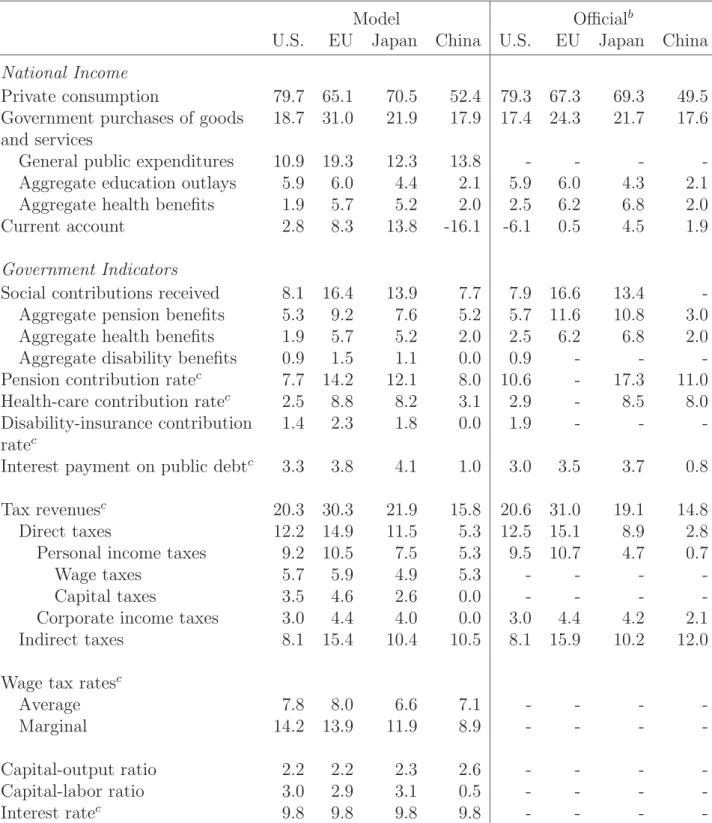
Table 3 reports key macroeconomic variables in 2004 in the four regions. Note that there is a fairly close accordance between actual and computed values of private consumption and gov-ernment purchases measured as a share of national income. The one exception is EU govgov-ernment purchases. The official data seem too low given the reported ratio of tax revenues to national income. In our calibration, we chose to benchmark government purchases based on the ratio of tax revenues to national income.
The reported ratios of educational expenditure to national income are very close to actual
levels3. In the case of pension, health, and disability, expenditures, we closely match the shares
of national income received in the form of social contributions in the U.S., the EU and Japan as reported in European Commission (2005). In China, the level of health expenditures measured as a share of national income was set in accord with WHO (2004, 136). The resulting social security payroll tax rates come close to observed levels. Concerning the overall structure of tax revenues, the assumed tax rates on capital income, corporate income, and consumption as well as
the expensing fractions (see Table 2) yield a realistic pattern4.
The baseline simulation ignores adjustment costs. Hence, capital prices do not change during the transition. However, due to the differences in the expensing fractions for the corporate tax, capital prices deviate from one in the EU and Japan. Thus the capital price is 0.964 in the EU and 0.936 in Japan throughout the transition, while it is 1.000 in the U.S. and China. Finally, the model’s year-2004 capital-output ratios seem reasonable not only relative to U.S. Commerce Department figures, but also in terms of the year-2004 marginal product of capital, which equals 9.8 percent.
Next we turn to the simulation results for the baseline transition. The transition paths for the four regions are reported in the upper panels of Tables 4 to 7 for the U.S., the EU, Japan, and China. Note that region-specific ratios of national income, the capital stock, the supply of labor, and the pre-tax wage rate are all expressed relative to the U.S. values in year 2004.
Although the four economies are aging, the baseline path shows a steady increase in effective labor supply in the U.S., the EU and Japan. This may seem surprising especially for Japan and the EU where the population and work force decline over time (see Table 1). The explanation lies in our assumption that each successive cohort has a higher effective time endowment, which admits greater effective labor supply by each successive cohort. Thus, the future decrease in the actual labor force is offset in the EU, Japan, and China and the growth in the actual number of workers in the U.S. is augmented. However, effective labor supply grows at much different rates in the regions. In Japan it increases over the century by 41 percent. In the EU it more than doubles
3See OECD (2003a, 178; 2003b, 71, 77).
over the same period. And in the U.S. it increases over the century by a factor of almost four. The evolution of effective labor supply in China is particularly interesting. During the next two decades effective labor supply increases, then it declines until mid century when it begins to increase again. This complex pattern reflects major changes in substitution and income effects over the transition, the demographic changes themselves, as well as the ongoing technological change. By the end of the century, China’s effective labor supply is larger, but only 18 percent larger, than it is today.
Due to the dramatic aging of populations,social security tax rates increase through 2050 by 5.5 percentage points in the U.S., by 12.8 percentage points in the EU, by 13.8 percentage points in Japan, and by 7.8 percentage points in China. Over the century the respective increases are 11.4 percentage points in the U.S. and the EU, 10.7 percentage points in Japan and 16.6 percentage points in China. These changes constitute very major percentage payroll tax hikes given the base-year values. In the U.S. and China, for example, the model is predicting more than a 100 percent rise in payroll tax rates.
Despite the rising payroll tax burden, capital stocks rise dramatically in all regions over the course of the century. The capital stock increases by a factor of 4.7 in the U.S., by a factor of 2.5 in the EU, by a factor of 1.7 in Japan and by a factor of 9.6 in China. In China this development is due to high investment rates associated with high private saving and the assumed rapid catch-up in the country’s level of technology. The other regions also benefit from the economic boom in China. As the development of the current accounts suggests, initially capital mainly flows from the three developed regions to China. However, in subsequent decades the asset holdings of the U.S., the EU, and Japan in China decline and capital starts to flow from China to all three of these regions. After 2050, this is reversed again so that capital flows from the U.S., EU, and Japan back to China. This reversal is expected; it reflects the repatriation of Chinese foreign capital earnings back to China.
The differences across the four regions in the growth of effective labor supply and capital stock and, in the case of China, in the evolution of the multifactor productivity coefficient materially affects overall economic growth. In the U.S. output grows by a factor of 4.1 over the next 100
years. It grows by a factor of 2.2 in the EU, 1.4 in Japan and 8.5 in China. The larger increase in capital compared to labor supply leads to an increase in the pre-tax wage rate in the developed economies of almost 16 percent through the middle of the century. In China wages rise by more than 700 percent thanks, primarily, to the gradual increase in China’s technology level. After 2050, however, growth in labor supply exceeds growth in capital stocks in all regions so that the wage rate starts to decline. At the end of the century real wages per unit of human capital in the developed economies are still above 2004 levels, but only 4 percent higher.
As one would expect, the world-wide capital deepening in the first half of the century and capital-shallowing in the second half has a major impact on the world interest rate. Between 2004 and 2030 the world interest rate declines by 370 basis points – from .098 to .061. This is followed by an increase to a 2100 level of .087 percent. Wage tax rates follow a similar pattern – declining in the first half of the century and rising in the second half.
This interesting pattern in the evolution of factor prices reflects China’s ongoing rapid growth and its assumed gradual change in saving behavior. During the first half of the century, China makes a major contribution to world-wide capital formation. In the second half of the century, more and more of its cohorts have adopted U.S. preferences with respect to spending and the Chinese saving engine starts to sputter and fail.
To understand better the role of China in worldwide capital formation, let’s consider what would happen were the developed world forced to evolve without the ability to import capital from China.
IV. The World Economy’s Baseline Transition Path Excluding China
Table 8 reports baseline transition paths for the developed economies if we calibrate the model as above, but simply exclude China. Doing so has dramatic effects. Capital stocks in all three regions in the initial years of the transition are much higher compared to the four-country case since more capital now remains in the developed world. For example, in 2010 the capital stock index in the U.S. is 1.60 compared with 1.02 in the 4-country simulation (see Table 4). In both simulations, the capital stock is measured relative to the U.S. value in 2004 in the 4-country simulation.
Interestingly, even though the developed world has more capital to work with initially, real wages are actually lower in 2010 than in the transition with China. The reason is that labor supply is initially also much higher in the developed world in the no-China simulation. Presumably this reflects the income effect of having lower real wages in the medium term when China is no longer serving as the developed world’s saving machine.
With China out of the picture, the developed regions’ capital stocks increase much less rapidly over time. This puts a significant damper on output growth. During the first half of the century, capital growth is somewhat larger than labor supply growth. Thus wage rates increase by approximately 2 percent and the world interest rate decreases by about 30 basis points. In the second half of the century, however, all three regions experience a capital shortage due to the high tax burden. As a consequence, wage rates decline. Indeed, the 2100 wage per unit of human capital is 4 percent below its 2004 level, and the interest rate is 100 basis points above its base year value. The lower level of real wages in the no-China transition leads to higher average wage and payroll tax rates, both of which limit capital accumulation.
The current accounts show that capital flows primarily to the U.S. during the coming decades due to its younger population and higher population growth rate. After 2050, capital flows to the EU and increasingly to Japan as the Europeans and Japanese repatriate their U.S.-earned income. As indicated in the introduction, the no-China developed world transition path shows a relatively modest capital shortage compared to our previous findings reported in Fehr, Jokisch and Kotlikoff (2004a,b; 2005). The main reason, again, is that we are now calibrating the model to include government investment. In addition, we’ve switched to using European Commission (2005) data for our measures of social contributions received. This lowers, somewhat, initial payroll tax rates as well as subsequent payroll tax hikes.
V. Adjustment Costs
Table 9 repeats the base-case simulation, but includes capital adjustment costs. A compar-ison of this table with the first panels in Tables 4 through 7 shows that adjustment costs make very little difference to the four-region dynamic equilibrium. The initial levels and times paths of regional stock prices per unit of physical capital (the ratio of market value to replacement cost)
are, however, interesting.
In 2004, EU stock prices are 5.1 percent lower than US stock prices. Japanese stock prices are 12.6 percent lower, and Chinese stock prices are 16.1 percent higher. The model predicts increases in stock values in all four regions for the next 10 to 20 years, depending on the region, followed by a long term decline in stock values. The U.S. stock market value is 1.000 in 2004, hits 1.062 in 2020, and falls to .917 in 2100. The EU’s 2004 stock market value is .949. It’s .979 in 2020 and then gradually falls to .882 in 2100. Japan’s 2004 stock market value is .874. In 2020 it’s .938, but then falls to .851 by Century’s end. And China’s stock market value starts at 1.161, reaches 1.196 in 2020 and declines to .914 in 2100.
VI. Examining China’s Saving and Absorption of Technology
This section returns to the four region model without adjustment costs and examines the importance of our assumptions about the evolution of Chinese saving behavior and the rate at which China absorbs developed-world technology. Specifically, we first consider keeping the time preference rate of successive Chinese cohorts at same the level calibrated for all Chinese cohorts for 2004 in the base case transition. Next we assume the technology coefficient in the Chinese Cobb-Douglas production function rises only to half, rather than 100 percent, of the U.S. level by 2050 and remains at that value thereafter.
1. Constant Time Preference Rate in China
The second simulation reported in Tables 4 through 7 from permanently maintains the Chinese time preference rate at its year-2004 level. Doing so has dramatic consequences. In particular, the 2100 world stock of capital is 5.9 times higher than in the base case! China not only becomes the world’s saver. It also becomes the world’s investor, sending huge flows of capital to the developed world over the course of the Century. By 2100, the capital stocks in the U.S., the EU, and Japan are 5.6, 5.6, and 5.8 times their initial values, respectively.
This huge impetus to capital formation has a major impact on economic growth in all four regions, leaving world output roughly 50 percent higher in 2100 than it would otherwise have been. This is true notwithstanding a basically unchanged supply of labor in the four regions. The
rough constancy of labor supply reflects competing income and substitution effects arising from roughly 55 percent higher long-run (year 2100) levels of the real wage per unit of human capital. The long-run capital glut also leads to a very major decline in the world real interest rates – from 9.8 percent in 2004 to 2.3 percent in 2100.
The long-run rise in real wages has a major effect on long-run payroll tax rates, although it does very little to payroll tax rates over the next three decades. Year-2100 payroll tax rates are now 16.4 percent instead of 23.0 percent in the U.S., 26.1 percent instead of 36.7 percent in the EU, 22.7 percent instead of 32.8 percent in Japan, and 26.0 percent instead of 27.7 percent in China. Higher output growth immediately translates into increased government expenditures. This explains the higher wage tax rates in the medium and long run.
2. Slower Technology Growth in China
Our next simulation, reported in the third panels of tables 4 through 7, assumes that the multi-factor technology coefficient in the Chinese production function rises by 2050 to only 50, rather than 100 percent of the U.S. level and remains fixed at half the U.S. level thereafter. As a comparison with the base case shows, slower Chinese technological growth means much lower capital demand, output, and real wage levels in China. Indeed, in 2100 the Chinese capital stock and output levels are just over half of their base-case values. And the Chinese real wage is only 39 percent of what it would otherwise have been.
In contrast to what happens to China’s capital stock, China’s labor supply is significantly higher along the entire transition path. This reflects the income effects (relative to the base case) experienced by the Chinese in receiving lower real wages as well as smaller inheritances. These income effects matter to labor supply from the get go. Indeed, the immediate increase in labor supply explains why Chinese output and capital stock levels are initially higher than they are in the base case.
The rise in China’s labor supply doesn’t suffice to offset the lower path of wages with respect to determining the Chinese payroll tax base. Consequently, social security payroll tax rates are markedly higher during this transition.