Shannon Hastings, MS, Scott Oster, MS, Steve Langella, MS, Tahsin M. Kurc, PhD, Tony Pan, MS, Umit V. Catalyurek, PhD, Joel H. Saltz, MD, PhD
Department of Biomedical Informatics Ohio State University
Columbus, OH, 43210
Contact Author: Tahsin Kurc
Address: Biomedical Informatics Department Ohio State University
3184 Graves Hall, 333 West 10th Ave. Columbus, OH, 43210
E-mail: [email protected]
Phone: 614-292-6568
With the increasing emphasis of medical research and clinical practice on complex datasets obtained from a variety of imaging modalities, there is a great need for advances in image processing, analysis, and storage capabilities. Imaging data yields a wealth of metabolic and anatomic information from macroscopic (e.g., radiology) to microscopic (e.g., digitized slides) scale. While this information can significantly improve understanding of disease pathophysi-ology as well as the noninvasive diagnosis of disease in patients, the need to process, analyze and store large amounts of image data presents a great challenge. In this paper we present a Grid-aware middleware system that enables management and analysis of images in a massive scale, leveraging distributed software components coupled with interconnected computation and storage platforms.
Key words: Image databases, image processing, metadata, distributed systems, Grid environ-ment.
1
Introduction
Biomedical imaging is increasingly becoming more prevalent and a key component in both basic research and clinical practice. Image data provides metabolic and anatomic information from microscopic to macroscopic scale. While advances in data acquisition technologies have improved the resolution and speed at which we can collect 2D, 3D, and time dependent image data, most researchers have access to a limited research repository mainly due to lack of efficient software for managing, manipulating, and sharing large volumes of image data. Querying and retrieving the data of interest so that the analysis can be completed quickly is a challenging step in performing research using large datasets of medical images. For instance, a single digitized microscopy image can reach up to several tens of Gigabytes in size, and a research study may require access to hundreds of such images. Formulation and execution of effective image analysis workflows is also crucial. An image analysis workflow can consist of many steps of simple and complex operations on image data (e.g., from cropping, correction of various data acquisition artifacts to segmentation, registration, and feature detection) and interactive inspection and visualization of images. There is also a need to support the information service needs of
collaborative studies, in which datasets may reside on various heterogeneous distributed resources including a wide range of networks, computation platforms, and data storage systems. Addressing these data management and processing challenges imposed by large image datasets requires an integrated system that will provide support to 1) implement the ability to integrate images from multiple studies and modalities in one or more distributed databases, 2) implement the
functionality to submit queries against such image databases, and 3) be able to quickly process hundreds or thousands of images.
In this work, we present a system, called GridPACS, that implements a set of core services, which extend the traditional image archival and communication systems in the following ways:
Virtualized Data Access. Data can be stored and accessed at distributed sites. Multiple image servers can be grouped to form a collective that can be queried as if the collective is located in a central repository.
Scalability. The infrastructure makes it possible to employ compute and storage clusters to store and manipulate large image datasets. An image server can be set up on one node of a cluster or the entire cluster. New image server nodes can be added to or deleted from the system with very little overhead.
Active Storage. The architecture supports invocation of procedures on ensembles of images. These procedures can be used to, for example, carry out post processing, error correction, image processing, and visualization. Processing of data can be split across storage nodes (where image data is stored) and compute nodes, without requiring the client to download the data to a local machine. The system is extensible in that application developers can define and deploy their own procedures.
On-demand Database Creation. Application-defined meta-data types and image datasets can be automatically manifested as custom databases at runtime, and image data adhering to these data types can be stored in these databases. An application-specific data type (e.g., results of an image analysis workflow) can be registered in the system as a new database schema. The schema can also be created by versioning an already existing schema by adding or deleting attributes. Moreover, the schema can be a composition of new attributes and references to multiple existing schemas. The system enables on-the-fly creation of distributed databases conforming to a given schema.
The GridPACS system is built using Mobius [27, 36, 41] and DataCutter [34, 10, 15], which are middleware frameworks for management and processing of large, distributed datasets. In our system, image datasets and data processing workflows are modeled by XML schemas. These schemas and instances of the schemas are stored, retrieved, and managed by distributed data management services. Images might be organized in volumes of 2D tiles, 3D volumes, and 2D/3D volumes dependent on time. Through the use of XML schemas, multiple attributes can be defined and associated with an image, such as the type of the image, study id for which the image was acquired, and the date of image acquisition. Distributed execution services carry out instantiation of data processing operations (components) on distributed platforms, management of data flow between operations, and data retrieval from and storage to distributed collections of data servers.
The rest of the paper is organized as follows. In Section 2, a brief overview of related projects that target storage and processing of large scale data is presented. Section 3 describes applications that have motivated the design of GridPACS. The description of the GridPACS system is given in Section 4. This section is followed by an experimental performance evaluation of the current implementation in Section 5. We conclude in Section 6.
2
Background
The growth of biomedical imaging data, has led to the development of Picture Archiving and Communication Systems (PACS) [29] that store images in the DICOM standard format [1, 2, 3]. PACS-based systems support storage, management, and retrieval of image datasets and meta-data associated with the image data. A client using these systems usually has to retrieve the data of interest, often specified through a GUI, to the local workstation for application-specific
processing and analysis. The effectiveness of imaging studies with such configurations is severely limited by the capabilities of the client’s workstation. Advanced analysis techniques and
exploration of collections of datasets can easily overwhelm the capacity of most advanced desktop workstations as well as premium clinical review stations.
There are a number of projects that target development of infrastructures for shared access to data and computation in various areas of medicine, science, and engineering. Biomedical Informatics Research Network (BIRN) [11] initiative focuses on support for collaborative access to and analysis of datasets generated by neuroimaging studies. The BIRN project uses the Storage Resource Broker (SRB) [51] as a distributed data management middleware layer. It aims to integrate and enable use of heterogeneous and grid-based resources for application-specific data storage and analysis. MEDIGRID [40] is another project recently initiated to investigate
application of Grid technologies for manipulating large medical image databases.
The Open Microscopy Environment project [47] develops a database-driven system for analysis of biological images. The system consists of a relational database that stores image data and metadata. Images in the database can be processed using a series of modular programs. These
programs are connected to the database; a module in the processing sequence reads its input data from the database and writes its output back to the database so that the next module in the sequence can work on it. The Virtual Slidebox project [54] at the University of Iowa is a
web-based portal of a database of digitized microscopy slides for education. The users can search for virtual slides and view them through the portal. The Visible Mouse project [53] provides access to basic information about the mouse and mouse pathology through a web-based portal. The Visible Mouse system can be used for educational and research applications.
Manolakos and Funk [39] describe a Java-based tool for rapid prototyping of image processing operations. This tool uses a component-based framework, called JavaPorts, and implements a master-worker mechanism. Oberhuber [45] presents an infrastructure for remote execution of image processing applications using SGI ImageVision library, which is developed to run on SGI machines, and NetSolve [12].
Andrade et al. [4] develops a distributed semantic caching system, called ActiveProxy-G, that allows proxies interspersed between application clients and application servers in order to speed up execution of related queries by exploiting cached aggregates. It also enables an application to explore the parallel capabilities of application servers. ActiveProxy-G requires integration of user-defined operators in the system to enable caching of application-specific intermediate results and searching of cached results.
The Distributed Parallel Storage Server (DPSS) [31, 52] project developed tools to use distributed storage servers to supply data streams to multi-user applications in an Internet environment. A prototype implementation of a remote, large scale data visualization framework using DPSS is demonstrated in [9]. Our middleware has similarities to DPSS in that it is used for storing and retrieving data. However, DPSS is designed as a block-server, while data in our system is managed as semi-structured documents conforming to schemas. This allows for more complex data querying capabilities, schema validation, and database creation from complex schemas.
The Chimera [5, 21] system implements support for establishing virtual catalogs that can be used to describe how a data product in an application has been derived from other data. The system allows storing and management of information about the data transformations that have generated
the data product. This information can be queried and data transformation operations can be executed to regenerate the data product.
In our work, we address the metadata and data management issues using a generic, distributed, XML-based data management system. This system, called Mobius [27, 36, 41], is designed as a set of loosely coupled services with well-defined protocols to interact with them. Building on Mobius, GridPACS allows for modeling and storage of image data and workflows as XML schemas and XML documents, enabling use of well-defined protocols for storing and querying data. A client can define and publish data models in order to efficiently store, query, reference, and create virtualized XML views into distributed and interconnected databases. Support for image data processing is an integral part of GridPACS. The image processing component builds on a component-based middleware [34, 10, 15] that provides combined task- and data-parallelism through pipelining and transparent component copies. This enables combined use of distributed storage and compute clusters. Data operations that carry out data subsetting and filtering
operations can be pushed to storage nodes in order to reduce the volume of network traffic, whereas compute intensive tasks can be instantiated on high-performance compute clusters. Complex image analysis workflows can be formed from networks of individual data processing components.
3
Design Objectives
The GridPACS architecture is designed to support a wide range of biomedical imaging applications encountered in translational research projects, basic science efforts and clinical medicine. These applications have in common the need to store, query, process and visualize large collections of related images. In this section, we briefly describe two biomedical imaging applications, with which our group has direct experience, and describe how these application scenarios motivate the requirement for GridPACS.
3.1
Dynamic Contrast Enhanced MRI Studies
Dynamic Contrast Enhanced Magnetic Resonance Imaging (DCE-MRI) [32, 33, 48] is a powerful method for cancer diagnosis and staging, and for monitoring cancer therapy. It aims to detect differences in the microvasculature and permeability of abnormal tissue as compared to healthy tissue. After an extracellular contrast agent is injected in the subject, a sequence of images are taken over some period of time. The time-dependent signal changes acquired in these images are quantified by a pharmacokinetic model to map out the differences between tissues.
State-of-the-art research studies in DCE-MRI make use of large datasets, which consist of time dependent, multidimensional collections of data from multiple imaging sessions. Although single images are relatively small (2D images consists of
to
pixels, 3D volumes of 64 to 512 2D images), a single study carried out on a patient can result in an ensemble of hundreds of 3D image datasets. A study that involves time dependent studies from different patients can involve thousands of images.
There are a wide variety of computational techniques employed to quantitatively characterize DCE-MRI results [28, 38, 33, 32]. These studies can be used to aid tumor localization and staging and to assess efficacy of cancer treatments. Systematic development and assessment of image analysis techniques requires an ability to efficiently invoke candidate image quantification methods on large collections of image data. A researcher might employ GridPACS to iteratively apply several different image analysis methods on data from multiple different studies to assess ability to predict outcome or effectiveness of a treatment across patient groups. Such a study would likely involve multiple image datasets containing thousands of 2D and 3D images at different spatial and temporal resolutions.
3.2
Digital Microscopy
Digital microscopy [19, 13] is being increasingly employed in basic research studies as well as in cooperative studies that involve Anatomic Pathology. For instance both the CALGB and the Children’s Oncology Group are making use of fully digitized slides to support slide review.
Researchers in both groups are developing algorithms to assist Anatomic Pathologists in developing computer based methods for quantification of histological features used to grade slides.
There are many examples of basic science applications of digitized microscopy. One such example involves the characterization of effects of genetic knock-outs and knock-ins on spatial patterns of gene expression, histology and tissue organization in the mouse placenta. These studies involve acquiring roughly one thousand adjacent stained thin slices of mouse placenta. These slices are digitized and used to quantify the role of genetic manipulations on
microanatomy, shape and protein expression.
These applications target different goals and make use of different types of datasets. Nevertheless, they exhibit several common requirements that motivate the need for a system like GridPACS. First of all, they all involve significant processing on large volumes of data. This characteristic requires the ability to push data processing near data sources. Second, in all of these application scenarios, it can be anticipated that data will be generated by distributed groups of researchers and clinicians. For instance, teams researchers from different institutions can generate various portions of mouse placenta datasets. In most cases it is safe to assume that a single very large storage system will not be allocated to a project. Instead, several sites associated with a project will contribute storage. These requirements motivate distributed storage and virtualized data access. Third, we also expect each such application to be in a position to make use of computing capacity located at multiple sites. Hence, a system should support combined use of distributed storage and compute resources to rapidly access data and pass it to relevant processing functions.
4
System Description
We have designed GridPACS to support distributed storage, retrieval and querying of image data and descriptive metadata. Queries can include extraction of spatial sub-regions, defined by a bounding box and other user-defined predicates, requests to execute user-defined image analysis operations on data subsets along with queries against metadata. A client query may span datasets
across multiple sites. For example, a researcher may want to perform a statistical comparison of images from two datasets located at two different institutions. While the current implementation does not support security, we are currently layering this system on OGSA-DAI [46] which will be employed to support authentication/authorization.
GridPACS can use clusters of storage and compute machines to store and serve image data. On such platforms efficient access to data depends on how well the data has been distributed across storage units so that data elements that satisfy a query can be concurrently retrieved from many sources. GridPACS manages the storage resources on the server and encapsulates efficient storage methods for image datasets. In addition to managing image datasets and descriptive metadata, GridPACS can maintain metadata describing workflows, and can checkpoint and retrieve
intermediate results check-pointed during execution of a workflow. It supports efficient execution of image analysis workflows as a network of image processing components in a distributed environment on commodity clusters and multiprocessor machines. The network of components can consist of multiple stages of pipelined operations, parameter studies, and interactive
visualization.
Descriptive metadata, workflows and system metadata are modeled as XML schemas. The close integration of image data and metadata makes it straightforward to maintain detailed
provenance [21] information about how imagery has been acquired and processed; the framework manages annotations and data generated as result of data analysis.
In the rest of this section we provide a more detailed description of the GridPACS architecture. We first present the two middleware systems, Mobius [27, 36, 41] and DataCutter [34, 10, 15], that provide the underlying runtime support. This presentation is followed by the description of the GridPACS implementation.
4.1
Mobius and DataCutter Middleware
4.1.1 Mobius
The Mobius middleware is used to manage and integrate data and metadata that may exist across many heterogeneous resources. Its design is motivated by the requirements of Grid-wide data access and integration [14, 20, 6, 7] and by earlier work done at General Electric’s Global Research Center [35]. Mobius provides a set of generic services and protocols to support distributed creation, versioning, and management of data models and data instances, on demand creation of databases, federation of existing databases, and querying of data in a distributed environment. Its services employ XML schemas to represent metadata definitions (data models) and XML documents to represent and exchange data instances.
Mobius GME: Global Model Exchange. For any application it will be essential to have a model for the data and metadata. By creating and publishing a common schema for data captured and referenced in a collaborative study, research groups can make sure that applications developed by each group can correctly interact with the shared data sets and inter-operate. While a common schema enables interoperability, each group may generate and/or reference additional data attributes. Thus, it is also necessary to support local extensions of the common schema (i.e., versions of the schema). For instance, a common image data schema may define attributes associated with an image, such as the type of the image, study id for which this image was acquired, date and time of image acquisition. A group may want to also capture lab values and demographic information about the patient, from whom the image data is obtained.
The Global Model Exchange (GME) is a distributed service that provides a protocol for
publishing, versioning, and discovering XML schemas. In this way, the GME allows distributed collections of users to examine and analyze distributed GridPACS imagery. In GME, a schema can be the same as a schema already registered in the system, or it can be created by versioning an already existing schema by adding or deleting attributes. The schema can also be a composition of new attributes and references to multiple existing schemas. Since the GME is a global service and needs to be scalable, it is implemented as an architecture similar to Domain Name Server
(DNS), in which there are multiple GMEs each of which is an authority for a set of namespaces.
The GME provides the ability for inserted schemas that reference entities already existing in other schemas and in the global schema defined by a researcher. When processing an entity reference, the local GME contacts the authoritative GME to make sure that the entity being referenced exists and that the schema referencing it has the right to do so. The GME enforces a policy for
maintaining the integrity of the global schema when deleting schemas. For example, deleting a schema which contains entities that other schemas reference will destroy the integrity of the global schema. The GME schema deletion policy will have to handle such special cases. Other services such as storage services can use the GME to match instance data with their data type definitions.
Mobius Mako: Distributed Data Storage and Retrieval. The Mako is a distributed data storage service that provides users the ability to create on demand databases, store instance data, retrieve instance data, query instance data, and organize instance data into collections. Mako exposes data resources as XML data services through a set of well-defined interfaces based on the Mako protocol. A data resource can be a relational database, an XML database, a file system, or any other data source. Data resources are exposed through a set of well-defined interfaces, thus exposing specific data resource operations as XML operations. For example, once exposed, a relational database would be queried through Mako using XPath as opposed to querying it
directly with SQL. Mako provides a standard way of interacting with data resources, thus making it easy for applications to interact with heterogeneous data resources.
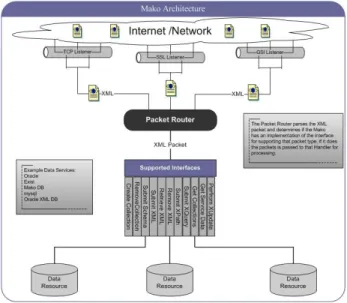
Clients interact with Mako over a network; the Mako architecture illustrated in Figure 1 contains a set of listeners, each using an implementation of the Mako communication interface. The Mako communication interface allows clients to communicate with a Mako using any communication protocol. Each Mako can be configured with a set of listeners, where each listener communicates using a specified communication interface.
When a listener receives a packet, the packet is materialized and passed to a packet router. The packet router determines the type of packet and decides if it has a handler for processing a packet of that type. If such a handler exists, the packet is passed onto the handler which processes the
Figure 1: Mako Architecture
packet and sends a response to the client. For each packet type in the Mako protocol, there is a corresponding handler to process that packet type. In order to abstract the Mako infrastructure from the underlying data resource, there is an abstract handler for each packet type. Thus, for a given data resource, a handler extending the abstract handler would be created for each supported packet type. This isolates the processing logic for a given packet, allowing a Mako to expose any data resource under the Mako protocol.
Data services can easily be exposed through the Mako protocol by creating an implementation of the abstract handlers. Since there is an abstract handler for each packet type in the protocol, data services can expose all or a subset of the Mako protocol. Once handler implementations exist, Mako can be easily configured to use them. This is done in the Mako configuration file, which contains a section for associating each packet type with a handler.
The initial Mako distribution contains a handler implementation to expose XML databases that support the XMLDB API [55]. It also contains handler implementations to expose MakoDB. MakoDB is an XML database optimized for interacting in the Mako framework. To meet its data storage demands, the GridPACS system is composed of several clusters, with each machine in a cluster running a MakoDB implementation of a Mako. As storage demands increase, the
GridPACS system can easily scale with the demands by adding more nodes running Mako to the system.
The Mako client interfaces enable application developers to communicate with Makos. Databases that store XML instance documents can created by using the client interfaces to submit the XML schema that models the instance data to a Mako. Once submitted the client interfaces can be used to submit, retrieve, delete, and query instance data. Instance data is queried using XPath [8].
4.1.2 DataCutter
DataCutter supports a filter-stream programming model for developing data-intensive applications. In this model, the application processing structure is implemented as a set of components (referred to as filters) that exchange data through a stream abstraction. Filters are connected via logical streams, which denote a uni-directional data flow from one filter (i.e., the producer) to another (i.e., the consumer). In GridPACS, DataCutter streams are strongly typed with types defined by XML schemas managed by the GME. The current runtime implementation provides a multi-threaded execution environment and uses TCP for point-to-point stream
communication between two filters placed on different machines.
The overall processing structure of an application is realized by a filter group, which is a set of filters connected through logical streams. Processing of data through a filter group can be pipelined. Multiple filter groups can be instantiated simultaneously and executed concurrently. Work can be assigned to any filter group.
4.2
GridPACS Implementation
GridPACS has been realized as four main components in an integrated system; frontend client, backend metadata and data management, image storage, and distributed execution. The client application can be used by a user to upload, query, and inspect the data at the server. The backend metadata and data management service is implemented as a collection of federated backend Mobius Mako servers. The distributed execution service, referred to as IP4G [26], uses the
Hand held computer Workstation
Review Station
Mako Image Data Storage Service Mako Image Data Storage Service Mako Image Data Storage Service Mako Image Data Storage Service Image Cluster Mako Image Data Storage Service Mako Image Data Storage Service Mako Image Data Storage Service Image Cluster Mako Image Data Storage Service Mako Image Data Storage Service Mako Image Data Storage Service Image Cluster Workstation Workstation Workstation Review Station Review Station Hand held computer
Hand held computer Hand held computer
Image Data Grid DPACS Clients in the Grid
Mobius Grid Middleware
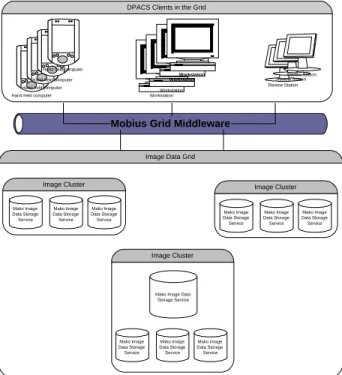
Figure 2: A sample GridPACS instance.
Visualization Toolkit (VTK) [50] and the Insight Segmentation and Registration Toolkit
(ITK) [30] frameworks for image processing and DataCutter for runtime support. Figure 2 shows a sample environment of front end clients and back end image data servers.
4.2.1 GridPACS Frontend and Client Component
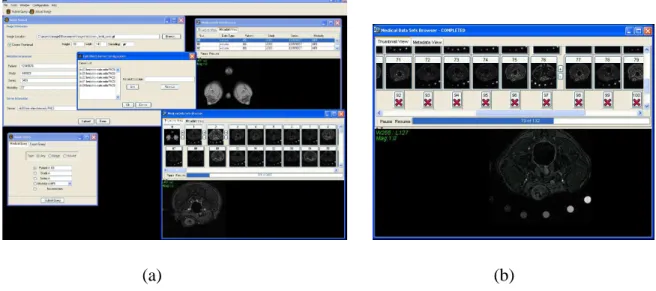
The GridPACS client front end, shown in Figure 3, provides an intuitive, centralized view of the GridPACS backend. It creates a local workspace for the user by hiding the details of retrieving and locating datasets within the back end. The results of queries are displayed in a browser, which provides mechanisms for traversing both volumetric and single image datasets as via thumbnails and a metadata viewer.
Accessing and displaying large datasets over a network of distributed servers can quickly become problematic for clients, because of issues such as network delays, large data sizes and quantities, and multiple servers. The GridPACS client application utilizes several techniques to overcome
(a) (b)
Figure 3: (a) GridPACS Client Screen Shot. (b) Medical Datasets Browser Screen Shot.
these adversities. The first important feature is the extensive use of background threading for tasks which communicate with network resources. The client application utilizes an active thread pool which allows sequences of tasks to be immediately performed in the background, while the main application thread continues to process user inputs and refresh the display. Another
powerful feature is the use of ”on demand”, lazy data loading. All data within datasets is left on the back end until it is absolutely needed. Only a reference to the data is stored in the client. The dataset object model abstracts this concept by presenting get methods which cache and
immediately return data if it is present, and transparently load the needed data from the back end when it is not. This allows the application components to work with the datasets as though they are all locally present, and the object model handles the requests and local storage when they are not. The dataset browser takes full advantage of this feature, and is able to present a large amount of data quickly.
4.2.2 Distributed Metadata and Data Management
The distributed back end of GridPACS relies heavily on the Mobius middleware for data and metadata management. In this work, image data is modeled using XML schemas and managed by Mobius GME. An instance of the schema corresponds to an image dataset with images and
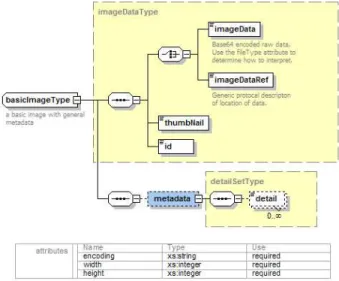
Figure 4: Basic Image Model.
associated image attributes stored across multiple storage systems running data management servers (i.e., Makos). In a cluster environment, multiple Mako servers can be instantiated on each node, and one or more GMEs can be instantiated to manage schemas.
Our image model is made up of two components: the image metadata and the image data. The image metadata component contains the encoding type of the image (JPEG, TIFF, etc.) and a detail set entity which allows a collection of user-defined key value pair metadata. This allows application specific metadata to be attached to an image, for application-specific purposes, while maintaining a common generic model. The image data component contains either a Base64 encoded version of the image data or a reference to a binary submitted with the XML instance. The Mako protocol supports the attachment of binary objects to XML documents, which is much more efficient than the Base64 encoding of binary objects.
We have designed a number of core models that any user can extend with specific versions which are more relevant to their domain. Figure 4 shows the basic single image type. The
basicImageType is a simple data model which has four main elements: the image data or a pointer to it, a thumbnail, an id, and a generic set of key-value metadata. It also defines three required attributes: the image data encoding type, the height, and the width. This model is the basic
(a) (b)
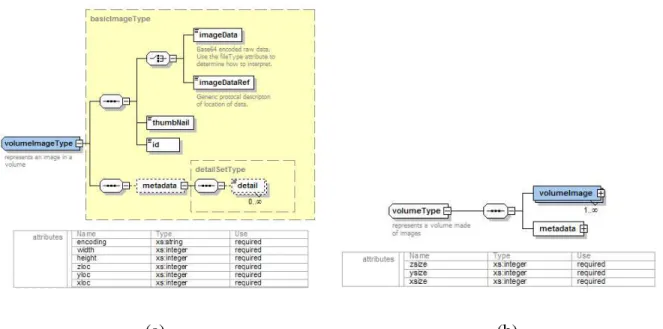
Figure 5: (a) Volume Image Model. (b) Volume Model.
starting point for representing an image in storage system. All images in the storage system are of this type or extends it.
A simple extension to the 2D image model, shown in Figure 4, is the volumeImageType shown in Figure 5(a). The volumeImageType extends the basicImageType and adds a few more descriptive attributes which are relevant to the image if it belongs to a volume. The new attributes xloc, yloc, and zloc are attributes which describe the image starting location with respect to the volume container. Figure 5(b) shows the volumeType which is the container for a set of
volumeImageTypes. This type contains a set of volumeImageTypes as well as some required metadata which describe the dimensions of the volume.
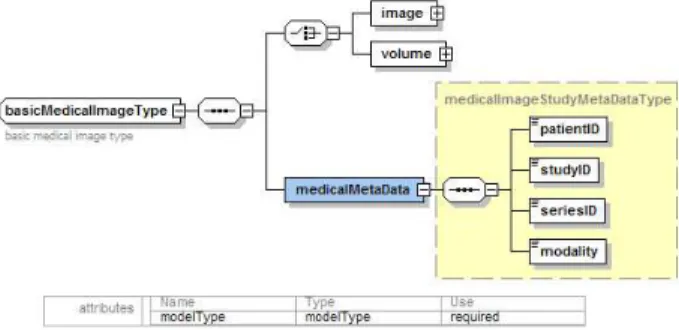
In order to handle medical image data the basic image and volume models described above are used in a new model which is more specific to medical image data sets. This model, shown in Figure 6, contains two basic elements, the image as defined by basicImageType or a volume as defined by volumeType and a set of medical image data set specific metadata. This model can be used to describe medical images or volumes and can be queried using the attached medical metadata and the metadata of the image data.
Figure 6: Medical Image Dataset Model.
4.2.3 Image Data Storage
In order to process data, a number of XML instances must be created and stored that adhere to the models defined by users and registered in the system. When input data sets are ingested, they are registered and indexed so that they can be referenced by clients in queries. GridPACS uses the Mako/MakoDB framework of Mobius in order to create the distributed image storage service infrastructure.
To maximize the efficiency of parallel data accesses for image data, GridPACS utilizes data declustering techniques. The goal of declustering [18, 37, 42, 43, 44] is to distribute the data across as many storage units as possible so that data elements that satisfy a query can be retrieved from many sources in parallel. An application programming interface (API) is provided by the system that can be used by an application to partition a large byte array into smaller pieces (chunks) and associate meta-data description with each piece (represented by a schema). For example, if the byte array corresponds to a large 2D image, each chunk can be a rectangular subsection of the image. The meta-data associated with a chunk can be the bounding box of the chunk, its location within the image, the image modality, etc.
The system currently supports several data distribution policies. These policies take into account the storage capacity and I/O performance of the storage systems that host the backend Mako databases, as well as the network performance. Distribution policy details and performance comparisons will be presented elsewhere. An application can specify a preferred declustering
mechanism, when it requests a distribution plan.
4.2.4 Distributed Execution
The distributed execution service [26] is developed as an integration of four pieces: 1) an image processing toolkit, 2) a visualization toolkit, 3) a runtime system for execution in a distributed environment, and 4) an XML based schema for process and workflow description.
Workflow Process Model. In this version of GridPACS, we have adapted the process modeling schema developed for the Distributed Process Management System (DPM) [25]. DPM describes workflows in a way that is comparable to systems such as Pegasus [16, 17] and Condor’s
DAGMan [22]. The Grid Service communities are defining standards to describe, register,
discover, and execute workflows [24]. We ultimately plan to adopt a model based on the emerging Global Grid Forum [23] workflow standards.
In DPM, the execution of an application in a distributed environment is modeled by a directed acyclic task graph of processes. This task graph is represented in an XML schema. The workflow schema in our system defines a hierarchical model starting with a workflow entity which
contains several jobs, each represented by the job tag. Each job represents a distributed
application which is composed of a set of local/distributed processes. Each component (or process), represented by the process tag, has attributes that describe its execution to the
distributed execution middleware. The name attribute allows the component to be named such that it can be uniquely identified by the distributed execution framework. The component type attribute describes which component type the process is.
We currently support internal and external component definitions. An internal component represents a process or function that adheres to an interface, DataCutter in this case, and is implemented as a application-specific component in the system. An external component
represents a self-contained executable that exists outside the system and communicates with other components through files.
component, this may be a path to an executable, whereas for an internal component it can be a method or interface. Each component entity may also contain three optional sub entities, a
parameter set list, a placement, and set of processes. The parameter set list consists of a list of set of key-value pair parameters that are passed as input into the process. A single set defines the input to a component, while the list allows for parameter studies, in which the same data is processed by the same component, but with different parameters. The placement entity specifies to the distributed execution service which nodes to run the process on and how many copies of the process should be run on each node. The placement entity also allows for more dynamic
scheduling, instead of specifying specific host names wild cards can be use. In this case, a scheduling software should generate the placement of components. Finally, the processes set is a set of processes that the current process is dependent on. The output from all the processes in the process set will be sent as input to the current process, thus creating a distributed process pipeline.
As discussed earlier, the GME allows a schema to reference in its definition other schemas registered in the system. This allows construction of complex database schemas from multiple schemas. We use this functionality to support nested workflows. That is, a workflow can consist of components and other workflows. A process in a workflow schema can be a reference to another job definition enabling one researcher’s process model to be comprised of references to other small process models.
Distributed Image Data Processing. An image analysis application is represented as a filter group consisting of filters that process the data in a pipelined fashion. That is, the functions constituting the image processing and visualization structure of the application are implemented as application components using DataCutter filter support. These application components operate in a dataflow style, where they repeatedly read buffers from their inputs, perform
application-defined processing on the buffer, and then write it to the output stream. We have developed a simple abstraction layer that provides support for executing image processing operations implemented using the Insight Segmentation and Registration Toolkit (ITK) [30] and the Visualization Toolkit (VTK) [50]. This enables the integration between different toolkits to be independent from any future changes to their underlying implementation.
system-level filters, MakoReader and MakoWriter. These filters provide interface between Mako servers and other filters in the workflow. The MakoReader filter retrieves images from Mako servers, converts them into VTK/ITK data structures, and passes them to the first stage filters in the workflow. The MakoWriter filter can be placed between two application filters, which are connected to each other in the workflow graph, if the output of a filter needs to be check-pointed. The last stage filters in the workflow also connect to MakoWriter filters to store output in Mako servers. The execution of a workflow and check-pointing can be done stage-by-stage (i.e., all the data is processed by one stage and stored on Mako servers before the next stage is executed) or pipelined (i.e., all stages execute concurrently; the MakoWriter filters interspersed between stages both send data to Mako servers and pass it to the next filter in the workflow).
5
Status Report
The GridPACS system implements support for a wide range operations from on-demand image database creation to querying of large images to processing of image data in a distributed environment. In this section, we present a performance evaluation of the system. In this
evaluation we used datasets generated by time-dependent MRI scans and digitized microscopes. A group of three PC clusters with a total number of 35 nodes were employed to run GridPACS servers. One cluster (OSUMED) consists of 24 Pentium III nodes, with 256MB memory and 300GB disk space per node. The nodes of this cluster are connected to each other over a Fast Ethernet Switch. The second cluster (DC) has 5 dual-processor nodes, each with Xeon 2.4GHz CPUs, 2GB memory and 250GB disk space. The third cluster (MOB) consists of 6 nodes with dual AMD Opteron CPUs. Each node of this cluster has 8GB memory and 1.5TB RAID disk array. The OSUMED cluster is connected to the MOB and DC clusters, which are connected to each other over a 1 GBit network, over a shared 100 Mbps wide-area network.
To obtain insight into how GridPACS performs in regards to creating an image database, we grouped 5 nodes of the MOB cluster into an image database server using a virtual Mako instance (i.e., each node executed a Mako server, which interacted with the virtual Mako instance), running on one of the nodes. The virtual Mako also served as a meta-data server. The client
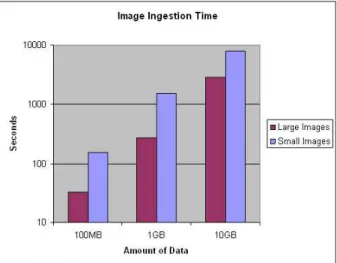
Figure 7: Performance numbers for creation of an image database.
machine was connected to the image database server over a 100 Mbps (100 Megabits per second) network. When submitting an image, the client first creates an XML document, based on the XML schema, that contains the metadata information about the image, which includes patient name, study id, imaging modality, date of acquisition, etc. It then submits this document with the actual image data as a binary attachment. Upon receiving the document, the image database server (i.e., the virtual Mako instance) separates the attachment, stores it in the database, and sends the document to the meta-data server for registration and indexing.
The size of each radiology image was on average 100KB, whereas digitized microscopy images ranged from 400MB to 5GB in size. The client partitioned each microscopy image into 512x512 pixel tiles and submitted each tile separately. Again, an XML document was created for each image. However, this document contained pointers to all the tiles as well as other metadata
information. Each tile was associated with a bounding box and location within the original image. This information is encoded in an XML file, to which the tile is attached. Figure 7 shows the timing results for creating image databases of 100MB, 1 GB, and 10GB in size. For both the small images (i.e., Radiology images) and large images (i.e., digitized microscopy images), as the size of the datasets increases, the time to create the databases increases linearly.
larger images than the smaller ones. This is expected since there is metadata associated with each image. Radiology images typically have higher metadata density per megabyte than digitized microscopy images. For the same amount of binary data, radiology images may result in 300 times the amount of metadata than a microscopy image dataset. For the same reason, there is more communication overhead in submitting the small image dataset since the client needs to setup a significant amount more connections to the Mako servers.
A query into the GridPACS system is executed in two phases. In the first phase, the list of images (or image tiles) that satisfy the query are retrieve from the metadata server. Then, the image tiles and their metadata are retrieved from the image servers. In order to evaluate the querying
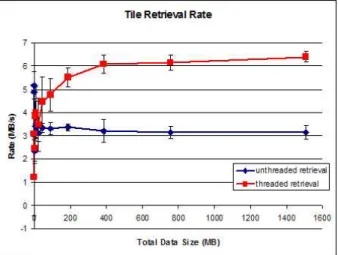
capabilities, we have uploaded 1200 digitized microscopy images, equivalent to 1 Terabytes of data, to the system. Each image was divided into 512x512 pixel tiles, which were stored across 30 nodes, 24 of which were formed into a single Virtual Mako server. The metadata associated with images is stored on a cluster of 5 Mako servers. The experiments are carried out using a client program connected to GridPACS via a 100 Mbps Ethernet connection. The client submitted queries that selected rectangular regions of a 40,000x40,000 pixel image in the database. The tests were ran with and without multi-threading at the client side. For the multi-threaded test, 8 concurrent active threads were used. Figure 8 shows that the throughput for large dataset retrieval is twice as high for multi-threaded version (threaded retrieval in the figure) compared to
single-threaded (unthreaded retrieval), since multi-threaded retrieval achieves better usage of the available network bandwidth.
To evaluate the basic functionality of data retrieval paired with on demand image analysis, we have implemented an image analysis scenario that classifies and segments nuclei in digitized microscopy images. The image analysis algorithm assumes that each pixel represents a mixture of actual materials, nucleus, cytoplasm, red blood cells, and background [49]. The complete image is then processed in chunks, and pixels are classified based on shortest barycentric distance to each of the cluster centers. The resulting classification is then segmented into components that represent individual nuclei. A mask image showing the location of the components is generated and sent to the client, along with metadata such as nuclear count.
Figure 8: Multi-threaded tile retrieval (threaded retrieval) outperforms single-threaded (un-threaded) retrieval.
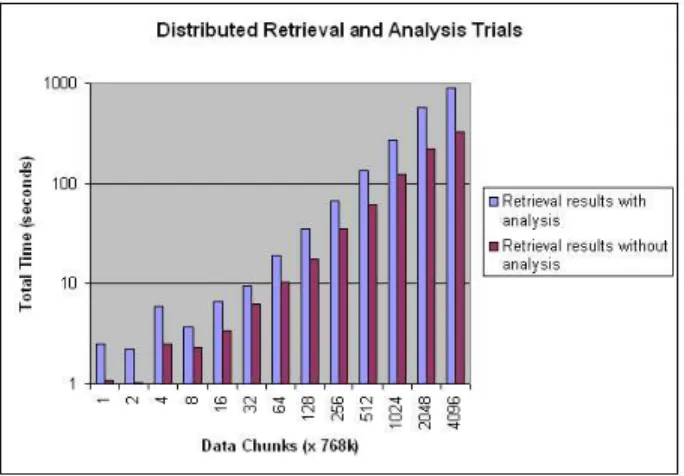
This image analysis scenario is implemented as a set of two IPG4 filters; a data retrieval filter that interacts with Mako servers to query for images and retrieve image chunks and a processing filter that implements the image analysis function. The client query specifies an image and a set of computation nodes for image processing. The data retrieval filters and processing filters execute on these nodes, retrieve portions of the image dataset (as defined in the query), apply the image analysis operation, and send the results to the client. The graph in figure 9 shows results where 10 parallel nodes are used to process image chunks. The Mako servers run on 5 of these nodes and each image is distributed across these nodes. The graph also show the timing results for data retrieval only.
6
Conclusions
This paper presented a distributed image archival and processing system, called GridPACS. The salient features of GridPACS are: (1) GridPACS provides support for active storage. Remote invocation of procedures on ensembles of images are supported. These procedures can be executed on a distributed collection of storage and compute platforms. New procedures can be added to the system. (2) With the GridPACS infrastructure, image servers can be added to or
Figure 9: Performance numbers when image analysis is performed as part of data retrieval in GridPACS.
deleted from the system easily and efficiently. (3) Application-defined meta-data types and image datasets can be automatically manifested as custom databases at runtime, and image data adhering to these data types can be stored in these databases. (4) Manifested databases can be stored and accessed at distributed sites. These mechanisms and features extend traditional PACS-based systems, which use centralized repositories for image archival, to a Grid-enabled system that addresses the storage, querying, and processing requirements of biomedical research projects that involve large-scale, distributed image databases.
Acknowledgment. This research was supported in part by the National Science Foundation under Grants #ACI-9619020 (UC Subcontract #10152408), #EIA-0121177, #ACI-0203846, #ACI-0130437, #ANI-0330612, #ACI-9982087, Lawrence Livermore National Laboratory under Grant #B517095 (UC Subcontract #10184497), NIH NIBIB BISTI #P20EB000591, Ohio Board of Regents BRTTC #BRTT02-0003.
References
[1] N. E. M. A. American College of Radiology. Acr-nema digital imaging and communications standard. NEMA Standards Publication, 300-1985, 1985.
[2] N. E. M. A. American College of Radiology. Acr-nema digital imaging and communications standard: Version 2.0. NEMA Standards Publication, 300-1988, 1988.
[3] N. E. M. A. American College of Radiology. Digital imaging and communications in medicine (dicom): Version 3.0. ACR-NEMA Committee, Working Group VI, 1993.
[4] H. Andrade, T. Kurc, A. Sussman, and J. Saltz. Active Proxy-G: Optimizing the query execution process in the Grid. In Proceedings of the 2002 ACM/IEEE SC Conference (SC 2002). ACM Press, Nov. 2002.
[5] J. Annis, Y. Zhao, J. Voeckler, M. Wilde, S. Kent, and I. Foster. Applying chimera virtual data concepts to cluster finding in the sloan sky survey. In Proceedings of Supercomputing 2002
(SC2002), 2002.
[6] M. Antonioletti, M. Atkinson, S. Malaika, S. Laws, N. Paton, D. Pearson, and G. Riccardi. Grid Data Service Specification. Technical report, Global Grid Forum, 2003.
[7] M. Antonioletti, A. Krause, S. Hastings, S. Langella, S. Malaika, J. Magowan, S. Laws, and N. Paton. Grid Data Service Specification: The XML Realisation. Technical report, Global Grid Forum, 2003. [8] A. Berglund, S. B. X. WG), D. Chamberlin, M. F. Fernndez, M. Kay, J. Robie, and J. Simon. XML
Path Language (XPath). World Wide Web Consortium (W3C), 1st edition, August 2003.
[9] W. Bethel, B. Tierney, J. Lee, D. Gunter, and S. Lau. Using high-speed WANs and network data caches to enable remote and distributed visualization. In Proceedings of the 2000 ACM/IEEE SC
Conference (SC 2000), Dallas, TX, Nov. 2000.
[10] M. D. Beynon, T. Kurc, U. Catalyurek, C. Chang, A. Sussman, and J. Saltz. Distributed processing of very large datasets with DataCutter. Parallel Computing, 27(11):1457–1478, Oct. 2001.
[11] Biomedical Informatics Research Network (BIRN). http://www.nbirn.net.
[12] H. Casanova and J. Dongarra. NetSolve: a network enabled server for solving computationa l science problems. The International Journal of Supercomputer Applications and H igh Performance
Computing, 11(3):212–223, 1997.
[13] U. Catalyurek, T. Kurc, A. Sussman, and J. Saltz. Improving the performance and functionality of the virtual microscope. Archives of Pathology & Laboratory Medicine, 125(8), Aug. 2001.
[14] Data Access and Integration Services. https://forge.gridforum.org/projects/dais-wg.
[15] The DataCutter project. http://www.cs.umd.edu/projects/hpsl/ResearchAreas/DataCutter.htm.
[16] E. Deelman, J. Blythe, Y. Gil, and C. Kesselman. Pegasus: Planning for execution in grids. GriPhyN
[17] E. Deelman, J. Blythe, Y. Gil, C. Kesselman, G. Mehta, K. Vahi, K. Blackburn, A. Lazzarini, A. Arbree, R. Cavanaugh, and S. Koranda. Mapping abstract complex workflows onto grid environments. Journal of Grid Computing, 1(1), 2003.
[18] C. Faloutsos and P. Bhagwat. Declustering using fractals. In the 2nd International Conference on
Parallel and Distributed Information Systems, pages 18–25, San Diego, CA, Jan. 1993.
[19] R. Ferreira, B. Moon, J. Humphries, A. Sussman, J. Saltz, R. Miller, and A. Demarzo. The Virtual Microscope. In Proceedings of the 1997 AMIA Annual Fall Symposium, pages 449–453. American Medical Informatics Association, Hanley and Belfus, Inc., Oct. 1997. Also available as University of Maryland Technical Report CS-TR-3777 and UMIACS-TR-97-35.
[20] I. Foster, S. Tuecke, and J. Unger. OGSA Data Services. Technical report, Global Grid Forum, 2003. [21] I. Foster, J. Voeckler, M. Wilde, and Y. Zhao. Chimera: A virtual data system for representing,
querying, and automating data derivation. In Proceedings of the 14th Conference on Scientific and
Statistical Database Management, 2002.
[22] J. Frey, T. Tannenbaum, I. Foster, M. Livny, and S. Tuecke. Condor-G: A computation management agent for multi-institutional grids. In Proceedings of the Tenth IEEE Symposium on High
Performance Distributed Computing (HPDC10). IEEE Press, Aug 2001.
[23] Global Grid Forum. http://www.gridforum.org/.
[24] Scientific Workflows Survey. http://www.extreme.indiana.edu/swf-survey/.
[25] S. Hastings. Distributed architectures: A java-based process management system. Master’s thesis, Computer Science Department, Rensselear Polytechnic Institute, 2002.
[26] S. Hastings, T. Kurc, S. Langella, U. Catalyurek, T. Pan, and J. Saltz. Image processing for the grid: A toolkit for building grid-enabled image processing applications. In CCGrid: IEEE International
Symposium on Cluster Computing and the Grid. IEEE Press, May 2003.
[27] S. Hastings, S. Langella, S. Oster, and J. Saltz. Distributed data management and integration: The mobius project. In GGF Semantic Grid Workshop 2004, pages 20–38. GGF, June 2004.
[28] U. Hoffmann, G. Brix, M. V. Knopp, T. Hess, and W. J. Lorenz. Pharmacokinetic mapping of the breast: a new method for dynamic mr mammography. Magn. Reson. Med., 33(4):506–514, 1995. [29] H. Huang, G. Witte, O. Ratib, and A. Bakker. Picture Archiving and Communication Systems (PACS)
in Medicine. Springer-Verlag, 1991.
[30] National Library of Medicine. Insight Segmentation and Registration Toolkit (ITK). http://www.itk.org/.
[31] W. Johnston, J. Guojun, G. Hoo, C. Larsen, J. Lee, B. Tierney, and M. Thompson. Distributed environments for large data-objects: Broadband networks and a new view of high performance, large scale storage-based applications. In Proceedings of Internetworking’96, Nara, Japan, Sept. 1996. [32] M. V. Knopp, F. Giesel, H. Marcos, H. von Tengg-Kobligk, and P. Choyke. Dynamic
contrast-enhanced magnetic resonance imaging in oncology. Topics in Magnetic Resonance Imaging, 12(2):301–308, 2001.
[33] M. V. Knopp, E. Weiss, H. Sinn, J. Mattern, H. Junkermann, J. Radeleff, A. Magener, G. Brix, S. Delorme, I. Zuna, and G. van Kaick. Pathophysiologic basis of contrast enhancement in breast tumors. Journal of Magnetic Resonance Imaging, 10:260–266, 1999.
[34] T. Kurc, M. Beynon, A. Sussman, and J. Saltz. Datacutter and a client interface for the storage resource broker with datacutter services. Technical Report CS-TR-4133 and UMIACS-TR-2000-26, University of Maryland, Department of Computer Science and UMIACS, May 2000.
[35] S. Langella. Intellegent data management system. Master’s thesis, Computer Science Department, Rensselear Polytechnic Institute, 2002.
[36] S. Langella, S. Hastings, S. Oster, T. Kurc, U. Catalyurek, and J. Saltz. A distributed data management middleware for data-driven application systems. In To be included in Cluster 2004
Proceesings, September 2004.
[37] W. Li and K. Pingali. Access normalization: Loop restructuring for NUMA compilers. In
Proceedings of the Fifth International Conference on Architectural Support for Programming Languages and Operating Systems (ASPLOS V), pages 285–295. ACM Press, Oct. 1992.
[38] R. E. Lucht, M. V. Knopp, and G. Brix. Classification of signal-time curves from dynamic mr mammography by neural networks. Magn. Reson. Imaging, 19(1):51–57, 2001.
[39] E. Manolakos and A. Funk. Rapid prototyping of component-based distributed image processing applications using javaports. In Workshop on Computer-Aided Medical Image Analysis, CenSSIS
Research and Industrial Collaboration Conference, 2002.
[40] MEDIGRID. http://creatis-www.insa-lyon.fr/MEDIGRID/home.html. [41] The Mobius Project. http://www.projectmobius.org.
[42] B. Moon, A. Acharya, and J. Saltz. Study of scalable declustering algorithms for parallel grid files. In
Proceedings of the Tenth International Parallel Processing Symposium. IEEE Computer Society
Press, Apr. 1996.
[43] B. Moon, A. Acharya, and J. Saltz. Study of scalable declustering algorithms for parallel grid files. In
IPPS96, pages 434–440, Honolulu, Hawaii, Apr. 1996. Extended version is available as CS-TR-3589
and UMIACS-TR-96-4.
[44] B. Moon and J. H. Saltz. Scalability analysis of declustering methods for multidimensional range queries. IEEE Transactions on Knowledge and Data Engineering, 10(2):310–327, March/April 1998. [45] M. Oberhuber. Distributed high-performance image processing on the internet. Master’s thesis,
Technische Universitat Graz, 2002.
[46] Open Grid Services Architecture Data Access and Integration. http://www.ogsadai.org.uk. [47] The Open Microscopy Environment. http://openmicroscopy.org.
[48] A. R. Padhani. Dynamic contrast-enhanced MRI in clinical oncology: Current status and future directions. Journal of Magnetic Resonance Imaging, 16:407–422, 2002.
[49] T. Pan, K. Mosaliganti, R. Machiraju, D. Cowden, and J. Saltz. Large scale image analysis and nuclear segmentation for digital microscopy images. In The Ninth Annual Conference on Advancing
Practice, Instruction and Innovation through Informatics (APIII 2004), 2004, Accepted for poster
presentation.
[50] W. Schroeder, K. Martin, and B. Lorensen. The Visualization Toolkit: An Object-Oriented Approach
To 3D Graphics. Prentice Hall, 2nd edition, 1997.
[51] SRB: The Storage Resource Broker. http://www.npaci.edu/DICE/SRB/index.html.
[52] B. Tierney, W. Johnston, J. Lee, G. Hoo, and M. Thompson. An overview of the distributed parallel storage server (DPSS). Available at http:// www-didc.lbl.gov/ DPSS/ Overview/
DPSS.handout.fm.html.
[53] The Visible Mouse. http://tvmouse.compmed.ucdavis.edu. [54] The Virtual Slidebox. http://www.path.uiowa.edu/virtualslidebox. [55] XML:DB Initiative for XML Databases. http://www.xmldb.org/.