The Saga Security System: A Security Architecture for Open Distributed Systems
Masakazu Soshi
Mamoru Maekawa
Graduate School of Information Systems,
University of Electro-Communications
1-5-1 Chofugaoka, Chofu-shi, Tokyo, JAPAN 182
Abstract
In the paper we present an overview of Saga Security
System, a security architecture in open distributed systems.
An agent in Saga Security System is called a Saga Agent. The authorization model in Saga Security System (Saga
authorization model) supports the novel concept of a service path and provides uniform and flexible protection
appro-priate for advanced computational models such as object-oriented systems and cooperative agent systems. With re-spect to the security mechanism of Saga Security System, its key features are an access token and a Security Monitor. Access tokens are implemented using public key technology and ensure integrity of request messages issued by Saga Agents. In addition, we can regard the Security Monitor of a Saga Agent as a reference monitor for the Agent. Security of a Saga Agent during its traversal over distributed envi-ronments is controlled by the Security Monitor integrated with the Agent.
1
Introduction
In recent years, inexpensive and high performance com-puters come into wide use, and more and more comcom-puters become interconnected through computer networks. In such environments, we can enjoy easy sharing of resources over networks, although, we usually suffer from reduced security of such environments at the same time.
It is often the case that in conventional “secure” systems, these environments are not taken into account. However, such environments as described above are expected to dom-inate, and establishment of security of a proper level in them is of critical importance.
Motivated by these concerns, we are designing and de-veloping Saga Security System1, a security architecture in
open distributed environments [9, 16, 17, 18]. In this paper we describe an overview of Saga Security System.
The remainder of the paper is structured as follows. We present the fundamental problem of security in open dis-tributed systems in Section 2. To solve the problem, we propose Saga Security System and discuss it in Section 3. Next in Section 4, we explore Saga authorization model. We present the security mechanism of Saga Security Sys-tem in Section 5. Then we review related work in Section 6. Finally we discuss the future work and conclude this paper in Section 7.
1We called this system “Security Agent System” before, but we have
changed the name because it was too generic and a little confusing.
2
Security Problems in Open Distributed
Systems
To begin with, let us consider the fundamental problem of security in open distributed systems.
In open distributed systems, among multiple nodes or applications, information is repeatedly copied or moved as it is. In such environments, once security is compromised in the middle of information flow and unauthorized dissemi-nation of the information takes place, its security can never be controlled anymore. This is one of the most serious security problems inherent in open distributed systems.
Unfortunately, however, the use of mutual authentica-tion protocols and encrypted communicaauthentica-tions for network security [13] alone is not a satisfactory solution to the prob-lem, because once encrypted information is decrypted, it is not protected anymore. Hence, though the use of en-cryption technique provides communication security, the ultimate security of information depends on security of the computer that processes the information.
These considerations naturally lead us to the concept of mobile agents or objects [4, 7]: instead of information being delivered as it is (whether encrypted or not), a dedicated autonomous agent traverses over a network system. Such an agent is a self-contained entity from the viewpoint of security, i.e., it has a security profile for the information, security procedures, audit trail, and so forth. Additionally, information contained in an agent is accessed only through the agent, and the required level of security is attained.
This is the background of Saga Security System, a se-curity architecture in open distributed environments. An agent in Saga Security System is called a Saga Agent.
3
Overview of Saga Security System
Saga Security System has the following outstanding fea-tures not found in traditional computer systems:
1. In order to apply to as many computing models and environments as possible, Saga Security System pro-vides a general security architecture that is indepen-dent of programming languages and application se-mantics.
2. Under the condition of Item 1 above, Saga Secu-rity System gives Saga authorization model, which supports advanced computing models such as object-oriented systems and cooperative agent systems, in open distributed environments. For that purpose, Saga
authorization model defines the novel concept of a
ser-vice path and provides flexible and powerful
protec-tion based on it.
3. A Saga Agent is a self-contained entity from the view-point of security. In particular, a Security Monitor is associated with every Saga Agent, and while the Agent travels over an open distributed system, its security can be controlled by the Security Monitor. Furthermore,
access tokens are implemented using public key
tech-nology and ensure integrity of request messages issued by Saga Agents.
Therefore, Saga Security System realizes a promising secu-rity architecture in current open distributed environments.
Now we present an overview of Saga Security System. Saga Agents as mobile agents (objects) can be implemented in scripts, byte codes, or machine (binary) codes. As men-tioned in Item 1 above, however, Saga Security System is supposed to provide a security architecture applicable to as many computing models and environments as pos-sible. Therefore, we do not make any assumption about how a Saga Agent is executed2. Instead, we make some
assumptions about a computational model of Saga Agents and about their execution environments, both of which are given below.
A Saga Agent is a self-contained entity from the view-point of security, where data and methods to access the data are encapsulated. In other words, a Saga Agent must be an instance of an abstract data type at the very least. Of course, it may or may not be completely object-oriented or intelli-gent. A method of a Saga Agent is called a service, and in the following discussions,o:sstands for a services imple-mented in a Saga Agento. Finally, Saga Agents interact with one another via synchronous message passing.
Furthermore, a Saga Agent is executed on a Saga Agent
Base (SAB). An SAB is an execution environment for Saga
Agents and is supposed to be a Trusted Computing Base (TCB) [6]. An SAB guarantees that each Saga Agent runs in its own address space distinctly separated from others and that message passing is the only means when a Saga Agent wants to access other Agents. Moreover, an SAB supports secure migration of Saga Agents.
Under these assumptions, in the paper we discuss Saga Security System, focusing on its authorization model (Saga authorization model) and security mechanism. For more details of Saga Security Systems, see [9, 16, 17, 18].
4
Saga Authorization Model
In this section, we discuss Saga authorization model, which provides uniform and flexible protection appropriate for advanced computational models such as object-oriented systems and cooperative agent systems. The reader is re-ferred to [18] for further details of the model.
4.1
Service Context
In traditional authorization models, users can exercise the privileges of directly invoking primitive operations, such as read and write, and these models cannot take advan-tage of the concept of encapsulation in object-oriented sys-tems [1]. To counter the problem, Saga authorization model should specify not only authorizations to invoke primitive
2For a full description of a framework of mobile agents, see [4, 8].
operations, but also authorizations to invoke services pro-vided by Saga Agents. Additionally, in Saga authorization model, if we can grant authorization on services to a prin-cipal as well as to another service, we can provide flexible protection scheme [2].
Moreover, Saga authorization model must take current distributed environments into consideration. Therefore, the model should be able to control security and trust relation-ships of Saga Agents. For example, in distributed environ-ments, it is desirable for the model to be able to describe which Saga Agent provides which service, or who is re-sponsible for which Saga Agent.
From the discussions above, Saga authorization model is modeled as follows. In the model, we define the current
user of a Saga Agent as the user who has invoked the Agent.
A Saga Agent executes on behalf of its current user. Then, with respect to a Saga Agento, its current useru, and a serviceo:s, a service contextis defined as the pair:
(u;o:s):
In Saga authorization model, authorization is given on the basis of service contexts. In other words, service contexts in Saga authorization model correspond to subjects/objects in conventional authorization models. This is a great depar-ture from conventional models. Moreover, in principle, we could contain in a service context arbitrary elements other than the above ones, for example, time variable, predicate on a system state, and we could perform security control according to them. Thus, the concept of a service context is applicable to a wide range of situations.
Now we can see from the above discussions that Saga authorization provides highly flexible and uniform protec-tion in current distributed systems.
4.2
Service Paths in Distributed Environments
In this section, we shall evolve the idea presented in Section 4.1.
In open distributed systems, multiple Saga Agents work in cooperation to achieve some goal. Conventional access control matrix models cannot be fully applicable to such situations.
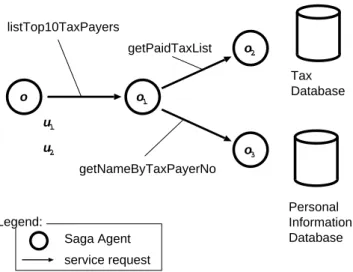
To discuss this, consider the case shown in Figure 1. Saga Agent o1 provides a service listTop10TaxPayers, which displays the data about top 10 taxpayers in some expected style. listTop10TaxPayerscalls two auxiliary services, namely, getPaidTaxListof Saga Agent o2 and
getNameByTaxPayersNo of Saga Agent o3.
getPaid-TaxListofo2 sorts all the paid taxes in descending order and returns the result together with corresponding taxpayer numbers. getNameByTaxPayersNo of o3 takes a tax-payer number as an argument and returns the name of the taxpayer. In the following discussion, for the sake of brevity, we mention only services in service contexts.
Now consider the case where a useru1and a useru2are about to invokelistTop10TaxPayers. Let us assume that u1is authorized to know the taxpayer names, the taxpayer numbers, and the paid taxes in the returned list, but assume that u2 is authorized to know only the taxpayer numbers and the paid taxes. Moreover, suppose thatu1, u2, and o1 are not authorized to directly invokegetPaidTaxList andgetNameByTaxPayersNo. Consequently, whenu1 invokeslistTop10TaxPayers, both ofgetPaidTaxListand
Legend: Saga Agent service request o o1 o2 o3 u1 u2 listTop10TaxPayers getNameByTaxPayerNo getPaidTaxList Tax Database Personal Information Database
Figure 1: Service Relationships
getNameByTaxPayersNoshould be allowed to execute, but whenu2invokeslistTop10TaxPayers, nothing but
get-PaidTaxListshould be allowed.
Traditional authorization models can only express sim-ple client/server relationships. Then, the most common solutions to the problem would be as follows:
1. We grant the authorization to invoke both of getPaid-TaxListandgetNameByTaxPayersNoto the service
listTop10TaxPayers. When the Saga Agento1 re-ceives a request forlistTop10TaxPayers,o1invokes either of or both ofgetPaidTaxListand getNameBy-TaxPayersNoin compliance with security policy. 2. According to each user’s own authorization, we
de-compose listTop10TaxPayers into services so that the user may be authorized to invoke some of them. Nevertheless, these solutions have a fatal drawback that ap-plications must provide protection by themselves because the security models and mechanisms alone cannot deal with the problem above. To put it another way, applications are imposed restrictions on not only by their own semantics, but also by security policies. Thus, for instance, ifu2is au-thorized to callgetNameByTaxPayersNosometime later, o1must be rebuilt (possibly from scratch) to incorporate the change in it. To make matters worse, it is nearly impossible that the solutions above apply to more complicated situa-tions, say,getPaidTaxListorgetNameByTaxPayersNo
further invokes services of other Saga Agents.
Therefore, authorization models in distributed systems must be able to represent, independently of application semantics, situations where agents or objects work in co-operation as the example above shows. For that purpose, we have only to be able to set authorizations based on
se-quences of invoked services. To demonstrate the
effective-ness of this approach, consider again the problem depicted in Figure 1. With the approach, we can readily solve the problem as shown in Table 1 (‘!’ stands for ‘invokes’ relation). We should note how simply it can be solved.
We are now ready to state this idea more formally. In Saga authorization model, we define a service path as a sequence of service context invocations:
12::: i
where1 invokes 2, which further invokes 3, ..., and finally
i01 invokes
i. In this paper, a service path is denoted. Additionally, a level is associated with a service path. The level of a service path is defined asiif the service path consists ofiservice contexts.
Then, in Saga authorization model, authorization to in-voke a service contextis not given to a principal as usual, but to a service path 12:::
i. To state the situation simply and clearly, a pair of a service pathand a service context:
(;)
is called a request pair in Saga authorization model. Then, when a request routed alongto callis allowed, we say that(;)is authorized.
The concept of service paths is one of the key features of Saga authorization model and is never found in other tra-ditional authorization models. The introduction of service paths makes it possible to uniformly synthesize the designs discussed in Section 4.1 and 4.2 into Saga authorization model and to realize flexible and powerful protection in distributed systems.
4.3
Delegation in Saga Authorization Model
With respect to a service path, there is another important aspect that we should not miss: namely, it is trust relation-ships, in particular, delegation of privileges expressed in a service path.
To take a closer look at this, let us consider Figure 1 again. Note thato1 by itself is not authorized to execute
getNameByTaxPayersNo, but authorized if and only ifu1 requestso1to executelistTop10TaxPayers. That is to say, it is the request ofu1forlistTop10TaxPayersthat brings o1the authorization to invokegetNameByTaxPayersNo, whicho1 by itself does not have. This implies that the request ofu1forlistTop10TaxPayersis equivalent to the agreement ofu1ono1’s execution of
getNameByTaxPay-ersNo: In other words,u1delegates some of its privilege too1through the request. Owing to the expressive power of service paths, Saga authorization model can clearly rep-resent such situations. Furthermore, we can evolve the idea by explicitly dispatching service paths. See [17] for further details.
Needless to say, it is not true that all requests immedi-ately imply delegation in Saga authorization model. How-ever, Saga authorization model can naturally express del-egation if necessary, which cannot be easily dealt with by traditional authorization models.
The notable concept of service paths is of great benefit to us, although, it is a little formidable task to implement them securely in open distributed systems. Therefore, next in Section 5, we thoroughly discuss the security mechanism to realize Saga authorization model.
5
Security Mechanism
In this section, we present the security mechanism of Saga Security System, highlighting its outstanding features,
service
getPaidTaxList getNameByTaxPayersNo
client u1!listTop10TaxPayers allowed allowed
u2!listTop10TaxPayers allowed denied
Table 1: Authorizations given to Sequences of Services
access tokens, access control vectors, and Security Moni-tors (Figure 2).
Saga Agent
service path
service
context misc. info. signature
Security Monitor Access Token Validator Token Generator service service Saga Agentj Saga Agenti ACL service path service ID misc. info.
Figure 2: Security Mechanism of Saga Agent
5.1
Access Token
To implement Saga authorization model, we cannot overemphasize the importance of ensuring the authentic-ity and integrauthentic-ity of a request pair(;), in particular, those of a service path . These are achieved in Saga Secu-rity System with access tokens, combined with public key
cryptosystems [5]. An access token of a Saga Agent is
constructed by the token generator of the Agent.
In public key cryptosystems, a key for encryption and one for decryption are not identical. An encryption key is called a public key and can be made public, on the other hand, a decrptyion key is called a private key and must be kept secret. One of the important features of public key cryptosystems is that they can generate a digital signature on a message, with which we make sure that the identity and the content of the message have not been compromised. In the rest of the paper,K andK
01
denote a public key and the corresponding secret key, respectively. In addition, we writefMg
K to mean that a message
M is encrypted (or decrypted) with a keyK.
Using public key technology, Saga Agents
sub-mit request messages via access tokens. To
dis-cuss the structure of an access token, let us
con-sider the case where a Saga Agent o
i sends to a Saga Agent o i+1 a request ( i ; i+1 ) where i = 12::: i = (u1;o1:s1)(u2;o2:s2):::(u i ;o i :s i ) and i+1 =(u i+1 ;o i+1 :s i+1
). denotes an access token and let
ibe the access token corresponding to ( i ; i+1 ). For convenience,0is supposed to be(u1;o1:s1). Now iis defined as follows: i =f i ; i+1 ;Π i ;Θ i g (i=1;:::) where Π i =fI1;I2;:::;I i g I
iincludes the constraints specified by o
i, for example, an expiration time of the access token, with whicho
i can counter a replay attack [5] on it.
Θ
i
=f1;2;:::; i
g
Θi is defined as the set of the signatures, f1;2;:::; i g, where k = f k 01 ; k +1 ;I k g K 01 k , k=1;:::;i. We assume0=1=(u1;o1:s1). i,
i+1, andΠiare stored in
iin plaintext. The authenticity and integrity of a request pair(
i ;
i+1 )
in
i is verified in the following manner. Recall that
i
=12:::
iby definition. Then, receiving
i, o
i+1can immediately generateituples from
i, f k ; k 01 ; k+1 ;I k g wherek = 1;:::;i. Next o i+1 verifies that f1g K1 = f0;2;I1g = f1;2;I1g and using I1, o i+1 also veri-fies that the conditions specified by o1are satisfied. If all the verifications succeed, similarlyo
i+1verifies f2g
K2 =
f1;3;I2g and the conditions in I2, ..., and eventually f i g Ki =f i01 ; i+1 ;I i
gand the conditions inI i. Note that a straightforward implementation of a request pair would be vulnerable to the attack of insertion, deletion, and exchange of service contexts of the service path because a service path is a sequence of service contexts3. However, we have a set of signatures
k = f k 01 ; k +1 ;I k g K 01 k , k= 1;:::;i, in
i and using them we provide protection against the attack.
Now, from these discussions, we see that the structure of an access token and a digital signature allowo
ito specify
i+1and
I1, but not to alter
ifreely. Of course, intruders cannot compromise the authenticity and integrity of access tokens. Therefore, with access tokens, we can realize Saga authorization model in open distributed environments.
Furthermore, since a service path can represent delega-tion of access rights as discussed in Secdelega-tion 4.3, an access token for a request pair inherently has an aspect of a del-egation token [15]. Then, Πi of an access token can be regarded as a condition under which an access privilege is transferred.
5.2
Access Control Vector
Every Saga Agent has an access control list, ACL, for services implemented in it, and using the ACL, the Agent determines whether a request issued to it is authorized or not. The ACL in a Saga Agent is a list of access control
vectors. An access control vector consists of three parts: (1)
a service path, (2) a service reference (Saga Agent ID and current user ID are not needed here), and (3) miscellaneous information.
When an access token for a request(;)is sent to a Saga Agent, the Saga Agent searches its ACL for an access control vector corresponding to the request. Direct imple-mentation of this search might incur severe performance degradation since we have to compare service contexts of and those of access control vectors one by one. To avoid this and perform effective search, a Saga Agent sorts its ac-cess control vectors in advance and performs binary search over them.
5.3
Security Control by Security Monitor
A service called a Security Monitor is associated with every Saga Agent. It is the Security Monitor of a Saga Agent that performs security control over the Saga Agent.
When a Saga Agent o receives an access token for a request( ;), its Security Monitormverifies the token in the way as discussed in Section 5.1. All accesses to a Saga Agent and accesses from the Agent cannot be bypassed, but are mediated and controlled by the Security Monitor of the Agent. Especially, security of all accesses to a Saga Agent is controlled by the validator of the Security Mon-itor of the Agent. Therefore, we can regard the Security Monitor of a Saga Agent as a reference monitor [10] for the Agent. This way, while a Saga Agent travels over an open distributed system, its security can be controlled by the Security Monitor integrated with it.
Furthermore, note that a Saga Agent is highly structured as depicted in Figure 2. Roughly speaking, we can clearly decompose a Saga Agent into two parts: (1) its Security Monitor, and (2) services that implements application se-mantics. As mentioned in Section 4.2, Saga authorization model is independent of application semantics, and this is true of the structure of a Saga Agent. Therefore, either of the Security Monitor and services of a Saga Agent are little affected by modification of the other, and can be developed without concerns about the other.
6
Related Work
This section examines the previous work relevant to ours.
Java is an object-oriented system developed by Sun Mi-crosystems [7]. Source codes of Java are compiled into
bytecodes, which are platform-neutral intermediate codes.
Executable bytecodes, called applet, can be retrieved and executed by WWW clients. Consequently, security is one of the greatest concerns from the beginning of the design of Java. Unfortunately, although various notable security mechanisms are incorporated into Java, the approach is a little ad hoc because of the lack of formal security models [11].
In order to take advantage of encapsulation of object-oriented systems, the authorization models where users are given authorization on methods, not on primitive opera-tions, have been an active area of research in recent years
[1, 2]. Nevertheless they are not so uniformly modeled as Saga authorization model is. Moreover, surprisingly few models addressed current open distributed environments.
Rabitti et al. [14] developed a sophisticated authorization model on ORION object-oriented database. In the model, exploiting relationships among subjects, objects, and access modes, we can derive implicit authorizations from explic-itly specified authorizations. However, the model could not appropriately deal with the situations where agents or ob-jects work in cooperation in distributed systems. In other words, the model is orthogonal to Saga authorization model and it is possible to integrate both of them.
PCM (Path Context Model) [3, 12] takes into account potentially insecure distributed environments and can per-form access control in terms of access path. Although PCM does not model semantics of authorization, it can express a wide variety of conditions of network environments, for instance, network domains and encrypted channels. It is desirable to accommodate such expressive power into our model in the future.
7
Conclusion and Future Work
Since current open distributed environments are ex-pected to prevail, it is of critical importance to establish security of a proper level in them. Nevertheless, in con-ventional “secure” systems, it is often the case that these environments are not taken into account. Additionally, traditional access control matrix models cannot be fully applicable to such environments.
In the paper we have discussed so far an overview of Saga Security System, a security architecture in such en-vironments, highlighting Saga authorization model and its security mechanism. The model is uniform and flexible, and is appropriate for advanced computing models such as object-oriented systems and agent systems, in open dis-tributed systems. Additionally, we have presented the se-curity mechanism of Saga Sese-curity System, which provides protection of a Saga Agent while it travels over an open dis-tributed system. Hence, the security model and mechanism of Saga Security System realize in current open distributed systems a promising security architecture, which has been strongly required but cannot be provided by traditional sys-tems.
Before concluding the paper, we should make a remark about our current research status. We are now developing a prototype version of Saga Security System, and at the same time, doing research on how Saga authorization model can be well adapted to a specific object-oriented system, and how the model can enforce a security policy of an enter-prise organization, especially, how it can enforce multiple security policies of federated systems.
Acknowledgments
We would like to thank other members of Saga Security System Project, Norihiko Kameda, Kiyoshi Une, Satoshi Yoshida, Atsuki Tomioka, Keisuke Yamaguchi, and Take-haru Kato for useful discussions and comments.
References
[1] R. Ahad, J. Davis, S. Gower, P. Lyngback,
A. Marynowski, and E. Onuegbe. Supporting ac-cess control in an object-oriented database language.
In Proc. 3rd International Conference on Extending
Database Technology (EDBT), pp. 184–200, 1992.
[2] E. Bertino and P. Samatari. Research issues in discre-tionary authorizations for object bases. In Proc.
OOP-SLA’93 Workshop on Security for Object-Oriented Systems, pp. 183–199, 1993.
[3] W. H. Boshoff and S. H. Solms. A path context model for addressing security in potentially non-secure en-vironments. Computers & Security, 8(5):417–425, 1989.
[4] D. Chess, B. Grosof, C. Harrison, D. Levine, and C. Parris. Itinerant agents for mobile computing. Technical Report RC 20010, IBM Research Division, T.J. Watson Research Center, Mar. 1995.
[5] D. E. R. Denning. Cryptography and Data Security. Addison-Wesley Publishing Co., Reading, MA, 1982. [6] Department of Defense. DoD trusted computer system evaluation criteria. Technical Report DoD 5200.28-STD, DoD Computer Security Center, Fort Meade, MD, Dec. 1985.
[7] J. Gosling and H. McGilton. The Java language en-vironment: A white paper. Technical report, Sun Microsystems, 1995.
[8] C. G. Harrison, D. M. Chess, and A. Kershenbaumn. Mobile agents: Are they a good idea? Technical Re-port RC 19887, IBM Research Division, T.J. Watson Research Center, Oct. 1994.
[9] Information-technology Promotion Agency (IPA), Japan. Research report on security architecture and automatic user authentication in downsizing environ-ments. Technical Report 159, Information-technology Promotion Agency (IPA), Japan, Mar. 1996. In Japanese.
[10] B. W. Lampson. Protection. In Proceedings of the 5th
Princeton Symposium of Information Sciences and Systems, pp. 437–443, Mar. 1971.
[11] G. McGraw and E. W. Felten. Java Security: Hostile
Applets, Holes and Antidotes. John Wiley & Sons,
Inc., 1997.
[12] M. S. Olivier and S. H. Solms. Building a secure database using self-protecting objects. Computers &
Security, 11(3):259–271, 1992.
[13] G. J. Popek and C. S. Kline. Encryption and secure computer networks. ACM Comput. Surv., 11(4):331– 356, Dec. 1979.
[14] F. Rabitti, E. Bertino, W. Kim, and D. Woelk. A model of authorization for next-generation database systems. ACM Trans. Database Syst., 16(1):88–131, Mar. 1991.
[15] K. R. Sollins. Cascaded authentication. In
Proceed-ings of the IEEE Symposium on Security and Privacy,
pp. 156–163, Apr. 1988.
[16] M. Soshi. The design and implementation of the Se-curity Agent mechanism. In The Collection of Papers
in the 15th Technical Presentations, volume 15, pp.
225–234. Information-technology Promotion Agency (IPA), Japan, Oct. 1996.
[17] M. Soshi, T. Kato, and M. Maekawa. Proxies in dis-tributed systems: Flexible protection realized by sim-ple and dedicated agents. Submitted for publication, 1997.
[18] M. Soshi and M. Maekawa. A new authorization model and its mechanism using service paths in open distributed environments. To appear in the Proceed-ings of IFIP WG 6.1 International Working Confer-ence on Distributed Applications and Interoperable Systems, Sept. 1997.