David C. Wyld et al. (Eds): CCSEA, BIoT, DKMP, CLOUD, NLCAI, SIPRO - 2020
pp. 51-64, 2020. CS & IT - CSCP 2020 DOI: 10.5121/csit.2020.101005
I
NTEGRATIVE
F
RAMEWORK FOR
B
LOCKCHAIN
I
MPLEMENTATION
:
U
NITING
ORGANIZATIONAL
,
B
USINESS AND
E
NGINEERING
F
ACTORS
Amr Adel
Whitecliffe College of Technology & Innovation, Auckland, New Zealand
A
BSTRACTAdopting new technologies such as the Blockchain technology requires considering the broad range of different factors associated with the same. There is just the emergence of the scholarly literature on the Blockchain technology. The studies mainly focus on the technical aspects of the technology specking on its architecture, way of functioning and such. Not many studies focus on the framework that can be referred to, to adopt the Blockchain technology. In this study a framework for adoption of the Blockchain technology has been proposed considering the different factors such as organizational, business and engineering factors. Each of these factors has been further divided into sub-factors for better understanding. These factors are interlinked to one another and mutually influence each other. This framework that has been proposed can be implemented by the organizations as a point of reference for adopting different applications of Blockchain. The scholars can further expand the study and refine as well as carry out future research in this domain.
K
EYWORDSBlockchain Technology, Framework, Transaction Per Second, Cryptocurrency, Contracts & General Ledger.
1.
I
NTRODUCTIONBlockchain is an overarching concept which consists of many different applications and technologies [1]. It is a decentralized digitized ledger for allowing record keeping of peer-peer transactions without the requirement for central authority. The concept of Blockchain has been compared to internet which has similar underlying applications and technologies. Some experts are of the belief that Blockchain might have a big transformation on the business like the internet. It has the potential of replacing the centralized platforms of banking and other cases that includes health information sharing, improvement in business process, automotive ownership, trades and voting [1]. Blockchain technology has enabled cryptocurrency which comprises of Ethereum and Bitcoin [35].
A cryptocurrency permits an exchange medium which is similar to US dollar, though it is digital in nature and utilizes encryption for controlling the creation of new currency and fund verification. The technology of Blockchain was popularized and created by cryptocurrency which is the bitcoin. Satoshi Nakamoto has created the bitcoin and subsequently the technology of Blockchain. Bitcoin was released as open source software and Nakamoto mined the initial Bitcoins, hence successfully implemented the Blockchain technology [1]. Blockchain can be
defined as blocks series which records data in hash functions with a timestamp and link to the existing block. Data is stored in the distributed ledger which eliminates the centralized vulnerability points. Blockchain technology utilizes peer-peer networking without the necessity of a central server. Instead it exists across a network of computers. By utilization of the database system which is distributed through Blockchain, digital ledger across a network is verified by any computer which removes the need for a centralized authority. As per the name Blockchain refers to a series of blocks combined together with computational algorithms that are complex. A block consists of the previous block hash, block header and merkle root [3]. For creating a new block, data is collected from the data portion which consists of one or more transactions. A copy of this information is created, then it is hashed and a pair is made with another hash, hashed and paired again and once more hashed. Thus, it leaves a single hash which is known as merkle root. New block consists of the information from the block that exists before and the blocks are combined together since there is a single way in which the blocks fit together on the Blockchain and that is in a computational way [3].
The use of the technology is growing across different industry sectors ranging from the logistics operations to the manufacturing and the public services sector. The Blockchain technology is growing rapidly in the financial services. Cryptocurrency is the common of all association. The crypto tokens are the special types of the virtual currency tokens that reside on their own Blockchain and these represent an asset or a utility. Tokens can be made use of for cryptocurrencies, investment tokens and utility tokens [6]. In not only this but also in other forms of Blockchain adoption, the concept that of a distributed ledger forms the means for gathering of information and its communication between the users. These kinds of distributed ledger are more about managing a system of different records rather than just maintaining of a database.
Therefore “smart contracts” have become significant amongst the users. A smart contract provides definition of the various rules as well as the associated penalties in an agreement and in an automatic way not only executes but also enforces the obligation in the contract [6]. This is more specifically a mechanism that involves digital assets along with two or more different parties where some or all of those parties put the assets in and theses assets are redistributed among those parties as per a specific formula depending on a data that is generally not known at the time when the contract is flagged off. Blockchain as mentioned earlier has brought in revolution mainly in the financial sector as this technology can be said to be as the vision of those developers that believed current banking system had some flaws. There are many potential uses of the Blockchain technology such as payment processing and transfer of money, monitoring the supply chains, digital IDs, data sharing, copyright and royalty protection, digital voting and many more [6]. Transferring of funds from one party to the other can be said to be as the one of the most logical use of Blockchain. Then comes monitoring of the supply chains in which Blockchain speeds up the processes and thus enhances productivity. Blockchain allows the businesses as well as the consumers to know how different products performed from the perspective of quality control as they made their journey from the place of origin to the different retailers. Blockchain technology has the capability to bring in revolution in the retail sector by becoming the best option for the loyalty programs [10]. This can happen by the creation of a token-based system that gives rewards to the consumers. These generated tokens can also be stored within a Blockchain thus incentivizing customers to return to a specific store. This would also help in eliminating fraud as well as waste that is commonly associated with the paper and card based loyalty rewards programs.
Blockchain technology certainly has the potential to bring in revolution in the market but along with this there are security issues as well that need to be addressed. The challenges are mainly associated with the social, technical, adoption and regulatory areas [32]. Adoption of new technology as such is a challenge as it depends on different factors such as acceptance by the
employees, proper knowledge of the technology, proper analysis as for what specific purpose the technology has to be used and many such things [25]. Reluctance of the employees to adopt new technologies has always been a concern for the management when thinking of adopting modern technologies [10]. Therefore, it is required that the technology is understood properly before even using it for any purpose. Blockchain technology can be integrated with different technologies as well to enhance their performance and have a positive effect on their productivity.
Focusing on the technology, new areas of growth and megatrends managers are trying to position the business organization. Although Blockchain technology exists from 2009, the introduction of bitcoin has brought into light the other management.
applications and thus has validated that technology of Blockchain is not just for cryptocurrency and cryptography enthusiasts [12]. The earlier applications proved that Bitcoin can be utilized as legitimate currency in a market [34]. The theory of diffusion of innovation explains about how a service, idea or product can be adopted through a system in due course of time. The rate of adoption of innovation is different within people or within an organization that ranges from early innovators to late laggards [29]. Five main adopter categories are early adopters, late majority, early majority, innovators and laggards. From a theoretical and managerial standpoint, it is not easy to determine the location of Blockchain technology exactly.
The paper is structured into different sections. Introduction to provide introductory topics about the blockchain applications in terms of electronic market. Research approach to explain how the conceptual framework was built and based on which procedures to comply with different factors that have been discussed in the literature review. The literature review focuses on the factors that affect blockchain implementation in terms of blockchain adoption in critical systems. In this part, the focus will be on identifying the problems and challenges that are faced with the use of systems. The second objective of the paper is evaluating the performance that is offered with the use of blockchain technologies. The main aim of this paper is addressed in the section conceptual framework for analysing blockchain technology.
2.
R
ESEARCHA
PPROACHTo come up with the conceptual framework, firstly the technology and the associated organizations related literary works have been reviewed. This has helped in finding out the major factors associated with the Blockchain technology. The review provided the research with many numbers of factors that should be considered by the organizations at the same time raising the most important question as how this particular technology can be managed in the best possible way. The research has characterized all of these factors on the basis of the institutional framework of Mohanta, Jena, Panda & Sobhanayak, (2019), into unique factors such as organizational, engineering and lastly business factors. The framework can be said to be useful enough as this provides the components of the technology, the different parties that are involved in the technology and lastly the role of the market forces. The different components of the Blockchain technology are important in their own unique way. The most disruptive component of the Blockchain technology is the component of technology as this particular component can be shaped in various different ways by the influence of both the actors and the markets. The different literary works that have been referred to in the research provide an appropriate point of reference for mapping the engineering, the organizational and the business factors. The study makes use of qualitative data analysis and secondary methods.
Qualitative data analysis provides insight to the study and helps in understanding the topic in a better way. This is a flexible approach as in case useful insights are not being obtained, there is the provision with the researcher to be quick to adapt questions, make modifications to the
settings or other such variable of the study for bringing in improvisation in the responses. This type of data permits the researcher to be more speculative about the significant areas of the research and carry out the investigation on the same. The study makes use of secondary data that is the data which is already collected by someone else and is easily available from different sources. The advantage of using these data in the research is that the cost of the research decreases and this gives a deeper insights and ads to the knowledge base. This is economical as compared to the primary data and saves both efforts as well as expenses. This is also preferred when in limited amount of time research needs to be done. The understanding of the Blockchain technology and its associated components was made easy by selecting the secondary data sources.
While searching for relevant articles, journals, books some keywords such as “Blockchain”, “integration” and “adoption” were used that resulted in more than 1000 outcomes in the databases that include Web of Science, Google Scholar, Business Source Complete and Scopus. Then these articles were properly scanned after which it was found that amongst so many of the literary works 40 papers laid stress on the adoption and integration of Blockchain. Reading and reviewing these 40 papers the various important factors were identified. The main aim was to recognize those factors which were relevant to the topic of the research. The factors identified have been listed below along with proper explanations and their reliability to the Blockchain technology. Some filters were applied to the sites such as Google Scholar and others as well such as the time range was set from 2015 to 2020 to ensure that outdated data related to the topic is not taken into consideration. The articles that were available for free from these websites were accessed and no paid articles were taken for the research. The research methodology that has been written above was strictly followed to come to the final conclusions. There are certain limitations in the research methodology such as use of primary data could have helped in statistically analyzing the topic or the work could be presented with some data visualizations tools such as charts and graphs. The practical implication of adoption of the Blockchain technology can be understood from the views of the companies or other institutions those who have worked on this. It can be said that using survey method and including appropriate participants could have helped the research to get a practical touch [7].
The research could have used interviews or focus groups discussions to get a deeper insight about the topic but due to the prevalent situation of the pandemic happening, it was carried out with the secondary sources. The selection of the secondary sources is what is important in this context. The study totally depends on these sources thus it was ensured that proper sources are made use of taking the sources from proper sites. Thereafter the keywords checked and furthermore the articles reviewed properly to check that they are topic relevant. In this way the research was undertaken keeping in mind all the vital aspects that need to be kept a check on while conducting any research.
3.
L
ITERATURER
EVIEW:
F
ACTORSA
FFECTINGA
DOPTION OFB
LOCKCHAINT
ECHNOLOGYThere were numerous factors for the adoption of block chain technology and they are classified into three dimensional as follows: Organizational, Engineering and Business.
3.1
Organizational Factors
Institutional arrangements can be observed as the rules regulating the interaction between the parties. These rules are changed over time and may be different among cultures and markets. Current players may retain the status quo and design the applications of Blockchain in a manner
that it is matching to the recent rules and governance while the new players may shape in new methods which may cause disruption in the markets that exist [7]. Institutional dimensions are utilized for the categorization of the factors which place a demand on the technology of Blockchain or the Blockchain application affects them.
3.1.1 Norms and Culture
Blockchain technology needs to be culturally resistant by market incumbents. In addition, resistance to change of companies and customers can have an effect on the Blockchain technology adoption. Customers are required to accommodate the fact that all the electronic transactions are secured, safe and complete. Intermediaries are required to go through the variation in roles and responsibilities. Modification and investment of the platform is required by the investors for becoming Blockchain based and simultaneously providing customer relationship and services [23]. On the other side new players make their entry to the field and they take a varied approach since they can be threat to the players who already exist. Current players are benefitted by the customers who exist but the dependencies of the path slow down the progress speed while the fresh players do not have any type of path dependency but are required to acquire new customers. Multiple sources reveal that there is a lack of understanding among authorities, business and consumers regarding the utilization of Blockchain, the methods of its operation and technology does [23]. The decentralized, accountability and possible transparency created by technology can build new settings where people can depend less on controlled, inefficient services offered through intermediary and associated service providers.
Therefore, it is important to understand how the innovation in technology integration within individual activities and business strategies for can have understanding its societal impact. Opinions of regulators, public, policymakers are influenced by the Blockchain technology perception. Bitcoin is perceived as money laundering venue, activities related to drug activities and other activities which are illegal. It is perceived by the public that mining of bitcoin is a waste of energy. Blockchain can be utilized in both bad and good ways with many other technologies and as per the study by Sadouskaya, (2017), the advantages of utilizing the Blockchain technology outweigh the negative sides. Blockchain should not be identified with bitcoin exclusively. Blockchain can be utilized for applications other than cryptocurrency with the other implementations without any drawbacks related to bitcoin.
3.1.2 Regulations and Legislation
One of the most important challenges of the Blockchain technology is the specific way in which they are to be regulated [11]. This has to be kept in mind that any technology cannot be subjected to regulation rather the arenas it is being used may require for regulatory constraints. Blockchain can be made use of in cryptocurrencies, smart contracts and many more things such as distributed ledgers. At present regulations related to the Blockchain-based digital currency or the cryptocurrencies have gained attention and other different applications are yet to receive the attention. Government agencies can slow down the adoption process of Blockchain and they even have the provisions with them to block certain applications. For instance, most recently the Federal Trade Commission that is FTC and the Securities Exchange Commission that is SEC are making evaluations on whether there is a need to introduce new laws in this context [11]. Various new laws and new regulations can certainly be taken into consideration for monitoring as well as regulating the industry for compliance.
There are many countries like Bangladesh, Ecuador, Nepal and Bolivia where there is a ban on the cryptocurrencies. The policy makers across the world are laying stress on regulating the use of cryptocurrencies so that taxation could be avoided along with criminal activities. There are
some countries that treat cryptocurrencies as digital money while others consider them to be as commodities. In the year 2015, ECJ or the European Court of Justice exempted cryptocurrency transactions from VAT and considered these as currency [11]. Thus it can be said that different laws and regulations can certainly influence as how fast Blockchain technology can develop. There are certain challenges to the wider adoption of the Blockchain technology despite of the opportunities that it is laced up with. Collaborative governance can help stop the Blockchain cybercrime and other such criminal activities [14]. The governments that have banned cryptocurrencies and are against the Blockchain technology require realizing the various societal benefits of the Blockchain. Governments are required to function collaboratively so that the benefits of the technology can be made use of checking on the crimes that are being done in this field [28]. The policy makers require revisiting the various regulatory frameworks that include the banking laws, securities laws and lastly the commodities laws so that Blockchain technology can be incorporated into the frameworks that are already present [14].
3.1.3 Governance
Blockchain has the requirement for being governed but in itself it is an instrument of governance. For adopting the Blockchain technologies, the participants in the market should put appropriate frameworks of governance in place which consists of rules for approving or rejecting the participants who are authorized, law applicable in case of disputes and mechanism of correction [17]. In addition, these frameworks of governance should be attached to the features and functions of Blockchain technology. The risk of manipulation in the market and practices that are unfair should be mitigated by governance. Due to the proper safeguard absence individuals might get information access recorded in Blockchain and utilize it for unfair activities like price manipulation and front run competitors. The outcome is that the requirement for protecting critical information and transparency level should be clear through the rules of privacy.
3.2.
Business Factors
This refers to the organization operating in its environment. Organizations make contract and operate in market structure type for buying and selling products and using their business processes for creating values [15]. Blockchain can bring variation in the way transactions are handled that influences the structure of the market. Literature challenges the intermediary role in the market structure.
3.2.1.Market Structures
Blockchain technology adoption needs a degree of computerization at a higher level. Therefore, certain countries are not ready for participating in the solutions on the basis of Blockchain. Since this technology requires data distribution across various nodes, the magnitude of the issues is increased for consideration due to processing power, high bandwidth and storage demand [15]. This leads to a condition where some regions and groups are unable to enjoy the Blockchain technology benefits. The technologies based on Blockchain also hold promise for disrupting the resilience and structure of financial markets. A report of 2017 highlights the risks and benefits of DLTs for the applications in financial markets, particularly the market volatility increase and the role that is controversial which smart contracts play if the Blockchain size on the basis of securities asset grow due to the automated triggers that are embedded and can provoke market reaction in one direction at the time of stress [15]. The results interconnection can be referred to as bloating. Scalability is among one of the challenges that Blockchain technology faces. The volumes of the transactions needed by the T2S services are higher than the bitcoin and Blockchain is not enough for dealing with it in the current stage. Thus the challenge degree will
be dependent on applications. For lower market segments challenge will be lesser whereas a very important role will be played by scalability for products of higher volume.
3.2.2.Contracts and agreements
Moving the existing contracts to new Blockchain technology can certainly need to migrate to the existing documents or the contracts to the Blockchain form that is equivalent to this. At present there is no such clarity related to smart contracts thus restricting them to simpler agreements. As per the definition of the smart contracts these are “computer protocols that facilitate, verify, execute and enforce the terms of a commercial agreement” [15]. For instance, in the agreements there can be said to be as least subjectivity on fulfillment of the terms. It is the conception of the people that smart contract are e-contracts that is a digital version of any paper based contract but they are unaware of the fact that the various rules of these mart contracts are embedded in software. The technology is such that if information gets added and consensus is obtained between the different parties then this contract gets executed automatically. Unlike paper contracts, the execution of the smart contracts require self-monitoring as well as self-enforcing that is obtained by a set of scripting, the systems specially been set for monitoring the off-Blockchain information along with data that is considered as essential for effectively executing the different terms of the smart contracts [15]. It can be said that all these pose significant programming challenges.
3.2.3.Business Processes
Business processes which are traditional may not seem to be applicable for utilization of Blockchain as a technology as this is based on middle man cutting principle and thus avoids intermediary transaction fees. Implementation and adoption fees of Blockchain for business that exists in the short run is very high, especially for those having processes of back office existing, complex legacy IT systems and creation of processes for being aligned with existing standards which need redesign that is expensive [19]. Replacing or removing certain back office processes with technology of Blockchain can generate problems.
3.3.
Engineering Factors
3.3.1.Information Exchange and Transactions
Time required for processing transactions can be a challenge for Blockchain technology adoption. Transaction processing time for the network of bitcoin is one transaction per second with a theoretical maximum of 7 tps (Transaction Per Second) which is small compared to other networks which process transactions [2]. However, this leads to other issues of Blockchain and size bloat. In time terms processing time of one bitcoin block is 10mins and this means that it takes minimum of 10mins for a confirmed transaction. For larger transactions it will take longer since it has to outweigh the cost of a double spend attack. 160 GB is the current size of Blockchain of Bitcoin [2]. When the speed of processing is increased to 2000 tps it is 1.42 PB/year.
3.3.2.Shared Infrastructure
Blockchain adoption has another challenge and that is the need for having a shared infrastructure which can provide entire service delivery value chain like messaging, communication protocols, transport, decentralized storage, network administrator, decentralized storage, address management and archival [20]. Blockchain economy needs to develop basic infrastructure components for industries to focus on higher level of development of value added services
instead of focusing on only infrastructure [33]. Economy of Blockchain also has sensitive and complicated aspects of engineering of networks that are decentralized and it is essential for having a well-developed and secured infrastructure [31]. In recent time it is highlighted that Blockchain technology has standardization lacking in it on various levels that ranges from smart contracts to technical protocols. Blockchain development did not have a connection with standard business organizations which existed like ISDA [27]. This forms one of the main reasons for Blockchain to be called as disruptive. Puthal, Malik, Mohanty, Kougianos & Yang, (2018), added technology components and process to the framework. Process can be defined as the changes that are needed and their management. On this basis authors concerned with this research developed PIMT framework for adoption of Blockchain; the process consists of change management and strategies for ensuring change in long term [26]. Market is the next layer and then it is required to examine which structure of market undergoes changes due to Blockchain. New agreements and contracts need to be developed within the framework of the new legislative which is developed at the institutional level. The process of business consists of the responsibilities and activities for operational level which is concerned with the technology comprises of the software design by utilization of various technologies such as distributed ledger, identification, cryptography. The first comprehensive framework that is conceptual and provides an overview of relationships of the factors while considering the adoption of Blockchain. There can be a limitation in the framework for finding application for other industries. The work of Puthal, Malik, Mohanty, Kougianos & Yang, (2018), categorized the factors which led to the framework proposed for analyzing the adoption of Blockchain.
It is the comprehensive framework which is first in integration of a range of factors for Blockchain adoption understanding. It is shown by the framework that various outcomes and process change is possible since it helps in shaping the form of Blockchain application. The framework presents various factors like engineering, organizational and business mutually influence and interacts with each other. Interaction of the different factors is dependent on the context of Blockchain adoption.
3.3.3.Distributed Ledger
Management and access distribution across various nodes leads to security threats since there are numerous back doors by which a system can be attacked. Companies in majority of the networks use the same code so if any vulnerability is found by a hacker it can result in serious consequences for the system [16] [30]. Hence, it is important to ensure integrity of users in the ledger distribution and run transactions in a secure way which is again a key challenge for adopting Blockchain technology widely. In addition to that there is a necessity for the companies to think about the data security and integrity stored on a ledger. For many ledgers there is a preference for transparent record at the time of Blockchain technology implementation and it is necessary for companies to ensure that only the individuals having the right permissions can access the data. Generally, individuals are not comfortable for storing personal records in a way which is decentralized. Utilizing a distributed ledger is a method for avoiding manipulation which is unseen and it is critical for technology of Blockchain for having cyber protection since cybercrime is an important concern for participants of the market. Cyber activities fear can prevent Blockchain adoption for various industries. Proponents argue that there is increased cyber security in Blockchain and testing is a key requirement for a broader scale in an environment which is highly regulated.
Newness of the technology of Blockchain is a second concern. Blockchain can be assumed to be in its initial stages; therefore, some information systems do not have security mechanism that is well developed. Suggestions are such that 15-50 defects are found in a code of 1000 lines. As the argument by Ølnes& Jansen, (2018), Blockchain has not been used broadly and enough testing
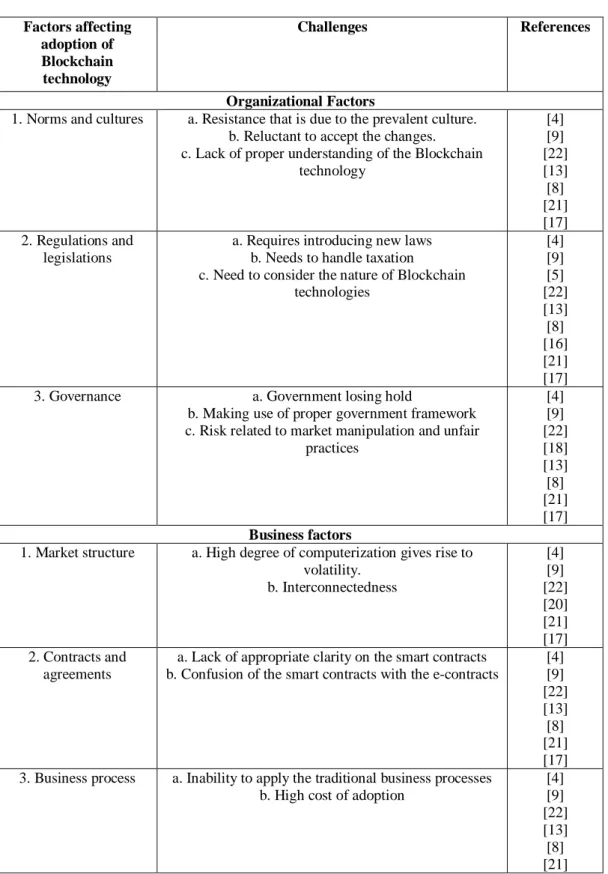
has not been done for it to be free of errors. It is confirmed that the immaturity perceived in the technology builds challenges for companies wanting to implement the technology of Blockchain. Table 1 shows the summary of major influences that could impact the integration of Blockchain technologies.
Table 1: Summary of Themain Factorsthat Affectthe Adoptionof Blockchain Technolgies
Factors affecting adoption of Blockchain technology Challenges References Organizational Factors
1. Norms and cultures a. Resistance that is due to the prevalent culture. b. Reluctant to accept the changes. c. Lack of proper understanding of the Blockchain
technology [4] [9] [22] [13] [8] [21] [17] 2. Regulations and legislations
a. Requires introducing new laws b. Needs to handle taxation
c. Need to consider the nature of Blockchain technologies [4] [9] [5] [22] [13] [8] [16] [21] [17] 3. Governance a. Government losing hold
b. Making use of proper government framework c. Risk related to market manipulation and unfair
practices [4] [9] [22] [18] [13] [8] [21] [17] Business factors
1. Market structure a. High degree of computerization gives rise to volatility. b. Interconnectedness [4] [9] [22] [20] [21] [17] 2. Contracts and agreements
a. Lack of appropriate clarity on the smart contracts b. Confusion of the smart contracts with the e-contracts
[4] [9] [22] [13] [8] [21] [17] 3. Business process a. Inability to apply the traditional business processes
b. High cost of adoption
[4] [9] [22] [13] [8] [21]
[17] Engineering factors
1. Information exchange and transactions
a. Time required to process the transactions b. Size of block c. Scalable nature d. Standardisation [4] [9] [22] [13] [8] [21] [17]
2. Distributed ledger a. Cybercrime
b. Newness [4] [9] [22] [13] [8] [21] [17] 3. Shared infrastructure a. Development of standard infrastructure components. [4]
[9] [24] [13] [8] [21] [17]
4.
C
ONCEPTUALF
RAMEW
ORK FORA
NALYZINGB
LOCKCHAINT
ECHNOLOGYIntegrated understanding of the different factors is required which ranges from technology to governance for creating Blockchain applications which fulfil the user benefits and service providers and accepted by the society. Socio-technical infrastructures which are complex can be examined at various levels like contracts, cultures, laws and regulations which co-ordinate and guide the behaviour of technology and actors. An institutional framework was developed for understanding the change factors and provides four levels namely resource allocation, institutional environment, governance, social embeddedness. Levels which are at the top of the framework take longer for changing compared to the aspects that are included in the bottom level. There is interconnection and dependency of the levels on each other. Change in the time period can be utilized for organizations for understanding the wider scope of Blockchain technology. The proposed framework helps to understand the organizational and institutional aspect which shapes the way in which application s of Blockchain are implemented and the ways in which they change or disrupt current structures or markets. The proposed framework also helps to understand the materiality and interaction between the factors during the process change and that shapes the usage of Blockchain technology. Further, organizations can use the proposed framework for adopting Blockchain applications. Though the applications of the Blockchain are at the technology level, its adoption needs the changing of the process of organization and introduces mechanisms of new governance. The framework can be utilized.
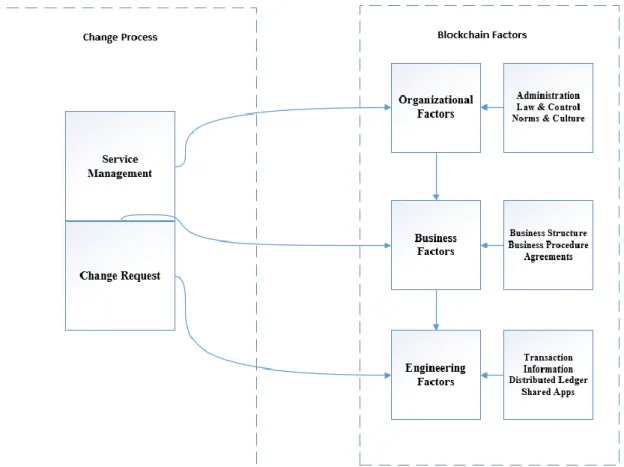
The proposed framework in Fig. 1 is the first inclusive theoretical framework demonstrating a synopsis of key factors and their connections when taking Blockchain integration into consideration. The proposed framework can be utilized for administrative associations to apprehend the larger range of Blockchain technology. It magnets the need to realize the organisational and institutional aspects which form the way Blockchain applications are applied and demonstrate how applications connected to Blockchain can heavily affect current structures and markets. It also appeals the necessity to know the link between the materiality and factors
throughout the transformation process which initiallyoutlines the practice of Blockchain technology. Besides, the proposed framework can be used by administrations to accept Blockchain applications. Although Blockchain applications are at the technology level, implementation requires the altering of bodies processes and the introduction of new governance practises. The proposed framework can be utilized to understand the wider effects of Blockchain acceptance.
Figure 1 : Framework for adopting Blockchain
5.
C
ONCLUSIONBlockchain technologies are a type of data management technology and decentralized transaction which provides data integrity, trust, security and anonymity without using any controlling organization which a third party is. A recent review reveals that most studies on Blockchain technology adoption and primarily focuses on technological aspects. Most of the studies which exist for Blockchain focus on the industry of finance that recommends more research for understanding this relationship. Many dependencies are there among the factors. The cryptocurrencies experience shows the many ways for shaping organizational factors and cryptocurrencies like the regulations will become influential in Blockchain adoption evolution. The discussion is limited about the engineering factors and organizational market. Hence it is recommended for more research for studying the factors that were identified. From the literature review it is clear that the utilization of Blockchain is evolving and nascent. Like other technological concepts the Blockchain hype has suspended the risks, benefits, opportunities, costs that are posed to markets and organizations. The study has generated the main factors reported in literature in present from 2015 to 2018. On the basis of factors identified the inquiry angles
require to be multiple. In this respect, adoption of Blockchain draws from the multitude of existing technology influenced studies change which use market oriented, institutional and adoption of technology. Hence Blockchain research needs a comprehensive inter-disciplinary effort and concentrated literature review utilizing all the major reference sources like Business Source Complete, Google Scholar, Scopus, Web of Science research in depth into adoption of Blockchain. There are certain limitations in the study which the research done in future can address. The proposed framework’s major focus is Blockchain adoption technology by the organizations. Research done in future may focus on adoption of technology of Blockchain by the citizens. The proposed framework is conceptual and it has not been tested empirically. The research of future requires for testing the framework proposed in various contexts. Many factors have been identified by present studies for providing solutions to the new challenges. The framework proposed on the basis of literature showed the interrelationship between factors and companies are offered a frame initially while adopting applications of Blockchain. Research done in future should refine, test and explore the relationships and framework expansion on the basis of practical evidence. The emergence of technology of Blockchain has been seen as the next revolution that transforms the size and shape of organizations. With new innovations adopters have encountered many challenges which have prompted technical researchers and experts for debating on the advantages of Blockchain technology during its early phase. Thus from the above discussion made it can be clearly understood that there needs to be a framework for adoption of Blockchain. The framework given in this study considers the three essential factors and the sub factors explaining each of these properly. The most important of all is the legislation sub-factor as this is what makes cryptocurrencies banned in some countries and get accepted in some other. The social benefits of Blockchain technology need to be understood properly so that it can be made proper use of by different firms. There needs to be collaboration between the governments to bring in a common law so that cybercrimes related to the Blockchain technology can be checked.
R
EFERENCES[1] Al-Saqaf, W., & Seidler, N. (2017). Blockchain technology for social impact: Opportunities and challenges ahead. Journal of Cyber Policy, 2(3), 338–354.
[2] Atzori, M. (2015). Blockchain technology and decentralized governance: Is the state still necessary?. Available at SSRN 2709713.
[3] Behnke, K., & Janssen, M. F. W. H. A. (2020). Boundary conditions for traceability in food supply chains using blockchain technology. International Journal of Information Management, 52, 101969. [4] Biswas, K., & Muthukkumarasamy, V. (2016, December). Securing smart cities using Blockchain
technology. In 2016 IEEE 18th international conference on high performance computing and communications.
[5] Blossey, G., Eisenhardt, J., & Hahn, G. (2019, January). Blockchain technology in supply chain management: An application perspective. In Proceedings of the 52nd Hawaii International Conference on System Sciences.
[6] Fusco, F., Lunesu, M. I., Pani, F. E., & Pinna, A. (2018). Crypto-voting, a Blockchain based e-Voting System. In KMIS (pp. 221-225).
[7] Holotiuk, F., Pisani, F., & Moormann, J. (2017). The impact of Blockchain technology on business models in the payments industry. 13th International Conference on Wirtschaftsinformatik, St. Gallen, Switzerland.
[8] Kamble, S., Gunasekaran, A., & Arha, H. (2019). Understanding the Blockchain technology adoption in supply Chains-Indian context. International Journal of Production Research, 57(7), 2009-2033. [9] Korpela, K., Hallikas, J., & Dahlberg, T. (2017, January). Digital supply chain transformation toward
Blockchain integration. In proceedings of the 50th Hawaii international conference on system sciences.
[10] Mackey, T. K., Kuo, T. T., Gummadi, B., Clauson, K. A., Church, G., Grishin, D., ... & Palombini, M. (2019). ‘Fit-for-purpose?’–challenges and opportunities for applications of Blockchain technology in the future of healthcare. BMC medicine, 17(1), 1-17.
[11] Min, H. (2019). Blockchain technology for enhancing supply chain resilience. Business Horizons, 62(1), 35-45.
[12] Mohanta, B. K., Jena, D., Panda, S. S., & Sobhanayak, S. (2019). Blockchain technology: A survey on applications and security privacy challenges. Internet of Things, 8, 100107.
[13] Mohanta, B. K., Panda, S. S., & Jena, D. (2018, July). An overview of smart contract and use cases in Blockchain technology. In 2018 9th International Conference on Computing, Communication and Networking Technologies (ICCCNT) (pp. 1-4). IEEE.
[14] Morabito, V. (2017). Business innovation through Blockchain. Cham: Springer International Publishing.
[15] Niranjanamurthy, M., Nithya, B. N., & Jagannatha, S. (2019). Analysis of Blockchain technology: pros, cons and SWOT. Cluster Computing, 22(6), 14743-14757.
[16] Ølnes, S., & Jansen, A. (2018, May). Blockchain technology as infrastructure in public sector: an analytical framework. In Proceedings of the 19th Annual International Conference on Digital Government Research: Governance in the Data Age (pp. 1-10).
[17] Orecchini, F., Santiangeli, A., Zuccari, F., Pieroni, A., & Suppa, T. (2018, October). Blockchain technology in smart city: A new opportunity for smart environment and smart mobility. In International conference on intelligent computing & optimization (pp. 346-354). Springer, Cham. [18] Perera, S., Nanayakkara, S., Rodrigo, M. N. N., Senaratne, S., & Weinand, R. (2020). Blockchain
technology: Is it hype or real in the construction industry? Journal of Industrial Information Integration, 17, 100125.
[19] Pieroni, A., Scarpato, N., Di Nunzio, L., Fallucchi, F., & Raso, M. (2018). Smarter city: smart energy grid based on Blockchain technology. Int. J. Adv. Sci. Eng. Inf. Technol, 8(1), 298-306.
[19] Post, R., Smit, K., & Zoet, M. (2018). Identifying factors affecting Blockchain technology diffusion.Twenty-fourth Americas Conference on Information Systems, New Orleans, 2018.
[20] Puthal, D., Malik, N., Mohanty, S. P., Kougianos, E., & Yang, C. (2018). The Blockchain as a decentralized security framework [future directions]. IEEE Consumer Electronics Magazine, 7(2), 18-21.
[21] Queiroz, M. M., Telles, R., & Bonilla, S. H. (2019). Blockchain and supply chain management integration: A systematic review of the literature. Supply Chain Management: An International Journal.
[22] Reyna, A., Martín, C., Chen, J., Soler, E., & Díaz, M. (2018). On Blockchain and its integration with IoT. Challenges and opportunities. Future generation computer systems, 88, 173-190.
[23] Sadouskaya, K. (2017). Adoption of Blockchain technology in supply chain and logistics supply chains using Blockchain technology. International Journal of Information Management.
[24] Wang, J., Wu, P., Wang, X., & Shou, W. (2017). The outlook of Blockchain technology for construction engineering management. Frontiers of engineering management, 67-7
[25] Mendling, J., Weber, I., Aalst, W. V. D., Brocke, J. V., Cabanillas, C., Daniel, F., ... & Gal, A. (2018). Blockchains for business process management-challenges and opportunities. ACM Transactions on Management Information Systems (TMIS), 9(1), 1-16.
[26] Wong, L. W., Leong, L. Y., Hew, J. J., Tan, G. W. H., & Ooi, K. B. (2019). Time to seize the digital evolution: Adoption of blockchain in operations and supply chain management among Malaysian SMEs. International Journal of Information Management, 101997.
[27] Drljevic, N., Aranda, D. A., & Stantchev, V. (2020). Perspectives on risks and standards that affect the requirements engineering of blockchain technology. Computer Standards & Interfaces, 69, 103409.
[28] Hughes, L., Dwivedi, Y. K., Misra, S. K., Rana, N. P., Raghavan, V., & Akella, V. (2019). Blockchain research, practice and policy: Applications, benefits, limitations, emerging research themes and research agenda. International Journal of Information Management, 49, 114-129.
[29] Li, J., Greenwood, D., & Kassem, M. (2018). Blockchain in the built environment: analysing current applications and developing an emergent framework. Diamond Congress Ltd.
[30] Putz, B., & Pernul, G. (2019). Trust factors and insider threats in permissioned distributed ledgers. In Transactions on Large-Scale Data-and Knowledge-Centered Systems XLII (pp. 25-50). Springer, Berlin, Heidelberg.
[31] Viriyasitavat, W., Da Xu, L., Bi, Z., & Pungpapong, V. (2019). Blockchain and internet of things for modern business process in digital economy—the state of the art. IEEE Transactions on Computational Social Systems, 6(6), 1420-1432.
[32] Werner, F., Basalla, M., Schneider, J., Hayes, D., & Vom Brocke, J. (2020). Blockchain Adoption from an Interorganizational Systems Perspective–A Mixed-Methods Approach. Information Systems Management, 1-16.
[33] Grover, P., Kar, A. K., & Janssen, M. (2019). Diffusion of blockchain technology. Journal of Enterprise Information Management.
[34] Kollmann, T., Hensellek, S., de Cruppe, K., & Sirges, A. (2019). Toward a renaissance of cooperatives fostered by blockchain on electronic marketplaces: A theory-driven case study approach. Electronic Markets, 1-12.
[35] Jirgensons, M., & Kapenieks, J. (2018). Blockchain and the future of digital learning credential assessment and management. Journal of Teacher Education for Sustainability, 20(1), 145-156.
A
UTHORAmr has received his Ph.D. in 2020 in cyber security and digital forensics from Auckland University of Technology. He used to work on industry research at AUT cyber forensics research centre. He got his masters in Telecommunications engineering from University of Sunderland in 2016. Amr got his bachelor degree in computer science from University of the District of Columbia. He is currently teaching at Whitecliffe College of Technology & Innovation. Previously, He used to teach IT courses at Auckland University of Technology. His research areas are in integration between the IT and Education and security aspects of critical sectors, internet of things, and blockchain applications in complex systems.
© 2020 By AIRCC Publishing Corporation. This article is published under the Creative Commons Attribution (CC BY) license.