AUSTRALIAN JOURNAL OF BASIC AND
APPLIED SCIENCES
8414 -2309 : 8178 EISSN
-ISSN:1991
Journal home page: www.ajbasweb.com
Open Access Journal
Published BY AENSI Publication
© 2016 AENSI Publisher All rights reserved
This work is licensed under the Creative Commons Attribution International License (CC BY). http://creativecommons.org/licenses/by/4.0/
To Cite This Article: : Idress A. Al Gehani and Tawfik M. Ismail., Effect of Soil Amendment on Growth and Physiological Processes of Rocket (Eruca Sativa L.) Grown Under Salinity Conditions. Aust. J. Basic & Appl. Sci., 10(1): 15-20, 2016
Effect of Soil Amendment on Growth and Physiological Processes of
Rocket (Eruca Sativa L.) Grown Under Salinity Conditions
Idress A. Al Gehani and Tawfik M. Ismail
Department of Plant Production, Faculty of Agriculture, University of Benghazi, Benghazi, Libya
Address For Correspondence:
Idress A. Al Gehani, Department of Plant Production, Faculty of Agriculture, University of Benghazi, Benghazi, Libya Tel: +218 91 4014212; P.O.Box: 17401 Benghazi-Libya; E-mail: [email protected]
A R T I C L E I N F O A B S T R A C T
Article history:
Received 04 December 2015 Accepted 28 January 2016 Available online 10 February 2016
Keywords:
Eruca sativa L.; Soil amendment; Substrate; Salinity; NaCl.
Plants of rocket (Eruca sativa L.) grown in pots filled with three types of mixed substrates, (i) 100% soil (S), (ii) 50% soil + 50% sand (SS), and (iii) 50% soil + 25% sand + 25% peat moss (SSP), by volume. The pots were watered daily with two different levels of salinity, (a) fresh water (0 mM NaCl) and (b) salt water (40 mM NaCl). The results showed that salinity led to a decrease of fresh weight (FW) production and relative water content (RWC), while specific leaf weight (SLW) was increased. No significant differences in dry weight (DW) and chlorophyll fluorescence parameters of stressed plants. Modifying substrate (SSP) led to maintain plant growth under salinity condition, whereas the substrate texture was ameliorated to more porosity and permeability. The salinity enhanced an increase in the Na+ and Cl- accumulation of
plant with different types of substrate treatments. While, the SSP substrate type showed a reduce in Cl- accumulation under salinity treatments. However, the reduction in
growth under NaCl treatment can be attributed to an accumulation of salts thereby decrease in osmotic potential with respect of toxicity from NaCl. Despite the parameters indicate to reduce the growth under salinity, the plant biomass was maintained with SSP substrate type. Our overall results indicate that the soil amendment would ameliorate the ability of plant from inhibitory effects of NaCl stress in plants by reduce Cl- accumulation thereby enhance plant tolerance.
INTRODUCTION
Many types of cultivated vegetable are spread in the vicinity of the coastal sea areas, such as leafy types, lettuce, cabbage, parsley, watercress, rocket and others that depend on irrigation from near-shore wells. The rocket plant is an edible annual plant, commonly known as salad rocket. In Libya, the plant is commonly eaten raw as a side dish with many meals, and regularly accompanies local food dishes. Given the importance of this kind of agriculture as one of the economic sectors in many coastal regions of the world and the employ many of the workers, it may need to be maintained and developed to keep pace with the steady increase in demand for its products.
reducing water availability; by increasing concentrations of toxic ions; and by affecting soil structure and thereby reducing both water permeability and soil aeration (Evangelou and McDonald, 1999).
To overcome this problem, many efforts have been directed by plant breeders and physiologists toward developing cultivars and agro-management techniques to improve growth and yield of crops under saline condition (Al Gehani and Kalifa, 2012).. There are many attempts to resolve the problem of salinity in plants and the conditions of agriculture such as the plant environment in the root substrate of agriculture (Wong et al., 2009 ; Lordan et al., 2013). It is known widely relationship between the physical, chemical and biological properties of the soil with salinity level on the ability to change salinity effects in plant growth and development. The agriculture in small spaces are easy to make amendment in soil environment to improve the growth of plant roots, perhaps including modulating the root substrate of agriculture by adding material improvement of soil physical or chemical properties (Rodionov et al., 2012). Many researches indicate that by addition the material to improve soil structure in order to raise the degree of porosity and permeability, thus to increase ventilation and to facilitate the leaching of excess salts away to the environment of root plants (Krzaklewski et al., 2012 ; Souza et al., 2013 ; Morales-Corts et al., 2014). The good substrates facilitate root development and root activity, thereby improving crop performance. Sand is one of the most important substances that lead to real changes in soil texture (Valdes-Rodriguez et al., 2011) as well as many organic substances, whether plant or animal waste sources. Factors such as soil texture and soil structure determine crop performance (Anikwe, 2000).
Modifying the soil structure and an appropriate irrigation water management may improve crop performance on coastal land. The hypothesis of this study was that using an appropriate substrate as a soil amendment combined with salty water irrigation could improve both soil conditions (i.e. soil saturated hydraulic conductivity and soil aeration) and crop response (i.e. crop growth and crop water status) in soils with determined physical properties.
The objective of this paper was to study the effects of soil amendment and salty water irrigation in the rocket plants (Eruca sativa L.) in terms of both soil physical properties and crop response, and evaluating the effects of saline water on growth and physiological parameters.
MATERIALS AND METHODS
Plant material, treatments, and growth conditions:
The experiment was conducted at the Faculty of Agriculture in the University of Benghazi. The soil was collected from horizon (0-30 cm) of a soil near "Jardina" region (dry Mediterranean climate, East Libya). Seeds of rocket (Eruca sativa L.) were germinated in 3L plastic pots filled with three types of mixed substrates, (i) 100% soil (S), (ii) 50% soil + 50% sand (SS), and (iii) 50% soil + 25% sand + 25% peat moss (SSP), by volume. The pots were watered daily with two different levels of salinity; fresh water (0 mM NaCl) and salt water (40 mM NaCl). The seedlings were thinned to 5 seedlings in each pot after measuring of germination percentage. Plants were grown under plastic cover to prevent reaching of rainfall, photoperiod was at 11h, and photosynthetic active radiation reached a daytime peak value of 900 µ mol.m-2.s-1, the temperature and relative humidity ranged to 20/11°C and 60/75% during day/night periods, respectively. Treatments were continued for 4 weeks, soil pH and EC (Electrical Conductivity) were measured and textures were assigned according to soil texture triangle for substrate types at the end of experimentation.
Growth measurements:
Plants were harvested at the end of the experiment; fresh weights (FW) were measured for each treatment. These plants were dried three days in an oven at 65 °C (until there was no decrease in weight) for determination of dry weight (DW).
Relative water content and specific leaf weight:
The midday relative water content (RWC) was measured using leaves, which were immediately weighed to obtain a leaf fresh weight. Leaves were placed in a beaker with the petioles submerged in water overnight in the dark at 4 °C, so leaves could become fully hydrated. Leaves were reweighed to obtain turgid weight and dried at 70 °C for 3 days to obtain dry weight. The RWC was calculated as [(FW – DW) × (TW – DW)-1]×100 according to Morgan (1984). Where FW is the leaf fresh weight; TW is the turgid weight; and DW is the dry weight. The specific leaf weight (SLW) was determined by dividing values of leaf dry weight by leaf area.
Ion analysis:
Shoots of four plants per replicate were washed with distilled water to remove dust and other residues, and dried in an oven at 65°C for 3 days to determine dry weights. The dried tissues were finely ground and stored in paper bags. After digestion of ground tissue with H2SO4 and HClO4, Na
+
measured by flame photometer, while those of Cl− were determined by titration with AgNO3 in the presence of NaCl, according to A.O.A.C. (1985)
Eaton et al., 1995
.Chlorophyll fluorescence:
Chlorophyll fluorescence parameters, minimal fluorescence (F0), maximal fluorescence (Fm), variable fluorescence (Fv), and the ratio Fv /Fm were measured in vivo 0.5 h after darkness adaptation of the leaves, using a portable fluorometer plant efficiency analyzer (Hansatech Instruments, King's Lynn, Norfolk, United Kingdom).
Experimental design and statistical analysis:
The data presented are representative of two independent experiments. The study was conducted in four replicates (five plants in each replicate), using factorial experimental 2×3 in completely randomized design, with the treatments of salinity as the first factor and substrate type as the second factor. Data were subjected to analysis of variance using a two-way ANOVA (SPSS statistical package, Chicago, IL). Differences among means of treatments were compared by Duncan's multiple range test at the 0.05 confidence level.
Results:
Plant growth, relative water content, specific weight of leaf, and chlorophyll fluorescence:
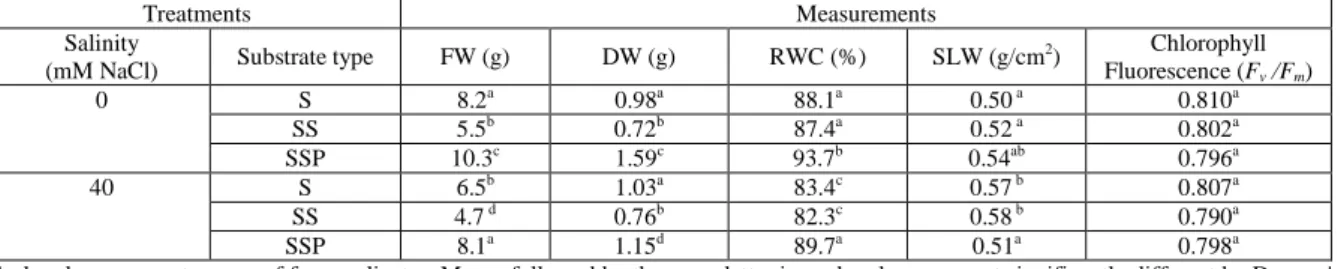
The fresh weight of plants (FW) was decreased by about 20 to 32% with increasing external salinity, whereas the value of dry weight of plants (DW) was not changed except with substrate type SSP (Table 1). The SSP lead to increase FW and DW with both treatments of salinity compared with substrate type S values. The SSP treatment with salinity (40 mM NaCl) was not showed significant difference with S of 0 mM NaCl treatment for plant FW values, while it was increased in DW of plants. Relative water content (RWC) of plants was reduced with salinity treatment, while the value of RWC of the SSP treatment with salinity has no significant difference with S substrate type of 0 NaCl treatment (Table 1). However, specific leaf weight (SLW) was increased in response to the NaCl treatment, but the SSP treatment with salinity has no significant difference with S substrate type of 0 NaCl treatment (Table 1). There is no significant differences in the chlorophyll fluorescence parameters, presented in the ratio of Fv/Fm were noted among treatments (Table 1).
Physico-chemical properties of substrates:
The results presented in (Table 2) showed the texture of substrate types as well as soil pH and EC at the end of experimentation. The texture of substrate types was Loam for S (the soil of region), SS was Loam-Sandy and SSP was Sandy-Loam. Substrate pH values were increased with high proportion of sand in SS treatment regardless the salinity level. The results also indicated that EC values were approximately doubled with salinity treatment, while, it was decreased to half the value in SS treatment due to more sand proportion.
Ion concentration:
The results of the analysis of some elements in plant tissue are presented in (Fig. 1). The Na+ content in plant tissue was obviously increased with salinity regardless the type of substrate to about 40%; but it was not affected by diversity of substrate type. Cl- accumulated in the plants was increased with salinity treatment; whereas it was significantly and gradient decreased in the plant tissue by about 50% as substrate texture changing from Loam to Loam-Sandy and Sandy-Loam. The treatment SSP with salinity (40 mM NaCl) showed a lowest amount of Cl- accumulated in the plant compared to S treatment with 0 mM NaCl. However, in this experimentation, K+ content was not significantly affected with all treatments.
Table 1: Effect of salinity (NaCl) and substrate type on fresh weight (FW), dry weight (DW), relative water content (RWC), specific leaf weight (SLW) and chlorophyll fluorescence (Fv / Fm) in rocket plants.
Treatments Measurements
Salinity
(mM NaCl) Substrate type FW (g) DW (g) RWC (%) SLW (g/cm
2) Chlorophyll
Fluorescence (Fv /Fm)
0 S 8.2a 0.98a 88.1a 0.50 a 0.810a
SS 5.5b 0.72b 87.4a 0.52 a 0.802a
SSP 10.3c 1.59c 93.7b 0.54ab 0.796a
40 S 6.5b 1.03a 83.4c 0.57 b 0.807a
SS 4.7 d 0.76b 82.3c 0.58 b 0.790a
SSP 8.1a 1.15d 89.7a 0.51a 0.798a
Table 2: Physico-chemical properties of substrates and salinity of NaCl at the end of experimentation.
Treatments Property
Salinity
(mM NaCl) Substrate type Clay % Silt % Sand % Texture PH EC mmhos/cm
0 S 26 36 38 L. 8.2 a 1.39 a
SS 9 11 80 L.Sa 8.7 b 0.58 b
SSP 14 21 65 Sa.L 8.1 a 1.27 c
40 S 22 35 43 L. 8.4 c 2.16 d
SS 9 10 81 L.Sa 8.8 b 1.29 c
SSP 15 20 65 Sa.L 8.2 a 2.45 e
Each value represents mean of four replicates. Means followed by the same letter in each column are not significantly different by Duncan's multiple range test at 5% level. (S) 100% soil, (SS) 50% soil + 50% sand and (SSP) 50% soil + 25% sand + 25% peat moss.
Fig. 1: Effect of salinity (fresh and salt water, 0 and 40 mM NaCl) and substrate type on: Na+, Cl- and K+ content (mg.g-1 DW) in rocket plants. Data are means of four replicates ±SE. Means with same letters are not significantly different tested by Duncan's multiple range test at 5% level. (S) 100% soil, (SS) 50% soil + 50% sand and (SSP) 50% soil + 25% sand + 25% peat moss.
Discussion:
The available of irrigation water in a many specific area of the world is characterized by a high level of salinity such in coastal areas. This requires working in order to find a way to deal with it, whether by cultivation of plants resistant or tolerant to salinity or adopt a particular strategy leads to minimize the adverse effects resulting from the use of salty water. Effect of salinity is on plant growth when irrigated with saline water and thus may have a severe effect on plant development (Debouba et al., 2006).
We found in this experiment that the salt water for irrigation of rocket plants has led to a decrease in the fresh weight (FW) of the plants compared to the situation of fresh water irrigation, despite that this effect does not appear clearly in respect of dry weight (DW) (Table 1). Our results showed that the chlorophyll fluorescence was not the physiological parameter that has correlation with salinity tolerance, as has been noted by Mekkaoui
et al. (1989) and Monneveux et al. (1990). There was an apparently greater detrimental effect of 50 mM NaCl
treatment on FW compared to that on DW. In the previous studies, the decline in growth of plants caused by salinity may be due to three principle mechanisms: osmotic stress, nutritional disruption and ion toxicity (Caines and Shennan, 1999). We assume that biomass decrease was related to the higher Na+ and Cl- accumulation into their tissues (Fig. 1).
the SSP treatment to give a FW and DW values was no different or beats what is the result has been obtained from the treatment of the control (S), and most importantly it is registered in particular when used salt water irrigation (Table 1). This concept was supported by indifferent pH values between the treatments of the SSP and S of substrate types, despite of the clarity of the high level of salinity in the SSP was (EC 2.45) compared to (EC 1.39) in S treatment (Table 2).
The results were showed a decrease in leaf RWC with increasing NaCl concentration, thus, to be indicated that plant tissues were under effect of osmotic stress. In addition, an increased SLW was rather common response in stressed plants and it's positively related to RWC reduction under saline stress condition. It means that less water is taken up by the root and transported into the shoot; consequently, less water is available for normal growth and development. As expected from the above mentioned the value of RWC and SLW under irrigation with salt water were comparable to values when irrigation with fresh water (0 mM NaCl) in case using SSP substrate type.
Our results suggest that salty water irrigation has led to obviously increased Na+ accumulation in the plant to about 40% due to the availability of Na+ ions in the soil (Fig 1). Thus, the plant was under the influence of the stress that led to absorption of the plant for additional quantities of Na+ ions to increase the water potential in the root cells to be able to adapt to soak up water to make up the shortfall. As for the effect of substrate texture type, there was no significant effect on the accumulation of Na+ in the plant.
The salty water irrigation has led to increased accumulation of Cl- in the plant by 30% approximately, on the other hand led diversity of substrate texture type to the difference in the amount of Cl- accumulated in the tissue of plants (Fig 1), where the absorbed amount of Cl- has been decreased to 50% when improved soil properties. The SSP substrate type characterized by high proportion of sand particles compared to the S substrate type (Table 2), this making change to more porosity and permeability based on the change of substrate texture, thereby increase water movement in the vertical direction and occurrence of leaching process for negative ions in the soil solution including chloride (Cl-). As in studies by others (Anikwe, 2000; Mavi et al., 2012) we found whenever the proportion of sand increased in the substrate that led to the improvement of the physical properties which the most important is permeability. The change related in the increase in the proportion of sand from the other components textures led to a lack of accumulation of Cl- in the plant grown in the SSP substrate type compared to other substrates S and SS (Figure 1). When the substrate is light texture (Loam-Sand and Sandy-Loam), was less accumulation of Cl- in the plant tissue and therefore less toxic effect of Cl- under conditions of saline irrigation water or affected by salinity, which reflected in the biomass presented in the table 1.
The results of this experiment showed that the K+ was not affected by the various treatments either the salinity or the type of substrate. This can be explained perhaps refer to the availability of potassium in the soil of the region in large quantities, there are previous experiences in the region reinforce this hypothesis.
From the above mentioned we can point out that this positive outcome may contribute to solving the problem of irrigation water salinity in coastal areas scattered in the vegetable farms. We are tried to understand what happened when we used SSP substrate type and irrigation with salty water so that led to this result. This finding enhances the possibility of conducting more research on modulating components of the substrate by amending the soil in agriculture in order to reduce the effects of some factors influencing the growth of plants which including salinity.
Conclusions:
The result shows that amending the soil can ameliorate the texture of substrate and adversely the effects of salinity and therefore increasing the ability of plants to growth under stressed condition. Fresh weight (FW), dry weight (DW), relative water content (RWC) and specific leaf weight (SLW) were maintained from effects of salinity under SSP substrate type. An increased of Na+ and Cl- accumulation in response to salinity treatment for plants whereas a decrease in Cl- was observed only at SSP substrate type treatment. Therefore, better substrate type in combination with salt water decreases the risk of salinity against plant growth. In addition, the results of the experiment also indicate that soil texture play an important role in determining the response of plants to salt due to their effect on the leaching process of Cl- from the soil solution.
ACKNOWLEDGEMENTS
The authors thank Salim Saaed for assistance in the field and laboratory, Dr. Saaed Helmi for analysis of the samples.
REFERENCES
Anikwe, M.A.N., 2000. Amelioration of a heavy clay loam soil with rice husk dust and its effect on soil physical properties and maize yield. Bioresource Technology. 74: 169-173.
AOAC, 1985. Official Methods of Analysis. 14th Edition, Association of Official Analytical Chemists, Washington DC, No. 43.292. 7.001, 7.009, 7.006.
Caines, A.M. and C. Shennan, 1999. Interactive effects of Ca2+ and NaCl salinity on the growth of two tomato genotypes differing in Ca2+ use efficiency. Plant Physiol. Biochemistry, 37 (7-8): 569-576.
Cuartero, J. and R. Fernandez-Munoz, 1999. Tomato and salinity . Sci. Hortic., 78: 83-125.
Debouba, M., H. Gouia, A. Suzuki and M.H. Ghorbel, 2006. NaCl stress effects on enzymes involved in nitrogen assimilation pathway in tomato "Lycopersicon esculentum" seedlings. J. Plant Physiol., 163: 1247-1258.
Evangelou, V.P. and L.M. McDonald, 1999. Influence of sodium on soils of humid regions. In: Pessarakali, M. (Ed.), Handbook of Plant and Crop Stress, 2. Marcel Dekker Inc., New York.
Hajer, A.S., A.A. Malibari, H.S. Al-Zahrani and O.A. Almaghrabi, 2006. Responses of three tomato cultivars to sea water salinity. 1. Effect of salinity on the seedling growth. Afr. J. Biotechnol., 5(10): 855-861.
Krzaklewski, W., M. Pietrzykowski and B. Woś, 2012. Survival and growth of alders (Alnus glutinosa (L.)
Gaertn. and Alnus incana (L.) Moench) on fly ash technosols at different substrate improvement. Ecological Engineering, 49: 35-40.
Lordan, J., M. Pascual, F. Fonseca, J.M. Villar and J. Rufat, 2013. Use of rice husk to enhance peach tree performance in soils with limiting physical properties. Soil & Tillage Research, 129: 19-22.
Maggio, A., S. De Pascale, G. Angelino, C. Ruggiero and G. Barbieri, 2004. Physiological response of tomato to saline irrigation in long-term salinized soils. Eur. J. Agron., 21: 149-159.
Martinez-Beltran, J. and C.L. Manzur, 2005. Overview of Salinity Problems in the World and FAO Strategies to Address the Problem. Proceedings of the International Salinity Forum, Riverside, California, 311-313.
Mavi, M.S., P. Marschner, D.J. Chittleborough, J.W. Cox and J. Sanderman, 2012. Salinity and sodicity affect soil respiration and dissolved organic matter dynamics differentially in soils varying in texture. Soil Biology & Biochemistry, 45: 8-13.
Mekkaoui, M.E., P. Monneveux and A.B. Damania, 1989. Chlorophyll fluorescence as a predictive test for salt tolerance in cereals: preliminary results on durum wheat. Rachis, 8: 16-19.
Monneveux, P., M.E. Mekkaoui and X. Xu, 1990. Physiological basis of salt tolerance in wheat chlorophyll fluorescence as a new tool for screening tolerant genotypes. In: Wheat Breeding. Prospects and Future Approaches. Varna, Bulgaria, 1-33.
Morales-Corts, M.R., M.Á. Gómez-Sánchez and R. Pérez-Sánchez, 2014. Evaluation of green/pruning wastes compost and vermicompost, slumgum compost and their mixes as growing media for horticultural production. Scientia Horticulturae, 172: 155–160.
Morgan, J.M., 1984. Osmoregulation and water stress in higher plants. Annu. Rev. Plant Physiol., 35: 299-319.
Pannell, D.J. and M.A. Ewing, 2006. Managing secondary dryland salinity: options and challenges. Agricultural Water Management. 80: 41-56.
Pessarakali, M. and I. Szabolcs, 1999. Soil salinity and sodicity as particular plant/crop stress factors. In: Pessarakali, M. (Ed.), Handbook of Plant and Crop Stress, 2. Marcel Dekker Inc., New York.
Rodionov, A., S. Nii-Annang, O. Bens, M. Trimborn, S. Schillem, B.U. Schneider, T. Raab and R.F. Huttl, 2012. Impacts of Soil Additives on Crop Yield and C-Sequestration in Post Mine Substrates of Lusatia, Germany. Pedosphere, 22(3): 343-350.
Shannon, M.C., J.W. Gronwald and M. Tal, 1987. Effect of salinity on growth and accumulation of organic and inorganic ions in cultivated and wild tomato species. J. Am. Hortic. Sci., 112: 516-523.
Souza, M.E.P., A.M.X. Carvalho, D.C. Deliberali, I. Jucksch, G.G. Brown, E.S. Mendonça and I.M. Cardoso, 2013. Vermicomposting with rock powder increases plant growth. Applied Soil Ecology, 69: 56- 60.
Valdes-Rodriguez, O.A., O. Sánchez-Sánchez, A. Pérez-Vázquez and R. Ruiz-Bello, 2011. Soil texture effects on the development of Jatropha seedlings - Mexican variety ‘piñón manso’. Biomass and Bioenergy, 35: 3529-3536.