S. Ponnusamy
Herb Silverman
Complex Variables
with Applications
S. Ponnusamy
Indian Institute of Technology, Madras Department of Mathematics
Chennai, 600 036 India
Herb Silverman College of Charleston Department of Mathematics Charleston, SC 29424 U.S.A.
Cover design by Alex Gerasev.
Mathematics Subject Classification (2000): 11A06, 11M41, 30-XX, 32-XX (primary); 26Axx, 40Axx, 26Bxx, 33Bxx, 26Cxx, 28Cxx, 31Axx, 35Axx, 37F10, 45E05, 76M40 (secondary)
Library of Congress Control Number:2006927602
ISBN-10: 0-8176-4457-1 eISBN: 0-8176-4513-6 ISBN-13: 978-0-8176-4457-4
Printed on acid-free paper.
c
2006 Birkh¨auser Boston
All rights reserved. This work may not be translated or copied in whole or in part without the writ-ten permission of the publisher (Birkh¨auser Boston, c/o Springer Science+Business Media LLC, 233 Spring Street, New York, NY 10013, USA), except for brief excerpts in connection with reviews or scholarly analysis. Use in connection with any form of information storage and retrieval, electronic adaptation, computer software, or by similar or dissimilar methodology now known or hereafter de-veloped is forbidden.
The use in this publication of trade names, trademarks, service marks and similar terms, even if they are not identified as such, is not to be taken as an expression of opinion as to whether or not they are subject to proprietary rights.
Printed in the United States of America. (TXQ/MP)
9 8 7 6 5 4 3 2 1
—S. Ponnusamy
To my wife, Sharon Fratepietro
Preface
The student, who seems to be engulfed in our culture of specialization, too quickly feels the necessity to establish an “area” of special interest. In keeping with this spirit, academic bureaucracy has often forced us into a compart-mentalization of courses, which pretend that linear algebra is disjoint from modern algebra, that probability and statistics can easily be separated, and even that advanced calculus does not build from elementary calculus.
This book is written from the point of view that there is an interdepen-dence between real and complex variables that should be explored at ev-ery opportunity. Sometimes we will discuss a concept in real variables and then generalize to one in complex variables. Other times we will begin with a problem in complex variables and reduce it to one in real variables. Both methods—generalization and specialization—are worthy of careful considera-tion.
We expect “complex” numbers to be difficult to comprehend and “imag-inary” units to be shrouded in mystery. Hopefully, by staying close to the real field, we shall overcome this regrettable terminology that has been thrust upon us. The authors wish to create a spiraling effect that will first enable the reader to draw from his or her knowledge of advanced calculus in order to demystify complex variables, and then use this newly acquired understanding of complex variables to master some of the elements of advanced calculus.
Sometimes, in an attempt to motivate, a discussion precedes a theorem. Sometimes, in an attempt to illuminate, remarks about key steps and possible implications follow a theorem. No apologies are made for this lack of terseness surrounding difficult theorems. While brevity may be the soul of wit, it is not the soul of insight into delicate mathematical concepts. In recognition of the primary importance of observing relationships between different approaches, some theorems are proved in several different ways. In this book, traveling quickly to the frontiers of mathematical knowledge plays a secondary role to the careful examination of the road taken and alternative routes that lead to the same destination.
A word should be said about the questions at the end of each section. The authors feel deeply that mathematics should be questioned—not only for its internal logic and consistency, but for the reasons we are led where we are. Does the conclusion seem “reasonable”? Did we expect it? Did the steps seem natural or artificial? Can we re-prove the result a different way? Can we state intuitively what we have proved? Can we draw a picture?1
“Questions”, as used at the end of each section, cannot easily be catego-rized. Some questions are simple and some are quite challenging; some are specific and some are vague; some have one possible answer and some have many; some are concerned with what has been proved and some foreshadow what will be proved. Do all these questions have anything in common? Yes. They are all meant to help the student think, understand, create, and ques-tion. It is hoped that the questions will also be helpful to the teacher, who may want to incorporate some of them into his or her lectures.
Less need be said about the exercises at the end of each section because exercises have always received more favorable publicity than have questions. Very often the difference between a question and an exercise is a matter of terminology. The abundance of exercises should help to give the student a good indication of how well the material in the section has been understood. The prerequisite is at least a shaky knowledge of advanced calculus. The first nine chapters present a solid foundation for an introduction to complex variables. The last four chapters go into more advanced topics in some detail, in order to provide the groundwork necessary for students who wish to pursue further the general theory of complex analysis.
If this book is to be used as a one-semester course, Chapters 5, 6, 7, 8, and 9 should constitute the core. Chapter 1 can be covered rapidly, and the concepts in Chapter 2 need be introduced only when applicable in latter chapters. Chapter 3 may be omitted entirely, and the mapping properties in Chapter 4 may be omitted.
We wanted to write a mathematics book that omitted the word “trivial”. Unfortunately, the Riemann hypothesis, stated on the last page of the text,
1 For an excellent little book elaborating on the relationship between questioning
Preface ix
could not have been mentioned without invoking the standard terminology dealing with thetrivial zerosof the Riemann zeta function. But the spirit, if not the letter, of this desire has been fulfilled. Detailed explanations, remarks, worked-out examples and insights are plentiful. The teacher should be able to leave sections for the student to read on his/her own; in fact, this book might serve as a self-study text.
A teacher’s manual containing more detailed hints and solutions to ques-tions and exercises is available. The interested teacher may contact us by e-mail and receive a pdf version.
We wish to express our thanks to the Center for Continuing Education at the Indian Institute of Technology Madras, India, for its support in the preparation of the manuscript.
Finally, we thank Ann Kostant, Executive Editor, Birkh¨auser, who has been most helpful to the authors through her quick and efficient responses throughout the preparation of this manuscript.
S. Ponnusamy
IIT Madras, India
Herb Silverman
Preface. . . vii
1 Algebraic and Geometric Preliminaries . . . 1
1.1 The Complex Field . . . 1
1.2 Rectangular Representation . . . 5
1.3 Polar Representation . . . 15
2 Topological and Analytic Preliminaries . . . 25
2.1 Point Sets in the Plane . . . 25
2.2 Sequences . . . 32
2.3 Compactness . . . 39
2.4 Stereographic Projection . . . 44
2.5 Continuity . . . 48
3 Bilinear Transformations and Mappings . . . 61
3.1 Basic Mappings . . . 61
3.2 Linear Fractional Transformations . . . 66
3.3 Other Mappings . . . 85
4 Elementary Functions . . . 91
4.1 The Exponential Function . . . 91
4.2 Mapping Properties . . . 100
4.3 The Logarithmic Function . . . 108
4.4 Complex Exponents . . . 114
5 Analytic Functions . . . 121
5.1 Cauchy–Riemann Equation . . . 121
5.2 Analyticity . . . 130
xii Contents
6 Power Series. . . 153
6.1 Sequences Revisited . . . 153
6.2 Uniform Convergence . . . 164
6.3 Maclaurin and Taylor Series . . . 173
6.4 Operations on Power Series . . . 186
7 Complex Integration and Cauchy’s Theorem. . . 195
7.1 Curves . . . 195
7.2 Parameterizations . . . 207
7.3 Line Integrals . . . 217
7.4 Cauchy’s Theorem . . . 226
8 Applications of Cauchy’s Theorem. . . 243
8.1 Cauchy’s Integral Formula . . . 243
8.2 Cauchy’s Inequality and Applications . . . 263
8.3 Maximum Modulus Theorem . . . 275
9 Laurent Series and the Residue Theorem. . . 285
9.1 Laurent Series . . . 285
9.2 Classification of Singularities . . . 293
9.3 Evaluation of Real Integrals . . . 308
9.4 Argument Principle . . . 331
10 Harmonic Functions . . . 349
10.1 Comparison with Analytic Functions . . . 349
10.2 Poisson Integral Formula . . . 358
10.3 Positive Harmonic Functions . . . 371
11 Conformal Mapping and the Riemann Mapping Theorem. . 379
11.1 Conformal Mappings . . . 379
11.2 Normal Families . . . 390
11.3 Riemann Mapping Theorem . . . 395
11.4 The ClassS . . . 405
12 Entire and Meromorphic Functions. . . 411
12.1 Infinite Products . . . 411
12.2 Weierstrass’ Product Theorem . . . 422
12.3 Mittag-Leffler Theorem . . . 437
13 Analytic Continuation . . . 445
13.1 Basic Concepts . . . 445
13.2 Special Functions . . . 458
References and Further Reading. . . 473
Index. . . 479
1
Algebraic and Geometric Preliminaries
The mathematician Euler once said, “God made integers, all else is the work of man.” In this chapter, we have advanced in the evolutionary process to the real number system. We partially characterize the real numbers and then, alas, find an imperfection. The quadratic equationx2+ 1 = 0 has no solution. A new day arrives, the complex number system is born. We view a complex number in several ways: as an element in a field, as a point in the plane, and as a two-dimensional vector. Each way is useful and in each way we see an unmistakable resemblance of the complex number system to its parent, the real number system. The child seems superior to its parent in every way except one—it has no order. This sobering realization creates a new respect for the almost discarded parent.
The moral of this chapter is clear. As long as the child follows certain guidelines set down by its parent, it can move in new directions and teach us many things that the parent never knew.
1.1 The Complex Field
We begin our study by giving a very brief motivation for the origin of complex numbers. If all we knew were positive integers, then we could not solve the equationx+ 2 = 1. The introduction of negative integers enables us to obtain a solution. However, knowledge of every integer is not sufficient for solving the equation 2x−1 = 2. A solution to this equation requires the study of
rational numbers.
While all linear equations with integers coefficients have rational solutions, there are some quadratics that do not. For instance, irrational numbers are needed to solve x2−2 = 0. Going one step further, we can find quadratic equations that have no real (rational or irrational) solutions. The equation
whose square is−1. This number, which we shall denote byi=√−1, is called animaginary unit.
Our sense of logic rebels against just “making up” a number that solves a particular equation. In order to place this whole discussion in a more rigorous setting, we will define operations involving combinations of real numbers and imaginary units. These operations will be shown to conform, as much as possi-ble, to the usual rules for the addition and multiplication of real numbers. We may express any ordered pair of real numbers (a, b) as the “complex number”
a+bi or a+ib. (1.1)
The set of complex numbers is thus defined as the set of all ordered pairs of real numbers. The notion of equality and the operations of addition and multiplication are defined as follows:1
(a1, b1) = (a2, b2)⇐⇒a1=a2, b1=b2, (a1, b1) + (a2, b2) = (a1+a2, b1+b2),
(a1, b1)(a2, b2) = (a1a2−b1b2, a1b2+a2b1).
The definition for the multiplication is more natural than it appears to be, for if we denote the complex numbers of the form (1.1), multiply as we would real numbers, and use the relationi2=−1, we obtain
(a1+ib1)(a2+ib2) =a1a2−b1b2+i(a1b2+a2b1).
Several observations should be made at this point. First, note that the formal operations for addition and multiplication of complex numbers do not depend on an imaginary numberi. For instance, the relationi2=−1 can be expressed as (0,1)(0,1) = (−1,0). The symbolihas been introduced purely as a matter of notational convenience. Also, note that the order pair (a,0) represents the real numbera, and that the relations
(a,0) + (b,0) = (a+b,0) and (a,0)(b,0) = (ab,0)
are, respectively, addition and multiplication of real numbers. Some of the essential properties of real numbers are as follows: Both thesumandproduct
of real numbers are real numbers, and theorderin which either operation is performed may be reversed. That is, for real numbersa and b, we have the commutative laws
a+b=b+a and a·b=b·a. (1.2)
The associative laws
a+ (b+c) = (a+b) +c and a·(b·c) = (a·b)·c, (1.3)
1.1 The Complex Field 3
and the distributive law
a·(b+c) =a·b+a·c (1.4)
also holds for all real numbersa, b, andc. The numbers 0 and 1 are, respec-tively, theadditive and multiplicative identities. Theadditive inverse of a is
−a, and the multiplicative inverseof a(= 0) is the real number a−1 = 1/a. Stated more concisely, the real numbers form afieldunder the operations of addition and multiplication.
Of course, the real numbers are not the only system that forms a field. The rational numbers are easily seen to satisfy the above conditions for a field. What is important in this chapter is that the complex numbers also form a field. The additive identity is (0,0), and the additive inverse of (a, b) is (−a,−b). The multiplicative inverse of (a, b)= (0,0) is
a a2+b2,−
b a2+b2
.
We leave the confirmation that the complex numbers satisfy all the axioms for a field as an exercise for the reader.
The discerning math student should not be satisfied with the mere veri-fication of a proof. He/she should also have a “feeling” as to why the proof works. Did the reader ask why the multiplicative inverse of (a, b) might be
expected to be
a a2+b2,−
b a2+b2
?
Let us go through a possible line of reasoning. If we write the inverse of (a, b) =a+bias
(a+ib)−1= 1
a+ib,
then we want to find a complex numberc+disuch that
1
a+ib =c+id.
By cross multiplying, we obtainac+i2bd+i(ad+bc) = 1, or
ac−bd= 1, ad+bc= 0.
The solution to these simultaneous equation is
c= a
a2+b2, d=− b a2+b2.
(a, b)−1=
a a2+b2,−
b a2+b2
?
Letz= (x, y) be a complex number. Thenxandy are called thereal partof
z, Rez, and theimaginary partofz, Imz, respectively. Denote the set of real numbers byR and the set of complex numbers by C. There is a one-to-one correspondence betweenR and a subset ofC, represented by x↔(x,0) for
x∈R, which preserves the operations of addition and multiplication. Hence we will use the real number x and the ordered pair (x,0) interchangeably. We will also denote the ordered pair (0,1) byi. Because a complex number is an ordered pair of real numbers, we use the termsC=R2 or C=R×R interchangeably. ThusR×0 is a subset ofCconsisting of the real numbers.
As noted earlier, an advantage of the field C is that it contains a root of z2+ 1 = 0. In Chapter 8 we will show that any polynomial equation
a0+a1z+ · · · +anzn= 0 has a solution inC. But this extension fromRto
Cis not without drawbacks. There is an important property of the real field that the complex field lacks. If a ∈ R, then exactly one of the following is true:
a= 0, a >0, −a >0 (trichotomy).
Furthermore, the sum and the product of two positive real numbers is positive (closure).
A field with an order relation<that satisfies the trichotomy law and these two additional conditions is said to beordered. In an ordered field, like the real or rational numbers, we are furnished with a natural way to compare any two elementsaandb. Eitherais less thanb(a < b), orais equal tob(a=b), orais greater thanb(a > b). Unfortunately, no such relation can be imposed on the complex numbers, for suppose the complex numbers are ordered; then either i or −iis positive. According to the closure rule, i2 = (−i)2 =−1 is also positive. But 1 must be negative if−1 is positive. However, this violates the closure rule because (−1)2= 1.
To sum up, there is a complex field that contains a real field that contains a rational field. There are advantages and disadvantages to studying each field. It is not our purpose here to state properties that uniquely determine each field, although this most certainly can be done.
Questions 1.1.
1. Can a field be finite?
2. Can an ordered field be finite?
3. Are there fields that properly contain the rationals and are properly contained in the reals?
4. When are two complex numbersz1 andz2 equal?
5. What complex numbers may be added to or multiplied by the complex numbera+ibto obtain a real number?
1.2 Rectangular Representation 5
7. What can we say about the real part of the sum of the two complex numbers? What about the product?
8. What kind of implications are there in defining a complex number as an ordered pair?
9. If a polynomial of degreenhas at least one solution, can we say more? 10. If we try to define an ordering of the complex numbers by saying that
(a, b)>(c, d) ifa > bandc > d, what order properties are violated? 11. Can any ordered field have a solution tox2+ 1 = 0?
Exercises 1.2.
1. Show that the set of real numbers of the forma+b√2, where aandb
are rational, is an ordered field.
2. Ifaandbare elements in a field, show thatab= 0 if and only if either
a= 0 orb= 0.
3. Supposeaandbare elements in an ordered field, witha < b. Show that there are infinitely many elements betweenaandb.
4. Find the values of
(a) (−2,3)(4,−1) (b) (1 + 2i){3(2 +i)−2(3 + 6i)} (c) (1 +i)3 (d) (1 +i)4
(e) (1 +i)n−(1−i)n.
5. Express the following in the formx+iy:
(a) (1 +i)−5 (b) (3−2i)/(1−i) (c) eiπ/2+√2eiπ/4 (d) (1 +i)eiπ/6
(e) a+ib
a−ib− a−ib
a+ib (f)
3 + 5i
7 +i +
1 +i
4 + 3i
(g) (2 +i)2+ (2−i)2 (h) (4 + 3i)
√
3 + 4i
3 +i
(i) (ai
40−i17)
−1 +i , (a−real) (j) (−1 +i
√
3)60
(k)
√
1 +a2+ia
a−i√1 +a2, (a−real) (l)
(√3−i)2(1 +i)5 (√3 +i)4 . 6. Show that
−1±√3 2
3
= 1 and
±1±i√3 2
6 = 1
for all combinations of signs.
7. For any integers k and n, show that in = in+4k. How many distinct
values can be assumed byin?
1.2 Rectangular Representation
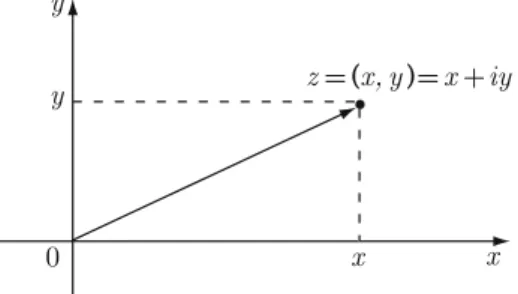
0 y y
z=(x, y)=x+iy
x x
Figure 1.1. Cartesian representation ofz in plane
Each complex number corresponds to one and only one point. Thus the terms complex number and point in the plane are used interchangeably. The
xandy axes are referred to as thereal axisand theimaginary axis, while the
xyplane is called thecomplex planeor thez plane.
There is yet another interpretation of the complex numbers. Each point (x, y) of the complex plane determines a two-dimensionalvector(directed line segment) from (0,0), the initial point, to (x, y), the terminal point. Thus the complex number may be represented by a vector. This seems natural in that the definition chosen for addition of complex numbers corresponds to vector addition; that is,
(x1, y1) + (x2, y2) = (x1+x2, y1+y2).
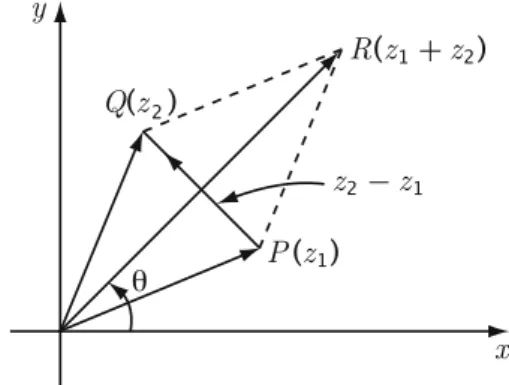
Geometrically, vector addition follows the so-calledparallelogram rule, which we illustrate in Figure 1.2. From the point z1, construct a vector equal in magnitude and direction to the vector z2. The terminal point is the vector
z1+z2. Alternatively, if a vector equal in magnitude and direction toz1 is joined to the vector z2, the same terminal point is reached. This illustrates the commutative property of vector addition. Note that the vector z1+z2 is a diagonal of the parallelogram formed. What would the other diagonal represent?
1.2 Rectangular Representation 7
Figure 1.3.Modulus of a complex numberz
By the magnitude (length) of the vector (x, y) we mean the distance of the point z = (x, y) from the origin. This distance is called the modulus
or absolute value of the complex number z, and denoted by |z|; its value is
x2+y2. For each positive real numberr, there are infinitely many distinct values (x, y) whose absolute value is r=|z|, namely the points on the circle
x2+y2=r2. Two of these points, (r,0) and (−r,0), are real numbers so that this definition agrees with the definition for the absolute value in the real field (see Figure 1.3).
Note that, forz= (x, y),
|x|=|Rez| ≤ |z|,
|y|=|Imz| ≤ |z|.
The distance between any two pointsz1= (x1, y1) andz2= (x2, y2) is
|z2−z1|=
(x2−x1)2+ (y2−y1)2.
The triangle inequalities
|z1+z2| ≤ |z1|+|z2|,
|z1−z2| ≥ | |z1| − |z2| |
say, geometrically, that no side of a triangle is greater in length than the sum of the lengths of the other two sides, or less than the difference of the lengths of the other two sides (Figure 1.2). The algebraic verification of these inequalities is left to the reader.
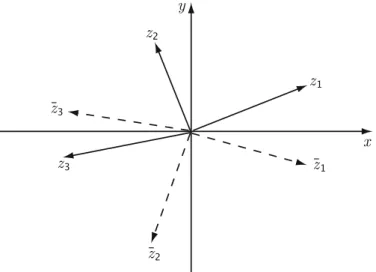
Among all points whose absolute value is the same as that of z= (x, y), there is one which plays a special role. The point (x,−y) is called theconjugate
ofz and is denoted byz. If we view the real axis as a two-way mirror, thenz
is the mirror image ofz (Figure 1.4).
Figure 1.4.Mirror image of complex numbers
z1+z2=z1+z2,
z1z2=z1z2. (1.5)
Some of the important relationships between a complex number z = (x, y) and its conjugates are
⎧ ⎪ ⎪ ⎨ ⎪ ⎪ ⎩
z+z= (2x,0) = 2Rez, z−z= (0,2y) = 2iImz,
|z|=|z|=x2+y2, zz=|z|2.
(1.6)
Thesquared form of the absolute value in (1.6) is often the most workable. For example, to prove that the absolute value of the product of two complex numbers is equal to the product of their absolute values, we write
|z1z2|2= (z1z2)(z1z2) = (z1z2)(z1z2) = (z1z1)(z2z2) = (|z1| |z2|)2.
Moreover, the conjugate furnishes us with a method of separating the inverse of a complex number into its real and imaginary parts:
(a+bi)−1= 1
a+bi· a+bi a+bi=
a−bi a2+b2 =
a a2+b2−
b a2+b2i.
Equation of a line in C.Now we may rewrite the equation of a straight line in the plane, with the real and imaginary axes as axes of coordinates, as
ax+by+c= 0, a, b, c∈R; i.e.,a
z+z
2
+b
z−z
2i
1.2 Rectangular Representation 9
where at least one ofa, bis nonzero. That is,
(a−ib)z+ (a+ib)z+ 2c= 0.
Conversely, by retracing the steps above, we see that
αz+βz+γ= 0 (1.7)
represents a straight line providedα=β,α= 0 andγ is real.
Equation of a circle in C.A circle inCis the set of all point equidistant from a given point, the center. The standard equation of a circle in thexy
plane with center at (a, b) and radius r >0 is (x−a)2+ (y−b)2=r2. If we transform this by means of the substitutionz=x+iy, z0=a+ib, then we havez−z0= (x−a) +i(y−b) so that
(z−z0)(z−z0) =|z−z0|2= (x−a)2+ (y−b)2=r2.
Therefore, the equation of the circle in the complex form with centerz0 and radiusris|z−z0|=r.In complex notation we may rewrite this as
zz−(zz0+zz0) +z0z0=r2, i.e. zz−2Re [z(a−ib)] +a2+b2−r2= 0,
wherez0=a+ib. Thus, in general, writinga−ib=β andγ=a2+b2−r2, we see that
α|z|2+βz+βz+γ= 0, i.e. z+β
α
2=|β|
2−αγ
α2 , (1.8)
represents a circle providedα,γare real, α= 0 and |β|2−αγ >0. The formulas in (1.6) produce
|z1+z2|2=|z1|2+ 2Re (z1z2) +|z2|2. (1.9)
Also, for two complex numbersz1 andz2, we have
(i) |1−z1z2|2− |z1−z2|2= (1 +|z1| |z2|)2−(|z1|+|z2|)2, since2
L.H.S = (1−z1z2)(1−z1z2)−(z1−z2)(z1−z2) = 1−(z1z2+z1z2) +|z1z2|2
−(|z1|2+|z2|2−z1z2−z1z2) = 1 +|z1z2|2−(|z1|2+|z2|2)
= (1− |z1|2)(1− |z2|2) = R.H.S.
Further, it is also clear from (i) that if|z1|<1 and|z2|<1, then
|z1−z2|<|1−z1z2|
and if either|z1|= 1 or|z2|= 1, then
|z1−z2|=|1−z1z2|.
(ii) |z1+z2|2+|z1−z2|2= 2(|z1|2+|z2|2) (Parallelogram identity); for,
L.H.S = (z1+z2)(z1+z2) + (z1−z2)(z1−z2) = [|z1|2+ (z1z2+z1z2) +|z2|2]
+ [|z1|2−(z1z2+z1z2) +|z2|2] = R.H.S.
Example 1.3.Let us use the triangle inequality to find upper and lower bounds for|z4−3z+ 1|−1 whenever|z| = 2. To do this, we need to find m
andM so thatm≤ |z4−3z+ 1|−1≤M for|z|= 2. As|3z−1| ≤3|z|+ 1 = 7 for|z|= 2, we have
|z4−3z+ 1| ≥ | |z4| − |3z−1| | ≥24−7 = 9
and|z4−3z+ 1| ≤ |z|4+|3z−1|= 24+ 7 = 23.Thus, for|z|= 2, we have
1 23 ≤ |z
4−
3z+ 1|−1≤ 1
9.
•
Example 1.4.Suppose that we wish to find all circles that are orthogonal to both|z|= 1 and|z−1|= 4. To do this, we consider two circles:
C1={z: |z−α1|=r1}, C2={z: |z−α2|=r2}.
These two circles are orthogonal to each other if (see Figure 1.5)
r21+r22=|α1−α2|2.
In view of this observation, the conditions for which a circle|z−α|=R is orthogonal to both|z|= 1 and|z−1|= 4 are given by
1 +R2=|α−0|2 and 42+R2=|α−1|2= 1 +|α|2−2Reα
which giveR= (|α|2−1)1/2and Reα=−7.Consequently,
α=−7 +ib and R= (49 +b2−1)1/2= (48 +b2)1/2 and the desired circles are given by
1.2 Rectangular Representation 11
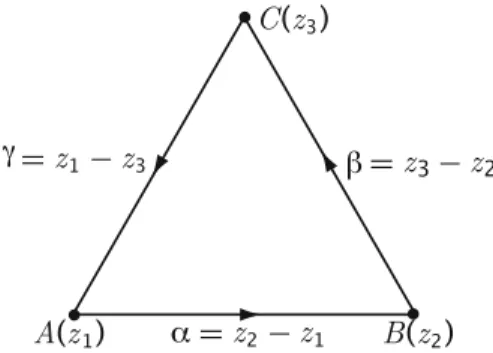
Example 1.5.We wish to show that triangleABC with verticesz1, z2, z3 is equilateral if and only if
z21+z22+z23=z1z2+z2z3+z3z1. (1.10)
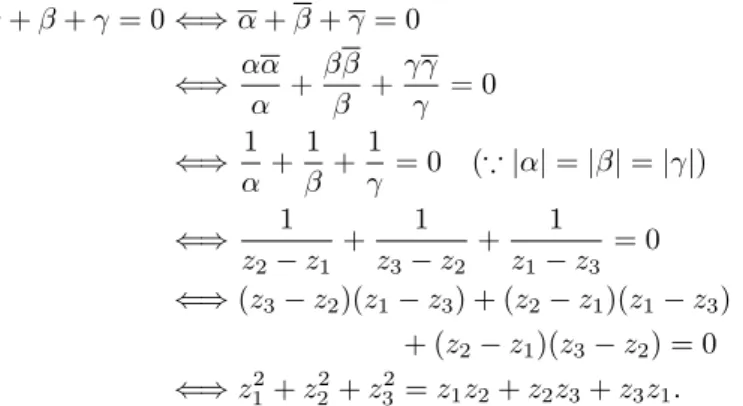
To do this, we letα=z2−z1,β=z3−z2, andγ=z1−z3so thatα+β+γ= 0. Further, ifABC is equilateral, then (see Figure 1.6)
α+β+γ= 0⇐⇒α+β+γ= 0
⇐⇒ αα
α + ββ
β + γγ
γ = 0
⇐⇒ 1
α+
1
β +
1
γ = 0 (∵|α|=|β|=|γ|)
⇐⇒ 1
z2−z1 + 1
z3−z2 + 1
z1−z3 = 0
⇐⇒(z3−z2)(z1−z3) + (z2−z1)(z1−z3) + (z2−z1)(z3−z2) = 0
⇐⇒z12+z22+z32=z1z2+z2z3+z3z1.
Conversely, suppose that (1.10) holds. Then
1
α+
1
β +
1
γ = 0 =⇒αβ+βγ+γα= 0
=⇒αβ+γ(−γ) = 0, sinceα+β=−γ,
=⇒αβ=γ2.
Thus,αβ=γ2. Similarly,βγ=α2andγα=β2. Further,
(αβ)(αβ) =γ2(γ)2, i.e., (αα)(ββ)(γγ) = (γγ)3.
Because of the symmetry, we also have
Figure 1.6.Equilateral triangleABC
(αα)(ββ)(γγ) = (αα)3 and (αα)(ββ)(γγ) = (ββ)3.
Thus,
1
α+
1
β +
1
γ = 0 =⇒ |α|
3=|β|3=|γ|3 =⇒ |α|=|β|=|γ|,
showing thatABC is equilateral.
Here is an alternate proof. First we remark that equilateral triangles are preserved under linear transformations f(z) = az+b, which can be easily verified by replacingzj byazj+b(j= 1,2,3) in (1.10). By a suitable
trans-formation, we can reduce the problem to a simpler one. If z1, z2, z3 are the vertices of a degenerated equilateral triangle (i.e.,z1=z2=z3), then (1.10) holds. If two of the vertices are distinct, then, by a suitable transformation, we can takez1= 0 andz2= 1. Then (1.10) takes the form 1 +z32=z3, which gives
z3=1 +i
√
3
2 or
1−i√3
2 .
In either case{0,1, z3}forms vertices of an equilateral triangle.
•
Example 1.6.Suppose we wish to describe geometrically the setS given by
S={z: |z−a| − |z+a|= 2c} (0=a∈C, c≥0), (1.11)
for the following situations:
(i)c >|a| (ii)c= 0 (iii) 0< c < a (iv)c=a >0.
The triangle inequality gives that
|2a|=|z−a−(z+a)| ≥ |z−a| − |z+a|= 2c, i.e., c≤ |a|.
1.2 Rectangular Representation 13
If c= 0, we have|z−a|=|z+a| which shows that S is the line that is the perpendicular bisector of the line joiningaand−a.
Next, we consider the casea > c >0. Then, writingz=x+iy,
|z−a| − |z+a|= 2c⇐⇒ |z−a|2= (2c+|z+a|)2
⇐⇒ |z−a|2= 4c2+|z+a|2+ 4c|z+a|
⇐⇒c|z+a|+c2=−aRez (Rez <0)
⇐⇒c2[|z|2+a2+ 2aRez] = (c2+aRez)2
⇐⇒c2|z|2−a2(Rez)2=c2(c2−a2)
⇐⇒ x2
c2 − y2 a2−c2 = 1.
Further, we observe that for |z−a| − |z+a| to be positive, we must have Rez <0. Thus, if a > c >0 we have
S=
x+iy: x 2
c2 − y2 a2−c2 = 1
and soS describes a hyperbola with focii ata,−a. Finally, ifc=athen
|z−a| − |z+a|= 2a ⇐⇒ |z+a|=−Re (z+a) =⇒ Re (z+a)<0
and therefore,S in this case is the interval (−∞,−a].
•
Questions 1.7.
1. In Figure 1.2, would we still have a parallelogram if the vectorz2 were in the same or the opposite direction as that ofz1?
2. Geometrically, can we predict the quadrant ofz1+z2from our knowledge ofz1and z2?
3. Why don’t we define multiplication of complex numbers as vector mul-tiplication?
4. When does the triangle inequality become an equality?
5. What would be the geometric interpretation of the inequality for the sum ofncomplex numbers?
6. Name some interesting relationships between the points (x, y) and (−x, y).
7. Ifaandbare positive rational numbers, why might we want to call the numbers√a+√b and√a−√breal conjugates?
8. Is every rational number algebraic? Are√3 and√55−3ialgebraic? Note: A number is algebraic if it is a solution of a polynomial (in z) with integer coefficients. Numbers which are not algebraic are called transcendental numbers.
Exercises 1.8.
1. Ifz1= 3−4iandz2=−2 + 3i, obtain graphically and analytically (a) 2z1+ 4z2
(d)|z1+z2|
(b) 3z1−2z2 (e)|z1−z2|
(c)z1−z2−4 (f)|2z1+ 3z2−1|.
2. Letz1=x1+iay1and z2=x2−ib/y1, wherea, bare real. Determine a condition ony1 so thatz1−1+z2−1 is real.
3. Identify all the points in the complex plane that satisfy the following relations.
(a) 1<|z| ≤3
(c)|z−1|+|z+ 1|= 2 (e) Rez2>0
(g) Re ((1−i)z) = 2 (i) Re (z) =|z|
(k)z= 5/(z−1) (z= 1)
(b)|(z−3)/(z+ 3)|<2 (d) Re (z−5) =|z|+ 5 (f) Imz2>0
(h)|z−i|= Rez
(j) Re (z2) = 1 (l) [Im (iz)]2= 1.
4. Let |(z−a)/(z−b)| =M, where a and b are complex constants and
M >0. Describe this curve and explain what happens asM →0 and asM → ∞.
5. Find a complex form for the hyperbola with real equation 9x2−4y2= 36.
6. If|z|<1, prove that
(a) Re
1 1−z
>1
2 (b) Re
z
1−z
>−1
2 (c) Re
1 +z
1−z
>0.
7. IfP(z) is a polynomial equation with real coefficients, show thatz1is a root if and only ifz1 is a root. Conclude that any polynomial equation of odd degree with real coefficients must have at least one real root. Can you prove this using elementary calculus?
8. Prove that, for everyn≥1,
|z1+z2+· · · +zn| ≤ |z1|+|z2|+· · · +|zn|.
9. Let a1, a2, . . . , an and b1, b2, . . . , bn be complex numbers. Prove the
Schwarz inequality, n k=1
akbk
2 ≤ n k=1
|ak|2 n
k=1
|bk|2|
.
When will equality hold?
10. Definee(α) = cosα+isinα, forαreal. Prove the following. (a)e(0) = 1
(c)e(α1+α2) =e(α1)e(α2)
(b)|e(α)|= 1 (d)e(nα) = [e(α)]n.
Which of these properties does the real-valued function f(x) = ex
1.3 Polar Representation 15
11. Show that the line connecting the complex numbers z1 and z2 is per-pendicular to the line connectingz3 andz4 if and only if
Re{(z1−z2)(z3−z4)}= 0.
12. Ifa, bare real numbers in the unit interval (0,1), then when do the three pointsz1=a+i,z2= 1 +ibandz3= 0 form an equilateral triangle? 13. If|zj|= 1 (j = 1,2,3) such that z1+z2+z3= 0, then show thatzj’s
are the vertices of an equilateral triangle.
1.3 Polar Representation
In Section 1.2, the magnitude of the vectorz =x+iy was discussed. What about its direction? A measurement of the angle θ that the vector z(= 0) makes with the positive real axis is called anargumentofz (see Figure 1.7). Thus, we may express the pointz= (x, y) in the “new” form
(rcosθ, rsinθ).
This, of course, is just the polar coordinate representation for the complex numberz. We have the familiar relations
r=|z|=x2+y2 and tanθ= y
x.
The real numbersrandθ, likexandy, uniquely determine the complex num-ber z. Unfortunately, the converse isn’t completely true. While z uniquely determines thexand y, hencer, the value of θis determined up to a multi-ple of 2π. There are infinitely many distinct arguments for a given complex numberz, and the symbol argzis used to indicateany oneof them. Thus the arguments of the complex number (2, 2) are
π
4 + 2kπ (k= 0,±1,±2, . . .).
This inconvenience can sometimes (although not always) be ignored by distin-guishing (arbitrarily) one particular value of argz. We use the symbol Argz
to stand for the unique determination ofθ for which−π <argz≤π. Thisθ
is called theprincipal valueof the argument. To illustrate,
Arg (2,2) = π
4, Arg (0,−5) =−
π
2, Arg (−1,
√
3) = 2π 3 .
Note that Rez >0 is equivalent to|Argz|< π/2. Ifx=y= 0, the expression tanθ=y/xhas no meaning. For this reason, argz is not defined whenz= 0.
Suppose thatz1 andz2have the polar representations
Figure 1.7. Polar representation ofz andz1z2
Then
z1z2=r1r2[(cosθ1cosθ2−sinθ1sinθ2) +i(sinθ1cosθ2+ sinθ2cosθ1)] =r1r2[cos(θ1+θ2) +isin(θ1+θ2)].
Loosely speaking, we may say that the argument of the product of two nonzero complex numbers is equal to the sum of their arguments; that is,
arg(z1z2) = argz1+ argz2. (1.12)
We understand (1.12) to mean that ifθ1 is one of the values of argz1 andθ2 is one of the values of argz2, thenθ1+θ2 is one of the values of arg(z1z2). Since (1.12) is valid only up to a multiple of 2π, a more explicit formulation is
argz1z2= argz1+ argz2+ 2kπ (kan integer)
or
argz1z2= argz1+ argz2 (mod 2π)
(see Figure 1.7). To illustrate, we observe that if z = (−1 +i√3)/2, then
z2= (−1−i√3)/2 so that
Argz=2π
3 and Arg (z 2
) =−2π 3 .
Thus, Arg (z.z) = Argz+ Argz−2π.
An induction argument (no pun intended) shows that ifzihas modulusri
and argumentθi (i= 1,2, . . . , n), then
z1z2· · · zn=r1r2 · · ·rn[cos(θ1+θ2+· · · +θn) (1.13)
+isin(θ1+θ2+· · · +θn)].
Example 1.9.Let z1 = 1 +i and z2 = √3 +i. We wish to express them in polar form and then verify the identities that hold for multiplication and division ofz1 andz2, respectively. To do this, we may write
1.3 Polar Representation 17
Figure 1.8. Geometric proof for Example 1.10
Then
z1z2= 2
√
2ei5π/12 and z1
z2 = 1
√
2e
iπ/12.
Thus, in this particular problem of product and division, it follows that
Arg (z1z2) = Argz1+ Argz2 and Arg
z1
z2
= Argz1−Argz2.
Similarly, we may easily check the following:
(i) (1−i√3)/(1 +i√3) =eiθ, θ= 2π/3 + 2kπ ;
(ii) (−√3 +i)(1 +i)/(1 +i√3) =√2eiθ, θ= 3π/4 + 2kπ;
(iii) (1−3i)/(2−i) =√2eiθ, θ=−π/4 + 2kπ,
wherekis an integer.
•
Example 1.10.Suppose that z1 and z2 are two nonzero complex numbers such that|z1|=|z2| but z1=±z2. Then we wish to show that the quotient (z1+z2)/(z1−z2) is a purely imaginary number. For a geometric proof, we consider the parallelogramOP RQ shown in Figure 1.8. Since the sides OP
and OQ are equal in length, OP RQ is a rhombus. Thus, the vector −→OR is perpendicular to the vector−→P Q, and so
Arg (z1+z2) = Arg (z1−z2)±iπ/2.
For an analytic proof, we may rewrite
w=z1+z2
z1−z2 = 1 +z
1−z (z=z2/z1).
The hypotheses imply that|z|= 1, z =±1. Therefore, letting z=eiθ with
θ∈(0,2π)\{π},
w=1 +e
iθ
1−eiθ =
e−iθ/2+eiθ/2
e−iθ/2−eiθ/2 =
2 cos(θ/2)
−2isin(θ/2) =icot (θ/2),
Example 1.11.Let z= sinθ+icos 2θ and w= cosθ+isin 2θ. We wish to show that there exists no value ofθfor whichz=w. To do this, we first note that
z=w⇐⇒sinθ= cosθ and cos 2θ= sin 2θ.
There exists no values of θ satisfying both conditions, because sinθ = cosθ
implies that cos 2θ= cos2θ−sin2θ= 0, and so the second condition reduces to sin 2θ= 2 sinθcosθ= 0, i.e., sinθ= 0 = cosθ.
•
Remark 1.12.Geometric considerations (Figures 1.2 and 1.7) indicate that the rectangular representation will frequently be more useful for problems involving sums of complex numbers, with polar representation being more
useful for problems involving products.
•
If we letz1=z2= · · · =zn in (1.13), we obtain
zn=rn(cosnθ+isinnθ). (1.14)
For|z|= 1 (the unit circle), (1.14) reduces to
(cosθ+isinθ)n= cosnθ+isinnθ, (1.15) a theorem of DeMoivre.
The possibility of findingnth roots of the complex number is suggested by (1.14). A complex numberz is annth root ofz0ifzn =z0, writtenz=z10/n. The problem is to reverse the multiplicative operation and determine a number which, when multiplied by itselfntimes, furnishes us with the original number. Given a complex numberz0=r0(cosθ0+isinθ0), how do you find a complex numberz=r(cosθ+isinθ) such thatzn=z
0? By (1.14), we must have
rn(cosnθ+isinnθ) =r0(cosθ0+isinθ0). (1.16) Since|cosα+isinα|= 1 for all realα, (1.16) yields the relations
rn =r
0, cosnθ+isinnθ= cosθ0+isinθ0. (1.17)
The first relation in (1.17) shows that |z| = r01/n, which we already knew (why)? But the second gives important information about the argument of
z, namely, that nargz differs from argz0 by a multiple of 2π(that is, nθ=
θ0+ 2kπ, k= 0,±1,±2, . . .):
θ= θ0+ 2kπ
n . (1.18)
How many integerskin (1.18) produce distinct solutions? We have
z=z01/n=r10/n
cos
θ0+ 2kπ
n
+isin
θ0+ 2kπ
n
1.3 Polar Representation 19
For eachk(k= 0,1,2, . . . , n−1), there is a different value forz. We leave it for the reader to verify that there are no more solutions. Thus, givenz0= 0, there are exactlyndistinct complex numbersz such thatzn =z
0.
By lettingz0= 1 in (1.19), we may find thenth roots of unity. Ifzn= 1, then
z= cos
2kπ n
+isin
2kπ n
(k= 0,1,2, . . . , n−1). (1.20)
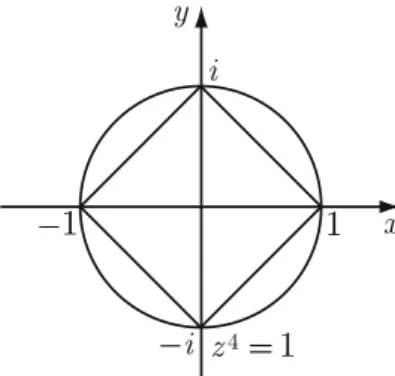
Geometrically, the solutions represent the nvertices of a regular polygon of
nsides inscribed in a circle with center at the origin and radius equal to one. See Figures 1.9 and 1.10 for the inscribed square and pentagon.
By (1.20), the difference in the arguments of any two successiventh roots of unity is constant (2π/n). If we let
ω= cos2π
n +isin
2π n,
then each root of unity may be expressed as a multiple ofω; that is,
ω, ω2, ω3, . . . , ωn−1, ωn=ω0= 1.
This gives interesting information about the sums and products of the roots of the unity, namely, that the product of any two roots of unity is also a root of unity, and that the sum of allnth roots of unity is zero. The latter statement follows from the identify
1 +ω+ω2+ · · · +ωn−1= 1−ω
n
1−ω .
Using (1.19), we easily see, for instance, the following:
(a) ∗√3 + 4i=±(2 +i) (b) ∗√−3 + 4i=±(1 + 2i)
Figure 1.10.Illustration for the 5th roots of unity
(c) ∗√1 +i=±
⎛ ⎝
√
2 + 1 2 +i
√
2−1 2
⎞ ⎠
(d) ∗√2i=±(1 +i)
(e) ∗
1−i√3
2 =±
√
3−i
2
(f) ∗1 +i√3 =±
√
3 +i
√
2
(g) ∗√−5−12i=±(−2 + 3i) (h) ∗√5 + 12i=±(3 + 2i)
(i) ∗√−5 + 12i=±(2 + 3i).
Here∗√a+ibdenotes the two 2th roots of the complex numbera+ib. Since then nth roots of unity are given by (1.20), we have
zn−1 = (z−1)(z−ω1)(z−ω2)· · · (z−ωn−1), ωk=ωk=e2πki/n.
Dividing both sides byz−1, using the identity
1 +z+z2+ · · · +zn−1= 1−z
n
1−z (z= 1),
and lettingz→1, we have
n= (1−ω1)(1−ω2)· · · (1−ωn−1), and
n= (1−ω1)(1−ω2)· · · (1−ωn−1).
As (1−e−iθ)(1−eiθ) = 2(1−cosθ) = 4 sin2(θ/2), it follows that
n2=
n−1
k=1
|1−ωk|2= n−1
k=1
4 sin2
kπ n
= 22(n−1)
n−1
k=1 sin2
kπ n
1.3 Polar Representation 21
Taking the positive square root on both sides we have
n= 2n−1
n−1
k=1 sin kπ n
, n >1. (1.21)
We can make the following generalization: Consider the equation
Ma(z) =z2n−2znancosnφ+a2n= 0 (n∈N, a∈R+, φ∈R).
Solving this forzn, we findzn=ane±inφ so that
Ma(z) = [zn−aneinφ][zn−ane−inφ].
Therefore, using the concept ofnth root of a complex number, we can write
Ma(z) = n
k=1
z−aei(φ+2kπ/n) z−ae−i(φ+2kπ/n)
= n k=1
z2−2zacos
φ+2kπ
n
+a2
. (1.22)
Some special cases of (1.22) follow:
(a) Taking φ= 0, we have
(zn−an)2=
n
k=1
z2−2zacos
2kπ n
+a2
.
(b) Taking φ=π/n, we have
(zn+an)2=
n
k=1
z2−2zacos
(2k+ 1)π n
+a2
.
(c) Ifa= 1 then, on dividing (1.22) byzn, z= 0, we have
zn+z−n−2 cos(nφ) =
n
k=1
z+z−1−2 cos
φ+2kπ
n
and so, ifz=eiθ, this becomes
cos(nθ)−cos(nφ) = 2n−1 n
k=1
cosθ−cos
φ+2kπ
n
which is, for cosθ= cosφ, equivalent to
cos(nθ)−cos(nφ) cosθ−cosφ = 2
n−1
n−1 k=1
cosθ−cos
φ+2kπ
n
In the limiting case whenθ, φ→0, the above reduces to
n= 2n−1
n−1 k=1
sin
kπ n
,
which is nothing but (1.21).
Questions 1.13.
1. What problem would be created by defining the argument ofz = 0 to be zero?
2. Loosely speaking, for complex numbersz1 andz2 we have
arg(z1z2) = argz1+ argz2.
What real-valued functions have the property that
f(x1x2) =f(x1) +f(x2)?
3. When does Arg (z1z2) = Argz1+ Argz2?
4. How are the complex numbersz1 andz2 related if arg(z1) = argz2? 5. How are the arguments arg(z1) and argz2 related ifz1=z2?
6. How are the arguments arg(z1) and argz2related if Re (z1z2) =|z1z2|? 7. How are the arguments arg(z1) and argz2related if|z1+z2|=|z1|+|z2|? 8. As the complex numberz approaches the negative real axis from above and below, what is happening to Argz? What ifzapproaches the posi-tivereal axis from above and below?
9. How do the arguments ofz and 1/z compare? 10. How do the arguments ofz andzcompare? 11. How do the arguments ofz and 1/z compare?
12. What is the position of the complex number (cosα+isinα)z relative to the position ofz?
13. What are some differences between the terms angle, real number, and argument?
14. Of what use might the binomial theorem be in this section? 15. For which integersndoeszn= 1 have only real solutions?
16. For which complex numbersz doesz/z=z/|z|?
17. Is it always the case that for any given nonzero complex number, either√
z2=zor√z2=−z?
18. Which postulates for a field are satisfied by the roots of unity under ordinary addition and multiplication of complex numbers?
19. What can you say about thenth roots of an arbitrary complex number? 20. For αan arbitrary real number, how many solutions might you expect
zα= 1 to have?
1.3 Polar Representation 23
Exercises 1.14.
1. For a fixed positive integern, determine the real part of (1 +i√3)n.
2. Find two complex numbersz1 andz2 so that
Arg (z1z2)= Argz1+ Argz2.
3. Find two complex numbersz1 andz2 so that
Arg (z1z2) = Argz1+ Argz2.
4. Describe the following regions geometrically. (a) Argz=π/6, |z|>1
(c)−π <Argz <0, |z+i|>2
(b)π/4<Argz < π/2 (d) 1<|z−1|<5. 5. If|1−z|<1, show that|Argz|< π/2.
6. If|z|<1, show that|Arg ((1 +z)/(1−z))|< π/2.
7. If Rez >0, show that Re (1/z)>0. If Rez > a >0, what can you say about Re (1/z)?
8. If|z|= 1,z=−1, show thatz may be expressed in the form
z=1 +it 1−it,
wheretis a real number.
9. Write the polar form of the following:
(a) 1 + cosφ+isinφ
1 + cosφ−isinφ (0< φ < π/2)
(b) 1 + cosφ+isinφ 1−cosφ−isinφ
(c) 1−sinφ+icosφ (0< φ < π/2) (d) −sinφ−icosφ
(e) (1 +i)n (n∈N)
(f) (1 +i√3)n+ (1−i√3)n (n∈N).
10. Find all values of the following and simplify the expressions as much as possible.
(a)i1/2 (b)i1/4 (c) (−i)1/3 (d)√1 +i (e) √68 (f) √4 + 3i (g) (4−3i)1/3 (h)√2 +i
11. Ifω= (−1 +i√3)/2 is a cube root of unity and if
Sn= 1−ω+ω2+· · · + (−1)n−1ωn−1,
then find a formula forSn.
12. Letωbe a cube root of unity and leta, b, cbe real. Determine a condition ona, b, cso that (a+bω+cω2)3is real.
13. Let ωbe a cube root of unity. Determine the value of
(a) (1 +ω)3 (b) (1 + 2ω+ω2)(1 +ω+ 2ω2)
14. Let ω= 1 be annth root of unity. Show that
1 + 2ω+ 3ω2+· · · +nωn−1=− n 1−ω.
15. Letωk= cos(2kπ/n) +isin(2kπ/n).Show that
n
k=1|ωk−ωk−1|<2π
for all values ofn. What happens asnapproaches∞? 16. Find the roots of the equation (1 +z)5= (1−z)5. 17. Findα, β, γ andδsuch that the roots of the equation
z5+αz4+βz3+γz2+δz+η= 0
lie on a regular pentagon centered at 1.
18. Prove that for any real xand a natural numbern,
ei2ncot−1(x)
ix+ 1
ix−1
n
= 1.
19. Find a positive integer nsuch that
2
Topological and Analytic Preliminaries
The neighborhood of a young child consists of the people very close on the left and right. As we get older we think in terms of two-dimensional neighborhoods (the people around the corner) or even three-dimensional neighborhoods (the people in the world). In this chapter we do likewise. We develop numerous methods for accurately describing sets in the real line (one-dimensional) and the plane (two-dimensional). In order to track down the elusive point at in-finity, it becomes necessary to introduce the sphere (three-dimensional).
When a set is described in a satisfactory manner, we become concerned about its image. We investigate conditions under which properties of a set are preserved when the set is transformed into a new set. A remarkable outcome of our investigation is that the removal of a single point from one set may entirely change its character, whereas the removal of infinitely many points from a different set may be insignificant. The removal of two points from a set on the line may give it more affinity to a set in the plane than to its former self. In this chapter we learn that in a sense all points are equal but some points are more equal than others.
2.1 Point Sets in the Plane
A neighborhood of a real numberx0is an interval in the form (x0−, x0+), whereis any positive real number. Thus we may say that anneighborhood ofx0is the set of pointsx∈Rfor which|x−x0|< . There are different ways to extend this one-dimensional neighborhood concept to include points in the plane. Asquareneighborhoodof a point (x0, y0) is the set of all points (x, y) whose coordinates satisfy the two inequalities
|x−x0|< , |y−y0|< .
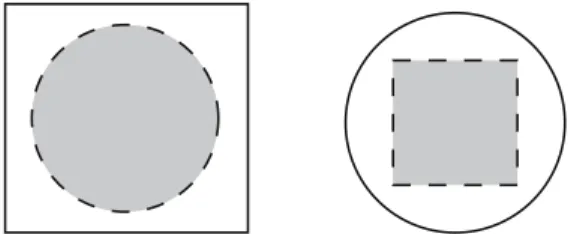
Figure 2.1.Illustration for open sets in the plane
neighborhood of (x0, y0) is the set of all points (x, y) whose distance from (x0, y0) is less than . It consists of all points (x, y) such that
(x−x0)2+ (y−y0)2< ,
i.e., points inside a circle centered at (x0, y0) whose radius is. Observe that every square neighborhood of a point contains a circular neighborhood of the point, and every circular neighborhood of a point contains a square neighbor-hood of the point (for a smaller, of course). This is illustrated in Figure 2.1. From our point of view (that a point in the plane represents a complex num-ber), it will be more convenient to deal with circular neighborhoods, for then an neighborhood of the complex number z0 consists of all points z ∈ C satisfying the inequality |z−z0| < . Such a neighborhood is denoted by
N(z0;).
Care must be taken to distinguish between a neighborhood on the real line and a neighborhood in the plane. For example, {x∈ R: −1 < x < 1} is a neighborhood of 0, a point on the line; it isnota neighborhood of (0,0), a point in the plane. A point in the plane is not permitted to have a one-dimensional neighborhood.
The definitions and theorems in this section are valid simultaneously for points on the line and points in the plane, when the concepts ofneighborhood are suitably interpreted. A set is said to bebounded if it is contained in some disk centered at the origin. A point is said to be aninterior pointof a set if there is some neighborhood of the point contained in the set. An important distinction between the bounded sets
A={z∈C: |z−z0|< } and B={z∈C: |z−z0| ≤}
is that every point inA is an interior point. To see this, letz1 be any point in A. Then |z−z0| = δ for some δ, 0 ≤δ < . But for η = (−δ)/2, we have N(z1;η)⊂ N(z0;δ) (see Figure 2.2). Of course, no point on the circle
2.1 Point Sets in the Plane 27
Figure 2.2. Description for an interior point
(a) the empty set,
(b) the set of all complex numbers, (c) {z: |z|> r},r≥0,
(d) {z: r1<|z|< r2}, 0≤r1< r2, (e) the intersection of any two open sets, (f) the union of any collection of open sets.
Remark 2.1.An open interval on the real line is not an open set in the plane, since any neighborhood of a point will contain points in the plane that are
not real.
•
Adeletedneighborhood ofz0, denoted byN(z0;), is the set of all points
zsuch that 0<|z−z0|< . That is, the pointz0 is “punched out” from the set. A pointz0 is called alimit pointof a setAif every deleted neighborhood ofz0 contains a point ofA. Note that a limit pointz0 may or may not be in the setA.
Examples 2.2. (i) The limit points of the open set |z| < 1 are |z| ≤ 1; that is, all the points of the set and all the points on the unit circle
|z|= 1. If ∂Δ ={z : |z| = 1} and Δ ={z : |z| ≤ 1}, then all points ofΔ are its limit points and no other point is a limit point of Δ. The same is true for∂Δ. On the other hand, all points ofΔ\ {0} together with 0 and the points of∂Δare limit points ofΔ\ {0}. Note that 0 and the points of∂Δare not inΔ\ {0}.
(ii) The set A ={1/n : n∈ N}, where N={1,2,3, . . . , n, . . .}, has 0 as a limit point (regardless of whether the set is considered a subset of the line or the plane) and 0 is not in the set. Similarly, the set A =
{eiπ/n: n∈N} has 1 as its only limit point, see Figure 2.3.
(iii) If A consists of the set of points that have both coordinates rational, then every point in the plane is a limit point ofA.
•
A set is said to beclosedif it contains all of its limit points. The union of a setA and its limit points is called the closureof A, and is denoted by A. Some examples of closed sets in the plane are
(a) the empty set,
Figure 2.3.Description of limit point 1 of{eiπ/n: n∈N}
(c) {z: |z| ≥r},r≥0,
(d) {z: r1≤ |z| ≤r2}, 0≤r1< r2, (e) the union of any two closed sets,
(f) the intersections of any collection of closed sets, (g) {z: |z| ≤1}.
Some examples of sets that are not closed in the complex plane C are Δ,
Δ\ {0},Δ\ {0}. Finally, we remark that the setΔ\ {0}is neither closed nor open.
Theorem 2.3.Ifz0 is a limit point ofA, then every neighborhood ofz0
con-tains infinitely many points ofA.
Proof. Assume that some deleted neighborhood of z0 contains only a fi-nite number of points of A. Let the points be z1, z2, . . . , zn and =
mini=1,2, ... ,n|z0−zi|. ThenN(z0;) contains no points ofA, andz0 can’t be
a limit point ofA.
Corollary 2.4.Every finite set is closed.
Proof. The set contains all of its limit points—all “none” of them.
For the set |z| ≤1, we would like to distinguish the interior points from t