Address for correspondence
Dr. Sumara Rashid, Assistant Professor Department of Dermatology
Fatima Memorial Medical & Dental College, Lahore
Email: [email protected]
Original Article
Efficacy and safety of sulphasalazine in
treatment of alopecia areata
Introduction
Alopecia areata (AA) is an autoimmune disorder that results in patchy hair loss without scarring.1 The disease can affect any age but peak incidence is second and third decade.2,3
The disease affects both sexes equally.2 Autoimmune nature of the disease is suggested by biopsy findings of involved areas that demonstrate predominantly T cell infiltrate around the hair follicles. It is also associated with other autoimmune diseases like vitiligo,
thyroiditis and pernicious anemia.4 Severe forms of AA include extensive AA, alopecia totalis (AT) and alopecia universalis (AU). Extensive AA is more than 40% hair loss from hair bearing areas. AT is the total absence of terminal scalp hair and AU is total loss of terminal body and scalp hair.5
Intralesional corticosteroids are used as first-line therapy for limited patchy AA. It stimulates hair regrowth at the site of injection. The effect lasts for a few months and re-treatment may be needed in some cases. Other options available for limited patchy AA are potent topical corticosteroids, dithranol and minoxidil lotion. They are safe but the treatment results are unsatisfactory.6-8
Sumara Rashid*, Uzma Ahsan**, Wajieha Saeed***
*Department of Dermatology, Fatima Memorial Medical & Dental College, Lahore
** Department of Dermatology, Sharif Medical & Dental College, Lahore *** Department of Dermatology Unit I, Mayo Hospital, Lahore
Abstract Objective To evaluate the safety and efficacy of sulphasalazine in treatment of severe alopecia
areata.
Methods It was a non-randomized open therapeutic trial. 41 subjects were included in the study. Patients were enrolled from department of dermatology Unit-II of Mayo Hospital Lahore. Subjects were stared on 500mg/day of sulphasalazine to a maximum of 3gram/day. The dose for children was 10mg/kg/day. Patients were followed fortnightly. Responsive patients were followed for another 3 months. All the relevant data was recorded and analyzed.
Results Four out of 50 patients (4%) responded to the treatment. Two of them demonstrated partial response and two had total response. There was no significant sex difference for the treatment response. Major side effect observed was hepatotoxicity seen in 3 patients resulting in discontinuation of drug.
Conclusion It is concluded that sulphasalazine is relatively safe but not effective in treatment of severe AA.
Keywords
Both topical and systematic agents are used in the treatment of severe AA. The topical agents include corticosteroids, minoxidil, psoralen therapy with ultraviolet radiation (PUVA) and anthralin.9 Systematic therapies other than oral and parenteral corticosteroids include cyclosporin.6
Contact immunotherapy with
diphenylcyclopropenone (DPCP) or squaric acid dibutylester (SADBE) is also recommended for severe AA.9-11 Hair regrowth occurs in about 50% of cases but response rate is much lower in patients with AT and AU. Its limitation is that it is not widely available and involves multiple visits to hospital.6 Continuous or pulsed systemic corticosteroids and PUVA have been tried to treat severe AA. Due to the lack of proven efficacy and potential for serious side effects, these therapies are not recommended to date.9
In general, treatment options for severe AA are limited and not effective. As it markedly affects the quality of life of the patient, new therapeutic options are, therefore, essential. Sulphasalazine is an anti-inflammatory agent and has been used in various autoimmune diseases like rheumatoid arthritis, psoriasis and inflammatory bowel disease. It has both immunosuppressive and immunomodulatory effects. There are few case reports of success of this drug in patients with severe AA.10 Sulphasalazine, therefore, is an option that needs to be explored in treatment of AA.
Methods
It was a nonrandomized, open, therapeutic trial, conducted in the department of dermatology, Unit II, Mayo Hospital, Lahore. Study was completed in 15 months (August 2005 to October 2006). A total of fifty patients, fulfilling the inclusion criteria were included in the study. Diagnosis of AA was made clinically. They
were of either sex, above two years of age and had the disease with involvement of more than 25% area of scalp with or without loss of hair on other body parts. It was ensured that they had no specific medications for last four weeks. Exclusion criteria included patients with evidence of chronic organ dysfunction such as chronic renal failure, heart failure, chronic liver disease and lung disease, pregnant and lactating females and those with hypersensitivity to sulpha group of drugs and/or salicylates.
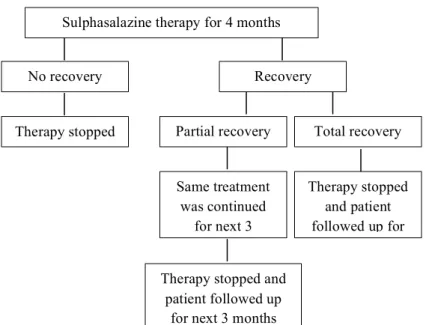
All the relevant data including the history, physical examination along with site, size and extent of alopecia areata were recorded in a proforma. Pretreatment investigations included complete blood count, renal function tests, liver function tests and urinalysis. After the initial workup, patients over 12 years of age were prescribed 500mg/day of sulphasalazine. The dose was increased by 500 mg every week to a maximum of 3 g/day. In patients under 12 years of age, initial dose was 10mg/kg body weight and it was increased by 10mg/kg every week to a maximum of 60mg/kg body weight. Maximum dose was not required in every patient and the determining factor to establish the dosage was the regrowth of hair. Rest of treatment plan is shown in Figure 1.
Patients were followed up, initially weekly till the required dosage to achieve a response and then fortnightly. On each visit, above mentioned laboratory investigation were repeated fortnightly during first month and every four weeks thereafter. Response was graded on a scale (Table 1).
Table 1 Grades of improvement.
Grade Recovery (%)
0 No response
1 1-25%
2 26-50%
3 51-75%
Figure 1 Study protocol for sulphasalazine in alopecia areata.
Table 2 Age and gender distribution of study population (n=41). Group Total number Alopecia areata >25% of scalp area
n (%)
Alopecia totalis n (%)
Alopecia universalis n (%)
Males 23 13 (31.7) 5 (12.2) 5 (12.2)
Females 18 12 (29.3) 3 (7.3) 3 (7.3)
Total Number 41 25 (61.0) 8 (19.5) 8 (19.5)
Table 3 The treatment response to sulphasalazine in different types of alopecia areata (n=41).
Category Number No response Partial response Total response Overall response
Extensive alopecia areata 25 24 0 1 1
Alopecia totalis 8 6 1 1 2
Alopecia universalis 8 7 1 0 1
Total number 41 37 2 2 4
P value <0.05 >0.05 >0.05 >0.05
Grades 2 and 3 were considered partial response while grade 4 was taken as total response.
SPSS version 13 was used for analysis. The variables analyzed were demographic data and were presented as simple statistics. The outcome of drug therapy was assessed by hair regrowth. It was expressed as either no response or response which may be partial or total. The association of response A p value of <0.05 was considered statistically significant.
Results
Fifty patients were initially enrolled in the study. There were nine dropouts. Out of them, medicine was discontinued in three patients because of deranged liver function tests. Six patients did not turn up for follow-up. Therefore, study was completed in 41 patients. There were 23 males and 18 females. 60% patients were of extensive AA, and 20% each of alopecia totalis and alopecia universalis. Age and gender distribution is shown in Table 2.
Sulphasalazine therapy for 4 months
No recovery Recovery
Therapy stopped recovery
Partial recovery Total recovery
Same treatment was continued
for next 3
Therapy stopped and patient followed up for
Therapy stopped and patient followed up
Figure 2 Treatment response among male and female patients.
Efficacy of drug is shown in Table 3. In extensive AA, one (4%) patient showed total response; in alopecia totalis 1 out of 8 (12.5%) patients showed total response whereas drug was ineffective in alopecia totalis. Regarding side effects, 3 out of 44 patients developed clinical and laboratory evidence of liver damage. Among them two were males and one female. None of
the patients developed hematologic
abnormalities. The drug was safe but not efficacious in alopecia areata.
Discussion
Our study showed that sulphasalazine is not effective in the management of severe alopecia areata. However, our results differ from that of study conducted by Ellis et al.10 in Michigan USA. This is the only study of sulphasalazine in
AA conducted internationally, which
demonstrated hair regrowth in 23% cases. However, it is important to note that the study was based upon five case reports only. Moreover there was no follow-up to see the relapse. The difference in response rates may be due to some racial, genetic or environmental factors. It may also be due to difference in treatment regimen and duration of therapy.
Minor side effects related to gastrointestinal system were not reported in our study probably due to low dosage as compared to that used in other autoimmune disorders like rheumatoid arthritis and inflammatory bowel disease and also because of use of enteric coated tablets.11 7% of our patients had disturbed liver functions. It is important to note that when liver toxicity occurred in our study, it did so in first two months. From this observation we infer that the side effect of sulphasalazine is not dose-related. It may be an idiosyncratic reaction.
Regarding the other treatment options for AA like steroids, topical minoxidil, anthralin, PUVA, interferon and dapsone, all have variable responses and maintenance therapy is often required.6,12,13 Sulphasalazine is thus a new addition in a long list of therapeutic agents. It is at least effective in some number of patients. It can be an alternative to the patients who avoid the prolonged use of messy agents. Compared with the other treatment modalities, sulphasalazine is still a hope for resistant and extensive cases that are non-responsive to other modes of treatment.
Conclusion
In the light of present study, it is recommended that sulphasalazine is associated with 0
10 20 30 40 50
Total patients Males Females 0
unsatisfactory response in patients with severe AA. Further studies are needed to establish its efficacy especially in combination with other treatment modalities.
References
1. Madani S, Shapiro J. Alopecia areata update. J Am Acad Dermatol. 2000;42:549-66.
2. Mc Donagh AJ, Tazi-Ahnini R. Epidemiology and genetics of alopecia areata. Clin Exp Dermatol. 2002;27:405-9. 3. Safavi KH, Muller SA, Suman VJ et al.
Incidence of alopecia areata in Olmsted County, Minnesota, 1975 through 1989. Mayo Clin Proc. 1995;70:628-33.
4. Duvic M, Nelson A, de Andrade M. The genetics of alopecia areata. Clin Dermatol. 2001;14:291-6.
5. Hordinsky MK. Clinical presentation of alopecia areata. Dermatol Ther. 2001;14:291-6.
6. Bolduc C, Shapiro J. The treatment of alopecia areata. Dermatol Ther. 2001;14:306-13.
7. Shapiro J, Price VH. Hair regrowth. Therapeutic agents. Dermatol Clin. 1998;16:341-56.
8. Price VH, Abdel-Salam MM, Stem M, Greenspan JS. Treatment of hair loss. N Eng J Med. 1999;341:964-73.
9. MacDonald Hull SP, Wood ML, Hutchison PE et al. Guidelines for management of alopecia areata. Br J Dermatol. 2003;149:692-9.
10. Ellis CN, Brown MF, Voorhees JJ. Sulfasalazine for alopecia areata. Clin Dermatol. 2002;46:541-5.
11. Van Riel PL, van Gestel AM, van de Putte LB. Long-term usage and side effect profile of sulphasalazine in rheumatoid arthritis. Br J Rheumatol. 1995;34:40-6. 12. Kar BR, Handa S, Dogra S, Kumar B.
Placebo-controlled oral pulse prednisolone therapy in alopecia areata. J Am Acad Dermatol. 2005;52:287-90.