Conceptualizing Language Learning Metaphors in the Saudi EFL
Context: Practicality, Applicability & Appropriacy
Mansoor S. Almalki*
English Language Centre, Deanship of Supportive Studies, Taif University, Taif 21974, Saudi Arabia Corresponding Author: Mansoor S. Almalki, E-mail: [email protected]
ABSTRACT
This paper tries to investigate the trends about the use of metaphors in the Saudi EFL classrooms. The proper implementation of metaphors (i.e. instruction, acquisition, and socialization metaphors) by teachers can be a reason for boosting source in the interactional and instructional patterns of the Saudi EFL classrooms, and the significance of these metaphors at aforementioned settings was investigated in the present study. Focusing upon the perceptive design of the study, a survey was conducted to know the significance of the three metaphors in the interactional settings of the Saudi EFL classrooms. This study targeted Saudi EFL teachers’ attitudes towards the three delimited metaphors. The respondents consisted of 200 Saudi EFL teachers drawn from the English Language Centers of the Saudi Universities. A 22-item Likert-scale questionnaire was designed to know the opinions of Saudi EFL teachers about the dynamic use of metaphors in the context of the Saudi EFL classroom. The findings of the study reflected that the Saudi EFL teachers represented by the cohort of this study presented a mixed attitudes towards the utilization of the three delimited metaphors. The findings show that a limited exposure of instructional metaphor may be one of the reasons of the poor performance of the Saudi EFL teachers. A limited exposure of acquisition metaphor may also be damaging the dynamics of teacher student interactional and instructional patterns inside the Saudi EFL classrooms. The findings further show that the teachers’ imbalanced use of class time and hardly any reliance on the coordinated interaction might be due to the limited exposure to the latest techniques embedded in the socialization metaphor. Although policy makers do not acknowledge the fundamental role of metaphors into classroom pedagogies, the participant-teachers recommended professional use of all the metaphors to achieve prerequisite dynamics of the EFL classrooms by fully acknowledging the applicability, appropriateness, and practicality of all the variables of acquisition metaphor.
Keywords: Metaphor Awareness, Saudi EFL Teachers, Instruction Metaphor, Acquisition Metaphor, Socialization Metaphor, Metaphoric Processing
INTRODUCTION
The significance of metaphor in language teaching and learning has been examined in second/foreign language learning. The application of metaphor in language teaching began approximately thirty years ago and it is situated in the cognitive linguistics paradigm (Danesi, 1986). The utiliza-tion of literature that investigates the relautiliza-tionship between metaphor and language learning has increased extensively, with most studies revolving around the conceptual role of metaphors. Lakoff and Johnson (1980) forwarded the Con-ceptual Metaphor Theory and asserted that metaphor is a matter of the mind, not an issue of language. According to Lakoff and Johnson (1980, p. 5) “ the essence of metaphor is understanding and experiencing one kind of thing in terms of another”. Lakoff and Johnson’s theory offered a theoretical framework to study metaphorical language and thoughts in
Published by Australian International Academic Centre PTY.LTD.
Copyright (c) the author(s). This is an open access article under CC BY license (https://creativecommons.org/licenses/by/4.0/) http://dx.doi.org/10.7575/aiac.ijalel.v.6n.7p.277
all the disciplines (Gibbs, 2008). Lakoff and Johnson delin-eate (1980, p. 9) that
“In all aspects of life, we define our reality in terms of metaphors and then proceed to act on the basis of the met
-aphors. We draw inferences, set goals, make commitments,
and execute plans, all on the basis of how we in part struc-ture our experience, consciously and unconsciously, by
means of metaphor”
A great number of linguists and researchers in the disci-pline of language and linguistics are becoming interested in the metaphor, and anomalously powerful claims have been made about the influence of metaphor in almost every aspect of language education. The use of the three metaphors of language learning as instruction, language learning as acqui-sition, and language learning as socialization represents a shift in ideology concerning the nature of language learning. Nonetheless, certain approaches to teaching and learning ARTICLE INFO
Conflicts of interest: None Funding: None
Article history
Received: June 04, 2017 Accepted: August 26, 2017 Published: December 01, 2017 Volume: 6 Issue: 7
of languages are more common in certain settings (Khan, 2011). In Saudi Arabia, research has been done on the sec-ond language learning environment, particularly in relation to the teaching and learning of the English language (Khan, 2011). Saudi Arabia uses a formal lecture-based approach to teaching and learning, similar to the ‘instruction’ metaphor (Almalki, 2011; Alebaikan, 2010). The literature on lan-guage learning in Saudi Arabia argues that lanlan-guage learn-ing as an instruction predominates the educational landscape (Elyas & Picard, 2010).
Concerning pedagogical success in Saudi Arabian lan-guage learning, achievement is increasingly demonstrated through meeting the requirements of internationally stan-dardized tests that assess the global proficiencies of speak -ing, listen-ing, read-ing, and writing (Khan, 2011). Having said this, achieving native-like production of language which is error-free is believed to be the ideal demonstration of achievement in language learning (Khan, 2011). With the development of EFL practices today, there will be a shift in language learning. This shift will be in moving from lan-guage learning as ‘Instruction’, as it is currently, to lanlan-guage learning as ‘Socialization’, where learning focus can be more on multimodal activities and the overall growth of the language community.
A large body of research acknowledges the power and significance of metaphor in the pedagogy of teaching En -glish as a second or foreign Language (Boers, 2000; Lazar, 1996; Littlemore, 2004). The use of metaphor as an peda-gogical tool in teaching lanugae is not quite new, however, the utilization of it has been limited and narrow. Most of the inquiries in this area focus only on the potential of met-aphor in increasing vocabulary retention (Boers, 2000; La-zar, 1996; Littlemore, 2004). It’s a reason that application of metaphor as a teaching tool has taken a long time to “make significant headway into mainstream pedagogical practice and the design of teaching materials” (Littlemore and Low, 2006, p. 4). Despite clear and solid theoretical implications, not much attention and due importance has been given to the empathic potential of metaphor as a teaching method-ology. In order to widen the scope of metaphor in language teaching, the current studyexamines the current scenario on the role of metaphors in language teaching and learning, and also examines how metaphoric processing was understood by the Saudi EFL interactants. It is prudent to consider the value of metaphor in language research and pedagogical contexts. And this is a shift that is already beginning to hap-pen as explained in the next section.
LITERATURE REVIEW
Language Learning as ‘Instruction’
Language learning as instruction focuses on the traditional notion of the student as a recipient of knowledge and skills, as well as on a didactic role of the instructor as controller of information (Richards & Rodgers, 2001). Predominating language ‘teaching’ for a century until the 1950s, the gram-mar-translation method of language learning comprised the direct translation of the target language into the student’s
pri-mary language. Lessons focused mainly on teaching read-ing and writread-ing skills with fixed or ultimate correct answers. Thus, every student was expected to provide the same con-vergent answer (Low, 2003). The grammar-translation meth-od placed emphasis on reading and writing, and demanded of students that they must demonstrate the translation of a pas-sage of the target language into their first language (Gozda -wa-Gołębiowski, 2013). Based on the grammar-translation method, language course plans focused on the accuracy of the translation and fluency of the communicated translation (Gozdawa-Gołębiowski, 2013). According to (Low, 2003), thus, accuracy and fluency were strong themes in learning items, such as in accurately translating a paragraph of writ-ing from Arabic to English, for example. In this era, the emphasis in learning was to achieve the correct linguistic product, rather than to develop cognitive strategies or social process. Students were imitators, instructors used error cor-rection to force accuracy, and researchers reduced linguistics to structural analysis of minute detail. The curriculum de-sign was a fixed set of grammar and vocabulary. The dom -inant pedagogy was instruction and success was defined as native-like fluency and accuracy in the new language. With the grammar-translation method primarily being concerned with reading and writing, features of the language, such as accurate spelling and correct word choice were the focus of learning: they were the learning units that were the outcomes that the student was able to achieve in the target language (Richards & Rodgers, 2001). The choice of the metaphor ‘instruction’ for this type of language learning is most likely to be derived from the focus on a direct instructor to student approach in the instruction of language (Low, 2003). Despite different innovative tools being used by educators around the world today, the instruction metaphor of language learning is still used in many EFL settings (Low, 2003). Among the is-sues for an instruction-based approach to language learning is that the focus on the educator can foster a dependency in students on the educator as the sole source of information.
Changes in Language Learning – Learning by ‘Acquisition’
-tion method; the latter requiring native speaker accuracy and fluency and being excessively concerned with details (Low, 2003). Richards and Rodgers (2001) maintain that the change in the language pedagogy was towards multi-dimensional learning objectives where learning and teaching included speaking, listening, reading and writing. Pedagogical suc-cess in language learning was demonstrated by proficiency in these four areas, or global proficiencies (Ellis, 2003). Many settings, even today, are still believed to adhere to language teaching practices which are consistent with the acquisition approach (Gruba&Hinkelman, 2012), and the rise of the ac-quisition world view of language learning can still be seen today in the case of high stakes tests. Global tests of English such as the International English Language Testing System (IELTS) and the Test of English for International Communi-cation (TOEIC) have been derived from the acquisition mod-el (Gruba&Hinkmod-elman, 2012).
The ‘Socialization’ Metaphor
Knight, Studdert-Kennedy, and Hurford (2000) argues against the biological interpretation of language acquisition, citing social evolution and the influence of culture and histo -ry in creating an evolving language. As well as, immersion in the target language has been encouraged by the advent of Web 2.0 (the ‘social web’ which facilitates interactive sharing) (Gray et al., 2011). Along the same lines as this so-cialization theme, Skehan (1998) argues that students need to actively use the target language to be competent: devel-oping skills in the language, becoming articulate, and the need for interaction countered the idea that mere exposure is sufficient to learn a language. This approach is known as socialization, which is now a popular approach to learning a second language (Davis, 2012).
Language learning using socialization is linked to the in-creased social skill development in students (Netten &Ger-main, 2010), deeper learning (Larsen-Freeman, 2000), rapid uptake of symbols, improved academic results (Duff, 2010) The socialization metaphor emphasises the role of substan-tive communication. While earlier perspecsubstan-tives placed great-er distance between language student and language teachgreat-er, philosophers started to note that students of foreign languag-es benefited from immersion in the target language, and in particular from opportunities to socialize using their new language (Davis, 2012; Duff, 2010; Hill & McNamara 2012; Netten&Germain, 2010). Learning in this format involves weighting of the learning components, especially substan-tive communication that involves using language for mean-ing and in real situations.
Larsen-Freeman (2000) and Dinçay (2010) provide ex-amples of typical learning activities used within the social-ization approach. These activities include:
1. Authentic materials. Students may not be able to direct-ly use their knowledge outside the class. To overcome this, everyday items in the target language can be used, including newspaper articles, weather forecast charts, timetables, and menus.
2. Scrambled sentences and other language games. Games are frequently used in Communicative Language
Teach-ing (CLT), alongside role playTeach-ing and interviews and other interactions between the students, for the purposes of flexibility and broadening the curriculum.
3. Comic strips. These are used because the pictures give indications of the text.
The above activities promote confidence and allow self-expression. In summary, the contemporary second-lan-guage goal in modern times, as expressed by the socializa-tion metaphor, is demonstrating accomplishment in using the language in real situations.
Objectives
Most research studies investigated the three language learn-ing metaphors in settlearn-ings like ESL, and there is a lack of research by investigating these metaphors in the EFL setting and especially in the Saudi EFL context. Therefore, it is as-sumed that the current research study will help contribute in shedding light on the best EFL teaching practices by investi-gating teachers’ perceptions about the three language learn-ing metaphors and so help in determinlearn-ing which one of these is more appropriate, practical and applicable in such settings. Thus, the objectives of this study are;
1. To investigate EFL language teachers’ perceptions about the three language learning metaphors (i.e. instruction metaphor, acquisition metaphor, and socialization meta-phor) in the Saudi EFL context.
2. To determine the practicality and applicability of the metaphors in the Saudi EFL classrooms.
3. To identify the appropriateness of language learning metaphor in the context of Saudi EFL classrooms.
Research Questions
Based on the research objectives mentioned above, I propose the following four research questions;
1. How do language teachers perceive the instruction met-aphor of language learning in the EFL context?
2. How do language teachers perceive the acquisition met-aphor of language learning in the EFL context?
3. How do language teachers perceive the socialization metaphor of language learning in the EFL context? 4. What is the most appropriate language learning
meta-phor in the Saudi EFL context?
RESEARCH METHODOLOGY
ran-dom sampling techniques were used to select respondents as a sample. Bell (1999, p. 126) opines that “a random sam-ple will give each of the individuals concerned an equal chance of being selected.” Further, a different sections of the questionnaire were designed in order to check the ap-propriateness of the survey items, the thing that enabled a researcher to elicit respondents’ authentic responses and examine the appropriateness, practicality and applicability of the three language learning metaphors. Consequently, 24-item Likert-scale questionnaire tried to focus on the do-mains of instruction, acquisition, socialization, appropriate-ness, practicality and applicability. In addition, a pilot study was also administered to examine the suitability of the sur-vey. The English version of the online questionnaire was distributed to the respondents. Finally, I gathered data on the basis of a structured questionnaire and drew the conclu-sions from the findings accordingly.
Delimitations of the Study
This study was delimited to explore and analyze the signif-icance of three metaphors in the context of the Saudi EFL classrooms. The focus of the study was narrowed down to the important functions of three metaphors such as instruction metaphor, acquisition metaphor, and socialization metaphor only. The present study did not include the use of metaphors as a metacognitive research tool to explore the conceptions of learning and teaching. Conversely, it focused only on studies that examined metaphor as a pedagogical entity.
Instrumentation
From the very outset of the study, I carefully considered selecting reliable methods that would help to identify the research problems. Thus, in order to investigate the phenom-ena under study, I used a survey as a research instrument as it allows asking a large group of people questions related to the issue of interest (Fraenkela, & Wallen, 2000:432). The reli-ability and validity of the questionnaires were determined by the pilot project and, consequently, well planned and struc-tured questionnaire was used to get a reliable data. For this purpose, English version of the questionnaire was provided to the subjects.
Statistical Analysis
At the stage of analysis, the responses of the subjects were analyzed to determine the significance of different vari -ables of metaphors in the Saudi EFL classrooms. The sig-nificance was determined by applying the value of mean for all the variables, but the significance of each variable of metaphors was determined by the value of the mean while considering its importance in the language research. As Brown (1988:154) defines: “the central tendency of groups is often described in terms of means and medians. Compar-ing the performance of groups will often involve lookCompar-ing at one or both of these basic characteristics”. Finally, the results were demonstrated by using frequency distribution tables.
RESULTS AND DISCUSSION ON THE FIRST PART OF THE QUESTIONNAIRE
The data generated through the questionnaire was analysed to examine the research questions. The questionnaire of the present survey was administered to the teachers (both males and females) to identify the significance of all three meta -phors in the Saudi EFL classrooms. The following Table 1 ranked hierarchy as determined by the respondents, and also presented individually identified mean scores for all the vari -ables of the questionnaire.
Based on the mean scores taken from the section of in-struction metaphor, the five items displayed the respondents’ ranking of variables from the most significant to the least significant. The most important item as identified by the re -spondents was item two ‘I talk more than my students in the classroom’ with a mean of 3.04. Hence, results report that the item two of the instruction metaphor revealed a big gap between teacher and student interactions. Therefore, such responses imply that there is a dire need to enhance the instructional patterns to achieve true objectives of the language learning through exposing instruction metaphor in the Saudi EFL classrooms.
-ods of teaching are employed in the Saudi EFL classrooms and that may be one of the reasons for the low preference of this variable. In the Saudi EFL classrooms, teachers were not properly trained to know the prerequisite of classroom dynamics, e.g. how to stipulate class time span, turn taking and interactional patterns according to the pre-requisites of the instruction metaphor. It is rightly pointed out by Kalyuga and Kalyuga (2008) who suggested raising metaphor aware-ness by enhancing metaphoric awareaware-ness via activities that help participants to establish the associations with the meta-phorical expressions and its more comprehensive utilization can lead to higher retention rate of contents (Boers, 2000; Guo, 2007). Discussing and comparing metaphors in the first and target language can also be effective in improving learners’ metaphor comprehension and production (Deignan, Gabrýs, & Solska, 1997). The findings of the current study agree with(Low, 2003) that despite different innovative tools being used by educators around the world today, the instruc-tion metaphor of language learning is still used in many EFL settings including in the EFL context of Saudi Arabia.
RESULTS AND DISCUSSION ON THE SECOND PART OF THE QUESTIONNAIRE
The following Table 3 presented the analysis of the results of part 2 of the questionnaire along with ranked hierarchy through individually identified means as recognized by the respondents for all the variables.
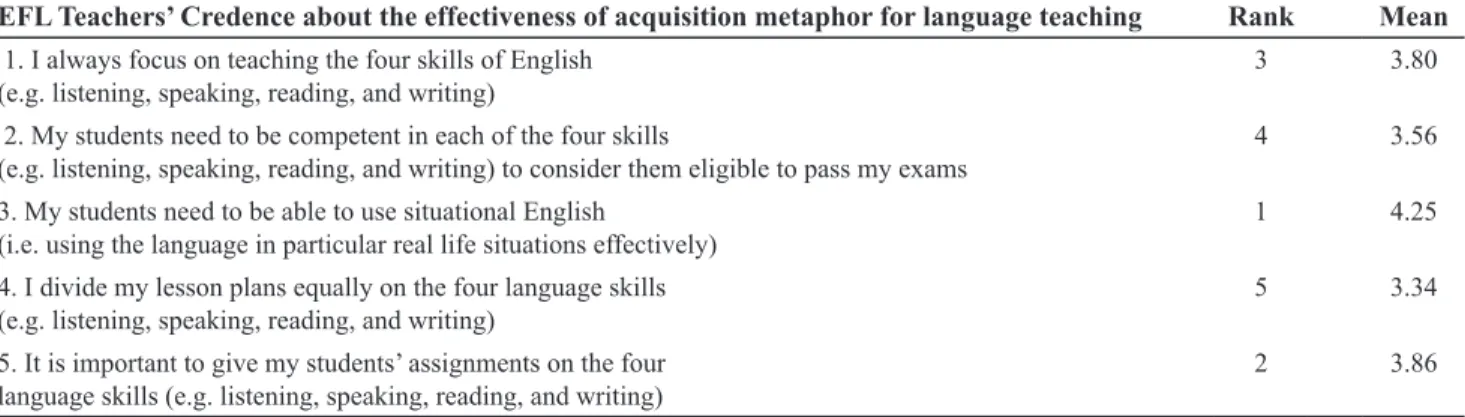
In Table 2, item 3 ‘my students need to be able to use situ-ational English (i.e., using the language in particular real life situations) effectively’ was shown to be the most preferred variable to teach English getting support from the materi-als based on a real life like situation with a mean of 4.25.
It was an important finding that considering the importance of situational English teachers recommended the use of all four language skills in the Saudi EFL classrooms. However, that was specified with acclimatizing them to the situational use of English to facilitate students to overcome their defi -ciencies. This result aligns with the suggestion as given by Savignon, (1986, p. 145) who stated that “items from news-papers, popular, or professional magazines can be introduced over a period of time for intensive and extensive exposure of English language”. And it is true because sometimes even a single page of a newspaper provides a plenty of the exposure of situational English in the classroom. This way, teachers may take out students from the cycle of dissatisfaction creat-ed due to rcreat-edundant lesson plans bascreat-ed on the artificially de -signed materials, and hence they can lead students towards the cycle of improvement by devising lesson plans based on such situational materials. Tuckner explaining the same situation (1986) claims that educational changes cannot be rushed, attitudinal change in Homo sapiens may be a long, painful or frustrating process, but it does happen. Item five ‘it is important to give my students’ assignments on the four language skills (e.g., listening, speaking, reading, writing)’ with a mean of 3.86 was reported as the second most pre-ferred variable. Similarly, AlAsmari & Gulzar (2016) also claim that situational material may provide their students with realistic experiences which capture their attention and appeal to the mind through visual auditory senses. Thus, this kind of material may be used as good teaching tools because they can provide many benefits and can also keep students’ interest and motivation intact. Data analysis also showed that the third most preferred item was one ‘I always focus on teaching the four skills of English (e.g., listening, speak-ing, readspeak-ing, writing)’ scoring a mean of 3.80. and it was
Table 1. Saudi EFL Teachers’ Beliefs about using instruction metaphor for language teaching. Analysis of Teachers’ questionnaire
Teachers’ beliefs about using instruction metaphor for language teaching Rank Mean
1. Instructing my students is the only approach I use 2 2.49
2. I talk more than my students in the classroom 1 3.04
3. Students don’t need to interact with each other in my classroom 5 1.76
4. External materials are not appropriate in my class 3 2.20
5. I don’t spend time talking to my students about their learning interests 4 2.18
Table 2. Saudi EFL Teachers’ Credence about the effectiveness of acquisition metaphor for language teaching
EFL Teachers’ Credence about the effectiveness of acquisition metaphor for language teaching Rank Mean
1. I always focus on teaching the four skills of English
(e.g. listening, speaking, reading, and writing) 3 3.80
2. My students need to be competent in each of the four skills
(e.g. listening, speaking, reading, and writing) to consider them eligible to pass my exams 4 3.56 3. My students need to be able to use situational English
(i.e. using the language in particular real life situations effectively) 1 4.25 4. I divide my lesson plans equally on the four language skills
(e.g. listening, speaking, reading, and writing) 5 3.34
5. It is important to give my students’ assignments on the four
graded at number three by the respondents. Metaphor aware-ness-raising activities help language learners in the reading of literature both in immediate and delayed interpretation, as shown in Picken (2005; 2007). Moreover, explaining these activities, Sacristán, (2009) defines these activities, when incorporated in translation classes, can enhance cross-lin-guistic awareness, translation competence, metaphoric com-petence, learner autonomy, interactive learning and critical thinking. In Csábi’s study (2004), learners who were ex-posed to metaphor-awareness instruction outperformed their peers in comprehension. The results of this variable reflected that the teachers were using all four language skills in the Saudi EFL classrooms. Based on that, it might be implied that the teachers’ were fully exposed to an acquisition met-aphor to a greater extent. Item two ‘My students need to be competent in each of the four skills (e.g. listening, speaking, reading, writing) to consider them eligible to pass my ex-ams.’ with a mean of 3.56, and item four ‘I divide my les-son plans equally on the four language skills (e.g., listening, speaking, reading, writing)’ scoring a mean of 3.34, were both respectively ranked at fourth and fifth positions by the respondents in the priority list of the variables. The inclina-tion of the Saudi EFL teachers revealed that that the teachers were not only acquainted, but also practicing, teaching fol-lowing the dynamics of the acquisition metaphor. Adding to the point, based on the results provided in Table 2, that lesson plans can be devised keeping in view all the language skills but measuring the level of the students. The beliefs of the teachers as emerging while sequencing the findings coincide with the beliefs reported by Crystal’s (2000), and Dubin and Olshtain (1981). Thus, the present study findings put across that teachers were fully responsive about the induction of all the language skills and situational sequences to enhance the competence of the Saudi EFL students which advocate the findings by (Gruba&Hinkelman, 2012) that many settings, even today, are still believed to adhere to language teaching practices which are consistent with the acquisition approach
In Table 3, item four ‘it is important to involve all stu-dents in different class activities’ was identified as the most preferred variable as supporting group work and pair work with a mean of 4.26. It was an imperative finding that con -sidering the importance of socialization metaphor, teachers were found inclined interacting with students using English and use of authentic material to present a real life like situa-tion. However, that was conditioned to teach language as a socialization metaphor to enable students to encounter day to day life situations. This result may align with the sugges-tion of Savignon, (1986) who stated that sometimes a few extracts from the newspaper can break the monotonous
en-vironment in the classroom. This way, teachers may man-age to take out students from the cycle of frustration created due to redundant lesson plans based on the official books, and hence they can lead them towards the cycle of devel-opment by devising lesson plans according to the prerequi-site of the socialization of metaphors (Gulzar & AlAsmari, 2014). Tuckner explaining the same/or opposite situation (1986) claims that Awareness-raising activities are general-ly found to be more effective than rote learning activities. Such activities are effective because they call learners’ at-tention to the metaphoric nature of language (Gibbs, 1994; Lakoff & Johnson, 1980). Item two ‘my students are al-ways encouraged to interact with each other using English’ with a mean of 3.85 was reported as the second most pre-ferred variable. Jin’s (2011) analysis of spatial metaphors in Chinese students’ writings and Littlemore et al.’s (2014) investigation of metaphors in German and Greek students’ essays also displayed a developmental trend in metaphor used across proficiency levels. Therefore, the use of En -glish in the Saudi EFL classroom discourse can provide an environment in which students can practice listening and speaking skills in the classroom. The respondents of the study ranked item three, ‘I always use external authentic materials to help my students understand more about the culture and use the language effectively’ at third position with a mean of 3.79. Data analysis also showed that the least preferred item was one ‘I always spend most of my class time talking to my students about their hobbies and life interests’ scoring a mean of 2.69 which was graded at number four by the respondents. Based on the reflected re -sults, it might be implied that the teachers’ imbalanced use of class time and hardly any reliance on the coordinated in-teraction might be due to the limited exposure to the latest techniques embedded in the socialization metaphor. For ex-ample, a learner’s L1 knowledge and culture may influence metaphoric processing in the L2, however, in terms of L2 learners’ metaphoric processing, L1 knowledge seems to be the useful strategy (Azuma, 2009; Cooper, 1999). And teaching trends can be improved if the teaching language is based on social metaphors. Because, language learning using socialization is linked to the increased social skill development in students (Netten&Germain, 2010), deeper learning (Larsen-Freeman, 2000), rapid uptake of symbols, improved academic results (Duff, 2010). The beliefs of the teachers as emerging while sequencing the findings coin -cide with the beliefs reported in Azuma, (2009) and Cooper (1999). Thus, the findings of the present study revealed that teachers were aware about the significance of items two and four, but they were not confident about the use of items Table 3. Saudi EFL teachers’ perceptions about teaching language as a socialization metaphor
Saudi EFL teachers’ perceptions about teaching language as socialization metaphor Rank Mean
1. I always spend most of my class time talking to my students about their hobbies and life interests 4 2.69 2. My students are always encouraged to interact with each other using English 2 3.85 3. I always use external authentic materials to help my students understand more about the culture
and use the language effectively 3 3.79
three and one as an aid to enhance English language com-petence of the Saudi PYP students.
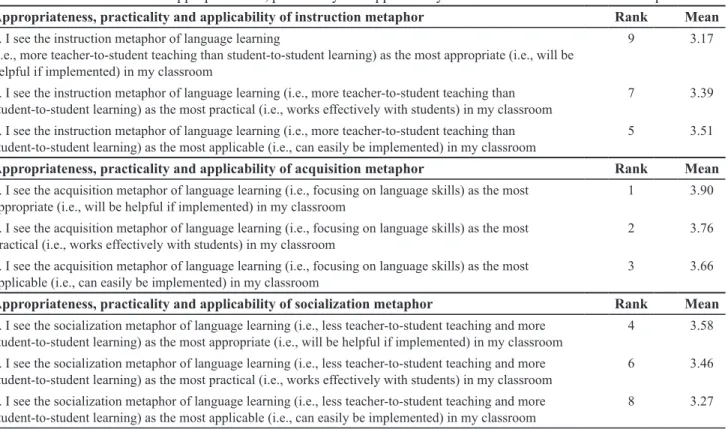
In Table 4, a comparative analysis of all three metaphors was presented to reflect the teachers’ determined applicabil -ity, appropriateness, and practicality among all three meta-phors about the Saudi EFL classrooms. In Table 4, items one to three present applicability, appropriation, and applicabil-ity for the instruction metaphor. Similarly, items four to to six present applicability, appropriateness, and practicality for the acquisition metaphor. Likewise, items seven to nine reflect applicability, appropriateness, and practicality for the instruction metaphor. The most important metaphor as re-flected by the respondents was acquisition metaphor. Items four, five and six were ranked respectively at the positions of one, two and three. It reflected that the EFL Saudi teachers fully acknowledged the applicability, appropriateness, and practicality of all the variables of acquisition metaphor. The findings of the respondents reflected that they were apply -ing all these techniques in the EFL classrooms. The research that promotes the utilization of metaphors in the EFL class-rooms assumes that the metaphors can enhance the process of language learning among the students. Due to the use of metaphors, learners draw attention to the metaphoric pro-cess of language, and can also facilitate the comprehension process. Yasuda’s (2010) experiment with Japanese students on phrasal verbs forwarded similar findings. Li (2009) also found that the intended application of metaphors in a series of experiments with 394 Chinese learners of English led to higher scores in recall post-tests in the experimental group (e.g., Li, 2009; Yasuda, 2010). Azuma (2009) also elaborates the significance of metaphor by acknowledging the recog -nition of metaphorical expressions in receiving discourse,
use of metaphorical expressions in producing discourse and understanding of the underlying concepts of metaphors in both L1 and L2. The results of the present study also reflect the moderately same results as mentioned in the above stud-ies, e.g. the second most important metaphor was socializa-tion metaphor as indicated by the respondents of the study. Item seven was ranked at fourth position and item eight was identified at number six position and similarly respondents ranked item nine at the eighth position. In this metaphor, re-spondents could not trace-out the applicability of variable nine and they ranked it at number eight to show very low applicability of this variable. It was very significant finding as it indicated that teachers were not applying interaction-al techniques related to applicability. Thus, in the metaphor of socialization, respondents did not fully authenticate the applicability, appropriateness, and practicality of the so-cialization metaphor. The third significant metaphor was an instruction metaphor as determined by the respondents of the present study. The first item was ranked at ninth posi -tion and item two were identified at number seven posi-tion and respondents identified item three at the fifth position. In this metaphor, respondents could not determine the great significance for all the variables clustered in the instruction metaphor. Likewise the applicability of variable nine of socialization metaphor and they ranked at number eight to show very low significance of this variable. It requires too much contribution on the part of the teachers to be viable: Paying attention to the learner’s individual aptitudes and provide them training that can help them apply autonomous-ly the needed knowledge to the right task. It was a pivotal finding reflected a critical issue about the teachers’ failure to properly conceive the interactional and instructional patterns
Table 4. Saudi EFL teachers’ appropriateness, practicality and applicability of the above mentioned three metaphors
Appropriateness, practicality and applicability of instruction metaphor Rank Mean
1. I see the instruction metaphor of language learning
(i.e., more teacher-to-student teaching than student-to-student learning) as the most appropriate (i.e., will be helpful if implemented) in my classroom
9 3.17
2. I see the instruction metaphor of language learning (i.e., more teacher-to-student teaching than
student-to-student learning) as the most practical (i.e., works effectively with students) in my classroom 7 3.39 3. I see the instruction metaphor of language learning (i.e., more teacher-to-student teaching than
student-to-student learning) as the most applicable (i.e., can easily be implemented) in my classroom 5 3.51
Appropriateness, practicality and applicability of acquisition metaphor Rank Mean
4. I see the acquisition metaphor of language learning (i.e., focusing on language skills) as the most
appropriate (i.e., will be helpful if implemented) in my classroom 1 3.90
5. I see the acquisition metaphor of language learning (i.e., focusing on language skills) as the most
practical (i.e., works effectively with students) in my classroom 2 3.76
6. I see the acquisition metaphor of language learning (i.e., focusing on language skills) as the most
applicable (i.e., can easily be implemented) in my classroom 3 3.66
Appropriateness, practicality and applicability of socialization metaphor Rank Mean
7. I see the socialization metaphor of language learning (i.e., less teacher-to-student teaching and more
student-to-student learning) as the most appropriate (i.e., will be helpful if implemented) in my classroom 4 3.58 8. I see the socialization metaphor of language learning (i.e., less teacher-to-student teaching and more
student-to-student learning) as the most practical (i.e., works effectively with students) in my classroom 6 3.46 9. I see the socialization metaphor of language learning (i.e., less teacher-to-student teaching and more
between teachers and students. Consequently, the improper utilization of these patterns might be the reason of of the Saudi EFL students’ poor performance in the context of the Saudi EFL classrooms. Thus, it can be claimed on the basis of the findings of the present study that the instruction met -aphor is a dreary locale with the Saudi EFL teachers. Also, there is a dire need to understand the proper improvisation of all three metaphors to boost teaching and learning dynamics in the Saudi EFL classrooms.
CONCLUSION
The present study tried to investigate the implementations of three metaphors in the Saudi EFL classrooms at the university level. The present study findings confirmed the Saudi EFL teachers’ awareness about the effectiveness of acquisition metaphor and socialization metaphor as an es-sential tool for improving the existing dynamics in the Sau-di EFL classrooms. The finSau-dings of the study also identified that a limited exposure of instructional metaphor may be one of the reasons of the poor performance of the Saudi EFL teachers. Also, teachers were not fully exposed to ac-quisition metaphor and a limited exposure of acac-quisition metaphor may also damage the dynamics of teacher student interactional and instructional patterns inside the Saudi EFL classrooms. Based on the findings of the present study, it can be implied that complete awareness of all the metaphors can be very convenient tool to improve the classroom dy-namics. Contrary to it, it is significant to highlight here that policy makers never acknowledged the fundamental role of metaphors into any policy related to classroom pedagogies. It can be said that this part despite carrying a great potential could not be recognized as a part of the classroom dynamics by our policy makers. The data based on the questionnaire provided useful insights of the Saudi EFL teachers’ opin-ions towards the dynamic use of all the metaphors in the Saudi EFL classrooms. It can be concluded that the sample group clustered by the cohort of the sample in this study recommended more professional use of all the metaphors to achieve prerequisite dynamics of the EFL classrooms. Also, they asserted that wise use of all metaphors is essential for the Saudi EFL teachers to make pedagogical changes in the classroom dynamics to accomplish more academic benefits by applying different metaphors. Due to lack of awareness about the use of instruction metaphor, teachers and master trainer should devise lesson plans based on the fitting use of instruction metaphor to coordinate teacher-student in-teractional patterns. Moreover, it was quite alarming that teachers were indecisive about the utilization of some of the variables in the Saudi EFL classrooms and it may be one of the reasons of teachers’ poor performance in the Saudi EFL classrooms. It can be concluded on the basis of the findings that the proper utilization of metaphors can help teachers to reset classroom dynamics, pedagogies and parameters to guarantee a harmonized academic atmosphere for all the Saudi students. A great number of researchers have made strong claims about the power of metaphor in almost ev-ery aspect of language education. Thus, it is significant to recognize the value of metaphor in language research and
pedagogical contexts. The results of the study have also made this point clear that metaphors in the class act as as a factor affecting intimacy, and thus, effective and selective use of this intimacy can motivate students. Teacher’s atti-tudes can create a greater influence on the students because the desirable indications of the metaphors express warmth, respect, fairness, and, conversely, the undesirable cues of the teachers communicate superiority, disinterest, and disre-spect in the students. Consequently, the appropriate use of metaphors can influence students’ moods, their perceptions, their learning and eventually can develop a perpetual effect on their learning capacities. Furthermore, teachers should be explicitly informed about the importance of different functions of these metaphors for teaching in the EFL class-rooms. Henceforth, according to the findings of the study, metaphors appeared to be functional and valuable source for the teachers to perform different functions in the classroom of the Saudi EFL students. Thus, it can be claimed that the techniques which teachers constitute need to be critically analyzed to consider their effectiveness on students’ learn-ing in the Saudi EFL classroom.
REFERENCES
AlAsmari A.A. & Gulzar, M.A. (2016). The Use of EFL Au-thentic Materials: A Gender-Line University Teachers’ Perspective. International Journal of Applied Linguis-tics & English Literature Vol. 5 No. 2; pp 128-136. Alebaikan, R. A. (2010). Perceptions of blended learning in
Saudi universities. PhD dissertation, University of Ex-eter.
Almalki, A. (2011). Blended learning in Higher Education
in Saudi Arabia: A study of Umm Al-Qura University. PhD Thesis. RMIT University, Melbourne, Australia. Azuma, M. (2009). Positive and negative effects of
moth-er-tongue knowledge on the interpretation of figurative expressions. Papers in Linguistic Science, 15, 165–192. Bell, J. (1999). Doing Your Research Project: A Guide for
First-Time Researchers in Education and Social Sci -ence. Open University Press, Philadelphia, USA. Boers, F. (2000). Enhancing metaphoric awareness in
spe-cialised reading. English for Specific Purposes, 19(2), 137–147.
Boers, F., Demecheleer, M., & Eyckmans, J. (2004). Cross-cultural variation as a variable in comprehending and remembering figurative idioms. European Journal of English Studies, 8(3), 375–388.
Brown. (1999). Collaborative action research for English language teachers. U.K: Cambridge University Press. Crystal, D. (2000). English as a Global Language.
Cam-bridge University Press, UK.
Chapelle, C. (2004). Technology and second language learn-ing: expanding methods and agendas. Systems. 32(4), 593–601.
Danesi, M. (1993). Metaphorical competence in second lan-guage acquisition and second lanlan-guage learning: The neglected dimension. In J. Alatis (Ed.), Language, com
-munication, and social meaning (pp. 489–500). Wash-ington: Georgetown University Press.
Davis, K. (2012). Ethnographic approaches to second lan-guage acquisition research. Encyclopesdia of Applied Linguistics. Hoboken, NJ: Wiley.
Deignan, A., Gabrýs, D., & Solska, A. (1997). Teaching En-glish metaphors using cross-linguistic awareness-raising activities. ELT Journal, 51(4), 352–360.
Dincay, T. (2010). A quick chronological review of the ELT methods along with their techniques and prin-ciples: choosing eclecticism from among language teaching methods. Language Magazine, (147), pp. 40-62. Accessed from dergiler.ankara.edu.tr/dergil-er/27/1603/17283.pdf.
Dubin, F. and Olshtain, E. (1981). Reading By All Means. Addison-Wesley Publishing Company Inc., Phillipines, USA.
Duff, P. A. (2010). Language socialization into academic discourse communities. Annual review of applied lin-guistics, 30, 169-192.
Ellis, R. (1997). SLA Research and Language Teaching. Ox-ford University Press, 198 Madison Avenue, New York, NY 10016-4314.
Ellis,R.(2003).Task-based language learning and teaching. Oxford: Oxford University Press.
Elyas, T., & Picard, M. (2010). Saudi Arabian educational history: Impacts on language teaching. Education,
Busi-ness, Society: Contemporary Middle Eastern Issues,
3(2), 136-145.
Gibbs, R. W. (1994). The poetics of mind: Figurative thought, language, and understanding. Cambridge Uni-versity Press.
Gozdawa-Gołębiowski, R. (2013). Basic dichotomies in for -eign language teaching and learning: a case of formulaic language. In D. Gabryś-Barker, E. Piechurska-Kuciel, & J. Zybert (Eds.) Second language learning and teaching, pp. 35-50. Cham, Switzerland: Springer
Gruba, P., &Hinkelman, D. (2012).Blending technologies
in second language classrooms. Basingstoke, England: Palgrave McMillan.
Gulzar, M.A. & Abdulrahman A.A. (2014). Effects of Print Media: A Study of Reading Skills among Uni-versity EFL Students. Research on Humanities and Social Sciences, Vol.4, No.28; pp 68-79, ISSN (Paper) 2224-5766 ISSN (Online) 2225-0484 (Online) www. iiste.org.
Guo, S. (2007). Is idiom comprehension influenced by meta -phor awareness of the learners? A case study of Chinese EFL learners. The Linguistics Journal, 3(3), 148–166. Hill, K., & McNamara, T. (2012). Developing a
compre-hensive, empirically based research framework for classroom-based assessment. Language Testing, 29(3), 395-420.
Jin, L. (2011). Second language acquisition of spatial met-aphors in English and Chinese writing: Insights from native and learner language corpora. The University of Arizona, Arizona.
Kalyuga, M., & Kalyuga, S. (2008). Metaphor awareness in teaching vocabulary. The Language Learning Journal, 36(2), 249–257.
Khan, I. A. (2011). Learning difficulties in English: Diag -nosis and pedagogy in Saudi Arabia. Educational Re-search, 2(7), 1248-1257.
Knight, C., Studdert-Kennedy, M., & Hurford, J. (Eds.). (2000). The evolutionary emergence of language: social function and the origins of linguistic form. Cambridge University Press.
Lazar, G. (1996). Using figurative language to expand stu-dents’ vocabulary. ELT journal, 50(1), 43-51.
Lakoff, G., & Johnson, M. (1980). Metaphors we live by. Chicago: The University of Chicago Press.
Larsen-Freeman, D. (2000). Second language acquisition and applied linguistics. Annual Review of Applied Lin-guistics, 20, 165-181.
Li, T. F. (2009). Metaphor, image,and image schemas in
sec-ond language pedagogy: The acquisition of metaphori
-cal expressions, idioms, and proverbs by Chinese learn -ers of English. Koln: Lambert Academic.
Littlemore, J. (2004). The misinterpretation of metaphors by international students at a British university: examples, implications, and possible remedies. Humanizing Lan -guage Learning, 6(3).
Littlemore, J., Krennmayr, T., Turner, J., & Turner, S. (2014). An investigation into metaphor use at different levels of second language writing. Applied Linguistics, 35(2), 117–144. Low, G. (2003). Validating metaphoric models in applied
linguistics. Metaphor and Symbol, 18(4), 239-254.Mo-hammed, 2011.
Picken, J. (2007). Literature, metaphor and the foreign lan -guage learner. Basingstoke: Palgrave Macmillan. Picken, J. D. (2005). Helping foreign language learners to
make sense of literature with metaphor awareness-rais-ing. Language Awareness, 14(2-3), 142–152.
Richards, J. C., & Rodgers, T. S. (2001). Communicative language teaching. Approaches and methods in lan-guage teaching, 2.
Skehan, P. (1998). A cognitive approach to language learn-ing. Oxford University Press.
Sacristán, M. S. V. (2009). A translation approach to meta-phor teaching in the LSP classroom: Sample exercises from a Business English syllabus. Ibérica, 17, 83–98. Savignon, J. S. (1986). Teaching Second Language
Read-ing for Academic Purposes. Addison-Wesley Publishing Company, Inc, USA.
Tuckner, N. R. (1986) The Integration of Media in the Cur-riculum Great Britain. Pergamon Press Ltd, UK. Yasuda, S. (2010). Learning phrasal verbs through
conceptu-al metaphors: A case of Japanese EFL learners. TESOL