Address for correspondence Dr. Nadia Sultan,
Department of Dermatology,
Rahbar Medical and Dental College/ Punjab Ranger’s Teaching Hospital, Lahore.
Original Article
Clinical patterns of psoriatic arthritis & association
with age & gender among patients presenting to a
tertiary care hospital
Introduction
PsA is a seronegative inflammatory disease of joints, enthuses and periarticular connective tissue in association with any clinical type of psoriasis.2 PsA frequently occurs with pustular
& erythrodermic variety of psoriasis.3 The original diagnostic criteria of Moll & Wright are the simplest and the most frequently used in current studies. The criteria are4:
• An inflammatory arthritis (peripheral arthritis and/or sacroiliitis or spondylitis).
• The presence of psoriasis.
• The (usual) absence of serological tests for rheumatoid factor.
Nadia Sultan, Asad Ali Chaudhry*, Ghazala Butt**, Saima Rehman#, Shahbaz Aman##, Tabinda Shoaib
Department of Dermatology, Rahbar Medical and Dental College/ Punjab Ranger’s Teaching Hospital, Lahore.
* Department of Orthopaedic Surgery, CMH Lahore Medical College. ** Department of Dermatology, Kind Edward Medical University, Lahore.
# Department of Dermatology, Saidu Medical College Swat. ## Department of Dermatology, SIMS, Lahore.
Abstract
Background Psoriasis is a common skin condition, which is known to affect about 1-2% of the world population. PsA is a known extra-cutaneous complication of psoriasis, which has variably been reported to affect 5-40%.1Objective To determine the clinical patterns of psoriatic arthritis & association with age & gender among patients of patients presenting to a tertiary care setting.
Materials and Methods A cross sectional study conducted at OPD, Unit-I, KEMU Mayo Hospital, Lahore, conducted for six months from 20th August, 2013 to 20th February, 2014. Total sixty five patients of psoriatic arthritis diagnosed according to Moll & Wright criteria were enrolled & evaluated for the pattern of arthritis & its association with age & gender. Data entry and analysis was done by using SPSS 16.
Results Among 65 cases of PsA, 44 (67.69%) M & 21 (32.31%) F, mean age 42.92±13.70 y, asymmetrical oligo-arthritis was most common pattern in 22 (33.85%). Most PsA cases were in their 2nd to 5th decade.
Conclusion Most common pattern was asymmetric oligo-arthritis. Males of late young and middle age were affected the most.
Key words
This classifies PsA as, peripheral mono-arthritis or asymmetrical oligoarthritis, distal interphalangeal arthropathy, symmetrical polyarthritis, arthritis mutilans, and axial arthritis (spine, sacroiliac joints or both). Patients may present with joint pains, morning stiffness, enthesitis, dactylitis and sausage-shaped digits.5,6 The most frequent presentation is polyarthritis followed by oligoarthritis.7 Arthropathy can occur at any age and either sex, but the incidence peaks around 40-50 years, and males are more likely to have the spondylitic form.8 The male-to-female ratio for PsA is 1:1, with the exception of some subsets of patients. Females are more commonly affected with the symmetrical polyarthritis that resembles rheumatoid arthritis & the juvenile form.5 A preponderance of males has been noted in the spondylitic form of PsA, which affects the axial spine, with the male-to-female ratio being 3:1.9 Males however show a greater tendency towards spondyloarthritis and more of the peripheral joint involvement than the females.10 The reason behind it is considered to be the difference between the physical activities among males and females11. In nearly 80% of patients, the skin disease precedes arthritis, while arthritis may precede psoriasis in about 15%. Radiological signs include local demineralization, narrowing of joint spaces, articular erosion and soft tissue swelling. In arthritis mutilans, osteolysis of heads of metacarpals & metatarsals gives pencil in cup appearance and opera-glass hand deformity. Indicators of poor prognosis are younger age at onset, extensive skin involvement, polyarticular synovitis, HIV, high ESR at presentation, large effusions and association with HLA B27, B39, and DLW3. In a study done on 104 psoriatic patients, 50 had seronegative arthritis. Out of these, 43% had symmetrical rheumatoid-like arthritis, 21% distal interphalangeal arthritis, 13% asymmetrical oligoarthritis, 13% sacroiliac
arthritis, 8% peripheral mono-arthritis and 2% arthritis mutilans.12 In another study, the frequency of symmetric arthritis was 14 (30.4%), oligoarthritis 16 (34.7%), axial disease 13 (28.2%) and classical (DIP) 3 (6.5%).3 One study conducted on 472 psoriatic patient detected arthritis in 40. Asymmetric oligoarthritis was the most commonly observed pattern in 42.5%.13
It is usually perceived that PsA is a benign disease but it has many serious sequele like mutilating digital disease and severe spondylitis. Early diagnosis of arthritis is very important in order to prevent and limit the deformities that come later in the disease. It is the job of a dermatologist to screen for joint involvement as part of the routine follow up of psoriatic patients, so that timely referral and intervention can be done which gravely affects the patient’s quality of life.
The rationale of this study was to observe the frequency of PsA in our population and identify its common presentations here, as different patterns have been observed in different studies conducted at various areas. This will help us in identifying the common presentations of psoriatic arthritis among our patients and we will be able to diagnose the disease at an early stage and refer it to the concerned speciality.
Materials and Methods
Cross sectional study at the outpatient Department of Dermatology Unit-I, KEMU/ Mayo Hospital, Lahore for Six months starting
from 20th August, 2013 till 20th February, 2014.
Table 1 Age distribution of patients n=140
Total PsA(+) Total
Male Female Male Female
N 87 53 140 44 21 65
Mean (Years) 41.09 40.79 40.97 41.34 46.23 42.92
SD 14.14 15.81 14.74 12.30 16.07 13.70
Minimum 16 17 16 16 20 16
Maximum 90 80 90 70 80 80
Figure 1 Gender distribution of total patients table 3
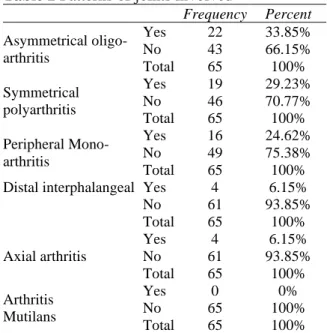
Table 2 Patterns of joints involved
Frequency Percent Asymmetrical
oligo-arthritis
Yes 22 33.85%
No 43 66.15%
Total 65 100%
Symmetrical polyarthritis
Yes 19 29.23%
No 46 70.77%
Total 65 100%
Peripheral Mono-arthritis
Yes 16 24.62%
No 49 75.38%
Total 65 100%
Distal interphalangeal Yes 4 6.15%
No 61 93.85%
Total 65 100%
Axial arthritis
Yes 4 6.15%
No 61 93.85%
Total 65 100%
Arthritis Mutilans
Yes 0 0%
No 65 100%
Total 65 100%
from study. Sampling technique was non probability purposive sampling. After taking informed consent, data was entered into the proforma & analyzed through SPSS 16.
Results
Total sixty five diagnosed patients of PsA were enrolled in the study. Mean age was, 41.34±12.30 for males, and 46.23±16.07 for
females respectively (Table 1). 44 (67.69%)
were male and 21 (32.31%) were female
(Figure 1). Various joints were affected either as a single joint, or in combination, with two or more joints affected in one patient. Observed
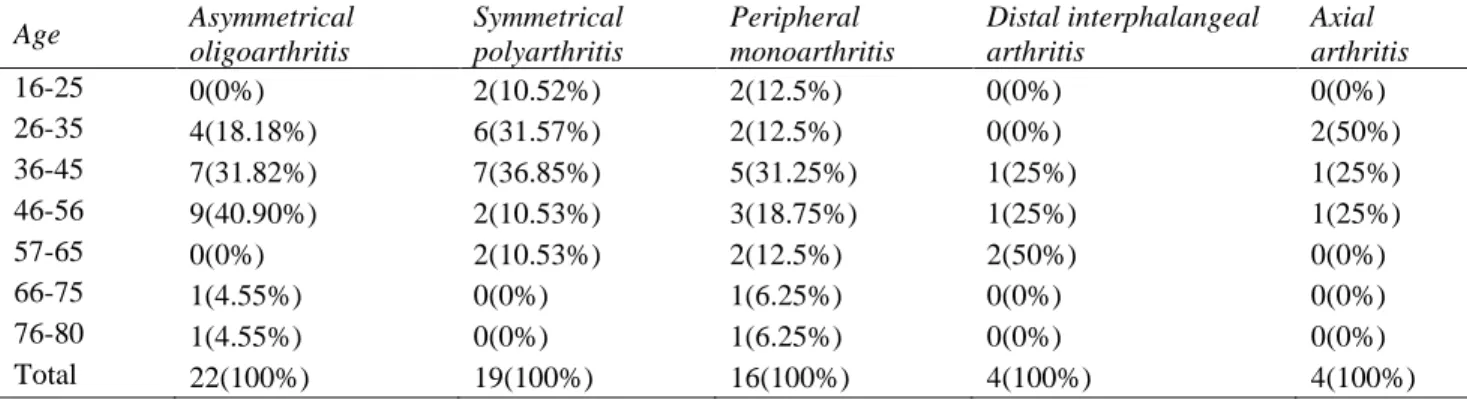
clinical patterns are tabulated in Table 2, gender
distribution in Table 3 and age stratification in
Table 4 respectively. Asymmetrical oligo-arthritis was observed in 22 (33.85%) patients out of which, 13 (59.09%) were male & 9 (40.91%) female with maximum 7 (36.85%) in the age group of 36-45 years. Symmetric polyarthritis observed among 19 (29.23%) patients, 14 (73.68%) male & 5 (26.32%) female with most 7 (36.85%) in the age group of 36-45 years. Peripheral mono-arthritis diagnosed among 16 (24.62%) patients, 10 (62.5%) male & 6 (37.5%) female & most 5 (31.25%) were between 36-45 years.
Distal interphalangeal arthritis in 4 (6.15%) patients, 3 (75%) male & 1 (25%) female, out of them 2 (50%) were in the age group of 57-65 years. Axial arthritis noted in 4 (6.15%) patients & all 4 (100%) were male .Maximum 2 (50%) in the age group of 26-35 years. .None of the patients was diagnosed with arthritis mutilans. No involvement of cervical, temporomandibular or sternomanubrial joints was seen.
Table 3 Stratification of Gender in relation to Types of Psoriatic Arthritis Gender Asymmetrical
oligoarthritis
Symmetrical polyarthritis
Peripheral monoarthritis
Distal interphalangeal arthritis
Axial arthritis
Male 13(59.09%) 14(73.68%) 10(62.5%) 3(75%) 4(100%)
Female 9(40.91%) 5(26.32%) 6(37.5%) 1(25%) 0(0%)
Total 22(100%) 19(100%) 16(100%) 4(100%) 4(100%)
Table 4 Stratification of Age in relation to Types of Psoriatic Arthritis Age Asymmetrical
oligoarthritis
Symmetrical polyarthritis
Peripheral monoarthritis
Distal interphalangeal arthritis
Axial arthritis
16-25 0(0%) 2(10.52%) 2(12.5%) 0(0%) 0(0%)
26-35 4(18.18%) 6(31.57%) 2(12.5%) 0(0%) 2(50%)
36-45 7(31.82%) 7(36.85%) 5(31.25%) 1(25%) 1(25%)
46-56 9(40.90%) 2(10.53%) 3(18.75%) 1(25%) 1(25%)
57-65 0(0%) 2(10.53%) 2(12.5%) 2(50%) 0(0%)
66-75 1(4.55%) 0(0%) 1(6.25%) 0(0%) 0(0%)
76-80 1(4.55%) 0(0%) 1(6.25%) 0(0%) 0(0%)
Total 22(100%) 19(100%) 16(100%) 4(100%) 4(100%)
changes were soft tissue swelling in the peri-articular area. There were 4 cases (6.15%) which showed narrowing of the joint space.
Discussion
The Moll and Wright criteria for diagnosis of PsA is the simplest and most frequently used for research. In the current study, asymmetrical oligo-arthritis was diagnosed in 22 (33.85%) patients, symmetric polyarthritis in 19 (29.23%) patients, peripheral mono-arthritis in 16 (24.62%) patients, distal interphalangeal arthritis in 4 (6.15%) patients and axial arthritis was diagnosed in 4 (6.15%) patients. According to the results of another local study out of 100 psoriatic patients enrolled, 46 had joint involvement. The frequency of oligoarthritis was 16 (34.7%), symmetric arthritis 14 (30.4%), axial arthritis 13 (28.2%) and classical (DIP) 3 (6.5%). These results are comparable with the results of present study, where the most common pattern was seen to be asymmetric oligo-arthritis, followed by symmetric polyarthritis. An international study conducted by Nossent in Norway also reports oligoarthritis as the most frequent subtype (48%), followed by
polyarthritis (32%).
In another study conducted in Pakistan, asymmetric oligo/mono arthritis was the commonest pattern noted (in 50%), manubriosternal joint involvement rare and cervical spondylosis and temporomandibular joint involvement unseen.15 These studies are again comparable to the current study where most commonly observed pattern is oligo-arthritis. Also the involvement of cervical & temporomandibular joints has not been seen.
A recent study from India analyzed the clinical characteristics of PsA patients attending a tertiary care center in South India. Clinical pattern of PsA patients showed that Polyarthritis (n=51, 36.2%) was the most common form noted during the study, followed by oligoarthritis (n=48, 34%).The difference in the results reported in this study compared to the current one can be attributed to the fact that the Indian study was a retrospective study, whereas, our study is cross-sectional.
Conclusion
study is 46.42%. The most common type in this study was asymmetrical oligo-arthritis. Majority cases of psoriatic arthritis were males, with their age lying in the 3rd & 4th decade & most of them developed joint involvement during the initial ten years of psoriasis onset. Among all the five patterns of arthritis in this study, maximum number of patients were males & joint disease appeared during the initial ten years of psoriasis. Therefore, according to the results of current study, it can be concluded that psoriatic arthritis mostly affects the males in their late young to middle age, & develops during the early years of psoriasis. Further studies are advised under joint supervision of dermatologists and rheumatologists for elaborate and comprehensive results on these patterns and involvement of other body joints. It is highly desired to standardize. One single diagnostic criteria & then research be done on that, so that one consensus can be made on the prevalence & the most common pattern of PsA presenting worldwide.
References
1. Cauli A, Gladman DD, Mathieu A, Olivieri I, Porru G, Tak PP, et al. Patient global assessment in psoriatic arthritis: a multicenter GRAPPA and OMERACT study. J Rheumatol 2011; 38(5): 898-903. 2. Christophers E, Barker JN, Griffiths CE,
Dauden E, Milligan G, Molta C et al. The risk of psoriatic arthritis remains constant following initial diagnosis of psoriasis among patients seen in European dermatology clinics. J Eur Acad Dermatol 2010; 24(5): 548-54.
3. Prasad P, Bikku B, Kaviarasan P, Senthilnathan A. A clinical study of psoriatic arthropathy Indian J Dermatol Venereol Leprol 2007; 73(3): 166-70. 4. Moll JM, Wright V. Psoriatic arthritis.
Semin Arthritis Rheum 1973; 3(1): 55-78.
5. Eder L, Thavaneswaran A, Chandran V, Gladman DD. Gender difference in disease expression, radiographic damage and disability among patients with psoriatic arthritis. Ann Rheum Dis 2013; 72(4): 578-82.
6. Eder L, Thavaneswaran A, Chandran V, Gladman DD. Gender difference in disease expression, radiographic damage and disability among patients with psoriatic arthritis. Ann Rheum Dis 2013; 72(4): 583-84.
7. Diagnosis and management of psoriasis and psoriatic arthritis in adults. National clinical guideline (October 2010). Retrieved from http://www.sign.ac.uk/assets/sign121.pdf. 8. Goldenstein-Schainberg C, Favarato MH,
Ranza R. Current and relevant concepts in psoriatic arthritis. Revista brasileira de reumatologia. 2012; 52(1): 98-106.
9. Nossent JC, Gran JT. Epidemiological and clinical characteristics of psoriatic arthritis in northern Norway. Scand J Rheumatol 2009;38(4):251-5.
10. Queiro R, Tejón P, Coto P, Alonso S, Alperi M, Sarasqueta C, et al. Clinical differences between men and women with psoriatic arthritis: relevance of the analysis of genes and polymorphisms in the major histocompatibility complex region and of the age at onset of psoriasis. Clin Dev Immunol 2013; 2013: 482691-.
11. Gladman DD, Brubacher B, Buskila D, Langevitz P, Farewell VT. Psoriatic spondyloarthropathy in men and women: a clinical, radiographic, and HLA study. Clinical and investigative medicine Medecine clinique et experimentale. 1992; 15(4): 371-5.
12. Battistone MJ, Manaster BJ, Reda DJ, Clegg DO. The prevalence of sacroilitis in psoriatic arthritis: new perspectives from a large, multicenter cohort. A Department of Veterans Affairs Cooperative Study. Skeletal radiology 1999; 28(4): 196-201. 13. Saeed M, Zaman T, Rashid T, Jahangir M.