Address for correspondence Dr. Siavash M. Shanehsaz,
Department of Dermatology and Venereology, Aleppo University Hospital,
Syria
E-mail: [email protected]
Original Article
Therapeutic and adverse effects of
standard-dose and low-standard-dose meglumine antimoniate
during systemic treatment of Syrian cutaneous
leishmaniasis patients
Siavash M. Shanehsaz, Silva Ishkhanian
Department of Dermatology and Venereology, Aleppo University Hospital, Syria
Abstract Objective To evaluate therapeutic and adverse effects of meglumine antimoniate (MA) during systemic treatment of Syrian cutaneous leishmaniasis (CL) patients.
Methods In this randomized study, of 70 Syrian clinically suspected CL patients referred to the Aleppo University Hospital Clinic, 60 patients with the clinical and parasitological diagnosis of CL were recruited and were randomly divided into two treatment groups of 30 subjects each. The first group was treated with 60 mg/kg/day/IM of MA (standard dose) and the second group received 30 mg/kg/day/IM of MA (low-dose). The duration of treatment was 3 weeks for both groups. The effectiveness of the treatment was classified in three levels as complete response, partial response and no response. Data were analyzed by SPSS 19 using Chi square, Mann-Whitney, Kaplan-Mayer and ANOVA tests.
ResultsThere were 38 males (63.4%) and 22 females (36.6%) among Syrian CL patients and the mean age of the patients was 25.7±12 years. At the end of the study (12 weeks), rate of complete response was (91.1%) in first group and (78.3%) in second group, respectively. The most common side effect was skin hypersensitivity and urticaria, fever, swelling without increased WBC count which was more seen in those received 60 mg/kg/day/IM MA, (40% in comparison with 23.3% in second group). Signs of stibio-intoxication were asymptomatic, cardiac toxicity ‘QT prolongation’ occurred in 8 (13.3%) patients in both groups during the third week of treatment for which finally their medication was discontinued and was switched to another group of drugs. No hepatic or renal complication was observed.
Conclusions Our results showed that complete response rate was higher (91.1%) for the group treated with standard-dose of systemic MA. Adverse effects of systemic MA were relatively frequent in our study. Skin hypersensitivity and urticaria, musculoskeletal pain, nausea and vomiting were not severe and disappeared when the treatment was stopped. Stibio-intoxication cases, cardiac toxicity (QT prolongation) were serious. Therefore, other therapies such as topical treatment or cryotherapy should be considered in any patient who develops suspicious symptoms.
Key words
Adverse effects, cutaneous leishmaniasis, meglumine antimoniate, Syria.
Introduction
Leishmaniasis is prevalent in 88 countries, affecting an estimated 12 million people with approximately 2 million new cases per year, 500,000 of which are visceral leishmaniasis (VL) and l500,000 cutaneous leishmaniasis
Sudan.1 CL has been endemic in Syria for hundreds of years.2 Common local names include ‘Aleppo boil’ and the ‘one-year boil’.
The annual number of reported CL cases is approximately 19,000. It has been documented that L. tropica subtype Mon-76,1 according to the classification ofMontpellier,is the causative parasite for the anthroponotic form of the disease in the traditional focus of Aleppo city,3 while Phlebotomus sergenti is the vector.4 After 1 to 12 week incubation period, the lesion appears as a red papule enlarging to nodule or plaque with a purple infiltrative border and central crust. Spontaneous healing occurs after 6 to 12 months, with a remaining scar.5 Although the adverse effects and inconveniences of pentavalent antimony derivatives used in the treatment of leishmaniasis for more than 7 decades are well known, these drugs remain the mainstay of systemic treatment.6 The mechanism of the drug inhibits the glucose uptake by promastigotes7 and decreases DNA, RNA and protein synthesis.8 In addition, both aerobic and anaerobic glucose oxidation are inhibited, resulting in a reduction in adenosine triphosphate (ATP) and guanosine triphosphate (GTP) production in the amastigotes.9 The reported efficacy of meglumine antimoniate (MA) in the treatment of CL varies from 2%-90% depending on dosage, duration of treatment definition of efficacy and the responsible
Leishmania spp.10 The purpose of this randomized study was to evaluate localized and systemic adverse effects of MA during systemic treatment of Syrian CL patients.
Methods
This study was a randomized, carried out in the department of Dermatology and Venereology, Aleppo University Hospital, Aleppo, Syria during the period from July 2009 to March 2010. Of 70 suspected CL patients referred to the
Aleppo University Hospital Clinic, 60 patients with the clinical and parasitological diagnosis of CL were recruited and were randomly divided into two treatment groups of 30 subjects each. The first group was treated with the standard-dose of MA (Glucantime; Aventis, France), 60 mg/kg/day/IM (intragluteal injection) and the second group received low-dose MA, 30 mg/kg/day/IM, respectively. The duration of treatment was 3 weeks for both groups. Skin biopsies were taken from the active indurated margin of the lesion under aseptic conditions. A 4-mm tissue sample was taken using a sterile biopsy punch. Parasitological confirmation, age 5 to 65 years, normal values of the liver, kidney, and pancreas function tests and EKG before treatment were inclusion criteria. Informed consent was obtained from all the cases. Contraindication to use MA, pregnant women, patients with cardiovascular problems, those under treatment with other drugs during the month prior to commencement of the study, Acute or chronic medical conditions which might interfere with the results of the laboratory tests were considered as exclusion criteria. EKG was performed on the patients before starting the treatment, during the treatment (weekly) and 1 month after stopping the treatment.
Patients selected 60 (30 patients in each
group)
Standard-dose meglumine antimoniate
(Group 1) 30 patients
Low-dose meglumine antimoniate (Group 2) 30 patients Patients excluded the
Electrocardiographic changes in P, PR, QT and QRS interval, heart rate (HR), ST depression, ST elevation, atrial and ventricular arrhythmia were recorded in the patient’s file. Normal QT interval was defined as QT interval less than 0.44 msec. Normal PR was defined as PR interval between 120 and 200 msec. Bradycardia was defined as heart rate less than 60 and tachycardia was defined as heart rate more than 100.11
All the patients visited every two weeks from the beginning of the trial up to six weeks and then at 8 and 12 weeks. The effectiveness of the treatment was classified in three levels as complete response, partial response and no response. Complete healing of the lesions was regarded as complete clinical and parasitological healing (negative direct smear). Partial healing of the lesions was regarded as decrease of the size and induration of the lesions and no response was regarded as no clinical change or progression of the lesions.
Data were analyzed by SPSS 19 using Chi square, Mann-Whitney, Kaplan-Mayer and ANOVA tests.
Results
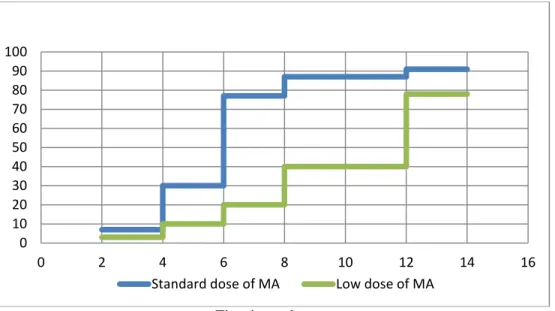
Sixty patients were enrolled in the study. There were 38 (63.4%) males and 22 (36.6%) females among Syrian (CL) patients and the mean age of the patients was 25.7±12 years. Demographic characteristic of the patients are shown in Table 1. At the end of the study (12 weeks), rate of complete response was 91.1% in first group and 78.3% in second group, respectively.
Therapeutic effects of MA and rate of its complications between the two groups are shown in Table 2. Healing rate during the course of treatment was more in the group
Table 1 Demographic characteristics of group 1 (standard dose of meglumine antimoniate) and group 2 (low dose of meglumine antimoniate).
Characteristics Group 1 n=30
Group 2 N=30 Age (years) 26.3±11.2 25.1±12.4
Males 20 (66.7%) 18 (60%)
Females 10 (33.3%) 12 (40%)
Number of lesions 3.0±1.92 4.0±1.2
Table 2 Therapeutic effects of (MA) in group 1 (standard-dose of meglumine antimoniate) and group 2 (low-dose of meglumine antimoniate).
Therapeutic effect Group 1 n=30
Group 2 N=30 Complete response 82 (91.1%) 94 (78.3%) Partial response 6 (6.7%) 24 (20%)
No response 2 (2.2%) 2 (1.7%)
Table 3 Percent cure in group 1 (standard-dose of meglumine antimoniate) and group 2 (low-dose of meglumine antimoniate) by the type and location of the lesions.
Group 1 n=30
Group 2 N=30 Type of lesion
Papule 100 64
Nodule NA 100
Plaque 90 79
Ulcer 86 75
Sporotrichoid 100 NA
Site of involvement
Face 100 100
Neck 100 80
Upper extremity 89 75
Lower extremity 83 19
Trunk 100 32
NA=Not available
Time in weeks
Figure 1Proportion of complete response in two groups during the course of treatment.
Table 4 Percent adverse effects of meglumine antimoniate (MA) between group 1 (standard-dose of MA and group 2 (low-dose of MA).
Side effects Group 1 n=30
Group 2 N=30 Complicated cases 25 (83.3%) 18 (60%) Skin hypersensitivity: 12 (40%) 7 (23.3%) Musculoskeletal pain 4 (13.3%) 4 (13.3%) Nausea and vomiting 2 (6.6%) 2 (6.6%) Inflammation of the
injection site
1 (3.3%) 1 (3.3%) Erythema nodosum 1 (3.3%) 1 (3.3%)
Others 5 (16.6%) 3 (10%)
Side Effects
In the first group (standard-dose of MA), antimony intolerance events occurred in 20 patients (13 men, 7 women) with an average age of 26 years and intoxication events were observed in five cases. The most frequent complication of antimony intolerance was skin hypersensitivity and urticaria, fever, swelling without increased WBC count, which was seen in 40% of patients, followed by musculoskeletal pain (4 cases), nausea and vomiting (2 cases), inflammation of the injection site (1 case) and erythema nodosum (1 case). Signs of intoxication were asymptomatic, cardiac toxicity
‘QT prolongation’ (5 cases) for which finally their medication was discontinued and was switched to another group of drugs. In the second group (low-dose of MA), antimony intolerance events occurred in 15 patients (10 men, 5 women) with an average age of 25 years and intoxication events were observed in three cases. The most frequent complication of antimony intolerance was skin hypersensitivity and urticaria, fever, swelling without increased WBC count, which was seen in 23.3% of patients, followed by musculoskeletal pain (4 cases), nausea and vomiting (2 cases), inflammation of the injection site (1 case) and erythema nodosum (1 case). Signs of intoxication were asymptomatic, cardiac toxicity ‘QT prolongation’ (3 cases) for which finally their medication was discontinued and was switched to another group of drugs. ST depression and inverted T was observed in 5% of the patients in both groups. In neither group, no hepatic or renal complication was seen. Percent adverse effects of MA in both groups are shown in Table 4.
0 10 20 30 40 50 60 70 80 90 100
0 2 4 6 8 10 12 14 16
Discussion
Pentavalent antimony, including sodium stibogluconate and meglumine antimoniate (MA) is used for treatment of leishmaniasis for the past 80 years. The mechanism of action of these agents is suppression of the phosphofructokinase (PFK) activity, resulting in blocked ATP production.14 Trivalent antimony components were used but they were replaced with pentavalent antimony in 1920’s because of severe renal and cardiac side effects. Additionally, the pentavalent agents reach the therapeutic serum level much earlier and are excreted in the urine 95% as pentavalent components and 5% as trivalent antimony. These agents were first introduced to treat schistosomiasis but today, they are drugs of choice for treatment of leishmaniasis, used as intralesional or intramuscular injections.12-20 At the end of 12 week randomized study, the healing rate was 91.1% and 78.3% in the ‘standard-dose of MA’ and ‘low-dose of MA’, respectively. Our results showed that the effect of standard-dose of MA was more than the other group. Two different studies have shown that low-dose of MA may be as effective as standard dose of MA while the side effects are less.21,22 In our study, the response rate was 78.3%. The WHO recommended dosage is 75 mg/kg/day of MA. It is also recommended to inject the drug in a q12h manner i.e. divided dose. The drug is recommended to be used in 10 to 15 day periods apart from each other by 10 to 15 days. For non-responding or recurring lesions, dose and length of treatment may be increased (up to 35 days). The response rate with intramuscular injection is reported to be 70% to 85% in different studies.20,23 Our response rate in the first group was 91.1% more than WHO report.
Regarding side effects, it is estimated that more than 200,000 patients are treated with
pentavalent antimony in the past 80 years,16 however, there are just two reports of death following drug administration which is not clear whether it was because of the drug side effects or the process of the disease.24 It means that these components are relatively safe agents. The most frequently seen adverse effects include nausea, vomiting, abdominal pain, diarrhea, cough, pneumonia, bleeding tendency, skin reactions (e.g., erythema and urticaria), albuminuria, convulsion, bradycardia, ECG changes such as prolonged QT interval and flat T wave, myositis and muscle pain.13,16 It should be noted that most side effects are reported in patients treated with high doses of MA for visceral leishmaniasis (kala-azar). It is also suggested that many of these effects is a sequel of the disease and not an untoward effect of the medication. There is no report of complications such as cough, pneumonia, bleeding tendency, diarrhea, albuminuria and convulsion in treating CL.
Our results were similar to the study performed in Iran26 that reported skin reactions (generalized urticaria) were major complication. It is not clear why these complications were seen more in our population. It is postulated that the preparations used in our setting may contain some allergens.
In conclusion, although many drugs are used in treatment of CL, there is no completely effective medication available, however, MA is the best available agent, which if used with recommended dosage protocol, complete response would be achieved in many cases. The most important side effect of the drug in our study was skin hypersensitivity and urticaria, which is dose-dependent and the cause was unclear. It is also concluded that complete response was seen more frequently in the first group treated with standard dose of MA compared to the second group.
Financial Support This project was funded by University of Aleppo, Aleppo, Syria. Conflict of interest: None.
References
1. Desjeux P. Leishmaniasis: current situation and new perspectives. Comp Immunol Microbiol Infect Dis. 2004;27:305-18. 2. Corrado M. Sul Bottone di Aleppo.
Stabilimento Tipografico dei Segretari Comunali, Napoli [in Italian]. 1892.
3. Belazzoug S, Pratlong F, Rioux JA. Un nouveau zymogeme de Leishmania tropica, agent du Bouton d'Alep (Syrie). Arch Inst Pasteur Alger. 1988;56:95-9.
4. Depaquit J, Ferte H, Leger N et al. ITS 2 sequences heterogeneity in Phlebotomus sergenti and Phlebotomus similis (Diptera, Psychodidae): possible consequences in their ability to transmit Leishmania tropica. Int J Parasitol. 2002;32:1123-31.
5. Hepburn NC. Cutaneous leishmaniasis. Clin Exp Dermatol. 2000;25:363-70.
6. Herwalt BL. Leishmaniasis. Lancet 1999;354:1191-9.
7. Voller A, Shaw JJ, Bryant C. The effects of two antimony drugs on the in vitro metabolism of radioactive glucose forms of Leishmania tropica. Ann Trop Med Parasitol. 1963;57:404-8.
8. Berman JD, Waddell D, Hanson BC. Biochemical mechanisms of the antileishmanial activity of sodium stibogluconate. Antimicrob Agents Chemother. 1985;27:916-20.
9. Berman JD, Wyler DJ. An in vitro model for investigation of chemotherapeutic agents in leishmaniasis. J Infect Dis. 1980;142:83-6. 10. Khatami A, Firooz A, Gorouhi F, Dowlati
Y. Treatment of acute Old World cutaneous leishmaniasis: A systematic review of the randomized controlled trials. J Am Acad Dermatol. 2007;57:335.e1-29.
11. Josephson ME, Zimetbaum P. The bradyarrhythmias: disorders of sinus node function and AV conduction disturbances. In: Kasper DL, Braunwald E, Fauci AS et al., editors. Harrison’s Principles of Internal Medicine. 16th edn. New York: McGraw Hill; 2005. P. 1333-42.
12. Conizares O, editor. Clinical Tropical Dermatology. Oxford: Blackwell Scientific Publication; 1975. P. 185-204.
13. Marintclle C. The control of leishmaniasis. Bull WHO. 1980:58:807-18.
14. Petersen EA, Neva FA, Barral A et al. Monocyte suppression of antigen specific responses in diffuse cutaneous leishmaniasis patients, Dominican republic. J Immunol. 1984;132:2603-6.
15. World Health Organization: The Leishmaniasis. Report of a WHO expert committee. WHO Technical Report Series 701, 1984.
16. Neva F, Sacks D, editors. Tropical and Geographical Medicine, 2nd edn. New York: McGraw-Hill; 1990. P. 296-307.
17. Berman JD. Human leishmaniasis: Clinical, diagnostic and therapeutic developments in the last 10 years. Clin Infect Dis. 1997;24:684-703.
19. Herwaldt BL. Leishmaniasis. Lancet. 1999;354:1191-9.
20. Weigle K, Saravia NG. Natural history, clinical evolution and the host-parasite interaction in new world cutaneous leishmaniasis. Clin Dermatol. 1996;14:433-50.
21. Oliveira-Neto MP, Schubuch A, Mattos SM et al. A low dose antimony treatment in 159 patients with American cutaneous leishmaniasis: extensive follow up studies (up to 10 years). Am J Trop Med Hyg. 1997;57:651-5.
22. Oliveira-Neto MP, Schubach A, Mattos SM et al. Treatment of American cutaneous leishmaniasis: a comparison between low dose (5 mg/kg/d) and high dosage (20
mg/kg/d) antimony regimens. Pathol Biol (Paris). 1997;45:496-9.
23. Chulay J, Auzez E, Kerch D et al. High dose sodium stibogluconate treatment of cutaneous leishmaniasis in Kenya. Trans R Soc Trop Med Hyg. 1981;77:717-21. 24. Harman PRM. Leishmaniasis. In: Rock A,
Wilkinson DS, Ebring FJO, editors. Textbook of Dermatology. Oxford: Blackwell Scientific Publications; 1979. P. 901-4.
25. Dostrovsky A, Cohen H. Treatment of late cutaneous leishmaniasis by simultaneous intralesional steroid and intramuscular antimony. Dermatol Internal. 1976;6:172-3. 26. Beheshti M, Ghotbi Sh, Amirizade S.