ISSN: 2147-611X
www.ijemst.com
Utilizing Concrete Manipulatives in
Contextually Distinct Situations to Assess
Middle School Students’ Meanings of
Force
Gokhan Ozdemir Nigde University
To cite this article:
Ozdemir, G. (2017). Utilizing concrete manipulatives in contextually distinct situations to
assess middle school students’ meanings of force.
International Journal of Education in
Mathematics,
Science
and
Technology
(IJEMST),
5(3),
187-202.
DOI:10.18404/ijemst.99659
This article may be used for research, teaching, and private study purposes.
Any substantial or systematic reproduction, redistribution, reselling, loan, sub-licensing,
systematic supply, or distribution in any form to anyone is expressly forbidden.
Authors alone are responsible for the contents of their articles. The journal owns the
copyright of the articles.
Volume 5, Number 3, 2017
DOI:10.18404/ijemst.99659
Utilizing Concrete Manipulatives in Contextually Distinct Situations to
Assess Middle School Students’ Meanings of Force
Gokhan Ozdemir
Article Info
Abstract
Article History
Received: 25 January 2016
Students’ alternative conceptions of force are one of the most studied topics, important for both science assessment and instruction. Previous studies often described students’ alternative conceptions of force with a small number of well-known frameworks by utilizing interviews and paper-pencil tests in their assessments. This study aims to explore middle school students’ meanings of force with a refined assessment tool that provides a) apparent contextually different situations, b) realistic and familiar situations, and c) presentation of the situations with concrete manipulatives in questioning. Eight 8th grade students studying in the same public school were selected for the interviews. The students’ responses to the interview questions were qualitatively analyzed and described in terms of their force meanings. The results of the study indicates that the students’ meanings of force are multiple and divergent. Seven new meanings of force that have not been captured in previous studies were determined in the students’ responses, in addition to the well-known meanings of force. The implications derived from the results of the study were discussed in terms of the potential influence of the refined assessment tool on the students’ reasoning and classroom practices for conceptual change.
Accepted: 11 April 2016
Keywords
Force Assessment Cognitive science Conceptual change Science education
Introduction
Especially over the last 30 years, a huge amount of research on student thinking and conceptual learning in science has shown that students have or develop “intuitive ideas” (McCloskey, 1983; Osborne, 1985), “misconceptions” (Clement, 1982), “alternative frameworks” (Driver & Easley, 1978; Driver, 1981; Watts, 1983), and “phenomenological primitives” (diSessa, 1988, 1993). A theory of science learning views learning as a change in existing beliefs and/or ideas, or as a major shift in students’ understanding of science concepts (Posner, Strike, Hewson, & Gertzog, 1982). Therefore, determining students’ understanding on various science concepts has naturally been of interest to the researchers.
The force concept is one of the most important and the richest concepts in Physics. Almost all curricula in Physics classes from K-12 to university level require the full understanding of this fundamental concept in order to comprehend advance concepts like kinematics or momentum. There has been quite a lot of research related to students’ thinking and understanding concerning force concepts in conceptual change literature. The outcomes of this research have shown that force concept is not well understood by the majority of students (Clement, 1982; Halloun & Hestenes, 1985; McDermott, 1984; Minstrell, 1982; Terry, Jones, & Hurford, 1985; Watts, 1983). More importantly, students’ knowledge structures about force concept have been explained with few alternative frameworks. However, recent studies have criticized previous research in terms of data collection tools and assessment format (diSessa, Gillespie, & Esterly, 2004). The major criticism is that researchers investigate students’ force conceptions with paper-pencil tests and drawings in similar imaginary contexts for students, and these result in interpreting students’ force knowledge structures with stereotype alternative frameworks (diSessa et al., 2004). Therefore, if we want to know more about students’ force meanings, we might need to assess their understanding in different, but realistic and familiar situations, by using concrete materials. Identifying students’ force meanings by using realistic situations will provide important implications for classroom practices and curriculum development.
(Clark & Linn, 2013). Also, if we consider students’ daily experiences and present them with familiar situations during questioning, we might gain more information about students’ interpretation of force. In this study, it is expected that the students will demonstrate some different forms of force meanings that cannot be matched with the common alternative frameworks documented previously in the literature. In this section, a review of the common alternative frameworks of force is firstly presented in light of the most cited research. Then, the assessment preference that motivated the current study and the purposes are discussed.
Review of the Literature for Well-Known Alternative Frameworks of Force Concept
The most frequent alternative conception held by students is that motion requires continuous force (Clement, 1982; diSessa et al., 2004; Enderstein & Spargo, 1996; Halloun & Hestenes, 1985; Ioannides & Vosniadou, 2002; Watts, 1983). This alternative concept is also known as “impetus theory” which was originally proposed by Buridan in the 14th century. According to impetus theory, a continuous force has to be exerted in order to keep an object in motion and as the “impetus”-exhausted object slows down. For example, a group of engineering students were asked to draw a free body diagram for a coin tossed straight up into the air by Clement (1982). Results reported that 88% of the engineering students gave incorrect responses, with most thinking that force from the hand at the beginning continuously pushes the coin upwards.
The second common alternative framework reported in the literature is “the greater mass exerts/implies greater force”, also known as the “dominance principle”. According to this principle, a heavier object exerts greater force on a lighter object in an interaction because it “overcomes” the lighter object’s opposition (Gunstone & Watts, 1985; Halloun & Hestenes, 1985).
The third most frequent response reported by researchers are a) “if the object is not moving, there is no force acting upon it”, or b) “gravity is the only force for objects at rest” (Driver, 1983; Gilbert & Watts, 1983; Jimoyiannis & Komis, 2003; Minstrell, 1982; Salyachivin, Schoenherr, & Shankar, 1985; Terry et al., 1985; Viennot, 1979; Watts, 1982). For example, Terry et al. (1985) conducted a study to investigate children’s understanding about the forces and equilibrium in the static case as function of amount of instruction. There were three groups of school students from Wales in the sample for the research. The results of the study indicated that a significant number of the students explained neither the static equilibrium, nor the force acting on the object properly.
The fourth most frequent response stated as students’ alternative conception is “if an object is moving, there should be force acting upon it in the same direction of motion”. Several studies found that students commonly assume there is force exerted in the direction of motion (Clement, 1982; Gardner, 1984; Gunstone, 1984; Gunstone & White, 1981; Osborne & Freyberg, 1985; Viennot, 1979; Watts & Zylbersztajn, 1981). For example, Clement (1982) worked with engineering students in an introductory mechanics course and investigated their “typical incorrect explanations” in different cases. For the pendulum case, Clement reported that most of the engineering students thought there should be a third force that makes the pendulum move upwards, in addition to the tension of the rod and gravity.
The fifth most common alternative conception stated “there must be an increasing force to accelerate the objects horizontally” (Gunstone, 1984; Gunstone & Watts, 1985; Halloun & Hestenes, 1985; Twigger et al., 1994; Watts, 1983; Watts & Zylbersztajn, 1981). For instance, research was conducted by Twigger et al. (1994) to find secondary school students’ (aged 10-15 years) prior conceptions about horizontal and vertical motion, and to explore the age dependency of the students’ prior conceptions. Interviews were conducted with 36 students; all of whom assumed they had to increase the applied force in order to increase the object’s horizontal speed.
Many researches also reported that students consider air pressure as either a force or a source of force (Hestenes, Wells, & Swackhamer, 1992; Minstrell, 1982; Sere, 1985; Smith & Ford, 1996). Minstrell (1982) found that approximately 15% of high school physics students assumed gravity was as a result of air pressure. Also, Smith and Ford (1996) reported that some students think that air only exerts pressure in one direction and that it is usually downward.
consider inanimate objects have force when they are in motion, however this force dissipates when the inanimate objects are not moving.
All the main alternative frameworks and meanings about force, as previously explained, were also found in the study by Ioannides and Vosniadou’s (2002). They conducted a cross-age study with 105 students and noted all of the above alternative frameworks in addition to a couple of mix of these frameworks. In their study, students’ alternative frameworks were explained by seven force meanings, the internal, internal/movement,
internal/acquired, push-pull, acquired, acquired/push-pull, gravity and other force meanings. Similar alternative force meanings have been found in cross-cultural and non-western studies across ages (Bar, Zinn, Goldmuntz, & Sneider, 1994; Enderstein & Spargo, 1996; Palmer, 2001; Ruggiero, Cartelli, Duprè, & Vicentini-Missoni, 1985; Salyachivin et al., 1985; Twigger et al., 1994).
In summary, researchers in different countries have investigated students’ alternative conceptions on force. Overall, the findings of those studies consistently stated the well-known alternative conceptions of students on force, even where researchers worked with different age groups and by using questionnaires focusing on different aspects of force. The consistent findings of cross-cultural and non-western studies with other studies also imply that well-known alternative meanings of force are independent from cultural and linguistic differences.
Assessment Preference
The type of assessment used varies by purpose, as each measures a different dimension of knowledge (Becker & Johnston, 1999). In the conceptual change literature, interviews (e.g., Clark, D’Angelo, & Schleigh, 2011; diSessa et al., 2004; McCloskey, 1983) and multiple choice tests (e.g., Halloun & Hestenes, 1985; Steif & Hansen, 2013) are widely employed as data collection tools in order to assess students’ understandings on science concepts. Although potential interviewer influence on the responses of interviewees cannot be disregarded (Schleigh, Clark, & Menekse, 2015), interviews provide richer and deeper data for students’ hidden alternative conceptions and structures, when compared to multiple choice tests (Nehm & Ha, 2011; Schneps, Sadler, Woll, & Crouse, 1989). There is a consensus that interview formats are more useful to uncover students’ alternative conceptions, even though the data collection and subsequent analysis of these data may require a great deal of time.
In conceptual change literature, interviews are sometimes performed with drawings and/or pictures in questioning to help students better visualize the context (e.g., Clark et al., 2011; Ioannides & Vosniadou, 2002). Utilizing visual components in interview questions helps students to talk about and compare the situations (e.g., Ioannides & Vosniadou, 2002; Schleigh et al., 2015). In turn, researchers obtain deeper information about students’ conceptual ecologies, their knowledge structures, and alternative meanings. To increase the depth of information about students’ conceptualization of force, three dimensional concrete manipulatives that are effectively used in conceptual development in science instruction and assessment, have important potential instead of two-dimensional visual manipulatives (e.g., Howe & Durr, 1982; Olympiou & Zacharia, 2012). The concrete manipulatives used in this study are developmentally appropriate, hands-on, real physical materials like coin, marble, and spring. It is expected that the manipulatives decrease the students’ cognitive load and help them focus on the properties of the situations or the problem (Sweller, 1988).
Another concern regarding assessment is the effect of context-related differences on students’ conceptualization of force. Utilizing similar situations in questions prevents researchers from uncovering the knowledge elements in students’ conceptual ecologies (diSessa et al., 2004). According to the knowledge in pieces perspective (diSessa, 1988, 1993), students’ knowledge pieces are loosely attached to their conceptual structures. Which knowledge pieces are primarily activated rely upon the properties of the context (Clark & Linn, 2013). For example, even the color of an object may change kindergarten students’ responses (diSessa et al., 2004). Because students’ interpretations of a concept are context-sensitive, deep-seated conceptual meanings can be extracted by increasing context-related differences.
Purposes of the Study
Force is rich and one of the most studied concepts in which students’ alternative ideas and meanings have been established through a limited number of well-known frameworks. Regarding criticism of certain aspects of the methodologies of the previous most-cited studies, this research study aims to explore middle school students’ meanings of force by means of applying a refined assessment tool. The tool provides us with a) apparent context-related differences, b) realistic and familiar situations, and c) presentations of the situations with concrete materials. In terms of questioning, comparison and “why” questions are employed in order to obtain richer information about the students’ meanings of force (Ioannides & Vosniadou, 2002). With this assessment tool, it is hypothesized that the middle school students will demonstrate context-dependent new force meanings, besides the well-known alternative force meanings, because of the potential influence of the refined assessment tool on the students’ reasoning. This study will therefore document the students’ meanings of force, and test the potential effects of the assessment tool on the students’ meanings of force.
Method
Participants
Eight middle school students volunteered to participate in this study. All of the students were studying at the same public school, located in a mid-size city in central Turkey. Four male and four female students, aged 12-13 years old, were selected for the interviews. After contacting their science teachers, the most talkative students, regardless of academic achievement levels, were selected in order to obtain the richest pool of data.
Instrument
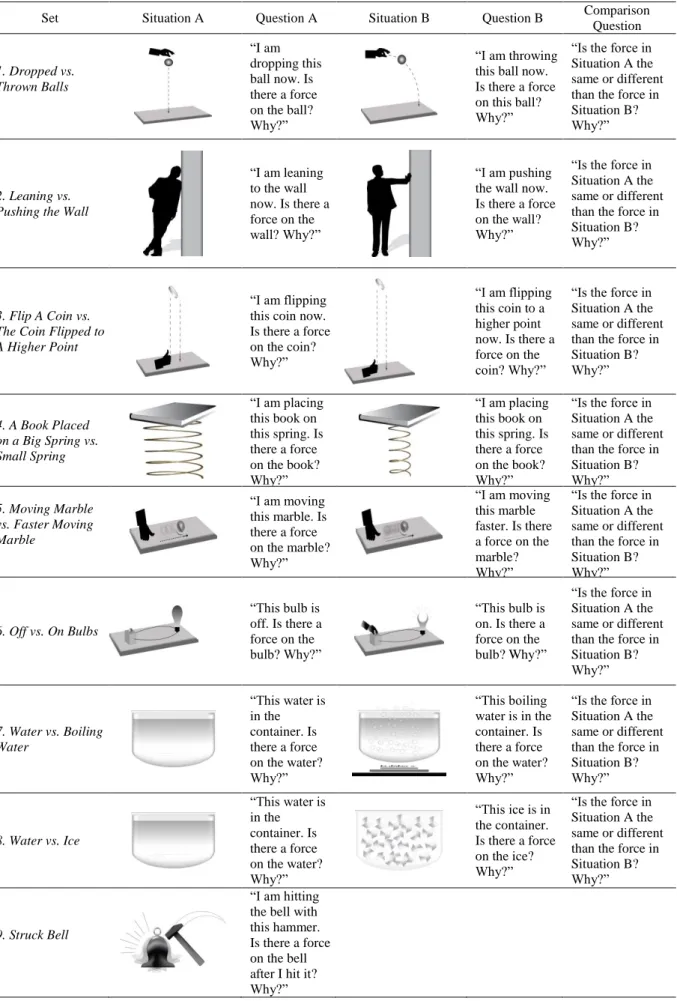
Students were asked nine sets of questions, as presented in Table 1. The situations in the first eight sets were developed by the researcher although the question structures were adopted from those of Ioannides and Vosniadou (2002). The first five sets of questions were previously used in another study (Özdemir, 2007). The question sets were derived from three different broad domains which are mechanics, electricity, and thermodynamics to check students’ reasoning. The questions sets 1, 2, 3, 4, 5, and 9 are about mechanics. The question set 6 is about electricity. The question sets 7 and 8 are about thermodynamics. Each question set consisted of two simple (Yes/No) questions and one comparison question. The ninth question, Struck Bell, which was developed by diSessa et al. (2004), comprises one simple question but no comparison question. Both simple and comparison questions are followed by “why” questions so as to better understand students’ reasoning in their responses.
In each set, the researcher demonstrated the first situation to the students using real materials. Students were then asked if there is a force on the demonstrated object in the first situation. After demonstrating the second situation to the students with real materials, students were again asked if there is a force on the object (in the second situation). Finally, where a student identified forces in both situations, the student was asked to compare the types and magnitudes of the forces in the two situations. The comparison questions, where applicable, were very informative as a means to understand the effects of contextually-related differences on students’ thoughts about force.
Procedures and Coding Criteria
Table 1. The nine sets
Set Situation A Question A Situation B Question B Comparison Question
1. Dropped vs. Thrown Balls
“I am dropping this ball now. Is there a force on the ball? Why?”
“I am throwing this ball now. Is there a force on this ball? Why?”
“Is the force in Situation A the same or different than the force in Situation B? Why?”
2. Leaning vs. Pushing the Wall
“I am leaning to the wall now. Is there a force on the wall? Why?”
“I am pushing the wall now. Is there a force on the wall? Why?”
“Is the force in Situation A the same or different than the force in Situation B? Why?”
3. Flip A Coin vs. The Coin Flipped to A Higher Point
“I am flipping this coin now. Is there a force on the coin? Why?”
“I am flipping this coin to a higher point now. Is there a force on the coin? Why?”
“Is the force in Situation A the same or different than the force in Situation B? Why?”
4.A Book Placed on a Big Spring vs. Small Spring
“I am placing this book on this spring. Is there a force on the book? Why?”
“I am placing this book on this spring. Is there a force on the book? Why?”
“Is the force in Situation A the same or different than the force in Situation B? Why?”
5. Moving Marble vs. Faster Moving Marble
“I am moving this marble. Is there a force on the marble? Why?”
“I am moving this marble faster. Is there a force on the marble? Why?”
“Is the force in Situation A the same or different than the force in Situation B? Why?”
6. Off vs. On Bulbs
“This bulb is off. Is there a force on the bulb? Why?”
“This bulb is on. Is there a force on the bulb? Why?”
“Is the force in Situation A the same or different than the force in Situation B? Why?”
7. Water vs. Boiling Water
“This water is in the container. Is there a force on the water? Why?”
“This boiling water is in the container. Is there a force on the water? Why?”
“Is the force in Situation A the same or different than the force in Situation B? Why?”
8. Water vs. Ice
“This water is in the container. Is there a force on the water? Why?”
“This ice is in the container. Is there a force on the ice? Why?”
“Is the force in Situation A the same or different than the force in Situation B? Why?”
9. Struck Bell
Where a student’s response indicated more than one force meaning for any question set, then the student’s force meanings were coded for multiple meanings of force, as indicated by the student. Lastly, if a student’ responses could not be coded to any of the five meanings of force, or his responses indicated an additional force meaning beyond the five meanings of force listed in Table 2, then a new meaning of force was established.
Table 2. Criteria for the well-known force meanings adopted from Ioannides and Vosniadou (2002)
1. Internal force. Students assigned a force on both situations or only on big/heavy ones because of their weight, heaviness, and big sizes.
2. Acquired. Students thought that force is a feature of the objects that makes them move and may act on other objects. Also, the students thought that force cannot be assigned on stationary situations because of lack of movement or disappeared force on stopped objects.
3. Force of push-pull. Students assigned a force on objects being pushed by an agent regardless of movement or stability.
4. Force of gravity. Students indicated gravity.
5. Force from the air. Students indicated pressure, air push or frictional force from the air.
Two coders, who have experience with cognitive studies in science education, independently coded the interview transcripts. Responses of each student were coded across the question sets for the force meanings. Because there were 8 students and 9 question sets, a total number of 72 data cells were obtained. The two coding results were then compared. The data cell consistency between the coders was calculated as 94%. A few discrepancies between the coders in terms of the assigned categories to responses were resolved mutually through discussion.
Results and Discussion
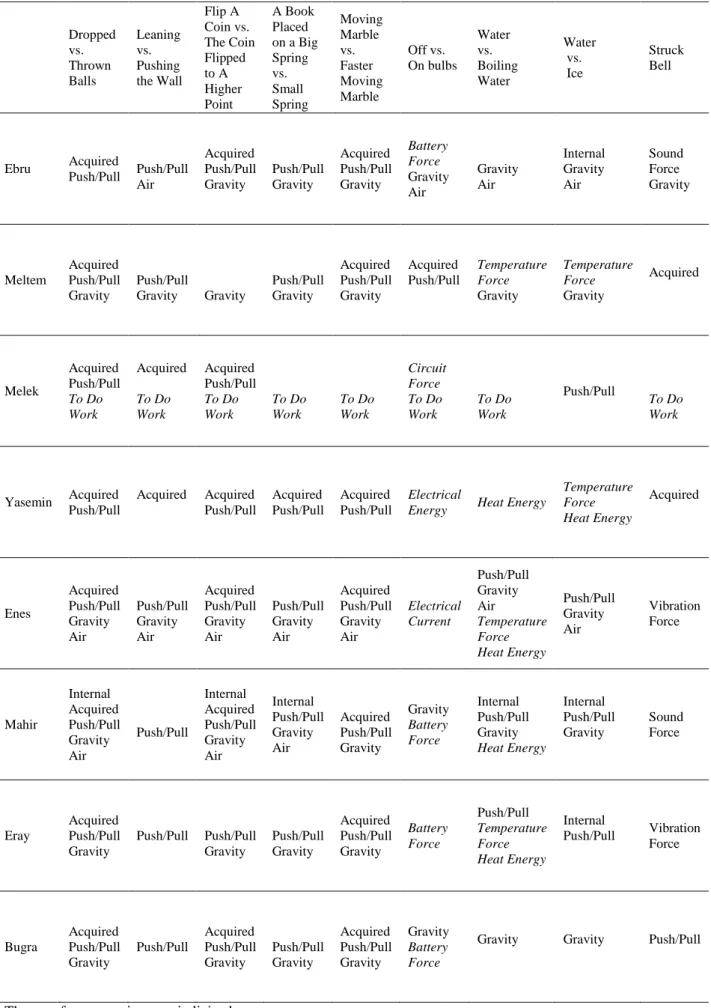
Table 3 presents the middle school students’ meanings of force across question sets. Two important results can be seen in Table 3. Firstly, students demonstrated multiple force meanings for most of the question sets. Secondly, contextual differences led to the students thinking of meanings of force outside of the expected five meanings, especially for the last four question sets. In this section, while students’ meanings of force will be presented for each question set, it will also be discussed how contextual differences can shift students’ reasoning about the meanings of force across question sets.
Dropped vs. Thrown Balls
For the first question set, all students expressed more than one force meaning. Mahir assigned five different force meanings to the situations, and Enes assigned four different force meanings. Then, while Meltem, Eray, and Bugra explained the situations with three different force meanings, Ebru, Melek, and Yasemin assigned only the acquired and push/pull force meanings.
The apparent pattern is that all students consistently explained the situations with the push/pull and acquired
force meanings. For the acquired force meaning, while half of the students assigned acquired force meaning to the thrown ball situation only, the other half explained both situations with the acquired force meaning. However, the responses of all the students included the push/pull force meaning to explain the movement. Overall, students assigned greater force to the thrown ball because they thought that it was pushed by the agent with a greater force. It is important to note that three of the eight students did not mention about the force of
gravity at all. This might be because these three students, Ebru, Melek, and Yasemin, focused on the pushing, which was an apparent property of the situation, and ignored gravitational force.
Table 3. Students’ force meanings across question sets
The new force meanings are italicized.
Dropped vs. Thrown Balls Leaning vs. Pushing the Wall Flip A Coin vs. The Coin Flipped to A Higher Point A Book Placed on a Big Spring vs. Small Spring Moving Marble vs. Faster Moving Marble Off vs. On bulbs Water vs. Boiling Water Water vs. Ice Struck Bell
Ebru Acquired
Push/Pull Push/Pull Air Acquired Push/Pull Gravity Push/Pull Gravity Acquired Push/Pull Gravity Battery Force Gravity Air Gravity Air Internal Gravity Air Sound Force Gravity Meltem Acquired Push/Pull Gravity Push/Pull
Gravity Gravity
Push/Pull Gravity Acquired Push/Pull Gravity Acquired Push/Pull Temperature Force Gravity Temperature Force Gravity Acquired Melek Acquired Push/Pull To Do Work Acquired To Do Work Acquired Push/Pull To Do Work To Do Work To Do Work Circuit Force To Do Work To Do Work Push/Pull To Do Work
Yasemin Acquired Push/Pull
Acquired Acquired Push/Pull Acquired Push/Pull Acquired Push/Pull Electrical
Energy Heat Energy
Temperature Force Heat Energy Acquired Enes Acquired Push/Pull Gravity Air Push/Pull Gravity Air Acquired Push/Pull Gravity Air Push/Pull Gravity Air Acquired Push/Pull Gravity Air Electrical Current Push/Pull Gravity Air Temperature Force Heat Energy Push/Pull Gravity Air Vibration Force Mahir Internal Acquired Push/Pull Gravity Air Push/Pull Internal Acquired Push/Pull Gravity Air Internal Push/Pull Gravity Air Acquired Push/Pull Gravity Gravity Battery Force Internal Push/Pull Gravity Heat Energy Internal Push/Pull Gravity Sound Force Eray Acquired Push/Pull Gravity
Push/Pull Push/Pull Gravity Push/Pull Gravity Acquired Push/Pull Gravity Battery Force Push/Pull Temperature Force Heat Energy Internal
Push/Pull Vibration Force Bugra Acquired Push/Pull Gravity Push/Pull Acquired Push/Pull Gravity Push/Pull Gravity Acquired Push/Pull Gravity Gravity Battery Force
He thought that “the air pressure on the balls make them fall faster”. For both situations, Melek came up with an interesting explanation that was coded as to do work. She thought that there was a force on the ball because I was doing a work to move the balls. The transcript excerpts, which were taken from the Dropped Balls situation, indicated that Melek assigned a force to the ball because it was moved from one point to another to do work.
I: I am dropping this ball now. Is there a force on this ball?
M: Yes, there is a force on this because you take the ball and throw it. That means you exert a force on the ball.
I: Actually, I do not throw the ball. It is falling. I am only dropping it [by demonstrating the situation again]
M: Force is exerted –pause for thinking– Yes, it is exerted because you do a work. That means you drop the ball from that point and it falls.
In summary, although the students responses were dominated by the acquired and push/pull force meanings, five students’ interpretations included more than these two force meanings. The force from the air that was interpreted as pressure by two students, and the force meaning to do work because of the action of the interviewer, was an unusual conceptualization of force for the first question set.
Leaning vs. Pushing the Wall
For the first question set, Enes demonstrated three different force meanings. Ebru, Meltem, Melek, and Mahir demonstrated two different force meanings, and the other three students, Yasemin, Eray, and Bugra, explained the situations with a single force meaning.
Akin to the first question set, six of the eight students’ explanations included the push/pull force meaning, but contrary to the first question set, only two students’ explanations were interpreted as the acquired force meaning due to a lack of movement. In addition, only two students talked about theforce of gravity meaning. None of the students assigned the internal force meaning to the situations. The other force meanings and interpretations are briefly summarized below.
Ebru and Enes believed that there was an air pressure on the walls, coded as a force from the air meaning. For the push/pull force meaning, Ebru and Enes came up with a different push/pull force meaning compared to that of their peers. These two students assigned greater force to the pushing situation because they thought that the surface area of the hand was smaller than the part of the arm touching the wall. In their understanding, the smaller the surface area pushing/leaning, the greater pressure exerted to the wall. On the other hand, for Mahir,
pressure and pushing from the agent were regarded as two different forces exerted on the walls. For the leaning situation, he stated:
M: I said two forces. One is pressure. The other one is pushing. For example, if a kid leans to the wall, the pressure will not be the same because the kid has less weight. Your pressure will be more. I also said pushing as a force because you are leaning to the wall.
The differences of agent in the situations resulted in different interpretations of force for Meltem. She stated that “force on the wall is greater in the leaning situation because you exert a greater force with your body to the wall. We give a smaller weight with our hands. There is a relationship between weight and force”. Lastly, as in the first question set, Melek interpreted the situation with the force meaning to do work, by saying that “you are not doing work then there is no force on the wall”.
In summary, although six of the eight students’ interpretations were coded as the push/pull force meaning, their explanations for this meaning demonstrated variations. Overall, students demonstrated multiple force meanings with different explanations. It is worth noting that while seven of the eight students assigned the force of gravity
Flip a Coin vs. the Coin Flipped to a Higher Point
For the third question set, all students’ responses, except those of Meltem, included more than one force meaning. Meltem’s response was the only normative explanation. She stated that the only force on the coins was gravity after they were thrown. However, similar to the first question set, students tended to explain the situations with the acquired, push/pull, and gravity force meanings. This similar pattern can be interpreted with the similarities of the two sets where objects were thrown by a human agent and fell downwards in both sets. Seven of the eight students stated that force was greater on the coin in the second situation because a greater force was exerted in order to flip it to a higher point. In addition to these patterns, the force from the air
meaning was observed two times, whereas the internal force meaning was observed only once. Finally, to do work meaning, as explained previously, was demonstrated by Melek. The most distinct force meaning was demonstrated by Bugra to explain why theforce of gravity is less on the coin flipped to the higher point in the air.
I: Okay. Is the force in Situation A [Flip a Coin] the same or different than the force in Situation B [the Coin Flipped to a Higher Point]?
B: You apply a greater push to the coin going a higher point. Also, gravity pulls it more. That is why. I: Why does gravity pull it more?
B: Sorry, gravity pulls it less because its weight receives more downward velocity. Also, gravity pulls it down more easily.
I: Do you mean the force on this coin is less [showing situation B again]?
B: On the coin reaching the higher point, it has a big pushing force, but a small gravity force. On the other coin, there is a big gravity force, but a small pushing force.
I: I got it. Okay, can you say something about the magnitude of the total force on the coins? Which one has the greater force?
B: It is bigger on the coin flipped to the higher point.
The context-related differences in this set affected Bugra’s conceptualization of gravitational force that depends on the differences in the velocity. Bugra assigned greater gravitational force to the coin flipped to the higher point because it fell down with a greater velocity.
In summary, students’ explanations included multiple force meanings with extraordinary explanations in this question set. Contextual similarities between the first set and this set resulted in observation of a similar meaning pattern between the students.
A Book Placed on a Big Spring vs. Small Spring
In the fourth question set, seven of the eight students demonstrated more than one force meaning. While the
internal, acquired, force from the air and to do work force meanings were rarely observed in students’ responses, the push/pull and gravity force meanings were noted seven and six times receptively, but with different interpretations.
Ebru, Meltem, and Mahir expressed the push/pull and gravity force meanings by assigning equal forces to the situations. They normatively thought that the differences in the width of the springs did not affect the magnitude of the force on the book. However, it should be noted that the same students assigned greater pushing force to the pushing wall situation in the comparison to the leaning man situation in the second question set. It is evident that the students’ reasoning changed when the agent was changed. On the other hand, Bugra assigned equal forces to the books, as he showed the same reasoning in the second set. Enes and Eray reasoned completely differently than their peers, as even their explanations included the push/pull and gravity force meanings. They believed that the push forces from the spring and gravity were greater on the book placed on the big spring, because the flexibility of this spring was higher than that of the small spring. In his conceptualization, this higher degree of flexibility required greater forces on the book in order to keep it on top of the big spring.
perceived lack of movement. In addition to these meanings, Enes and Mahir demonstrated theforce from the air
meaning. Also, Mahir’s explanations included the internal force meanings.
In summary, although the push/pull and gravity forces were common meanings stated in students’ explanations for this set, the internal, acquired, force from the air and to do work force meanings were also observed. Students’ causal explanations were divergent and included multiple force meanings.
Moving Marble vs. Faster Moving Marble
In the fifth question set, seven of the eight students were pretty consistent in assigning the same acquired and
push/pull force meanings to the marbles. They thought that the force was greater on the faster moving marble, because this marble travelled a longer distance on the desk and moved faster. While these students explained the movement with the acquired and push/pull force meanings, six of the students’ responses demonstrated the
gravity force meaning as well. In addition to these meanings, Enes assigned theforce from the air meaning to the marbles.
Melek was the only student who applied a totally different force meaning to interpret the situations. She believed that the agent did not perform any work while the marbles were moving, and therefore, there was no force on the moving marbles. This was assigned to the to do work meaning category, as she knew that there was a force exerted at the first touch in order to make the marbles move. Interestingly, she never mentioned about theforce of gravity in any of the sets.
In summary, students mostly interpreted the situation with the acquired, push/pull, and gravity force meanings in the fifth question set. The force meaning pattern observed in this set was very similar to the first and third sets. This was most probably due to contextual similarities of these three sets, where objects were moved by an agent.
Off vs. On Bulbs
In this set, all of the students but one demonstrated new force meanings which were related to apparent properties of the Off vs. On Bulbs situation. Ebru, Mahir, Eray, and Bugra came up with a new force meaning, the battery force. Similarly, Yasemin’s explanations were coded as the force of electrical energy. Enes’s
explanations were coded as the force of electrical current. Melek’s explanations were coded as the circuit force,
in addition to the todo work force meaning, as she consistently demonstrated in all the previous situations. Only Meltem did not demonstrate a new force meaning. Her explanations indicated the acquired and push/pull force meanings. In addition to these meanings, the force of gravity meaning was observed only three times between the students. Samples from the transcript indicating the new force meanings are presented below for Mahir, Yasemin, Enes, and Melek respectively.
Battery Force
M: The force exerted on the bulb is in atoms only. I mean the battery exerts something. I: What is this force?
M: The battery exerts force on the bulb.
Electrical Energy
Y: Electrical energy exerts force on the bulb here. Electrical energy is coming from here to here [pointing at the battery and bulb respectively] and that makes it light up.
Electrical Current
Circuit Force
M: I do not know exactly. Maybe, there is a circuit inside the bulb. Maybe a force from the circuit is applied. There is a force this time because there is a circuit in the lit bulb. If we take into account the inside of the bulb, there is a force.
I: What is this force?
M: It is a force from the circuit to light the bulb.
In summary, the students were demonstrated pushing, falling, throwing, dropping and stationary situations by this set. As a result, students’ responses most frequently included the push/pull, acquired, and gravity force meanings, besides the internal force meaning that was rarely observed. However, when we changed the properties of the context dramatically, students’ interpretation of force radically changed and demonstrated different force meanings, depending on the apparent properties of the situations.
Water vs. Boiling Water
Similar to the previous set, students applied new force meanings by taking the apparent properties of the situations into consideration. Yasemin, Enes, Mahir, and Eray indicated a new force meaning, coded as the force of heat energy. Then, Meltem, Enes, and Eray demonstrated another new force meaning coded as the
temperature force. While Melek’s explanations indicated the to do work force meaning again, the gravity,
push/pull,force from the air, and internal forcemeanings were also observed in the students’ interpretations. Samples from the transcript about the newly explored force meanings are presented below for Yasemin, and Meltem respectively.
Heat Energy
I: This water is in the container. Is there a force on the water? Y: No.
I: Why?
Y: Because there is no effect placed on the water. It is just standing there.
I: I understand. But this is boiling water in the container. Is there a force on the water?
Y: I think there is. Because heat energy is exerted on the water to make it boil. That’s why there is [a force].
I: How about the first one [pointing to the water situation]? Y: No force.
I: Why?
Y: Because no energy is exerted on it [water], that’s why.
Temperature Force
I: This boiling water is in the container. Is there a force on the water?
M: There is force because of the temperature. Temperature exerts a force on it. I said before that force moves and changes the objects; something like that. It is the same thing here. Let’s say temperature changes the water when we heat it; I mean there is a force applied by temperature.
I: What is this force? M: It is temperature force.
In summary, the boiling situation was the most distinct feature of this set. Therefore, six of the eight students generated two new meanings of force, the force of heat energy and the temperature force.Again, the students’ interpretation of force changed when the context-related factors changed.
Water vs. Ice
force of heat energy and the temperature forcemeanings. The other students’ explanations did not indicate these two, or any other new meanings beyond the expected meanings of force detected before. Here are the transcript segments of Meltem and Yasemin again indicate the force of heat energy andthe temperature force meanings.
Temperature Force
I: This water is in the container. Is there a force on the water?
M: There is a force on the water of the room temperature. There is also a force of gravity and a force of room temperature.
I: Okay. This ice is in the container. Is there a force on the ice?
I: There is a certain amount of force in the room temperature that causes ice to melt over time. If we kept the ice in a cold place, it wouldn’t melt. However, if we keep it at room temperature, the room temperature causes the ice to melt. There is a force in the room temperature.
I: Is the force in Situation A the same or different than the force in Situation B?
M: They are different because the exerted force of room temperature to melt the ice should be more than on just the water. Here [Situation A], the water is not boiling or anything else. It is just standing. Therefore, the room temperature doesn’t affect it so.
I: You say that the force exerted on this is the force of room temperature? M: Yes.
Heat Energy / Temperature Force
I: This water is in the container. Is there a force on the water? Y: No.
I: Why?
Y: No energy is exerted on it; that’s why.
I: Okay. This ice is in the container. Is there a force on the ice?
Y: Certainly, ice is colder than the container where the ice is and the heat of the container is higher than the heat of ice. Normal room temperature melts the ice by applying a force. Again, a temperature is exerted on the ice with heat energy.
In summary, the responses of Meltem and Yasemin showed their context-dependent meanings of force. As seen in Yasemin’s interview, she used the temperature force and heat energy meanings interchangeably. Even she may have also thought that the heat energy was the source of the temperature, Yasemin’s explanations were coded for both meanings. It is also worth indicating that for the same water situations in the last two sets, Yasemin came up with different explanations. While Yasemin said “Because there is no effect placed on the water. It is just standing there” in the seventh set, she said “No energy is exerted on it; that’s why” for the same
simple water situations. This is most probably because she was familiar with the boiling water situation and developed a new meaning, theforce of heat energy.
Struck Bell
In this set, the apparent properties of the struck bell situation, vibration and sound had priority in students’ interpretations of force. While Ebru and Mahir produced the sound force meaning, Enes and Eray produced the
vibration force meaning. Each of the push/pull, acquired, gravity, and to do work force meaningswere observed only once for this question set. The unusual force meanings of sound force and vibration force can be seen in the following transcript segments from Ebru and Eray respectively.
Sound Force
I: I am hitting the bell with this hammer. Is there a force on the bell after I hit it?
Vibration Force
I: I am hitting the bell with this hammer. Is there a force on the bell after I hit it?
E: After you hit it, the hammer creates an effect on the bell and causes the vibration of the bell. By this way, a force occurs here. There is a force.
I: What is this force?
E: After hitting… After hitting reaction, the bell made a sound. It is a vibration force. I think it is a reaction to hitting.
In summary, the sound forceand vibration forcewere two unusual force meanings generated by the half of the students. It is again clear that the students used two apparent properties, sound and vibration, in order to explain the concept of force in the situation. Overall, context-related differences radically changed students’ conceptualizations of force that cause the new force meanings.
Synthesis and Implications
So far, the meanings of force have been presented and discussed for all question sets presented to the middle school students. Next it is important to discuss the significant implications derived from the results of the study. These implications are discussed with regard to (1) how the students’ force meanings in this study are similar or different from the common force meanings in the literature, (2) how context-related differences affect the students’ interpretations of force, (3) how using concrete manipulatives in questioning affect students’ force meanings, and (4) classroom practices.
Implication #1: Students Express New Force Ideas
Parallel to the finding of several previous studies as discussed earlier, the expected well-known force meanings, the internal, acquired, push/pull, air, and gravity, were noted in the students’ explanations. Also, sound force and vibration force, as discovered by diSessa et al. (2004), were the two interesting meanings of force from the students’ explanations. On the other hand, the new force meanings of, the to do work force, battery force,
electrical energy, electrical current, circuit force, heat energy, and temperature force, were captured in this study. It is worth noting that although the purpose of this study is not to investigate alternative frameworks or the broad consistency of middle school students’ conceptualization of force, the obtained data from the current sample implies that students’ meanings of force may not always be described with a few alternative frameworks. In the literature, students’ meanings of force are usually described with a small number of well-developed knowledge structures, the internal, acquired, push/pull,and gravity, plus a few hybrid models that are a mix of these meanings as discussed earlier. These meanings are common misconceptions related to movement, size, weight, mass, and positions of objects. However, students in this study expressed several new misconceptions that did not fit the well-developed knowledge structures.
Implication #2: Context-Related Differences Affect Students’ Interpretations of Force
In this study, the middle school students usually assigned multiple and divergent meanings of force to the situations (Table 3). In the first five sets, students’ responses mostly indicated the acquired, push/pull, and
gravity meanings of force. This is most probably because the apparent properties of the situations in the five first sets are about dropping, throwing, moving, or pushing, which imply the most common meanings of force. Similarly, students demonstrated new force meanings according to apparent properties of the situations as in the force of heat energy and the sound force seen in the last four sets. Therefore, it can be concluded that context-related differences provoke students’ ways of thinking, and result in changes in the students’ meanings of force (Clark & Linn, 2013).
Implication #3: Utilizing Three-Dimensional Manipulatives in Questioning May Affect Students’ Meanings of Force
assessed with real materials representing situations which were familiar to them. As a result, students demonstrated multiple and divergent force meanings across the question sets. Therefore, it can be concluded that using real materials to represent familiar situations to students in questioning result in the multiple and divergent meanings of force.
Implication #4: Different Situations in Assessment Help Teachers to Explore and Refine Students’ Knowledge
The results of the study have two important implications for classroom practices. Firstly, teachers should know that students’ knowledge structures of force include several alternative conceptions affected from different sources (Clark, 2006; Clark & Linn, 2013; Posner et al., 1982). Paper-pencil assessment format may not be adequate to identify students’ knowledge pieces and alternative conceptions. Multiple representations by touching on students’ daily experiences in real situations provide more information about students’ knowledge structures of force. Secondly, for an effective and normative understanding of force, teachers should reveal several different situations to their students. In this way, students have multiple opportunities to test and apply their knowledge to the new situations, and to construct their knowledge gradually over time (Clark, 2006; Clark & Linn, 2013).
Conclusions, Limitations, and Next Steps
The result of this study indicated that the middle school students’ meanings of force are multiple and divergent. These meanings are not limited just to the well-known conceptions of internal, acquired, push/pull, air and
gravity forces. Students may trigger unexpected knowledge pieces according to the apparent properties of the situation. That means that context-related differences may result in dramatic changes in students’ interpretations of force. Therefore, representing real situations in assessments may add more support to understand students’ conceptualization of force. However, we should also be careful about these conclusions due to the limitations of the small sample size and age group of this study. This research was conducted with only eight middle school students. Subsequent studies with a similar assessment format should be performed across grade levels and with a larger sample size in order to test the consistency of the results. Different age groups may demonstrate different meanings of force. Also, the stability of the meanings may change according to grade levels.
References
Bar, V., Zinn, B., Goldmuntz, R., & Sneider, C. (1994). Children’s concepts about weight and free fall. Science Education, 78(2), 149-169.
Becker, W., & Johnston, C. (1999). The relationship between multiple choice and essay response questions in assessing economics understanding. Economic Record, 75(4), 348-357.
Clark, D. B. (2006). Longitudinal conceptual change in students’ understanding of thermal equilibrium: An examination of the process of conceptual restructuring. Cognition and Instruction, 24(4), 467–563. Clark, D. B., D’Angelo, C., & Schleigh S. (2011). Comparison of students’ knowledge structure coherence and
understanding of force in the Philippines, Turkey, China, Mexico, and the United States. Journal of the Learning Sciences, 20(20), 207-261.
Clark, D. B., & Linn, M. C. (2013). The knowledge integration perspective: connections across research and education. In S. Vosniadou (Ed.) International handbook of research on conceptual change (2nd Edition) (pp. 520-538). New York: Routledge.
Clement, J. (1982). Students’ preconceptions in introductory mechanics. American Journal of Physics, 50(1), 66-71.
diSessa, A. A. (1988). Knowledge in pieces. In G. Forman & P. B. Pufall (Eds.), Constructivism in the computer age (pp. 49–70). Hillsdale, NJ: Lawrence Erlbaum Associates, Inc.
diSessa, A. A. (1993). Toward an epistemology of physics. Cognition and Instruction, 10(2&3), 105-225. diSessa, A. A., Gillespie, N., & Esterly, J. (2004). Coherence versus fragmentation in the development of the
concept of force. Cognitive Science, 28, 843-900.
Driver, R. (1981). Pupils’ alternative frameworks in science. European Journal of Science Education, 3(1), 93-101.
Driver, R. (1983). The pupil as scientist? Milton Keynes, UK: The Open University Press.
Enderstein, L., & Spargo, P. (1996). Beliefs regarding force and motion: A longitudinal and cross-cultural study of South African pupils. International Journal of Science Education, 18(4), 479-492.
Gardner, P. (1984). Circular motion: Some post-instruction alternative frameworks. Research in Science Education, 14(1), 136-145.
Gilbert, J. K., & Watts, D. M. (1983). Concepts, misconceptions and alternative conceptions: changing perspectives in science education. Studies in Science Education, 10, 61-98.
Gunstone, R. F. (1984). Circular motion: Some pre-instruction alternative frameworks. Research in Science Education, 14, 125-136.
Gunstone, R., & Watts, M. (1985). Force and motion. In R. Driver, E. Guesne, & A. Tiberghien (Eds.),
Children’s ideas in science (pp. 85-104). Milton Keynes, UK: Open University Press. Gunstone, R. F., & White, R. T. (1981). Understanding of gravity. Science Education, 65, 291-299.
Halloun, I. A., & Hestenes, D. (1985). Common sense concepts about motion. American Journal of Physics,
53(11), 1056-1065.
Hestenes, D., Wells, M., & Swackhamer, G. (1992). Force concept inventory. The Physics Teacher, 30(3), 141-158.
Howe, A. C., & Durr, B. (1982). Using concrete materials and peer interaction to enhance learning in chemistry.
Journal of Research in Science Teaching, 19(3), 225-232.
Ioannides, C., & Vosniadou, S. (2002). The changing meaning of force. Cognitive Science Quarterly, 2, 5-61. Jimoyiannis, A., & Komis, V. (2003). Investigating Greek Students’ Ideas about Forces and Motion. Research
in Science Education, 33(3), 375-392.
McCloskey, M. (1983). Intuitive physics. Scientific American, 248(4), 122-130.
McDermott, L. C. (1984). Research on conceptual understanding in mechanics. Physics Today, 37, 24-32. Minstrell, J. (1982). Explaining the "at rest" condition of an object. The Physics Teacher, 20, 10-14.
Nehm, R. H., & Ha, M. (2011). Item feature effects in evolution assessment. Journal of Research in Science Teaching, 48(3), 237-256.
Olympiou, G., & Zacharia, Z. C. (2012). Blending physical and virtual manipulatives: An effort to improve students’ conceptual understanding through science laboratory experimentation. Science Education,
96(1), 21-47.
Osborne, R. J. (1980). Force: Learning in Science Project, Working Paper No. 16, Hamilton, (N.Z.) University of Waikato.
Osborne, R. (1985). Building on children’s intuitive ideas. In R. Osborne & P. Freyberg (Eds.), Learning in
Science (pp. 41-50). Auckland, NZ: Heinemann.
Osborne, R., & Freyberg, P. (1985). Learning in science: The implications of children’s science. Portsmouth, NH: Heinemann Publishers.
Özdemir, G. (2007). Öğrencilerin kuvvet kavramına ilişkin bilgi yapılarının bir analizi. Mehmet Akif Ersoy Üniversitesi Eğitim Fakültesi Dergisi, 8(14), 37-54.
Palmer, D. (2001). Students’ alternative conceptions and scientifically acceptable conceptions about gravity.
International Journal of Science Education, 23(7), 691-706.
Posner, G. J., Strike, K. A., Hewson, P. W., & Gertzog, W. A. (1982). Accommodation of a scientific conception: Toward a theory of conceptual change. Science Education, 66, 211-227.
Ruggiero, S., Cartelli, A., Duprè, F., & Vicentini-Missoni, M. (1985). Weight, gravity, and air pressure: mental representations by Italian middle school pupils. European Journal of Science Education, 7(2), 181-194. Salyachivin, S., Schoenherr, J., & Shankar, N. (1985). Students’ conceptions on force. Journal of Science and
Mathematics Education in Southeast Asia, 13(1), 28-31.
Schleigh, S. P., Clark, D. B., & Menekse, M. (2015). Constructed-response as an alternative to interviews in conceptual change studies: Students’ explanations of force. International Journal of Education in Mathematics, Science, and Technology, 3(1), 14-36.
Schneps, M. H., Sadler, P. M., Woll, S., & Crouse, L. (1989). A private universe. Astronomical Society of the Pacific.
Sere, M. (1985). The gaseous state. In R. Driver, E. Guesne, & A. Tiberghien (Eds.), Children’s ideas in science (pp. 105-123). Milton Keynes, UK: Open University Press.
Smith, P. S., & Ford, B. A. (1996). Project Earth Science: Meteorology. Arlington, VA: National Science Teacher Association.
Steif, P. S., & Hansen, M. A. (2013). New practices for administering and analyzing the results of concept inventories. Journal of Engineering Education, 96(3), 205-212.
Sweller, J. (1988). Cognitive load during problem solving: Effects on learning. Cognitive Science, 12, 257-285. Terry, C., Jones, G., & Hurford, W. (1985). Children’s conceptual understanding of forces and equilibrium.
Twigger, D., Byard, M., Driver, R., Draper, S., Hartley, R., Hennessy, S.,…Scanlon, E. (1994). The conception of force and motion of students aged between 10 and 15 years: an interview study designed to guide instruction. International Journal of Science Education, 16(2), 215-229.
Viennot, L. (1979). Spontaneous reasoning in elementary dynamics. European Journal of Science Education,
1(2), 205-221.
Watts, D. M., & Zylbersztajn, A. (1981). A survey of some children’s ideas about force. Physics Education, 16, 360-365.
Watts, M. (1982). Gravity don’t take it for granted. Physics Education, 17(3), 116-121.
Watts, M. (1983). A study of schoolchildren’s alternative frameworks of the concept of force. European Journal of Science Education, 5(2), 217-230.
Author Information
Gokhan Ozdemir
Nigde University Education Faculty Nigde, 51240, Turkey