EVALUATION OF UNIVERSAL BASIC EDUCATION PROGRAMME ON EDUCATIONAL DEVELOPMENT
IN NIGERIA: A STUDY OF SELECTED PRIMARY SCHOOLS IN AKU, IGBO-ETITI LOCAL GOVERNMENT
AREA, ENUGU STATE
Onyeze C.N.Ph.D
Department of Co-Operatives and Rural Development, Faculty of Management Sciences, Enugu State
University of Science and Technology (ESUT)
Ochiaka D.I. Ph.D
Department of Co-Operatives and Rural Development, Faculty of Management Sciences, Enugu State
University of Science and Technology (ESUT)
Ochiaka Francisa
Nwaafor Orizu College of Education (NCE), Nsugbe, Anambra State
ABSTRACT
This study centred on Evaluation of Universal Basic Education Programme on Educational
Development in Nigeria: A Study of Selected Primary Schools in Aku, Igbo-Etiti Local Government
Area, Enugu State. The decision of the Federal and State Governments to leave the responsibility of
managing primary education to the local government council brought about the down turn of the
standard and quality of primary education as classrooms built for the UPE intake began to collapse,
and could not be rehabilitated. The pupils’ enrolment and attendance started to decline.
Instructional materials and equipment became scarce in the schools. The broad objective of this
study is to examine the relationship between universal basic education and educational
development in Nigeria. The specific objectives of this study are; to assess the rate at which
universal basic education programme has contributed to educational development in Nigeria,
ascertain the extent the implementation of the universal basic education programme has gone in
educational development in Nigeria among others. Survey design was adopted in this study. The
population of the study is 50. The entire population was used as the sample size since it is not up to
or above hundred. Data for this study were collected through the use of questionnaire to illicit
response from the respondents. The data collected were analysed using Chi-Square. Some of the
findings of the study showed that there is strong relationship between universal basic education
programme and educational development in Nigeria, the rate at which universal basic education
programme has contributed to educational development in Nigeria is high and implementation of
Nigeria. In conclusion therefore, the introduction of universal basic education programme has
significant effect and has gone to a very large extent in educational development in Nigeria. The
study recommends among others that there is need to strengthen the relationship between
universal basic education programme and educational development in Nigeria, there should be
adequate and proper implementation of universal basic education programme to ensure increase
and stable educational development in Nigeria and Government should increasing budgetary
allocation to education for the effective implementation of universal basic education programme in
Nigeria.
KEYWORDS: Universal basic education, Primary school, Programme, Educational development
1.1 INTRODUCTION
The complex and conflicting nature of education system in Nigeria led to so many trials and errors in
the smooth running of schools right from primary to tertiary level largely due to inconsistence and
lack of continuity in formulating education policy objectives and the methods employed to realize
such objectives (Asemota, 1999). It is an open secret that the education system bequeathed to us by
the colonial masters was tailored towards achieving narrow minded political objectives in which the
emphasis was to produce white collar jobs for immediate post independent elites (Ajayi, 2004).
However, the idea to introduce Universal Primary Education (U.P.E) was first nurtured by the then
regional government of Western Nigeria in 1955 as a last resort for a massive expansion of
education services to the generality of school age children in the area (Boyd and King, 1989).
Consequently, the concept of U.P.E later became the watchword in the other regions as a political
idea to satisfy the yearning and aspirations of their people in a slogan called, “Educational Services
for All”.
This massive development and investment in the education sector which has far reaching
consequences in the national education system was adopted by the Federal Government and
launched in 1976 with the sole aim to produce citizens that are capable of using their heads, hands
and hearts for the overall socio-economic improvement of the individuals and their nation at large
(Dukor, 1995). As a result of the 1976 Ibrahim Dasuki Committee report in Local Government
reforms, coupled with the transfer of power to civilian government in 1979, the responsibility of
shouldering primary education was rested with the Local Government councils. Subsequently, and in
line with the new revenue formula introduced in 1981, the Federal Government withdrew itself from
the Federal Government led to the down turn of the standard and quality of primary education as
classrooms built for the UPE intake began to collapse, and could not be rehabilitated. The pupils’
enrolment and attendance started to decline. Instructional materials and equipment became scarce
in the schools (Federal Republic of Nigeria, 1999).
In the same vein, teachers’ salaries and allowances were not paid for several months. The whole
system witnessed an unprecedented deterioration, when it was under the supervision of the Local
Government councils, which echoed in every part of the country manifesting itself in the form of
poor funding and gross mismanagement (Fafunwa, 1983). Such crisis and conflict in the running of
primary education necessitated the introduction and the reintroduction of National Primary
Education Commission (NPEC) through Decree No. 31 of 1988 and No. 96 of 1993 respectively.
The introduction and reintroduction of the commission though short lived had contributed greatly in
the areas of prompt payment of teachers’ salaries and allowances, renovation and rehabilitation of
infrastructures, mobilization for community participation and the provision of teaching and learning
material (Maduewesi, 2001).
The launching of the Universal Basic Education (UBE) by the former Head of State Chief Olusegun
Obasanjo at Sototo state on 3oth September, 1999 is a clear testimony of the fact that the civilian
administration is also very much concerned about the general improvement of primary and junior
secondary education which is the bedrock of future educational endeavours (Nwagwu, 2004).
However, in order to ensure the success of the programme, adequate measures should be taken to
avoid the past mistakes of the U.P.E. thus, aspects of staff welfare, provision of infrastructure,
teacher training and retraining, proper utilization of curriculum as well as management and funding
should be given top priority (Obanya, 2006).
1.2 STATEMENT OF THE PROBLEM
The decision of the Federal and State Governments to leave the responsibility of managing primary
education to the local government council brought about the down turn of the standard and quality
of primary education as classrooms built for the UPE intake began to collapse, and could not be
rehabilitated. The pupils’ enrolment and attendance started to decline. Instructional materials and
equipment became scarce in the schools. In the same vein, teachers’ salaries and allowances were
not paid for several months. The whole system witnessed an unprecedented deterioration, when it
was under the supervision of the Local Government councils, WHICH echoed in every part of the
1.3 OBJECTIVE OF THE STUDY
The broad objective of this study is to examine the relationship between universal basic education
programme and educational development in Nigeria.
The specific objectives of this study are to;
1 ascertains the role of universal basic education programme in educational development in Nigeria.
2 identify the effects of introduction of universal basic education programme in educational
development in Nigeria.
3 assess the rate at which universal basic education programme has contributed to educational
development in Nigeria.
4 ascertain the extent the implementation of the universal basic education programme has gone in
educational development in Nigeria.
5 proffer possible solutions to problems encountered with the introduction of universal basic
education programme in Nigeria.
1.4RESEARCH HYPOTHESES
i. Ho: Universal basic education programme played no significant role in educational development
in Nigeria.
ii. Ho: Universal basic education programme has no positive effect in educational development in
Nigeria.
iii. Ho: The rate at which universal basic education programme has contributed to educational
development in Nigeria is not high.
iv. Ho: Implementation universal basic education programme has not gone to a very large extent in
educational development in Nigeria.
2.1 CONCEPTUAL REVIEW
2.1.1THE EVOLUTION OF UNIVERSAL BASIC EDUCATION IN NIGERIA
The desire to achieve universal access to education in Nigeria could be traced to 1955 when the
government of western Nigeria started Universal Free Primary Education. The scheme was also
launched in Eastern Nigeria in 1957. The Universal Free Primary Education recorded a considerable
success in Western region, but a total failure in Eastern region as a result of various problems. In
September 1976, the Universal Primary Education was launched by the then Head of State, General
Olusegun Obasango, which increased children access to education, but could not achieve some of its
objectives as a result of problems, such as, lack of reliable statistics, financial constraints, lack of
On 30th September 1999, the Universal Basic Education (UBE) programme was launched by the
Federal Government of Nigeria. The launching of the programme was a strong evidence of Nigeria’s
commitment to different international conventions to the promotion of basic education. The UBE
programme is intended to be universal, free and compulsory. These terms according to Obanya
(2000) imply that appropriate types of opportunities will be provided for the basic education of
every Nigerian child of school going-age; that parents have an obligation to ensure that children in
their care avail themselves of such opportunities; and that sanctions will be imposed on persons,
societies, or institutions that prevent children, adolescents and youths from benefiting from UBE.
2.1.2 AIMS OF BASIC EDUCATION IN NIGERIA
Basic education is aimed at equipping individuals with such knowledge, skills and attitudes that will
enable them to;
1 Live meaningful and fulfilling life;
2 Contribute to the development of the society;
3 Derive maximum social, economic and cultural benefits from the society; and
4 Discharge their civic obligations competently.
2.1.3 OBJECTIVES OF UNIVERSAL BASIC EDUCATION IN NIGERIA
The objectives of the UBE as stated in the implementation guidelines are as follows:
1 Developing in the entire citizenry a strong consciousness for education and a strong commitment
to its vigorous promotion
2 The provision of free, universal basic education for every Nigerian child of school-going age.
3 Reducing drastically the incidence of drop-out from the formal school system (through improved
relevance, quality and efficiency).
4 Catering for the learning needs of young persons, their schooling through appropriate forms of
complementary approaches to the provision and promotion of basic education.
5 Ensuring the acquisition of appropriate levels of literacy, numeracy, manipulative, communicative
and life skills as well as the ethnical, moral and civic values needed for laying solid foundation for
life-long learning.
2. 1.4 SCOPE OF THE UNIVERSAL BASIC EDUCATION IN NIGERIA
The UBE scheme covers three areas of education namely, the formal basic education, nomadic
education and literacy non-formal education. The formal basic education covers the first nine years
of schooling (primary and junior secondary education of 6 and 3 years respectively for all children).
The nomadic education is for school-age children of pastoral farmers and migrant fishermen. The
2.1.5 UNIVERSAL BASIC EDUCATION VISION STATEMENT
At the end of nine years continuous education, every child that passes through the system should
acquire appropriate levels of literacy, numeracy, communication, manipulative and life skills and be
employable, useful to him/her and the society at large by possessing relevant ethical, moral and civic
values.
2.1.6MISSION STATEMENT OF UNIVERSAL BASIC EDUCATION
To serve as a prime energizer of a national movement for the actualization of the nation’s Universal
Basic Education vision by mobilizing the nation’s creative energies to ensure that Education for all
becomes the responsibility for all.
2.1.7 MEANING OF EDUCATION
Kellerman (1980) defines education as the process of teaching and training of the child. It is the
imparting or acquisition of skills for a particular trade or profession in which applicable methods are
used. According to Fafunwa (1983), education is all positive efforts, conscious and direct incidental
and indirect, made by a given society to accomplish certain objectives that are considered
2.1.8 GOALS OF EDUCATION IN NIGERIA
Fafunwa (1975:20) identified the seven cardinal goals of traditional African education as to:-
1 develops the child’s latent physical skills.
2 develop character.
3 inculcate respect for elders and those in position of authority.
4 develop intellectual skills
5 acquire specific vocational training and to develop a healthy attitude towards honest labour.
6 develop a sense of belonging and to participate actively in family and community affairs.
7 understand, appreciate and promote the cultural heritage of the community at large.
2.1.9 THE MEANING OF BASIC EDUCATION
Basic education is universally acclaimed as the fulcrum which revolves and upholds all other
educational establishments and attainments. Basic education is aimed at examining the fundamental
issues in education industry to provide the enabling background for the holistic development of
children. Basic education demands the provision of the following:-
1 Construction of class room blocks across primary schools
2 Disarticulation of junior secondary schools.
3 Publication and distribution of customized textbooks and sports equipment’s.
2.1.10 MEANING OF UNIVERSAL BASIC EDUCATION
Universal basic Education is an educational reform programme of the Nigerian government that
provides free, compulsory and continuous 9-year education in 2 levels of 6 years of primary and 3
years of junior secondary educations for all school-aged children. UBE programme is constituted by 3
components:-
1 Early child care and development education (ECCDE)
2 6 year primary education
3 3 years junior secondary education
2.1.11 BASIC FEATURES OF THE REFORM PROGRAMME
1 Free Formal Basic Education
2 Compulsory, Uninterrupted Nine years of primary and Junior Secondary School Education.
3 Provision of mid-day meals to enhances children’s access, retention and completion of the school
cycle.
4 Emphasis on curriculum diversification and relevance to effectively and adequately cover
individual and community needs and aspirations.
5 Disarticulation of junior secondary schools from senior secondary schools.
6 Realignment/integration of junior secondary education with primary education.
7 Individualized teaching methods
8 Introduction of rudiments of computer literacy
9 Appropriate continuous teacher professional development.
10 Community ownership of schools including participation in decision-making process in schools
(Ibukun, 2004).
2.1.12 CONSTRAINTS OF UNIVERSAL BASIC EDUCATION
In spite of its laudable objectives and foregoing modest efforts, the UBE programme has been
contending with a number of problems. The most worrisome of which are:
1 Many of the activities of the departments cannot be implemented due to lack of funds. As a result
only World Bank credit supported projects are being implemented.
2 Shortfall in the funds made available for the areas of capital commitments and personnel costs.
3 Lack of an enabling law to operate some aspects of the programme. So far the programme has
been operating under the canopy of Decree 96 of 1993 that established the National Primary
2.1.13 COMPULSORY, FREE UNIVERSAL BASIC EDUCATION: KEY ISSUES
1The federal government’s intervention shall provide assistance to the State and local governments
in Nigeria for the purpose of uniform and qualitative basic education throughout Nigeria.
2 Every government in Nigeria shall provide free, compulsory and universal basic education for every
child of primary and junior secondary school age.
3 Every parent shall ensure that his/her child or ward attends and completes primary school
education; and Junior Secondary School education.
4 The stakeholders in education in a Local Government Areas shall ensure that every parent or
person who has the care and custody of a child performs the duty imposed on him/her under the
Universal Basic Education Act, 2004.
5 Every parent shall ensure that his/her child receives full-time education suitable to his/her age,
ability and aptitude.
6 Transition from primary to Junior Secondary (JSS) should be automatic; as basic education
terminates at the Junior Secondary School level thus entrance examination may no longer be
necessary. Emphasis will be placed on effective continuous assessment, while final examination and
certification will now be done at the end of the nine year basic education programme.
7 The secondary school system should be restructured so as to ensure that the JSS component is
disarticulated from the SSS as stipulated in the National Policy of Education (NPE).
8 The services provided in public primary and junior secondary schools shall be free of charge. These
are tuition, books, instructional materials, furniture and mid-day meal.
2.1.14 THE IMPACT OF UBE ON THE EDUCATIONAL DEVELOPMENT OF NIGERIA
It is important to note that some of the problems that led to the failure of Universal Primary
Education (UPE) which was launched in 1976 still manifest in the implementation of UBE
programme. The UBE programme since it was lunched has not yielded any positive impact on the
educational development of Nigeria. The UBE programme has not solved the basic problems facing
education sector in Nigeria. Such educational problems are discussed below:
Poor infrastructures: Infrastructures such as laboratories, classrooms, furniture and fittings are still
inadequate in Nigerian primary and secondary schools, since the commencement of UBE
programme. Where the infrastructures are available, in some schools, they are in a very bad state. In
many schools, inadequate classroom building has resulted in overcrowded classrooms, a situation
which is not conducive for effective teaching and learning. There are many schools without libraries,
Inadequate Supervision and Monitoring: Regular monitoring of what goes on in Basic Education
Centres is necessary for quality assurance in the UBE programme. Shortage of qualified school
supervisors and vehicles for effective school supervision has been identified as one of the major
constraints of UBE programme (UBEP, 2002).
Shortage of Teachers: Effective instructional delivery under the UBE programme will, to a large
extent, depend on availability of qualified and motivated teachers. No educational system can rise
above the level of its teachers.
Shortage of Textbooks and Instructional Materials: The importance of textbooks and instructional
materials in teaching-learning process cannot be over-emphasized. For learning to take place, there
is the need for the teachers to sensitize pupils’ senses of seeing, hearing, smelling, testing and
touching. In order to do this, the teachers must use instructional materials (Ajayi, 2004:32). Without
the provision of adequate textbooks and instructional materials, it will be difficult to implement the
school curriculum.
The Problem of the Walking Distance from Home to School: Trekking a long distance by children
from home to school is likely to encourage lateness, absenteeism, truancy and drop-out. Experience
has shown that most children in rural areas trek for more than 2Km from home to school. To solve
this problem, schools should be established within one or at most 1.5km walking-distance from
home.
Inadequate Funding: The issue of funding of education in Nigeria has been a very contentious one.
While it is the feeling of educators that education is grossly underfunded, government usually
proclaims that education is given priority attention in its annual budget. If the advice of UNESCO that
not less than 26% of the national budget should be devoted to education is anything to go by,
education is grossly underfunded in Nigeria.
2.2 THEORETICAL FRAMEWORK
Education theory includes many topics, such as pedagogy, andragogy, curriculum, learning and
education policy, organization and leadership. This study is anchored on normative theories of
education. "Normative philosophies or theories of education may make use of the results of
[philosophical thought] and of factual inquiries about human beings and the psychology of learning,
but in any case they propound views about what education should be, what dispositions it should
cultivate, why it ought to cultivate them, how and in whom it should do so, and what forms it should
take. In a full-fledged philosophical normative theory of education, besides analysis of the sorts
described, there will normally be propositions of the following kinds: 1. Basic normative premises
based on these two kinds of premises, about the dispositions education should foster; 4. Further
factual premises about such things as the psychology of learning and methods of teaching; and 5.
Further conclusions about such things as the methods that education should use."
Examples of the purpose of schools include: to develop reasoning about perennial questions, to
master the methods of scientific inquiry, to cultivate the intellect, to create change agents, to
develop spirituality, and to model a democratic society. Normative theories of curriculum aim to
"describe, or set norms, for conditions surrounding many of the concepts and constructs" that
define curriculum. These normative propositions differ from those above in that normative
curriculum theory is not necessarily untestable. A central question asked by normative curriculum
theory is: given a particular educational philosophy, what is worth knowing and why? Some
examples are: a deep understanding of the Great Books, direct experiences driven by student
interest, a superficial understanding of a wide range knowledge (e.g. Core knowledge), social and
community problems and issues, knowledge and understanding specific to cultures and their
achievements (e.g. African-Centred Education)
2.3 EMPIRICAL REVIEW
Boyd and King (1989) conducted a study on “The History of Western Education” in London. The
broad objective of the study is to examine the relationship between Western Education and that of
the African education. Data were generated by means of two sets of questionnaires administered to
some selected schools in London. The study generated responses from five primary schools. The
responses from the survey were statistically analysed using Chi-Square method. The result of the
study indicates that there is strong relationship between Western Education and that of the African
education. Therefore, the study recommends that Western Education should be encouraged in
Africa.
Ebong (1996) conducted a study on “Early Childhood Education” in Southern Nigeria. The study aims
to examine the importance of early Childhood education. Data were generated by means of
questionnaires administered to some selected schools in the South-south region of Nigeria. The
study generated responses from seven selected schools in the region. The responses from the survey
were statistically analysed using Pearson Product Moment Correlation. The findings of the study
indicate that a well fashioned out programme for early Childhood education should be encouraged
in Nigeria.
Ejiogu (1988) carried out a study on “Landmarks in Educational Development in Nigeria” in Lagos.
administered to some selected schools in western Nigeria. The study generated responses from six
selected primary and secondary schools. The responses from the survey were statistically analyzed
using Chi-Square method. The result of the study indicates that standard of education is falling in the
region. Therefore, the study recommends that there is need to introduce a type of education that
will bring about rapid educational development in Nigeria.
Olaniyan (2003) conducted a study on “Financing Education in Nigeria” in Ibadan. The broad
objective of the study is to examine the effect of poor financing of education in Nigeria. Data for this
study were obtained from questionnaires, interviews and personal observation. A total of 30
respondents drawn from selected schools in the residents in the town were sampled for the study.
Descriptive statistics and Likert Rating System were used in the analyses of the study. The result of
the analyses showed that poor financing of education in Nigeria has brought a very serious draw
back on academic attainment of pupils. The study recommends that education sector should be
adequately financed to enhance academic attainment of the pupils in Nigeria.
METHODOLOGY
3.1 RESEARCH DESIGN
A research deign is a systematic plan to study a scientific problem. It is a plan or blue-print which
specifies how data relating to a given problem should be collected and analysed. The study adopted
survey method.
3.2 STUDY AREA
Aku is a town in Igbo-Etiti Local government Area. It forms the south western boundary between
Nsukka and Udi division in Enugu State. The Town is bounded on the East by Ohebe Dim, on the
South-East by Ikolo and Ukehe, on the North-East by Ozalla and Lejja, on the North by Obimo, on the
North-West by Affa Ugwuoye and Nze in Udi Local Government Area.
The town is surrounded by a chain of hills separated by a number of passes. Through these passes
radiate roads along which people pass to and from Aku. The valleys and the slopes of Aku hills
harbour the inhabitants of Aku. In these valleys and on these slopes rest the Aku villages and their
compact buildings, which may suggest to one’s mind, the ancient Athenian Greek City States, the
polis.
Aku is presently in Igbo-Etiti Local Government Area of Enugu North senatorial zone, of Enugu state.
It is about 14 kilometers by roads from and to the South-West of Nsukka and 36 kilometers by road
to Enugu. It is completely surrounded by a chain of hills, which in many places are over 1, 4000
maters high. Thus, it had a very defensive position in the days when inter town wars and raids were
Most of its population live clustered in the valley formed by hills so that the surrounding hill slopes
and grass land areas are used as farm.
3.3 SOURCES OF DATA
Data for this study were sourced from both primary and secondary sources.
3.3.1 PRIMARY SOURCES OF DATA
Information was obtained directly from the field in the course of the study. A close ended
questionnaire was used to obtain information from the respondents. The instrument was divided
into two sections. Section “A” contained questions on the social and demographic background of the
respondents while section “B” succinctly addresses contextual issues of primary concern to the
subject matter of this research work.
3.3.2 SECONDARY SOURCES OF DATA
In the event of our investigation, relevant information were sourced from related published works
such as textbooks, Newspaper, journals and other unpublished materials relevant to the study.
3.4 POPULATION OF THE STUDY
The population of the study is 50 drawn from tutorial and non-tutorial staff of three selected
primary schools of study in the community.
3.5 SAMPLE SIZE DETERMINATION
Since the population was small and it is not up to 100, the entire population was used as sample size
for the study.
3.6 RESEARCH INSTRUMENT
The study adopted questionnaire administration to illicit response from the respondent. A total of 50
copies of questionnaire were distributed for this study. 46 copies of the questionnaire representing
92% were returned while 4 copies representing 8% were not returned.
3.7 VALIDITY OF THE INSTRUMENT
Uzoagulu (1998) defines validity as the appropriateness of an instrument in measuring what it tends
to measure. The validity of the research instrument is the extent to which it measures what it
purports to measure so as to ensure it is logical and correct in approach. The researcher used
content validity to validate the instrument. A total of five experts three from academics and two
from the organization of the study looked into the instrument to make sure that the instrument is in
line with the objectives stated in chapter one of this study.
3.8 RELIABILITY OF THE INSTRUMENT
(Anastasi, 1969 as cited by Ikeagwu, 1998). It is the accuracy of data by the degree of stability,
repeatability and precision.
The researcher employed the test-retest method so as to obtain the measuring instrument. To do
this, the researcher ensured that the same questionnaire items were administered to the
respondents from the selected schools of study on one occasion and after ten days, administered
the same questionnaire items to the same respondents in order to ascertain the extent to which
there is correlation between the two sets of scores obtained.
3.9 METHOD OF DATA ANALYSIS
Basically, in statistics, the type of data collected determines the statistical tool to be used in the
presentation and subsequent analysis. For this study, the data collected were in frequency tables.
The responses from the respondents were expressed in percentages in relation to the number of
respondents.
4.0 PRESENTATION AND ANALYSIS OF DATA
4.1 RESPONSE RATE
Earlier in this study, we had determined the same size to be 50. A total of 50 copies of
questionnaire were distributed for this study. 46 copies of the questionnaire representing 92% were
returned while 4 copies representing 8% were not returned.
Table 4.1: Questionnaire Response Rate
Features of
Questionnaire
Number Percentage (%)
Questionnaire administered
50 100
Questionnaire collected
46 92
Questionnaire rejected
4 8
Questionnaire used for analysis
46 92
Source: Field Survey, 2016
4.2 ANALYSIS OF DATA
Table 4.2: Classification of respondents based on gender
Gender Number of Respondents Percentage (%)
Male 32 70
Female 14 30
Total 46 100
The above table shows that 70% of the respondents are male while 30% of them are females.
Table 4.3: Classification of respondents based on status
Age Number of Respondents Percentage (%)
Single 16 35
Married 30 65
Total 46 100
Source: Field Survey, 2016
The above table shows that 65% of the respondents are married while 35% of them are single.
Table 4.4: Classification of respondents based on age
Age Number of Respondents Percentage (%)
20-30 9 20
31-40 21 46
41-50 10 22
51and above 6 12
Total 46 100
Source: Field Survey, 2016
The above table shows that 20% of the respondents are between the ages of 10-30 years, 46 % of
them are between the ages of 31-40 years, 22% of them are between the ages of 41-50 while 12% of
them are from 51 years and above.
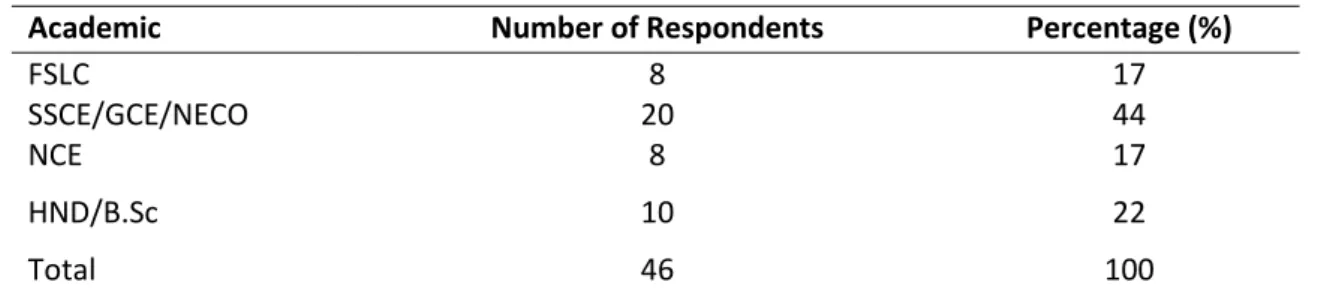
Table 4.5: Classification of respondents based on academic
Academic Number of Respondents Percentage (%)
FSLC 8 17
SSCE/GCE/NECO 20 44
NCE 8 17
HND/B.Sc 10 22
Total 46 100
Source: Field Survey, 2016
The above table shows that 17% of the respondents are FSLC holders, 44 of them are
SSCE/GCE/NECO holders, 17% of them are NCE while 22% of them are HND/B.Sc holders.
Table 4.6: Classification of respondents based on staff
Category of Staff Number of Respondents Percentage (%)
Tutorial staff 38 83
Non- tutorial Staff 8 17
Total 46 100
From table 4.6 on category of staff, it is observed that 38 representing 83% of all the respondents of
the study are tutorial staff while 8 representing 17% of the respondents are non-tutorial Staff.
Table 4.7: Classification of respondents based on the number of years in the school system
Number of years worked Number of Respondents Percentage (%)
1-10 5 11
11-21 24 52
22-32 32 15
33 and above 10 22
Source: Field Survey, 2016
From table 4.6 on the number of years in the organization, 5 representing 11% of the respondents
of the study have worked between 1-10 years, 24(52%) worked between 11-21 years, 22-32 worked
for 32(15%) years while 10 (22%) worked for 33 years and above.
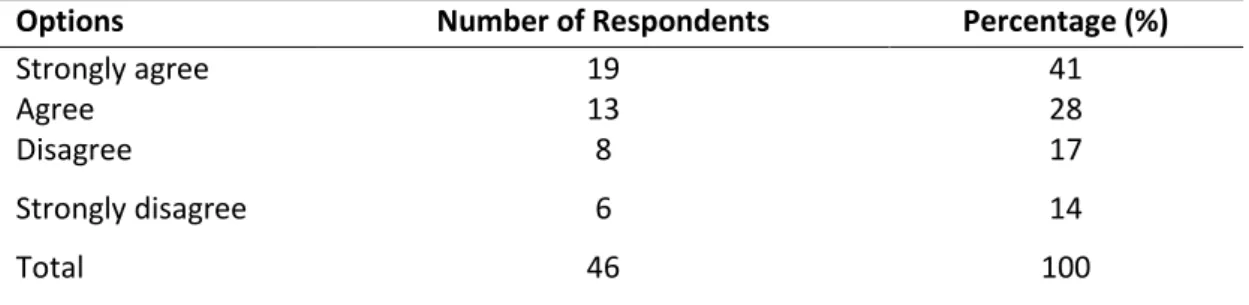
Table 4.8: Universal basic education programme plays significant role in educational development
in Nigeria
Options Number of Respondents Percentage (%)
Strongly agree 19 41
Agree 13 28
Disagree 8 17
Strongly disagree 6 14
Total 46 100
Source: Field Survey, 2016
The above table shows that 19(41%) of the respondents strongly agree that universal basic
education programme plays significant role in educational development in Nigeria, 13(28%) agree,
8(17%) disagree while 6(14%) strongly disagree. Therefore, it can be concluded that universal basic
education programme plays significant role in educational development in Nigeria.
Table 4.9: Introduction of universal basic education programme has significant effect in
educational development in Nigeria
Options Number of Respondents Percentage (%)
Strongly agree 25 54
Agree 10 22
Disagree 6 13
Strongly disagree 5 11
Total 46 100
Source: Field Survey, 2016
The above table shows that 25(54%) of the respondents strongly agree that introduction of universal
agree, 6(13%) disagree while 5(11%) strongly disagree. Therefore, it can be concluded that
introduction of universal basic education programme has significant effect in educational
development in Nigeria.
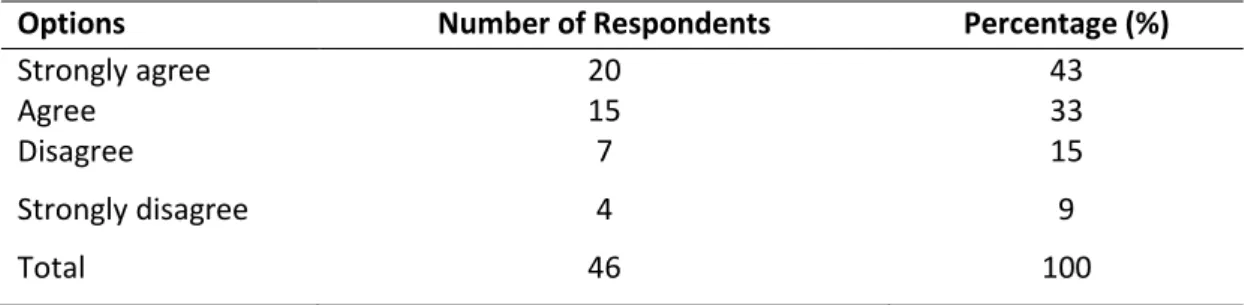
Table 4.10: The rate at which universal basic education programme has contributed to educational
development in Nigeria is high
Options Number of Respondents Percentage (%)
Strongly agree 20 43
Agree 15 33
Disagree 7 15
Strongly disagree 4 9
Total 46 100
Source: Field Survey, 2016
The above table shows that 20(43%) of the respondents strongly agree that the rate at which
universal basic education programme has contributed to educational development in Nigeria is high,
15(33%) agree, 7(15%) disagree while 4(9%) strongly disagree. Therefore, it can be concluded that
the rate at which universal basic education programme has contributed to educational development
in Nigeria is high.
Table 4.11: Implementation of universal basic education programme has gone to a very large
extent in educational development in Nigeria
Options Number of Respondents Percentage (%)
Strongly agree 8 17
Agree 10 22
Disagree 12 26
Strongly disagree 16 35
Total 46 100
Source: Field Survey, 2016
The above table shows that 8(17%) of the respondents strongly agree that implementation of
universal basic education programme has gone to a very large extent in educational development in
Nigeria, 10(22%) agree high, 12(26%) disagree while 16(35%) strongly disagree. Therefore, it can be
concluded that implementation of universal basic education programme has gone to a very large
4.3 TEST OF HYPOTHESES
The hypotheses will be tested using the chi-square formula stated below:
x2 = ∑ (0-∑ )2
∑
Where:
x2 = calculated chi-square
0 = observed frequency
E = expected frequency
∑ = summation
The expected frequency (E) is calculated by adding all the observed frequency (0) and dividing by the
number of observations.
Decision Rule: If the calculated chi-square value (X2) is greater than or equal to the table value at
0.05 level of significance, the alternate hypothesis (H1) is accepted, but if the calculated chi-square
value is less than the table value, the null hypothesis (H0) is accepted.
TEST OF HYPOTHESIS ONE
H0: Universal basic education programme play significant role in educational development in
Nigeria.
H1 Universal basic education programme does not play significant role in educational
development in Nigeria.
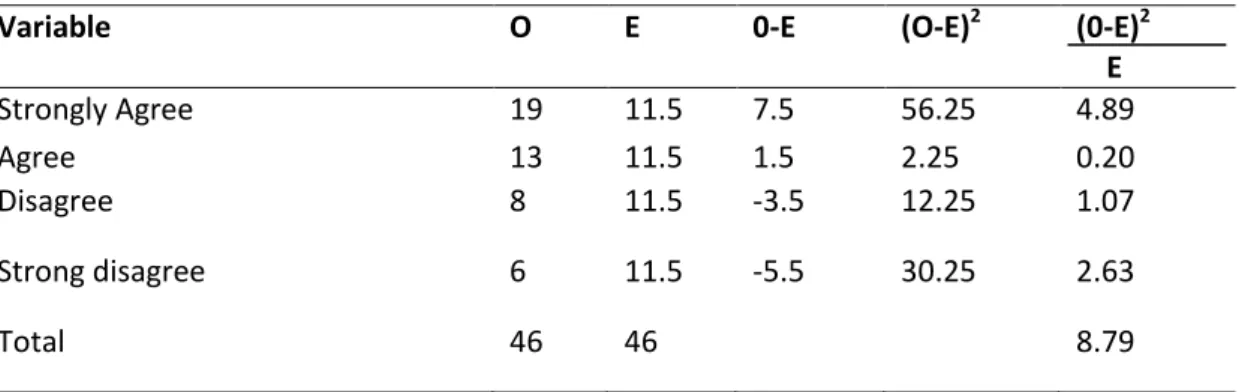
Data from table 4.8 was used to test the hypothesis
The calculated chi-square value = 8.79
Df= (C — 1) (R— 1) = (2— 1) (4— 1) = 3
Table value at 0.05 of significance and 3 degree of freedom (Df = 7.3777
Decision: Since the calculated chi-square (X2) value (8.79) is greater than table value (7.3777), we
reject the null hypothesis (Ho) and accept the alternate hypothesis (H1). Therefore, it can be
Variable O E 0-E (O-E)2 (0-E)2
E
Strongly Agree 19 11.5 7.5 56.25 4.89
Agree 13 11.5 1.5 2.25 0.20
Disagree 8 11.5 -3.5 12.25 1.07
Strong disagree 6 11.5 -5.5 30.25 2.63
concluded that universal basic education programme plays significant role in educational
development in Nigeria.
TEST OF HYPOTHESIS TWO
H0: Implementation of universal basic education programme has gone to a very large extent in
educational development in Nigeria.
H1: Implementation of universal basic education programme has not gone to a very large extent
in educational development in Nigeria
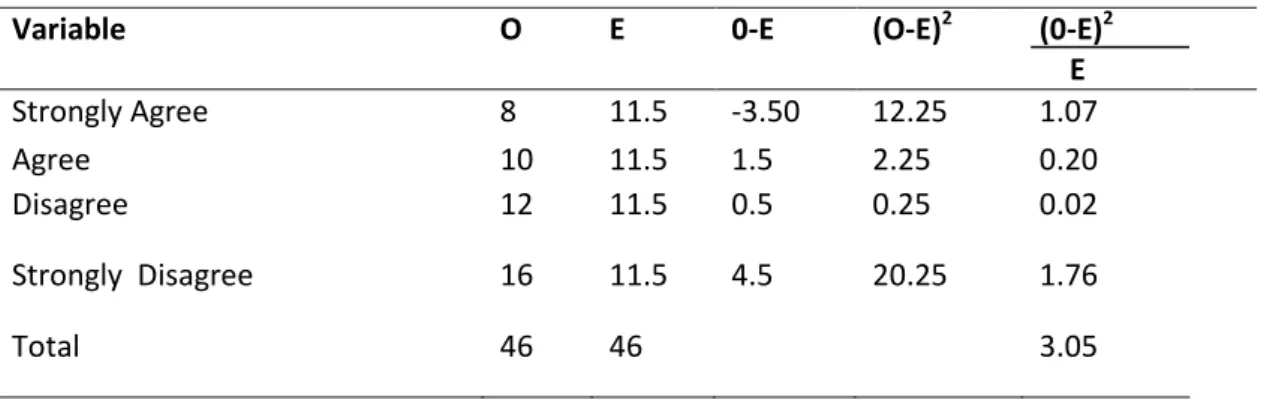
Data from table 4.11 was used to test the hypothesis
The calculated chi-square value 3.05
Df = (C 1) (R— 1) = (2—1) (4—1) = 3
Table value at 0.05 of significance and 3 degree of freedom (D 7.3777)
Decision: Since the calculated chi-square (X2) value (3.05) is less than table value (7.3777), we accept
the null hypothesis (Ho) and reject the alternate hypothesis (H1). Therefore, universal basic
education programme has gone to a very large extent in educational development in Nigeria.
4.4 DISCUSSION OF RESULTS
Based on the data collected, presented and analysed, the following among other things were
observed. Findings showed that there is strong relationship between universal basic education
programme and educational development in Nigeria. It also showed that universal basic education
programme play significant role in educational development in Nigeria. Since the calculated
chi-square (X2) value (8.79) is greater than table value (7.3777), we reject the null hypothesis (Ho) and
accept the alternate hypothesis (H1). The findings of the study indicate that the rate at which
universal basic education programme has contributed to educational development in Nigeria is high.
The result of the study indicates that universal basic education programme has gone to a very large
extent in educational development in Nigeria. This is because the calculated chi-square (X2) value
(3.05) is less than table value (7.3777), we accept the null hypothesis (Ho) and reject the alternate
Variable O E 0-E (O-E)2 (0-E)2
E
Strongly Agree 8 11.5 -3.50 12.25 1.07
Agree 10 11.5 1.5 2.25 0.20
Disagree 12 11.5 0.5 0.25 0.02
Strongly Disagree 16 11.5 4.5 20.25 1.76
hypothesis and that the result of the analyses showed that introduction of universal basic education
programme has significant effect in educational development in Nigeria.
5.1 CONCLUSION
It can be concluded that there is strong relationship between universal basic education programme
and educational development in Nigeria. Universal basic education programme play significant role
in educational development in Nigeria. The introduction of universal basic education programme has
significant effect and has gone to a very large extent in educational development in Nigeria. The rate
at which universal basic education programme has contributed to educational development in
Nigeria is high. The study also concludes that the implementation of universal basic education
programme has gone to a very large extent in educational development in Nigeria
5.2 RECOMMENDATIONS
Based on the above findings, the following recommendations were made;
1 There is needed to strengthen the relationship between universal basic education programme and
educational development in Nigeria.
2 There should be adequate and proper implementation of universal basic education programme to
ensure increase and stable educational development in Nigeria.
3 Government should increasing budgetary allocation to Education for the effective implementation
of UBE programme.
4 Governments at all levels should ensure timely release of the funds allocated to education in their
budgets.
5 No matter the quantum of fund allocated and released to the education sector, if such funds are
not judiciously utilized, the accomplishment of UBE will be jeopardized.
6 Prevention of embezzlement and misappropriate of funds through anti-corruption agencies such
as the Economic and Financial Crime Commission and Independent Corrupt Practices and other
Related Offences Commission.
7 Strengthening the education tax fund (ETF)
8 Participation of other stakeholders
9 External aids
5.3 SUGGESTION FOR FURTHER STUDIES
Further studies should be carried out on the adequate incentives and motivation of teachers and
other staff of the school for effective participation and implementation of universal basic education
REFERENCES
Ajayi, I. A., (2004): Social Science Methods. Ado-Ekiti: Green Line Publishers.
Ajayi, I. A., J. B. Ayodele and D. J. Tenibiaje, (2002): Education in Nigeria: Past and Present. Ado-Ekiti:
Green Line Publishers.
Asemota, S. A. (1999). “Social Justice –the Right of the Poor”. A paper presented at the Annual
National Conference of the Society of St. Vincent De Paul held at the Holy Cross Cathedral
Benin-City. 6th – 9th May.
Boyd, W. and E.J. King. (1989). The History of Western Education. London: Black.
Case, K.E. and Fair R.C. (1989). Principals of Economic New Jersey: Prentice-Hall Inc.
Conkling, E.C., B. J. L. Berry and D. M. Ray. (1993). The Global Economy. Resource Use, Location
Choice and International trade. New Jersey: Prentice-Hall Inc.
Dukor, R.O. (1995). “An Address Presented by the Metropolitan Council of Society of St. Vincent De
Paul” on the Inauguration Ceremony of the Owerri, St. and Asumpta Cathedral Hall, Owerri,
on 19th November. The Vincentia Ibanda, National Publication foth society of St. Vincent De
Paul.
Ebong, E. (1996). “Early Childhood Education: Concept and Scope”, Clabar: Bow Universal Ltd.
Ejiogu, A. M. (1988). Landmarks in Educational Development in Nigeria. Lagos: Joja Educational
Research and Publishers Ltd.
Fafunwa, A. B (1975). History of Education in Nigeria. London: George Allen and Unwin Ltd.
Fafunwa, A. B. (1983). Development of Education in Nigeria. Trends and Issues in Nigerian Education,
Ife: University of Ife Press Ltd.
Federal Republic of Nigeria, (1999). Implementation Guidelines for the Universal Basic Education
(UBE) Programme. Abuja: Federal Ministry of Education.
Ibukun, W.O., (2004). Management of Secondary School Education in Nigeria: Problems and
Challenges in Fagbamiye, E. O. Babalola, J. B. Fabunmi, M. and Ayeni, A. O. (Eds.),
Management of Primary and Secondary Education in Nigeria. Ibadan: NAEAP.
Igwe, S.O., 2004. The Universal Basic Education (UBE) programme in Nigeria: Challenges and
Prospects in Fagamiye, E. O. Babalola, J. B. Fabunmi, M. and Ayeni, A. O. (Eds.), Management
of Primary and Secondary Education in Nigeria. Ibadan NAEAP.
Keleman, D.F. (1980). The Lexicon Webster Dictionary. U.S.A: Delair Pub. Company Inc.
Kinderleberger, C. P. and Herrick B. (1977). Economic Development. Tokyo: McGraw-Hill Kogakuha,
Maduewesi, E., (2001). Financing of Education in Nigeria Ibadan: Nigerian Academy of Education
Yearbook.
Morphet, E.L. and Johus, R. L. (1975): Planning and developing the School Finance Programme. The
economics and Financing of Education. A systems approach. New Jersey: Prentice-Hall Inc.
National Policy of Education (1981). Lagos Federal Ministry of Education.
Nwagwu, N.A., (2004). The Organization and Management of Primary and Secondary Education in
Nigeria, in Fgbamiye, E.O.; Babalola, J. B.; Fabunmi, M. and Ayeni, A. O. (Eds.), Management of
Primary and Secondary Education Nigeria. Ibadan: NAEAP.
Obanya, p., (2000) National Press Briefing on the UBE Programme. Lagos.
Obanya, p., (2006). Teaching without Teacher. 24th Distinguished Lecture Series, Adeniran
Ogunsanya College of Education, Otto/Ijanikin, Lagos State, Nigeria.
Olaniyan, O. (2003). Financing Education in Nigeria: what has the Education Tax Fund Achieve? In:
Babalola, J. B. and Adedeji, S. O. (Eds.) contemporary of Honour. Ibadan: Department of
Educational Management, University of Ibadan, Ibadan, Nigeria.
Salami, K. A. (2004) Provision and Management of School Facilities for the Implementation of
Universal Basic Education (UBE): The Ogun State Experience in Fagbamiye, E. O., J. B. Babalola,
M. Fabunmi and A. O. Ayeni, (Eds.): Management of Primary and Secondary Education in
Nigeria. Ibadan: NAEAP.
UBEP, (2002). Routine Monitoring Report. Department of Monitoring and Evaluation, Vol. 1.
Venn, G. (1970). Man, Education and Manpower. Washington DC: American Association of School