INSTITUTIONAL RESEARCH AGENDA EXECUTION
THROUGH UNDERGRADUATE THESIS OUTPUT
Edgar Allan Dela Cruz Mendoza. Far Eastern University [email protected]
Abstract
As the universities in the Philippines aspires to be among the leading institutions within ASEAN together with other ASEAN universities, research initiatives have been one of the way for them to internationalize. Research agenda were created to align all the efforts of the higher education institution towards few, if not one, foci. This paper is a formative evaluation of the initial execution of a certain autonomous university in the country. Utilization of the research agenda as well as the research capability of the advisers is looked into in this paper.
The 10-fold agenda, sixty eight (68) theses and thirty (30) faculty members, twenty (20) of which are thesis advisers, are used as data for the document analysis. Slovin’s formula is shown to set the minimum required number of data needed. The census of the population is gathered. Descriptive statistics, such as frequency and percentage, are employed since the research is qualitative in nature. Among the 68 theses analyzed, 6 are classified as Type A, 18 are Type B, and the rest are Type C. Scoring is based on the panel or paper critique done at the end of the semester. The bias is reduced through a ranking of score, instead of using the weighted mean to eliminate sensitivity to extreme values.
In its entirety, this research is valuable to the institution as its results could be used to improve the current system of the institution and further strengthen its research culture. At the end of this paper, a model is proposed to aid the other institution in formulating its own research agenda through internal and external assessment – Tri-Focal Assessment for Research Agenda Creation (TARAC).
Keywords: research agenda, undergraduate thesis, thesis advising, TARAC, 10-fold agenda
INTRODUCTION
With K-12 and ASEAN Mutual Recognition Agreement bugging the educational system in the Philippines, different higher educational institutions (HEIs) have been improving different aspects of its operations to keep at par with international standards.
University of Sto. Tomas (UST) (Geronino, 2015). Within the Philippines, only AdMU, DLSU, and UST are granted five (5) years of autonomous status by the Commission on Higher Education (CHED), while only 5% of all HEIs are autonomous with three (3) years and (1) year autonomous status. UP, on the other hand is under the Office of the Philippine President and thus stands as an entity not within the umbrella of CHED.
The focus of this study is one of the autonomous universities in the country with three (3) year grant. The university envisions being one of the top five universities in the Philippines following the list of HEIs above by 2020. This paper is limited with the research initiative of one institute of that specific university through thesis advising. The highlight of this study is the match and skills inventory of the adviser through its set 10-fold agenda.
Aligning to the priorities of National Higher Education Research Agenda (NHERA) (CHED, 2013) with that of the university through its University Research Center, its institute pursues to be the tourism and hospitality education’s pioneer in revitalizing research-stalled initiatives. Through this philosophy, the Institute is geared towards focusing its research endeavor in the following 10-fold agenda:
Agendum 1 - Tourism and Hospitality Policy Orientation and Formulation. This aspect focuses on legislative agenda of the Tourism Initiatives of the Congress through the House of Representatives and Senate, Department of Tourism (DOT), Department of Trade and Industry (DTI), and other related government agencies that deal with the operations of tourism and hospitality sectors.
Agendum 2 - Tourism and Hospitality Innovation. Trends and updates in the tourism and hospitality sectors are quite fast approaching in terms of consumer preferences and desires. In this manner, the Institute will be prepared and be updated of these changes in order to align to the needs of the market today.
Agendum 3 - Use of ICT in Tourism and Hospitality. Information is very substantial in all aspects whether in business or any other educational field. This has to be coupled with the communication efforts on how the information will be received by the right people through the right channel. Technology comes in the picture in order to lessen the time requirement of every transaction.
Agendum 4 - Educational Services in Tourism and Hospitality Programs. The educational services of all the private and public HEIs should be considered as another focal point considering the demand of the world labor market. The training ground of all Filipino Tourism and Hospitality professionals are rooted from the educational services of the country.
Agendum 5 - Relationship, Participation, Linkages and Exchange Programs. The university is also anchored on establishing worthwhile partnership in local and international arena wherein aspects such as research, facilities, exposure, and, student and faculty exchange programs are to be undertaken.
Agendum 6 - Quality Assurance. It is the foremost goal of every establishment to give 100% quality assurance to their stakeholders. In this concept, researchers may focus on the supply chain management up to the delivery to the customers especially services.
the upgrading on the acquired competencies of the labor force based on their trainings with different learning facilities like HEIs, TESDA, other private training providers and professional assessment centers. This area may be a good starting point on how the stakeholders affected by this phenomenon reacted and prepared.
Agendum 8 - Tourism and Hospitality Businesses and Investments. It will always be a very sound proposal if the focus on the research involves the business and investments initiatives happening in the country. It may also focus on emerging industries, matured ones and the entry-level companies that are playing currently and focusing on specific market areas.
Agendum 9 - Sustainability, Nature, and Environmental Concerns. Continuous progress, maintaining the system and practices, relevance of nature preservation, environmental impact and climate change are some of the research areas that will tremendously help the existence of our Mother Earth. This aspect may be a very common proposal but very important at the same time.
Agendum 10 - Tourism and Hospitality Internal Business Environment. The operational requirement of every business allows for the reformulation and reengineering of company objectives and strategies. Tourism establishments, hotels, restaurants and institutional educations are no exception in the research proposals to be worked upon.
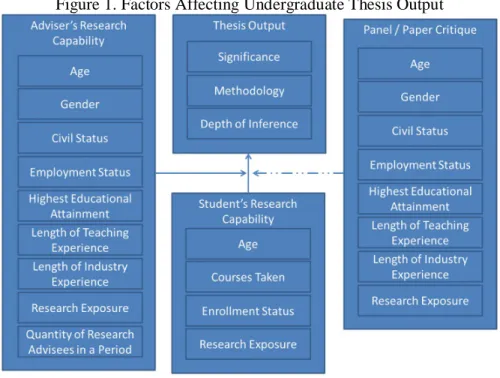
Figure 1. Factors Affecting Undergraduate Thesis Output
OBJECTIVES
to how the institute could improve the research outputs of the students through the advisers.
Though this research follows the framework in Figure 1, this study did not include all factors that were not gathered such as advisers’ research exposure, students’ and panel members’ demographics. Students’ profile would be hard to analyze since their thesis is done in groups.
There is a dearth of literature on how research agendas have been developed (Bourke et al, 2015). This research is valuable to the institution as it evaluates the current advising policy and research agenda match. Results of this study could be used to improve the current system of the institution.
Another major contribution of this paper is its recommended framework in developing institutional agenda through the TARAC Model proposed in Figure 2. As compared to the study of Bourke et al, the context of this paper is within the tourism and hospitality industry. Nonetheless, the proposed TARAC Framework is applicable to other industries, as well.
METHOD
This research is descriptive in nature. Burns and Grove (2003) define descriptive research as a research designed to provide a picture of a situation as it naturally happens. Descriptive research may be used to justify current practice and make judgment, revalidate known theories, and also to develop new theories.
The data gathering done for this research is document analysis. Thesis outputs of the undergraduate tourism students last semester, Second Semester Academic Year 2015-2016 are collected and so with the profiles of all faculty members within the tourism department, those who acted as research advisers and those who did not.
The whole Census of the undergraduate thesis of the tourism majors and faculty member profiles were gathered and so sampling design and computation won’t be presented. However, when Slovin’s Formula is used:
= 1 + where n = sample size
N = total population of 30 faculty members e = margin of error,
twenty eight (28) faculty members are needed to reach a 95% confidence level with 5% margin of error ( =0.05).
This research employs qualitative approach. Statistical analyses used are descriptive statistics only. Frequencies and percentages are utilized to describe the characteristics of the data gathered.
RESULTS ANDDISCUSSION
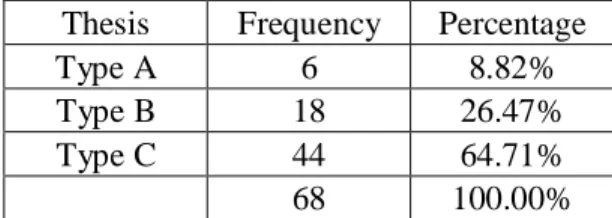
At the end of the Second Semester of Academic Year 2015-2016, 68 undergraduate tourism theses were created by the institute’s Bachelor of Science in Tourism Management students.
Thesis scores were generated from the panel defense set by the institute where all theses were presented in 9 different set of panel or paper critique, where each panel is composed of one chairman and 2 panel reactors.
Thesis Frequency Percentage
Type A 6 8.82%
Type B 18 26.47%
Type C 44 64.71%
68 100.00%
Rank average is employed to determine the scores of each thesis to remove the bias of the panel members. With this process, the top-tier researches that reached the bracket score were classified Type A, the next bracket got 18 papers and were classified Type B, and the rest were classified as Type C.
This is the first year that the institute implemented its new 10-fold agenda as part of the university’s way to reach its vision to be a top-tier university in the Philippines.
Table 2. Inclination the Thesis Output of the Student with the Research Agenda
Agenda Thesis Percentage Rank
Agendum 1 24 35.29% 2
Agendum 2 7 10.29% 3
Agendum 3 2 2.94% 6.5
Agendum 4 2 2.94% 6.5
Agendum 5 4 5.88% 4
Agendum 6 3 4.41% 5
Agendum 7 0 0.00% 9.5
Agendum 8 0 0.00% 9.5
Agendum 9 25 36.76% 1
Agendum 10 1 1.47% 8
68 100.00%
Among the ten agenda, Agenda 7 and 8 – Manpower, Competencies and Labor Challenges, and Tourism and Hospitality Businesses and Investments – were the only ones not utilized by the students as they finish their capstone research for their degree.
Table 3. Demographics of the Faculty Members who are not Thesis Advisers
Gender
Male 4
Female 6
Civil Status
Single 5
Married 5
Employment Status
Regular Full Time 1 Lecturer Full Time 5 Lecturer Part Time 4
Highest Educational Attainment
Bachelor's Degree 7 Professional Master's Degree 3 Research Master's Degree 0 Professional Doctorate 0 Research Doctorate 0
Appendix A and B shows the demographic profiles of the faculty members of the tourism management department of the institute. Table 3 indicates the profile of the faculty who opted not to get thesis advisees. Most of these faculty members are currently in the process of finishing their graduate thesis and seasoned industry practitioner who cannot handle research load on top of their teaching loads.
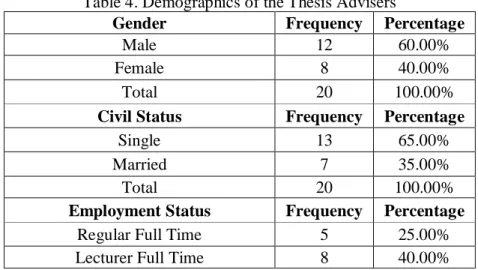
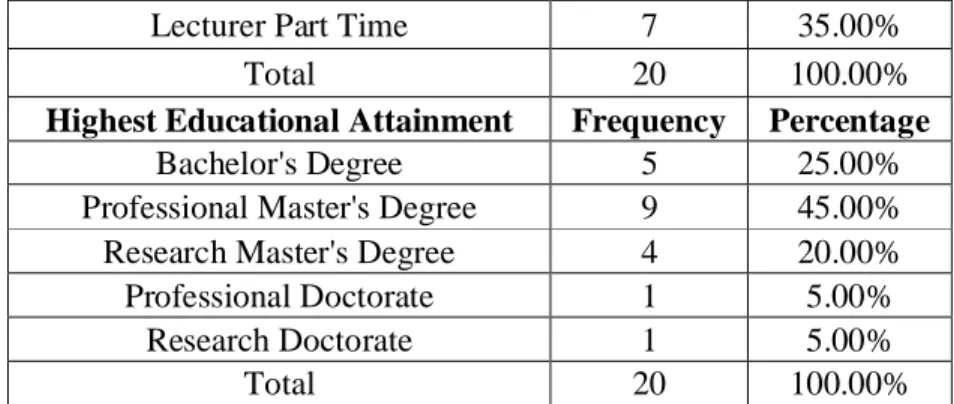
Table 4 shows the demographic profile of the thesis advisers last term. Most of them are men, with 60%, and the rest are women, with 40%. As per their gender, 65% are single, and 35% of them are married. Sixty-five percent (65%) works full time, while only 25% of the advisers are tenured. Three fourths or 75% has graduate degrees but only 10% has doctorate, and the remaining 25% are bachelor’s degree holder who are exposed into research production
Table 4. Demographics of the Thesis Advisers
Gender Frequency Percentage
Male 12 60.00%
Female 8 40.00%
Total 20 100.00%
Civil Status Frequency Percentage
Single 13 65.00%
Married 7 35.00%
Total 20 100.00%
Employment Status Frequency Percentage
Regular Full Time 5 25.00%
Lecturer Part Time 7 35.00%
Total 20 100.00%
Highest Educational Attainment Frequency Percentage
Bachelor's Degree 5 25.00%
Professional Master's Degree 9 45.00%
Research Master's Degree 4 20.00%
Professional Doctorate 1 5.00%
Research Doctorate 1 5.00%
Total 20 100.00%
The above table shows the complete roster of the faculty advisers. The next tables would indicate only the list of those that have produced thesis output that are classified Type A and B.
Table 5. Degree Attained by Adviser
Highest Educational Attainment Type A Type B
Bachelor's Degree 1 2
Professional Master's Degree 3 6
Research Master's Degree 0 2
Professional Doctorate 1 1
Research Doctorate 1 1
Most of the Type A and Type B thesis were advised by professional master’s degree holder advisers. This result is not unexpected since most of the advisers fall under this highest educational attainment.
It’s interesting to note that: 1) a bachelor’s degree holder could produce a Type A and B thesis through its advisee; 2) though a research master’s degree is trained the faculty in research, this doesn’t equate to being a trained research adviser; and 3) a doctorate degree, be it professional or research, equipped the faculty to produce both Type A and Type B papers, though not all of their advisees fall on those category.
Table 6. Gender of Adviser Gender Type A Type B
Male 2 6
Female 3 6
Table 6 shows the gender of the advisers that produced Type A and B thesis. The numbers are almost, if not, the same. Gender, in this case, doesn’t affect the advising process.
Table 7. Civil Status of Adviser Civil Status Type A Type B
Single 3 8
Most of the advisers for both Type A and Type B thesis are single. This is expected since most of the advisers are single. In essence, civil status doesn’t affect the advising, as well.
Table 8. Employment Status of Adviser Employment Status Type A Type B
Regular Full Time 2 4
Lecturer Full Time 4 6
Lecturer Part Time 0 2
Employment status, as shown in table 8, affects the advising process. Most of those that have produced Type A and B papers are full time faculty employees. This gives them more time in the university to advise and do research, if they may. Tenure, though, doesn’t affect advising. Being tenured doesn’t mean one would be a better adviser.
As the university becomes a matured research institution, tenured faculty members are expected to be more matured when it comes to research as compared to the non-tenured ones as this promotes research productivity of the institution. A note should be taken, as well, that some non-tenured and new faculty members might have come from a more matured research institution.
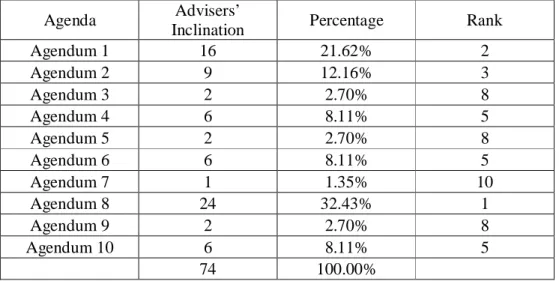
Table 9. Inventory of Adviser Inclination with the Research Agenda
Agenda Advisers’
Inclination Percentage Rank
Agendum 1 16 21.62% 2
Agendum 2 9 12.16% 3
Agendum 3 2 2.70% 8
Agendum 4 6 8.11% 5
Agendum 5 2 2.70% 8
Agendum 6 6 8.11% 5
Agendum 7 1 1.35% 10
Agendum 8 24 32.43% 1
Agendum 9 2 2.70% 8
Agendum 10 6 8.11% 5
74 100.00%
Most faculty members have expertise in Agenda 8 and 1 – Tourism and Hospitality Businesses and Investments, and Tourism and Hospitality Policy Orientation and Formulation. This result is found to be expected since most of the advisers have a professional master’s degree in business and have worked as managers in the tourism and hospitality industry.
Of all the 68 theses, only 18 or 26% are matched with the advisers’ academic background. Intervention has to be done to increase the percentage. Since the students are into Agendum 9, seminars regarding environmental science, management, planning, and tourism could be put to place to equip the advisers to handle research on this agenda. Ideally, advisers could only take advisees studying within their research capability and interest but since there’s a lack in some research expertise they are allowed to accept research that they think they could help with without compromising the quality of the paper and the research process learned by the student.
Since only descriptive statistics are used in this study, further inference and generalization could not be created. It is recommended though to: 1) include the research design and the approach in analyzing the adviser-advisee match; 2) include the adviser demographic profiles in further study to see if the other factors affect the thesis output of the advisees;, and 3) to use inferential statistics to determine correlation of the output using the advisers’ demographic profile and students’ research outputs.
Some knowledge created through research are industry exclusive, examples in the services industry are Parasuraman, Zeithaml, and Berry (1985), Rust and Chung (2006), Vargo and Lusch (2004); in the tourism industry are Irritation Index or Irridex (Doxey, 1975), Tourist Area Life Cycle (Butler, 1980), Social Representations Theory (Moscovici, 1981, 1983, 1988; Pearce et aI., 1996), Stakeholder Theory (Freeman, 1984), Growth Machine Theory (Canan and Hennessy, 1989; Molotch, 1976; Molotch and Logan, 1984), Play and Compensation Theory (Bystrzanowski, 1989), Attribution Theory (Pearce, 1989), Equity Theory (Pearce et aI., 1991), Social Exchange Theory (Ap, 1992; Blau, 1964; Homans, 1961; Perdue et aI., 1987), and Power Theory (Kayat, 2002). Universities, then, need to focus their research initiatives towards certain research agenda.
Since this research focuses on the analysis of the institute’s 10-fold research agenda, a recommendation as to how an institution could create the same are indicated below. The researcher recommends the use of internally and externally analysis in determining the institutions’ research agenda.
Internal assessment is done through finding the link between the capability of the faculty and students and the research inclination of the institution itself. University agendas, for example, may emerge from specific teams or leading researchers who have identified more nuanced research approaches for a particular field (Becker et al., 2013; Gedajlovic, Honig, Moore, Payne, & Wright, 2013). Assessment through the faculty and researcher is one part.
Figure 2. Tri-focal Assessment for Research Agenda Creation (TARAC)
NOTES
1. This study did not use inferential statistics and thus generalization is not appropriate.
2. Only a test case is used in this study, a more conclusive data should be gathered from a higher number of higher education institutions is needed to produce a generalization.
REFERENCES
Ap, J. (1992). Residents' Perceptions on Tourism Impacts, Annals of Tourism Research. 19(4),665-690
Becker, W. C., Fraenkel, L., Kerns, R. D., & Fiellin, D. A. (2013). A research agenda for enhancing appropriate opioid prescribing in primary care. Journal of General Internal Medicine, 28(10), 1364-1367.
Blau, P.M. (1964). Exchange and Power in Social Life. New York: Wiley Homans, C.G, 1961, Social Behaviour: Its Elementary Forms. New York: Harcourt Brace
Bourke, L., Best, J. D., Wakerman, J., Humphreys, J. S., & Wright, J. R. (2015). Reflection on the development of a research agenda in rural health. Journal of Research Practice, 11(1), Article M1. Retrieved from http://jrp.icaap.org/index.php/jrp/article/view/470/415
Butler, R.W. (1980). The Concept of Tourism Area Cycle of Evolution: Implications for Management of Resources, Canadian Geographer. 24(1), 5-12
Burns, S.N., and Grove, S.K. (2003). Understanding nursing research. 3rd edition. Philadelphia: Saunders.
Bystrzanowski, J. (1989). Tourism as a Factor of Change: A Socio-cultural Study. Vienna: Centre for Research and Documentation in Social Sciences
Canan, P., and Hennessy, M. (1989). The Growth Machine, Tourism, and the Selling of Culture, Sociological Perspectives. 32(2), 227-243
Commission on Higher Education (CHED), (2013). National Higher Education Research Agenda 2 2009-2018.
Doxey, G. (1975). A Causation Theory of Visitor-Residents Irritants: Methodology and Research Inferences. In: Travel and Tourism Research Associations Sixth Annual Conference Proceedings, pp. 195-198. San Diego, CA: ITRA
Freeman, R. (1984). Strategic management: A stakeholder approach. Boston: Pitman
Geronimo, J.Y. (2015). 4 PH schools make it to Asian university rankings again. Rapler: Manila. Retrieved from http://www.rappler.com/nation/95860-philippines-universities-2015-qs-university-rankings-asia
Kayat, K., (2002). Power, social exchanges and tourism in Langkawi: Rethinking resident perceptions, International Journal of Tourism Research. 4(3), 171-191
Molotch, H., (1976). The city as a growth machine: Toward a political economy of place. The American Journal of Sociology, 82(2).309-332
Molotch, H., and Logan, J. (1984). Tension in the Growth Machine: Overcoming Resistance to Value-Free Development, Social Problems. 31 (5),483-499 Moscovici, S. (1981). On Social Representations. In J.P. Forgas. Soeia. Cognition:
Perspectives on Everyday Understanding, pp. 181-209. London: Academic Press
Moscovici, S. (1983). The Coming Era of Social Representations. In J.P. Codol and J.P. Leyens (Eds), Cognitive Approaches to Social Behaviour. The Hague: Nijholl'
Moscovici, S. (1988). Notes toward a description of social representations. European Journal of Social Psychology. 18, 211-250
Parasuraman, A., Zeithaml V.A., and Berry, L.L. (1985), “A Conceptual Model of Service Quality and Its Implications for Future Research,” Journal of Marketing, 49 (Fall), 41–50.
Pearce, D.G. (1989), Tourist Development. New York: Longman
Pearce, P.L., Moscardo, G., and Ross, O.F. (1991). Tourism impact and community perception: An equity-social representational perspective, Australian Psychologist. 26(3). 147-152
Pearce, P.L., Moscardo, G., and Ross, O.F. (1996). Tourism Community Relationships. Oxford: Pergamon
Perdue, R.R., Long, P.T., and Allen, L. (1987). Rural Resident Tourism Perceptions and Attitudes, Annals of Tourism Research. 14(3).420-429 Rust, Roland T. and Tuck Siong Chung (2006), “Marketing Models of Service
and Relationships,” Marketing Science, 25 (6), 560–80.
Appendix A. Demographics of Thesis Advisers Adviser
Highest Educational
Attainment
Gender Civil Status
Employment Status
Length of Teaching Experience
1 MBA Female Single LFT 27
2 BS Female Single LFT 2
3 MBA Male Single RFT 4
4 DBA Male Single RFT 10
5 MS Female Married LPT 9
6 MBA Female Married RFT 6
7 PHD Female Married RFT 14
8 BS Female Single LFT 12
9 MS Male Single LPT 6
10 MBA Male Married LPT 6
11 MS Male Single LPT 5
12 BS Male Married LPT 10
13 BS Male Single LFT 3
14 MBA Female Married LFT 19
15 MS Female Married RFT 4
16 MBA Male Single LFT 4
17 MBA Male Single LFT 0
18 BS Male Single LPT 2
19 MBA Male Single LFT 9
20 MBA Male Single LPT 16
Appendix B. Thesis Turnout of the Advisers
Adviser Type A Type B Type C Average Rank
1 1(16.67%) 2(33.33%) 3(50%) 6(100%) 1.67 4.5
2 0(0%) 0(0%) 5(100%) 5(100%) 1.00 14
3 0(0%) 1(100%) 0(0%) 1(100%) 2.00 2.5
4 1(14.29%) 2(28.57%) 4(57.14%) 7(100%) 1.57 7
5 0(0%) 1(33.33%) 2(66.67%) 3(100%) 1.33 17
6 0(0%) 0(0%) 4(100%) 4(100%) 1.00 17
7 1(20%) 1(20%) 3(60%) 5(100%) 1.60 6
8 0(0%) 2(50%) 2(50%) 4(100%) 1.50 9
9 0(0%) 0(0%) 1(100%) 1(100%) 1.00 17
10 0(0%) 0(0%) 5(100%) 5(100%) 1.00 17
11 0(0%) 0(0%) 1(100%) 1(100%) 1.00 17
12 0(0%) 0(0%) 1(100%) 1(100%) 1.00 17
13 1(33.33%) 0(0%) 2(66.67%) 3(100%) 1.67 4.5
14 2(50%) 1(25%) 1(25%) 4(100%) 2.25 1
15 0(0%) 1(25%) 3(75%) 4(100%) 1.25 12
17 0(0%) 1(100%) 0(0%) 1(100%) 2.00 2.5
18 0(0%) 1(50%) 1(50%) 2(100%) 1.50 9
19 0(0%) 2(50%) 2(50%) 4(100%) 1.50 9