343
USE OF ISOTOPIC TECHNIQUES TO EVALUATE FOLIAR
FERTILIZATION EFFICIENCY
Mihalache Daniela1, Ana-Maria Stanescu1, Adriana Grigore1, Mariana Iancu1, Bogdan Rujoi1 1
National Research & Development Institute for Soil Science, Agrochemistry and Environment Protection Bucharest
Keywords: nuclear techniques, foliar fertilizer, 15N isotope, agrochemical testing, mineral nutrition
ABSTRACT
In this study, the foliar fertilization efficiency was assesed by using nuclear techniques and the stable isotope 15N. The objective was to increase nitrogen use efficiency in plants. In addition, the mobility of nitrogen in plants was evaluated.
The environmentlly friendly impact of this type of fertilizer is supported by means of an increase in nutrients uptake from the natural soil supplies, and as a result of foliar fertilization.
The trials were conducted in INCDPAPM-ICPA Bucharest greenhouse, using sunflower as test plant.
To evaluate the mobility of nitrogen in plants, a PK with mezo and microelements (Mg, S, Fe, Cu, Zn, Mn, Co, Mo) foliar fertilizer was enriched with labeled 15N and unlabeled N, using urea and ammonium nitrate as nitrogen sources. Therefore, 6% of the total nitrogen content was represented by the 15N labeled isotope (in all three forms: ammoniacal,15N-NH4, nitric , 15N-NO3 and amide, 15N-NH2).
The obtained results suggest that nuclear techniques can be successfully used in agrochemical research to deepen plant nutrition and nutrients translocation studies.
INTRODUCTION
In the recent years, nuclear techniques have been used in agronomic research due to their advantages (i.e. sensitivity) as concerns the results related to plant nutrition, fertilizers application, genetic studies, plant breeding and soil development studies, conservation and preservation of agricultural products, monitoring and implementation of environmental procedures [4]. This methods can accurately determine the amounts of nutrients absorbed by plants from soil, respectively, fertilizers, their mobility in plants, as well as the transformations that occur in the soil-plant-fertilizer complex system [5].
Given that nutrient absorption and metabolism by plants are governed by complex microscopic mechanisms that can not be investigated using conventional methods, the chemical substances used in agriculture, namely the chemical fertilizers are labeled using stable and radioactive isotopes (i.e. 15N, 13C, 2H, 14C, 35S, 32P etc.) [1, 2]. The researches carried out using 15N isotope as carried out to assess the are focused on the absorption mechanisms and mobility in plant of the three forms of nitrogen present in the fertilizers (amide, nitric and ammoniacal) [3].
It was reported that 15N is the isotope most widely used in agricultural research. 15N was separated by 14N - 15N isotope exchange method using nitrogen oxide (NO) and nitric acid (HNO3) at the National Institute for Research and Development of Isotopic and Molecular Technologies Cluj-Napoca (INCDTIM) [8].
15
N isotopic labeling techniques can be used to assess the processes and mechanisms related to nitrogen assimilation and translocations, as well as the metabolic processes occurring in plants and their relationships with the environment [6, 7].
The use of nuclear techniques and stable isotope 15N in different experimental conditions can help to elucidate certain agrochemical problems, as follows:
344
agrochemical efficiency and quantification of the environmentlly friendly effect of the fertilizer (supported by an increase in nutrients uptake from the natural soil supplies and as a result of foliar /soil incorporation fertilization).
MATERIAL AND METHOD
The experimental activities were focused on:
identifying the (15N) nitrogen labeled sources, used as a tracer in the experiments;
identifying the isotope labeling methods that use 15N to evaluate nitrogen mobility in plant;
selecting the foliar fertilizer;
fertilizer characterization;
developing the 15N labeled fertilizer (PK matrix labeled with 15N isotope);
selecting the test plant and the appropriate experimental design;
selecting the soil;
soil characterization;
selecting treatments (fertilizer solution concentration, application method);
foliar fertilization of the test plant;
establishing the sampling moment of the plant material and the set of analyses to be carried out;
harvesting the plant material; sample preparation for biometric, analytical and isotopic determinations;
chemical and isotopic determinations;
interpretation of the results.
The experiments were carried out in INCDPAPM-ICPA Bucharest greenhouse, using sunflower as test plant. The experimental designs consisted of single-factor experiments.
To investigate the mobility of nitrogen in plant and the agrochemical efficiency, experiments were performed using a PK matrix with trace elements foliar fertilizer enriched with labeled 15N and unlabeled N (from urea and ammonium nitrate). 6% of the total nitrogen content was represented by the 15N labeled isotope (in all three forms: ammoniacal, nitric and amide).
The isotopic determinations of the dry calatide samples (δ 15
N and 15N/14N ratio) and the total nitrogen analyses were performed at the Cornell Isotope Laboratory (COIL), Cornell University, Ithaca, USA :
Determination of the isotopic ratio (R) or the atoms percentage , AT% 15N/14N, in the plant samples in accordance to the applied (15N) species. R is the ratio of the heavy to light isotope in the sample;
Determination of δ15N vs. At Air - the accumulation of 15N isotope in the analyzed sample. This is the corrected value of the delta isotope for 15 N, measured against a primary reference scale. The primary reference scale for δ15
N is the Atmospheric Air. δ 15N values are expressed in units per million (‰).cann be calculated by means of the following formula, δ15
N = 1000 * (Rsample-Rstandard) / Rstandard);
The export of 15N isotope to sunflower calatide, as a function of the foliar fertilization with 15N species;
The degree of 15N isotope translocation represents the mobility of different forms of nitrogen in plant and can be assessed by using 15N isotope-labeled fertilizers.
Working conditions:
Mitscherlich pots with 20 kg of dry soil.
Soil type: Chernozem.
345
Nutrient dose to base fertilization was N90P90K90 using NPK complex fertilizer 15:15:15 (6 g/pot).
Irrigation 50% of the water capacity of the pot.
Sowing - uniform seed material (appearance, weight).
Plants maintenance: daily irrigation up to 2/3 of the water capacity of the pots.
3 replicates, 2 plants/pot, for each of the combination of the experimental factors (experimental variants).
In the experiments was used a PK matrix with trace elements foliar fertilizer enriched with urea and 15N isotope-labeled urea at amide group (urea-15NH2), and ammonium nitrate and 15N isotope-labeled ammonium nitrate at ammoniacal or nitric group ammonium nitrate (ammonium nitrate-15NH4; ammonium nitrate-15NO3).
Treatments: 15 ml solution(1 %)/ plant (30 ml/pot. The application was performed on each leaf using a 1,0 ml syringe.
Treatments: 4; interval: 7-days; application: in the morning.
RESULTS AND DISCUSSIONS
The chemical characteristics of the PK foliar fertilizer used as the basis for obtaining the variants of foliar fertilizers and 15N isotope-labeled foliar fertilizers are presented in Tables 1- 2.
Table 1
Chemical characteristics of the PK foliar fertilizer
Chemical characteristics PK matrix
(g/l)
Nitrogen ( N) -
Phosphorus (P2O5) 70
Potassium ( K2O) 60
Boron (B) 0,300
Cobalt (Co) 0,010
Cuprum (Cu) 0,300
Iron (Fe) 0,400
Magnesium (Mg) 0,300
Manganese (Mn) 0,300
Molybdenum (Mo) 0,010
Sulfur (SO3) 2,00
Zinc (Zn) 0,100
Table 2
The chemical characteristics of 15N isotope-labeled foliar fertilizers
Chemical characteristics
FOLIAR FERTILIZERS VARIANTS
PK matrix AMMONIUM NITRATE
UREA-15NH2
PK matrix
UREA
AMMONIUM NITRATE-15NO3
PK m
UREA
AMMONIUM NITRATE-15NH4
Determined values Determined values Determined values
(g/l) Total nitrogen from
the addition, from which:
120,06 120,45 120,45
like 15 N 6,75 6,02 6,02
Phosphorus (P2O5) 69,60 70,40 69,80
Potassium ( K2O) 58,80 59,40 58,9
Boron (B) 0,310 0,310 0,310
Cobalt (Co) 0,010 0,010 0,010
Cuprum (Cu) 0,290 0,310 0,280
346
Magnesium (Mg) 0,290 0,310 0,310
Manganese (Mn) 0,310 0,290 0,290
Molybdenum (Mo) 0,010 0,010 0,010
Sulfur (SO3) 2,26 2,30 2,34
Zinc (Zn) 0,120 0,130 0,120
Note: the difference between the experimental variants consists in the nature of the applied 15N
The physicochemical characteristics of the soil (Chernozem) used in the experiments are presented in the table below.
Table 3
Physicochemical characteristics of the soil
Humus Nitrogen Phosphorus
(PAL)
Potassium
(KAL) pH
(%) (mg/kg)
3,26 0,22 188 162 7,48
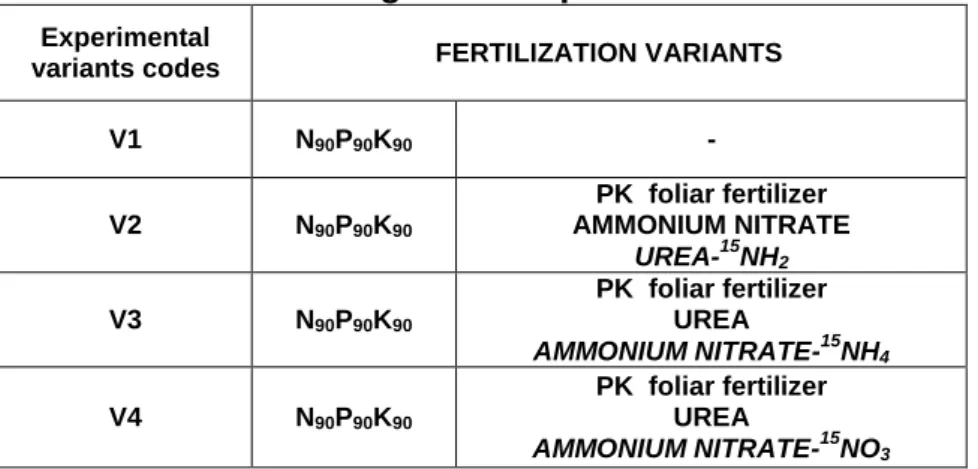
In Table 4 is presented the experimental diagram used for the study of the mobility of nitrogen in plant. Variant 1 represents the unfertilized control.
Table 4
Experimental diagram used for the study of the mobility of different forms of nitrogen in the plants
Experimental
variants codes FERTILIZATION VARIANTS
V1 N90P90K90 -
V2 N90P90K90
PK foliar fertilizer
AMMONIUM NITRATE
UREA-15NH2
V3 N90P90K90
PK foliar fertilizer
UREA
AMMONIUM NITRATE-15NH4
V4 N90P90K90
PK foliar fertilizer
UREA
AMMONIUM NITRATE-15NO3
The interpretation of the results was performed using Duncan's multiple range test, at a significance level = 0,05 with SPSS 14.0 software. The results present a 95% confidence level with a 5% error margin. Values followed by the same letter do not differ significantly between them.
In the Table 5 shows the values of the isotopic parameters determined in the dried samples of sunflower calatidium depending on the experimental factors, depending on the applied foliar fertilization variants.
Table 5 The values of isotopic parameters determined in sunflower calatidium
FOLIAR FERTILIZING VARIANTS
15
N/14N
ratio δ
15
N Nt
export
15
N export
Degree of 15N translocation
(AT %) (‰) (g) (mg) (%)
(average values) PK foliar fertilizerAMMONIUM
NITRATEUREA-15NH2 1,03971 1876,66 0,155 1.613 42.9
PK foliar fertilizerUREA
AMMONIUM NITRATE-15NH4 0,97000 1604,25 0.184 1.787 49.5
PK foliar fertilizerUREA
347
Figure 1 graphically illustrates the influence of foliar fertilization with different 15N isotope-labeled foliar fertilizers on the total nitrogen concentration from sunflower
calatidium in comparison to the unfertilized control.
Values followed by the same letter (a) does not show a significant difference from one another. The values obtained for the total nitrogen concentration for all experimental variants do not differ significantly between them.
Figure 1. The concentration of total nitrogen in sunflower calatidium according with experimental factors (%)
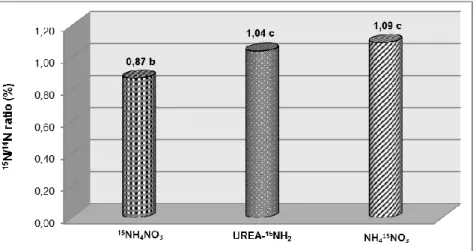
Figure 2 graphically shows the influence of the fertilization with the different foliar variants that contain with 15N isotope-labeled foliar fertilizers on the ratio 15N/14N (%) in sunflower calatidium samples.
Figure 2. Influence of experimental factors on the evolution of 15N/14N ratio in sunflower calatidium (%)
The values of 15N/14N ratio obtained for the samples of plant material harvested from variants fertilized with fertilizer containing urea-15NH2 (1,04%) and ammonium nitrate-15NO3 (1,09%) do not present a significant difference from each other, but are significantly higher from the variant that contains ammonium nitrate-15NH4 (0,87%).
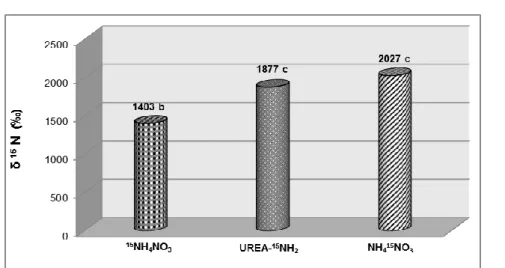
Figure 3 graphically shows the influence of fertilization with different foliar variants that also contain 15N isotope-labeled foliar fertilizers (to evaluate the mobility of different forms of nitrogen in plant) on the evolution of δ 15
348
Figure 3. Influence of experimental factors on the evolution of δ15N parameter in sunflower calatidium (‰)
The values of δ15
N parameter obtained for the samples of plant material harvested from variants fertilized with fertilizer containing urea-15NH2 (1877 ‰) and ammonium nitrate-15NO3 (2027 ‰) do not present a significant difference from each other, but are significantly higher from the variant that contains ammonium nitrate-15NH4 (1403 ‰).
Figure 4 graphically shows the influence of fertilization with the different 15N isotope-labeled foliar fertilizers on the evolution of the total nitrogen export in the sunflower calatidium (g).
The values obtained for the total amount of nitrogen exported from samples of plant material harvested from variants fertilized with foliar fertilizers containing 15N isotopically labeled fertilizer do not differ significantly between them. A higher amount of total nitrogen exported was obtained for variant fertilizing with ammonium nitrate-15NH4 (0,184 g) and the smallest for variants fertilized with foliar fertilizers containing urea-15NH2 (0,155 g).
Figure 4. Influence of the experimental factors on the total amount of nitrogen exported in sunflower calatidium (g)
349
Figure 5. Influence of experimental factors on the amount of 15N exported to sunflower calatidium (mg)
The values for the 15N quantity exported in sunflower calatidium obtained for the samples of plant material harvested from variants fertilized with foliar fertilizers containing 15
N isotopically labeled fertilizer do not differ significantly between them.
A higher amount of 15N exported in sunflower calatidium was obtained for the samples collected from variants fertilizing with ammonium nitrate-15NO3 (1,753 mg).
Figure 6 graphically presents the translocation degree of 15N (%) in sunflower calatidium for each foliar fertilizing that contains 15N isotope-labeled fertilizers.
The highest amount of 15N translocated in the sunflower calatidium (48,54 %) was determined in the samples of plant material harvested from variants fertilized with ammonium nitrate-15NO3. The lowest amount of 15N translocated was obtained for plant samples fertilized with urea-15NH2 (39,82 %).
Figura 6. Influence of experimental factors on the translocation degree of 15N in sunflower calatidium (%)
ACKNOWLEGMENTS
350
CONCLUSIONS
In this study, unlabeled and 15N isotope-labeled (at different nitrogen forms, i.e. amide, nitric and ammoniacal) foliar fertilizers were obtained starting from a PK + trace elements matrix.
The amount of 15N exported to sunflower calatidium was 1,605 mg for ammonium nitrate-15NH4 and 1,753 mg for ammonium nitrate-15NO3, with no significant differences recorded between the three 15N-labeled nitrogen forms.
The mobility of nitrogen, expressed as a degree of translocation in sunflower calatide, varied from 39,82% in the case of urea-15NH2 (amide form of nitrogen) to 48,51% in the case of ammonium nitrate -15NO3 (nitric form of nitrogen).
Using of experimentally obtained foliar fertilizers does not significantly affect the mobility of various forms of nitrogen in the plant.
BIBLIOGRAPHY
1. Axente D., Abrudean M., Bâldea A., 1994 - Separarea izotopilor 15N, 18O, 10B, 13C prin schimb izotopic. Editura "Casa Cărţii de Ştiinţă", Cluj-Napoca, p.72-73.
2. Axente D., Marcu C., Mureşan A., Kacsar M., Mişan I., Openeciu G., Gligan N.,
Cristea G., 2010 - Experimental plant for simultaneous production of 14N and 15N by
15
N/14N exchange in NO,NO2 – HNO3 system under pressure, Isotopes in
Environmental and Health Studies. Germania, vol 46 (2), p.242-248.
3. Bengtsson G., Bergwall C., 2000 - Fate of 15N labelled nitrate and ammonium in a fertilized forest soil. Soil Biology and Biochemistry, Anglia, vol. 32, Issue 4, p.545-557.
4. Blair G. și Till R., 2000 - Inovations in isotope techniques to enhance the evaluation and management of nutrients sources. in Proceedings of International Symposium on Nuclear Techniques in Integrated Plant Nutrients, Water and Soil Management, Austria.
5. Mihalache, D., Sirbu, C., Cioroianu, Tr. M., Grigore, A., Mărin, N., Stănescu, A.
M., Rujoi, B., Iancu, M., 2016 – Study on the efficiency and mobility of different formson nitrogen from foliar fertilizers by using of 15N isotope, Lucrări Ştiinţifice, seria Agronomie Universitatea de Ştiinţe Agricole şi Medicină Veterinară, vol. 59 (1), Nr. 2, IAȘI, p. 147-152.
6. Soare, M., Dana, D., Anton, I., Sârbu, C., Mihalache, D., Cioroianu, Tr. M., Mărin
N., 2009 - The influence of nitrogen chemical sources on the penetration, uptake and distribution of nitrogen in different organs of sunflower plants, Lucrari ştiintifice, vol 52, seria Agronomie, ISSN 1454-7415.
7. Soare, M., Dana, D., Anton, I., Sârbu, C., Mihalache, D., Cioroianu, Tr. M., Mărin
N., 2009 - The influence of nitrogen chemical sources on the penetration, uptake and distribution of nitrogen in different organs of sunflower plants, Lucrari ştiintifice, vol 52, seria Agronomie, ISSN 1454-7415.
8. Soare M., Sîrbu C., Cioroianu Tr. M., Oprică I., Mihalache D., Grigore A., Anton