Prosumers knowledge sharing to develop and
manage products
Ewa Ziemba, Faculty of Finance and Insurance, University of Economics in Katowice, Poland, [email protected]
Monika Eisenbardt, Faculty of Finance and Insurance, University of Economics in Katowice, Poland, [email protected]
Roisin Mullins, Faculty of Business and Management, University of Wales Trinity Saint David, United Kingdom, [email protected]
Dariusz Grabara, Faculty of Finance and Insurance, University of Economics in Katowice, Poland, [email protected]
Abstract
The purpose of this paper is to advance research on prosumers knowledge sharing with enterprises and public organizations by examining as well as improve the understanding of what knowledge about products, prosumers share and would like to share in order to improve products. This paper provides and verifies a new theoretical framework depicting prosumers knowledge about products, which they can share with business and public organizations. The reported outcomes are the result of a questionnaire survey that yielded responses from 783 Poland and 171 United Kingdom (UK) based prosumers. The research findings reveal that prosumers mainly share their knowledge about products functionality, ease and intuitiveness of use, as well as a products reliability and durability, whereas they rarely share knowledge related to products design or the packaging of products. It is also found that there are significant differences between knowledge about products that prosumers share and would like to share. In addition, Poland prosumers share and would like to share various kinds of knowledge about products more frequently than UK based prosumers.
Keywords: Consumer knowledge, prosumer, knowledge sharing, product development,
prosumers in Poland, prosumers in UK.
Introduction
Jurgenson, 2010; Tapscott & Williams, 2006; Xie, Bagozzi, & Troye, 2008). In general, prosumption refers to prosumers’ activities, which they undertake to produce things of value for enterprises, as well as for themselves.
For modern enterprises knowledge is valued as a strategic advantage that helps them maintain their market competitiveness. Moreover it helps them invest in research and development from knowledge sharing with prosumers, which is essential, while continue to develop themselves to become more responsive to customer needs (Aghamirian, Dorri, & Aghamirian, 2013; Brabham, 2012; Tsai, Tsai, Li, & Lin, 2012; Tseng, 2016; Song & Kang, 2016). Knowledge is created inside a particular enterprise (Nonaka & Takeuchi, 2000). However, more companies that focus on external knowledge sources are recognising that consumers’ knowledge have become elevated as one of the most important intangible assets for enterprises (Planells, 2015; Ziemba & Mullins, 2016).
Also while there is still much research being undertaken to analyse knowledge culture and determine frameworks to diagnose knowledge culture (De Long, 1997; Gold, Malhotra, & Segars, 2001; Kayworth & Leidner, 2003), it is clear that cultural perspectives must be considered across country boundaries when capturing prosumer perspectives on products and services for the current and future marketplace. Furthermore, Glisby (2003) suggested that culture influences knowledge sharing and is associated with the learning processes in Nonaka’s Socialization, Externalization, Combination and Internalization (SECI) model, which also affect the social interaction of certain forms of knowledge sharing. However, this study of Polish and UK-based prosumers is mindful of these culturally determined conditions.
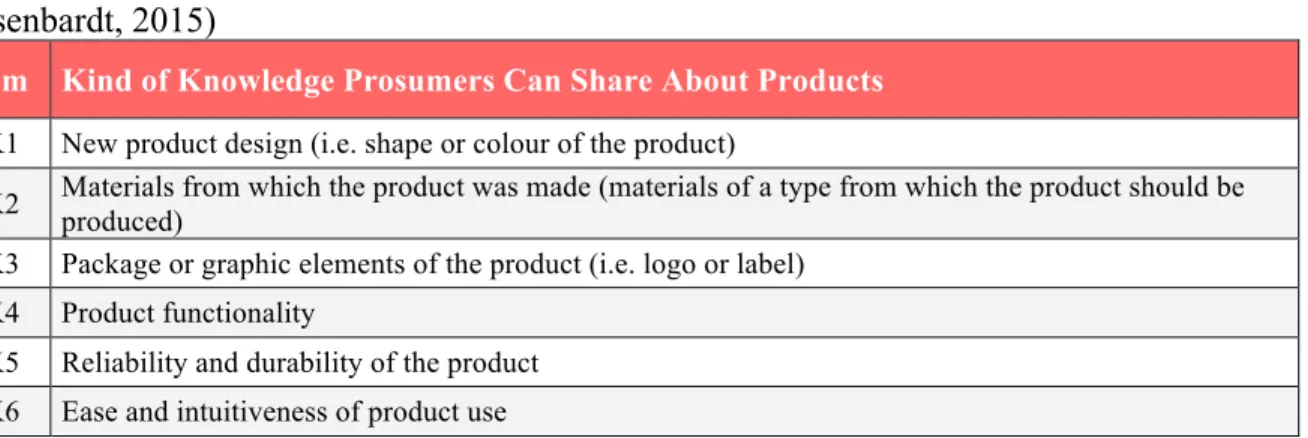
Sharing knowledge in the role of a prosumer can play a vital role in the whole product’s life cycle as they participate in the process as co-creators or even co-producers of products (Ritzer & Jurgenson, 2010; Tapscott & Williams, 2006). Xie, Bargozzi, and Troye (2008) acknowledged that resulting from knowledge sharing, prosumers can use products that more closely fit to their expectations and needs. Thus, prosumers knowledge can be embedded into the business process, especially those of them that are connected with development of products (Aghamirian, Dorri, & Aghamirian, 2015; Trejo, Gutiérrez, & Guzman, 2016). Ziemba and Eisenbardt (2015) explained the basis of the American Productivity and Quality Center (APQC)’s Process Classification Framework (APQC, 2016), and proposed a conceptual framework of prosumers participation in business processes. The framework embraces four operational processes in which prosumers’ knowledge can be notably used, such as: Process 2.0 Develop and Manage Products and Services; Process 3.0 Market and Sell Products and Services; Process 4.0 Deliver Products and Services; and Process 5.0 Manage Customer Service. Their research indicated that prosumers mainly share knowledge for development of products suggesting the close connections to business process 2.0 Develop and Manage Products and Services (Ziemba & Eisenbardt, 2017). Table 1 indicates the kinds of prosumers knowledge connected with business process 2.0.
Table 1: Kinds of Knowledge That Prosumers Can Share About Products (APQC, 2016; Ziemba & Eisenbardt, 2015)
Item Kind of Knowledge Prosumers Can Share About Products
K1 New product design (i.e. shape or colour of the product)
K2 Materials from which the product was made (materials of a type from which the product should be produced)
K3 Package or graphic elements of the product (i.e. logo or label)
K4 Product functionality
K5 Reliability and durability of the product
K6 Ease and intuitiveness of product use
products. Second, performed a thorough analysis, to determine what knowledge about products prosumers share and would like to share. Finally, investigated the different kinds of knowledge about products that prosumers share and would like to share, as well as considering the differences between Poland and United Kingdom (UK) based prosumers. Hence, this study tests whether there are statistically significant differences between knowledge about products that Poland and UK based prosumers share, and similarly whether there are statistically significant differences between knowledge about products that Poland and UK based prosumers would like to share. In practical terms, enterprises gain new insight from these findings with specific reference to Poland and UK based prosumers knowledge sharing about products what may help them to make decisions about which projects and activities they can engage with prosumers for future knowledge sharing. This paper is organized as follows: the research questions and hypotheses followed by the research methodology; then results, analysis, and discussion are provided; while the paper concludes with a summary, limitations, and avenues for future research.
Research Questions and Hypotheses
become more essential (Cui & Wu, 2015; Geri, Gafni, & Bengov, 2017; Panni, 2015; Taherparvar, Esmaeilpour, & Dostar, 2014).
We revealed that despite the wealth of literature on knowledge management, as well as the increasingly growing literature on prosumption, the association between business processes development and prosumers knowledge remains largely unexplored and poorly understood. Some researchers have considered that efficient business processes management is crucial for enterprises and could bring rational consequences (Aghamirian, Dorri, & Aghamirian, 2015; Kania, 2012; Trejo, Gutiérrez, & Guzman, 2016). While others presented research outcomes, which show that prosumers can share knowledge about products and at the same time have an impact on products development (Ziemba & Eisenbardt, 2015, 2015a), however, their participants were from Poland prosumers only. Therefore, their findings are a particular view of Poland prosumers on knowledge sharing with enterprises. After an extensive review of the literature, we were unable identify any detailed study concerning business processes development, especially products development, and prosumers’ knowledge sharing. Furthermore, we have not found papers that focused on comparison of different countries in that matter. Carrying out the research between Poland and UK based prosumers may contribute to greater understanding of prosumers’ knowledge sharing for products development and could help fill the gap in the existing body of knowledge. This paper focuses on addressing the following research questions:
RQ1: What knowledge about products do Poland and UK based prosumers (combined) share?
RQ2: What knowledge about products would Poland and UK based prosumers (combined) like
to share?
RQ3: Are there statistically significant differences in knowledge about products that Poland and UK based prosumers (combined) share and would like to share?
RQ4: What knowledge about products do Poland prosumers share?
RQ5: What knowledge about products do UK based prosumers share?
RQ6: Are there statistically significant differences in knowledge about products that Poland and UK based prosumers share?
RQ7: What knowledge about products would Poland prosumers like to share?
RQ8: What knowledge about products would UK based prosumers like to share?
RQ9: Are there statistically significant differences in knowledge about products that Poland and UK based prosumers would like to share?
Taking into account all above considerations and the above research questions, three research hypotheses were formulated:
H1: There are statistically significant differences in knowledge about products that Poland and UK based prosumers (combined) share and would like to share.
H2: There are statistically significant differences in knowledge about products that Poland and UK based prosumers share.
Figure 1 depicts the graphical combination of research questions with research hypotheses posed for knowledge sharing about products.
RQ1
H1
Main research question:
What kind of knowledge about products do Poland and UK based prosumers share and would like to share?
RQ2
RQ3
RQ4
H2 RQ5
RQ6
RQ7
H3 RQ8
RQ9
Figure 1: Graphical Combination of the Research Questions with Research Hypotheses.
Figure 1 shows that each posited hypothesis was supported by three research questions. That approach enabled us to confirm or to reject the hypotheses and as a result led us to the answer to the main research question.
Research Methodology
Research methods included a critical review of the literature, logical deduction, case studies, a survey questionnaire, and statistical analysis. The research process took the following steps:
Literature: A critical review of existing studies related to ‘prosumption’, ‘prosumer’,
‘customer’, ‘consumer’, ‘knowledge sharing’, ‘business processes’, and ‘products development’ enabled examination of prosumers knowledge sharing to develop and manage products. The review embraces four bibliographic databases: Ebsco, ProQuest, Emerald Management, and ISI Web of Knowledge. In addition, some journals and Web materials dedicated to research on ‘consumption’ and ‘prosumption’ were also explored.
Case Studies: Case studies of prosumers’ knowledge sharing indicated that prosumers can share
their knowledge and at the same time they can develop and manage products (Ziemba & Eisenbardt, 2015). Based on the analysis of literature, as well as the analysis of the above mentioned case studies, the specific kinds of knowledge that they can share about products were proposed.
Pilot: An initial pilot survey instrument was designed in Polish for the Polish participants and
products? This question enabled the division of respondents into consumers (not active in this area) and prosumers (active ones). The survey instrument contained questions concerning specified kinds of knowledge that prosumers can share. The questions were: (1) Please indicate, what were your assessments or comments on products or proposals of product development concerns? (2) If you could, in a free and unlimited way, share your knowledge about products, propose ideas of products developments or ideas for the design of new products – please indicate what would your proposals be concerned with? The former question was directed only to prosumers. The latter was directed to both – consumers and prosumers. The kinds of knowledge about products were listed for these questions (see Table 1). For each listed kind of knowledge the respondents could choose one of five responses, according to a 5-point Likert scale: (1) definitely no, (2) rather no, (3) neither yes nor no, (4) rather yes, (5) definitely yes. In November 2014, the more in-depth pilot survey was conducted in Poland. The purpose was substantive and methodological scrutiny of the questionnaire. To conduct reliability analysis, Cronbach’s coefficient Alpha was used. For all analyzed items the Cronbach’s Alpha was 0.881. According to Hinton (2004), it can be concluded that the scale had high reliability, and it could be used in the research process. Moreover, substantive scrutiny of the survey instrument enabled to perform minor changes to improve the quality of the survey.
CAWI: Applying the Computer-Assisted Web Interview (CAWI) method and employing the
Poland platform Ankietka.pl, and the UK platform Bristol Online Survey (BOS), hosted at the University of Bristol, the survey instrument was uploaded to the website. Data collection took place between the end of December 2014 and March 2015 in Poland, and between February and April 2016 in the UK. In Poland, the designed sample size was 2,500 people, comprising people of different age, gender, and Information and Communication Skills (ICT) skills. In the UK, the online survey letter and URL was initially posted to 1,000 individuals comprising people of different age, gender, and ICT skills, as well as presented to a random sample of the target population. Using online tools permits contact with an accessible audience as the survey appears on search engine lists due to metatags and appropriate placing of keywords. After screening the responses and excluding outliers, there was a final research sample of 783 usable, correct and complete questionnaires from Poland and 171 from the UK. The demographic analysis of the research sample is presented in Table 2.
Reliability: As the process of collecting data was completed, the reliability was calculated. The
Cronbach’s Alpha coefficient with all seven items confirmed a high internal consistency (0.86). In addition, it was determined that the removal of some items would not lead to the significant improvement of internal consistency among items on the scale. Therefore, it was decided that for further analyses all seven items would be used.
Statistical Analyses: In order to answer the research questions and confirm the research
independent samples of observations are drawn from the same or identical distribution. The statistical analysis was made using Microsoft® Excel and Statistica® (ver.13.1) software.
Table 2: Demographic Analysis of the Research Participants (N=954)
Demographic profile
Poland (n1=783) United Kingdom (n2=171)
Number of
Participants Percentage
Number of
Participants Percentage
Gender
Female 599 76.5% 98 57.3%
Male 184 23.5% 73 42.7%
Age
Builders generation: over 65 years old 14 1.8% 8 4.68%
Baby-Boomers generation: 51–65 years old 35 4.5% 25 14.62%
X generation: 36–50 years old 108 13.8% 67 39.18%
Y generation: 21–35 years old 369 47.1% 68 39.77%
Z generation: less than 21 years old 257 32.8% 3 1.75%
Level of education
higher education 217 27.7% 89 52.05%
secondary education 559 71.4% 75 43.86%
less than secondary education 7 0.9% 7 4.09%
Place of residence
city with a population of more than 100,000 419 53.5% 96 56.14%
city with a population of less than 100,000 244 31.2% 53 30.99%
rural area 120 15.3% 22 12.87%
Research Findings
Knowledge About Products that Poland and UK Based Prosumers (Combined) Share and Would Like to Share
The following research questions and hypothesis were posed related to a comparison between knowledge about products that Poland and UK based prosumers (combined) share and would like to share:
RQ1: What knowledge about products do Poland and UK based prosumers (combined) share?
RQ2: What knowledge about products would Poland and UK based prosumers (combined) like
to share?
RQ3: Are there statistically significant differences in knowledge about products that Poland and UK based prosumers (combined) share and would like to share?
H1: There are statistically significant differences in knowledge about products that Poland and UK based prosumers (combined) share and would like to share.
to share knowledge about new product design (Mean=2.72; MDN=2; Mode=2), as well as about package or graphic elements of the product (Mean=2.79; MDN=3; Mode=2). However, it is found that prosumers would like to share knowledge more widely than they are currently sharing. Especially they would like to share knowledge about ease and intuitiveness of product use (Mean=4; MDN=4; Mode=4), and product functionality (Mean=3.95; MDN=4; Mode=4). What is more, the greater difference between means values pertains to new product design, as well as materials from which the product was made, indicating that there is a group of prosumers who are not sharing knowledge about products, nonetheless having such opportunity they would like to be engage in knowledge sharing.
Table 3: Knowledge About Products that Poland and UK Based Prosumers (Combined) Share
Item
Prosumers Share Knowledge Prosumers Would Like to Share Knowledge
Mean MDN Mode SDV CV SK Mean MDN Mode SDV CV SK
K1 2.72 2 2 1.26 0.47 0.57 3.50 4 4 1.19 0.34 -0.42
K2 2.92 3 4 1.22 0.42 -0.89 3.58 4 4 1.13 0.32 -0.37
K3 2.79 3 2 1.24 0.44 0.64 3.19 3 4 1.18 0.37 -0.68
K4 3.63 4 4 1.17 0.32 -0.32 3.95 4 4 1.08 0.27 -0.05
K5 3.48 4 4 1.23 0.35 -0.42 3.87 4 4 1.14 0.29 -0.11
K6 3.55 4 4 1.21 0.34 -0.37 4.00 4 4 1.05 0.26 0.00
K7 3.41 4 4 1.25 0.37 -0.47 3.82 4 4 1.12 0.29 -0.16
Abbreviations used: MDN – median, SD – standard deviation, CV – coefficient of variation, and SK – skewness
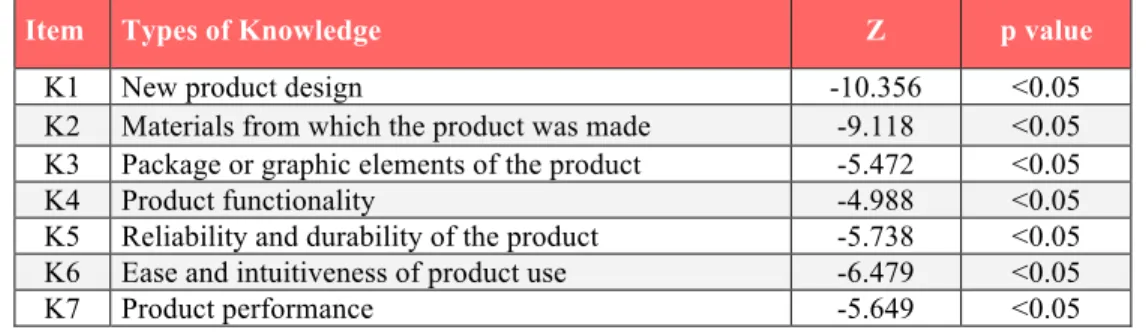
In order to answer RQ3 (Are there statistically significant differences between knowledge about products that Poland and UK based prosumers (combined) share and would like to share?), the Mann-Whitney U test was used. It was used since in this study, two independent samples were analyzed: (1) knowledge about products that prosumers share; and (2) knowledge about products that they would like to share. The analysis results presented in Table 4 show that there were significant differences (p<0.05) for all analyzed items. Thus, H1 was supported.
Table 4: The Mann-Whitney U test results for Knowledge About Products that Poland and UK
Based Prosumers (Combined) Share and Would Like to Share
Item Types of Knowledge Z p value
K1 New product design -10.356 <0.05
K2 Materials from which the product was made -9.118 <0.05
K3 Package or graphic elements of the product -5.472 <0.05
K4 Product functionality -4.988 <0.05
K5 Reliability and durability of the product -5.738 <0.05
K6 Ease and intuitiveness of product use -6.479 <0.05
K7 Product performance -5.649 <0.05
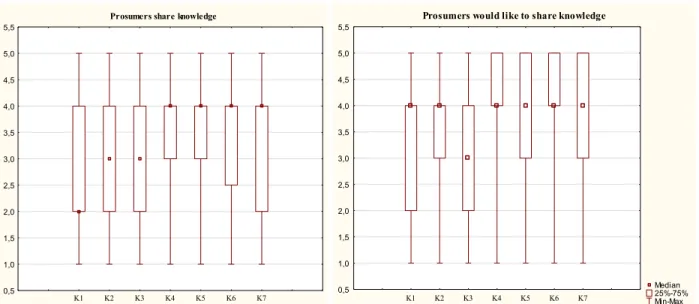
Prosumers share knowledge
K1 K2 K3 K4 K5 K6 K7
0,5 1,0 1,5 2,0 2,5 3,0 3,5 4,0 4,5 5,0 5,5
Prosumers would like to share knowledge
Median 25%-75% Min-Max
K1 K2 K3 K4 K5 K6 K7
0,5 1,0 1,5 2,0 2,5 3,0 3,5 4,0 4,5 5,0 5,5
Figure 2: Knowledge About Products that Poland and UK Based Prosumers (combined) Share
and Would Like to Share The box plots presented in Figure 2 show that:
• There are median differences only in the case of new product design, as well as materials
from which the product was made.
• In general, the values of the first quartile Q1 (25%) are lower in the left box plot in
comparison with the right box plot. It may suggest that prosumers would like to share knowledge about products, especially concerning the materials from which the product was made; product functionality; ease and intuitiveness of product use; as well as product performance, in improved ways than they are currently sharing.
• The values of the third quartile Q3 (75%) in the left box plot do not exceed 4, whilst in
the right box plot they exceed that value in four cases: product functionality; reliability and durability of the product; ease and intuitiveness of product use; as well as product performance. The results indicate that consumers would like to improve their shared knowledge in the future, particularly in those four kinds of knowledge K4, K5, K6 and K7. The language associated with these cases is highly technical, and as a cautionary note this may also result from self-selection bias of the respondents.
Knowledge About Products that Poland and UK Based Prosumers Share
The following research questions and hypothesis were posed related to a comparison in knowledge about products that Poland and UK based prosumers share:
RQ4: What knowledge about products do Poland prosumers share?
RQ5: What knowledge about products do UK based prosumers share?
H2: There are statistically significant differences in knowledge about products that Poland and UK based prosumers share.
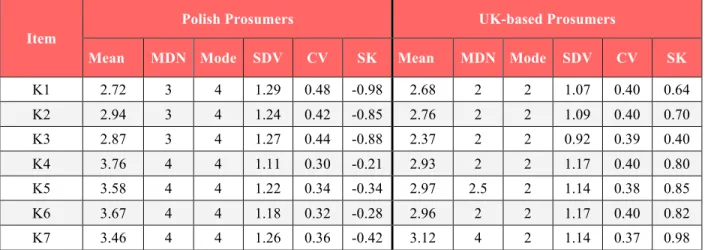
Table 5: Knowledge About Products That Poland and UK Based Prosumers Share
Item
Polish Prosumers UK-based Prosumers
Mean MDN Mode SDV CV SK Mean MDN Mode SDV CV SK
K1 2.72 3 4 1.29 0.48 -0.98 2.68 2 2 1.07 0.40 0.64
K2 2.94 3 4 1.24 0.42 -0.85 2.76 2 2 1.09 0.40 0.70
K3 2.87 3 4 1.27 0.44 -0.88 2.37 2 2 0.92 0.39 0.40
K4 3.76 4 4 1.11 0.30 -0.21 2.93 2 2 1.17 0.40 0.80
K5 3.58 4 4 1.22 0.34 -0.34 2.97 2.5 2 1.14 0.38 0.85
K6 3.67 4 4 1.18 0.32 -0.28 2.96 2 2 1.17 0.40 0.82
K7 3.46 4 4 1.26 0.36 -0.42 3.12 4 2 1.14 0.37 0.98
Abbreviations used: MDN – median, SD – standard deviation, CV – coefficient of variation, and SK – skewness
In order to answer RQ4 and RQ5, a detailed analysis concerning knowledge about products that Poland and UK based prosumers share was completed. The results are presented in Table 5. It was found that Poland prosumers mainly share their knowledge about product functionality (Mean=3.76; MDN=4; Mode=4), ease and intuitiveness of product use (Mean=3.67; MDN=4; Mode=4), and reliability and durability of the product (Mean=3.58; MDN=4; Mode=4). On the other hand, in general UK based prosumers are reluctant to share knowledge – the majority of the median and mode values are 2s, which means that they would rather not to share knowledge about products. If they do that, they only share knowledge about product performance (Mean=3.12; MDN=4; Mode=2). The general analysis of the results shows that Poland prosumers share knowledge more widely than UK based ones. Especially it is clearly visible in the case of product functionality, as well as ease and intuitiveness of product use, when the differences of median values are in the range of 2s.
Table 6: The Mann-Whitney U Test Results for Knowledge About Products That Poland and UK Based Prosumers Share
Item Types of Knowledge Shared Z p value
K1 New product design -0.015 0.988
K2 Materials from which the product was made 1.158 0.247
K3 Package or graphic elements of the product 3.104 <0.05
K4 Product functionality 5.119 <0.05
K5 Reliability and durability of the product 3.916 <0.05
K6 Ease and intuitiveness of product use 4.396 <0.05
K7 Product performance 2.309 <0.05
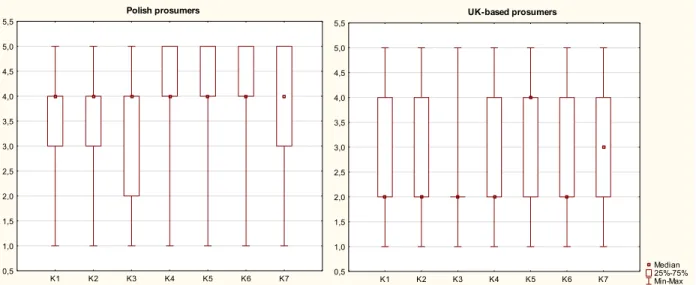
It was decided to perform detailed analysis of knowledge about products that Poland and UK based prosumers share as our intention was to draw a whole picture in that matter. Also here, further analysis was made using box plots. The results are presented in Figure 3.
The box plots presented in Figure 3 show that:
• In all cases (despite product performance) the median values are higher in the case of
Poland prosumers than UK based ones. The median values indicate that UK based prosumers do not have a strong preference to share knowledge about products – as the majority of them have median values of 2.
• Three values of the first quartile Q1 (25%) are higher in the case of Poland prosumers
than UK based ones. This suggests that Poland prosumers share their knowledge about product functionality, reliability and durability of the product, and ease and intuitiveness of product use more often than UK based prosumers.
Polish prosumers
K1 K2 K3 K4 K5 K6 K7
0,5 1,0 1,5 2,0 2,5 3,0 3,5 4,0 4,5 5,0
5,5 UK-based prosumers
Median 25%-75% Min-Max K1 K2 K3 K4 K5 K6 K7
0,5 1,0 1,5 2,0 2,5 3,0 3,5 4,0 4,5 5,0 5,5
Knowledge About Products That Poland and UK Based Prosumers Would Like to Share
The following research questions and hypothesis related to a comparison in knowledge about products that Poland and UK based prosumers would like to share were posed:
RQ7: What knowledge about products would Poland prosumers like to share?
RQ8: What knowledge about products would UK based prosumers like to share?
RQ9: Are there statistically significant differences in knowledge about products that Poland and UK based prosumers would like to share?
H3: There are statistically significant differences in knowledge about products that Poland and UK based prosumers would like to share.
In order to answer the RQ7 and RQ8 a detailed analysis concerning knowledge about products that Poland and UK based prosumers would like to share was completed. The results are presented in Table 7. It is found that Poland prosumers would like to share their knowledge about ease and intuitiveness of product use (Mean=4.23; MDN=4; Mode=5), product functionality (Mean=4.16; MDN=4; Mode=4), as well as product performance (Mean=4.04; MDN=4; Mode=4). On the other hand, UK based prosumers are reluctant to share knowledge – where the majority of the median and mode values are 2, which means that they would not like to share knowledge about products. If they do they would like to share knowledge only about reliability and durability of the product (Mean=3.12; MDN=4; Mode=4). Nonetheless, the general analysis of the results shows that Poland prosumers would like to share knowledge more widely than UK based ones. It is clearly visible in case of: new product design, materials from which the product was made, package or graphic elements of the product, product functionality, as well as ease and intuitiveness of product use, when the differences of median values are equal to 2.
Table 7: Knowledge About Products That Poland and UK Based Prosumers Would Like to
Share
Item
Polish Prosumers UK-based Prosumers
Mean MDN Mode SDV CV SK Mean MDN Mode SDV CV SK
K1 3.62 4 4 1.15 0.32 -0.33 2.93 2 2 1.36 0.40 0.80
K2 3.71 4 4 1.09 0.29 -0.27 2.98 2 2 1.30 0.38 0.86
K3 3.38 4 4 1.15 0.34 -0.54 2.33 2 2 0.88 0.40 0.35
K4 4.16 4 4 0.92 0.22 0.18 2.97 2 2 1.45 0.41 0.81
K5 4.04 4 5 1.07 0.26 -0.90 3.12 4 4 1.40 0.38 -0.75
K6 4.23 4 5 0.86 0.20 -0.89 2.93 2 2 1.32 0.39 0.81
K7 3.99 4 5 1.03 0.26 -0.98 3.04 3 2 1.42 0.39 0.87
Abbreviations used: MDN – median, SD – standard deviation, CV – coefficient of variation, and SK – skewness
was used since there are two independent samples: (a) Poland, and (b) UK based prosumers. The test results presented in Table 8 show that there were significant differences for all analyzed items. Thus, H3 is supported.
Table 8: The Mann-Whitney U Test Results for Knowledge About Products That Poland and
UK Based Prosumers Would Like to Share
Item Types of Knowledge Would like to Share Z p value
K1 New product design 6.470 <0.05
K2 Materials from which the product was made 7.012 <0.05
K3 Package or graphic elements of the product 10.298 <0.05
K4 Product functionality 10.875 <0.05
K5 Reliability and durability of the product 8.868 <0.05
K6 Ease and intuitiveness of product use 12.171 <0.05
K7 Product performance 8.966 <0.05
It was decided to perform a detailed analysis of knowledge about products that Poland and UK based prosumers would like to share as our intention was to draw a complete picture in that matter. The analysis was made using box plots. The results are presented in Figure 4.
Polish prosumers
K1 K2 K3 K4 K5 K6 K7
0,5 1,0 1,5 2,0 2,5 3,0 3,5 4,0 4,5 5,0
5,5 UK-based prosumers
Median 25%-75% Min-Max K1 K2 K3 K4 K5 K6 K7
0,5 1,0 1,5 2,0 2,5 3,0 3,5 4,0 4,5 5,0 5,5
Figure 4: Knowledge About Products That Poland and UK Based Prosumers Would Like to
Share The box plots presented in Figure 4 show that:
• There were median differences between countries for all analyzed items, except
reliability and durability of the product.
• In general, the values (median, first quartile 25%, third quartile 75%, as well as min-
max) for Poland prosumers are higher than these values for UK based prosumers.
• In cases of product functionality, reliability and durability of the product, and ease and
reluctant to share knowledge, except for reliability and durability of the product, when the median value is the highest and is equal to 4.
Discussion of Research Findings
The business environment has embedded Web 2.0 into their marketing strategy and use social media technologies to capture customers’ views, opinions, and early discussions to inform branding and promotional marketing. These tools are important in the bi-directional communication strategy for enhanced prosumer engagement. Further, the educational status of the prosumers tends to be high as indicated in these results and they tend to be heavy technology users (Gerhardt, 2008). The survey responses lead to three research hypotheses formulated and statistically tested. Using the data for Mann-Whitney U test, we were able to show support or non-support for the hypotheses and the results indicated that all three hypotheses were supported. The knowledge sharing process has been categorized to identify distinctive types of knowledge that provides opportunities for business to improve understanding of their customers input into the product development process/cycle (Lee et al., 2006).
This study supports the need for business to recognize the knowledge expected to be shared by prosumers to ensure improved knowledge sharing capabilities and improved engagement with customers. Businesses focus on the market, more particularly the needs of the market, should recognize the results of this study that reports on the role prosumers play in creating value for better as well as improved knowledge sharing about products and services currently on the market or those in the product life cycle. The results compared the prosumers current sharing of knowledge to future willingness to share knowledge with businesses. Box plots for all questions showed that half the scores in a distribution are between the hinges, and this suggests that Polish prosumers engage in sharing all kinds of knowledge during the product cycle; K1,K2, K3, K4, K5, K6, and K7. Whereas UK-based prosumers are less engaged in sharing knowledge than Polish prosumers in K1, K2, K4, but slightly more engaged in K5 and are similarly engaged in K7. This suggests that engaging prosumers from Poland and UK in sharing knowledge about product performance will generate new ideas and should be considered more carefully in the product life cycle. The results also clearly showed that UK-based prosumers do not wish to share knowledge in K3 while Poland prosumers do so (Table 7). This indicates an interesting country specific preference from the prosumers groups (Hafkesbrink & Evers, 2010). Furthermore, the results indicate the types of knowledge generated by consumers that feed back into the upstream activities (Piller, 2008) and the downstream activities (Hafkesbrink & Schroll, 2010), while these activities on the part of the prosumers are largely non technical they are valuable in supporting the perceived needs of the market.
they are still in the early stages of the product life cycle. This study also suggests that K4, K5, K6 and K7 are areas where the product cycle needs careful attention to align and encourage prosumers future knowledge sharing interests. The results clearly show that the UK based consumers who shared knowledge about product performance (K7), in the past are less inclined to share knowledge about product performance in the future. This suggests that there is a need for more refined and focused use of customer engagement and feedback tactics to ensure customer engagement in this nuanced part of the product cycle (Huang et al., 2016). To speculate this may be perhaps because product performance is viewed in the UK as one of the primary drivers for business in competitive markets. There are major differences between Poland and UK consumers and these differences are being observed in K6 and K4 followed by K3. The UK economy has historically been more consumer rich than the Poland economy and so the UK consumers may well be more settled with regard to ease and intuitiveness of product use (K6) and product functionality (K4) than their Poland counterparts for whom consumer acquisitions of certain ranges of products is still a relatively recent and newly developing feature, and for whom it might be understandable that a higher priority is placed upon these fundamental important factors determining why a product is bought. Similarly it may well be a perception on the part of the UK prosumers that packaging and graphic elements (K3) are much more settled issues. However, these results should be treated with caution because there are evidently wide differences between different industrial sectors even within the UK.
There was a clear indication that only one kind of knowledge sharing was a preference for UK based prosumers in the future, that being reliability and durability of the product (K5). The contribution of collaborators in sharing in communities of knowledge was reported by Groh et al. (2010), where they identified that participation may be strengthened by offering incentives as part of community engagement and knowledge sharing. Therefore, incentives may encourage more preferences for knowledge sharing from UK based prosumers in the future. This indicates another interesting country specific preference from the prosumers (Hafkesbrink & Evers, 2010). The findings in this study point to the choices businesses need to make in gauging the types of knowledge that are important in the product and service life cycle development processes and align with those areas where prosumers can engage most often and as a consequence for both parties to gain the most benefits.
Summary and Conclusions
Research Contribution
This work contributes to extant research on prosumers engagement in knowledge sharing by:
• Indicating the cultural knowledge sharing differences between prosumers in countries such
as Poland and UK
• Addressing the types of knowledge that Poland prosumers share and are willing to share in
the future
• Addressing the types of knowledge that UK based prosumers share and are willing to share
in the future
• Identifying significant association between types of knowledge preferences of Poland
knowledge that UK based prosumers would engage in the development process with enterprises in the future.
This work contributes to existing research on prosumption, especially prosumers’ willingness to share knowledge. The specific kinds of knowledge identified in this study relate to the APQC Process Classification Framework (APQC, 2016). Consequently, indicating where the primary focus should be to align prosumer knowledge sharing with product processes to optimise intangible assets. It was interesting in this study that UK based prosumers did not regard engaging in discussions about product packaging elements of the product as useful whereas Poland prosumers saw value in this and strengthened collective ties with enterprises and customers. A second result appears that prosumers expectations vary depending on the types of knowledge offered to them by the enterprises. However, this may be related to how well the interaction is rewarded and managed.
Implication for Research and Practice
This study can be useful for researchers and practitioners. Researchers may use this methodology and do similar analyses with different samples in Poland, the UK, and other countries, additionally many comparisons between different groups and countries can be made. Moreover, the methodology constitutes a very comprehensive basis for identifying the types of knowledge that can encourage prosumers to engage in knowledge sharing, but researchers may develop, verify and improve this methodology and its implementation. In addition, researchers may use these research findings and employ them in studies of enterprises. Furthermore, for practitioners, the results of this study can be used to target the types of knowledge that align closely to the business product processes and optimise the decision outputs gained through knowledge sharing. Limitation and Future Research
References
Aghamirian, B., Dorri, B., & Aghamirian, B. (2013). Effects of customer knowledge
management’s eight factors in e-commerce. Management Science and Engineering, 7(4), 1-11.
APQC. (2016). Process classification framework [online]. Houston: American Productivity and Quality Center. Retrieved from http://www.apqc.org/pcf
Brabham, D. C. (2012). Motivations for participation in a crowdsourcing application to improve public engagement in transit planning. Journal of Applied Communication Research, 40(3), 307-328.
Bylok, F. (2013). Konsumpcja, konsument i społeczeństwo konsumpcyjne we współczesnym świecie [Consumption, the consumer and the consumer society in the modern world]. Katowice: Śląsk.
Calosci, A. (2017). Places, communities and knowledge. You’ll be part of an upcoming exhibition. The Design Journal, 20(1), 3393-3400. https://doi.org/10.1080/ 14606925.2017.1352843
Chesbrough, H.W. (2006). Open innovation: The New Imperative for Creating and Profiting from Technology. Harvard Business Press.
Cui, A.S., & Wu, F. (2015). Utilizing customer knowledge in innovation: antecedents and impact of customer involvement on new product performance. Journal of the Academy of
Marketing Science, 3, 1-23. https://doi.org/10.1007/s11747-015-0433-x
De Long, D.W. (1997). Building the knowledge-based organisation: How culture drives
knowledge behaviors. Boston, MA: Center for Business Innovation, Ernst & Young LLP. Fine, M.B., Gironda, J., & Petrescu, M. (2017). Prosumer motivations for electronic
word-of-mouth communication behaviors. Journal of Hospitality and Tourism Technology, 8(2), 280-295. https://doi.org/10.1108/JHTT-09-2016-0048.
Geri, N., Gafni, R., & Bengov, P. (2017). Crowdsourcing as a business model: extrinsic
motivations for knowledge sharing in user-generated content websites. Journal of Global Operations and Strategic Sourcing 10(1), 90-111. https://doi.org/10.1108/JGOSS-05-2016-0018
Gerhardt, W. (2008). Prosumers: A new growth opportunity. Cisco Internet Business Solutions Group (IBSG). Cisco Systems, Inc.
Glisby, M., & Holden, N. (2003). Contextual constraints in knowledge management theory: the cultural embeddedness of Nonaka's knowledge-creating company. Knowledge and Process Management, 10(1), 29-36.
Gold, A. H., Malhotra, A., & Segars, A.H. (2001). Knowledge management: An organizational capabilities perspective. Journal of Management Information Systems, 18(1), 185-214. Groh, G., Brocco, M., & Asikin, Y.A. (2010). Contribution awareness and fame in open
Competence Management for Open Innovation – Tools and IT-support to unlock the potential of Open Innovation, pp. 115-138. Lohmar-Koln: Josef Eul Verlag.
Hafkesbrink, J., & Evers, J. (2010). Innovation 3.0: Embedding into community knowledge - The relevance of trust as enabling factor for collaborative organizational learning. Proceedings of the XXI ISPIM Conference Bilbao, The Dynamics of Innovation.
Hafkesbrink, J., & Schroll, M. (2010). Organizational competences for open innovation in small and medium sized enterprises of the digital economy’. In Hafkesbrink, J., Hoppe, H.-U., & Schlichter, J. (eds.), Competence management for open innovation – tools and IT-support to unlock the potential of Open Innovation, pp. 21-52. Lohmar-Koln: Josef Eul Verlag.
Hernández-Serrano, M.J., Renés-Arellano, P., Graham, G., Greenhill, A. (2017). From prosumer to prodesigner: Participatory news consumption. Comunicar, 25(50), 77-87.
Hinton, P. (2004). Statistics explained: A guide for social science students. New York, NY: Routledge.
Huang, N., Burtch, G., Hong, Y., & Polman, E. (2016). Effects of multiple psychological
distances on construal and consumer evaluation: A field study of online reviews. Journal of Consumer Psychology, 26(4), 474-482. https://doi.org/10.1016/j.jcps.2016.03.001 Kania, K. (2012). Doskonalenie zarządzania procesami biznesowymi w organizacji z
wykorzystaniem modeli dojrzałości i technologii informacyjno-komunikacyjnych
[Business processes management improving with employing of majority frameworks and ICT]. Katowice: University of Economics Publishing House.
Kayworth, T., & Leidner, D. (2003). Organizational culture as a knowledge resource. In: C.W. Holsapple (Ed.), Handbook on Knowledge Management, 1, pp. 235-252. Berlin: Springer.
Löcker, A.K., Eraßme, D., Jakobs, E.M., Schaar, A.K., Valdez, A.C., & Ziefle. M. (2014). Yet another platform? Motivational factors for using online communities in business contexts. Proceedings of the 5th International Conference on Applied Human Factors and Ergonomics AHFE 2014, pp. 1145-1156. 19-23 July 2014, Krakow, Poland. Nonaka, I., & Takeuchi, H. (2000). Kreowanie wiedzy w organizacji [Knowledge creation in
organizations]. Warszawa: Poltext Press.
Piller, F. (2008). Interactive value creation with users and customers. Retrieved from http://www.mass-customization.de/download/piller_2008-pribilla.pdf.
Planells, A.J. (2015). Video games and the crowdfunding ideology: From the gamer-buyer to the prosumer-investor. Journal of Consumer Culture, 17(3), 620-638.
https://doi.org/10.1177/1469540515611200
Ritzer, G., & Jurgenson, N. (2010). Production, consumption, prosumption: The nature of capitalism in the age of the digital ‘prosumer’. Journal of Consumer Culture, 10(1), 13-36.
Song, E.-J., & Kang, M.-S. (2016). A study on the platform of knowledge integration for customer feedback in B2C service industry. International Journal of Information and Communication Technology, 8(1), 26-36. https://doi.org/10.1504/ ijict.2016.073637 Taherparvar, N., Esmaeilpour, R., & Dostar, M. (2014). Customer knowledge management,
innovation capability, and business performance: A case study of the banking industry. Journal of Knowledge Management, 3(18). Retrieved from
http://www.emeraldinsight.com/journals.htm?issn=1367-3270&volume=18&issue=3 Tapscott, D., & Williams, A.D. (2006). Wikinomics: How mass collaboration changes
everything. New York, NY: Penguin Group.
Trejo, J.M., Gutiérrez, J.S., & Guzman, G.M. (2016). The customer knowledge management and innovation. Contaduría y Administración, 61(3), 456-477. https://doi.org/
10.1016/j.cya.2015.11.011
Tsai, W., Tsai, M., Li, S., & Lin, C. (2012). Harmonizing firms’ knowledge and strategies with organizational capabilities. Journal of Computer Information Systems, 53(1), 23-32. Tseng, S.-M. (2016). The effect of knowledge management capability and customer knowledge
gaps on corporate performance. Journal of Enterprise Information Management, 29(1), 51-71. doi: 10.1108/JEIM-03-2015-0021
Walsh, J. P. Lee, Y.-N., & Nagaoka, S. (2016). Openness and innovation in the US:
Collaboration form, idea generation and implementation. Research Policy, 45(8), 1660-1671. doi: 10.1016/j.respol.2016.04.013
Xie, C., Bagozzi, R.P., & Troye, S.V. (2008). Trying to prosumer: Toward a theory of consumers as co-creators of value. Journal of the Academy of Marketing Science, 36, 109-122. Ziemba, E., Eisenbardt, M. (2017). Utilization of consumers’ knowledge in organizations. In
F. Marimon, M. Mas-Machuca, J. Berbegal-Mirabent, R. Bastida, (Eds.), Proceedings of the 18th European Conference on Knowledge Management ECKM 2017, 2, pp. 1084-1093. Barcelona, International University of Catalonia, September 7-8, 2017.
Ziemba, E., Eisenbardt, M., & Mullins, R. (2017). Use of Information and Communication Technologies for Knowledge Sharing by Polish and UK-Based Prosumers. In Ziemba E. (ed.), Information Technology for Management: New Ideas and Real Solutions. Lecture Notes in Business Information Processing, 277, 49-73. Switzerland: Springer. DOI: 10.1007/978-3-319-53076-5_4
Ziemba, E. & Mullins, R. (2016). Identifying more about customers: the phenomenon of the switch to the knowledge exchange. Online Journal of Applied Knowledge Management, 4(1), 165–179.
Ziemba, E., & Eisenbardt, M. (2015a). Examining prosumers participation in business processes. Polish Journal of Management Studies, 12(1), s. 219-229.
Authors’ Biographies
Ewa Ziemba completed her Ph.D. and Post Ph.D. in Management, with a major focus on
management information systems. She is an Associate Professor at the University of Economics, Katowice, Poland. Her current research focuses on information systems and technologies for business and public administration transformation. She has published over 170 peer-reviewed papers and 18 books, and has played an instrumental role in prestigious Polish and international research projects. Ewa Ziemba serves on the editorial boards of several international journals, is the Founding Editor-in-Chief of The Online Journal of Applied Knowledge Management, the Editor-in-Chief of Journal of Economics and Management, and the Editor of Interdisciplinary Journal of Information, Knowledge, and Management. She is also the Vice President for Research Collaborations of the International Institute for Applied Knowledge Management. Ewa Ziemba has received numerous awards for research and teaching, including The Excellent Award of the President of the University of Economics in Katowice, The Silver Cross of Merit from the President of Poland, The Medal of the National Education Commission from the Ministry of National Education in Poland, The Award of Fellow & Distinguished Scholar and The Excellence in Research & Scholarship Award from the International Institute for Applied Knowledge Management, and several The Best Papers awards.
Monika Eisenbardt completed her Ph.D. with a major focus on management information
systems as well as changes and challenges involving modern consumers. She is an Assistant Professor at the University of Economics in Katowice, Poland. She has published over 30 peer-reviewed pieces including conference papers, book chapters and international journal papers. She has received few Best Paper awards at the international conferences. Her current research focuses on consumers’ knowledge and their willingness to knowledge sharing, as well as knowledge-based organizations. The background of her research is information and communication technologies. Monika serves Editorial Assistant function in Journal of Economics and Management – the official international journal of University of Economics in Katowice. She has received several Best Paper awards at the international conferences.
Roisin Mullins completed her Ph.D. in the development and evaluation of e-learning systems,
learning communities and business training systems. She has published over 50 peer-reviewed pieces including conference papers, book chapters and international journal papers. Roisin Mullins serves on the editorial boards of several international conferences. Her research has emphasized practical solutions to technology problems or novel applications of technology, so that in addition to answering a question, the research outcomes have informed policy and practice guidelines at the European level and decision making processes in the SMEs of EU member countries. She has received several Best Paper awards at the international conferences.
Dariusz Grabara is a Ph.D. student. He completed his MSc. with strong focus on the computer