115
QUERYING DATA IN WEB DATABASE USING AGGREGATE
ESTIMATION WITH E-LEFT DEEP TREE ALGORITHM
D.suganthi
II-ME CSE
SSM College of Engineering, Komarapalayam, Tamil Nadu, India
S.Vimalananthi
Department of Computer Science and Engineering
SSM College of Engineering, Komarapalayam Tamil Nadu, India
ABSTRACT
HIDDEN databases are data repositories ―hidden behind‖ only accessible through a restrictive web search interface. Input capabilities provided by such a web interface range from a simple keyword-search textbox to a complex combination of textboxes, drop-down controls, checkboxes. A large number of web data repositories are hidden behind restrictive web interfaces, making it an important challenge to enable data analytics over these hidden web databases. Most existing techniques assume a form-like web interface which consists solely of categorical attributes. Nonetheless, many real-world web interfaces (of hidden databases) also feature checkbox interfaces—e.g., the specification of a set of desired features, such as A/C, navigation, etc., for a car-search website like Yahoo! Autos. It is found that, for the purpose of data analytics, such checkbox-represented attributes differ fundamentally from the categorical/numerical ones that were traditionally studied. In this study, the problem of data analytics over hidden databases with checkbox interfaces is analyzed. Extensive experiments on both synthetic and real datasets demonstrate the accuracy and efficiency of the proposed algorithms
I-INTRODUCTION
In this paper, we develop novel techniques for estimating and tracking various types of aggregate queries, e.g., COUNT and SUM, over dynamic web databases that are hidden behind proprietary search interfaces and frequently changed. Hidden Web
Databases: Many web databases are ―hidden‖ be- hind restrictive search interfaces that allow a user to specify the desired values for one or a few attributes (i.e., form a conjunctive search query), and return to the user a small number (bounded by a constant k which can be 50 or 100) of tuples that match the user-specified query, selected and ranked according to a proprietary scoring function. Examples of such databases include Yahoo! Autos, Amazon.com, eBay.com, CareerBuilder.com, etc. Problem Motivations: The problem we consider in this paper is how a third party can use the restrictive web interface to estimate and track aggregate query answers over a dynamic web database.
Aggregate queries are the most common type of queries in decision support systems as they enable effective analysis to glean insights from the data.
Tracking the number of tuples in a web database is by itself an important problem. For example, the number of active job postings at Monster.com or listings at realestate.com can provide an economist with real-time indicators of US economy. Similarly, tracking the number of apps in Apple’s App Store and Google Play provides us a continuous understanding of the growth of the two platforms. Note that while some web databases (e.g.,
App Store) periodically publish their sizes for advertisement purposes, such published size is not easily verifiable, and some times doubtful because of the clear incentive for database owners to exaggerate the number
116
To produce unbiased aggregate estimations over the hidden databases with checkbox interfaces and develop the data structure of left-deep-tree.
Define the concept of designated query to form an injective mapping from tuples to queries supported by the web interface.
To reduce the variance of aggregate estimations, we develop the ideas of weighted sampling and special tuple-crawling.
The proposed system main contributions also include a comprehensive set of experiments which demonstrate the effectiveness of enhanced UNBIASED-WEIGHTED-RAWL algorithm on aggregate estimation over real world hidden data- bases with checkbox interface, as well as the effective- ness of each of three ideas on improving the performance of UNBIASED-WEIGHTED-CRAWL.
II-RELATED WORKS
CHENG SHENG [1] stated that a
hidden database refers to a dataset that an organization makes accessible on the web by allowing users to issue queries through a search interface. In other words, data acquisition from such a source is not by following static hyper-links. Instead, data are obtained by querying the interface, and reading the result page dynamically generated. This, with other facts such as the interface may answer a query only partially, has prevented hidden databases from being crawled effectively by existing search engines.
This paper remedies the problem by giving algorithms to extract all the tuples from a hidden database. Our algorithms are provably efficient, namely, they accomplish the task by performing only a small number of queries, even in the worst case. They also establish theoretical results indicating that these algorithms are asymptotically optimal – i.e., it is impossible to improve their efficiency by more than a constant factor. The derivation of our upper and lower bound results reveals significant insight into the characteristics of the underlying problem. Extensive experiments
confirm the proposed techniques work very well on all the real datasets examined.
A. DASGUPTA [2] stated about the growth interest in random sampling from online hidden databases. These databases reside behind form-like web interfaces which allow users to execute search queries by specifying the desired values for certain attributes and the system respond by returning a few tuples that satisfy the selection conditions, sorted by a suitable scoring function. In this paper, they considered the problem of uniform random sampling over such hidden databases. A key challenge is to eliminate the skew of samples incurred by the selective return of highly ranked tuples. To address this challenge, all state-of-the-art samplers share a common approach: they do not use overflowing queries.
SRIRAM RAGHAVAN [3] crawlers
retrieve content only from the publicly index able Web, i.e., the set of Web pages reachable purely by following hypertext links, ignoring search forms and pages that require authorization or prior registration. In particular, they ignore the tremendous amount of high quality content ―hidden‖ behind search forms, in large searchable electronic databases. They address the problem of designing a crawler capable of extracting content from this hidden Web
III-EXISTING SYSTEM
117 interpreted as ‖do-not-care‖ instead of ‖not-containing-v ‖ in the interface.
If one considers a feature as a Boolean attribute, then the checkbox interface places a limitation that only TRUE, not FALSE, can be specified for the attribute.
As a result, it is impossible to apply the existing techniques which require all values of an attribute to be specifiable through the input web interface.
Such databases also have the same limitations as the hidden databases with drop-down-list interface. i.e., (1) a top-k restriction on the number of returned tuples, and (2) a limit on the number of queries one can issue (e.g., per IP address per day) through the web interface.
Cache results of previous queries are not maintained in web server space and so the burden of database server is more.
IV-PROPOSED SYSTEM
Like existing system, the first idea is to organize these overlapping queries in a left-deep-tree data structure which imposes an order of all queries. Based on the order, it is capable of mapping each tuple in the hidden database to exactly one query in the tree, which is referred as the designated query. By performing a drill-down based sampling process over the tree and testing whether a sample query is the designated one for its returned tuple(s), it develops an aggregate estimation algorithm that provides completely unbiased estimates for COUNT and SUM queries.
In addition, (1) a top-k restriction on the number of returned tuples, and (2) a limit on the number of queries one can issue (e.g., per IP address per day) through the web interface. Also, cache results of previous queries are maintained in web server space
A top-k restriction on the number of returned tuples.
A limit on the number of queries one can issue (e.g., per IP address per day) through the web interface.
Cache results of previous queries are maintained in web server space and so eliminated the burden of database server.
V-PERFORMANCES ANALYSIS
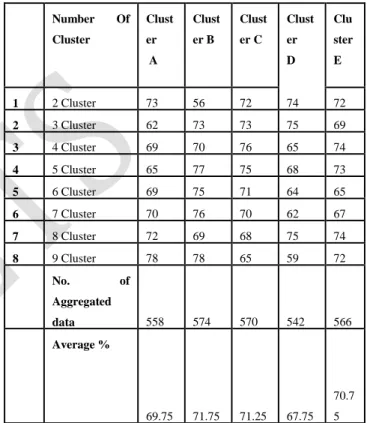
The following Table 6.1 describes experimental result for existing system performance rate analysis. The table contains number of cluster, cluster size and number of aggregated data and average aggregated data details are shown
Number Of
Cluster
Clust
er
A
Clust
er B Clust
er C Clust
er
D
Clu
ster
E
1 2 Cluster 73 56 72 74 72
2 3 Cluster 62 73 73 75 69
3 4 Cluster 69 70 76 65 74
4 5 Cluster 65 77 75 68 73
5 6 Cluster 69 75 71 64 65
6 7 Cluster 70 76 70 62 67
7 8 Cluster 72 69 68 75 74
8 9 Cluster 78 78 65 59 72
No. of
Aggregated
data 558 574 570 542 566
Average %
69.75 71.75 71.25 67.75
70.7
5
Table 6.1 Cluster Size: Existing System and Performance Rate
118
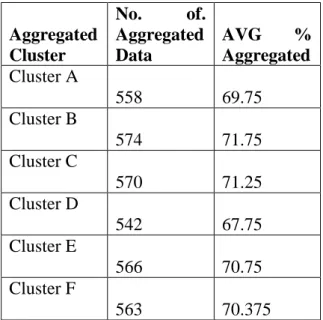
Aggregated Cluster
No. of.
Aggregated Data
AVG %
Aggregated
Cluster A
558 69.75
Cluster B
574 71.75
Cluster C
570 71.25
Cluster D
542 67.75
Cluster E
566 70.75
Cluster F
563 70.375
The following Table 6.3 describes experimental result for proposed system performance rate analysis. The table contains number of cluster, cluster size and number of aggregated data and average aggregated data details are shown
S.NO Number Of Cluster
Cluster A
Cluster B
1 2 Cluster 56 89
2 3 Cluster 67 89
3 4 Cluster 78 68
4 5 Cluster 89 56
5 6 Cluster 56 67
6 7 Cluster 67 72
7 8 Cluster 78 89
8 9 Cluster 89 67
No. Of
Aggregated
Data 580 597
Avg % 72.5 74.625
Table 6.3 Cluster Size: Proposed System And Performance Rate
The following Table 6.4 describes experimental result for existing system over all experimental result analysis. The table contains aggregated cluster, number of aggregated data cluster data and average aggregated data details are shown
Aggregated Cluster
No.Of. Aggregated Data
AVG %
Aggregated
Cluster A
580 72.5
Cluster B 597 74.62
Cluster C 578 72.25
Cluster D 557 69.62
Cluster E 579 72.37
Cluster F 569 71.12
Table 6.4 Overall Experimental Result - Proposed System
The following Fig 6.1 describes experimental result for existing system
aggregated data analyses are
shown.
Existing system for Aggregated data
No. of cluster data
No.Of. Aggregated Data
No.Of. Aggregated Data
558 574 570 542 566 563
Cluster Cluster Cluster Cluster Cluster Cluster
Fig 6.1 Existing System - Aggregated Data
The following Fig 6.2 describes experimental result for proposed data transfers for hybrid method rate analyses are shown.
Data Transfers for Hybrid Methods
Aggregated Data
Aggregated Data 580 597 578 557 579 569
Cluster A Cluster B Cluster C Cluster D Cluster E Cluster F
119 The following Fig 6.2 describes experimental result for existing system aggregation scheme analyses are shown
Fig 6.3 Aggregation Scheme- Existing System
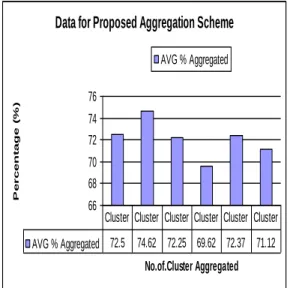
The following Fig 6.4 describes experimental result for proposed system aggregation scheme analyses are shown
Data for Proposed Aggregation Scheme
66 68 70 72 74 76
No.of.Cluster Aggregated
P
e
r
c
e
nt
a
ge
(
%
)
AVG % Aggregated
AVG % Aggregated 72.5 74.62 72.25 69.62 72.37 71.12 Cluster Cluster Cluster Cluster Cluster Cluster
Fig 6.3 Aggregation Scheme- Proposed System
The following table describes experimental result for comparison between existing and proposed aggregation data scheme system. The table contains number of cluster, cluster size and number of aggregated data and average aggregated data in existing and proposed system details are shown
VI-MODULE:
1.ADMIN MODULE
Admin Module is developed only for the Higher Level Executives to create and View all the details of the following options. The admin module includes category entry, items entry and view users.The admin module is used to generate the dataset for the experimental system for aggregate estimation. It is used to add the items information to the data base. Also by using this module, the attribute information will be added into the database.The item details attribute details and user details will be stored and maintained in this module. Change password This module is mainly developed for changing the old password of the administrator. During the modification, the old password and
new password are to be given so that the new password is effective in successive logins.
2.VIEW CATEGORY
View Category module is used to view the categories of various items which are persisted in the database. This module is mainly developed for viewing the category details such as Category id, category.
3.USER MODULE
The user module is used to register the user and the details will be stored into the database. The registered user can able to view the products which are already added form the admin module.User Module is developed for all users even they are not registered in the site. The item categories and item details, item categories are viewed by them.In this module user can able to view the item list by means of selecting the category and top N records from the database or from the web server cache until the access will reach. If the access count will be reached, then the user will not be able to view the item list. Ie (1) a top-k restriction on the number of returned tuples, and (2) a limit on the number of queries one can issue (e.g., per IP address per day) through the web interface.This module also provides an option for changing the old password of the user.
4. SHOPPING LEDGER ENTRIES
The master module contains options for customer entry such as customer no, customer name, address and contact details. The item details such as grocessary item, food product. The master component is used to enter the input of all customer and item details.
5. SHOPPING ACCOUNT ENTRIES
120 purchase details include bill number, date, supplier id and item code, qty, rate, tax percent and amount. The new item can be added in new bill or recent bill. The sales details are same as purchase but stock checking is made. The stock is calculated on purchase –sales-wastage basis. The wastage is same as sales except tax details.
6. VIEW SHOPPING
This module is used to view all the above modules in user convenient. What user thinks to view such details from the above module is very easy and tabular format. The supplier, item, purchase, sales and wastage details are viewed in data grid and can be modified if necessary.
7.LEFT DEEP TREE CONSTRUCTION MODULE
To estimate the size of a hidden database, one insightful idea is to perform the database record (tuple) sampling. Assume that, sample a tuple t with probability p(t), estimate the size of the hidden database as n=1/P(t). The tuple sampling can be achieved by means of query sampling.The hidden data base D has m checkbox attributes as its query interface, one can enumerate that there are in total 2m possible queries, from {}q to {A1 & … & Am}q which are all possible combinations of the m attributes. All of these 2m queries are in the query space. Because if discard any query from them, may not be able to access to some tuples which are only returned by the discarding queries. Every node is corresponding to a query and a directed edge from a node to a child node indicates that the query corresponding to this child node includes all attributes in the parent query and one additional attribute. The root node represents query {}q, while the bottom leaf
8.AGGREGATE ESTIMATION MODULE
This module is used to enabling the aggregate queries over a hidden database with checkbox interface by issuing a small number of queries (sampling) through its web interface.
In this module, an aggregate estimation algorithm is implemented and used that provides completely unbiased estimates for COUNT and SUM queries. unbiased algorithm is executed to perform drilldown sampling with structure-based weight allocation scheme on the left-deep tree. At the same time, visited tuples are gathered into a set T. In the second phase, we
use T to compute p(Ai), for i = 1 to m, and call independent weight allocation to adjust weights of edges. Then, drill-down sampling algorithm is performed with the updated weight allocation of edges, and T is also updated with newly gathered tuples.
The second phase will be recursively executed until the query cost exceeds the query budget. There is a pre-determined pilot budget w to separate the above two phases, where w is the number of queries. When the number of queries exceeds w, the algorithm estimates p(Ai) and adjusts weight allocation accordingly, then performs new drill-down sampling. And the algorithm produces unbiased (for COUNT and SUM) aggregate estimations with small variances with the number of tuples and top-k restrictions.
VII-CONCLUSION
121 worst-case scenario, achieve around 25 percent relative error with 300 queries issued for the synthetic dataset, and less than 10 percent relative error with about 2,500 queries issued for the real-world dataset. The experimental results demonstrate the effectiveness of proposed algorithms.
i) SCOPE FOR FURTHER
ENHANCEMENTS
The paper has the scope for probing the hidden databases since query probing techniques have been widely used in the hidden database. In this area, there are three key related subareas: (1) resource discovery, i.e., the discovery of hidden database URLs from the web, (2) interface understanding, i.e., the proper understanding of how to issue (supported) search queries through a web interface and to extract query answers from the returned web pages, (3) crawling, sampling and data analytics over hidden web databases, which is the most related to our problem. The paper provides a best assistance in the network environment. It allows adding up the following facilities in future. The paper provides an enabling analytics on hidden web database which is a problem that has drawn much attention in proposed system. The application become useful if the below enhancements are made in future.
o If the application is designed as web service, it can be integrated in many network applications.
o The application is developed such that above said enhancements can be integrated with current modules.
REFERENCES
[1] C. Sheng, N. Zhang, Y. Tao, and X. Jin, ―Optimal algorithms for crawling a hidden database in the web,‖ Proc. VLDB Endowment, vol. 5, no. 11, pp. 1112–1123, 2012.
[2] Monster, Job search page [Online]. Available: http://jobsearch. monster.com/ AdvancedSearch.aspx, 2011.
[3] Epicurious, Food search page [Online]. Available: http://www.epicurious.com/ recipesmenus/advancedsearch, 2013.
[4] Homefinder, Home finder page [Online]. Available: http://www.homefinder.com/search, 2013.
[5] A. Dasgupta, X. Jin, B. Jewell, N. Zhang, and G. Das, ―Unbiased estimation of size and other aggregates over hidden web databases,‖ in Proc. Int. Conf.Manage. Data, 2010, pp. 855– 866.
[6] M. Benedikt, G. Gottlob, and P. Senellart, ―Determining relevance of accesses at runtime,‖ in Proc. 30th ACM SIGMOD-SIGACT-SIGART Symp. Principles Database Syst., 2011, pp. 211–222.
[7] M. Benedikt, P. Bourhis, and C. Ley, ―Querying schemas with access restrictions,‖ Proc. VLDB Endowment, vol. 5, no. 7,pp. 634– 645, 2012