www.ijseat.com
Page 260
An Overview of 4G LTE Technologies – A Top down Approach
Sami Ullah1, Attaur Rahman1, Tahir Islam1, Moeedur Rehman1, Itizaz Ahmad1 1Department of Computer Science, Abdul Wali Khan University Mardan, KPK, Pakistan
Email: *[email protected]
Abstract- 4G LTE design began in 2000 and was first implemented in 2010.commercially in DLTE technology introduced December 2009 by teliasonerain Norway and Sweden came to the U.S. in 2010.Data rates and supportable bandwidths much higher in Forth generation and This has a significant in fact on voice. In cellular telecommunications, the term handover or handoff refers to the process of transferring an ongoing call or data session from one channel connected to the core network to another channel.In This paper we provide a comprehensive overview of Long Term Evolution network evolution.4G technologies are designed to provide IP-based voice, data and multimedia streaming at speeds of at least 100 Mbit per second and up to as fast as 1 Gbitper second.
Keywords: LTE, IP-based Communication, FDD, Telecommunication
I. INTRODUCTION
Long haul Evolution, ordinarily advertised as 4G LTE, is a standard for remote correspondence of fast information for cell telephones and information terminals. It depends on the GSM/EDGE and UMTS/HSPA system advances, expanding the limit and speed utilizing an alternate radio interface together with center.
Long haul Evolution and is an enlisted trademark claimed by European Telecommunications Standards Institute) for the remote information correspondences innovation and an advancement of the GSM/UMTS norms. However different countries and organizations do assume a dynamic part in the LTE venture. The objective of LTE was to build the limit and speed of remote information systems utilizing new computerized signal preparing) strategies and regulations that were produced around the turn of the thousand years. A further objective was the upgrade and improvement of the system architectureto an IP-based framework with essentially decreased exchange inactivity looked at tothe 3G engineering [1]. The LTE remote interface is incongruent with 3G and 3G systems, so it must be worked on aseparate radio range.
II. History of LTE
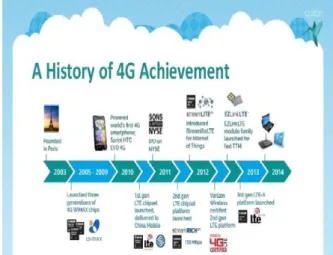
LTE technology introduced commercially in December 2009 by teliasonerain Norway and Sweden came to the U.S. in 2010. That year, Verizon Wireless answered the needs of its customers and revolutionized lives across the United States.Today, 4G LTE enables advanced technologies introduced over the last three years in the fields of transportation, healthcare, small business, enterprise and education. Solutions likein gopayment enable consumers and businesses to experience the power of 4G LTE. Through gopayment, small businesses, such as street vendors, farmers markets and food trucks, can attach a small card reader to a smartphone or tablet, making payment transactions quick and easy for the vendor and customer [2-9]. A brief history is shown in Figure 1.
Figure 1: A History of 4G Technologies
www.ijseat.com
Page 261
operators, allowing commercial deployment of 4GLTE servicesfourth wireless carrier in 2014, which would provide
a. Speed
A theoretical download speed of more than 100Mbps (megabits per second) and 50Mbps upload speed. However, the practical speeds experienced in a real-life scenario and in a commercial network are closer to that of 10Mbps to 30Mbps download speeds and 5Mbps to 10Mbps upload speeds.
3G should be capable of handling around 2 Megabits per second. 4G – The speed and standards of this technology of wireless needs to be at least 100 Megabits per second and up to 1 Gigabit per second to pass as 4G [19-22]
b. Throughput
Extremely low data latency throughputs of 5 milliseconds (ms), which translate to faster response time from network servers, thereby allowing real-time applications such as online stock transaction or gaming to happen without lag.
c. Frequency bands
The LTE standard covers a scope of a wide range of groups, each of which is assigned by both a recurrence and a band number. In North America, 700, 750, 800, 850, 1900, 1700/2100 (AWS), 2300 (WCS) 2500 and 2600 MHzare utilized (groups 2, 4, 7, 12, 13, 17, 25, 26, 41); 2500 MHzin South America; 700, 800, 900, 1800, 2600 MHzin Europe (groups 3, 7, 20); 800, 1800 and 2600 MHzin Asia (groups 1, 3, 5, 7, 8, 11, 13, 40) and 1800 MHzand 2300 MHzin Australia and New Zealand (groups 3, 40). Therefore, telephones from one nation may not work in different nations. Clients will require a multi-band proficient telephone for meandering universally [23-27].
d. Voice calls
In this methodology, LTE just gives information administrations, and when a voice call is to be started or got, it will fall back to the circuit-exchanged space. At the point when utilizing this arrangement, administrators simply need to redesign the MSC as opposed to conveying the IMS, and along these lines, can give benefits rapidly. Notwithstanding, the drawback is longer call setup delay. OFDM (orthogonal Frequency Division Multiplexing): OFDM builds transmission capacity by part an information bearing radio sign into littler sign sets and adjusting each onto an alternate subcarrier, transmitting them all the while at various frequencies. The subcarriers are separated orthogonally and in this way substantial individuals are dispersed orthogonally among the tones, a cyclic prefix is
included, the length of which is more prominent than the normal postponement spread.
Recurrence assorted qualities OFDM can be executed productively by utilizing quick Fourier Transforms (FFTs) at all transmitter and beneficiary.
e. MIMO (Multiple input Multiple output) MIMO is a special diversity technique that increases coverage or data capacity by either transmitting the same data on different antennas or different data on different antennas.
An elite 4G broadband remote portable administration requires different recieving wires be utilized at both the base station and an endorser closes. Various radio wires tech empowers high limits suited for web and sight and sound administrations furthermore syntactically build extent and unwavering quality. Various recieving wires at the transmitter and collector give differing qualities and a cushioning domain by utilizing different radio wires. Various spatial channels are made, making it improbable that all channels blur all the while [28, 29]. With MIMO the channel reaction turns into a framework. Since every tight band bearer can be evened out autonomously, the intricacy of space time equalizer is kept away from.
f. AMC (Adoptive modulation and Coding) The principle of AMC is to change the modulation and coding formats (Transport format) in accordance with instantaneous variations in channel conditions. AMC extends the system’s ability to adopt to Good Channels conditions. Channel conditions should be estimated based on feedback from the receiver. AMC allows different data rates to be assigned to different users, depending on their channel conditions [30-36]. Since channel condition vary over time the receiver collects a set of channels statistics, such as mutilation and coding , signal Bandwidth , signal power , trainingperiod, channelestimation filters , and automatic gain control, which are used by both the transmitter and the receiver to optimize system parameters.
g. Open Broadband Wireless Core: The open wireless platform requires:
Area and power- efficient broadband signals processing for void band wireless applications
The highest industry channel density in flexible new base transceiver station (BST) signal processing architecture.
www.ijseat.com
Page 262
The terminal solution that achieve the highest computational efficiency for application with high flexibility.
Powerful, layered software architecture using the virtual machine programming concept.
h. Advantages of 4G:
1. Support for interactive multimedia services like teleconferencing and wireless internet. 2. Wider bandwidths and higher bit rates 3. Global mobility and service portability. 4. Scalability of mobile network.
5. Entirely packet-Switched networks. 6. Digital network elements.
7. Higher band widths to provide multimedia services at lower cost (up to 100 Mbps). 8. Tight Network Security.
i. Security.
One point of emphasis when creating the 4G LTE network was security. Out of all wireless standards in the world 4G has the most secure network without sacrificing and speed or accessibility. The 4G LTE security was actually pioneered by DAROA, the Defense Advanced Research Projects Agency which is a branch of Department ofdefense (Motorola, 2007).
3. Conclusion
The 4G LTE innovation is nothing not as much as earth shattering. The progression that has been produced using 3G to 4G LTE alone is psyche blowing. With the information preparing rate being expanded to no less than 100 Mb/sec the conceivable outcomes are boundless in the remote correspondence world. Everything with this new innovation has been conveyed to another standard. The security, complete IP-based arrangement permits the client to utilize the full ability of the telephone and also feel totally secure in the meantime; this is a standout amongst the most imperative perspectives that have been redesigned from the past remote correspondence innovations. Even though the hardware and coverage areas aren’t up to paryet though, isn’t that big of a setback. The technology is still considered brand new and will only be improved in the coming years.
REFERENCES
[1]. Khan, F., Bashir, F., & Nakagawa, K. (2012). Dual Head Clustering Scheme in Wireless Sensor Networks. in the IEEE International Conference on Emerging Technologies (pp. 1-8). Islamabad: IEEE Islamabad.
[2]. M. A. Jan, P. Nanda, X. He, Z. Tan and R. P. Liu, “A robust authentication scheme for
observing resources in the internet of things environment” in 13th International Conference on Trust, Security and Privacy in Computing and Communications (TrustCom), pp. 205-211, 2014, IEEE.
[3]. Khan, F., & Nakagawa, K. (2012). Performance Improvement in Cognitive Radio Sensor Networks. in the Institute of Electronics, Information and Communication Engineers (IEICE) , 8.
[4]. M. A. Jan, P. Nanda and X. He, “Energy
Evaluation Model for an Improved Centralized Clustering Hierarchical Algorithm in WSN,” in
Wired/Wireless Internet Communication,
Lecture Notes in Computer Science, pp. 154– 167, Springer, Berlin, Germany, 2013.
[5]. Khan, F., Kamal, S. A., &Arif, F. (2013). Fairness Improvement in long-chain Multi-hop
Wireless Adhoc Networks. International
Conference on Connected Vehicles & Expo (pp. 1-8). Las Vegas: IEEE Las Vegas, USA.
[6]. M. A. Jan, P. Nanda, X. He and R. P. Liu, “Enhancing lifetime and quality of data in cluster-based hierarchical routing protocol for
wireless sensor network”, 2013 IEEE
International Conference on High Performance Computing and Communications & 2013 IEEE International Conference on Embedded and Ubiquitous Computing (HPCC & EUC), pp. 1400-1407, 2013.
[7]. Q. Jabeen, F. Khan, S. Khan and M.A Jan. (2016). Performance Improvement in Multihop
Wireless Mobile Adhoc Networks. in the
Journal Applied, Environmental, and Biological Sciences (JAEBS), vol. 6(4S), pp. 82-92. Print ISSN: 2090-4274 Online ISSN: 2090-4215, TextRoad.
[8]. Khan, F., & Nakagawa, K. (2013). Comparative Study of Spectrum Sensing Techniques in Cognitive Radio Networks. in IEEE World Congress on Communication and Information Technologies (p. 8). Tunisia: IEEE Tunisia.
[9]. Khan, F. (2014). Secure Communication and
Routing Architecture in Wireless Sensor
Networks. the 3rd Global Conference on
Consumer Electronics (GCCE) (p. 4). Tokyo, Japan: IEEE Tokyo.
www.ijseat.com
Page 263
[11].Khan, F. (2014, May). Fairness and throughputimprovement in multihop wireless ad hoc
networks. In Electrical and Computer
Engineering (CCECE), 2014 IEEE 27th Canadian Conference on (pp. 1-6). IEEE.
[12].Mian Ahmad Jan and Muhammad Khan, “A
Survey of Cluster-based Hierarchical Routing Protocols”, in IRACST–International Journal of Computer Networks and Wireless Communications (IJCNWC), Vol.3, April. 2013, pp.138-143.
[13].Khan, S., Khan, F., & Khan, S.A.(2015). Delay and Throughput Improvement in Wireless Sensor and Actor Networks. 5th National
Symposium on Information Technology:
Towards New Smart World (NSITNSW) (pp. 1-8). Riyadh: IEEE Riyad Chapter.
[14].Khan, F., Khan, S., & Khan, S. A. (2015, October). Performance improvement in wireless sensor and actor networks based on actor repositioning. In 2015 International Conference on Connected Vehicles and Expo (ICCVE) (pp. 134-139). IEEE.
[15].Khan, S., Khan, F., Jabeen. Q., Arif. F., & Jan. M. A. (2016). Performance Improvement in Wireless Sensor and Actor Networks. in the Journal Applied, Environmental, and Biological Sciences Print ISSN: 2090-4274 Online ISSN: 2090-4215
[16].Mian Ahmad Jan and Muhammad Khan,
“Denial of Service Attacks and Their Countermeasures in WSN”, in IRACST– International Journal of Computer Networks and Wireless Communications (IJCNWC), Vol.3, April. 2013.
[17].M. A. Jan, P. Nanda, X. He and R. P. Liu, “A
Sybil Attack Detection Scheme for a Centralized Clustering-based Hierarchical Network” in Trustcom/BigDataSE/ISPA, Vol.1, PP-318-325, 2015, IEEE.
[18].Jabeen, Q., Khan, F., Hayat, M.N., Khan, H., Jan., S.R., Ullah, F., (2016) A Survey : Embedded Systems Supporting By Different Operating Systems in the International Journal of Scientific Research in Science, Engineering and Technology(IJSRSET), Print ISSN : 2395-1990, Online ISSN : 2394-4099, Volume 2 Issue 2, pp.664-673.
[19].Syed Roohullah Jan, Syed TauhidUllah Shah, Zia UllahJohar, Yasin Shah, Khan, F., " An Innovative Approach to Investigate Various Software Testing Techniques and Strategies",
International Journal of Scientific Research in
Science, Engineering and
Technology(IJSRSET), Print ISSN : 2395-1990, Online ISSN : 2394-4099, Volume 2 Issue 2, pp.682-689, March-April 2016. URL : http://ijsrset.com/IJSRSET1622210.php
[20].Khan, F., Jan, SR, Tahir, M., & Khan, S., (2015) Applications, Limitations, and Improvements in
Visible Light Communication Systems” In 2015
International Conference on Connected
Vehicles and Expo (ICCVE) (pp. 259-262).
IEEE.
[21].Syed Roohullah Jan, Khan, F., Muhammad
Tahir, Shahzad Khan,, (2016) “Survey: Dealing Non-Functional Requirements At Architecture Level”, VFAST Transactions on Software Engineering, (Accepted 2016)
[22].M. A. Jan, “Energy-efficient routing and secure communication in wireless sensor networks,” Ph.D. dissertation, 2016.
[23]. M. A. Jan, P. Nanda, X. He, and R. P. Liu, “A Lightweight Mutual Authentication Scheme for IoT Objects,” IEEE Transactions on Dependable and Secure Computing (TDSC), “Submitted”, 2016.
[24]. M. A. Jan, P. Nanda, X. He, and R. P. Liu, “A Sybil Attack Detection Scheme for a Forest Wildfire Monitoring Application,” Elsevier Future Generation Computer Systems (FGCS), “Accepted”, 2016.
[25].Puthal, D., Nepal, S., Ranjan, R., & Chen, J. (2015, August). DPBSV--An Efficient and Secure Scheme for Big Sensing Data Stream. InTrustcom/BigDataSE/ISPA, 2015 IEEE (Vol. 1, pp. 246-253). IEEE.
[26].Puthal, D., Nepal, S., Ranjan, R., & Chen, J. (2015). A Dynamic Key Length Based Approach for Real-Time Security Verification
of Big Sensing Data Stream. In Web
Information Systems Engineering–WISE
2015 (pp. 93-108). Springer International
Publishing.
[27].Puthal, D., Nepal, S., Ranjan, R., & Chen, J. (2016). A dynamic prime number based efficient security mechanism for big sensing data streams.Journal of Computer and System Sciences.
www.ijseat.com
Page 264
[29].Puthal, D., Sahoo, B., &Sahoo, B. P. S. (2012).Effective Machine to Machine Communications
in Smart Grid Networks.ARPN J. Syst.
Softw.© 2009-2011 AJSS Journal,2(1), 18-22.
[30]. M. A. Jan, P. Nanda, M. Usman, and X. He, “PAWN: A Payload-based mutual Authentication scheme for Wireless Sensor Networks,” “accepted”, 2016.
[31]. M. Usman, M. A. Jan, and X. He, “Cryptography-based Secure Data Storage and Sharing Using HEVC and Public Clouds,” Elsevier Information sciences, “accepted”, 2016.
[32]. Jan, S. R., Khan, F., &Zaman, A. THE
PERCEPTION OF STUDENTS ABOUT
MOBILE LEARNING AT UNIVERSITY
LEVEL. NO. CONTENTS PAGE NO., 97.
[33]. Khan, F., & Nakagawa, K. (2012). B-8-10 Cooperative Spectrum Sensing Techniques in
Cognitive Radio
Networks. 電子情報通信学会ソサイエティ大
会講演論文集, 2012(2), 152.
[34]. Safdar, M., Khan, I. A., Ullah, F., Khan, F., & Jan, S. R. Comparative Study of Routing Protocols in Mobile Adhoc Networks.
[35].Shahzad Khan, Fazlullah Khan, FahimArif,
QamarJabeen, M.A Jan and S. A Khan (2016). “Performance Improvement in Wireless Sensor and Actor Networks”, Journal of Applied Environmental and Biological Sciences, Vol. 6(4S), pp. 191-200, Print ISSN: 2090-4274 Online ISSN: 2090-4215, TextRoad.
[36]. M. Usman, M. A. Jan, X. He and P. Nanda, “Data Sharing in Secure Multimedia Wireless SensorNetworks,” in 15th IEEE International