129
THE AGRICULTURAL SYSTEM IN BEBA VECHE, TIMIŞ COUNTY
KOCIS ELISABETA, OKROS A, SIMONA NIŢA, CASIANA MIHUŢ, NIŢA L., ANIŞOARA DUMA COPCEA, BOLDEA M. USAMV Timisoara, Calea Aradului,Nr. 119, Timisoara, e-mail: [email protected]
Key words: Beba Veche, agricultural systems, fertility, production, agricultural lands
ABSTRACT
Beba Veche is a locality in Timiş County. Its coordinates in what latitude is concerned are 46° 7' 60 north, 20° 19' east. It lies 81 m above sea level. It is the most western locality in Romania, situated at the border with Serbia and Hungary. The archaeological discoveries made here attest the millenary existence of the locality( Ţărău D., Luca M., 2002).
The agricultural land of the commune is composed of the following: arable 7.767 ha, pastures 976 ha, hay land 3 ha, vineyard 16 ha and orchard 30 ha. As for the fertility classes, for the "arable" land the situation is the following: 1st class 804 ha (9.3%), 2nd class 2193 ha (25.5%), 3rd class 2755 ha (31.9%), 4th class 2777 ha (32.2%) and 5th class 98 ha (1.1%). The limiting factors that influence land quality in this area are represented by the phenomenon of severe salinization (salinization on 6.3% and alkalisation on 34.5% of the surface), low humus content (0.82%). (Puşcă I., 2002)
INTRODUCTION
Agricultural yield has manifested very diverse specific dynamics, both sectorially (vegetal and animal sectors), and regionally, in relation to the diversity of suitability conditions: agricultural conditions, soil and weather.
The degree to which production factors are used also plays an important part in this matter (Toncea I., Alecu I.N., 1999).
Vegetal yield has had a faster growth rhythm, since it requires smaller material and financial efforts, under the conditions of a lack of capital market and advantageous credits. That is why it is advisable to develop the associative and co-operative system for increasing the agriculturists' power of negotiation (Borcean I., Tabără V., David G., Borcean Eugenia, Ţărău D., Borcean A., 1996).
During the last decade, the numbers of animals have been severely reduced, and further reduction that would bring them under the current level, which is the technological minimum, may lead to a compromised gene pool in animal husbandry.
The average productions obtained in animal husbandry are far from the genetic and technological progress happening in western Europe. By comparison, Romanian average productivities are inferior to the ones in other EU countries.
The increase of agriculture as an occupation among the active adult population (9.3 percent) and in gross added value (4.9 percent) gives Romanian economic transition the feature of tentative re-agrarization, with unfavourable implications on the trend of social productivity of work.
130
MATERIAL AND METHOD
For writing this paper, we used data provided by MADR and INSSE, as well as data supplied by Beba Veche Town Hall, and measurements and observations in the field.
RESULTS AND DISCUSSIONS
Beba Veche is a locality in Timiş County, with the latitudinal coordinates 46° 7' 60 north, 20° 19' east. It lies 81 m above sea level. It is the most western locality in Romania, situated at the border with Serbia and Hungary. The archaeological discoveries made here attest the millenary existence of the locality.
The agricultural land of the commune is composed of the following: arable 7.767 ha, pastures 976 ha, hay land 3 ha, vineyard 16 ha and orchard 30 ha.
In terms of quality (fertility) classes, for the "arable" land the situation is the following: Ist class 804 ha (9.3%), IInd class 2193 ha (25.5%), IIIrd class 2755 ha (31.9%), IVth class 2777 ha (32.2%) and Vth class 98 ha (1.1%).
The limiting factors that influence land quality in this area are represented by the phenomenon of severe salinization on 6.3% and alkalisation on 34.5% of the surface, low humus content (0.82%), clayish texture (moderate 48.3% and low 11.20%) and soil settlement (severe 17.61% and moderate 42.13%).
Due to the nature and intensity of the factors that limit and/or restrict agricultural yield, improvement of the productive capacity of soils will be oriented towards promoting and generalizing systems of sustainable agriculture.
This type of agriculture promoted her will be competitive, profitable, ecological and it will involve minimal land works, soil improvement crops, pest control, based on various individual initiatives or international or governmental programs of technical assistance.
Table 1 presents the situation of agricultural lands of commune Beba Veche in 2011. The table 1 and figure 2 shows clearly that the arable lands cover 7793 hectares while agricultural lands cover 8818 ha in total. Pastures cover 976 ha, hay lands 3 ha, grapevine is grown on 16 ha and fruit trees on 30 ha.
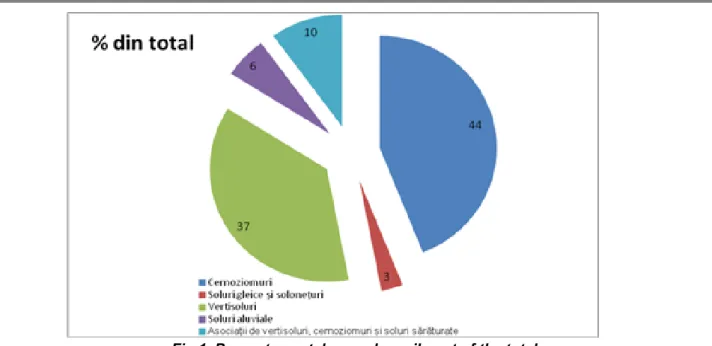
Thus, we can say that the agricultural lands of commune Beba Veche covers the entire range of agricultural uses. These areas can fluctuate with time due to requirements for certain species rather than others or simply due to agriculturists' wish. (fig. 1). The structure of soils in the arable lands belonging to the commune is the following:
1.Chernozems: 44%.
2. Gleyic soils and solonchack: 3% 3. Vertisols: 37%
4. Alluvial soils: 6%
5. Associations of vertisols, chernosems and saline soils: 10% (fig. 2). Crop structure
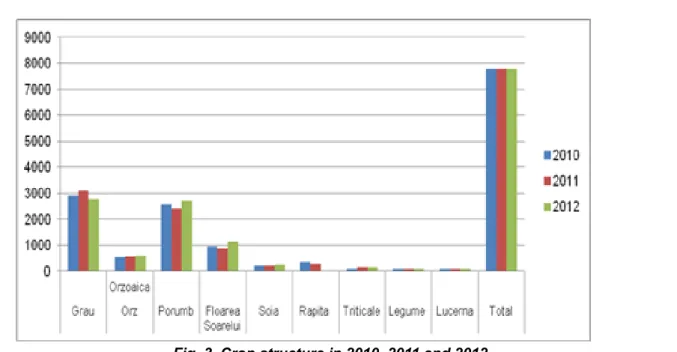
As one can see in table 2 and figure 3, the structure of crops is very varied, covering a wide range of crops.
Thus, in 2010 straw cereals covered 3560 ha. The predominant crop was maize in three consecutive years: in 2010, maize was sown on 2550 ha, in 2011 on 2400 ha (150 ha more than in the previous year) and in 2012 it covered 2725 ha, 325 ha more than in 2011 and 225 ha more than in 2010.
The second crop, in terms of percentage of the land covered, is wheat, with 2920 ha in 2010, 3112 ha in 2011 (an increase of 192 ha) and 2770 ha in 2012, which meant a decrease of 342 ha.
131
conditions (frost), rape crop was totally compromised, and so the area previously covered by rape was used in spring for sowing sunflower and maize.
The surface covered by triticale increased from one year to another; thus, in 2010 it was made up of 100 ha, in 2011 150 ha and in 2012, it covered 135 ha.
Soy is cultivated on a relative constant area, with small fluctuations from one year to another: 2010 - 200 ha, 2011 – 220 ha and in 2012 – 250 ha.
As for vegetables, they covered a wider area every year, from 80 ha in 2010 to 85 ha in 2011 and 100 ha in 2012.
These are the main source of income for the inhabitants of Beba Veche. Fodder plants are found on an area of 75 ha. (Table 2).
In what the technological park of Beba Veche is concerned, we can say that it is varied, covering all requirements for obtaining good crops (from the point of view of both quality and quantity), because the large number of machines and equipments allow us to perform the works at the optimum moment.
Table 1
Situation of agricultural lands in commune Beba Veche 2011
Use Surface (ha)
Arable Pastures Hay lands Vineyards Orchards 7793 976 3 16 30 Total agricultural lands: 8818 Forests, bushes Waters, ponds Non-productive Roads, railroads Constructions 4 216 14 164 189 Total non-agricultural lands: 587
Total general 9405
The technological park is made up of the following machines and equipments:
Tractors from 45 to 65 HP - 12 items;
Tractors from 65 HP - 65 items;
Ploughs - 92 items;
Sowing machines - 49 items;
Harrows - 197 items,
Sowing machines for straw cereals and weeders - 80 items;
Seedling planting machines - 2 items;
Herbicide machines - 25 items;
Self-propelled combines for straw cereals and weeders- 25 items;
132
Fig.1. Percentages taken up by soils out of the total
Fig. 2. Situation of agricultural lands in commune Beba Veche 2011
Table 2. Crop structure in 2010, 2011 and 2012
(data provided by the Agricultural chamber of commune Beba Veche) Year Wheat Barley
Two-row barley
Maize Sunflower Soy Rape Triticale Vegetables Alfalfa Total
2010 2920 540 2550 952 200 350 100 80 75 7767
2011 3112 570 2400 875 220 280 150 85 75 7767
2012 2770 585 2725 1127 250 -- 135 100 75 7767
133
Fig. 3. Crop structure in 2010, 2011 and 2012
CONCLUSIONS
The arable land in Beba Veche is suitable for agricultural crops, enabling people to cultivate a wide range of crop plants.
Nevertheless, limited specialized knowledge, difficulties in capitalizing agricultural products and especially limited economic power of the locals caused wheat, maize and sunflower to be the main crops cultivated in the area.
Smaller areas are cultivated with potatoes, vegetables and sugar cane. The sugar cane crop was dropped because the locals did could not capitalize it.
During our research, we discovered that individual households have small numbers of animals for which part of the vegetal production is used.
The main problem in capitalizing the agricultural yield is the lack of an organized system of distribution.
There are no organized channels of distribution for the main agricultural products, and thus we cannot talk about vertical integration in these channels.
As for supplying seeds, chemical fertilizers and pesticides, there is not an organized market either; some private entrepreneurs perform these activities, via the trading firms they own.
The Ministry of Agriculture is involved in helping agriculturists, through various programmes, such as payments per hectare and crops through APIA (Agency for payments and interventions in agriculture), which directs annually 130 Euro/ha for this purpose, and various measures, such as Measure 112 - Installation of young farmers - which offers 40.000 Euro, non-refundable, to young people under 40 who become farm managers for the first time.
134
BIBLIOGRAPHY
BORCEAN I., TABĂRĂ V., DAVID G., BORCEAN EUGENIA, ŢĂRĂU D., BORCEAN A., 1996 - Zonarea, cultivarea şi protecţia plantelor de câmp în Banat, Ed. Mirton, Timişoara;
POSEA G., 1995 – Câmpia de Vest a României (C. Banato-Crişană), Ed. Fundaţiei
„România Mare”, Bucureşti;
PUŞCĂ I., 2002 - Câmpia Banatului, Fundaţia Naţională „Satul românesc”,
Bucureşti;
TONCEA I., ALECU I.N., 1999, Ingineria sistemelor agricole, Ed. Ceres, Bucureşti,.
ŢĂRĂU D., LUCA M., 2002 - Panoptic al comunelor bănăţene din perspectivă
pedologică, Ed. Marineasa, Timişoara;
xxx, 1966 – Atlasul Climatologic, I.M.H., Bucureşti; xxx, 1976 – Atlasul României, Ed. Academiei, Bucureşti; xxx. Date furnizate de Primăria Beba Veche;
xxx. Date furnizate de staţia meteo Timișoara; xxx. Anuarul statistic al României;
http://www.apmtm.ro/timis.htm;