57
IMPACT EVALUATION OF SOME CROPS INTEGRATED PEST
MANAGEMENT SYSTEMS ON MICROORGANISMS AND SOIL
ARTHROPODS
MIHAELA-MONICA DINU1, ANA-CRISTINA FĂTU1, VIOREL FĂTU1, MARIA IAMANDEI1, SORIN STEFAN1, ANA-MARIA ANDREI1 1 Research-Development Institute for Research-Development Institute for Plant Protection
Key words: soil biodiversity, microorganisms, arthropods
ABSTRACT
The paper presents the results of experiments aimed at determining the ecological functionality of pests management model in order to stimulate the biological control agents in sunflower, barley and peas crops. The environmental quality and bio-monitoring of the experimental parcels by identifying communities of soil microorganisms and arthropod populations was performed. For microbiological characterization of experimental fields, representative samples of soil were collected and analyzed. The main groups of microorganisms isolated from samples analyzed are entomogenic microorganisms belonging to the following genera: Aspergillus, Bacillus, Penicillium, Beauveria, Alternaria, Trichotecium, Trichoderma and Fusarium. Entomological methods of observation and sampling of biological material were used to studied the arthropod populations.
INTRODUCTION
The agricultural management practices could quantitatively and/or qualitatively affect soil biological communities by decreasing the soil capacity to sustain plant health and production. The soil biodiversity studies focused on relationship between specific practices of different agricultural systems and soil functions. In this respect, the paper prepared as a background paper for the Ninth Regular Session of the Commission on Genetic Resources for Food and Agriculture (CGRFA) FAO-Rome (2002) specifies that the management strategies, including tillage, crop rotations and use of plant residues and manure, change in soil habitats and food web alter soil quality or the capacity of the soil to perform its functions; the author, emphasizing on the vital role and functions of soil biodiversity, its importance and value for a sustainable and productive agriculture, considers that the means to create a more favourable environment within soil and soil biological community for crop production involves site-specific decisions concerning crop selection and rotations, tillage, fertilizer, planting practices and crop residues (www.fao.org/.../CGRFA_SoilBiodSustAg.doc).
Brussaard et al. (2007) presented a conceptual diagram relating to plant and soil biodiversity, considering how cropping systems design and management are interrelated. Buckley and Schmidt (2003) reported on the dynamics of the relative abundance of broad bacterial groups in soils under different cultivation regimes. The impact of long-term grassland management systems on microbial community structure in soils was also assessed at the Institute of Grassland and Environmental Research, North Wyke Okehampton (Clegg et al. 2003).
58
practices. Our research objective was to develop optimal solutions for efficient exploitation of biological and technological resources.
In this paper we presented the results of some studies regarding the microorganisms and arthropods occurrence in the experimental field where reduced soil tillage and enrichment with organic material (mulch incorporation into the soil) was practiced.
MATERIAL AND METHOD
An experimental field was exposed to agricultural management system, characterized by successive crops system (barley, peas, sunflower), in three variants: V1: wheat and wheat chemically fertilized, with herbicide (classical technology); V2: autumn barley and pea (pea haulms used as mulch), incorporated into the soil before sowing, with herbicide (improved technology); V3: autumn barley and pea (pea haulms used as mulch), incorporated into the soil before sowing, without herbicide. Chemical fertilization was achieved by applying a complex fertilizer that supplemented the soil with 90 kg nitrogen/ha. Unfertilized and unmulched soil was used as control variant. Soil samples were collected during the third year of experimentation, after the sunflower was harvested;
the samples were analyzed by delimitation of some homogenous analytical units, for every
analytical unit, five soil samples was analyzed, each of it containing 15 partial samples (100 g/sample). The depth of drilling (the analyses limits) was 25 cm and the partial samples were taken diagonally for a uniform reaping. Several simultaneous techniques were used in order to evaluate the quantitative aspects of soil microfungi. The soil sampling procedure for microbiological analyses was in accordance with the methods for research on the ecology of soil-borne plant pathogens (Johnson, 1972). Soil samples were microbiologically analyzed by direct examination technique (Constantinescu, 1974) and by cultivation of microorganisms on selective culture media. Mechanical fragmentation and dispersal of the sporophore hyphae were made in order to obtain monosporal cultures.
Entomological observations and sampling of biological material methods (Barber and Moeriche traps) were used for studying the arthropods population. Comparative data on the composition of arthropod species, biodiversity and entomophagous arthropod population’s role for natural control of sunflower culture pests were obtained in two different eco-pedo-climatic areas (Bucharest and Dobruja areas). The analysis of data was based on structural diversity indices (species richness, relative abundance, frequency etc.) and analytical method (Shannon-Wiener indices, equitability, Soerensen similarity index). T-test variance analysis was used to make observations about the differences between the calculated values of the indices of diversity.
RESULTS AND DISCUSIONS
The environmental quality evaluation in the experimental field was realized by identifying the edaphic community of microorganisms and arthropods population. The quantitative data was analyzed concerning different types of microorganisms isolated from the experimental field. Distribution of microorganisms in different horizons of the soil profile was also monitored. The largest number of microorganisms (bacteria and fungi) was recorded in first soil horizon at a depth ranging between 0-10 cm, and the number obtained was 1.03 x10⁵ fungi/g soil and 6.1x10⁶ bacteria/g soil.
59
from the soil samples belonged to the following genera: Aspergillus, Bacillus, Penicillium, Beauveria, Alternaria, Trichotecium, Trichoderma, Fusarium. The bacteria from the analyzed samples were in microcolonies on the surface of the soil particles and the number of direct counted bacteria/g soil varied between 5.8x10⁷ (classical technology variant) and 20x1011 (improved technology variant).
The analyzed samples of fungi were important part of the microbial biomass identified in soil (Fig. 1). Cultivation technique on selective medium favoured microbial species which grew quickly: those with abundant sporulation and those which can use more effectively nutrients from the environment (Fig. 2).
Fig. 1 Soil sample with fungal colonies Fig. 2 Fungal colonies on selective growth medium
Using non-selective medium led to the simultaneous isolation of bacteria and fungi (Fig. 3). Average number of fungal units able to generate a colony – spores, hyphae or hyphal fragments - was 3.2x10⁵/g soil. Entomopathogenic fungi B. bassiana and B. brongniartii were identified in the analyzed samples (Fig. 4).
Fig. 3 Various microorganisms isolated simultaneously from the same soil
sample
Fig. 4 B. bassiana colonies
Quantitative analyses of the number of colony-forming units/g soil (2.1×10⁴–0.9 x 10⁵) were made. The concentration of nutrients was the variable factor with major effects on the micro-organisms development in the soil. Mycelium growth and conidiogenesis was influenced by nitrogen and organic matter content of the soil (V2). Studies on the microbial biomass and activity in an agricultural soil with different organic matter contents developed in Sweden proved that hyphae diameters and bacterial cell volumes decreased along with decreasing soil organic matter content (Schnurer et al., 1985).
Fungi were not recorded due to significant numerical fluctuations during observation period. This result has led to their classification in category of permanent or constant micro-organisms.
Fig. 5 Microbial colonies adsorbed on soil particles
60
Sunflower agroecosystem is populated by a wide range of arthropod communities (Araneae, Myriapodae, insects, Collembolans and Diplurans).
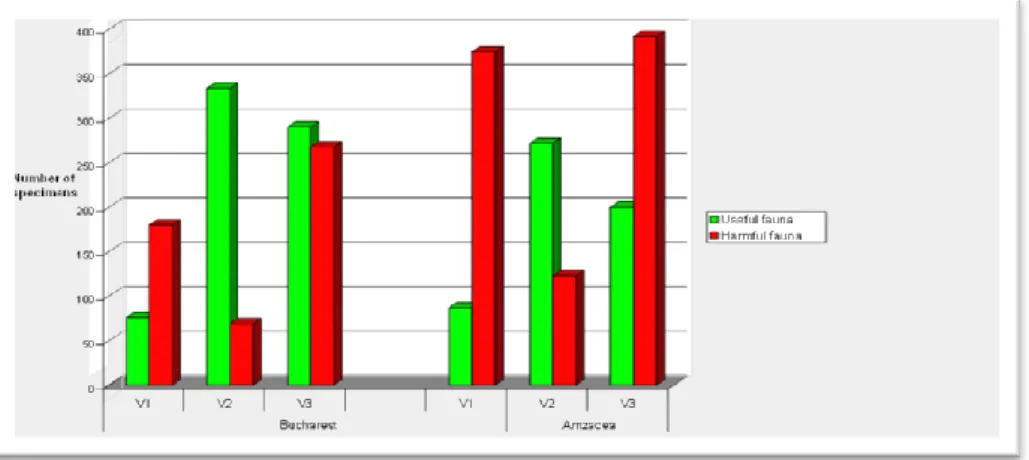
A number of 2549 specimens were collected in experimental fields: 1290 were useful fauna and 1259 were part of the phytophagous component (Table 1). Harmful fauna contained 41 species of 10 families belonging to 4 systematic orders.
Abundance of polyphagous pest of Coleopterans (wire worms, white worms, true weevils and darkling beetle) was found to be dependable on crop technology and connected with the eco-pedo-climatic area; thus, compared to the R.D.P.P.I. Bucharest experimental field.
Phytophagous spectrum from Dobruja was mostly represented by two species of grasshoppers, three species of white worms, two wire worms and two species of true weevils. Also, in all variants, aphidian homoptera were dominant harmful component. Aphis fabae had the higher frequency in Bucharest and Brachycaudus helichrysi species had the higher frequency at Dobruja. In both experimental area, abundance of aphids in V3 (prior technology of barley after peas, using pea haulms as mulch embedded in the soil before sowing, without herbicides) is explained by the presence of the host weeds for these species in the culture.
Fig. 6 shows the ratios of useful fauna structure counted in a number of 30 species from 14 families belonging to 6 systematic orders. Entomophagous species have been a specific category of the fauna, being linked with the host species abundance, particularly with the management method of damaging agents. V2 (technology improved by using pea haulms as mulch embedded in the soil before sowing, with herbicide) registered a useful/harmful fauna ratio favourable to useful component (Fig. 6). This is explained by the repellent effect of pea culture on Tanymecus dilaticollis pest (both by reducing the reserve and by protecting and processing, because it did not require chemical intervention), as well as by biological nitrogen fixation in soil which improved it. The consequence of this enhancement is the increased abundance of collembolans too.
Fig. 6 The ratio between the useful and harmful fauna in experimental fields
Table 1
The number of species
(S) and numerical abundance (A) of groups of arthropods
Sistematic group Dobruja R.D.P.P.I. Bucharest
V1 V2 V3 V1 V2 V3
S A S A S A S A S A S A
Aranea 3 20 5 56 4 60 2 12 5 88 5 93
Collembolla 1 22 2 76 2 44 1 33 2 122 2 95
Diplura Japigidae 1 4 1 12 1 8 0 0 0 0 0 0
Hemiptera Nabidae 0 0 1 2 0 0 0 0 0 0 0 0
61
Coleoptera Carabidae 3 13 8 62 6 47 4 5 7 44 6 28 Coleoptera Coccinellidae 2 7 4 16 4 18 2 4 5 21 6 23
Hymenoptera 1 21 3 46 1 23 1 22 3 59 3 51
Useful fauna - total 11 87 25 272 18 200 10 76 22 334 22 290
Iulidae 1 2 0 0 1 1 1 1 0 0 0 0
Orthoptera Gryllidae 2 4 2 2 2 6 2 2 0 0 1 1
Orthoptera Acrididae 2 7 2 2 2 4 0 0 0 0 0 0
Hemiptera Miridae 1 15 0 0 1 1 1 1 0 0 0 0
Hemiptera Aphididae 16 230 12 87 23 312 14 112 14 55 22 235
Coleoptera Carabidae 1 4 0 0 0 0 0 0 1 1 0 0
Coleoptera Scarabaeidae 3 12 1 3 3 9 0 0 0 0 1 1 Coleoptera Curculionidae 3 87 3 25 3 48 1 54 1 6 1 25
Coleoptera Elateridae 3 6 2 4 1 3 1 1 1 1 0 0
Coleoptera Tenebrionidae 1 11 1 4 1 9 1 10 1 7 1 6
Harmful fauna - total 33 378 23 127 37 393 21 181 18 70 26 268
CONCLUSIONS
Edaphic communities of microorganisms were not affected by agricultural and chemical methods. Bacteria were the most numerous and most active group in the soil and Gram negative bacteria were dominant. The variable factor with major repercussions for the development of microorganisms in the soil was the concentration of nutrients. Biodiversity of harmful or useful arthropods species was heavily influenced by the management procedure used. This fact was revealed by computing diversity indices.
The abundance of species, the dominant component of useful fauna and increased diversity from soil enriched with pea haulms mulch revealed that agro-technical and chemical experimented methods on sunflower crops, barley and peas maintained the balance of natural entomocenotic equilibrium and protection of the biological control factor.
BIBLIOGRAPHY
Andrei Ana-Maria, 1998. Influenta unor factori edafici asupra micopatogenului
Beauveria bassiana (Bals.)Vuill. Analele I.C.P.P., vol. XXIX, pp. 113-118.
Brussard, L., Ruiter, P. and Brown, G., 2007. Soil biodiversity for agricultural sustainability. Agriculture, Ecosystems & Environment, vol. 121 (3), pp. 233-244.
Buckley, D.H and Schmidt, T.M., 2003. Diversity and dynamics of microbial
communities in soils from agro-ecosystems. Environ Microbiol. 5 (6), pp. 441-52
Clegg C.D, Lovell, R. and Hobbs, P. 2003. The impact of grassland management
regime on the community structure of selected bacterial groups in soils. FEMS Microb. Ecol. 43 (2), pp. 263-70.
Constantinescu, O. 1974. Metode şi tehnici în micologie. Ed: Ceres, Bucureşti, pp
26.
Fierer, N. Schimel, J. and Patricia Holden, 2003. Variations in microbial
community composition through two soil depth profiles. Soil biology&Biochemistry, 35, pp.167-176.
Johnson, L., Curl, E., 1972, Methods for research on the ecology of soil-borne plant pathogenesis. Burgess publishing Company, 244 pp.
Schnurer, J., Marianne, C., Rosswall, T., 1985, Microbial biomass and activity in