INTRODUCTION
During the past few decades, various types of oral extended release formulations have been developed to improve the clinical effi cacy of the drug having a short half-life, as well as patient compliance. A critical role for an extended
Formulation and development of multiparticulates dosage form of
propranolol hydrochloride
Niti Yadav
1*, Alka Lohani
11School of Pharmaceutical Sciences, IFTM University, Moradabad, Uttar Pradesh, India
ABSTRACT
Aim: The objective of the present research work was to develop stable extended release (ER) pellets of propranolol hydrochloride, an antihypertensive drug, for which drug release profi le is compared with reference to the multiple conventional dosage form i.e. marketed product “Inderal LA” (160 mg). Method: ER formulations were developed using fl uid bed layering and coating techniques on sugar spheres. Pellets were characterized in reference to the drug content, size distribution, scanning electron microscopy (SEM); dissolution study of various formulations was performed in 1.2 pH HCl buffer for 1.5 hours followed by testing in 6.8 pH phosphate buffer for 24 hours (USP Criteria). Stability studies of the optimized formulation were carried out for a period of 30 days at 40 ± 2°C and 75 ± 5% relative humidity and were found to be stable. SEM photograph confi rmed that the prepared pellets were spherical in nature. The drug content of the formulations was found in the range of 98 to 99.7% and the mean particle size of the drug loaded pellets was in the range of 1190 to 420 μm (F1 to F3 formulation).
Result and Conclusion: Results revealed that EC N50: TEC (90:10) is the best combination of polymer which controls the drug release profi le up to 24 hours. Moreover similarity of release between optimized formulation and Inderal LA was confi rmed by calculation of two factors f1 (difference factor) = 1.95 and f2 (similarity factor) = 99 from the dissolution data. The kinetic data of ER pellets formulation showed good fi t in Korsmeyer-Peppas model and followed by Higuchi kinetic drug release.
Key words: Fluidized bed processor, Fickian, Inderal LA, Non-Fickian, Sugar spheres
*Address for correspondence:
Ms. Niti Yadav, School of Pharmaceutical Sciences, IFTM University, Lodhipur Rajpoot, Delhi Road, (NH-24), Moradabad - 244 102, Uttar Pradesh, India. E-mail: [email protected]
release formulation is in the therapy of cardiovascular disease, whereby the blood level of a medicament must be maintained at the steady state level to achieve the desired therapeutic effect.
As it is well-known, propranolol hydrochloride formulations are effective only for a few hours, because of biological modifi cation and/or elimination of the medication in the body.1 Since the half-life of propranolol hydrochloride is only 3-4 h; therefore, repeated doses must be taken at frequent intervals to obtain a long-term therapeutic level of drug. Furthermore, propranolol hydrochloride usually dissolves readily in the digestive juices and the total dosage is immediately fed into the
Access this article online Journal Sponsor
Website:
www.jyoungpharm.org
DOI:
blood stream. After high initial peak concentrations, the level of drug in the bloodstream constantly decreases because of the biological elimination, so there is little or no therapeutic effect at the end of the period between doses. As a result, the therapeutic effect fluctuates between doses corresponding to the peaks and valleys in the level of drug in the blood.
The most conventional way to make extended release formulation is a tablet. The tablet can be either monolithic matrix tablet or heterogeneous matrix tablet or tablet coated with release controlling membrane. Tablet based matrix formulations have variations in gastric emptying rates and overall transit times leading to intra- and inter-subject variability of plasma profi les. The other way to make extended release formulation is multiparticulates formulation based on pellets or spheroids. Pelletized products not only offer fl exibility in dosage form design and development, but are also utilized to improve the safety and effi cacy of active ingredients or substances. Pellets offer significant therapeutic advantages over single unit dosage forms like matrix-based tablets because pellets disperse freely in the gastrointestinal tract; they invariably maximize drug absorption, reduce peak plasma fl uctuations, and minimize potential side-effects. The pellets also reduce variations in gastric emptying rates and overall transit times. Thus, intra-and inter-subject variability of plasma profi les, which are common with single unit regimens, is minimized.
Hence, there is a need to develop a drug delivery system for propranolol hydrochloride in the form of extended release (ER) multiparticulates,2,3 which can deliver, preferably for 24 h.
In this study, ER pellets of propranolol hydrochloride were formulated and evaluated the ratio of polymers for coating, particle size of pellets and drug release profi le. Hydroxy propyl methyl cellulose (HPMC) E5 and ethyl cellulose (EC) N50 were the polymers used for the coating of drug loaded pellets. Triethyl citrate (TEC) was used as a pore forming agent to modify the release of the drug. Research showed that for drug-layered sugar spheres coated with an aqueous pseudolatex dispersion of EC, drug release was mainly driven by osmosis through aqueous pores and cracks.4 Both highly soluble drug and sugar from the core can contribute signifi cantly to the osmotic pressure gradient5,6 across the rate controlling membrane. This drives the diffusion of water and a buildup of hydrostatic pressure in the core. Consequently, the ER membranes are subjected to tensile stress, which can lead to structural changes and eventual stress cracks
and rupture of the film.7 Formulation development process8,9 had undergone the preformulation studies, formulating the product, optimizing the formula and comparing the in vitro dissolution profi le of the fi nal formulation with the innovator (Inderal LA).
MATERIALS AND METHODS
Materials
Propranolol hydrochloride was obtained from IPCA Laboratories Mumbai, HPME E5 from Colorcon, EC N50 from Aqualon and all other chemicals and ingredients used were of analytical grade.
Methods
Preparation of standard plot at different pH Standard plot of the drug was prepared by ultraviolet (UV) spectrophotometer in the following dissolution media - distilled water, 0.1 N HCl (pH: 1.2) and phosphate buffer pH 6.8.
A stock solution of propranolol hydrochloride having a concentration of 1000 μg/ml was prepared in above-mentioned dissolution media, respectively. Then by appropriate dilution with respective media 20, 40, 60, 80, and 100 μg/ml concentration solution was made from working stock solution and absorbance of their solution was taken at 320 nm, using carry 50 double beam spectrophotometer. A graph between concentration (x-axis) and absorbance (y-axis) was plotted and was found to obey Beer Lambert law.
Solubility
Saturated solubility of the drug was determined by keeping the excess amount of it with dissolution media at 25°C in a mechanical shaker for 24 h, to attain equilibrium. The suspension was filtered and quantified by UV spectrophotometer.
Particle size
The particle size of the drug was determined by a dry dispersion method using Malvern Mastersizer 2000.
Step 1 - Seal coating: 3% seal coating of the sugar spheres were done by preparing 5% w/v solution of HPMC E5 in isopropyl alcohol (IPA): Dichloromethane (DCM)(50:50) and this solution was loaded on to the core sugar pellets. Then, pellets were dried for 15 min at 35-40°C. The seal coated pellets were sieved using a nest of standard sieves (1190, 1000, 850, 710, 590, 500, and 420 μm) shaken for 10 min on a sieve shaker. The pellets retained on each sieve were weighed in order to compare the size range with the innovator, after which loading of the drug was done on those pellets.12
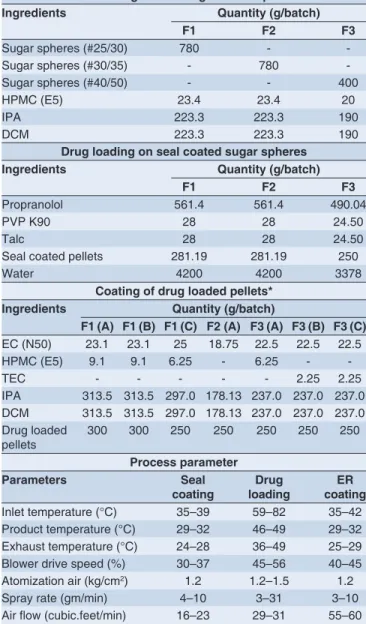
Step 2 - Drug loading: All the ingredients were weighed out as per given formula (Table 1). The required quantity of water was taken and kept it under stirring, polyvinyl pyrrolidone K-90 and propranolol hydrochloride was added to the vortex of the solution under stirring and stirred for 20 min. Then talc was added and stirred for 10 min and the dispersion was passed using nylon cloth (mesh number 20). Finally, drug was loaded using dispersion on the sugar spheres in the chamber of fl uidized bed processor.
Step 3 - ER coating: Required quantity of IPA was taken and HPMC E5/TEC was added to it. Then same amount of DCM so that (IPA:DCM = 50:50) and EC N50 was added under stirring. The solution was ready for ER coating on to the drug loaded sugar spheres. In this study, experimental parameter were fi xed9,13-16 (Table 1).
Drug content determination or assay
Test preparation
277.5 mg of coated pellets (equivalent to 160 mg of propranolol hydrochloride) was swirled in a sonicator with methanol and was centrifuged. 2.5 ml of clear solution was taken and diluted with methanol up to 100 ml. Absorbance was measured by UV spectrophotometer at 320 nm.17
Standard preparation
50 mg of propranolol hydrochloride was taken and diluted up to 100 ml with methanol. 4 ml of the solution was taken and diluted up to 50 ml with methanol. Absorbance was measured by UV spectrophotometer at 320 nm.
Drug content was calculated by following formula:
Quantity of propranolol hydrochloride (mg) in fi nished dosage form (capsule)
(LC/D)* Av/As
L = Labeled quantity of propranolol hydrochloride (mg) in fi nished dosage form (capsule)
C and D were concentration in μg/ml of USP propranolol hydrochloride RS in standard solution and capsule respectively.
Av and AS are the absorbance of the solution from the capsule and the standard solution.
Coated pellet equivalent to 160 mg of propranolol hydrochloride were then fi lled in the hard gelatin capsule.
Micromeritic properties of pellets
Angle of repose (θ) was assessed to know the fl owability of matrix pellets, by a fi xed funnel method. Tap density and bulk Table 1: Composition of formulation
Seal coating of core sugar coated pellets Ingredients Quantity (g/batch)
F1 F2 F3
Sugar spheres (#25/30) 780 - -Sugar spheres (#30/35) - 780 -Sugar spheres (#40/50) - - 400
HPMC (E5) 23.4 23.4 20
IPA 223.3 223.3 190
DCM 223.3 223.3 190
Drug loading on seal coated sugar spheres Ingredients Quantity (g/batch)
F1 F2 F3
Propranolol 561.4 561.4 490.04
PVP K90 28 28 24.50
Talc 28 28 24.50
Seal coated pellets 281.19 281.19 250
Water 4200 4200 3378
Coating of drug loaded pellets* Ingredients Quantity (g/batch)
F1 (A) F1 (B) F1 (C) F2 (A) F3 (A) F3 (B) F3 (C) EC (N50) 23.1 23.1 25 18.75 22.5 22.5 22.5 HPMC (E5) 9.1 9.1 6.25 - 6.25 -
-TEC - - - 2.25 2.25
IPA 313.5 313.5 297.0 178.13 237.0 237.0 237.0 DCM 313.5 313.5 297.0 178.13 237.0 237.0 237.0 Drug loaded
pellets 300 300 250 250 250 250 250 Process parameter
Parameters Seal
coating
Drug loading
ER coating Inlet temperature (°C) 35–39 59–82 35–42 Product temperature (°C) 29–32 46–49 29–32 Exhaust temperature (°C) 24–28 36–49 25–29 Blower drive speed (%) 30–37 45–56 40–45 Atomization air (kg/cm2) 1.2 1.2–1.5 1.2
Spray rate (gm/min) 4–10 3–31 3–10 Air fl ow (cubic.feet/min) 16–23 29–31 55–60
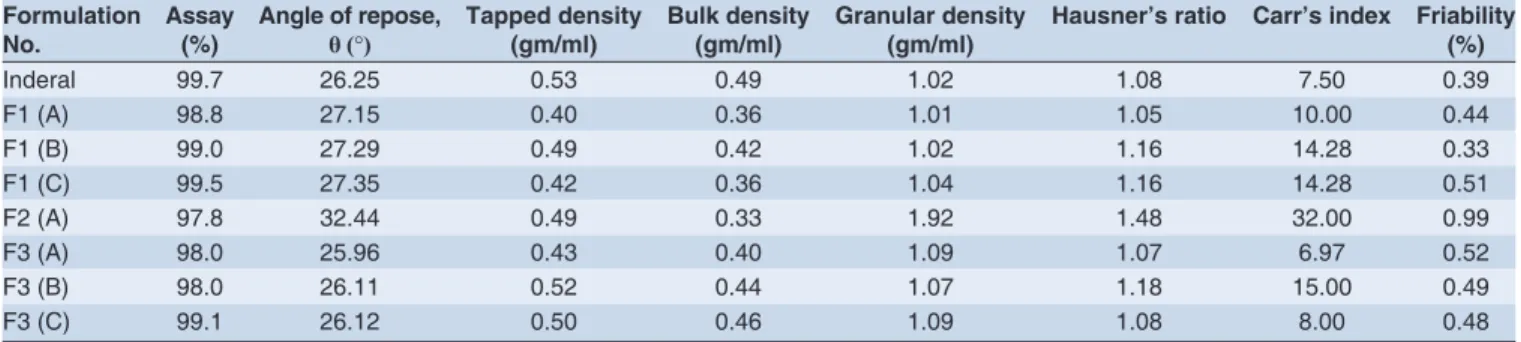
density of the pellets was determined using tap density tester (TDT, Electrolab, India). The granule density of the pellets was determined by the displacement method using petroleum ether. For the friability test, pellets of known mass were placed in a Roche Friability tester (Electro lab Friability tester, EF - 2, India) and subjected to testing at 25 RPM for 4 min (Table 2).
Size distribution
The ER coated pellets were sieved using a nest of standard sieves (1190, 1000, 850, 710, 590, 500, and 420 μm) shaken for 10 min on a sieve shaker. The pellets retained on each sieve were weighed18 (Table 3).
Surface morphology
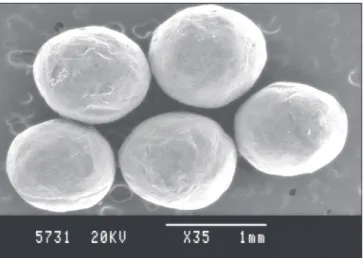
Morphological characteristics of ER pellets were analyzed by scanning electron microscopy (SEM).
In vitro drug release
Dissolution was carried out in USP Apparatus Type I at 320 nm.19-21 In vitro drug release were performed for all the formulations using 0.1N HCl (pH 1.2) for 1.5 h followed by 6.8 pH phosphate buffer as a dissolution medium for 24 h at 37 ± 2°C. The graphs were plotted by taking cumulative percentage drug release versus time.
Drug release kinetic models
Drug release mechanisms and kinetics are the two important characteristics of a drug delivery system in
describing the drug release profi le. To describe the kinetics of the drug release from capsule, mathematical models such as Higuchi, Korsmeyer–Peppas, Zero order, and First order were used.
Stability studies
The stability studies of the optimized formulation were carried out according to International Conference on Harmonization (ICH) guidelines at (40 ± 2°C/75% RH) for 1 month and uses similarity factor (f2) calculation to confi rm this.22
f2 = 50 × log{[1 + (1/n) Σnt =1 (Rt−Tt)2]−0.5 × 100}
RESULT AND DISCUSSION
Characteristics of pure drug
The result of the standard plot in different dissolution media was found to obey Beer Lambert law given in Figure 1.
Studies were conducted and found that propranolol hydrochloride is a highly water soluble drug (146 mg/ml), if not formulated properly may readily release the drug at a faster rate and produces a toxic concentration on oral administration. Particle size of drug determined by the Malvern Mastersizer-2000 found in the range of 70-500 μm (Figure 2).
Table 2: Assay, angle of repose, tapped density, bulk density, granular density, Hausner’s ratio, Carr’s index, friability Formulation
No. Assay (%) Angle of repose, θ (°)
Tapped density
(gm/ml) Bulk density (gm/ml) Granular density (gm/ml) Hausner’s ratio Carr’s index Friability (%)
Inderal 99.7 26.25 0.53 0.49 1.02 1.08 7.50 0.39
F1 (A) 98.8 27.15 0.40 0.36 1.01 1.05 10.00 0.44
F1 (B) 99.0 27.29 0.49 0.42 1.02 1.16 14.28 0.33
F1 (C) 99.5 27.35 0.42 0.36 1.04 1.16 14.28 0.51
F2 (A) 97.8 32.44 0.49 0.33 1.92 1.48 32.00 0.99
F3 (A) 98.0 25.96 0.43 0.40 1.09 1.07 6.97 0.52
F3 (B) 98.0 26.11 0.52 0.44 1.07 1.18 15.00 0.49
F3 (C) 99.1 26.12 0.50 0.46 1.09 1.08 8.00 0.48
Table 3: Characterization of innovator product and formulations
Sieve number Weight retained on sieve (%)
Inderal LA 160 mg F1 (A) F1 (B) F1 (C) F2 (A) F3 (A) F3 (B) F3 (C)
16 (1190 μm) 1 0 2 1 0 0 0 0
18 (1000 μm) 76 79 77 80 0 0 0 0
20 (840 μm) 22 21 21 19 22 0 0 0
25 (710 μm) 1 - - - 18 1 1 1
30 (590 μm) - - - - 50 52 53 55
40 (420 μm) - - - - 10 46 45 45
Evaluation of prepared formulations
Assay
Assay of the drug in pellets indicated that the amount of drug present in the formulation 1-3 was found to be well within the USP specifi cation limits (90-110%) (Table 2). Based on these results, dissolution studies were conducted for formulation 1-3.
In this study, the value of angle of repose, tapped density, granular density, % Carr’s Index, and Hausner’s ratio values indicate good fl ow potential of the pellets. The friability of the propranolol pellet formulation was found to be in the range from 0.33 to 0.99. SEM image Figure 3 shows that the pellets had a satisfactory surface morphology and also the pellets are spherical in nature not dumbbell shaped.23
Pellet size
The result obtained from particle size analysis showed seal coated and drug loaded pellets of F1 formulation have size range of 1190-840 μm, F2 formulation have 840-420 μm
and F3 formulation have size range 710-420 μm. ER coated pellets size ranges were shown in Table 3.
Drug release profile
In this study, EC N 50, HPMC E5 and TEC were used in various ratios in order to control the drug release rate. Dissolution results (Figure 4) obtained from drug release studies showed that F1 (A) formulation prepared from sugar spheres (#25/30) having 11% coating of EC N50: HPMC E5 (70:30) shows faster release when compared with innovator. F1 (B) has 14% coating of the same formulation, now the release rate was controlled, but not comparable to innovator’s drug release profi le. In formulation F1 (C) the ratio of polymers was changed, but now due to increase concentration of EC N50 the release profi le slows down.24
In formulation, F2 sugar spheres (#30/35) were used because as size decreases the surface area to volume ratio of the particle increases, i.e., the release rate increases, Figure 1: Standard plot of propranolol hydrochloride
Figure 2: Particle size distribution of propranolol hydrochloride by Malvern Mastersizer 2000
hence in F2 (A) EC N50 coating was done to control the release, but fi nes generation were more and also the release profi le was found to be inappropriate. In F3 formulation sugar spheres (#40/50) were used because water penetration in the smallest particle is quicker due to short distance from the surface to the center of the particle. F3 (A) has EC N50:HPMC E5 coating, but release rate was faster due to smaller size sugar spheres, so in order to control the release TEC was used instead of HPMC E5 here as TEC ratio decreases release rate decrease, TEC acting as a pore former here and F3 (C) formulation release rate was found comparable to innovator’s release profi le.
Comparison of release profile of optimized formulation with innovator’s product
Similar drug release profi le of optimized formulation with Inderal LA was confi rmed by calculation of two factors, i.e., difference factor (f1) and similarity factor (f2) from the dissolution profi le in 0.1 N HCl for 1.5 h followed by 6.8 pH phosphate buffer.25
f1 = {[Σnt =1 |Rt−Tt|]/[Σnt =1Rt]} × 100
f2 = 50 × log{[1 + (1/n) Σnt =1 (Rt−Tt)2]−0.5 × 100}
Where n is the sampling number,
Rt and Tt are the percent dissolved of the reference and test products at each time point t.
Result of f1 (Difference factor) and f2 (Similarity factor) was found to be 1.95 and 99, respectively. It was found to be within the standards. The standards for similarity factor and difference factor are 50-100 and 0-15.
Drug release kinetics
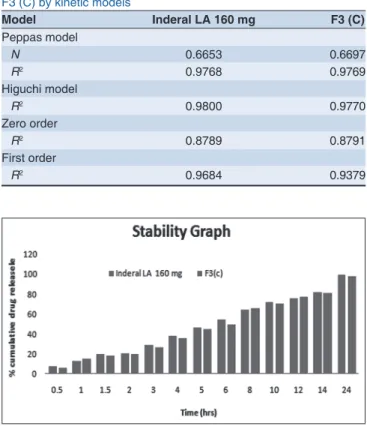
In order to describe the kinetics of the release process of drug from optimized formulation F3 (C) the data were fi tted with different kinetic model such as zero order,
fi rst order, Higuchi, and Korysmeyer–Peppas equation as shown in Table 4. The correlation coeffi cient (R2) of the drug release from optimized formulation predominantly followed Higuchi model indicating diffusion dependent release process. Assuming that the polymeric formulation was non swellable and non-degradable, Peppas equation refers to mechanism of release as Fickian and non-Fickian.26-28 Where n is the release exponent, an indication of the drug release mechanism. Release exponent value (n) of Inderal LA and optimized formulation was 0.665 and 0.669, so both Inderal and optimized formulation shows Fickian i.e., drug is released by diffusion.
Stability studies
The stability studies of the optimized formulation and Inderal LA were carried out according to ICH guidelines at (40 ± 2°C/75% RH) for 1 month29 and found there was no change in the release profi le before and after stability testing, Similarity factor (f2) was found to be 99, respectively i.e., the formulation was stable (Figure 5).
CONCLUSION
From the calculation of f2 (Similarity factor)= 99; f1 (Difference factor)= 1.95, we concluded that the release
Figure 4: Comparative dissolution profi le of different formulations with Inderal LA
Table 4: Comparative study of Inderal LA and optimized formulation F3 (C) by kinetic models
Model Inderal LA 160 mg F3 (C)
Peppas model
N 0.6653 0.6697
R2 0.9768 0.9769
Higuchi model
R2 0.9800 0.9770
Zero order
R2 0.8789 0.8791
First order
R2 0.9684 0.9379
profi le of optimized formulation was comparable to that of the Inderal LA drug release profi le and from the stability studies it was confi rmed that the formulation was stable after 1 month.
REFERENCES
1. Hoffman BB. Catecholamine, Sympathomimetic drugs and adrenergic receptor antagonist. In: Gilman AG, editor. The Pharmacological Basis of Therapeutics. 5th ed. New York: McGraw Hill; 1996. p. 249-54.
2. Halkin H, Vered I, Saginer A, Rabinowitz B. Once daily administration of sustained release propranolol capsules in the treatment of angina pectoris. Eur J Clin Pharmacol 1979;16:387-91.
3. Shivakumar HN, Patel R, Desai BG. Formulation optimization of propranolol hydrochloride microcapsules employing central composite design. Indian J Pharm Sci 2008;70:408-13.
4. Sahoo J, Murthy PN, Biswal S, Sahoo SK, Mahapatra AK. Comparative study of propranolol hydrochloride release from matrix tablets with Kollidon SR or hydroxy propyl methyl cellulose. AAPS Pharm Sci Tech 2008;9:577-82.
5. Bussemer T, Bdmeier R. Multiparticilate pulsatile drug delivery system. In: Benita S, editor. Microencapsulation Method and Industrial Applications. 2nd ed. New York: Marcel Dekker; 1989. p. 79-94.
6. Chien YW. Fundamentals of rate controlled delivery. In: Chien YW, editor. Novel Drug Delivery Systems. 2nd ed. New York: Marcel Dekker; 2000.
p. 55-64.
7. Jantzen GM, Robinson JR. Sustained and controlled release drug delivery systems. In: Swarbrick J, editor. Modern Pharmaceutics. 3rd ed. New York:
Marcel Dekker; 2000. p. 575-95.
8. Cole G, Hogan J, Aulton ME. Film coating material and their properties. In: Mcginity J, editor. Pharmaceutical Coating Technology. 3rd ed. UK: Taylor
and Francis Ltd.; 1995. p. 13-5.
9. Kim MS, Jun SW, Lee S, Lee TW, Park JS, Hwang SJ. The infl uence of Surelease and sodium alginate on the in-vitro release of tamsulosin hydrochloride in pellet dosage form. J Pharm Pharmacol 2005;57:735-42. 10. Patil D, Sajeeth CI, Sirwani R, Santhi K. Modulation of combined release
behaviors from a natural pellets and mini tablets in capsule system. Int J Pharm Biomed Sci 2011;2:649-60.
11. Dashevsky A, Kolter K, Bodmeier R. pH-independent release of a basic drug from pellets coated with the extended release polymer dispersion Kollicoat SR 30 D and the enteric polymer dispersion Kollicoat MAE 30 DP. Eur J Pharm Biopharm 2004;58:45-9.
12. Almadi SN, Azar JZ, Varshosaz J, Ghaffari S, Kobarfard F. Preparation and evaluation of sustained release tramadol. Afr J Pharm Pharamacol 2012;6:2123-32.
13. Hariharan M, Gupta V, Price JC. Optimization of sustained-release tablet
formulations: a four-component mixture experiment. Pharm Dev Technol 1997;2:365-71.
14. Frenning G, Tunón A, Alderborn G. Modelling of drug release from coated granular pellets. J Control Release 2003;92:113-23.
15. Frohoff-Hülsmann MA, Lippold BC, McGinity JW. Aqueous ethyl cellulose dispersion containing plasticizers of different water solubility and hydroxypropyl methyl-cellulose as coating material for diffusion pellets II: properties of sprayed fi lms. Eur J Pharm Biopharm 1999;48:67-75. 16. Siepmann F, Siepmann J, Walther M, MacRae RJ, Bodmeier R. Blends of
aqueous polymer dispersions used for pellet coating: importance of the particle size. J Control Release 2005;105:226-39.
17. FDA-Food and drug Administration, Center for Drug Evaluation and Research (CDER). Guidance for Industry, Dissolution Testing of Immediate Release Solid Oral Dosage Forms, 1997c. Available from: http://www.fda. gov/cder/guidance.htm. [Last Accessed date: 03-05-14].
18. Herman J, Remon JP, Lefebvre R, Bogaert M, Klinger GH, Schwartz JB. The dissolution rate and bioavailability of hydrochlorothiazide in pellet formulations. J Pharm Pharmacol 1988;40:157-60.
19. Banker GS, Anderson NR. Tablets. In: Lachman L, editor. The Theory and Practice of Industrial Pharmacy. 3rd ed. Mumbai: Varghese Publishing
House; 2009. p. 301-3.
20. Ong KT, Rege PR, Rajabi siabhoomi AR. Effect of hyperomellose as a pore former in aqueous ethylcellulose dispersion: Characterization of dispersion properties. Colorcon, USA: Controlled Release Society; 2006. p. 1-4. 21. Ozturk AG, Ozturk SS, Palsson BO, Wheatley TA, Dressman JB. Mechanism
release from pellets coated with an ethyl cellulose based fi lm. J Control Release 1990;14:203-13.
22. Mafadi SE, Hayert M, Poncelet D. Fluidization control in the Wurster coating process. Chem Ind 2003;57:641-4.
23. Wong D, Bodmeier R. Flocculation of aqueous colloidal ethyl cellulose dispersion (Aquacoat) with a water-soluble polymer, hydroxypropyl methyl cellulose. Eur J Pharm Biopharm 1996;42:12-5.
24. Robinson RJ. Controlled release drug delivery systems. In: Gennaro AF, editor. Remington: The Science and Practice of Pharmacy. 20th ed.
New Delhi: B.I. Publications Pvt. Ltd.; 2000. p. 903-7.
25. Vyas P, Khar RK. Controlled Drug Delivery - Concept and Advances. New Delhi: Vallabh Prakashan; 2001. p. 5-25.
26. Ford JL, Mitchell K, Rowe P, Armstrong DJ, Elliott PN, Rostron C, et al. Mathematical modeling of drug release from hydroxypropyl methylcellulose matrices: effect of temperature. Int J Pharm 1991;71:95-104.
27. Higuchi T. Mechanism of sustained-action medication. Theoretical analysis of rate of release of solid drugs dispersed in solid matrices. J Pharm Sci 1963;52:1145-9.
28. Korsmeyer RW, Gurny R, Doelker E, Buri P, Peppas NA. Mechanism of solute release from porous hydrophilic polymers. Int J Pharm 1983;15:25-35. 29. ICH guideline for immediate release, Center for Drug Research (CDER)