Finest Informant Filtering of Malicious Traffic in Intrusion
Detection System
1Palli Rama Krishna ,2K Ravi Kumar
1M.Tech In Computer Science & Engineering , KIET,
2HOD & Assoct. Proff. In Computer Science & Engineering for KIET-W,
Kakinada Institute of Engineering and Technology, Korangi
Abstract:
Traffic volume and diversity will have a major impact on the power of network intrusion detection systems (NIDS) to report malicious activity accurately. Supported the observation that a good deal of traffic is, in fact, not necessary to correct attack identification, we have a tendency to investigate affiliation filtering as a technique for up the performance of NIDS. Filtering capabilities are accessible in access management lists (ACLs). it's generally hold on in Ternary Content available Memory (TCAM), whereas the scale and value of TCAM puts a limit on the amount of filters. Although the filters were restricted in range it still was dear. And henceforward we have a tendency to gift a secured framework for filtering Malicious Traffic. This filtering framework is meant victimization Markov’s Chain model which may be effectively compared with the CRF. The framework is meant such the way that the Markov’s chain model are extensively trained by the system and so concerned within the purpose of filtering malicious traffic in network.
Keywords- Filtering Malicious Traffic, Intrusion Detection System, and CRF based filtering, Network security.
I. Introduction
Task of protective networks from malicious traffics like spammers, bots, web worms, worst-case threats, flash crowds , malicious codes and denial of service attacks (DOS).These are the platform for launching malicious traffic. These activities cause issues on traditional sources, starting from straightforward traffic to operational, money and political harm to official places, organizations, and important infrastructure. In most of those years, they need rising in sophistication, and automation, mostly enabled by botnets, volume, that are used because the platform for launching these attacks. protective a bunch or network from malicious traffic may be a onerous downside that needs the coordination of many complementary parts, together with business, legal and technical solutions at the appliance and levels of business. Filtering support from the network may be a elementary building block during this effort. With this traffic on the increase, the attackers have a keen interest
network attacks against vulnerable services, knowledge driven attacks on applications, host based mostly attacks like privilege step-up, unauthorized logins and access to sensitive files, and viruses Detection system has the inherent necessities to search out the numerous attacks with minimum range of false to defeat the network system. Associate degree correct system which will handle the massive range of malicious traffic and slow within the filtering of specific attacks within the system. to beat the weakness of single prefix-based system the amount of framework are projected, that describes the cooperative use of the network based mostly systems [3].The main purpose of this framework is to spot the supply prefix to filter a malicious attacks. The matter of block malicious traffic on the net via source-based filtering. above all filtering via access management list they're accessible at a routers nowadays, however are a scarce resource as a result of their hold on within the dear Ternary Content available Memory (TCAM).By filtering supply prefixes rather than individual information processing addresses helps to scale back the no of filters, however comes conjointly at the value of block legitimate traffic originating from the filter prefixes. This project shows a way to optimally select that supply prefix to filter for a spread of realistic attack situation and operator policies.
II. Related Work
Computer networks have become an ubiquitous but vulnerable aspect of corporate, university, and government life. Yet the increased complexity of computer networks combined with the ingenuity of attackers means that they remain susceptible to expensive attacks from worms, viruses, Trojans, and other malicious software, which we simply refer to as
malware [1],[2]. Network traffic filtering is one of many security methods available to network administrators. Network traffic filters provide protection by sampling packets or sessions and either comparing their contents to known malware signatures or looking for anomalies likely to be malware. Filtering capabilities have begun to be integrated into routers themselves, so as to reduce hardware deployment costs and to allow for more adaptive security Future traffic filters are expected to be configurable, networked, and even autonomous. The objective in this paper is to investigate the deployment and configuration issues of such devices within an optimization framework. A related and more studied area of research is network monitor placement for traffic measurement. In this paper we make use of the framework introduced by Cantieni et. al. The monitor placement problem. In the mentioned paper, the authors set up various optimization problems using the sum of the squared relative errors of traffic flow sizes as the convex objective function for minimization problems involving
reducing the number of filters necessary to block all attack traffic, but also the undesired effect of blocking legitimate traffic originating from the blocked prefixes (we will call the damage that results from blocking legitimate traffic “collateral damage”). Therefore, filter selection can be viewed as an optimization problem that tries to block as many attack sources with as little collateral damage as possible, given a limited number of filters. Furthermore, several measurement studies have demonstrated that malicious sources exhibit temporal and spatial clustering [5] a feature that can be exploited by prefix-based filtering.
III. Proposed Work
We propose an efficient filtering mechanism in a network using CRF (Conditional Random Field) [6].Generally these CRF are probabilistic systems that are used to model the conditional distribution over a set of random variables. In our framework we use CRF in labeling the malicious nodes.Conditional Random fields (CRFs) is used to model the conditional distribution over a set of random variables.Conditional random fields exploit the sequence structure in the observations without making unwarranted assumptions, which results in better classification [7]. Hence, in Conditional random fields for building intrusion detection systems. The figure 1 shows CRF models with different attributes. It shows inter-dependence between the features which are used to find the conditional dependence.
Figure. CRF model
Protecting a victim (host or network) from malicious traffic is a hard problem that requires the coordination of several complementary components, including nontechnical and technical solutions (at the application and/or network level). Several mechanisms have been proposed. So implementing firewall and access control rules are very tedious because the network has so many vulnerabilities and security issues. The proposed system introduces a new protocol which is named as DROP (Decentralized Rule Optimized Protocol). The decentralized approach provides effective rule matching and verification process in the network while data transmission. Access Control List has also applied in
order to maintain black and white list of users and nodes for effective data restriction. The importance of the DROP protocol is facilitating a solution against filter selection problem.
IV. Problem Definition
Given a policy comprising a set of rules, the goal is to discover and eliminate troublesome rules and find an ordered list of consistent ones while performing the minimum number of comparisons. Formally, the ANOMALY- detection and filter selection problem is defined as follows.
Firewall policy management is a challenging task due to the complexity and interdependency of policy rules. This is further exacerbated by the continuous evolution of network and system environments. It’s also related to knapsack problems. Filter selection belongs to the family of multidimensional knapsack problems. The general KP problem is well-known to be NP-hard. The most relevant variation is the knapsack with cardinality constraint. This study the practical problem of distributed filtering against a flooding attack. The proposed system proves that the problem can be decomposed into several FLOODING problems, which can be solved in a distributed way. Studying filter selection as a resource allocation problem. There are different filters for different events. It deals filter selection optimization leads to novel variations of the multidimensional knapsack problem, malicious traffic finding and unwanted message filtering dynamically, existing system does not Finds and protects a trusted network from an un-trusted network ,Solutions are hardware based. And Time and cost was so high. The Traffic filtering systems proposed earlier for detecting the malicious traffic and spammer, deducts the attack path and the data over the system but fail to preclude data loss. Several filters have used to filter the malicious traffic. But filter selection generated many delay and communication overhead. The data are transmitted in the form of packets from sender to the receiver, at the same time as transmission packet loss occurs and this leaves the system more vulnerable. This allows the spammer to hack the data through packet loss with ease. When the system encounters encrypted traffic, these systems become highly ineffectual. In existing system the filtering systems have implemented on hardware’s. So implementation cost was too high. Access control lists (ACLs) can selectively block traffic based on fields of the IP header. Filters (ACLs) are already available in the routers today but are a scarce resource because they are stored in the expensive ternary content addressable memory (TCAM).
V. Performance Evaluation
correspond to Probe, DoS, R2L, and U2R. For each layer, we then selected a set of features that is sufficient to detect attacks at that particular layer. Feature selection for each layer enhances the performance of the signature based detection.
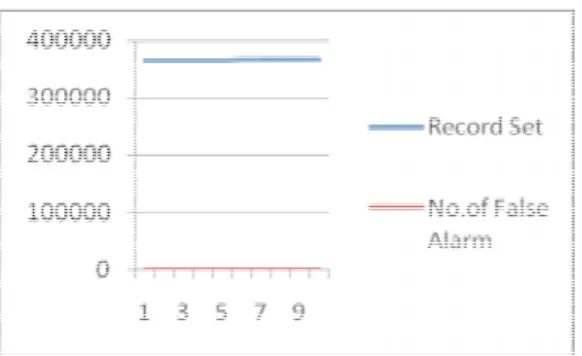
For this analysis we consider ten record set and results for this is as shown in Table.
Sr.
No. Layer SampleRecord set FalseAlarm % AttackDetection
1 Probe 10 03 70
2 DoS 10 00 100
3 R2L 10 00 100
4 U2R 10 00 100
Table 1Result on Different Features and Attacks
From these values we plot the graph for the false alarm rate which is as shown in
Figure 1 to Figure 4VII.
Our results show that this system is more accurate and efficient one.
VI.Results And Discussion
In Traffic Filtering system consider two performance metrics: latency and throughput. Latency is the time between the existing of a request at a server and the completion of the request. Throughput is the number of requests completed per second. The latency and throughput results of the three models are in a 16-node application server. The results are measured as the parameter of the verification for the incoming requests and data.
Since routing systems are much faster than the domain name service in detecting failures and responding to it, network and server failures have only temporary impact on the any cast based server location and load distribution scheme. Additionally, it has no single point of failure or bottleneck as is the case for a connection router. The deficiency of an any cast based scheme, as compared to a connection router, is that it cannot distribute load based on precise information. Achieving these performance benefit in the domain of server Traffic Filtering concept is not a small task, even the load has increased the performance will be effectively.
FIG: Traffic Filtering
The performance impact of Traffic Filtering can be measured in four key areas:
A.Latency,B.Throughput,C.Coverage, D.Security
0 1 2 3 4 5 6 7 8 9 10
Security latency Throughput Coverage
Exisitng
Proposed
Figure 4:
U2R attack
Figure 2:
DoS attack
Figure 3:
R2L attack
The above figure describes the performance comparison between the existing approaches such as optimal source filtering and DROP protocol with the proposed system. That result shows the effectiveness of the proposed system by using three parameters such as latency, throughput and security. The following indicates the detailed results of the proposed system performance.
Figure: performance comparison A.Latency:
In practice, hosts are added to a Network Traffic Filtering cluster in proportion to the request rate as the client load increases. When this is the case, the server may respond later. This will affect the client. This system propose to minimize the latency when the client requesting a file. This can be done by Traffic Filtering scheme which regulates user request and makes the prompt response. Fig2. a shows the average request latency, throughput, coverage and security measurements with the EXISITNG, proposed DROP, and other Traffic filtering modals. EXISITNG shows the worst performance since subsequent requests from a client are not likely to be forwarded to the same server that caches the previous session information of the client. EXISITNG cannot yield good performance. B.Throughput:
Throughput is the average rate of successful message delivery over a communication channel. Network throughput is the sum of the data rates that are delivered to all terminals in a network.Throughputto clients, which increases with additional client traffic that the cluster can handle prior to saturating the cluster hosts (higher is better).
Network Traffic Filtering simultaneously delivers incoming packets to all cluster hosts and applies a filtering algorithm that discards packets on all but the desired host. Filtering imposes less overhead on packet delivery than re-routing, which results in lower response time and higher overall throughput. Network Traffic Filtering scales performance by increasing throughput and minimizing response time to clients. When the capacity of a cluster host is reached, it cannot deliver additional throughput, and response time grows
non-linearly as clients awaiting service encounter queuing delays. Adding another cluster host enables throughput to continue to climb and reduces queuing delays, which minimizes response time. As customer demand for throughput continues to increase, more hosts are added until the network's subnet becomes saturated. At that point, throughput can be further scaled by using multiple Network Traffic Filtering clusters and distributing traffic to them using Round Robin DNS.
C.Coverage:
Dealing the client requests efficiently even the serer load capacity exceeds is more important for every Traffic Filtering scheme. But in the existing proposals existing and ssl_session methods are considering only a limited set of client request. This makes the performance better than the other two schemes.
D.Security:
Sharing the files in the network makes every file available in the sub server. So that the sub server can respond to their clients more effectively. But the security issues may create problems by using sub servers. Preventing those files from the security threads is more important, in this system the files are shared and stored after the encryption, so that security is high than the existing schemes.
The performance of other policies is similar to each other. The efficiency never exceeds 50% of the average load and is below 30% in most cases. Although the number of active connections is a good measure of server load, the amount of data transfer is a more appropriate metric for network load.
The proposed system model shows the performance advantages between the existing system models. The result defines the impact and efficiency of the proposed system. The above topics discussed with the consideration of comparison where the followings are the evaluation of the proposed technique.
From the above results it can observe that EXISITNG shows the worst performance since subsequent requests from a client are not likely to be forwarded to the same server that caches the previous session information of the client. Thus, CPU cycles are wasted to re-authenticate and negotiate keys between a client and a server. The results of EXISITNG show that the techniques of filter selection setup procedure are the main bottleneck in application servers.
Like the latency result, the throughput of existing filter selection is much lower compared to the proposed DROP models. The DROP model also yields a better throughput compared to the existing system as the load increases.
VII. Conclusion:
We introduce a framework for optimal source prefix-based filtering. The framework is rooted at the theory of
the knapsack problem and provides a novel extension to it. Within it, we formulate five practical problems, presented in increasing order of complexity. For each problem, we designed optimal algorithms that are also low-complexity (linear or pseudo-polynomial in the input size). We simulate our algorithms over Dshield.org logs and demonstrate that they bring significant benefit compared to non-optimized filter selection or to generic clustering algorithms. A key insight behind that benefit is that our algorithms exploit the spatial and temporal clustering exhibited by sources of malicious traffic.
References:
1. Understanding ACL on Catalyst 6500 series switches,” Cisco Systems, San Jose, CA, 2003 [Online]. 2. “Protecting your core: Infrastructure protection access control lists,” Cisco Systems, San Jose, CA, 3 M. Collins, T. Shimeall, S. Faber, J. Janies, R.Weaver,M.De Shon, and J. Kadane, “Using uncleanliness to predict future botnet addresses,” in Proc. ACM Internet Meas. Conf., San Diego, CA, Oct. 2007, pp. 93–104.
4. Z. Chen, C. Ji, and P. Barford, “Spatial-temporal characteristics of internet malicious sources,” in Proc. IEEE INFOCOM Mini-Conf., Phoenix, AZ, May 2008, pp. 2306–2314.
5. Z. Mao, V. Sekar, O. Spatscheck, J. Van Der Merwe, and R. Vasudevan, “Analyzing large DDoS attacks using multiple data sources,” in Proc. ACM SIGCOMM Workshop Large-Scale Attack Defense, Pisa, Italy, Sep. 2006, pp. 161–168.
6. A. Ramachandran and N. Feamster, “Understanding the network-level behavior of spammers,” in Proc. ACM SIGCOMM, Pisa, Italy, Sep. 2006, pp. 291–302. 7. S. Venkataraman, S. Sen, O. Spatscheck, P. Haffner, and D. Song, “Exploiting network structure for proactive spam mitigation,” presented at the USENIX Security Symp., Boston, MA, Aug. 2007.
8. Y. Xie, F. Yu, K. Achan, E. Gillum, M. Goldszmidt, and T. Wobber, “How dynamic are IP addresses?,” in Proc. ACM SIGCOMM, Kyoto, Japan, Aug. 2007, pp. 301–312.
9. J. Zhang, P. Porras, and J. Ullrich, “Highly predictive blacklisting,” presented at the USENIX Security Symp., San Jose, CA, Jul. 2008.
Authors:
Mr.Palli Rama Krishnais a student of Kakinada Institute of Engineering and Technology, Kakinada. Presently I am pursuing my M.Tech [Computer Science Engineering] from this college. My area of interest includes Computer networks and Programing languages.