Finno-Ugric Languages and Linguistics Vol. 6. No. 2. (2017), 80–105. http://full.btk.ppke.hu ISSN: 2063-8825
David Ogren
The article describes the ways in which various aspectual characteristics and markers affect the total vs. partial object alternation in Estonian da-infinitive constructions, where object case usage is far less consistent than it is in finite clauses. The variation in object case in these constructions can be seen as a case of competing motivations, where some elements of the sentence support the use of the total object and others the use of the partial object. Using corpus data, the article explores the interplay between different constructions and aspectual features, revealing a considerable degree of construction-specificity: while some aspectual features prove significant for object case in all the constructions examined, others may have a substantial impact on object case in one da -infinitive construction but no impact at all in another construction. Moreover, aside from the core criteria which condition the use of the partitive object in all constructions in Estonian (including finite clauses), none of the relationships between aspect and object case in da-infinitive constructions are anywhere close to absolute. Finally, attention is drawn to the notion of the partitive as the default object case and how this default status manifests itself in da-infinitive constructions as compared to finite clauses.
Keywords: aspect, competing motivations, differential object marking, infinitives, variation
1 Introduction
This paper explores a relatively under-researched phenomenon in Estonian: the irregular variation in object case in da-infinitive constructions and its relationship with aspect. The paper illustrates the differences between finite clauses and da-infinitive constructions with regard to the role of aspect in object marking, demonstrates that the relationship between aspect and object case in da-infinitive constructions cannot be described solely by means of the concept of “boundedness” as commonly understood, and presents quantitative data showing the impact of various aspect-related features on object case in these constructions. As expected, features that facilitate imperfective readings (e.g. durativity and distributivity) are associated with increased partial object use, and features that facilitate perfective readings (e.g. perfective particles and destination adverbials) are associated with reduced partial object use; however, the extent of these aspectual features’ influence on object case varies from one construction to another, and none of them can be said to require a particular case for the object, but merely to increase the likelihood that one or another form will be used. The relationship between aspect and object case is therefore much less consistent in da-infinitive constructions than it is in finite clauses.
∗
1.1 Object case in Estonian: the basic rules
Estonian, like other Finnic languages, distinguishes between total and partial objects. The total object (in the nominative or genitive case, depending on the construction) appears when all of the following conditions are met: a) the object modifies an affirmative verb form, b) the object is quantitatively bounded, and c) the verb expresses a bounded action. If any of the above conditions are not met, the partial object (partitive case) is used. (Metslang 2017: 266) In other words, the total object is only used under certain special circumstances, and in all other instances, the partial object is used. Accordingly, some researchers have regarded the partitive as the default object case (see e.g. Vainikka & Maling 1996, discussing Finnish, as well as Lees 2015, discussing Finnic languages in general).
Clearly, the rules for object case as outlined above depend heavily on the concept of “boundedness”, the precise nature of which, for both objects and actions, has long been a popular object of study (see Kont 1963, Pihlak 1985a, 1985b and Tamm 2004, 2012, 2014, among others). It encompasses not only perfectivity (temporal boundedness, i.e. whether the action is conceptualized as completed or in progress), but also telicity (whether or not the event contains an inherent terminal point), as there are many verbs that, due to their intrinsic atelicity, govern partitive objects even if the action is explicitly temporally bounded.1 These include verbs expressing feelings or sensory perceptions, for instance the verb armastama ‘to love’, as in example (1) below:2
(1) Armastasin
teda/*tema
kaks aastat. love.PST.1SG 3SG.PART/*3SG.TOT3 two.NOM year.PART ‘I loved him/her for two years.’The telicity criterion also incorporates the quantitative boundedness of the object, as events with quantitatively unbounded objects (e.g. “I ate some soup”, “he bought books”, etc.) lack a set terminal point and are therefore atelic.
Based on these rules, we can clearly describe the role of verbal/situational aspect in the determination of object case: given an affirmative sentence describing a telic event, the total object expresses perfectivity and the partial object expresses imperfectivity. This opposition is shown in examples (2) and (3) below:
(2) Ema lõikas
tordi
lahti. mother.NOM cut.PST.3SG cake.TOT open‘Mother cut the cake.’ (perfective)
1 In this paper, the terms boundedness, perfectivity, and telicity are to be understood as indicated above: perfectivity is synonymous with “completedness”, telicity is the property of having an inherent terminal point, and situational boundedness is the combination of perfectivity and telicity: a situation is bounded if and only if it is both perfective and telic. A more detailed discussion of the terminology regarding these and other related distinctions can be found in Chapter 3 of Tamm (2012).
2 Abbreviations: ABL = ablative, ADE = adessive, ALL = allative, CMP = comparative, COM = comitative, CON = converb, COND = conditional, DIM = diminutive, ELA = elative, GEN = genitive, ILL = illative, IMP = imperative, INE = inessive, INF = infinitive, NEG = negation, NOM = nominative, PART = partitive, IMP = impersonal, PP = perfective particle, PRS = present, PST = past, PTCP = participle, SUP = supine, TOT = total object form, TRANS = translative
(3) Ema lõikas
torti
lahti. mother.NOM cut.PST.3SG cake.PART open‘Mother was cutting the cake.’ (imperfective)
1.2 Object case in infinitive constructions
Previous studies of the relationship between aspect and object case in Finnic languages have focused overwhelmingly on finite clauses, where there is a very clear difference in meaning between the partial and the total object (as shown in the translations of examples (2) and (3) above). However, non-finites, especially infinitives, present additional complications for analysis. As will be shown in this paper, the crucial parameter of perfectivity, which is relatively straightforward to assess in the case of finite verb forms, is less clear and less salient when the verb form in question is an infinitive. As such, the relationship between aspect and object case is less transparent.
Moreover, the peripheral, non-prototypical nature of non-finite constructions makes them less stable than simple sentences with finite verb forms: “Category margins are vulnerable to linguistic change because they can have a double, and many times doubtful, categorical interpretation, a fact which creates permanent potential structural ambiguity” (Company 2002: 203). Accordingly, object case in non-finite constructions varies in ways not seen in finite clauses, variation which cannot be explained by the simple aspectual opposition illustrated in (2) and (3).
Consider examples (4) and (5) below, constructed on the model of (2) and (3), but with the object now modifying an infinitive.
(4) Ema tahtis
tordi
lahti lõigata. mother.NOM want.PST.3SG cake.TOT out cut.INF ‘Mother wanted to cut the cake.’(5) Ema tahtis
torti
lahti lõigata. mother.NOM want.PST.3SG cake.PART out cut.INF ‘Mother wanted to cut the cake.’Erelt (2006: 42) states that in such sentences, both the total and the partial object can be used, and the possible difference in interpretation is negligible. It is true that, if the activity of cutting the cake is conceptualized as imperfective, the partial object would be required, and this is indeed a possible interpretation; however, it is a rather unlikely one, essentially implying that Mother’s desire was merely to be engaged in the activity of cutting the cake, not to produce any result. In any case, even if Mother’s desire was to actually cut the entire cake and produce the expected result, the partial object would still be possible, because the non-finite clause is subordinate to the finite form tahtis ‘wanted’, the intrinsic atelicity of which encourages the use of the partial object.4
Thus, in infinitive constructions, the relationship between aspect and object case is inconsistent even when the object nominal is bounded (unlike in finite clauses, where the
relationship is consistent because the aspectual interpretation of the sentence is determined by the object case itself). While the use of the total object does indeed indicate that the event described in the infinitive phrase is interpreted as bounded, the reverse is not true: the use of the partial object does not by itself reveal whether the event described in the infinitive phrase is construed as bounded or unbounded (assuming that the event is telic, “bounded or unbounded” can be replaced here by “perfective or imperfective”). Therefore, there is no clearly identifiable difference in meaning between the partial and the total object in such cases. As a consequence, when the partial object is used (unless, again, the object is quantitatively unbounded and/or the verb is intrinsically atelic, conditions which trigger the use of the partial object in all constructions, whether finite or non-finite), the event described in the da-infinitive phrase is ambiguous with respect to the boundedness criterion.5
Unfortunately, this means that it is impossible to conclude anything on the basis of such sentences about how aspect is computed in infinitival clauses, since the result of that computation (i.e. the actual aspectual interpretation of the infinitival clause) remains unclear. Accordingly, the focus of this paper is not on the computation of aspect per se; I do not seek here to re-define the notion of boundedness. Rather, my focus is on variation in object marking associated with more peripheral aspectual indicators, those that do not by themselves suffice to declare a situation bounded or unbounded.
1.3 Aims and structure of the paper
This paper presents a corpus-based investigation of the relationship between aspect and object case in Estonian constructions featuring da-infinitive verb forms describing telic events. It explores the influence of a variety of aspectual phenomena on object case, from characteristics such as distributivity and durativity to explicit aspect markers (perfective particles). The paper seeks to determine 1) which aspectual features have the largest impact on object case in da-infinitive constructions and 2) how da-infinitive constructions differ from one another, as well as from finite clauses, with respect to the impact of these aspectual features on object case. Throughout the paper, comparisons will be made between da-infinitive constructions and finite clauses, highlighting the different, irregular usage observed in the former.
The paper is divided into eight sections. Section 2 gives an overview of the various aspectual properties and oppositions which have been discussed in previous literature on aspect in Finnic languages and introduces the particular da-infinitive constructions that will be examined in the paper. Section 3 summarizes the data and methods used in the study. Sections 4–7 examine the relationships between individual aspectual features/oppositions and object case in these constructions. The findings of the paper are summarized in section 8.
2 Background: Estonian
da
-infinitive constructions and aspectual parametersThe Estonian da-infinitive is a “neutral” form that merely expresses an action without conveying any clear temporal meaning. It appears in a wide variety of grammatical roles, including:
a) subject, e.g. Mõtelda on mõnus ‘Thinking is pleasurable’;
b) object, e.g. Katsu selle peale mitte
mõtelda ‘Try not
to think about that’;c) predicative, e.g. Jüri ainus siht on edasi
jõuda ‘Jüri’s only aim is
to move forward’; d) attribute, e.g. Maris tärkas kihk plehkupanna
‘An urge to scamper away arose inMari’
(Erelt et al. 2007: 263–265)
In all of the roles shown above, the da-infinitive form may take an object.
This paper examines four common da-infinitive constructions, previously described in Penjam (2008) and Ogren (2015a: 286–287), which often occur with objects. They are as follows:
i) The purpose construction (otstarbe- ja põhjuslausekonstruktsioon), in which a non-finite subordinate clause expresses the purpose or reason for doing something (Penjam 2008: 117):
(6) Jaan läheb metsa, et
tappa
põde
r. Jaan.NOM go.PRS.3SG forest.ILL to kill.INF moose.TOT ‘Jaan is going into the forest to kill a moose.’ii) The assessment construction (hinnangukonstruktsioon), consisting of a da-infinitive phrase in subject position and an adjectival predicate expressing the speaker’s assessment of the activity described by the infinitive phrase (Penjam 2008: 117):
(7) On parem
osta
odav arvuti
.be.PRS.3SG good.CMP.NOM buy.INF cheap.TOT computer.TOT ‘It is better to buy a cheap computer.’
iii) The translative adverbial construction (translatiivadverbiaaliga kavatsuskonstruktsioon), in which a nominal in the translative case serves as the predicative and the da-infinitive phrase is the subject (Penjam 2008: 65):
(8) Tema eesmärgiks on
leida
viiruseleravim.
3SG.GEN goal.TRANS be.PRS.3SG find.INF virus.ALL cure.TOT ‘His/her goal is to find a cure for the virus.’iv) The object construction (objektikonstruktsioon), where the da-infinitive phrase serves as the direct object (Penjam 2008: 74–75):
Crucially, unlike objects of finite verbs, objects of da-infinitive forms in such constructions may appear in the partitive even when the object nominal is bounded and the verb does not reasonably allow an imperfective interpretation. This is illustrated in the following example, featuring the assessment construction with the punctual verb leida ‘to find’:
(10)
Süüdlast
on alati lihtne leida. culprit.PART be.PRS.3SG always easy.NOM find.INF ‘It’s always easy to find a culprit.’There are a number of different types of aspectual indicators which may influence object case usage. The most salient aspectual parameter in Estonian is unquestionably boundedness, which plays a role in object case in all constructions (regardless of mood, voice, finiteness of verb, etc.): if the boundedness criteria are not met, the total object form cannot be used. However, there are a range of other aspectual parameters/oppositions to consider, which in finite clauses may have no effect at all on object case (or whose effect on object case can be explained entirely via the boundedness criterion as typically interpreted) but emerge as relevant factors to consider when analyzing object case in non-finite constructions. Some of these factors may explain the seemingly anomalous use of the partial object in sentences such as (10) above, where the boundedness criterion as typically understood points clearly in the direction of the total object. Erelt (2017: 112) distinguishes three types of aspect:
1. Boundedness aspect, i.e. perfectivity6
2. Phasal aspect: continuativity, progressivity, etc.
3. Quantitative aspect: iterativity, distributivity, frequentativity
Of particular interest for the purposes of this article are perfectivity, continuativity (more broadly, durativity), and distributivity.
Perfectivity in Estonian can be expressed by the following lexical/syntactic means:
i) Perfective particles, the most common of which is ära:
(11) Sõin pudru
ära
.eat.PST.1SG porridge.TOT away ‘I ate (up) the porridge.’
ii) Clause elements expressing the destination (end location, recipient/beneficiary, or end state) of an action:
(12) Ta viis lapse
kooli
.3SG.NOM take.PST.3SG child.TOT school.ILL ‘She took the child to school.’
iii) The total object case alone, with no destination adverbial or perfective particle:
(13) Kirjutasin
pika kommentaari.
write.PST.1SG long.TOT comment.TOT ‘I wrote a long comment.’It should be noted that while the use of the total object by itself necessitates a perfective reading, perfective particles and destination adverbials do not; imperfective uses (with partial objects) are also possible, e.g. Ta viis last kooli ‘She was taking the child to school’ (cf. example (12) above). It is thus object case that determines whether the sentence is given a perfective or imperfective reading. However, in non-finite constructions, the presence of destination adverbials or perfective particles, which emphasize the boundedness of the event, may increase the frequency with which the total object is used. Perfective particles will be further discussed in section 5, destination adverbials in section 7.
Continuativity is the property of an event as having started at some point in the past and continuing onward; it can be expressed in Estonian by adverbs indicating duration (Erelt 2017: 119), such as aina ‘always, continually’ and muudkui ‘all the time, constantly’ as well as by verbs whose meaning inherently contains or implies it, e.g. the verbs jätkama ‘to continue (trans.)’ and jätkuma ‘to continue (intrans.)’. An example of a sentence with continuativity expressed by the verb jätkama is given in (14) below.
(14) Niisiis me jätkasime oma otsinguid, et thus 1PL.NOM continue.PST.1PL our search.PART.PL to
leida
tõelist siirast egiptlast
, kes find.INF true.PART sincere.PART Egyptian.PART who.NOM meid lihtsalt aidata tahab.1PL.PART simply help.INF want.PRS.3SG
‘Thus we continued our searches, in order to find a true sincere Egyptian who just wanted to help us.’
(ETT)7
For the purposes of this article, however, I will focus not on continuativity per se, but rather on the broader notion of durativity (in the simple sense of “having (marked) duration”), of which continuativity is a subset, as the notion of “continuing onward” naturally implies some degree of prolonged duration. The influence of durativity markers on object case in da-infinitive constructions will be explored in section 4.
The properties of iterativity and distributivity both concern the repetition of an event. They differ in that iterativity refers to the repetition of an event with the same participants, while in the case of distributivity, one or more of the participants in the event is changed from one repetition to the next (Erelt 2017: 126–127). An example of a distributive event is shown in (15) below:
(15) Näiteks on tema vastuvõtule tulnud
example.TRANS be.PRS.3SG 3SG.GEN reception.ALL come.PTCP
noori naisi, kes tahavad
last
young.PART.PL woman.PART.PL who.NOM want.PRS.3PL child.PART
saada
, kuid pöörduvad järgmine kord nuttesget.INF but turn.PRS.3PL next.NOM time.NOM cry.CON abordisooviga tagasi.
abortion.desire.COM back
‘For example, she has received young women who want to have a child, but then come back crying and wanting an abortion.’
(ETT)
The meaning of (15) is distributive because it refers to a repeating situation (young women who want to have a child) with no requirement that the same people be involved in each repetition. In addition to examples such as this, the notion of distributivity will also be used to describe sentences that may be traditionally classified as generic or gnomic, such as example (10) above, repeated below as (16):
(16)
Süüdlast
on alati lihtne leida. culprit.PART be.PRS.3SG always easy.NOM find.INF ‘It’s always easy to find a culprit.’In generic sentences like this, distributivity is implied; the sentence holds true in any situation, regardless of the identity of the participants. Distributive and iterative situations can be collectively referred to as “repeating situations”, the term that will be used throughout this article.
Finally, a further key concept for the purposes of the present analysis is that of competing motivations (see e.g. MacWhinney et al. 2014). As illustrated in example (16) in the previous paragraph, sentences may feature multiple aspectual indicators; here, while the punctual verb leida ‘to find’ favors the use of the total object, the adverb alati ‘always’ and the assessment adjective lihtne ‘easy’ render the situation sufficiently unbounded to make the partial object possible. The choice of object case can thus be seen as the product of the competition between the factors (“motivations”) favoring the partial object and those favoring the total object. The interplay between conflicting aspectual characteristics such as these is a focal point of this paper.
sections 4–7 of this paper, but that competition cannot on the basis of object case usage be reliably distilled into an overall interpretation of “bounded” or “unbounded”, either for the infinitive phrase or for the sentence as a whole).
3 Material and method
This article employs data from the etTenTen corpus of Estonian online texts,8 which covers a variety of domains including government websites, blogs, forums and news sites, as well as religious and informative texts. The etTenTen corpus has been chosen for its size (330 million tokens), its modernity and its diversity. Example sentences from the corpus presented in this article are marked with (ETT).
Relevant sentences were extracted from the corpus by searching for sentences containing the core elements of the particular construction in question (a clause containing a da-infinitive and an object nominal, as well as sometimes specific lexemes, e.g. the adjective lihtne in the assessment construction, the noun soov in the postposed attribute construction, or the subordinating conjunction et in the purpose construction). In order to properly isolate the aspectual phenomena under investigation from other factors, however, a great number of sentences have been excluded from consideration. Specifically, sentences have been omitted if they meet any of the following conditions:
1) the da-infinitive phrase describes an atelic event (because in this case, the object always appears in the partitive and there is no variation to analyze, e.g. example (1));
2) the main verb is negated (since negation triggers the use of the partitive);
3) the object nominal is quantitatively unbounded (e.g. mass nouns; again, in this case, the object always appears in the partitive);
4) the object nominal is in the plural (as the partitive plural in Estonian may indicate the unboundedness of either the action or the object (or both), it is often difficult to determine its precise meaning in a given sentence. As such, sentences with partitive plural objects cannot be reliably analyzed for the purposes of this study, and therefore, in order to avoid biasing the sample, all sentences with plural objects, whether partial or total, must be excluded);
5) the object nominal is a pronoun (pronouns as objects appear uncommonly often in the partitive, and usage is less consistent than with non-pronominal objects); 6) the case of the object nominal is impossible to determine due to homonymy of
forms (e.g. if the nominative and partitive singular forms of a word are identical).
These conditions may be more succinctly summarized as follows: sentences are admissible for inclusion in the study if and only a) if the object is a singular, quantitatively bounded common or proper noun, b) the main verb is in the affirmative form, c) the da -infinitive phrase describes a telic event and d) the forms of the partial and total object are morphologically distinct from one another. As these rules illustrate, this paper thus takes for granted the well-established rules requiring the use of the partitive for objects which modify atelic verbs (whether finite or non-finite) or are quantitatively unbounded, in order to focus specifically on the role of aspect in determining object case in da-infinitive constructions. This means that the results presented herein do not merely reflect which constructions and elements thereof occur most often with da-infinitive phrases
describing bounded events, but rather answer the question of which constructions and elements thereof are most commonly associated with the appearance of a partial object in the da-infinitive phrase, given that the semantics of the sentence do not rule out the use of the total object.
All sentences examined have been coded for the aspectual characteristics described in section 2 above, including durativity, repeating/non-repeating situation, and the presence/absence of a perfective particle or destination adverbial. In addition, for each sentence, the word order of the non-finite clause has been recorded, as it has been shown that OV order in da-infinitive constructions favors the use of the partial object and VO favors the use of the total object (Ogren 2015b). The overall approach is to identify the relative frequencies of partial and total objects under a variety of different conditions, in order to determine the influence of those conditions (i.e. the aspectual parameters under investigation) on object case.
In order to better isolate the impact of aspectual features on object case, and to eliminate the confounding effect of the varying object case preferences of different verb lexemes, the analysis and statistical results presented in this article are largely based on data from sentences featuring two common verbs. These are the verb leidma ‘to find’ in the da-infinitive form (in numerous constructions) and, in the object construction, the verb tahtma ‘to want’ in its various finite forms. These verbs have been chosen due to their combination of frequency, object case variation (i.e. frequent usage with both partial and total objects), and semantic/aspectual clarity (leidma is a typical bounded verb, perfective and telic, while tahtma is clearly unbounded, imperfective, and atelic). As such, it should be safe to assume that these verbs are representative of the broader classes of verbs that they belong to (tahtma as a typical unbounded verb appearing as the finite verb in the object construction, and leidma as a typical bounded verb appearing in the da -infinitive form). It is true that these choices reduce the lexical diversity of both verbs and objects represented in the data, but nevertheless, the results observed with these verbs ought to be representative of the general patterns of the language as a whole.
To conclude this section, I would like to add a note regarding the example corpus sentences presented in this article. Examples are given in order to illustrate the typical patterns in usage, to help the reader follow along and better grasp the phenomena under discussion. However, no individual example sentence can meaningfully demonstrate the link between object case and any of the aspectual phenomena discussed herein, because in all of the example sentences, the opposite object case could be used instead. The relationships between aspectual features and object case emerge only when looking at large data samples, where the influences of the aspectual features can be quantified. As such, the explanations accompanying the examples are worded rather conservatively, e.g. “factor X contributes to the use of the partial object”. It would not be accurate to say “factor X causes the use of the partial object”, because the total object could be used as well.
4 Durativity
In finite clauses, durative adverbials may occur with either total or partial objects, depending on whether the durative adverbial expresses the amount of time required to complete an action (in which case it appears in the comitative, as in example 17) or the amount of time spent performing an action (in which case it appears in the nominative or partitive, as in example 18).
(17) Jaan ehitas
suvila
poole aastaga. Jaan.NOM build.PST.3SG cottage.TOT half.GEN year.COM ‘Jaan built a/the summer house in half a year.’(18) Jaan ehitas
suvilat
pool aastat. Jaan.NOM build.PST.3SG cottage.PART half.NOM year.PART ‘Jaan built a/the summer house for half a year.’In each of these examples, the opposite object case (i.e. partial object in (17), total object in (18)) would be incorrect.
Of the da-infinitive constructions examined in this paper, the only one in which explicit expressions of durativity appear with any regularity is the purpose construction. These durativity expressions are analogous to the phrase pool aastat ‘half a year’ in example (18) above, merely indicating the duration of the activity expressed in the main clause (unlike in (17), where perfectivity is expressed as well). An example is shown below:
(19) Niimoodi vaevas Kossa kuid ja
thus trouble.PST.3SG Kossa.NOM month.PART.PL and kuid oma pead, et
leida sobivat
month.PART.PL own.PART head.PART to find.INF suitable.PARTteemat
,romaani ideed, sündmustikku ning
topic.PART novel.GEN idea.PART plot.PART andõiget vormi.
right.PART form.PART
‘Kossa wracked his brain like this for months and months, in order to find an appropriate topic, an idea for the novel, the plot and the right form.’
(ETT)
The time adverbial kuid ja kuid ‘for months and months’, appearing in the main clause, emphasizes the duration of the situation and thereby facilitates an imperfective reading of it. Thus, while the event described in the da-infinitive phrase is not itself construed as imperfective – it cannot be, since Kossa’s goal is clearly to perform a perfective action, i.e. to actually find an idea for the novel, not merely to look for one – the situation as a whole is, and this contributes to the use of the partial object.
Durative marker Partial object Total object Total Partial object %
Yes 11 8 19 58%
No 18 113 131 14%
Total 29 121 150 19%
Table 1:Object case variation in the da-infinitive purpose construction featuring the infinitive form leida ‘to find’, by the presence/absence of a durativity marker in the main clause
The difference in partial object frequency with and without a durative marker is highly statistically significant (p < .001, using a Fisher exact test).
It should be noted that there is no clear relationship between the presence of durativity markers and the perceived realization (or non-realization) of the event described in the infinitive phrase. In some examples, it seems that the presence of a time adverbial facilitates the interpretation that the purpose expressed in the infinitive phrase was/has not been achieved, which would favor the use of the partial object. One such example is (20) below:
(20) Ka mina käisin 6 kuud arstide vahet, also 1SG.NOM go.PST.1SG 6 month.PART doctor.GEN.PL gap.PART et
leida
tohutu väsimusepõhjust.
to find.INF huge.GEN fatigue.GEN cause.PART
‘I too went to different doctors for six months in order to find the cause of my overwhelming fatigue.’
(ETT)
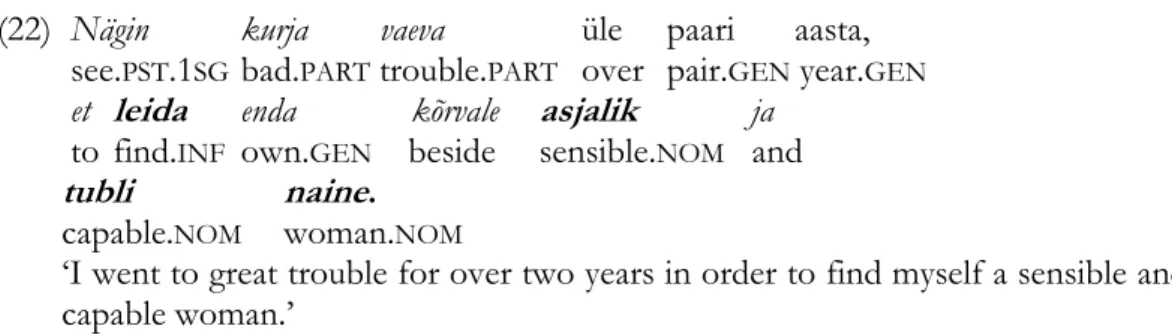
It is worth reiterating here that the use of the partial object in cases like (20) is not related to the (im)perfectivity of the infinitive phrase, as an imperfective reading of the infinitive phrase itself is implausible (i.e. the purpose of visiting different doctors is not merely to engage in the imperfective activity of trying to find the cause of fatigue, but rather to achieve the result (perfective) of actually finding said cause). The expression of duration, though, indicates that the process was difficult and perhaps unsuccessful. However, there are also examples in which the partial object is used despite the fact that the sentence explicitly states that the purpose has indeed been achieved. This is illustrated in (21):
(21) Pikalt käisime vaatamas, et
leida sobivat
long.time go.PST.1PL look.SUP.INE to find.INF suitable.PARTpisikest kutsut
ja lõpuks selle ka leidsime. little.PART puppy.PART and finally it.GEN also find.PST.1PL‘We looked for a long time to find the right little dog, and finally we found it.’ (ETT)
(22) Nägin kurja vaeva üle paari aasta, see.PST.1SG bad.PART trouble.PART over pair.GEN year.GEN et
leida
enda kõrvaleasjalik
jato find.INF own.GEN beside sensible.NOM and
tubli naine
.capable.NOM woman.NOM
‘I went to great trouble for over two years in order to find myself a sensible and capable woman.’
(ETT)
As demonstrated by the results shown in Table 1, the durativity marker transforms the construction from one in which the total object dominates to one in which total and partial objects appear with roughly equal frequency; the former is motivated by the boundedness of the non-finite clause, the latter by the presence of the durativity marker in the main clause. This stands in contrast to the situation observed in finite clauses, where analogous expressions of durativity necessitate an imperfective interpretation and therefore a partial object, as in example (18).
5 Perfective particles (on the example of
ära
)The most common perfective particle in Estonian is ära ‘away’, which has developed from a pure directional adverbial into something approaching a universal perfectivity marker (see Metslang 2001). The particle ära can be used to turn an imperfective verb into a perfective one, e.g. seletama ‘to explain (imperf.)’ vs. ära seletama ‘to explain (perf.)’, as well as to merely emphasize the perfectivity of an action, e.g. sünnitama ‘to give birth’ vs. ära sünnitama ‘to give birth (and be done with it)’. This section examines the impact of the particle ära on object case in a pair of da-infinitive constructions: the assessment construction and the object construction. These two constructions have been chosen because the partial object appears in them relatively frequently (as shown in Ogren 2014, 2017), and therefore the effect of ära on object case will be more visible.
First, we will take a look at the assessment construction. The following analysis focuses on examples of the assessment construction with the adjective lihtne ‘easy’. This adjective has been chosen due to its frequency as well as the fact that it freely allows the use of both partial and total objects; the partial object occurs roughly 65% of the time (Ogren 2014). The data for assessment constructions featuring the adjective lihtne and the particle ära is shown in Table 2. As previous studies (see Ogren 2015b) have shown a strong relationship between word order and object case in da-infinitive constructions, the results are separated by word order here as well (note that the V for these purposes is the da-infinitive form that the object modifies, not the finite copula).
Word order ära Partial object Total object Total Partial object %
OV + 59 13 72 82%
VO + 2 6 8 25%
OV - 258 56 314 82%
VO - 35 100 135 26%
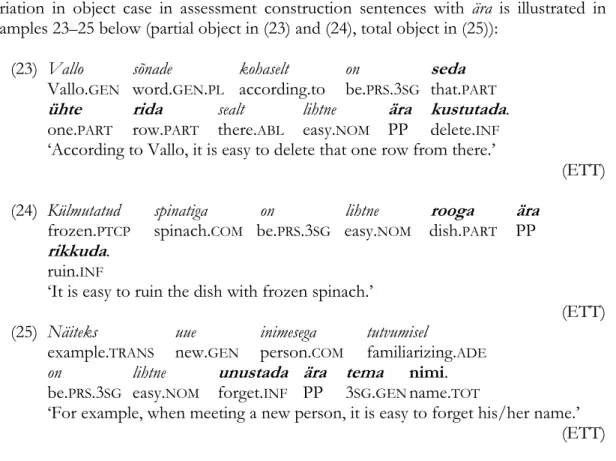
It is clear from the table above that the presence of ära is not sufficient to require the use of the total object; in fact, it appears to make no difference at all, as the partial object frequencies in sentences with ära are identical to those in sentences without ära. The variation in object case in assessment construction sentences with ära is illustrated in examples 23–25 below (partial object in (23) and (24), total object in (25)):
(23) Vallo sõnade kohaselt on
seda
Vallo.GEN word.GEN.PL according.to be.PRS.3SG that.PARTühte
rida
sealt lihtneära kustutada.
one.PART row.PART there.ABL easy.NOM PP delete.INF ‘According to Vallo, it is easy to delete that one row from there.’(ETT)
(24) Külmutatud spinatiga on lihtne
rooga ära
frozen.PTCP spinach.COM be.PRS.3SG easy.NOM dish.PART PPrikkuda.
ruin.INF‘It is easy to ruin the dish with frozen spinach.’
(ETT) (25) Näiteks uue inimesega tutvumisel
example.TRANS new.GEN person.COM familiarizing.ADE on lihtne
unustada ära tema
nimi.be.PRS.3SG easy.NOM forget.INF PP 3SG.GEN name.TOT
‘For example, when meeting a new person, it is easy to forget his/her name.’ (ETT)
These examples are all clearly perfective in meaning, with the particle ära expressing (or at least emphasizing) the completedness of the action; however, as seen in (23) and (24), the partial object is still possible. It is thus clear that the perfectivity of the non-finite clause, even when explicitly expressed, does not render the total object obligatory. Perfectivity is a necessary condition for total object use, but not a sufficient condition.
The picture is somewhat different in the object construction. While there is roughly a 50–50 split between partial and total objects in object construction sentences featuring finite forms of the verb tahtma ‘to want’, the addition of the perfective particle ära yields a clear preference for the total object. The results are summarized in Table 3; again, data for OV and VO word order in the non-finite clause is presented separately.
Word order ära Partial object Total object Total Partial object %
OV + 29 50 79 36%
VO + 5 21 26 19%
OV - 65 48 113 58%
VO - 33 48 81 41%
Table 3:Object case variation in the da-infinitive object construction featuring the finite verb tahtma ‘to want’
and the particle ära, by word order
without ära is the same for VO as it is for OV, and there is no reason to suspect that the influence of ära would be present only with OV word order, so it seems safe to presume that the presence of ära does indeed reduce the frequency of the partial object with both word orders. However, as the table indicates, the partial object still appears quite often, even in the presence of ära. A few examples to illustrate the variation are presented below (OV word order in examples 26–28, VO word order in example 29).
(26)
Tahaks
seda jama ära lõpetada
aga want.COND this.PART nonsense.PART PP finish.INF but nõutakse selle sigaduse eest veeldemand.IMPRS this.GEN piggery.GEN for also käitlustasu.
processing.fee.PART
‘I would like to end this nonsense, but they are charging a processing fee for this piggery as well.’
(ETT)
(27) Kui NATO meid ei kaitse ja Venemaa
if NATO.NOM 1PL.PART NEG defend and Russia.NOM
tahab
kogu väegaEestit ära vallutada
want.PRS.3SG all.GEN force.COM Estonia.PART PP conquer.INF siis ta ka seda teeb.then 3SG.NOM also that.PART do.PRS.3SG
‘If NATO doesn’t defend us and Russia wants to conquer Estonia with all its might, then it will do so.’
(ETT) In examples 28 and 29, the total object is used:
(28) Kahjuks pole mul võimalust osta
unfortunately be.PRS.NEG 1SG.ADE possibility.PART buy.INF
kallimat kraami, kui
tahan
pere
expensive.CMP.PART stuff.PART if want.PRS.1SG family.TOT
ära toita
ja maksud ära maksta.PP feed.INF and tax.TOT.PL PP pay.INF
‘Unfortunately I don’t have the option of buying more expensive stuff if I want to feed the family and pay my taxes.’
(ETT) (29) Lausa aitasin ta elu päästa, ennast
even help.PST.1SG 3SG.GEN life.PART save.INF self.PART ohtu seades, kuigi tegelikkuses
tahaks
danger.ILL put.CON although reality.INE want.COND
ära tappa tüübi.
PP kill.INF guy.TOT
‘I even helped to save his life, putting myself in danger, but really I’d like to kill the guy.’
(ETT)
non-finite verb, always governs a partitive object) and the semantically perfective infinitival phrase. While the presence of ära is enough to clearly shift the balance in favor of the total object, the imperfectivity of the finite verb tahtma still proves quite often to be the deciding factor. This is true even when the semantics of the infinitive make an imperfective reading particularly implausible, as in (26) with the verb lõpetada ‘to finish’, where it is highly unlikely that what is meant is “I want to be engaged in the process of finishing this nonsense” (imperfective) as opposed to the much more natural interpretation of “I want to finish this nonsense and be done with it” (perfective). Most importantly, however, the competition between perfective and imperfective semantic features in this construction is resolved quite inconsistently; it is not possible to formulate a reliable rule stating when the imperfectivity of the finite verb “outweighs” the perfectivity of the infinitival phrase and when the reverse is true.
What, then, do the assessment construction and the object construction have in common, as regards the influence of ära on object case? In the former construction, ära appears to have no effect at all, while in the latter construction, its presence significantly increases the likelihood that the total object will be used. In neither construction, then, does it render the total object obligatory. It is instructive here to think back to the basic rules guiding the total vs. partial object opposition in Estonian finite clauses: the total object is used only if all of the criteria for its use are met. In other words, the partial object is the default, used unless there is no clear indication of unboundedness. As such, even a non-finite clause describing a maximally unambiguously bounded event may feature a partial object, if there are elements outside the non-finite clause that support an unbounded reading of the whole situation being described. The particle ära, when modifying an infinitive, can perfectivize (or emphasize the perfectivity of) the non-finite clause in which it appears, but its impact does not extend outside of that clause.
6 Repeating vs. non-repeating situations
In finite clauses, whether or not a situation is repeating/repeatable (i.e. iterative/distributive/generic) has no discernible effect on object case beyond that which would be predicted on the basis of the boundedness criterion. For instance, in example (30), despite the repeating nature of the situations described, only the total object is possible.
(30) Jaan ostab igal hommikul
ajalehe.
Jaan.NOM buy.PRS.3SG every.ADE morning.ADE newspaper.TOT ‘Jaan buys a newspaper every morning.’The reason for the use of the total object here is that object case in finite clauses is determined by the aspectual properties of an individual repetition/iteration; buying a newspaper is a bounded, telic action. A non-bounded action, whether repeating (31) or not (32), requires the object to be in the partitive:
(32) Jaan pesi täna hommikul
põrandat.
Jaan.NOM wash.PST.3SG today morning.ADE floor.PART ‘Jaan mopped the floor this morning.’However, as we have seen, in da-infinitive constructions object case does not depend on the semantics of the non-finite clause alone. Rather, factors outside the infinitive phrase may cause the object of the infinitive to appear in the partitive even when the infinitive phrase taken by itself is clearly bounded, consisting of a telic verb and a quantitatively bounded object nominal (see examples (17) and (18), illustrating the influence of durativity markers in the main clause on the object of the infinitive). Accordingly, various da-infinitive constructions exhibit a tendency for partial objects to be used more frequently in repeating situations than in non-repeating situations. While each individual repetition may be bounded, that is, as previously established, not by itself sufficient to require the use of the total object in combination with a da-infinitive form; as such, the repeating nature itself (a property external to the infinitive phrase) may cause the situation as a whole to be seen as unbounded and thereby trigger the use of the partial object.
Interestingly, however, the influence of the repeating/non-repeating situation parameter on object case varies dramatically across different da-infinitive constructions. In the purpose construction, where the total object dominates in general and most sentences describe non-repeating situations, the repeating/non-repeating parameter appears to have no effect at all on object case, as shown in Table 4.
Situation type Partial object Total object Total Partial object %
Repeating 9 39 48 19%
Non-repeating 20 82 102 20%
Total 29 121 150 19%
Table 4:Object case variation in the da-infinitive purpose construction featuring the infinitive leida‘to find’, by
situation type
A pair of examples are presented below. In (33), the total object is used in a repeating situation (here, a generic situation; as explained in section 2, generic situations are by their nature distributive, ergo repeating); (34) shows the opposite, a non-repeating situation with a partial object.
(33) Et
leida
tõeline õnn
, mida to find.INF true.TOT happiness.TOT which.PART dalai-laama nimetab ka sisemiseks rahuks, Dalai_Lama.NOM call.PRS.3SG also inner.TRANS peace.TRANS on vaja kaastunnet kõigi suhtes.be.PRS.3SG necessary compassion.PART everyone.GEN with.regard.to ‘In order to find true happiness, which the Dalai Lama also calls inner peace, it is necessary to have compassion for everyone.’
(34) Tormasin kohe haiglasse, et
leida
sealt rush.PST.1SG immediately hospital.ILL to find.INF there.ABL meie legendiks saanudabistajat.
1PL.GEN legend.TRANS become.PTCP helper.PART
‘I rushed immediately to the hospital, in order to find our legendary helper.’ (ETT)
Like the purpose construction, the object construction also describes overwhelmingly non-repeating situations; however, here we find a higher percentage of partial objects in repeating situations (Table 5).
Situation type Partial object Total object Total Partial object %
Repeating 68 20 88 77%
Non-repeating 156 133 289 54%
Total 224 153 377 59%
Table 5:Object case variation in the da-infinitive object construction featuring the verb chain leida tahtma ‘to want to find’, by situation type
The difference in partial object frequency in repeating vs. non-repeating situations is highly statistically significant (p < .001, using a Fisher exact test). Examples (35) and (36) below illustrate a non-repeating situation with a total object and a repeating situation with a partial object, respectively:
(35) Nemad
tahtsid leida
koha
, kuhu ära 3PL.NOM want.PST.3PL find.INF place.TOT where.ILL away anda voodi ning netist leidsid meid. give.INF bed.NOM and internet.ELA find.PST.3PL 1PL.PART‘They wanted to find a place to give the bed away to and they found us online.’ (ETT)
(36) Noored seevastu
tahavad
ikkaleida
väärilist
young.NOM.PL by.contrast want.PRS.3PL still find.INF worthy.PARTtöökohta
ja neid maaelu ei tõmba.job.PART and 3PL.PART rural_life.NOMNEG attract.PRS
‘Young people, by contrast, want to find a good job and rural life doesn’t attract them.’
(ETT)
Situation type Partial object Total object Total Partial object %
Repeating 53 8 61 87%
Non-repeating 9 10 19 47%
Total 62 18 80 78%
Table 6:Object case variation in the da-infinitive assessment construction featuring the adjective lihtne ‘easy’ and the particle ära, by situation type
Here as well, the difference in partial object frequency in repeating vs. non-repeating situations is highly statistically significant (p < .001, using a Fisher exact test). These results generally agree with the findings of Ogren (2014), which examined the effect of situation type in assessment construction sentences without the particle ära, finding partial object usage frequencies of 77% and 48% for repeating and non-repeating situations respectively.
Example (37) below shows a repeating situation with a partial object, while example (38) features a non-repeating situation with a total object:
(37)
Autot
on väga lihtneära lõhkuda
mõne tunniga car.PART be.PRS.3SG very easy.NOM PP wreck.INF few.GEN hour.COM piisab vaid lollile sõita anda.suffice.PRS.3SG only fool.ALL drive.INF give.INF
‘It’s very easy to wreck a car in a few hours, you just have to let a fool drive it.’ (ETT)
(38) Vene riigi kapitaliga on ülimalt lihtne Russian state.GEN capital.COM be.PRS.3SG extremely easy.NOM
kogu eesti riigikese majandus ära nullida.
whole.TOT Estonian state.DIM.GEN economy.TOT PP nullify.INF‘With Russia’s capital, it is extremely easy to render null the entire Estonian economy.’
(ETT) In addition to these constructions, in which it is possible to find examples of both situation types and both partial and total objects, there is a da-infinitive construction in which object case is determined entirely via the boundedness criterion, i.e. there is none of the irregular, inconsistent object case usage found in other da-infinitive constructions. This is the translative adverbial construction, examples of which are shown below:
(39) Komisjoni ülesandeks on
teha
commission.GEN task.TRANS be.PRS.3SG make.INFvalitsusele
ettepanek
keeleauhinna määramiseks. government.ALL proposal.TOT language.prize.GEN designation.TRANS ‘The commission’s task is to make a proposal to the government for the awarding of the language prize.’(40) Kursuse eesmärgiks on
anda
ülevaade
course.GEN goal.TRANS be.PRS.3SG give.INF overview.TOT kirjamärkidest, sümbolitest ja kalligraafia olemusest. letter.ELA.PL symbol.ELA.PL and calligraphy.GEN essence.ELA‘The goal of the course is to give an overview of letters, symbols and the basics of calligraphy.’
(ETT)
Crucially, it should be noted that this construction, when used with a singular object (as required for the present study), expresses almost exclusively non-repeating situations; in fact, an examination of 100 translative adverbial construction sentences from the etTenTen corpus does not yield a single example with a repeating situation. It is certainly possible to construct such an example, though. For instance, sentence (40) above can be modified as follows to yield a repeating situation:
(41) Kursus on mõeldud kõigile, kelle course.NOM be.PRS.3SG think.PTCP everyone.ALL who.GEN sooviks on
saada
ülevaade
kirjamärkidest, desire.TRANS be.PRS.3SG get.INF overview.TOT letter.ELA.PL sümbolitest ja kalligraafia olemusest.symbol.ELA.PL and calligraphy.GEN essence.ELA
‘The course is intended for everyone whose desire is to receive an overview of letters, symbols and the basics of calligraphy.’
Such examples, however, are quite rare. In general, the situation is concretized, i.e. confined to a specific actor or actors; it is always someone’s goal/task/desire, and that someone is usually a specific entity (even if not explicitly mentioned in the sentence). This concretization renders the situation non-repeating. What we are left with, then, is a construction exhibiting virtually no variation either in situation type or in object case; da -infinitive translative adverbial constructions express only non-repeating situations and feature only total objects (assuming that the boundedness criteria are met).
7 Destination adverbials
In finite clauses, the presence of a destination adverbial (marking end location, recipient/beneficiary, or end state) may render an otherwise unbounded situation bounded, thus occasioning the use of the total object. This is illustrated in (42) and (43) below:
(42) Veeretasin
suurt notti.
roll.PST.1SG big.PART log.PART ‘I rolled the big log.’(43) Veeretasin
suure noti jõkke.
roll.PST.1SG big.TOT log.TOT river.ILL ‘I rolled the big log into the river.’Here, whereas in (42) the action is conceptualized as unbounded and the partial object is used, the presence of the destination adverbial jõkke ‘into the river’ in (43) brings about a bounded interpretation. The destination adverbial does not itself indicate boundedness – in (43), the partial object suurt notti is also possible, and would denote imperfective/continuous aspect (‘I was rolling the big log into the river’) – but it is a necessary element in order for the action to be understood as bounded.
It is natural to surmise that destination adverbials may have a similar effect in da -infinitive constructions as well. While markers of boundedness by themselves do not determine object case in da-infinitive constructions (as we have seen in section 5 of this paper, dealing with the perfective particle ära), they may influence it somewhat, increasing the likelihood that the total object will be used. Indeed, the analysis of assessment construction sentences with the adjective lihtne ‘easy’ in Ogren (2014) found that the frequency of the partial object falls from 67% in sentences with no destination adverbial to 23% in sentences containing such an element. What follows is an examination of the effect of destination adverbials in another da-infinitive construction, namely the object construction.
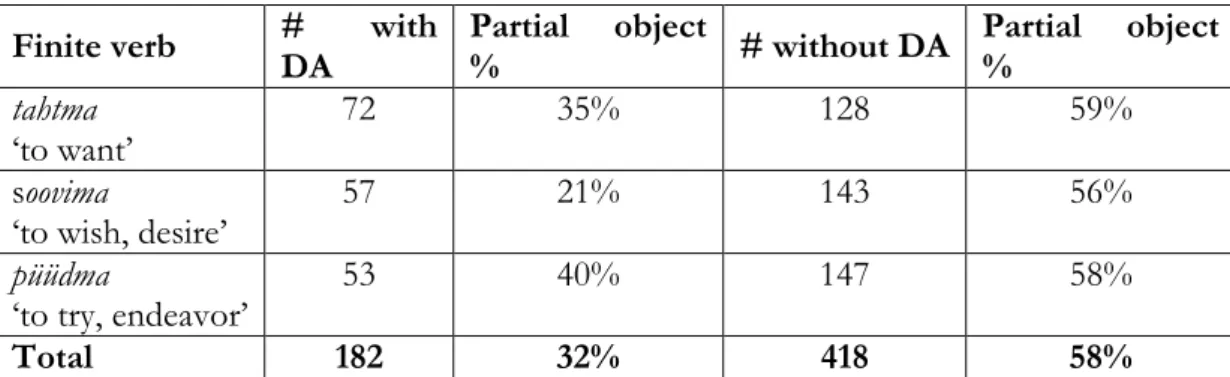
Whereas the analysis in previous sections of this article has relied heavily on data from sentences featuring the infinitive form leida ‘to find’, a proper survey of destination adverbials requires the inclusion of a variety of non-finite verbs, in order to obtain sufficient examples of the different types of destination adverbials in existence. The following analysis is based on a sample of 600 sentences featuring the object construction with the finite verbs tahtma ‘to want’, soovima ‘to wish, desire’ and püüdma ‘to try, endeavor’ (200 sentences for each verb) together with various verbs in the da-infinitive form. (In addition to the large data samples it affords, the object construction with the verbs tahtma, soovima and püüdma has been chosen for this analysis because it does not exhibit a strong preference for either total or partial objects9). The results are
summarized in Table 7.
Finite verb # with DA
Partial object
% # without DA
Partial object %
tahtma ‘to want’
72 35% 128 59%
soovima
‘to wish, desire’
57 21% 143 56%
püüdma
‘to try, endeavor’
53 40% 147 58%
Total 182 32% 418 58%
Table 7:Object case variation in the da-infinitive object construction, by finite verb and the presence/absence of a destination adverbial (DA)
The table shows a consistent picture: for all three verbs, the frequency of partial object usage is considerably higher in the absence of a destination adverbial than when such an adverbial is present. Combining the data for all three verbs, the difference in partial object frequency with and without a destination adverbial is highly statistically significant (p < .001, using a Fisher exact test). Some example sentences are given below, with destination adverbials expressing end location (44), end state (45) and recipient/beneficiary10 (46):
(44) Alati
püüan oma ajakavasse
mahutada kamingi
always try.PRS.1SG own schedule.ILL fit.INF also some.TOT
muu trenni.
other.TOT training.TOT
‘I always try to fit some other training into my schedule as well.’
(ETT)
(45) Meie ruumid ei ole küll väga avarad,
1PL.GEN room.NOM.PL NEG be.PRS indeed very spacious.NOM.PL kuid sellest hoolimata
püüame
oma patsientidefüüsilise
but this.ELA regardless try.PRS.1PL own patient.GEN.PL physical.TOTkeskkonna
muuta võimalikult koduseks.environment.TOT change.INF as.possible cozy.TRANS
‘Our rooms aren’t very spacious, it’s true, but despite that, we are trying to make our patients’ physical environment as cozy as possible.’
(ETT)
(46) “Tahame sellega
anda
tudengiteleselge sõnumi –
want.PRS.1PL this.COM give.INF student.ALL.PL clear.TOT message.TOT õppige edasi,” ütles Klaas.study.IMP.2PL forward say.PST.3SG Klaas.NOM
‘ “By doing this, we want to give the students a clear message: keep studying,” Klaas said.’ (ETT)
However, the partitive is still used fairly frequently even in conjunction with a destination adverbial, and indeed, it would be possible (albeit somewhat unexpected) in each of these examples.
The results are also fairly consistent for the various types of destination adverbials, as illustrated in Table 8 below.
DA type Partial object Total object Total Partial object %
End location 34 62 96 35%
Recipient/beneficiary 21 47 68 31%
End state 3 15 18 17%
Table 8: Object case variation in the da-infinitive object construction, by DA type
As the table indicates, the partial object was especially rare in sentences featuring end-state adverbials (marked in Estonian by the translative case); unfortunately, the sample of such sentences is too small to permit any wide-ranging conclusions. However, the two more common types of destination adverbials appear to have roughly the same impact on object case, reducing the frequency of the partial object from 55–60% in sentences with no DA to 30–35% in sentences with a DA.
8 Conclusion
The most important conclusion to be drawn from the data presented in this paper is that, unless the da-infinitive phrase itself clearly expresses an unbounded action (atelic verb and/or quantitatively unbounded object), none of the relationships between aspectual parameters and object case in da-infinitive constructions are anything close to absolute. Variation is ubiquitous. Rather than rules, then, what we are left with is a set of competing motivations for the use of a particular object case, features that have a strong influence on object case in one direction or another.
As expected, features expressing boundedness (whether by making explicit the existence of an endpoint, i.e. telicity, or emphasizing the completedness of the action, i.e. perfectivity) favor the usage of the total object, while features expressing durativity or distributivity – portraying the situation as somehow open or unbounded, or facilitating an imperfective interpretation – are associated with partial object usage. However, despite the general status of the partitive as the “default” object case, this does not mean that any indicator of unboundedness necessitates the use of the partial object. For instance, while durativity markers in the purpose construction do significantly increase the frequency of the partial object, the total object remains quite common (43%). The partial object is indeed obligatory when unboundedness is expressed in the non-finite clause itself (i.e. when the non-finite clause expresses an atelic event), but the competition between unbounded main clause and bounded non-finite clause is resolved inconsistently, i.e. both partial and total objects are possible.
unboundedness, contrasting with the bounded action described by the non-finite verb. In the object construction, unboundedness is found in the finite verb, e.g. tahtma ‘to want’; in the assessment construction with the adjective lihtne ‘easy’, it is the assessment adjective lihtne itself, drawing attention to the process rather than the result, which facilitates an unbounded reading. There is no evident reason why the particle ära should be able to tip the scales in one of these constructions, but not the other. Similarly, situation type (repeating or non-repeating) has no discernible effect on object case in the purpose construction, but has a significant effect in the object construction with the verb chain leida tahtma ‘to want to find’ (77% partial object use in repeating situations vs. 54% in non-repeating situations) and an even larger effect in the assessment construction. Overall, it is difficult to identify any one of these aspectual features as the most (or least) significant with respect to object case in da-infinitive constructions as a whole; the data resist such generalizations. Rather, each aspectual feature is important in at least one construction, but irrelevant (or simply absent) in others.
The construction-specific nature of the relationships between aspectual features and object case is further exemplified by the translative adverbial construction, which has two distinguishing characteristics: 1) unlike the other constructions discussed here, it shows no variation in object case beyond that described by the simple boundedness criterion, and 2) it describes almost exclusively non-repeating situations. It seems unlikely that the latter explains the former, i.e. that the reason why this construction shows none of the object case variation characteristic of other da-infinitive constructions is because it is associated only with repeating situations; after all, in the other constructions, non-repeating situations do exhibit substantial object case variation, by no means requiring the total object.
Why, then, should there be variation in object case in non-repeating situations with a destination adverbial in the object construction, or non-repeating situations with a perfective particle in the assessment construction, but no variation at all in the translative adverbial construction (with or without a destination adverbial or perfective particle)? One possibility is that the amount of anomalous partial object usage (instances of partial object usage that are not ascribable to the simple boundedness criterion) in a construction is to some extent a function of the frequency with which that construction describes repeating situations. There is more variation in object case in the assessment construction and object construction, both of which regularly describe repeating situations, than in the purpose construction (where repeating situations are relatively rare) and in the translative adverbial construction (where repeating situations are almost completely absent). However, such a general principle ought to extend beyond da -infinitive constructions and apply to finite clauses as well; since finite clauses may express repeating situations, by this principle they too should exhibit some degree of anomalous partial object usage. But they do not. Thus it seems that the lack of object case variation in the translative adverbial construction is a construction-specific feature that cannot be adequately explained by any more general (i.e. cross-constructionally relevant) parameter.