THE PARTICIPATING POOR: THE EFFECT OF CONDITIONAL CASH TRANSFERS ON BENEFICIARY POLITICAL PARTICIPATION
Claire E. Dunn
A thesis submitted to the faculty of the University of North Carolina at Chapel Hill in partial fulfillment of the requirements for the degree of Master of Arts in the Department of Political Science, Concentration in Comparative Politics .
Chapel Hill 2017
Approved by: Evelyne Huber Jonathan Hartlyn
ABSTRACT
CLAIRE E. DUNN: The Participating Poor: The Effect of Conditional Cash Transfers on Beneficiary Political Participation
(Under the direction of Evelyne Huber.)
Conditional cash transfer (CCT) programs entered the social policy scene in Mexico and Brazil in the mid-1990s and have since been adopted by policymakers throughout Latin America. While the effects of these programs on health, education, child labor and poverty have been widely studied, the political effects have not been considered in nearly as much depth. Yet we know from studying other social policies that they often have consequences beyond their intended goals. In this paper I build on the existing literature on CCTs and the political consequences of social policies to examine the effect of CCTs on broad polit-ical participation. Using survey data from across Latin America and the Caribbean, I find that beneficiaries of CCTs are more likely to participate in a variety of electoral and non-electoral types of participation. Using the same survey data, I also aim to understand the mechanisms that lead CCT beneficiaries to participate at higher rates than non-beneficiaries. I find that beneficiaries express higher levels of political interest, stronger senses of political efficacy and greater trust in political institutions than non-beneficiaries. I argue increased participation among CCT beneficiaries is a result of policy feedback effects, but that these feedback effects are the opposite of what existing literature on advanced democracies would lead us to expect, indicating a need to adjust our theories to the Latin American context. 1
TABLE OF CONTENTS
LIST OF TABLES . . . v
Introduction . . . 1
Political Participation and Social Policy . . . 1
Data and Methods . . . 1
Results . . . 6
Discussion . . . 11
APPENDIX A: SURVEY QUESTIONS . . . 13
APPENDIX B: MODEL OUTPUTS . . . 14
APPENDIX C: SUMMARY STATISTICS . . . 27
LIST OF TABLES
Table
1 Participation Summary Statistics-Dummy Variables . . . 3
2 Participation Summary Statistics-Ordinal Variables . . . 3
3 Model Coefficients and Standard Errors for CCT . . . 6
4 Predicted Probabilities of Participating-Dichotomous Variables . . . 8
5 Predicted Probabilities of Participating-Categorical Variables . . . 9
6 Model Coefficients and Standard Errors for CCT*Female . . . 10
7 Predicted Probabilities-Political Interest . . . 10
8 Predicted Probabilities-Political Efficacy . . . 11
9 Survey Questions and Response Options . . . 13
10 Model Output:Vote . . . 14
11 Model Output: Registering to Vote . . . 15
12 Model Output: Attend Political Meeting . . . 16
13 Model Output: Attend Municipal Meeting . . . 17
14 Model Output: Attend Community Meeting . . . 18
15 Model Output: Solve Community Problem . . . 19
16 Model Output:Contact Local Official . . . 20
17 Contact Municipal Office . . . 21
18 Model Output: Protest . . . 22
19 Model Output: Political Interest . . . 22
20 Model Output: Political Efficacy-Government Listens . . . 23
21 Model Output: Political Efficacy-Trust President . . . 24
22 Model Output: Political Efficacy-Trust National Congress . . . 25
23 Model Output: Political Efficacy-Trust Local Government . . . 26
INTRODUCTION
Conditional cash transfers(CCTs), programs that provide cash transfers to low-income families provided that they comply with certain conditions related to the development of human capital among their children, became a major new tool in Latin American social policy in the mid-1990s. With few exceptions, the programs are now found throughout the region and have been shown to have major effects on poverty-reduction, school attendance and utilization of health services(Fiszbein, Schady and Ferreira 2009). These wide-ranging positive effects are all the more impressive given that CCTs cost just 0.3 to 0.4 percent of GDP on average(Paes-Sousa, Regalia and Stampini 2013).
Despite the fact the CCTs have been so widely studied and have been adopted in coun-tries across the world, we do not know a great deal about the political effects of CCTs. In political science, the study of CCTs has narrowly focused on whether or not the pro-grams are insulated from clientelism and, as such, has focused almost exclusively on voting behavior. To date our knowledge about the political effects of CCTs beyond voting re-mains limited. Given that these programs cover so many citizens, nearly a quarter of the region’s population in 2010 (Paes-Sousa, Regalia and Stampini 2013), understanding how these policies impact political behavior among beneficiaries is a substantively important question.
baseline participation levels of the poor in Latin America higher than we see in more devel-oped countries like the United States(Booth and Seligson 2008), but the welfare state is also much less extensive(Huber and Stephens 2012). Likewise, the conditions associated with CCTs are often not enforced or, when enforced, are used as a means of identifying when families may need more help rather than less(Bastagli 2009). I argue that these new and positive interactions with the state should increase the political interest of beneficiaries as well as their sense of political efficacy and trust in political institutions resulting in higher levels of political participation compared to other citizens of similar socioeconomic status. To test my argument I use the 2014 Latin American Public Opinion Project (LAPOP) AmericasBarometer survey data. The AmericasBarometer survey is a representative survey of voting age individuals throughout Latin America and the Caribbean and is particularly useful because it asks respondents if they benefit from a conditional cash transfer program2. My sample includes all countries in which a CCT program is present and in which citizens were asked about their beneficiary status. The survey also asks respondents about their participation in a number of political activities, their level of political interest and probes their senses of political efficacy and trust making it well suited for me to consider not only the level of participation among CCT beneficiaries, but also to test the mechanisms I suspect are at work in leading to increased participation.
The remainder of this paper is divided into four sections. First I examine what we know about the feedback effects of social policies and discuss why these theories may need to be adjusted to fit the Latin American context. Second, I discuss the data and methods I use to test my theory. Third, I discuss the results of my statistical tests and finally I conclude and provide steps for future research.
Political Participation and Social Policy
Before examining how social policies can impact political participation, it is first impor-tant to consider what political participation looks like and who tends to participate.
racy is based on the concept of citizen participation in governing. While the precise defini-tion of democracy is often debated, no definidefini-tion excludes the role of participadefini-tion by the people. Beyond being a basic component of democracy, political participation can be seen as key to the quality of democracy. Where a greater portion of the population actively partic-ipates in politics, the government is responsive to a greater portion of the citizenry(Altman and P´erez-Li˜n´an 2002). We should think then of participation not just as an integral part of democracy, but that frequent and diffuse participation is integral to high quality democracy. Political participation is a broad concept. I follow Seligson and Booth (1976) in defining political participation as an action taken to influence the political system at any level as well as working collectively to solve problems not addressed by the government. Voting is perhaps the most obvious variety of participation, however many more political activities should also be considered.
Different types of political participation are more or less frequent depending on the level of initiative, coordination, and information required to complete each(Verba, Nie and Kim 1987). Voting, for instance, requires minimal information, initiative, or coordination and therefore a large portion of the population often participates in this way. Contacting a public official, on the other hand, while still requiring low coordination, requires high information and high initiative resulting in lower rates of participation.
I consider nine types of participation including voting, attending different types of po-litical meetings, solving a community problem, contacting popo-litical officials and protesting. While protest is often categorized as an unconventional form of participation and there-fore excluded from many studies of political participation, I choose to include it because protest is relevant in this case. The increased demand for health and education services by beneficiaries due to CCT conditionalities, it was thought, should lead to pressures on the government for increased supply as well as improved quality of such services. Some bene-ficiary protests have been reported (2006 CCT benebene-ficiary protests for better health services in Panama, for example), though they have been few.
large body of literature has argued that political participation is also effected by public poli-cies. This literature focuses on the idea of policy feedback effects and is the foundation of my argument for why CCT beneficiaries are more likely to participate in politics than non-beneficiaries.
Policy feedback effects arguments build on the idea that “new policies create a new politics”(Schattschneider 1935). Policies create both incentives and resources that influence the actions of groups influenced by that policy (Pierson 1993). That social policies have feedback effects is not a new concept and many studies have considered what such effects might be. The majority of this literature has focused on the United States and Western Europe. For example, Social Security in the United States led to a major mobilization of senior citizens. Once among the least likely to participate, senior citizens of all education and income levels have become among the most politically active groups following the expansion of Social Security(Campbell 2003).
The feedback effects of social policies, however, are not always positive. Looking more specifically at particular types of welfare programs, a number of studies have a found that universal welfare programs increase participation, while targeted, means-tested programs have the opposite effect(Kumlin 2004; Mettler and Stonecash 2008; Bruch, Ferree and Soss 2010; Watson 2015). Targeted programs, though, can have a positive effect if they are not highly stigmatized (Watson 2015) or if the policy’s authority structure is democratic instead of paternalistic(Bruch, Ferree and Soss 2010). The structure of the program is key to understanding what effects the policy will have on beneficiaries.
in Mexico(De La O 2013; D´ıaz-Cayeros and Magaloni 2009). Most of this work has the underlying goal of identifying whether or not these programs are used in a clientelistic manner, but it has largely been acknowledged that, at least in the cases of Brazil and Mex-ico, the electoral bonus from the CCT is due to a mobilizing mechanism compatible with programmatic politics rather than a persuasive mechanism(De La O 2013).
I have already acknowledged, however, that political participation goes beyond voting behavior. There is some evidence that Mexico’s CCT program has led CCT beneficiaries to contact public officials, engage in community activism, and engage in civil society at higher rates than non-beneficiaries(Schober 2013). If this effect exists in Mexico, we may expect to see similar effects from CCTs in other countries.
Given the evidence found in this literature, we are then left to wonder why CCTs may have the opposite effect than we should expect given the findings from studies of feedback effects on targeted social policies in advanced democracies. I aim to explain the gap.
The policy feedback effects literature would suggest that the conditions associated with CCTs are paternalistic and therefore keep beneficiaries marginalized rather than giving them an incentive to participate more. While it is possible to argue that CCTs are paternalis-tic due to the conditions, I argue that paternalism is in fact limited. While the programs have behavioral requirements attached to them, this is balanced out to some extent by the fact that these programs are based on joint responsibility of the family to bring their children to school and regular health appointments, but also the state to provide and improve education and health services (Rawlings 2006). Likewise, in some Latin American countries, such as Brazil, access to public health and education services are considered constitutional rights so the conditions can also be considered simply as a mechanism for encouraging citizens to realize their rights to such services.
initial enforcement is a warning and continued failure to comply is met with gradually more serious responses. Non-compliance, though, is actually viewed as a sign that the family may need additional support rather than as a reason to punish them(Bastagli 2009). With this type of enforcement, again, the paternalistic aspect is somewhat minimized.
In addition to programs being less paternalistic than perhaps assumed, CCTs often rep-resent beneficiaries initial interaction with the welfare state. One of the key differences between the Latin American context and the US or European context is the size of the wel-fare state. The Latin American welwel-fare state is less developed than the welwel-fare states of the advanced industrial world and has largely been linked to formal sector employment(Huber and Stephens 2012). As such, those who benefit from CCT programs are generally peo-ple who were not previously incorporated into the welfare state. Welfare programs have the ability to either reinforce the marginal status of citizens by excluding them from such programs or incorporating them only in paternalistic programs or, conversely, to draw them into democratic society(Soss 2000). As I have already argued against CCTs being strongly paternalistic, I argue that by incorporating new citizens into the welfare state, they are be-ing drawn into democratic society and given more full citizenship rights. The realization of such rights should give beneficiaries a greater stake in democratic politics and therefore a greater interest in participating to influence such politics.
making such claims as well as protest and sign petitions should such a person get elected and move forward with eliminating the program (Hunter and Sugiyama 2014). Such re-sponses provide evidence that beneficiaries, at least in Brazil, have an interest in politics as a result of their status as beneficiaries. As such, I hypothesize that beneficiaries should have increased levels of political interest compared to non-beneficiaries controlling for levels of education, wealth and other key factors that may impact political interest.
In addition, seeing the state responding to their needs may lead to increased feelings of political efficacy among beneficiaries. Political efficacy refers both to the idea that politicians are responsive to citizen demands and that citizens feel they are able to influ-ence the political process. The way in which a policy is formulated has the potential to convey the positive message to beneficiaries that they are deserving and the government cares about helping them or, conversely, that they are burdensome. When beneficiaries receive the more positive message, they may see the government as responsive to their needs(Schneider and Ingram 1993). Similarly, beneficiaries may view the government as responsive to their needs when the policy leads them to have positive interactions with a government agency. For example, Hunter and Sugiyama note that beneficiaries of Bolsa Familia are those who historically would have received social benefits through clientelistic means. The CCT benefit on the other hand, is largely viewed by beneficiaries as free from influence of single politician or group of politicians; rather than being viewed as contin-gent, benefits are seen as a right(Hunter and Sugiyama 2014). The process of receiving a benefit in a non-clientelistic manner may lead to an increased sense of political efficacy. Likewise, evidence from a short-term CCT programs in Uruguay showed that beneficiaries of that program reported higher levels of confidence in the government(Manacorda, Miguel and Vigorito 2011). When political efficacy is higher, we should expect levels of political participation to be higher as well(Seligson 1980).
findings are quite varied with some suggesting that high trust, particularly when combined with high efficacy, leads to increased political participation(Gamson 1968) while others have found evidence that trust does not play an important role, but rather political efficacy is the main driver of participation(Seligson 1980). Given the lack of consensus in the liter-ature, I choose to consider trust along with efficacy and hypothesize that beneficiaries will express higher levels of trust in government and that this higher level of trust contributes to greater levels of participation.
Additional explanations for why CCTs may lead to higher participation are possible, but unconvincing. For example, one could make a socioeconomic resources case for in-creased participation. Underlying much of the work on political participation is the initial assumption that the poor participate less than the non-poor. This assumption is prevalent, though debated, and underlies much of the literature that claims democracy is only possible when a country reaches a certain income level (Lipset 1959, 1960; Boix and Stokes 2003). The argument is that the poor lack the time or money to participate in democracy. This assumption runs deep and is supported by evidence from wealthy democracies where the poor do in fact tend to participate at lower rates than the non-poor(Verba and Nie 1987).
Evidence from Latin America, however, suggests that the poor and non-poor partici-pate at relatively equal rates(Booth and Seligson 2008). We therefore would not expect an increase in resources alone to influence participation. Even if we were to accept the idea that socioeconomic resources are the main driver of participation, CCT beneficiaries remain poor (Stampini and Tornarolli 2012). While CCT benefits have been shown to have a poverty-reducing effect, they are actually quite small transfers and generally do not bring beneficiaries out of poverty, but rather just reduce the severity of poverty. For example, the average transfer from Brazil’s Bolsa Familia program in 2015 was R$167.15 , or just under USD $50.00(Gazola Hellman 2015) per family. Even though their resources increase due to the CCT, beneficiaries continue to have comparatively low resources so would not be expected to participate at higher rates. Changes in levels of political interest, efficacy, and trust are much more promising mechanisms.
behav-iors as well as test possible explanations for why CCT beneficiaries may participate more. My hypotheses are as follows:
H1: CCT beneficiaries will participate in politics at a higher rate than non-beneficiaries of similar socioeonomic status. While the magnitude of this effect may differ based on types of participation, I expect it to hold for all types of participation.
H2:CCT beneficiaries will express higher levels of political interest than non-beneficiaries of similar socioeconomic status.
H3: CCT beneficiaries will express a stronger sense of political efficacy and greater trust in political institutions compared to non-beneficiaries of similar socioeconomic status.
While the existing research suggests that CCTs shape participatory behavior among beneficiaries, this body of work is heavily focused on voting behavior and single country case studies without considering broader trends across the region as a result of these pro-grams. If CCTs have important impacts on democratic participation, we should see these effects hold across the region.
Data and Methods
To test my hypotheses, I use data from the 2014 Latin American Public Opinion Project (LAPOP) AmericasBarometer surveys. The surveys are nationally and regionally repre-sentative samples of voting age individuals conducted throughout Latin America and the Caribbean. For the purposes of this study, I use all of the countries in the region that have conditional cash transfer programs and for which participants were asked about their beneficiary status in such a program. This results in 17 countries 3 in my sample and
approximately 25,000 observations.
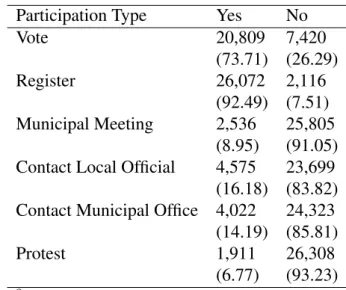
First I examine whether evidence supports my theory that beneficiaries will participate at higher rates than non-beneficiaries. I look at nine different types of participation, con-sidering each as a separate dependent variable. These dependent variables are voting in the last presidential election, registering to vote, attending political meetings, attending munic-ipal meetings, attending community meetings, solving a community problem, requesting help from a local official, requesting help from a municipal office, and protesting. As is evident from the summary statistics in tables 1 and 2, citizens are most likely to partici-pate by registering to vote and voting. We may be somewhat suspect of the high degree of voting reported in part because the survey question asks citizens if they voted in the last presidential election. In some cases the last presidential election may have been quite re-cent while in others it may have been a number of years ago in which case we may have reason to distrust citizen’s ability to remember. In none of the other types of participation is participating more common than not participating.
Table 1:Participation Summary Statistics-Dummy Variables
Participation Type Yes No
Vote 20,809 7,420
(73.71) (26.29)
Register 26,072 2,116
(92.49) (7.51) Municipal Meeting 2,536 25,805
(8.95) (91.05) Contact Local Official 4,575 23,699
(16.18) (83.82) Contact Municipal Office 4,022 24,323
(14.19) (85.81)
Protest 1,911 26,308
(6.77) (93.23) *percent in parentheses
Table 2:Participation Summary Statistics-Ordinal Variables
Participation Type Weekly Monthly Yearly Never
Comm. Prob. 1,400 3,360 4,916 18,527
(4.96) (11.91) (17.43) (65.69)
Comm. Meet 776 2,977 3,279 21,317
(2.74) (10.50) (11.57) (75.19)
Pol. Meet 425 1,185 3,127 23,604
(1.50) (4.18) (11.03) (83.29) *percent in parentheses
In each of the models, my main independent variable is CCT beneficiary status coded as a dummy variable with 0 for non-beneficiaries and 1 for beneficiaries. I control for other demographic characteristics that are frequently thought to influence political participation including sex, age, years of education, wealth4 , and a dummy variable for whether the person lives in a urban or rural area. Additionally, age is often argued to have a curvilinear effect on participation with the young and old participating less than those in middle age categories. As such, I include both age and age squared to model this curvilinear effect.
In the developed world, the gender gap in participation has narrowed or disappeared, however, there is some evidence that a gender gap still seems to exist in Latin Amer-ica(Desposato and Norrander 2009). Because of the continued existence of a gender gap, I expect the female variable to have a negative effect on participation. That education should have a positive effect on participation is widely accepted (Almond and Verba 1963; Putnam 1995), so I expect my education control variable to have a positive effect on participation. The effect of wealth is arguable(Krishna 2008; Verba and Nie 1987) so I have no clear ex-pectation of how wealth may impact participation. Finally, urban residents may participate more than rural residents in certain types of political participation such as voting where central location may facilitate participation, but may have the opposite effect on other types of participation where the interpersonal reliance of rural communities may facilitate coordi-nation and mobilization(Seligson and Booth 1976). Because of the varied effect depending on type of participation, I am neutral as to the expected effect of the urban dummy.
The model for each type of participation is shown below. The only differences between the models is that when looking at voting and voting registration, I add an additional control for whether or not these actions are compulsory in each country.5
Participationij=γ00+γ10(CCTij) +γ20(Femaleij) +γ30(Eduij) +γ40(Ageij) +γ50(Age2ij) +γ60(Wealthij) +γ70(Urbanij) +υ0j+rij
To test my second hypothesis, I look at the effect of being a CCT beneficiary on reported political interest. Political interest is measured on scale of zero to three with zero being no interest and 3 being a lot of interest. I recode the variable as dichotomous, setting the two lowest response categories (indicating little to no interest) to 0 and the 2 highest response categories (indicating some to a lot of interest) to 1. I use the same set of controls as I use
in the models for my first hypothesis.
PoliticalInterestij =γ00+γ10(CCTij) +γ20(Femaleij) +γ30(Eduij) +γ40(Ageij) +γ50(Age2ij) +γ60(Wealthij) +γ70(Urbanij) +υ0j+rij
Finally, I test my final hypothesis, that beneficiaries will express a greater sense of political efficacy and greater trust in political institutions. My measure of political efficacy takes into account how much respondents agree or disagree with the statement, “Those who govern this country are interested in what people like you think.” Respondents answer on a scale of one to seven with one indicating strongly disagree and 7 indicated strongly agree. I recode responses to create a dichotomous variable with only the 2 highest response categories being recoded 1 and the 5 lower response options recoded to 0. I use this question as it gets at whether or not citizens view government as interested in responding to their needs.
As a compliment to this measure, I also look at trust in government institutions. As previously noted, political efficacy and trust in institutions are closely tied in the literature. I specifically focus on trust in the president, the national congress, and the local or municipal government. As with efficacy, trust is originally measured on a 1 to 7 scale with 1 indicating no trust and 7 indicating high trust. I recode these variables to dichotomous variables as well with responses of a six or a seven recoded 1 to indicate high levels of trust and the five lower responses recoded zero indicating low levels of trust.
improvements in perception of economic status are expected to have a positive effect on efficacy(Lee, Randall and Vaught 2015).
PoliticalEfficacyij =γ00+γ10(CCTij) +γ20(Femaleij) +γ30(Eduij) +γ40(Ageij) +γ50(Ageij2) +γ60(Wealthij) +γ70(Urbanij) +γ80(Crimeij) +γ90(Econij) +γ100(Clientelismij) +υ0j+rij
Results
My statistical analyses provide support for each of my three hypotheses; CCT beneficia-ries seem to participate at higher rates as well as express higher levels of political interest, political efficacy, and trust in institutions.
Political Participation
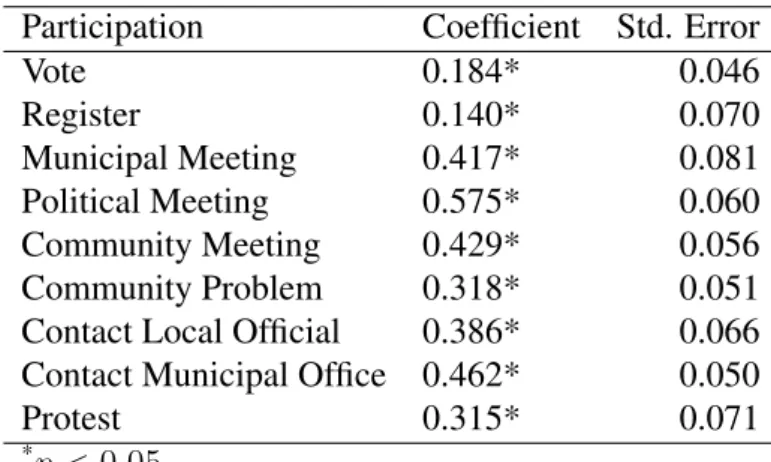
I find that CCT beneficiaries participate at higher rates than non-beneficiaries across all nine forms of political participation considered. The models produce the following coefficients and standard errors for the the independent variable, CCT.6
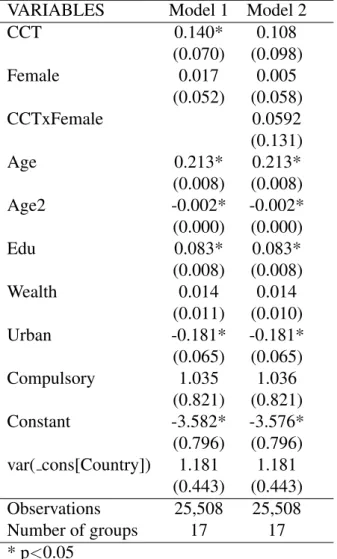
Table 3:Model Coefficients and Standard Errors for CCT
Participation Coefficient Std. Error
Vote 0.184* 0.046
Register 0.140* 0.070
Municipal Meeting 0.417* 0.081
Political Meeting 0.575* 0.060
Community Meeting 0.429* 0.056
Community Problem 0.318* 0.051
Contact Local Official 0.386* 0.066 Contact Municipal Office 0.462* 0.050
Protest 0.315* 0.071
*p < 0.05
The first two types of political participation I test, registering to vote and voting, are considered among the easiest types of participation in which citizens can engage. Given that both of these types of participation are compulsory or automatic in much of the region and the vast majority of the population already participates in both, I did not necessarily expect to find large differences here. I do, however, find a positive and statistically significant relationship between being a CCT beneficiary and both voting in the presidential election and registering to vote. The predicted probability of CCT beneficiaries having voted is .80 compared with .77 for non-beneficiaries. As noted previously, there is reason to be hesitant about the results related to voting however, given that the survey used asks about voting in the last presidential election which may have been a number of years ago in some cases. Responses to this question may not be reliable.
Likewise, the predicted probability of beneficiaries registering to vote is .944 compared to .936 for non-beneficiaries. That beneficiaries may be more likely to register to vote makes sense given that a voter registration card is in many cases one of the identification documents that beneficiaries can use to meet CCT program requirements. While the coef-ficient on CCT is significant for registering to voter, the difference between the predicted probabilities is not statistically significant indicating that the substantive difference is neg-ligible.
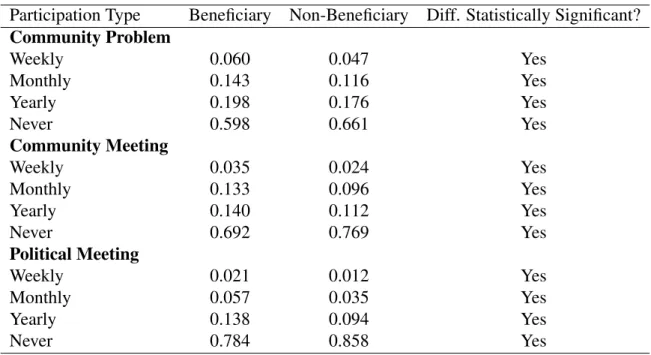
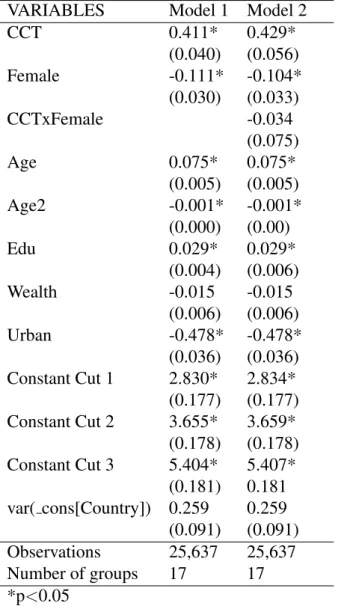
beneficia-ries have a predicted probability of attending a community meeting yearly of .14 compared to .11 for non-beneficiaries and a predicted probability of helping to solve a community problem yearly of .20 compared to .18 for non-beneficiaries. Again, the pattern holds when looking at participating in each of these activities monthly or weekly as well, while non-beneficiaries are more likely to never participate in any of these activities. The predicted probabilities for beneficiaries and non-beneficiaries are statistically significantly different from one another for each of these types of participation.
The next type of participation I consider is contacting public officials or offices. I look at contacting a local official and contacting a municipal office. CCT beneficiaries have a .19 predicted probability of requesting help from a municipal office compared to .13 for non-beneficiaries and a .21 predicted probability of requesting help from a local official compared to a .14 predicted probability for non-beneficiaries. Again, predicted probabilities for beneficiaries compared to non-beneficiaries are statistically significantly different from each other.
Finally, I look at protest, a type of participation that is the least frequent. The pattern of CCT beneficiaries participating more than non-beneficiaries, however, continues. Partic-ipation in protest is much less common overall, though CCT beneficiaries have a predicted probability of protesting of .08 compared to .06 for non-beneficiaries, a 33% increase in participation. It would be useful to know what types of protests beneficiaries are joining,bt they pro or anti government, but unfortunately this information is not available in this sur-vey.
Table 4:Predicted Probabilities of Participating-Dichotomous Variables
Participation Type Beneficiary Non-Beneficiary Diff. Statistically Significant?
Vote 0.799 0.769 Yes
Register 0.944 0.937 No
Municipal Meeting 0.113 0.078 Yes
Contact Local Official 0.205 0.144 Yes
Contact Municipal Office 0.186 0.126 Yes
Protest 0.080 0.060 Yes
for all types of participation, the magnitude of the difference varies. For the most part, sub-stantive differences are small with predicted probabilities increasing by approximately .03 in most cases for beneficiaries compared to non beneficiaries. When we look at contacting officials, however, the increase is greater with the predicted probability for beneficiaries approximately .06 higher than for non-beneficiaries. The larger substantive effect in this type of participation makes sense for a number of reasons. First, beneficiaries are learning to interact with the government. Beneficiaries may start engaging with local officials as a means of understanding their benefits, addressing potential problems with their benefits, or expressing dissatisfaction with public services they must use as part of the conditions at-tached to receiving benefits. Likewise, compared to other types of participation, contacting officials can happen on the beneficiaries own schedule and is not dependent on coordination with others or an event like a meeting, protest, or election being scheduled.
Table 5:Predicted Probabilities of Participating-Categorical Variables
Participation Type Beneficiary Non-Beneficiary Diff. Statistically Significant?
Community Problem
Weekly 0.060 0.047 Yes
Monthly 0.143 0.116 Yes
Yearly 0.198 0.176 Yes
Never 0.598 0.661 Yes
Community Meeting
Weekly 0.035 0.024 Yes
Monthly 0.133 0.096 Yes
Yearly 0.140 0.112 Yes
Never 0.692 0.769 Yes
Political Meeting
Weekly 0.021 0.012 Yes
Monthly 0.057 0.035 Yes
Yearly 0.138 0.094 Yes
Never 0.784 0.858 Yes
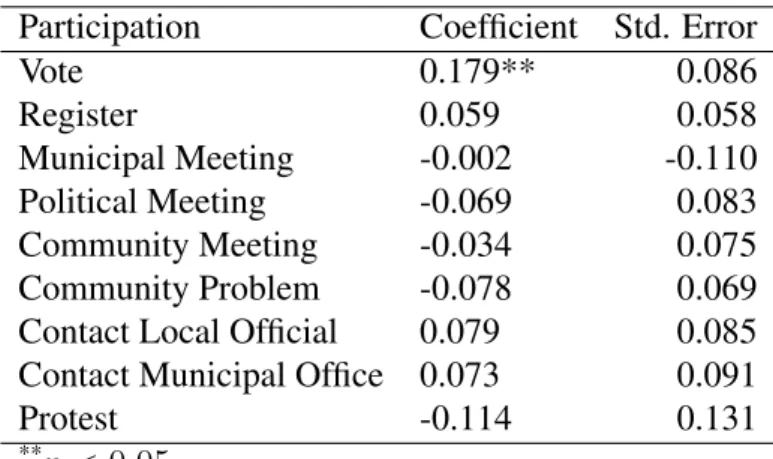
men. To test this possibility, I interact female and CCT. There is some evidence that CCTs do lead to higher rates of voting among women(Baez, Camacho, Conover and Z´arate 2012) and my analysis corroborates this finding across the region. When I include the interaction, the effect of CCT alone goes away indicating that the effect was likely mostly due to the increase in voting by female beneficiaries. With the exception of voting, the interaction term does not have a statistically significant effect on political participation. I do not find an interactive effect for any other type of participation. Additionally, for five of the nine types of participation, the interaction terms is negative, while in four it is positive. CCTs do not appear to have a consistently stronger mobilizing effect on women than on men.
Table 6:Model Coefficients and Standard Errors for CCT*Female
Participation Coefficient Std. Error
Vote 0.179** 0.086
Register 0.059 0.058
Municipal Meeting -0.002 -0.110
Political Meeting -0.069 0.083
Community Meeting -0.034 0.075
Community Problem -0.078 0.069
Contact Local Official 0.079 0.085 Contact Municipal Office 0.073 0.091
Protest -0.114 0.131
**p < 0.05
Political Interest
Table 7:Predicted Probabilities-Political Interest
Variable Beneficiary Non-Beneficiary Diff. Statistically Significant?
Political Interest 0.380 0.324 Yes
Political Efficacy
Finally I test my third hypothesis, that beneficiaries will have stronger sense of political efficacy and higher levels of trust in government than non beneficiaries7 . Again, I find support for my hypothesis. Benefiting from a CCT has a statistically significant and positive effect on political efficacy. Beneficiaries have a higher predicted probability of agreeing that the government listens to people like them. Similar trends hold for trust in the president , the national congress, and local or municipal government.
Table 8:Predicted Probabilities-Political Efficacy
Variable Beneficiary Non-Beneficiary Diff. Statistically Significant?
Gov. Listens to People Like Me 0.307 0.280 Yes
Trust President 0.306 0.244 Yes
Trust National Congress 0.155 126 Yes
Trust Local Government 0.214 0.191 Yes
As with political interest, the results suggest that political efficacy may also be at work in linking CCT beneficiary status with higher levels of political participation. Given that CCT beneficiaries also express higher levels of trust in institutions, my work seems to suggest that both political efficacy and trust may be at work rather than just one or the other.
Discussion
Using survey data from 17 Latin American countries, I find support for my hypothesis that CCT beneficiaries participate more than non-beneficiaries in nine different types of political participation. Beneficiaries participate more in very common activities such as
voting, but also in less common activities such as contacting public officials, attending meetings, and protesting.
Increases in political participation are consistent with the concept of policy feedback effects. My statistical results suggest that increased political interest, feelings of political efficacy, and trust in government institutions as a result of benefiting from these programs may be at work in influencing beneficiaries decisions to participate more frequently.
The fact that CCT beneficiaries participate at higher rates than non-beneficiaries runs contrary to what we would expect based on the policy feedback effects literature. The conditional nature of CCT programs does not have a demobilizing effect and actually has the opposite effect. These results are consistent with my argument that we need to adjust our theories to fit the Latin American context. The history of less developed welfare states that failed to cover much of the population in Latin America contrasts with more expansive welfare states in Europe and the US. This contrast can help explain why we see a different impact of a targeted, conditional program in the Latin American context than the literature would lead us to expect. Accounting for the importance of initial inclusion into the welfare state is necessary.
While I find evidence to support my theory, more work is needed on the broader polit-ical effects of CCTs. Speaking to beneficiaries about their motivations for participating in democratic politics will take us a long way in understanding the causal mechanism behind their higher levels of participation compared to the non-beneficiary population.
Additionally, work should also consider whether CCT beneficiaries exhibit similar trends in participation over time or if the effect diminishes or grows over time. It is con-ceivable that once beneficiaries begin to develop a stronger interest in politics, this interest will remain high or continue growing and, as a result, participation may remain higher among this group. Panel data would be very helpful in examining such trends, but to my knowledge is not yet available.
a larger impact on policymaking.
APPENDIX A: SURVEY QUESTIONS Table 9:Survey Questions and Response Options
Question Response 1 Response 2 Response 3 Response 4
Are you registered to vote? Yes No Did you vote in the last
presidential elections? Yes No Have you attended a town
meeting,city council meeting or other meeting in the past 12 months?
Yes No
Do you attend meetings of a political party or political organization...
Once a week Once or twice a month Once or twice a year Never
Do you attend meetings of a community improvement committee or association... Once a week Once or twice a month Once or twice a year Never
In the last twelve months have you helped to solve a problem in your community or in your neighborhood?
Once a week Once or twice a month Once or twice a year Never
Have you sought assistance from or presented a request to any office, official or councilperson of the
municipality within the past 12 months?
Yes No
In order to solve your problems have you ever requested help or cooperation from a local public official or local government:for example , a mayor,municipal council, provincial official, civil governor or governor?
Yes No
In the last 12 months have you participated in a demonstration or protest march?
Yes No
How much interest do you have in
politics? A lot Some Little None
Those who govern this country are interested in what people like you think. How much do you agree or disagree with this statement?
Strongly Disagree (0) - Strongly Agree(6)
To what extent do you trust the President? Not at All(0) - A lot(6) To what extent do you trust the
National Congress? Not at All(0) - A lot(6) To what extent do you trust the local
APPENDIX B: MODEL OUTPUT Table 10:Model Output:Vote
VARIABLES Model 1 Model 2.
CCT 0.184* 0.088
(0.046) (0.064)
Female 0.074* 0.045
(0.032) (0.035)
CCTxFemale 0.179*
(0.086)
Age 0.226* 0.226*
(0.005) (0.005)
Age2 -0.002* -0.002*
(0.000) (0.000)
Edu 0.064* 0.064*
(0.005) (0005)
Wealth 0.011 0.011
(0.007) (0.007)
Urban -0.228* -0.228*
(0.041) (0.041)
Compulsory 0.711* 0.712*
(0.222) (0.223)
Constant -5.188* -5.173*
(0.218) (0.218) var( cons[Country]) 0.188 0.188
(0.067) (0.067) Observations 25,555 25,555
Number of groups 17 17
* p<0.05
Table 11:Model Output: Registering to Vote
VARIABLES Model 1 Model 2
CCT 0.140* 0.108
(0.070) (0.098)
Female 0.017 0.005
(0.052) (0.058)
CCTxFemale 0.0592
(0.131)
Age 0.213* 0.213*
(0.008) (0.008)
Age2 -0.002* -0.002*
(0.000) (0.000)
Edu 0.083* 0.083*
(0.008) (0.008)
Wealth 0.014 0.014
(0.011) (0.010)
Urban -0.181* -0.181*
(0.065) (0.065)
Compulsory 1.035 1.036
(0.821) (0.821)
Constant -3.582* -3.576*
(0.796) (0.796) var( cons[Country]) 1.181 1.181
(0.443) (0.443) Observations 25,508 25,508
Number of groups 17 17
* p<0.05
Table 12:Model Output: Attend Political Meeting
VARIABLES Model 1 Model 2
CCT 0.542* 0.575*
(0.045) (0.060)
Female -0.299* -0.283*
(0.035) (0.040)
CCTxFemale -0.069
(0.083)
Age 0.040* 0.041*
(0.006) (0.006)
Age2 -0.000* -0.000*
(0.000) ((0.000))
Edu 0.032* 0.0302*
(0.005) (0.005)
Wealth -0.027* -0.027
(0.007) (0.007)
Urban -0.238* -0.238*
(0.043) (0.043) Constant Cut 1 2.691* 2.699* (0.216) (0.216) Constant Cut 2 3.929* 3.937* (0.217) (0.217) Constant Cut 3 5.340* 5.348
(0.222) (0.222) var( cons[Country]) 0.429 0.429
(0.152) (0.152) Observations 25,625 25,625
Number of groups 17 17
* p<0.05
Table 13:Model Output: Attend Municipal Meeting
VARIABLES Model 1 Model 2
CCT 0.416* 0.417*
(0.059) (0.081)
Female -0.153* -0.152
(0.045) (0.050)
CCTxFemale -0.002
(0.110)
Age 0.066* 0.066*
(0.008) (0.008)
Age2 -0.001* -0.001*
(0.000) 0.000
Edu 0.056* 0.056*
(0.007) (0.007)
Wealth -0.014 -0.014
(0.009) (0.009)
Urban -0.352* -0.352*
(0.055) (0.055)
Constant -4.204* -4.204*
(0.202) (0.202) var( cons[Country]) 0.058 0.058
(0.024) (0.024)
Observations 25,629 25629
Number of groups 17 17
*p<0.05
Table 14:Model Output: Attend Community Meeting
VARIABLES Model 1 Model 2
CCT 0.411* 0.429*
(0.040) (0.056)
Female -0.111* -0.104*
(0.030) (0.033)
CCTxFemale -0.034
(0.075)
Age 0.075* 0.075*
(0.005) (0.005)
Age2 -0.001* -0.001*
(0.000) (0.00)
Edu 0.029* 0.029*
(0.004) (0.006)
Wealth -0.015 -0.015
(0.006) (0.006)
Urban -0.478* -0.478*
(0.036) (0.036) Constant Cut 1 2.830* 2.834*
(0.177) (0.177) Constant Cut 2 3.655* 3.659*
(0.178) (0.178) Constant Cut 3 5.404* 5.407*
(0.181) 0.181 var( cons[Country]) 0.259 0.259 (0.091) (0.091) Observations 25,637 25,637
Number of groups 17 17
*p<0.05
Table 15:Model Output: Solve Community Problem
VARIABLES Model 1 Model 2
CCT 0.278* 0.317*
(0.037) (0.051)
Female -0.274* -0.260*
(0.026) (0.029)
CCTxFemale -0.078
(0.069)
Age 0.059* 0.059*
(0.005) (0.005)
Age2 -0.000* -0.000*
(0.000) (0.000)
Edu 0.051* 0.051*
(0.004) (0.004)
Wealth 0.006 0.006
(0.006) (0.006)
Urban -0.196* -0.196*
(0.033) (0.033) Constant Cut 1 2.480* 2.487*
(0.140) (0.140) Constant Cut 2 3.472* 3.479*
(0.141) (0.141) Constant Cut 3 4.870* 4.877
(0.143) (0.143) var( cons[Country]) 0.129* 0.129
(0.045) (0.045) Observations 25,520 25,520
Number of groups 17 17
* p<0.05
Table 16:Model Output:Contact Local Official
VARIABLES Model 1 Model 2
CCT 0.430* 0.386*
(0.046) (0.066)
Female 0.054 0.038
(0.035) (0.039)
CCTxFemale 0.079
(0.085)
Age 0.057* 0.057*
(0.006) (0.006)
Age2 -0.000* -0.000*
(0.000) (0.000)
Edu 0.019* 0.019*
(0.005) (0.005)
Wealth -0.046* -0.046*
(0.007) (0.007)
Urban -0.219* -0.219*
(0.043) (0.043)
Constant -2.857* -2.849*
(0.157) (0.157) var( cons[Country]) 0.059 0.059
(0.157) (0.023) Observations 25,593 25,593
Number of groups 17 17
*p<0.05
Table 17:Contact Municipal Office
VARIABLES Model 1 Model 2
CCT 0.462* 0.422*
(0.050) (0.070)
Female 0.049 0.0324
(0.037) (0.041)
CCTxFemale 0.073
(0.091)
Age 0.068* 0.068*
(0.006)
Age2 -0.001* -0.001*
(0.000) (0.000)
Edu 0.032* 0.032*
(0.005) (0.005)
Wealth -0.028* -0.028*
(0.008) (0.008)
Urban -0.219* -0.219*
(0.046) (0.046)
Constant -3.542* -3.534*
(0.170) (0.171) var( cons[Country]) 0.079 0.079
(0.030) (0.030) Observations 25,642 25,642
Number of groups 17 17
*p<0.05
Table 18:Model Output: Protest
VARIABLES Model 1 Model 2
CCT 0.315* 0.371*
(0.071) (0.095)
Female -0.200* -0.179*
(0.051) (0.056)
CCTxFemale -0.114
(0.131)
Age 0.018 0.018
(0.009) (0.009)
Age2 -0.000* -0.000*
(0.000) (0.000)
Edu 0.072* 0.072*
(0.008) (0.008)
Wealth 0.002 0.001
(0.008) (0.011)
Urban 0.121 0.121
(0.069) (0.069)
Constant -3.726* -3.736*
(0.241) (0.241) var( cons[pais]) 0.211 0.211
(0.079) (0.079) Observations 25,546 25,546
Number of groups 17 17
*p<0.05
Standard errors in parentheses
Table 19:Model Output: Political Interest
VARIABLES Coef S.E.
CCT 0.240* (0.033)
Female -0.245* (0.023)
Age 0.025* (0.004)
Age2 -0.000* (0.000)
Edu 0.072* (0.003)
Wealth 0.026* (0.005)
Urban -0.136* (0.029)
Constant Cut 1 0.628* (0.117) Constant Cut 2 2.164* (0.118) Constant Cut 3 3.760* (0.120) var( cons[pais]) 0.089 (0.031) Observations 25,611
Number of groups 17 *p<0.05
Table 20:Model Output: Political Efficacy-Government Listens
VARIABLES Coef S.E.
CCT 0.088* (0.035)
Female -0.064* (0.024)
Age -0.003 (0.004)
Age2 0.000* (0.000)
Edu 0.002* (0.004)
Wealth -0.005 (0.005)
Urban -0.083* (0.031)
Crime -0.191* (0.032)
Econ 0.243* (0.018)
Clientelism -0.194* (0.037) Constant Cut 1 -1.224* (0.123) Constant Cut 2 -0.601* (0.123) Constant Cut 3 0.042 (0.123) Constant Cut 4 0.780* (0.123) Constant Cut 5 1.712* (0.123) Constant Cut 6 2.504* (0.125) var( cons[pais]) 0.092 (0.033) Observations 21,210
Number of groups 16 * p<0.05
Table 21:Model Output: Political Efficacy-Trust President
VARIABLES Coef S.E.
CCT 0.338* (0.035)
Female 0.006 (0.024)
Age 0.002 (0.004)
Age2 0.000* (0.000)
Edu -0.018* (0.004)
Wealth -0.024* (0.005)
Urban -0.141* (0.030)
Crime -0.272* (0.032)
Econ 0.447* (0.018)
Clientelism -0.294* (0.037) Constant Cut 1 -1.872* (0.180) Constant Cut 2 -1.344* (0.180) Constant Cut 3 -0.740* (0.179) Constant Cut 4 0.010 (0.179) Constant Cut 5 0.856* (0.179) Constant Cut 6 1.655* (0.180) var( cons[pais]) 0.366 (0.130) Observations 21,417
Number of groups 16 * p<0.05
Table 22:Model Output: Political Efficacy-Trust National Congress
VARIABLES Coef S.E.
CCT 0.212* (0.035)
Female 0.121* (0.025)
Age -0.037* (0.004)
Age2 0.000* (0.000)
Edu -0.007* (0.004)
Wealth -0.012* (0.005)
Urban -0.268* (0.031)
Crime -0.271* (0.032)
Econ 0.234* (0.018)
Clientelism -0.256* (0.037) Constant Cut 1 -2.489* (0.154) Constant Cut 2 -1.815* (0.153) Constant Cut 3 -1.019* (0.153) Constant Cut 4 -0.138 (0.153) Constant Cut 5 0.876* (0.153) Constant Cut 6 1.809* (0.155) var( cons[pais]) 0.223 (0.080) Observations 21,044
Number of groups 16 * p<0.05
Table 23:Model Output: Political Efficacy-Trust Local Government
VARIABLES Coef S.E.
CCT 0.133* (0.034)
Female 0.067* (0.024)
Age -0.022* (0.004)
Age2 0.000* (0.000)
Edu -0.023* (0.004)
Wealth 0.010 (0.005)
Urban -0.163* (0.030)
Crime -0.308* (0.032)
Econ 0.266* (0.018)
Clientelism -0.337* (0.037) Constant Cut 1 -2.346* (0.138) Constant Cut 2 -1.739* (0.138) Constant Cut 3 -1.007* (0.138) Constant Cut 4 -0.183 (0.137) Constant Cut 5 0.744* (0.138) Constant Cut 6 1.613* (0.138) var( cons[pais]) 0.155 (0.056) Observations 21,388
Number of groups 16 *p<0.05
APPENDIX C: SUMMARY STATISTICS Table 24:Respondent CCT Beneficiary Status by Country
Country Non-Beneficiary Beneficiary Total
Argentina 1220 279 1499
Brazil 1117 381 1498
Chile 1471 87 1558
Colombia 1038 439 1477
Costa Rica 1403 124 1527
Dom. Rep. 941 579 1520
Ecuador 1038 439 1477
El Sal. 1389 120 1509
Guatemala 1243 260 1503
Honduras 1226 331 1557
Jamaica 1077 411 1488
Mexico 1168 361 1529
Panama 1283 199 1482
Paraguay 1379 116 1495
Peru 1409 75 1484
Trin. & Tob. 3735 406 4141
Uruguay 1349 161 1510
Total 23486 4783 28269
Table 25:Continuous Variable Summary Statistics
Age Age2 Wealth Edu
Min 16 256 1.00 0.00
Mean 40.75 1920.35 8.86 9.63
Max 99 9801 16 18
Table 26:Political Interest and Efficacy Summary Statistics
Frequency Percent
Political Interest
None 8,939 31.59
Little 9,914 35.04
Some 6,732 23.79
A Lot 2,709 9.57
Political Efficacy
0 7,445 26.76
1 3,833 13.78
2 4,268 15.34
3 4,635 16.66
4 3,927 14.12
5 1,884 6.77
6 1,829 6.57
Table 27:Dichotomous Variable Summary Statistics
Frequency Percent
Male 13796 48.46
Female 14672 51.54
Rural 7264 25.52
REFERENCES
Almond, Gabriel Abraham and Sidney Verba. 1963. The civic culture: Political attitudes and democracy in five nations. Princeton University Press.
Altman, David and An´ıbal P´erez-Li˜n´an. 2002. “Assessing the Quality of Democracy: Free-dom, Competitiveness and Participation in Eighteen Latin American Countries.” Democ-ratization9(2):85–100.
Baez, Javier Eduardo, Adriana Camacho, Emily Conover and Rom´an David Z´arate. 2012. “Conditional Cash Transfers, Political Participation, and Voting Behavior.”World Bank Policy Research Working Paper(6215).
Bastagli, Francesca. 2009. “Conditionality in public policy targeted to the poor: promoting resilience?”Social Policy and Society8(01):127–140.
Boix, Carles and Susan C Stokes. 2003. “Endogenous Democratization.” World politics
55(04):517–549.
Booth, John A. and Mitchell A. Seligson. 2008. Inequality and Democracy in Latin Amer-ica: Individual and Contextual Effects of Wealth on Political Participation. InPoverty, Participation, and Democracy: A Global Perspective, ed. Anirudh Krishna. Cambridge: Cambridge University Press chapter 4, pp. 94–124.
Bruch, Sarah K, Myra Marx Ferree and Joe Soss. 2010. “From Policy to Polity Democracy, Paternalism, and the Incorporation of Disadvantaged Citizens.” American Sociological Review75(2):205–226.
Campbell, Andrea Louise. 2003. How Policies Make Citizens: Senior Political Activism and the American Welfare State. Princeton University Press.
Cruz-Coke, Marta Lagos. 2001. “Between stability and crisis in Latin America.” Journal of democracy12(1):137–145.
De La O, Ana, L. 2013. “Do Conditional Cash Transfers Affect Electoral Behavior? Evi-dence from a Randomized Experiment in Mexico.”American Journal of Political Science
57(1):1–14.
D´ıaz-Cayeros, Alberto and Beatriz Magaloni. 2009. “Aiding Latin America’s Poor.” Jour-nal of Democracy20(4):36–49.
Espinal, Rosario, Jonathan Hartlyn and Jana Morgan Kelly. 2006. “Performance Still Mat-ters: Explaining Trust in Government in the Dominican Republic.”Comparative Political Studies39(2):200–223.
Fiszbein, Ariel, Norbert R¨udiger Schady and Francisco HG Ferreira. 2009. Conditional Cash Transfers: Reducing Present and Future Poverty. World Bank Publications.
Gamson, William A. 1968. Power and discontent. Vol. 124 Dorsey Press Homewood, IL.
Gazola Hellman, Aline. 2015. How Does Bolsa Familia Work?: Best Practices in the Imple-mentation of Conditional Cash Transfer Programs in Latin America and the Caribbean. Technical report Inter-American Development Bank.
Huber, Evelyne and John D Stephens. 2012. Democracy and the Left: Social Policy and Inequality in Latin America. University of Chicago Press.
Hunter, Wendy and Natasha Borges Sugiyama. 2014. “Transforming Subjects into Citizens: Insights from Brazils Bolsa Fam´ılia.”Perspectives on Politics12(04):829–845.
Hunter, Wendy and Timothy J Power. 2007. “Rewarding Lula: Executive Power, Social Pol-icy, and the Brazilian Elections of 2006.”Latin American Politics and Society49(1):1–30.
Krishna, Anirudh. 2008. Poverty, Participation, and Democracy. Cambridge University Press.
Kumlin, Staffan. 2004. The personal and the political. In The Personal and the Political: How Personal Welfare State Experiences Affect Political Trust and Ideology. Springer pp. 3–19.
Lee, Hannury, Ginny Randall and Jackson Vaught. 2015. “AmericasBarometer Insights: 2015.”.
Lipset, Seymour Martin. 1959. “Some Social Requisites of Democracy: Economic Devel-opment and Political Legitimacy.”American Political Science Review53(01):69–105.
Manacorda, Marco, Edward Miguel and Andrea Vigorito. 2011. “Government Transfers and Political Support.”American Economic Journal: Applied Economics3(3):1–28.
Mettler, Suzanne and Jeffrey M Stonecash. 2008. “Government Program Usage and Politi-cal Voice.”Social Science Quarterly89(2):273–293.
Paes-Sousa, Romulo, Ferdinando Regalia and Marco Stampini. 2013. “Conditions for Suc-cess in Implementing CCT Programs: Lessons for Asia from Latin America and the Caribbean.”.
Pierson, Paul. 1993. “When Effect Becomes Cause: Policy Feedback and Political Change.”
World Politics45(04):595–628.
Putnam, Robert D. 1995. “Bowling alone: America’s declining social capital.”Journal of democracy6(1):65–78.
Rawlings, Laura B. 2006. “Examining Conditional Cash Transfer Programmes: A Role for Increased Social Inclusion?” Social protection and Inclusion: Experiences and Policy Issuesp. 9.
Schattschneider, Elmer Eric. 1935. Politics, Pressures and the Tariff: A Study of Free Private Enterprise in Pressure Politics, as Shown in the 1929-1930 Revision of the Tariff. Prentice-Hall, inc.
Schneider, Anne and Helen Ingram. 1993. “Social Construction of Target Populations: Implications for Politics and Policy.”American political science review87(02):334–347.
Schober, Gregory S. 2013. “Conditional Cash Transfers and Broad Political Participation.”
Available at SSRN 2324884.
Seligson, Mitchell A. 1980. “Trust, efficacy and modes of political participation: A study of Costa Rican peasants.”British Journal of Political Science10(01):75–98.
Seligson, Mitchell A and John A Booth. 1976. “Political Participation in Latin America: An Agenda for Research.”Latin American Research Review11(3):95–119.
Soss, Joe. 2000. Unwanted claims: The politics of participation in the US welfare system. University of Michigan Press.
Trans-fers in Latin America and the Caribbean: Did They Go Too Far?”.
Verba, S., N.H. Nie and J. Kim. 1987. Participation and Political Equality: A Seven-Nation Comparison. University of Chicago Press.
Verba, Sidney and Norman H Nie. 1987. Participation in America: Political Democracy and Social Equality. University of Chicago Press.
Watson, Sara. 2015. “Does Welfare Conditionality Reduce Democratic Participation?”
Comparative Political Studies48(5):645–686.
Zucco, Cesar. 2008. “The President’s New’Constituency: Lula and the Pragmatic Vote in Brazil’s 2006 Presidential Elections.”Journal of Latin American Studies40(1):29.