July 2020
Learning Assistant
and Instructor
Communication:
Impacts on
Perceived Efficacy
Jahangir Rassouli and Laura Ríos
I. Introduction
The Learning Assistant (LA) Model was co-developed by Richard McCray and Valerie Otero at the University of Colorado Boulder in 2003. In this model, senior undergraduate students serve as facilitators for group discussion in lower-division courses, and employ evidenced-based practices for promoting inquiry and active learning [1]. Since its inception, the LA model has grown to various departments, disciplines, and universities.
At California Polytechnic State University San Luis Obispo (Cal Poly), the LA program in the physics department is still in its early stages. As such, it is an environment rich for exploration into the affordances, limitations, and benefits of the program for students, instructors, and Learning Assistants (LAs).
In this thesis, we explore the link between instructor communication and educational efficacy as perceived by LAs in various stages of their participation in the program. Through analysis of semi-structured interviews, we find that LAs perceive themselves as more effective when they reflect with instructors on short-, medium- and long-term goals for the course, and are given the opportunity to prepare conceptual content, questions, and also be integrated into the classroom to attend to students’ affective needs. In short, LAs find themselves responding best to a full
integration into the classroom structure on various levels.
In Section II (Theoretical Framing), we discuss the research literature that frames our methods and analytical lens. In Section III (Methodology), we outline the methods for collecting interview data and participation demographics for full context. In Section IV (Data and
Analysis), we provide details about the interview data and thematic analysis. Finally, we discuss implications for concrete actions for instructors and program directors in Section V.
II. Theoretical Framing
To begin our theoretical framing, we first researched in what ways the LA model is employed and studied in other institutional or educational contexts. Our goal was to understand how this research may extend, complement, or align with existing efforts.
The effect of the LA model on the attitudes, beliefs, and views of pre-service teachers has been extensively researched, with major findings concluding that even though some superficial facets of LA duties are similar to those of teaching assistants (TAs), the requisite pedagogy course in the LA model often results in more sophisticated understanding of teaching and learning [2]. LAs view their questioning serves many purposes; in particular, LAs view their questioning as an avenue to understand students’ thinking. We believe instructors can help reinforce this avenue by providing critical long-term information. Professors develop and plan the full structure of their class with specific goals in mind. They are in tune with how they want students to think about problems and what tools the students have to tackle them. This information, when passed along to the LA, triangulates the information the LA gleans from their questioning strategies.
their study, Close discusses their diverse pool of LAs and find they benefit from increased interaction with faculty. This helps LAs develop a shared identity within the program. Thus, it stands to reason that the way they identify within the LA model is important because it provides them resources in the form of community members. With their role in supporting students in the classroom, LAs begin to identify as a part of the community they work with. This builds closer relationships with the students they support, but also the professors they work with. We
hypothesize that these relationships are closely connected to the communication between LAs and their instructors and can contribute to a Learning Assistant’s efficacy, and discuss the possible connection in the analysis section.
The role of self-reflection within the Learning Assistant model is something that has been previously researched. A study at Florida International University observed how physics LAs engaged in reflection through their practices [4]. The study found through close contact with students’ struggles, LAs tend to reflect with their own struggles of being an LA, and reflection is not limited to inside the classroom. This empathetic and emotional aspect of the LA experience is something that could show up in many other parts of the LA model. The “resonance” created by being involved in the same cognitive tasks as the students could give LAs a stronger sense of empathy with their students and their struggles. With our method of data collection being a reflective process, we also expect to see some elements of reflection arise in our data.
In addition to studying what the physics education research community has developed in terms of understanding the LA model and program on various levels, we sought to inform our
interview protocol specifically from research on classroom communication structures. For our purposes, we define “communication” to mean verbal and nonverbal cues that transmit messages of approval, disapproval or direction in the classroom. This is slightly different from
communication as defined by, for example, Wubbels et al. [5], wherein they restrict their definition of communication to occur “only if the same meaning is perceived by the sender and the receiver.” [pg. 1241]. Since we did not triangulate our data by including instructor interviews or viewpoints, we cannot operationalize communication in the same way. Without this
triangulation, we do not make strict claims about overall classroom cohesion or effectiveness, and instead focus on LAs self-perceived efficacy and attitudes about the program more generally.
We also wanted to attend to the power structure in the classroom. By design, the LA should be positioned outside the hierarchy of the classroom; an LA neither grades exams, nor participates in classroom management or discipline. However, the way that instructors position themselves towards their students often has strong effects on student motivation [6]. While the LA program aims to avoid the hierarchy of the classroom, instructors naturally are in a position of power with respect to both the students and the LAs. As such, it is reasonable to expect this power dynamic to be relevant to how LAs communicate with their instructors. We looked for evidence of this in our analysis of the interviews.
III.Methods
For this study, we measured how communication with an LA’s instructor influenced their effectiveness in the classroom. In the LA program, there are many forms where communication can occur between the Learning Assistant and their professors they work with. In particular, we focused on three areas in which communication occurs: during the content preparation session, outside of the classroom through in person or electronic means, and inside the classroom.
Subjects were sent a consent form (Figure 1 of Appendix) prior to the interview via Adobe Sign. Once signed, the interviewer signed the form to complete it, allowing subjects to download and keep the completed form for themselves. Interviews were conducted and recorded via Zoom. The audio files were transcribed by JR. Identifiable information removed from the transcripts. These transcripts are the data we analyzed.
In order to facilitate the unpacking of the thoughts of our Learning Assistants, a semi structured protocol was created (Figure 2 of Appendix). This format allows for some consistency, while giving room for participants to express their ideas freely. Question 4 begins by getting a bit of background about their general affective experience as an LA. Understanding the different backgrounds of the respondents is critical to situating their overall experience. Question 5 asks the subjects what they think an effective LA in the classroom is. By seeing their interpretation of what makes an effective LA, we can make connections between what communication influences in the subject and how that directly makes them effective. By asking the interviewees their definition of efficacy, we also explore the breadth of this construct (which we do not strictly define a priori.) Question 5a gets at this further by unpacking what the subjects think they do well and/or what they could improve on. Question 5b is asked in order to see what prior thoughts they have regarding communication with their instructor and how that impacts them as an LA.
Question 6 aims to understand communication relating to content preparation. How students are prepared for their classes can vary dramatically, and so we aim to narrow in on how
communication with their instructors regarding content preparation impacts the LA’s perceived efficacy.
Though LAs work with their professors primarily inside the classroom, there are many opportunities for students and their instructors to communicate outside of the classroom. To understand their communication, we need to see the mode of communication, how frequent that communication happens, and then what kind of impact they feel that communication has on their effectiveness as an LA. This is what Question 7 is tailored to elicit. It is possible that subjects could have little to no communication with their instructor outside of class. As such, Question 15 is an option for those situations to see if the subjects feel like more communication would be beneficial to them and see what kind of communication that might be.
broadly. We also want to know if the environment inside the classroom facilitates productive communication, with the students in addition to the professor. Question 8 gets at these aspects of communication so that we can understand what kind of communication is happening inside the classroom, as well as how the subjects feel that influences their effectiveness as an LA.
Question 9 again asks how the subject feels communication with their instructor influences their effectiveness as an LA based on what they have expressed throughout the interview. To wrap up the interview, students were asked a few demographic questions, including self-identified race and gender, for further context. This helps in making sure we have accurate representation of Learning Assistants at Cal Poly. While we will not be making any correlative statements about race or gender, it is important for us to report this information in order to fully contextualize the
experiences of our subjects. This is also in response to a recent call by Kanim and Cid to properly describe the context in which
physics education research is done [7]. Subjects were asked to self-identify; and, if they did not feel comfortable answering, they were free to abstain from answering.
Over 30 Learning Assistants from California Polytechnic State University were asked to participate in the study with 13 agreeing to participate. Students who had actively been a Learning Assistant for the physics
department within the past year were recruited. Three participants identified as female and 10 identified as male. Prior to the interview, five had completed only one quarter as a Learning Assistant, three had completed two quarters, and five had
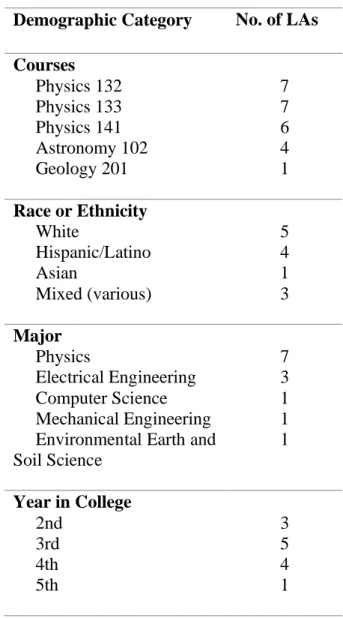
completed three or more quarters. The rest of the demographic information can be found in Table 1. Interviews were on average about 45 minutes long, with a total time of 10 hours and 4 minutes.
Physics 132 is an introductory physics course covering topics in waves, optics, and
thermodynamics. Physics 133 is an
introductory physics course covering topics in electricity and magnetism. Physics 141 is an introductory physics course covering topics in mechanics, kinematics, work, and energy. Astronomy 102 is an introductory
Demographic Category No. of LAs
Courses Physics 132 Physics 133 Physics 141 Astronomy 102 Geology 201 7 7 6 4 1
Race or Ethnicity White Hispanic/Latino Asian Mixed (various) 5 4 1 3 Major Physics Electrical Engineering Computer Science Mechanical Engineering Environmental Earth and Soil Science 7 3 1 1 1
Year in College 2nd 3rd 4th 5th 3 5 4 1
Table 1: Aggregated study participant demographics.
“Courses” denotes the number of participants that
astronomy course covering topics in stars, galaxies, and cosmological models. Geology 201 is an introductory geology course covering topics in structural surface structures, geological hazards, and natural resources.
IV.Data and Analysis
We analyzed the transcription data using a thematic analysis. From the thematic analysis, four major themes emerged: Effective preparation, Shared Language, Big Picture Planning, and Reflection. These themes reflect common patterns and ideas proposed by the LAs around their perceived effectiveness. In the Effective preparation theme, LAs discuss the different ways that being prepared ahead of time in terms of concepts and content allows them to anticipate student questions and derive a sense of confidence. In the Shared Language theme, LAs describe how each classroom environment carries its own set of rules, language and notation that they need to know in order to be “good” LAs. In the Big Picture Planning theme, LAs explain how
understanding the boarder structure of instructional content gives LAs goals they can work towards. In the Reflection theme, LAs describe how instructors give them avenues to reflect and improve on their Learning Assistant skills.
A. Effective Preparation
Content preparation sessions (content prep) are a core part of the Learning Assistant program. It covers the physics concepts and ideas that will be presented in the course. All content
preparation occurs weekly; however, depending on the class, it can be structured differently. Most LAs participate in a group content prep for one hour per Physics class (i.e., PHYS 132, PHYS 133, etc.). In these sessions, an experienced instructor and physics education researcher guides LAs from various professors through the material that will be covered throughout the week. Other LAs, such as those who assist Astro 102, have individual content prep with their professor. For example, Phys 141 studio classes employ Tutorials in Introductory Physics from the University of Washington [8] and Tutorials in Physics Sense Making from the University of Maryland [9]. The tutorials are small-group activities that the students work on after direct instruction. The LAs go through the concepts contained in each week’s tutorial, but also discuss common student preconceptions and potential setbacks.
Figure 1: Section taken from the Newton’s Third Law Tutorial used in Physics 141.
forces are equal, but the masses are not. Content prep has the Learning Assistants work through these Tutorials and allow LAs to discuss the common misconceptions. It also gives LAs a chance to practice their skills by pretending to, or even truly being confused. Content prep is an
opportunity for LAs to build and practice the tools they use inside the classroom.
Although the content prep is almost exclusively focused on the mechanics of teaching physics, students also describe how content prep aids them in also connecting with their students on an emotional level. This arose in the context of a mismatch between the content prep and the content covered in class.
Periodically, it seems what is covered in content prep does not always translate directly to what happens in the classroom. In fact, most participants stated that they had experienced days in which material in the classroom was completely new to them. While these LAs have a basic understanding of the concepts, many find it difficult to help students without knowing the specific questions and lab material ahead of time.
One LA we interviewed had many experiences where he was not properly prepared for the weekly content. He felt that this caused him to feel stressed, saying the following:
would go into class and feel like I would have to, like, put effort into just being where I should initially be (Tyler)1.
Tyler is describing how by being underprepared for the classes he LAs for, the job changes from one where he has set goals and pathways to achieve them, and instead becomes improve, an on the spot experience that he must deal with in the moment. This lack of direction in what he needs to do leads to stress which hurts his ability to be effective. Tyler also must exert more mental effort at the beginning of his classes into “being where I should initially be”. By not having communication of what was going to happen in the class, Tyler now must dedicate the time which would normally be allocated to helping students into preparing himself for that very thing.
Tyler goes on to describe how this affects him on an emotional level. He continues:
And so I think it makes me feel, I think it prepares me. But, almost more than that, it makes me more prepared and more comfortable in that environment so I can be a lot calmer going around to different students and answering questions which allows me to be moreempathetic and understanding about where they are coming from (Tyler).
Tyler states that content prep does more than just prepare them for the material; it can be beneficial to their mental state in the classroom. By being prepped effectively, Tyler becomes “calmer... more empathetic and understanding” with the students he is working with. There is an aspect to being well prepared that allows Tyler and other LAs connect with their students on a deeper level. Many LAs express the importance of building a connection with their students, and Tyler here expresses that effective content preparation plays a role in that process. Considering the focus of content preparation is focused on refreshing and understanding the concepts students are working on, it is surprising to see that there is both a logical, cognitive aspect to content prep, along with an “empathetic” and emotional component that can help LAs feel “comfortable”.
Like Tyler, Cody believed that being prepared ahead of time gave him a framework for interacting with students, saying,
Having the professors tell me at the beginning of the week what [the students] are gunna do each class is really helpful... It gives me a heads up to what students will be learning. So again, so I’m not completely going in blind. And so, if I’m not going in blind, I can give a bit more confidence when going into students and helping them learn (Cody).
Cody describes being ill prepared for class as “going in blind”. He loses sight of what he needs to do for the class and for the students, and thus must mentally prepare himself. Cody is forced to use more mental energy to focus on the concepts he may have forgotten, instead of focusing on what the students think about a particular topic. This inhibits Cody’s ability to help the students through conceptual difficulties and as such, hurts his ability to be an effective LA.
Cody also says that when he is effectively prepared, he can “give a bit more confidence”. The use of the word “give” is interesting, as it states that it is not Cody who is more confident, but the students he is helping. Cody goes on to explain,
Yeah I think as a student, when you are talking to someone who is not wavering, then you gain a lot of, the student automatically is more intent on listening... my sort of intuition is that if an LA is stuttering and mumbling and confused, but like, it’s ok for the LA to be confused, that doesn’t come across as incompetence, but if the LA is not
prepared, clearly not prepare, then they, what’s the word, trust? But yeah, the student’s trust in the LA diminishes because the LA doesn’t really know what they are doing. And that confidence, that confidence in the subject matter and what the students are doing helps the LA to put the student at ease when they express confusion (Cody).
Cody is saying that when he is well prepared, students recognize that, and are “more confident” when it comes to getting help. Rather than empathy, being prepared the students gain a “trust” in the LAs. The student gain confidence that if they have a question, an LA will be there to help. This is significant because it is often hard for an LA to recognize when an individual student is struggling, but when students feel comfortable and confident in approaching the LA, it creates more productive interactions and can immensely benefit learning. Cody feels as though he must earn this trust in order to be effective in the classroom. And by being well prepared, Cody helps “put the student at ease” by instilling that sense of trust and showing the students their questions and confusion will be resolved.
Content prep is focused on physics concepts and typical student problems. So, it is quite surprising that the LAs tended to focus on more affective outcomes related to content prep during their interviews. The affective outcomes had a nuanced and varied impact of their self-perceived instructional efficacy. The experiences of the LAs reflect how teaching and learning are cognitive and affective experiences, and it is difficult to separate these two aspects. In fact, it may be more useful not to try to separate them but attend to both as valid avenues for supporting student achievement.
B. Shared Language
From the previous section, we learned that LAs feel more effective when they know what the students will learn content-wise. In this section, we describe another aspect to this general theme: LAs feel more effective when they have a shared language with the students. LAs have typically taken the course before, but perhaps with a different textbook or instructor. When the instructor communicates to the LAs the language, notation, and ideas that they are communicating with the students, the LAs can “translate” their own previous knowledge into the language used by the students.
To exemplify this theme, we consider how Ezekiel expresses his desire to understand the students’ shared language created by the professor. He explains,
was at the same time. So, I… being able to communicate with the professor on how they were being taught what they were being taught, stuff like that was able, gave me the opportunity to help them in more of an effective manner. And I wouldn’t confuse them at the same time... by confusing them, by giving them something they’ve never seen before and they get scared or confused (Ezekiel).
Here Ezekiel describes his desire to teach the students he helps “how they were taught” or using the shared language of the classroom that is created by the professor. Ezekiel doesn’t “wanna pull out” examples, metaphors, or ideas that the students “weren’t taught” currently, but that he was introduced to when he took the same class previously. He feels as though without that shared language, he would confuse or scare the students he is trying to help “by giving them something they’ve never seen before”.
DJ offers a unique perspective on this theme, since he was an LA for ASTRO 102. Unlike the physics sequence, Astro LAs are required to attend all classes. DJ describes how this helps him create that shared language with students. He contrasts his experience in ASTRO 102 with PHYS 133. In the physics sequence, LAs attend for 1 hour of a 2 hour class session. DJ explains,
Another thing that’s kind of interesting to see is like, with the ASTRO class, we knew exactly what they had gone over and we could reference their notes to them. And in the 133 class, we weren’t there for lecture, so we weren’t sure how they covered stuff or what they covered. We just went over the tutorials. So it was really hard to reference their notes to them because a lot of the times you want to see what you’ve gone over in your notes if you’ve taken notes, but like we weren’t able to do that in the 133 class, we weren’t able to be like, a couple of pages ago, or like a couple, two days ago you went over this (DJ).
By being a member of the classroom during the lectures, DJ finds that he has a better
understanding of what the students know. This helps DJ by allowing him to reference key ideas he knows the students have gone over by directly “[referencing] their notes to them”. This builds a shared language between the LA and students which allows for better communication between the two. DJ also describes his desire to use a students’ notes in his PHYS 133 class when he says, “a lot of the times you want to see what you’ve gone over in your notes if you’ve taken notes”. Here DJ describes two different “you”s. The first “you” is DJ himself or a hypothetical LA, while the following “you”s describe a student he would be working with. Inserting the agents into DJ’s sentence, one realizes that DJ “wants to see” what the students have “gone over” in their notes, assuming they have taken notes. This allows DJ to feel comfortable that he is using the shared language of the classroom.
This type of communication with LAs may also have a dual benefit of supporting students who already feel different from their peers. For example, DJ goes on to describe how being a transfer student impacts his ability to use a shared language:
transfer [student], the material that we’ve gone over and the style it’s gone over isn’t the same. Or it, like, it could even differ from professor to professor because, like, the way that they cover material could be different and some may use examples that work better than another example that could work for somebody else (DJ).
First, DJ describes how even though the general concepts in Phys 133 (introductory electricity and magnetism) are the same, the “style it‘s gone over” such as the notation, variables, examples, etc., are not the same. He attributes some of this difference to his transfer student status, but recognizes that even within the same institution, that same “style” may “differ from professor to professor.” DJ feels that it is “especially” important to build that shared language for transfer students who are unfamiliar with the university. Coming in from other universities or community colleges, transfer students typically learn the concepts in these lower division classes prior to transferring. DJ finds that the difference in where he learned the concepts initially made an impact on what language he uses around it, and thus inhibits his ability to use a shared language with the students.
C. Big Picture Planning
While shared language of the classroom is narrower, this theme focuses on the bigger picture of the classroom created by the instructor. Medium- and long- term goals for students are important pieces of context for LAs who support the class. Instructors design their classes with guidelines of what student should know and by what time throughout the course. By communicating this broader context, LAs have a stronger sense of direction in the way they create their questions and lead the students through their thoughts and struggles.
Mental models are an idea discussed largely in the Learning Assistant Seminar, a two-unit course to train LAs in pedagogical techniques and concepts [10]. While the mental models can be built through the shared language of the classroom, they are developed and refined throughout the quarter. One of our participants, Trent, explains how understanding these models helps him as an LA, saying,
I can get a better understanding of how, of what type of mental modelor what end they want me to reach when I am teaching the students. I think understanding what they [the instructor] want out of their curriculum helps me know how I can structure my questions (Trent).
Trent finds value in understanding not just the students’ mental models, but in particular the mental model the professor is trying to instill on the students. He also states his desire to understand “what end [the professor] want me to reach”, which shows a desire to know what knowledge the students need to gain by the end of the class. Trent finds that by understanding these big picture goals the instructor has, it gives him a direction in which he can “structure [his] questions” to be more effective.
we don’t grade the students and we don’t get to see how the students are doing in the class and so a lot of times I’ll go up to the teacher and ask them what groups are
struggling and what groups are doing great. That way, I know which ones [groups] I can attend to and be around more, and those would be the groups I would make an extra effort to be comfortable enough that they can ask me questions and I can ask them questions without it feeling awkward (Noah).
As Noah describes, the LAs are outside the hierarchy of the classroom. By design, the LAs in the physics studios participate for 1 of the 2-hour period and do not serve as graders or teaching assistants (although they may at times hold office hours). The idea behind keeping LAs separate from grading is so LAs are not put into a position that they might judge a student based on their homework performance. So, without intimate knowledge of the students’ grades, Noah describes that the LAs rely on communication from the instructor to know to whom to pay particular attention (“know which [groups of students] I can attend to and be around more”). Noah finds it valuable to “make an extra effort” to help struggling students feel “comfortable enough that they can ask me questions”. So, when Noah’s instructor gives him that background of which students or groups need help, he can utilize that extra information and take appropriate action.
From our study, many participants’ professors give the LAs a brief rundown before students begin working. What they discuss will vary depending on the day and class, but often the
professors will introduce the worksheets or lab the students are about to partake in. Eva feels this communication can be very helpful, stating,
they’ll [the instructor] walk over to the LA and be like, 'Ok, this is worksheet they are doing,’ they will usually hand us the same worksheet we’ve already seen hopefully, and then they are like, ‘Here’s what I really want them to get out of this, here is the part I really want them to emphasize, and by the end we want everyone to understand, you know, what a spring constant is, or whatever.’ To give us like a learning objective and that’s my favorite because then I can go up to like any group at any time and be like, have you reached this unspoken learning objective, and if you haven’t, let’s get you there (Eva).
D. Reflection
The interviewing process is, by design, a reflective process. As participants look back and reflect on their experiences, it is natural to think about the process of reflection itself. One of the very first questions the participants are asked is, “Do you feel that you are an effective LA?” As such, reflection came up many times as participants talked about communication with their instructors. Most LAs value reflecting, and some specifically value it with their instructors. This reflection helps the LAs learn from their mistakes or give feedback to improve instruction and
communication with students after the class period is over.
Many participants had moments in which they would talk with their professors at the end of class to discuss the struggles and triumphs both the students and LAs had that day. The LAs found these moments as a chance to reflect and think deeper about the interactions they’ve had. Eva found this communication helpful, saying,
I thought it was good to just have face-to-face communication once a week, but I also really like the aspect that it was, like, self-reflective, that, like, I would realize that we were meeting up that day, and I would, like, ‘hold on, let me think about how this week went’. And so I'd have that sort of moment of self-reflection, like, ‘Ok well, it went well. Is there anything that, like, everyone was killing it on, they did really good. Was there anything that a, that like multiple groups were having a hard time with. Was there anything that I was having a hard time conceptually’ was also something thatwe would talk about if I was like ‘Oh yeah, I, you know at the end of class someone asked this and I couldn’t figure it out’, we could talk about that (Eva).
At the beginning, Eva states she benefits from the “face-to-face communication” with the instructor she is working with. She follows this with a “but” even though Eva is not contrasting two different experiences. The “but” is followed by her explaining how the face-to-face
communication gives her the opportunity to self-reflect because she “would realize that [Eva and her instructor] were meeting up that day”. By knowing she would have a discussion later, Eva makes the conscious decision to reflect on her interactions with students, whether they be good or bad. Eva gives examples of what she reflects on such as “Is there anything that... everyone was killing it on2” and “Was there anything that I was having a hard time conceptually”. Here we see two foci of Eva’s reflection. At first, she focuses on reflecting outward on the class, asking herself about the extent to which the students understand the given topics. But then she turns her focus on herself, and her own actions. These reflections are distinct in that one looks inward, reflecting on personal actions, and the other looks outwards, reflecting on the environment and the students Eva supports. The meeting with the instructor serves as a low-stakes way for Eva to share her thoughts on her own instructional practices. As Eva processes her ideas out loud, she is also refining them, so the instructor proves as a critical sounding board.
Eva finds her reflection process becomes more useful the longer she engages with the practice, stating,
I think as the quarter went on, and I became sort of used to that self-reflection thing, I would do it as I was going, and that was I think helpful in the sense of being like ‘Ooo, I don’t think that interaction went that well. I’m, 1, I’m going to talk about that later, but 2, why didn’t that go well, and how could I not do that again.’ Which ideally you do
anyways, but like being like very specifically conscious of it and not just ‘Ooo that was bad, ok moving on, try not to do that again’ (Eva).
After weeks of reflecting with her instructor, Eva is “specifically conscious” of making a good effort in learning from her interactions with students. Her thinking becomes less about what happened--an ineffective interaction with a student--to a focus on why it happened. Eva's
orientation toward reflection becomes more nuanced as she tries to improve on her abilities as an LA. This complexity is a product of repeated meetings with her instructor where she was able to build this reflective skill and develop tools to improve her own efficacy.
Complementary to Eva’s ideas of reflection, Noah also takes an outward approach to reflection. Eva says she experienced both an inward and outward type of reflection, but Noah focuses in on reflecting on the class. He finds the professor aids in this reflection stating,
The only real important dialogue I had with the instructors is usually at the end of class they’ll pull me assist and say “Did you notice anything that they weren’t getting?” and I think that’s super important, because when you have such large class sizes, it’s hard for the instructors to keep tabs on what individual topics (Noah).
Noah says these meetings after class can give the LA a chance to give feedback to their
instructor because “it’s hard for the instructors to keep tabs on” the topics that students could be struggling with. Noah defines this communication as “important dialogue I had with the
instructors” signifying how impactful he finds this communication. While this reflection focuses less on improving Noah’s personal efficacy, he finds it indirectly supports the students as it helps the instructor who can in turn help the students. Noah here describes a more logistical reason why a reflection period with the instructor is useful for him as an LA.
Izzy values reflection more similarly to Eva through self-reflection. But uniquely, Izzy also finds value in reflecting with their instructor for their pedagogical experience, allowing for an
opportunity for feedback. Izzy begins,
’How was today’, questions like that are nice because it also helps you reflect on what happened during the day and what went well and what didn’t go well... Yeah, I think reflection is always good for like any part of your life (Izzy).
The simple question from the instructor of “How was today”, to Izzy, helps her take a step back and “reflect on what happened during the day”. Just like Eva, it is the communication with their instructors that enables the chance to reflect on their interactions with students.
Izzy continues,
am doing ok, and then I guess I haven’t heard anything negative so that’s good. And I, yeah. So I, there’s never really like a performance review, or like, you know I was seeing you do this, and this is good about it, but you know, you might wanna work on this (Izzy).
Izzy says these conversations with her instructor are also a chance to get feedback herself. She thinks she is “doing ok”, but she wants the knowledge of a more experienced instructor to help her improve. Izzy wants “constructive criticism” to help her act in making herself a better LA, and she finds these meetings with her professor are a perfect opportunity for that. While Eva finds the reflection itself very effective for her, Izzy believes this communication with their instructor can lead to a more actionable improvement with the help of that constructive criticism. And like Noah, the feedback can go both ways, improving both the instructor and the LA.
V. Discussion
This study shows some of the ways that LAs greatly value communication with the instructors they work with and look to the instructors for feedback on their performance. LAs find that communication can help them connect with students, and work with them in a shared language. It also aids in creating goals for the LAs as well as allowing for deeper reflection on their endeavors. Here, we discuss some recommendations for instructors working with LAs to create productive communication and support LAs in their practice based on our findings.
A. Communicate Classroom Content and Language
In principle, LAs are most effective when they have a decent background in the appropriate discipline. However, a background in the content knowledge of the discipline is not a sufficient condition for effective assistance. Each instructor and course carry a subset of accepted
vocabulary and notation, which may be distinct from the LA's content background. As such, it is critical that LAs are given ample time to review the content they are working with ahead of time so they can prepare themselves to use the shared language of the classroom with the students.
Ideally, LAs are fully prepped from the hour prep they do each week; however, it is often not enough time to discuss all the different ways an instructor may present material, or the different acceptable notational rules. The content prep focuses on the tutorials that are used in all classes, but each instructor is different, and will have different supplemental work that the content prep cannot go through. Therefore, it is best if there is distinct and comprehensive communication between the LAs and their instructor about not only what worksheets, labs, etc., that will be used that week, but also what language they use regarding this content. LAs want to help the students in a way the students can understand, and this is best achieved when the LA knows how the ideas of the week are being communicated.
variability. To illustrate, DJ describes that he learned about charge distribution, or “the electric field rather, along an axis of a ring of charge” [DJ], but his LA class used a line of charge. When DJ was trying to use the ring of charge example to work on a separate problem with the students, he says: “ it is an example which I [DJ] had done and it wasn’t something that they [the students] had done yet and it was like, I was trying to reference that but I had no idea that they had even seen it.” So, if there are canonical problems specific to the course that one is using as an anchoring phenomenon, these should be communicated directly with the LAs, as they might have been exposed to a different set of canonical problems.
B. Communicate the Big Picture
As described in Gray’s paper [2], LAs use questioning to help understand how students think and approach problems. From our study, we have also found that LAs value this information when it is communicated from the instructors as well. So with classroom structure, instructors, and other factors contributing to a variety of learning environments a student might experience, how an LA best supports the students varies greatly from class to class. To aid a smooth transition between learning environments, it can be useful to communicate one’s long-term instructional goals. These goals can be important conceptual takeaways, learning objectives, or heuristics. It is also to communicate when and how an instructor observes that students that are struggling, so that LAs can keep an eye out on them and provide additional support.
A way to implement this can be before, or as students begin their discussion groups. Have a short meeting to discuss what should the students understand by the end of the class period.
Communicate who is doing well and who is struggling so the LAs can prioritize those who need them the most. This communication gives the LAs a direction and objective for them to work towards throughout the class. This can help counter the difficulty many LAs said they feel during class when they are underprepared to tackle the nuances of different learning environments
C. Opportunity to Reflect
Similar to the conclusions in [4], we found reflection was an important aspect of how LAs interacted with the broader LA model. What is unique about what we found is that LAs value their instructors as a component of their reflection process. Our data shows that LAs value reflecting with their instructors who can act as experiential feedback. For an advisor to get the most value from their LAs, and to help them improve their abilities, it is best if instructors find ways to reflect with their LAs directly. Having a routine opportunity to reflect helps the LAs practice and be more mindful about their interactions. We can recall Eva’s succinct summary around this experience: “I became sort of used to that self-reflection thing, I would do it as I was going.” As such, it is best to set up a daily, or weekly meeting to reflect on the LAs’ experiences with students. This is also a great opportunity for the instructor to ask for feedback or get a better understanding of the students in the classroom.
VI.Conclusion
understand how communication with the instructor affected their self-perceived educational efficacy. The results was four major themes: Effective Preparation, where LAs describe the benefits of effective communication of classroom content; Shared Language, where
communicating the language of the classroom aids in how LAs communicate with students; Big Picture Planning, where LAs express a desire to understand the scope and structure of the class; and Reflection, where LAs explain how instructors can work with them to reflect and improve themselves. These themes tie into previous work that found the LA model useful for identity formation. As Close [3] describes, there is value in creating a community within the LA model that encompasses both LAs and the faculty they work with. Our data supports this heavily, showing that communication between LAs and faculty within the themes can improve an LA’s perceived efficacy. As with Gray’s paper [2], we found LAs’ value understanding the students they work with. Along with questioning students directly, instructors can act as a resource for student knowledge and the shared language of the class. With this, we find that communication between an LA and their instructors can have a positive impact on the LA’s perceived efficacy.
These have direct implications for further research regarding communication within the Learning Assistant model. Unlike how Wubbles [5] defines communication, we view communication from one lens, that being from the LA’s perspective. It would be beneficial to fully understand
communication within the Learning Assistant model by viewing the instructor’s perspective. This would allow for a fuller understanding of the communication occurring between the LAs and their instructors. Another avenue of exploration could be to understand the effects of classroom hierarchy on LA efficacy. Some of our data found that LAs were split between considering their instructors of a similar power level, while others found them as superiors. This dynamic, if explored more, could provide important context to this area of research.
VII. Works Cited
[1] Otero, Valerie, Steven Pollock, and Noah Finkelstein. “A Physics Department’s Role in Preparing Physics Teachers: The Colorado Learning Assistant Model.” American Journal of Physics 78, no. 11 (November 2010): 1218–24. https://doi.org/10.1119/1.3471291.
In this article, the authors are motivated by a lack of specific physics training for K-12 physics teachers. The Learning Assistant model, created in CU Boulder, was intended to achieve four main goals: improved education of science and math students, recruit more future science and math teachers, engage faculty in the preparation of future teachers, and change science
education, there is a lot of interest in the LA program as a way to improve many levels of education at once.
[2] Gray, Kara E., Valerie K. Otero, Charles Henderson, Mel Sabella, and Leon Hsu. “Analysis of Learning Assistants’ Views of Teaching and Learning.” In AIP Conference Proceedings, 123– 26. Edmonton, Alberta (Canada): AIP, 2008. https://doi.org/10.1063/1.3021233.
This study focused on finding how Learning Assistants view the role of questioning in the classroom. As part of a requisite pedagogical preparation course (LA seminar), LAs were required to fill out weekly reflections. These reflections were analyzed to find Learning Assistants’ views on questioning, and how that changes over the course of one semester. The study found six major themes such as the theme that LAs view of questioning as a way to support students without giving answers. Another theme they found was that LAs view questioning as a tool for LAs to understand the student’s thinking. All the themes showed prevalence early in the semester, but weakened in frequency as the quarter ended. The study found two possible reasons for this: the LA seminar focused less on questioning as the quarter passed, or questioning became natural to LAs and thus became less of a talking point.
[3] Close, Eleanor W., Jessica Conn, and Hunter G. Close. “Becoming Physics People: Development of Integrated Physics Identity through the Learning Assistant Experience.” Physical Review Physics Education Research 12, no. 1 (February 22, 2016): 010109. https://doi.org/10.1103/PhysRevPhysEducRes.12.010109.
A study was done on physics Learning Assistants at Texas State University by collecting data from over 60 physics Learning Assistants. The data consisted of teaching reflections over the course of 5 semesters, as well as interviews from a subset of participants (12 total). Data was analyzed with the goal of finding what impacts the LA program has on the participants’ construction and perception of identity. From the analysis, the effects of the LA program manifested in many ways such as settling into the physics community or building a sense of personal interest. What is most relevant to our study, however, is the idea of building and strengthening a relationship between the LA and the physics faculty. Our study echoes the idea that LAs’ find value in their relationship with their faculty, and more specifically, their
instructors. This relationship, as the study finds, builds community and allows LAs to be comfortable failing knowing there is support from their faculty and peers.
[4] Cochran, Geraldine L, and David T Brookes. “Prospective Teachers Serving as Physics
Learning Assistants’ Perspectives on Reflective Practice.” In Proceedings of the 12th Annual South Florida Education Research Conference, edited by M. S. Plathotnik and S. M. Neilsen, 19–26. Miami: Florida International University, 2013.
http://education.fiu.edu/research_conference.
Learning Assistants, and reflecting allows the LAs to improve themselves, their skills and their techniques in supporting students.
[5] Wubbels, Theo, and Mieke Brekelmans. “Teacher–Students Relationships in the Classroom.” In Second International Handbook of Science Education, edited by Barry J. Fraser, Kenneth Tobin, and Campbell J. McRobbie, 1241–55. Dordrecht: Springer Netherlands, 2012. https://doi.org/10.1007/978-1-4020-9041-7_80.
This chapter from the Second International Handbook of Science Education focuses on describing the various conclusions from research on teacher-student relationships. Data is gathered from various means such as observations, interviews, and questionnaires such as the Questionnaire on Teacher Interaction (QTI). They discuss research on teaching styles where they found that more direct and structured teaching leads to better student outcomes. Also discussed are non-verbal teacher behaviors that show how visual contact, among other things, impact students’ view on the teacher’s presence in the classroom. Variables such as student gender and setting are looked at to see impacts on teacher student relationships. Wubbles finds that good teacher student relationships aid in producing an environment for productive scientific learning.
[6] Richmond, Virginia P. “Communication in the Classroom: Power and Motivation.” Communication Education 39, no. 3 (July 1, 1990): 181–95.
https://doi.org/10.1080/03634529009378801.
In order to understand the power dynamic of the classroom, a study was done on students’ perception surrounding various aspects of teachers’ behaviors and techniques and to what extent they influence motivation to study. 366 undergraduate students enrolled in elective courses in communication were selected for their broad representation. To measure motivation, subjects were asked to respond to questions with reference to the statement “My feelings about studying the content in the class.” For questioning student perceptions on teacher techniques and
behaviors, the study provided lists for students to indicate whether their teacher used them, and to what frequency. The study found that some behaviors and techniques can impact student motivation positively and some negatively. In general, the study finds that teachers must be conscious of the way they communicate with students in order to incite stronger motivations to learn. They find that when positive relationships are built with students and teachers, the students are more likely to take part in cognitive and affective learning.
[7] Kanim, Stephen, and Ximena C. Cid. “The Demographics of Physics Education Research.” ArXiv:1710.02598 [Physics], October 6, 2017. http://arxiv.org/abs/1710.02598.
This study looks into the use of research demographics in physics education research (PER) and the under and/or overrepresented populations within it. The study took a sample of research papers within PER from 1970 to 2015. In total, 417 papers were used with a total student population of over 250,000 varying from all levels of education. The study found many
study to three journals, those being the American Journal of Physics, Physical Review – Physics Education Research, and The Physics Teacher. The study discusses how demographics can affect outcomes of studies, and that it is important a study denotes the subjects’ demographics in order to give greater context to the study’s results.
[8] Shaffer, Peter S., and Lillian C. McDermott. “A Research-Based Approach to Improving Student Understanding of the Vector Nature of Kinematical Concepts.” American Journal of Physics 73, no. 10 (October 2005): 921–31. https://doi.org/10.1119/1.2000976.
This study looks into developing tutorials for kinematic problems. Initially, introductory physics students at University of Washington, students in preservice high school courses, teaching assistants, and graduate students taking Ph.D qualifying examinations, were all given a test to determine their understanding of 2-D kinematics. These tests found that all groups had little understanding of acceleration vectors in 2-D kinematics. With this in mind, they developed a set of tutorials to leave students with a stronger understanding of kinematics. The study found their tutorials better helped students with many common misconceptions such as: distinguishing between velocity and acceleration vectors, mistaking that the acceleration is zero at the turnaround in 1-D motion, or assuming the acceleration is zero if the speed is constant in 2-D motion. These Tutorials in Introductory Physics prove useful for both students learning them and teaching assistants working with them.
[9] Elby, Andrew. “Helping Physics Students Learn How to Learn.” American Journal of Physics 69, no. S1 (July 2001): S54–64. https://doi.org/10.1119/1.1377283.
This study identifies how student beliefs on learning physics develops when being taught an epistemology-focused physics class. The study was done at two high schools: one in San
Francisco, California, and one in Virginia near Washington, DC. The Virginia school is a magnet high school for gifted and talented students. To measure the students’ beliefs, two questionnaires. Both schools’ students were given the Epistemological Beliefs Assessment for Physical Science (EBAPS), while only the Virginia school was given the Maryland Physics Expectations Survey (MPEX) due to it being developed for higher educated students. The tests were given at the beginning of the year and again at the end to find temporal differences in student answers. Both schools resulted in similar gains towards viewing physics learning in the following ways: constructing their own understanding, concepts rather than formulas, and connections towards the real word. The study shows that with an epistemology-focused course, students take with them stronger epistemological beliefs, helping in their further understanding of physics concepts.
[10] Redish, Edward F. “Implications of Cognitive Studies for Teaching Physics.” American Journal of Physics 62, no. 9 (September 1994): 796–803. https://doi.org/10.1119/1.17461.
VIII. Appendix
INFORMED CONSENT TO PARTICIPATE IN A RESEARCH PROJECT:
“Effects of Communication Between Learning Assistants and Advisors on the Learning Assistant’s’ perceived effectiveness”
This form asks for your agreement to participate in a research project on the communication taking place between Learning Assistants (LAs) and the professors they work with. Your participation involves participating in a 1-on-1 interview, and it is expected that it will take approximately 1 hour. There are minimal risks anticipated with your participation. You and other LAs may benefit from your participation. If you are interested in participating, please review the following information:
The purpose of the study is to understand the importance and impact communication between Learning Assistants and the professors they work with can have on the LAs perceived effectiveness. Potential benefits associated with the study include changes to the LA program in order to improve LA perceived effectiveness .
If you agree to participate, you will be asked to complete a 1-on-1 interview via Zoom software, in which you will be asked about your experiences in the LA program.
Please be aware that you are not required to participate in this research, refusal to participate will not involve any penalty or loss of benefits to which you are otherwise entitled, and you may discontinue your participation at any time. You may omit responses to any questions you choose not to answer. There are minimal risks anticipated to your reputation and employment if your responses to questions and identity are accidentally disclosed outside of the research team. These risks will be minimized because the data will only be seen by verified researchers and will be transcribed with pseudonyms for confidentiality. The interviews will be transcribed by the research team (Rios and Rassouli).
This research is being conducted by Dr. Laura Rios and Jahangir Rassouli in the Department of Physics at Cal Poly, San Luis Obispo. If you have questions regarding this study or would like to be informed of the results when the study is completed, please contact Dr. Laura Rios at [email protected] or Jahangir Rassouli at [email protected].
If you have concerns regarding the manner in which the study is conducted, you may contact Dr. Michael Black, Chair of the Cal Poly Institutional Review Board, at (805) 756-2894,
[email protected], or Ms. Trish Brock, Director of Research Compliance, at (805) 756-1450,
If you agree to voluntarily participate in this research project as described, please indicate your
agreement by signing below. Please keep a copy of this form for your reference, and thank you for your participation in this research.
____________________________________ ________________ Signature of Volunteer Date
____________________________________ ________________ Signature of Researcher Date
Interview Protocol
1) Hello. Thank you for joining me for this interview. The primary focus of this is to see how the communication between an LA and the instructor(s) they work with, affect the LA’s effectiveness in the classroom.
2) As a part of this interview, let’s review the consent form you signed electronically. Do you have any questions about it I can answer?
Wait and answer questions.
3) Just as a reminder, AdobeSign allows you to download your signed document for a period of time after signing it. If you would like an extra copy of your consent form, you can always download it directly from AdobeSign.
Start recording on Zoom
4) To start off, as a bit of background, what physics courses do you LA for? a) How often do you LA? (How many hours/ how many days of the week) 5) For these classes, what do you think makes an effective LA in the classroom?
a) Do you feel that you are an effective LA?
b) What role do you think communication with the instructor plays in [your answer]
6) Could you describe the material you work on in content prep?
a) Could you describe how that material translates to your LA class?
b) How does the material worked on in content prep help you be an effective LA? 7) What communication, if any, do you have outside of class with your LA instructors?
a) Ask following if not answered after initial question
i)How frequently do you communicate with your instructor outside of class?
ii) What medium do you communicate through?
iii) How does the communication outside of class help you be an effective LA?
8) What communication, if any, do you have with your instructor within the classroom? a) How often do you communicate in class with your instructor?
b) Does the instructor create an open environment for communication between you, the students, and the instructor?
i)How do they facilitate in creating that environment?
ii) What could they do to help foster an open environment? c) How do these factors influence your effectiveness as an LA?
9) Finally, as a whole, how do you feel communication with your instructor(s) influences your effectiveness as an LA?
10)Thanks so much for telling me about that. We’re almost done. I just have a couple demographic questions.
b) Can you tell me your race and/or ethnicity? c) What year are you in school?
d) Are you a transfer student, by any chance? Or an international student? e) Can you remind me of your major?
f) How many quarters have you been an LA for?
11)So that is the end of my questions, and I wanted to say thank you so much for participating. Did you have any closing questions you wanted to ask?
12)Finish paperwork and payment
13)Again, thank you for your time, and your help in my research project.
End Interview
14)Things to pay attention to through interview:
15)In question 8 and 9, there is the possibility of no communication. In such a case, lead to following questions:
a) What communication would you like to see?
b) What communication do you think would help you be a more effective LA? 16)For question 7, some students have content prep separate from the group. In this case,
lead to the following questions:
a) How do you prepare for the material the students work on in class?
b) Do you feel having content prep separate from the group has an effect on your effectiveness as an LA?