arXiv:1602.01588v1 [nucl-th] 4 Feb 2016
Low-energy hypernuclear spectra with microscopic particle-rotor model with
relativistic point coupling hyperon-nucleon interaction
H. Mei,1, 2 K. Hagino,1, 3, 4 J. M. Yao,5, 2 and T. Motoba6, 7
1Department of Physics, Tohoku University, Sendai 980-8578,Japan
2School of Physical Science and Technology, Southwest University, Chongqing 400715, China 3
Research Center for Electron Photon Science, Tohoku University, 1-2-1 Mikamine, Sendai 982-0826, Japan
4 National Astronomical Observatory of Japan, 2-21-1 Osawa, Mitaka, Tokyo 181-8588, Japan 5Department of Physics and Astronomy, North Carolina University, Chape Hill 27599-3255, USA
6Laboratory of Physics, Osaka Electro-Communications University, Neyagawa 572-8530, Japan 7Yukawa Institute for Theoretical Physics, Kyoto University, Kyoto 606-8502, Japan
We extend the microscopic particle-rotor model for hypernuclear low-lying states by including
the derivative and tensor coupling terms in the point-coupling nucleon-Λ particle (NΛ) interaction.
Taking13ΛC as an example, we show that a good overall description for excitation spectra is achieved
with four sets of effective NΛ interaction. We find that the Λ hyperon binding energy decreases
monotonically with increasing the strengths of the high-order interaction terms. In particular, the
tensor coupling term decreases the energy splitting between the first 1/2− and 3/2− states and
increases the energy splitting between the first 3/2+ and 5/2+ states in13 ΛC.
PACS numbers: 21.80.+a, 23.20.-g, 21.60.Jz,21.10.-k
I. INTRODUCTION
The spectroscopic data on low-lying states of light Λ hypernuclei have been accumulated [1] and more data on those of medium and heavy hypernuclei are expected to be obtained with the next-generation facilities such as J-PARC [2]. Rich information on the hyperon-nucleon interaction in nuclear medium and the impurity effect of a Λ particle on nuclear structure are contained in these data. Because hyperon-nucleon and hyperon-hyperon scattering experiments are difficult to perform, the struc-ture of hypernuclei has been playing a vital role in order to shed light on baryon-baryon interactions. Such in-formation is crucial in order to understand also neutron stars, in which hyperons may emerge in the inner part [3]. However, extracting information on baryon-baryon inter-actions from the spectroscopic data relies much on nu-clear models.
In the past decades, several different types of theo-retical models have been developed to study the struc-ture of hypernuclei, including an ab-initio method [4], a cluster model [5–11], a shell model [12–14], the anti-symmetrized molecular dynamics (AMD) [15–18], self-consistent mean-field approach [19–27] and the genera-tor coordinagenera-tor method (GCM) based on energy den-sity functionals [28]. In recent years, we have also de-veloped a microscopic particle rotor model (MPRM) for hypernuclear low-lying states based on the beyond-mean-field approach [29, 30]. In contrast to the GCM for the whole hypernuclei [28], where the wave function of the hypernuclear states is given as a superposition of hyper-nuclear mean-field states, the hyperhyper-nuclear states in the MPRM are constructed by coupling a hyperon to low-lying states of the core nucleus. The MPRM provides a convenient way to analyze the components of hypernu-clear wave function and has been applied to study the
low-lying states of9
ΛBe [29],13ΛC,21ΛNe and155Λ Sm
hyper-nuclei [30]. For the sake of simplicity, only the leading-order four-fermion coupling terms of scalar and vector types were adopted for the NΛ effective interaction in these studies.
The aim of this paper is to extend the previous calcu-lations by implementing the higher-order derivative and tensorNΛ interaction terms in the point-coupling inter-action [31]. The derivative terms simulate to some extent the finite-range character of NΛ interaction and these terms are expected to be more pronounced in light hy-pernuclei [32]. On the other hand, the tensorNΛ interac-tion is important to reproduce a small hyperon spin-orbit splitting in Λ hypernuclei [33]. It is therefore important to assess the effect of these terms on hypernuclear low-lying states.
The paper is organized as follows. In Sec. II, we present the main formulas of the microscopic PRM for Λ hyper-nuclei with the full point-coupling effectiveNΛ interac-tion. In Sec. III, we show the results for hypernuclear low-lying states in13
ΛC and discuss the influence of the
higher-order terms on the energy spectra. We then sum-marize the paper in Sec. IV.
II. MICROSCOPIC PARTICLE-ROTOR MODEL FORΛHYPERNUCLEI
In this paper, we consider a single-Λ hypernucleus and describe the hypernuclear low-lying states using the microscopic particle-rotor model (MPRM). Since the detailed formulas for the MPRM have been given in Refs. [29, 30], we give here only the main formulas of this approach. To this end, we put a particular emphasis on the implementation of the higher-order NΛ interaction terms.
hyper-nuclear wave function by coupling the valence Λ hyperon to the low-lying states of nuclear core in the laboratory frame, that is,
ΨJM(r,{ri}) =
X
n,j,ℓ,I
RjℓnI(r)FJM
jℓnI(ˆr,{ri}), (1)
with
FJM
jℓnI(ˆr,{ri}) = [Yjℓ(ˆr)⊗ΦnI({ri})](JM), (2)
whererandri are the coordinates of the Λ hyperon and the nucleons, respectively. Here,J is the angular momen-tum for the whole system, whileM is its projection onto the z-axis in the laboratory frame. Yjℓ(ˆr) is the spin-angular wave function for the Λ hyperon. |ΦnIi is the wave functions for the low-lying states of the core nucleus, where I represents the angular momentum of the core state and n = 1,2, . . . distinguish different core states with the same angular momentum I. In the MPRM, the core states|ΦnIiare constructed with the quantum-number projected GCM approach [29, 30]. For conve-nience, hereafter we introduce the shorthanded notation
k={jℓnI}to represent different channels.
In Eq. (1), Rk(r) is the radial wave function for the Λ-particle. In the relativistic approach, it is given as a four-component Dirac spinor
Rk(r) =
fk(r)
igk(r)σ·ˆr
. (3)
We assume that the Hamiltonian ˆH for the whole Λ hypernucleus is given as
ˆ
H = ˆTΛ+ ˆHc+
Ac X
i=1
ˆ
VNΛ(r,ri). (4)
Here ˆTΛ = −iα· ∇Λ +γ0mΛ is the relativistic kinetic
energy of Λ hyperon, wheremΛis the mass of Λ particle,
and α and γ0 are the Dirac matrices. ˆHc is the many-body Hamiltonian for the core nucleus [34], with which the core state|ΦnIi satisfies ˆHc|ΦnIi =EnI|ΦnIi. The last term in Eq. (4) represents theNΛ interaction term between the valence Λ particle and the nucleons in the core nucleus, where Ac is the mass number of the core nucleus.
We construct the NΛ interaction ˆVNΛ based on the
relativistic point-coupling model [31], in which the energy functional for theNΛ interaction reads
Eint(NΛ)=
Z dr
h αNΛ
S ρS(r)ρΛS(r) +αVNΛρV(r)ρΛV(r)
+δNSΛρS(r)∆ρΛS(r) +δVNΛρV(r)∆ρΛV(r)
+αNTΛρΛT(r)ρV(r)
i
. (5)
Here ρS, ρV and ρT are the scalar, the vector and the tensor densities defined in Ref. [31], respectively. Taking
the second functional derivative of Eq. (5) with respect to the densities [35],
ˆ
VNΛ(r,ri) = δ 2E[ρ]
δρΛ
S(r)δρS(ri)
+ δ
2E[ρ]
δρΛ
V(r)δρV(ri)
+ δ
2E[ρ]
δρΛ
T(r)δρV(ri)
, (6)
we obtain the following form for theNΛ effective inter-action
ˆ
VNΛ= ˆVSNΛ+ ˆVVNΛ+ ˆVTenNΛ, (7)
where the scalar, vector and tensor types of coupling terms read
ˆ
VSNΛ(r,ri) =αNSΛγΛ0δ(r−ri)γN0 +δSNΛγΛ0
h←−
∇2δ(r−ri)
+δ(r−ri)−→∇2+ 2←∇ ·− δ(r−ri)−→∇
i γN0
(8)
ˆ
VNΛ
V (r,ri) =αNVΛδ(r−ri) +δNVΛ
h←−
∇2δ( r−ri)
+δ(r−ri)−→∇2+ 2←∇ ·− δ(r−ri)−→∇
i
(9)
ˆ
VTenNΛ(r,ri) =iαNTΛγ0Λ
h←−
∇δ(r−ri) +δ(r−ri)−→∇
i
·α.
(10)
Here,−→∇ and←∇−are understood to act on the right and left hands sides of the Λ hyperon coordinates, respectively. Vice versa, Eq. (5) can be obtained from the above ef-fectiveNΛ interaction (see Appendix A). We note that similar terms appear in the chiral hyperon-nucleon in-teraction [36], in which the non-derivative four-fermion coupling corresponds to the contact leading-order (LO) term.
With Eqs. (1) and (4), the radial wave functionRk(r) in Eq. (3) and the energyEJfor each hypernuclear state are obtained by solving the following coupled-channels equations,
d
dr −
κ−1
r
gk(r) + (EnI−EJ)fk(r)
+X
k′
Ukk′
T (r)gk′(r) +
X
k′
h Ukk′
V (r) +Ukk
′
S (r)
i
fk′(r) = 0,
(11a)
d
dr +
κ+ 1
r
fk(r)−(EnI−2mΛ−EJ)gk(r)
−X
k′
UTkk′(r)fk′(r)−
X
k′
h
UVkk′(r)−Ukk
′
S (r)
i
gk′(r) = 0,
(11b)
where κ is defined as κ = (−1)j+ℓ+1/2(j + 1/2). The
by
USkk′(r)≡hFjlnIJM| Ac X
i=1
ˆ
VSNΛ(r,ri)|FjJM′l′n′I′i (12a)
UVkk′(r)≡hFjlnIJM| Ac X
i=1
ˆ
VVNΛ(r,ri)|FjJM′l′n′I′i (12b)
UTkk′(r)≡hFjlnIJM| Ac X
i=1
ˆ
VTNΛ(r,ri)·σ|FjJM′˜l′n′I′i, (12c)
with
ˆ
VNΛ T ≡αNTΛ
h←−
∇δ(r−ri) +δ(r−ri)−→∇
i
. (13)
By expanding each of the large fk(r) and small gk(r) components of the Dirac spinors, Eq.(3), in terms of the radial functionRαl(r) of a spherical harmonic oscillator, that is,
fk(r) = f(k)
max X
α=1
FkαRkαl(r), (14a)
gk(r) = g(k)
max X
α=1
GkαRkα˜l(r), (14b)
with l =j±1/2 and ˜l =j∓1/2, the coupled-channels equations (11a), (11b) are transformed into a real sym-metric matrix equation,
X
α′,k′
Akk′
αα′+V
kk′
αα′ +S
kk′
αα′ B
kk′
αα′+T
kk′
αα′
Bkk′
αα′+Tkk ′
αα′ Ckk
′
αα′+Vkk ′
αα′ −Skk ′
αα′
Fk′
α′
Gk′
α′
=EJ
Fk
α
Gk α
. (15)
The dimension of the matrix isX k
fmax(k) +g(maxk) , where
k represents different channels. In Eq. (15), the matrix elements are given by
Akkαα′′ =hR
k
αl(r)|EnI|Rk
′
α′l′(r)iδk,k′ (16a)
Bααkk′′ =hR
k αl(r)|
d
dr −
κ−1
r |R
k′
α′˜l′(r)iδk,k′ (16b)
Cααkk′′ =hR
k
α˜l(r)|(EnI−2mΛ)|R k′
α′˜l′(r)iδk,k′ (16c)
Vααkk′′ =hR
k
αl(r)|Ukk
′
V (r)|Rk
′
α′l′(r)i
=(−1)j′+I+JX λ
J I j λ j′ I′
hjℓ||Yλ||j′ℓ′i
×
Z
r2drρnInλ,V′I′(r)
n
αNVΛRkαl(r)Rk
′
α′l′(r) +δNVΛ
1
r2
d dr(r
2 d
dr)−
λ(λ+ 1)
r2
h
Rkαl(r)Rk
′
α′l′(r)
i o
(16d)
Sααkk′′ =hR
k
αl(r)|Ukk
′
S (r)|Rk
′
α′l′(r)i
=(−1)j′+I+JX λ
J I j λ j′ I′
hjℓ||Yλ||j′ℓ′i
×
Z
r2drρnInλ,S′I′(r)
n
αNSΛRkαl(r)Rk
′
α′l′(r) +δNSΛ
1
r2
d dr(r
2 d
dr)−
λ(λ+ 1)
r2
h
Rkαl(r)Rk
′
α′l′(r)
i o
(16e)
Tααkk′′ =hR
k
αl(r)|Ukk
′
T (r)|Rk
′
α′˜l′(r)i
=−αNTΛ(−1)j+I
′+JX
λ
J I j λ j′ I′
Z
r2drρnInλ,V′I′(r)
×nhdR
k αl(r)
dr +
κ+ 1
r R
k αl(r)
i
Rαk′′˜l′(r)hjℓ˜||Yλ||j ′ℓ˜′i
+hdR k′
α′˜l′(r)
dr −
κ′−1
r R
k′
α′˜l′(r)
i
Rkαl(r)hjℓ||Yλ||j′ℓ′i
o .
(16f)
See Appendices B and C for the derivation of Eqs. (16e) and (16f), respectively. In Eq. (16), ρnIn′I′
λ,V (r) and
ρnIn′I′
λ,S (r) are the reduced vector and scalar transition densities, respectively, between the nuclear initial state
|Φn′I′iand the final state|ΦnIidefined as
ρnInλ,V′I′(r) = hΦnI|| Ac X
i=1
δ(r−ri)
rir
Yλ(ˆri)||Φn′I′i,(17a)
ρnInλ,S′I′(r) = hΦnI|| Ac X
i=1
γi0
δ(r−ri)
rir
Yλ(ˆri)||Φn′I′(17b)i.
The detailed expressions for the transition densities can be found in Ref. [37].
III. APPLICATION TO 13 ΛC
Let us now apply the MPRM with the higher-orderNΛ interaction to13
ΛC, for which several low-lying states have
been observed experimentally [38, 39]. To this end, we first generate several low-lying states of the core nucleus
12C with a quantum-number projected GCM calculation,
where the mean-field configurations are obtained from deformation constrained relativistic mean-field plus BCS calculation using the point-coupling PC-F1 for the effec-tive nucleon-nucleon interaction [34]. A zero-range pair-ing force supplemented with a smooth cutoff is adopted to treat the pairing correlation among the nucleons. Ax-ial symmetry and time-reversal invariance are imposed in the mean-field calculations. The Dirac spinor for each nucleon state is expanded on a harmonic oscillator basis with 10 shells. More numerical details have been pre-sented in Refs. [29, 30]. The wave functions and the en-ergies of the low-lying states of12C are then used to
TABLE I: The four parameter sets of relativisitc point-couplingNΛ interaction proposed in Ref. [31].
PCY-S1 PCY-S2 PCY-S3 PCY-S4
αNΛ S (MeV−
2) −2.0305×10⁻⁴ −4.2377×10⁻⁵ −2.0197×10⁻⁴ −1.8594×10⁻⁴
αNΛ
V (MeV−2) 1.6548×10⁻⁴ 1.4268×10⁻⁵ 1.6449×10⁻⁴ 1.4981×10⁻⁴ δNΛ
S (MeV−
4) 2.2929×10⁻⁹ 1.2986×10⁻⁹ 2.3514×10⁻⁹ −1.9958×10⁻¹⁰
δNΛ
V (MeV−4) −2.3872×10⁻⁹ −1.3850×10⁻⁹ −2.4993×10⁻⁹ 0 αNΛ
T (MeV−
3) −1.0603×10⁻⁷ 0 −4.082×10⁻⁹ −5.5322×10⁻⁸
0 5 10 15 20 0 5 10 15 20 3/2 1/2 + 3/2 1/2 + 3/2 1/2 + 3/2 5/2 + 3/2 + 1/2 + 5/2 + 1/2 + 3/2 LO (f) 3/2 1/2 5/2 7/2 9/2 + 7/2 + 3/2 + 5/2 + PCY-S4 (e) (d) (c) (b) 9/2 + PCY-S3 PCY-S2 PCY-S1 13 C E x c i t a t i o n E n e r g y ( M e V ) 15.31 11.8 1/2 10.982(87) 10.830(87) 3/2 4.880(27) 3/2 + 5/2 + 1/2 + Exp. 3/2 + 5/2 + 7/2 + 3/2 1/2 5/2 7/2 9/2 + 3/2 + 5/2 + 7/2 + 3/2 1/2 5/2 7/2 9/2 + 3/2 + 5/2 + 7/2 + 3/2 1/2 5/2 7/2 9/2 + 3/2 + 5/2 + 7/2 + 3/2 1/2 5/2 7/2 (a) 3/2 + 5/2 + 3/2 + 5/2 + 3/2 + 5/2 + 3/2 + 5.64 13.18 94.3|0 + 1 s1/2 95.1|2 + 1 s1/2 97.1|2 + 1 s1/2 86.2|0 + 1 p3/2 78.9|0 + 1 p1/2 5.65 11.84 94.2|0 + 1 s1/2 95.0|2 + 1 s1/2 95.1|2 + 1 s1/2 90.9|0 + 1 p3/2 88.4|0 + 1 p1/2 78.4|0 + 1 p1/2 89.8|0 + 1 p3/2 96.8|2 + 1 s1/2 96.6|2 + 1 s1/2 95.5|0 + 1 s1/2 88.5|0 + 1 p1/2 92.1|0 + 1 p3/2 97.6|2 + 1 s1/2 97.3|2 + 1 s1/2 96.8|0 + 1 s1/2 92.3|0 + 1 p1/2 92.7|0 + 1 p3/2 94.3|2 + 1 s1/2 94.3|2 + 1 s1/2 94.0|0 + 1 s1/2 11.48 5.68 12.99 5.86 13.06 5.69
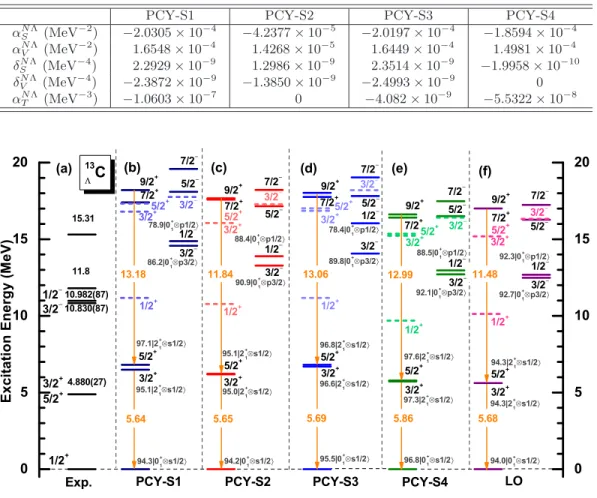
FIG. 1: (Color online) The low-energy excitation spectra of 13
ΛC obtained with the microscopic particle-rotor model with
(b)PCY-S1, (c)PCY-S2, (d)PCY-S3 and (e)PCY-S4. Fig. 1(f) shows the spectrum taken from Ref. [30], which was obtained by
including only the leading-order (LO)NΛ interaction. The experimental data shown in Fig. 1(a) are taken from Refs. [38, 39].
The numbers with the arrows indicate the B(E2) value for the 3/2+
1 →1/2 +
1 and the 9/2 + 1 →5/2
+
1 transitions, given in units
ofe2 fm4. The dominant component of several hypernuclear states, together with its weight (in percent), is also given.
Eq. (17) as well as the matrix elements in Eq. (15). The radial wave function for the spherical harmonic oscillator basis with 18 shells are used to expand the radial part of the hypernuclear wave function,Rk(r). We use the effec-tiveNΛ interaction with the PCY-S1, PCY-S2, PCY-S3 and PCY-S4 parameter sets, which were determined by fitting to the experimental data of Λ binding energies from light to heavy mass hypernuclei [31]. We list these parameters in Table I. Notice that S2 and PCY-S4 do not include the tensor and the derivative terms, respectively. Notice also that PCY-S3 was obtained by excluding the spin-orbit splitting of the 1p state of Λ in 16
ΛO from the fitting, and the strength of the tensor
coupling is considerably smaller than that in PCY-S1.
A. Low-energy spectra
Figures 1(b)-(e) show the calculated low-energy spec-tra of13
ΛC with the higher orderNΛ interaction, in
com-parison with the experimental data as well as with the results of Ref. [30] obtained only with the leading-order
NΛ interaction. One can see that the calculated energy splitting between the 1/2− and 3/2− states, as well as that between the 5/2+ and 3/2+ states, are clearly
dif-ferent among the four difdif-ferent parameter sets, although the main structures of the low-lying states are the same. That is, the splitting between the 1/2−1 and 3/2−1 with
PCY-S1 and PCY-S4 forces are smaller than that with PCY-S2 and PCY-S3 forces and much close to the exper-iment data. The splitting between the 5/2+ and 3/2+
0 5 10 15 20 0 5 10 15 20 1/2 94.3|2 + 1 s1/2 97.6|2 + 1 s1/2 97.4|2 + 1 s1/2 95.9|2 + 1 s1/2 96.2|2 + 1 s1/2 95.7|0 + 1 s1/2 97.1|2 + 1 s1/2 91.5|0 + 1 p3/2 87.9|0 + 1 p1/2 91.9|0 + 1 p1/2 93.2|0 + 1 p3/2 96.0|2 + 1 s1/2 95.1|0 + 1 s1/2 96.5|0 + 1 s1/2 97.6|2 + 1 s1/2 93.3|0 + 1 p3/2 89.3|0 + 1 p1/2 97.2|0 + 1 s1/2 98.0|2 + 1 s1/2 93.7|0 + 1 p3/2 91.1|0 + 1 p1/2 92.7|0 + 1 p3/2 92.3|0 + 1 p1/2 94.0|0 + 1 s1/2 94.3|2 + 1 s1/2 LO (f) 3/2 1/2 5/2 7/2 9/2 + 7/2 + 3/2 + 5/2 + 0.92*PCY-S4 (e) (d) (c) (b) 9/2 + 0.84*PCY-S3 0.91*PCY-S2 0.82*PCY-S1 13 C E x c i t a t i o n E n e r g y ( M e V ) 15.31 11.8 1/2 10.982(87) 10.830(87) 3/2 4.880(27) 3/2 + 5/2 + 1/2 + Exp. 3/2 + 5/2 + 7/2 + 3/2 5/2 7/2 9/2 + 3/2 + 5/2 + 7/2 + 3/2 1/2 5/2 7/2 9/2 + 3/2 + 5/2 + 7/2 + 3/2 1/2 5/2 7/2 9/2 + 3/2 + 5/2 + 7/2 + 3/2 1/2 5/2 7/2 (a) 5.77 13.38 5.71 12.18 5.80 13.30 5.91 13.15 5.68 11.48 1/2 + 5/2 + 3/2 + 3/2 1/2 + 3/2 + 5/2 + 1/2 + 3/2 + 5/2 + 3/2 3/2 1/2 + 3/2 + 5/2 + 3/2 1/2 + 3/2 + 5/2 + 3/2
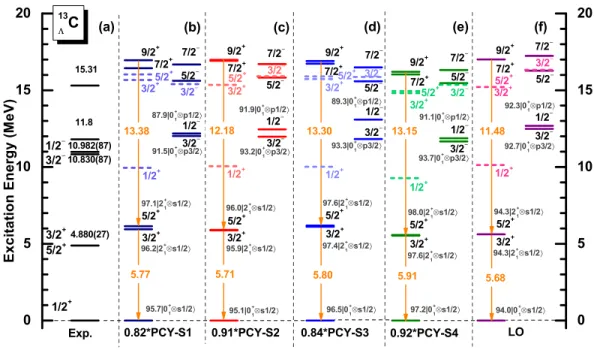
FIG. 2: (Color online) Same as the Fig. 1, but with the scaled NΛ interaction, in which the scaling factor is determined for
each parameter set to reproduce the empirical Λ binding energy of13
ΛC.
performed similar calculations for 9
ΛBe, and have found
that the effects of the derivative and the tensor terms are similar to those in13
ΛC. Notice that even though the
ten-sor term is absent in the PCY-S2 force, a good description is still acieved by largely deviating from the expected re-lations of a naive quark model, that is, αNΛ = 2
3αN N
etc. [40]. We will further discuss the role of the higher order terms in NΛ interaction in the next subsections. In particular, we will demonstrate that the tensor term plays an important role if the expected relations of the naive quark model are maintained.
In Fig.1, theE2 transition strengths between the low-lying states of13
ΛC are also presented. One can see that
the E2 transition strengths do not much vary with the fourNΛ effective interactions and are close to those with the LO interaction.
Given the fact that all the four parameter sets of the effectiveNΛ interaction were adjusted to Λ binding en-ergy of hypernuclei at the mean-field level [31], the use of these forces in the present MPRM calculation over-estimates the Λ binding energy of 13
ΛC. That is, the Λ
binding energy of 13
ΛC defined as the energy difference
between the 0+1 state of 12C and the 1/2+
1 state of13ΛC
are calculated to be 15.72, 13.63, 15.42 and 13.22 MeV using the PCY-S1, PCY-S2, PCY-S3 and PCY-S4 sets ofNΛ interaction, respectively, while the empirical value isBΛexp.= 11.38±0.05 MeV[1]. If we want to reproduce the Λ binding energy within this approach, we need to scale all the coupling strengths in the parameters of the
NΛ interaction by 18%, 9%, 16% and 8% for PCY-S1, PCY-S2, PCY-S3 and PCY-S4, respectively.
Figure 2 shows the calculated low-lying spectra of13 ΛC
with those scaled effectiveNΛ interactions. It is shown
that the predicted low-lying excitation spectrum of13 ΛC
is slightly compressed and the E2 transition strengths are somewhat increased. On the other hand, the energy splitting between the 1/2−1 and 3/2−1 states remains large
by the PCY-S2 and PCY-S3 forces, while it is reduced from 303.7 keV (253.7 keV) to 161.5 keV(206.3 keV) after scaling the coupling strengths for the PCY-S1 (PCY-S4) interaction. Due to the slightly weakerNΛ interaction, the configuration mixing for the 1/2+1, 3/21+, 5/2+1, 1/2−
1
and 3/2−
1 states becomes slightly reduced for all the four
parameter sets.
B. Effects of the derivative coupling terms
We now examine the effect of the derivative cou-pling terms on the Λ binding energy. To this end, we fix the coupling strengths for the leading order terms (αNΛ
V , αNSΛ) to be the same values as those in the PCY-S2 force and study the Λ binding energy as a function of the coupling strengths (δNΛ
V , δNSΛ) of the derivative terms. Notice that the tensor coupling is absent in PCY-S2, so that we can isolate the effect of the derivative terms. The results are shown in Fig. 3(a). A clear linear correlation is observed betweenδNΛ
V andδNSΛ. By selecting three sets of (δNΛ
V , δSNΛ) along the valley in Fig. 3(a), we calculate the low-lying states of13
ΛC and show them in Fig. 3(b). One
can see that the low-lying states are similar to each other. This implies that the coupling strengths (δNΛ
V , δNSΛ) may not be uniquely determined by the energies of hypernu-clear low-lying states.
Since the vector coupling strengthsαNΛ
FIG. 3: (Color online) (a) and (c): Contour plots for the ab-solute value of the difference between the theoretical and the
experimental hyperon binding energies of 13
ΛC hypernucleus
as a function of the coupling strength parameters (δNΛ
S ,δ NΛ V )
and (δNΛ S , α
NΛ
S ), respectively. In the former, α
NΛ V and α
NΛ S
are fixed to the same values as in PCY-S2, while in the latter, the value ofαNΛ
V andδ NΛ
V is determined for each (α
NΛ S , δ
NΛ S )
so as to keep the ratios αNΛ
V /α NΛ S and δ
NΛ V /δ
NΛ
S to be the
same as those for PCY-S2. (b) and (d): Low-lying states in
13
ΛC calculated with the strength parameters denoted by the
dots in the panels (a) and (c), respectively.
linearly correlated with the corresponding scalar coupling strengths αNΛ
S and δNSΛ, respectively, we next keep the ratios ofαNΛ
V /αNSΛandδNVΛ/δNSΛto be the same as those in PCY-S2 force and calculate the Λ binding energy as well as the low-lying spectrum as a function ofαNΛ
S and
δNΛ
S as shown in Fig. 3(c) and (d), respectively. It is shown that the parametersδNΛ
S andαNSΛare also linearly correlated when these are fitted to the Λ binding energy in13ΛC (see Fig. 3(c)).
Notice that the difference between the vector transi-tion density ρnInλ,V′I′(r) and the scalar transition density
ρnIn′I′
λ,S (r) in the low-lying states of12C is small (see Fig.4 in Ref. [30]). In the non-relativistic approximation, with the same scalar and vector densities, the sum of LO cou-pling strengthsαNΛ
S +αNVΛ and the sum of the derivative coupling strengths δNΛ
S +δNVΛ can be regarded as the depth of the central potential and the surface coupling
0 25 50 75 100 -0.5
0.0 0.5 1.0 1.5 2.0 2.5 0 25 50 75 100 5
10 15 20 25
0 20 40 60 80 100 5
10 15 20
0 25 50 75 100 0.0
0.1 0.2 0.3 0.4
1
/
2
1
3
/
2
1
(
M
e
V
)
PCY-S1 PCY-S2 PCY-S3 PCY-S4
|
N
S
+
N
V
| (fm
5
MeV)
B
(
M
e
V
)
(a)
3/2
+
1
5/2
+
1
1/2
+
2
5/2
1
3/2
1
1/2
1
(c)
E
x
(
M
e
V
)
(b) PCY-S1
13
C
(d)
|
N
S
+
N
V
| (fm
5
MeV)
5
/
2
1
3
/
2
1
(
M
e
V
)
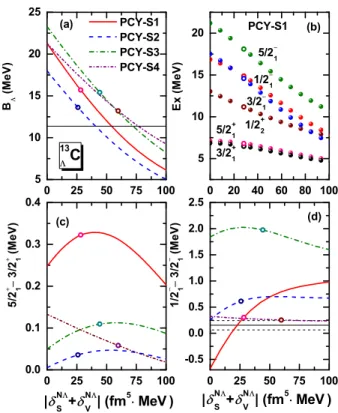
FIG. 4: (Color online) (a): The Λ binding energy in13
ΛC as
a function of|δNΛ S +δ
NΛ
V |, while keeping the same values of
αNΛ S ,α
NΛ V ,α
NΛ T and δ
NΛ V /δ
NΛ
S as the original values for the
PCY-S1, PCY-S2,PCY-S3, and PCY-S4 parameter sets. BΛ
with the original value of δNΛ
S and δ NΛ
V is denoted by the
open circles for each parameter set. The experimental value is denoted by the thin solid line. (b): The energy levels of the low-lying states as a function of|δNΛ
S +δ NΛ
V |for the PCY-S1
parameter set. (c) and (d): The energy splitting between the 5/2+1 and 3/2
+
1 states and that between the 1/2−1 and 3/2−1
states, respectively, as a function of|δNΛ S +δ
NΛ V |.
strength, respectively. Therefore, these are also linearly correlated, as has been found in Ref. [32]. Taking three sets of the parameters along the valley withBth
Λ =B exp Λ
in Fig. 3(c), we find that those three sets yield almost the same excitation energies (within around 0.13 MeV) for the 3/2+1, 5/21+, 1/2+2 and 1/2−
1 states, while the
dif-ference is much larger (around 0.45 MeV) for the 3/2−1
and 5/2−1 states. A comparison between Figs 3(b)and
3(d) suggests that the excitation energies of the low-lying states are more sensitive toαNΛ
S andαNVΛ as compared toδNΛ
S and δVNΛ.
We next examine the influence of the derivative inter-action terms for the other parameter sets as well. To this end, we varyδNΛ
S andδVNΛ by keeping the values of
αNΛ
S ,αNVΛ, αTNΛ and the ratio δNSΛ/δVNΛ to be the same as the original values for each parameter set. Fig. 4(a) shows the Λ binding energy so obtained as a function of |δSNΛ +δVNΛ| = −(δNSΛ+δVNΛ). The calculated BΛ
with the original value ofδNΛ
S andδNVΛis denoted by the open circle for each parameter set. BΛdecreases with
in-creasing|δNΛ
0 80 160 240 320 5
10 15 20
0 80 160 240 320 -1.6
-0.8 0.0 0.8 1.6 2.4 0 80 160 240 320 5
10 15 20 25
0 80 160 240 320 0.0
0.2 0.4 0.6 0.8
5/2
+
1
5/2
1
3/2
1
1/2
1
3/2
+
1
1/2
+
2
(c)
E
x
(
M
e
V
)
(b)
PCY-S1
(d)
|
N
T
|(fm
4
MeV)
1
/
2
1
3
/
2
1
(
M
e
V
)
13
C
PCY-S1 PCY-S4
|
N
T
|(fm
4
MeV)
B
(
M
e
V
)
(a)
5
/
2
1
3
/
2
1
(
M
e
V
)
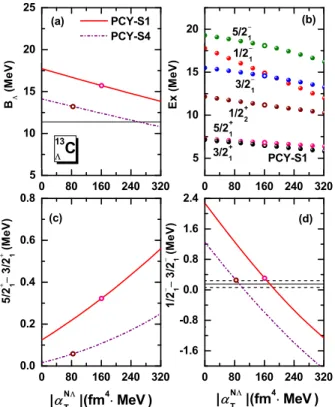
FIG. 5: (Color online) Same as Fig. 4, but as a function of the tensor coupling strength|αNΛ
T |(=−α NΛ
T ) for the PCY-S1
and PCY-S4 forces.
value denoted by the thin solid line. The Λ binding en-ergy decreases from 21.28MeV to 15.72 MeV by adding the derivative coupling terms to the PCY-S1 interaction (that is, by changing|δNΛ
S +δVNΛ|from 0 to the original value denoted by the open cicle). For PCY-S2, PCY-S3, and PCY-S4 interactions, the shift is from 18.01, 23.29, and 21.27 MeV to 13.63, 15.42, and 13.22 MeV, respec-tively.
The excitation energies of the low-lying states as a function of the derivative coupling strength|δNΛ
S +δVNΛ| are shown in Figure 4(b), where αNΛ
S , αNVΛ , αNTΛ and
δNΛ
S /δNVΛ are kept to be the same as those for PCY-S1. As one can see, the excitation energies decreases with the increase of |δNΛ
S +δVNΛ|. Notice that the change of the 3/2+ and 5/2+ states are much smaller compared
to the change in the other states. Similar behaviors are found also for the PCY-S2, PCY-S3 and PCY-S4 forces (not shown). The energy splittings of (3/2+1, 5/2+1) and (1/2−1, 3/2−1) states as a function of the strength of the
derivative coupling terms are shown in Fig. 4(c) and (d), respectively. It is found that the 5/2+1 state is always
slightly higher than the 3/2+1 state, which is by less than
0.15 MeV except for PCY-S1 in the range of|δNΛ
S +δNVΛ| shown in the figure. In contrast, the available data indi-cate that the 5/2+1 state is slightly lower than the 3/2+1
state. This discrepancy may be due to the spin-spinNΛ interaction [41], which is missing in the present calcula-tions.
For the doublet of (1/2−,3/2−), the 1/2− state is pre-dicted to be higher than the 3/2−state for all the forces except for the PCY-S1, with which the 1/2−state is lower than the 3/2−state for|δNΛ
S +δNVΛ|<17.56 MeV. As will be discussed in the next subsection, this splitting, which reflects the spin-orbit splitting of thepΛ hyperon [30], is
mainly governed by the tensor coupling term.
C. Effects of the tensor coupling term
Let us next examine the effects of the tensor coupling term on hypernuclear low-lying states. For this purpose, we adopt the PCY-S1 and PCY-S4 sets of theNΛ inter-action and vary the strengthαNΛ
T for the tensor coupling term. Fig. 5(a) shows the Λ binding energy of13
ΛC as a
function of|αNΛ
T |=−αNTΛ. The Λ binding energy gradu-ally decreases from 17.71 MeV (14.12 MeV) forαNΛ
T = 0
to 15.72 MeV (13.22 MeV) for the original value ofαNΛ
T for the PCY-S1 (PCY-S4) force, which is indicated by the open circle in Fig. 5(a).
Figure 5(b) shows the excitation energies for the low-lying states of 13
ΛC as a function of the tensor coupling
strength|αNΛ
T |for the PCY-S1. As already shown in the previous mean-field studies [24, 40, 42], the tensor cou-pling term makes thesΛhyperon less bound by increasing
the energy of the s1/2 level. Moreover, it decreases
(in-creases) the energy of the hyperonp3/2(p1/2) state. This
is consistent with Fig.5(a) for the ground state (1/2+) of
the13
ΛC, the energy of which decreases by the tensor
cou-pling. As a result, the Λ binding energy is reduced by 0.9 MeV for the PCY-S1 and 1.99 MeV for the PCY-S4 after turning on the tensor coupling term. At the same time, the tensor coupling term decreases (increases) the energy of the 3/2−(1/2−) state, which mainly consists of thep3/2(p1/2) hyperon coupled to the ground state (0+)
of 12C. Since the 1/2− changes more significantly than the 3/2− state, the higher lying 1/2− state approaches the 3/2− state and even becomes lower than the 3/2− state for large values of the tensor coupling strength, in-dicating that the energy splitting of the 1/2− and 3/2− states is sensitive to the tensor coupling strength. For the PCY-S1 and PCY-S4 forces, the energy difference between 1/2−
1 and 3/2−1 states decreases from 2.28 MeV
to 0.31 MeV, and from 1.25 MeV to 0.25 MeV, respec-tively, while turning on the tensor coupling term. For the energy gap between the 3/2+1 and 5/2+1 states, it
in-creases with increasing the |αNΛ
T |, as shown in Fig.5(c). Again, the tensor coupling term does not invert the en-ergy ordering of the 3/2+1 and 5/2
+ 1 states.
IV. SUMMARY
We have implemented the higher-order derivative and the tensor terms in the point coupling NΛ interaction in the microscopic particle-rotor model for hypernuclear low-lying states. By taking13
adopted the four sets of effective NΛ interaction, which were adjusted at the mean-field level to the Λ binding energy. We have shown that the four parameter sets yield a qualitatively similar low-lying spectrum to one another, even though these parameter sets were obtained using only the ground state energy.
We have discussed in detail the impact of eachNΛ in-teraction term on hypernuclear low-lying states for13
ΛC.
We have shown that both the second-order derivative and the tensor coupling terms raise the energy of hy-pernuclear states and thus reduce the Λ binding en-ergy. With the increase of the tensor coupling strength, the excitation energy of the 1/2− state has been found to decrease faster than the 3/2− states. As a result, the energy difference E(1/2−)−E(3/2−) decreases to a small value and even changes its sign for large val-ues of the tensor coupling term. We have also found that the energy ordering of the 3/2+1 and 5/2+1 states
cannot be reproduced by the present effectiveNΛ inter-action. We note that the four-fermion coupling terms ( ¯ψNΓiψN)( ¯ψΛΓiψΛ) with Γi =σµν andγµγ5, which pro-vides the spin-spinNΛ interaction [36], are not taken into account in the present study. This interaction term may have an important influence on the energy ordering of the 3/2+1 and 5/2+1 states. It will be interesting to study in near future the role of these terms in hypernuclear spectroscopy with the present microscopic particle-rotor model.
Another interesting work is to compare directly be-tween the microscopic particle-rotor model and the gen-erator coordinate method for the whole Λ hypernu-clei [28] using the same point-coupling NΛ interaction. A work is now in progress, and we will report on it in a separate paper.
Acknowledgments
This work was supported in part by the To-hoku University Focused Research Project “Under-standing the origins for matters in universe”, JSPS KAKENHI Grant Number 2640263, the National Natural Science Foundation of China under Grant Nos. 11575148,11475140,11305134, and the Funda-mental Research Funds for the Central University (XDJK2013C028).
Appendix A: TheNΛeffective interaction and the corresponding energy functional
In this Appendix A, we show that theNΛ interaction given by Eqs. (8), (9) and (10) lead to the energy func-tional given by Eq.(5). The energy funcfunc-tional for NΛ interaction is given by the expectation value of the
effec-tive interaction ˆVNΛ at the Hartree level,
EintNΛ=
Ac X
i=1
Z
drdr′ψ†Λ(r)ψi†(r′) ˆVNΛ(r,r′)ψΛ(r)ψi(r′).
(18) Substituting the LO scalar effective interaction term,
ˆ
VSNΛ(r,r′) =αNSΛγΛ0δ(r−r′)γN0 (19)
to Eq.(18), one finds
ENΛ S
= Ac X
i=1
Z
drdr′ψΛ†(r)ψ†i(r′)αNSΛγΛ0δ(r−r′)γN0ψΛ(r)ψi(r′)
=αNSΛ Ac X
i=1
Z
drψ†Λ(r)γΛ0ψΛ(r)ψi†(r)γN0ψi(r)
=
Z
drαNSΛρΛS(r)ρS(r), (20)
whereρS andρΛS are the scalar densities defined as
ρS(r) =
Ac X
i=1
¯
ψi(r)ψi(r), ρΛS(r) = ¯ψΛ(r)ψΛ(r). (21)
The effective interaction with the scalar derivative term,
ˆ
VDerNΛ(r,r′) =δSNΛγΛ0
h←−
∇2δ(r−r′) +δ(r−r′)−→∇2
+ 2←∇ ·− δ(r−r′)−→∇
i
γN0, (22)
leads to
ENΛ S
= Ac X
i=1
Z
drdr′ψΛ†(r)ψ†i(r′)δSNΛγΛ0
h←−
∇2δ(r−r′)
+δ(r−r′)−→∇2+ 2←∇ ·− δ(r−r′)−→∇
i γ0
NψΛ(r)ψi(r′)
=δNΛ
S Ac X
i=1
Z dr
n
[∇2ψ†
Λ(r)γΛ0]ψΛ(r) + [ψΛ†(r)γΛ0][∇2ψΛ(r)]
+ 2[∇ψ†Λ(r)γΛ0]·[∇ψΛ(r)]
o
[ψi†(r)γN0ψi(r)]
=
Z
drδNSΛρS(r)∇2ρΛS(r). (23)
A similar derivation holds also for the vector part of the
NΛ interaction.
On the other hand, the tensor effective interaction,
ˆ
VNΛ
T (r,r′) =iαNTΛ
h←−
∇ ·γδ(r−r′)+δ(r−r′)−→∇ ·γ
i
leads to
ETNΛ
= Ac X
i=1
Z
drdr′ψΛ†(r)ψi†(r′)iαNTΛ
h←−
∇ ·γδ(r−r′)
+δ(r−r′)−→∇ ·γ
i
ψΛ(r)ψi(r′)
=αNΛ
T Ac X
i=1
Z dr
n
[∇ψΛ†(r)γΛ0]·iαψΛ(r)
+ [ψ†Λ(r)γΛ0][∇ ·iαψΛ(r)]
o
[ψi†(r)ψi(r)]
=
Z
drαNTΛρV(r)[∇ ·( ¯ψΛ(r)iαψΛ(r))]
=
Z
drαNTΛρV(r)ρΛT(r), (25)
whereρV andρΛT are the vector and the tensor densities defined as
ρV(r) =
Ac X
i=1
ψ†i(r)ψi(r), (26a)
ρΛT(r) =∇ ·( ¯ψΛ(r)iαψΛ(r)). (26b)
Putting all these together, we finally obtain Eq.(5).
Appendix B: A derivation of Eq.(16d) for the matrix elements of the vector derivative coupling term
With the NΛ vector derivative effective interaction ˆ
VD=δVNΛ
h←−
∇2δ(r−ri) +δ(r−ri)→−∇2+ 2←∇ ·− δ(r−ri)−→∇
i
, and the definition of
FJM
jlI (ˆr,{ri}) =
X
mIm
CImJMIjmYjlm(ˆr)ΦImI({ri}), (27)
whereYjlm(ˆr) is the spinor spherical harmonics,
Yjℓm(ˆr) = X
mlms Clmjml1
2msYlml(ϑ, ϕ)χms, (28)
the coupling matrix element of the vector derivative term reads
hRkαl(r)FjlIJM(ˆr,{ri})|VˆD|FjJM′l′I′(ˆr,{ri})Rk
′
α′l′(r)i
=δSNΛ
X
mIm X
m′
Im′
CImJMIjmC
JM I′m′
Ij′m′
×X
λµ
Z r2dr
Z
dˆrhΦImI|
Ac X
i=1
δ(r−ri)
rri
Yλµ(ˆri)|ΦI′m′
Ii
×Y∗
λµ(ˆr)∆[Yjℓm∗ (ˆr)Yj′ℓ′m′(ˆr)Rkαl(r)Rk
′
α′l′(r)]. (29)
Here, we notice
hΦImI|
Ac X
i=1
δ(r−ri)
rri
Yλµ(ˆri)|ΦI′m′
Ii
=(−1)I−mI
I λ I′
−mI µ m′I
hΦI||
Ac X
i=1
δ(r−ri)
rri
Yλ(ˆri)|ΦI′i
=(−1)I−mI
I λ I′
−mI µ m′I
ρIIλ,V′ (r). (30)
With the relation of
Y∗
jℓm(ˆr)Yj′ℓ′m′(ˆr)
= X
mlms X
m′
lm′s Clmjm
l12msC
j′m′
l′m′
l
1
2m′sδmsm
′
s(−1)
ml
×X
LM ˆ
lˆl′
√
4πLˆC
L0
l0l′0ClLM−mll′m′lYLmL(ˆr), (31)
we have
∆[Y∗
jℓm(ˆr)Yj′ℓ′m′(ˆr)]
= X
mlms X
m′
lm′s X
LM ˆlˆl′
√
4πLˆC
jm lml12msC
j′m′
l′m′
l
1 2m′sδm
sm′s(−1)
ml
×ClL00l′0ClLM−mll′m′l
1
r2
d dr
r2 d
dr
−L(Lr2+ 1)
YLmL(ˆr).
(32)
According to the orthogonalization of the spherical har-monics,
Z
Yλµ∗(ˆr)YLmL(ˆr)drˆ=δλ,Lδµ,mL, (33)
the matrix element is then given by
hRkαl(r)FjlIJM(ˆr,{ri})|VˆD|FjJM′l′I′(ˆr,{ri})Rkα′′l′(r)i
=δNVΛ(−1)j
′+I+JX
λ
J I l
λ j′ I′
hjℓ||Yλ||j′ℓ′i
×
Z
r2drρIIλ,V′ (r)
1
r2
d dr
r2 d
dr
−λ(λr+ 1)2
×[Rkαl(r)Rk
′
Appendix C: A derivation of Eq.(16f) for the matrix elements of the tensor coupling term
The matrix elements of the tensor coupling term is given by
Tααkk′′ ≡ hR
k
αl(r)FjlIJM(ˆr,{ri})|αNTΛ Ac X
i=1
h←−
∇δ(r−ri)
+δ(r−ri)−→∇
i
·σ|FjJM′˜l′I′(ˆr,{ri})R
k′
α′˜l′(r)i
=αNTΛ
X
m′
Im′ X
mIm CIJM′m′
Ij′m′C
JM ImIjm
×X
λµ
Z
r2drdˆrhΦImI|
Ac X
i
δ(r−ri)
rri Yλµ(ˆ
ri)|ΦI′m′
Ii
×Y∗
λµ(ˆr)∇ ·[Rkαl∗(r)Yjlm∗ (ˆr)σRk
′
α′˜l′(r)Yj′˜l′m′(ˆr)].
(35)
Notice
∇ ·[Rk∗
αl(r)Yjlm∗ (ˆr)σRk
′
α′˜l′(r)Yj′˜l′m′(ˆr)]
=h−dR
k αl(r)
dr −
κ+ 1
r R
k αl(r)
i
[Rαk′′˜l′(r)Y ∗
j˜lm(ˆr)Yj′˜l′m′(ˆr)]
−hdR
k′
α′˜l′(r)
dr −
κ′−1
r R
k′
α′˜l′(r)
i
[Rk∗
αl(r)Yjlm∗ (ˆr)Yj′l′m′(ˆr)].
(36)
With the Wigner-Eckart theroem, one obtains
Z
dˆrYjlm∗ (ˆr)Yλµ∗ (ˆr)Yj′l′m′(ˆr)
= (−1)µ+j−m j λ j′
−m −µ m′
hjl||Yλ||j′l′i. (37)
From the relation
X
m′
Im′ X
mIm X
µ
CIJM′m′
Ij′m′C
JM ImIjm(−1)
I−mI
I λ I′
−mI µ m′I
×(−1)µ+j−m
j λ j′
−m −µ m′
= (−1)I′+J+j
J I j λ j′ I′
,
(38)
one finally obtains
Tααkk′′ =−α
NΛ
T (−1)j+I
′+JX
λ
J I j λ j′ I′
Z
r2drρIλ,V′I (r)
×nhdR
k αl(r)
dr +
κ+ 1
r R
k αl(r)
i
Rkα′′˜l′(r)hj˜l||Yλ||j ′˜l′i
+hdR k′
α′˜l′(r)
dr −
κ′−1
r R
k′
α′˜l′(r)
i
Rkαl(r)hjl||Yλ||j′l′i
o .
(39)
[1] O. Hashimoto and H. Tamura, Prog. Part. Nucl. Phys.
57, 564 (2006).
[2] H. Tamura, Int. J. Mod. Phys. A24, 2101 (2009).
[3] N. Glendenning, Compact Stars (Springer-Verlag, New
York, 2000).
[4] R. Wirth, D. Gazda, P. Navratil, A. Calic, J.
Langham-mer, and R. Roth, Phys. Rev. Lett.113, 192502 (2014).
[5] T. Motoba, H. Band¯o, and K. Ikeda, Prog. Theor. Phys.
70, 189 (1983).
[6] E. Hiyama, M. Kamimura, K. Miyazaki, and T. Motoba,
Phys. Rev. C59, 2351 (1999).
[7] H. Bando, T. Motoba and J. ˇZofka, Int. J. Mod. Phys.
A 5, 4021 (1990).
[8] E. Hiyama, Y. Kino, and M. Kamimura, Prog. Part.
Nucl. Phys.51, 223 (2003).
[9] E. Cravo, A. C. Fonseca, Y. Koike, Phys. Rev. C 66,
014001 (2002).
[10] V. M. Suslov, I. Filikhin, and B. Vlahovic, J. Phys. G:
Nucl. Part. Phys.30, 513 (2004).
[11] M. Shoeb and Sonika, Phys. Rev. C79, 054321 (2009).
[12] R. H. Dalitz and A. Gal, Ann. Phys. (N.Y.) 116, 167
(1978).
[13] A. Gal, J.M. Soper, and R.H. Dalitz, Ann. Phys. (N.Y.)
63, 53 (1971).
[14] D. J. Millener, Nucl. Phys.A804, 84 (2008);A914, 109
(2013).
[15] M. Isaka, M. Kimura, A. Dot´e and A. Ohnishi, Phys.
Rev. C83, 044323 (2011).
[16] M. Isaka, M. Kimura, A. Dot´e and A. Ohnishi, Phys.
Rev. C83, 054304 (2011).
[17] M. Isaka, H. Homma, M. Kimura, A. Dot´e and A.
Ohnishi, Phys. Rev. C85, 034303 (2012).
[18] M. Isaka, M. Kimura, A. Dot´e and A. Ohnishi, Phys.
Rev. C87, 021304(R) (2013).
[19] X. R. Zhou , H.-J. Schulze, H. Sagawa, C. X. Wu, and
E.-G. Zhao, Phys. Rev. C76, 034312 (2007).
[20] M. T. Win and K. Hagino, Phys. Rev. C 78, 054311
(2008).
[21] H.-J. Schulze, M. T. Win, K. Hagino, and H. S. Sagawa,
Prog. Theo. Phys.123, 569 (2010).
[22] Myaing Thi Win, K. Hagino, and T. Koike, Phys. Rev.
C83, 014301 (2011).
[23] B.-N. Lu, E.-G. Zhao, and S.-G. Zhou, Phys. Rev. C84,
014328 (2011).
[24] W. X. Xue, J. M. Yao, K. Hagino, Z. P. Li, H. Mei, and
Y. Tanimura, Phys. Rev. C91, 024327 (2015).
[25] A. Li, E. Hiyama, X.-R. Zhou, and H. Sagawa, Phys.
Rev. C87, 014333 (2013).
[26] B.-N. Lu, E. Hiyama, H. Sagawa, and S.-G. Zhou, Phys.
Rev. C89, 044307 (2014).
[27] K. Hagino and J.M. Yao, inRelativistic Density
Func-tional for Nuclear Structure, Int. Rev. Nucl. Phys. 10, 263-303 (2016), edited by J. Meng (World Scientific, Sin-gapore, 2016).
[28] H. Mei, K. Hagino, and J. M. Yao, Phys. Rev. C93,
011301(R) (2016).
[29] H. Mei, K. Hagino, J. M. Yao, and T. Motoba, Phys.
Rev. C90, 064302 (2014).
[30] H. Mei, K. Hagino, J. M. Yao, and T. Motoba, Phys.
[31] Y. Tanimura and K. Hagino, Phys. Rev. C85, 014306 (2012).
[32] E. Hiyama, Y. Funaki, N. Kaiser, and W. Weise, Prog.
Theor. Exp. Phys.,2014, 013D01(2014).
[33] J. V.Noble, Phys. Lett. B89, 325,(1980).
[34] T. Burvenich, D. G. Madland, J. A. Maruhn, and P.-G.
Reinhard, Phys. Rev. C65, 044308 (2002).
[35] P. Ring and P. Schuck,The Nuclear Many-Body Problem
(Springer-Verlag, Berlin, 1980).
[36] H. Polinder, J. Haidenbauer, Ulf-G. Meissner, Nucl.
Phys.A779, 244 (2006).
[37] J. M. Yao, M. Bender, and P.-H. Heenen, Phys. Rev. C
91, 024301 (2015).
[38] S. Ajimuraet al., Phys, Rev. Lett.86,4255 (2001).
[39] H. Kohriet al., Phys.Rev.C65,034607 (2002).
[40] Y. Sugahara, and H. Toki, Prog. Theo. Phys. 92,
803(1994).
[41] L. Canton, K. Amos, S. Karataglidis, and J. P. Svenne,
Int. J. Mod. Phys. E19, 1435 (2010).
[42] J. Mareˇs and B. K. Jenings, Phys. Rev. C49, 2472-2478