ENVISIONING THE PLASTIC PLANET
by
Cassidy A. Kulhanek
Documents submitted to the Faculty of the University of North Carolina at Chapel Hill in partial fulfillment of the requirements for the degree of
Master of Fine Arts in the Department of Art
Chapel Hill
2020
Approved by:
Beth Grabowski, Chair
Hồng-Ân Trương
Table of Contents
Table of Contents ... 3
Introduction ... 4
Denial ... 10
Anger ... 16
Bargaining ... 24
Depression ... 29
Acceptance ... 35
Conclusion ... 46
Acknowledgments ... 50
Works Cited ... 51
On July 8, 2019, I took a grocery trip in preparation for a small dinner party I
party I planned to host that night for friends. Among the purchases made were
two plastic containers of mayonnaise and three plastic bags of shredded cheese.
In conversation later that evening, my friends and I found ourselves discussing
our plastic habits: lamenting the amount that we purchase, expressing that we try
to avoid it, and debating the efficacy and efficiency of recycling versus complete
elimination of plastic consumption. The debate shifted to include glass, and the
group weighed the pros and cons of the materials. Of course, glass is always the
preferred material for the eco-conscious; glass containers are easily cleaned and
repurposed, and unwanted glass is infinitely recyclable1. Plastic, on the other
hand, is not recyclable—at least, not in the way that we commonly imagine. Plastics, when recycled at all (as opposed to the 91% of plastics that do not get recycled2), are “downcycled,” meaning that the object is broken down into its
component materials, rendering the plastic weaker and less functional than
before. Because of this process, plastics are only able to be “recycled” once before
becoming waste, and the process does not affect the lengthy lifespan of plastics.
The life cycle of single-use plastics is both incredibly short and devastatingly
long: the average lifespan of consumer plastics from creation to being discarded
is 40 days, and this period of time is, in a sense, its first life cycle—the time when
humans most consciously interact with the material. However, past those 40 days
(or roughly another 40, should the item be recycled) the plastic will continue to
live life behind-the-scenes for up to 1,000 years somewhere in our environment,
1 Details of glass production and recycling provided by the Glass Packaging Institute.
out of sight and out of mind3. The lengthy lifespan of plastics would be an
incredibly useful property were the material not so extensively used for single-use
consumables; as a colleague told me in the conversation that evening, “plastic is
the perfect material for things that need to last forever.4” Though that may be
true, plastic is not primarily used to build the things we need to last, and for a simple reason: there is no profit to be made in an object that lasts forever.
Plastic has always been a thoroughly profit-driven material5. Since its
creation in the early twentieth century, its intended use has always been to
maximize profits by making hard-to-get items more accessible, either through
price or through quantity. Heather Davis refers to plastics as “the substrata of
advanced capitalism6,” noting that the material has been a driving force of the
growth of capitalist economies and that it mirrors us and reveals a great deal
about our social structures and lives. Plastic production has never been aimed at
advancing fields such as medicine, but has instead persisted as a means of
replacing objects that we already own in order to prop up the
consumption-driven identity of the American middle class7. It is inherently connected to the
petroleum industry and our reliance on oil, and we have crafted all aspects of our
modern lives—our clothing manufacturing processes, our handheld technologies,
our vehicles, our foods, the internet, etc.—to in turn rely on plastic and the
consistent production of new plastics. In turn, plastic as an industry (as well as
3“Where Does This Stuff Come From?” Accumulation: The Material Politics of Plastic, 2013 4Quote taken from a conversation with my colleague and fellow visual artist ChloëRager. 5“Art in the Anthropocene,” Heather Davis, 2015
6ibid.
the plastic recycling industry) is wholly dependent on the curtain of capitalism to shield consumers from its violent existence. Plastic now permeates every inch of
our planet8 and brings with it serious consequences on human health, being
linked to infertility, cancers, miscarriages, senility, and various other physical
and neurological ailments9. Take note that these effects are just the effects we
have begun to see appearing in the general populace of what we call developed
nations; it is important to address that the health effects on both humans and the
environment are vastly worse in locales that become the designated dumping
grounds for the world’s recycling. Wen’an County, China, which served as one of
the world’s primary plastic recycling centers for 25 years, is now an ecological
dead zone. Pollutants from the plastics themselves, as well as the chemicals used
to wash and melt them, have polluted all parts of the natural landscape and
rendered the water undrinkable and the soil unusable.
People living in Wen’an experience lethal levels of high blood pressure at
unprecedented rates, often below the age of 3010. When China stopped accepting
much of the world’s plastic waste in 2018, the rates of recycling around the world
dropped as the cost of recycling rose11. This reveals a cultural conflict between our
priority toward the environment and our priority toward capital: when it began to
cost to get rid of our waste, many local and national governments simply shifted
to burning or discarding it, rather than creating safer, more expensive recycling
centers at home. To bring this process here would pull aside capitalism’s curtain
8“Plastic is Everywhere. We Can No Longer Ignore That.” The Washington Post, July 2019.
9“Plasticizers: A Twenty-first-century Miasma”Accumulation: The Material Politics of Plastic, 2013 10“Plastic, Poverty, and Pollution in China’s Recycling Dead Zone” The Guardian, July 2014
and reveal the toll our consumerism has on our human bodies and the world
around us; this, according to Rob Nixon, is capitalism’s slow violence12. In order
for western economic policies to continue to “succeed” by the capitalist
definition, we sacrifice the lives and the wellbeing of people and land in faraway,
less prosperous regions. We are content to live with—and contribute to—this
violence, because it happens gradually, and out of sight.
Fig. 1: Pollution lining and inhabiting a canal between Beijing and Wen’An. Image from The Guardian
The conversation that afternoon had a strange tone, as I have noticed
conversations about the environment often do when participants are all aware of
the extreme damage done, and being done, to our planet at the hands of humans.
Perhaps that tone comes from a place of guilt: each person present is an active
participant in the anthropocene. We drive, we wear plastic-blend fabrics, we ship
objects across the globe for convenience, and we almost exclusively purchase and
consume rather than produce; we contribute to the system that prioritizes
economic advancement over environmental health and, by doing so, we
contribute to the creeping and imminent threat of catastrophic climate change.
As we ate dinner and discussed the climate crisis in the abstract, I soaked a
depleted mayonnaise jar to recycle later—the shredded cheese bags, being made
of multiple types of plastic and thus non-recyclable, were tossed into the
garbage—and nearly a year later, despite never having seen these objects again, it
is factually accurate for me to say that they are certainly not gone. There is an
incredible burden that comes along with learning about the impact of humans on
our planet; for the most part, most people acknowledge that climate change is
real and is happening at all times. This is obviously a devastating thing to learn, especially when that knowledge threatens us in so many ways: it threatens the
social structures and comforts of living that we have become accustomed to; it
threatens the foundations of our economic systems; it threatens our lives and the
lives of those around us; and, perhaps most terrifyingly, it threatens our
preconceived notions of ourselves as being morally good. If we are to
acknowledge the environmental crisis during which we are living, we must in
turn acknowledge our roles in it and the global power structures that make individual change effectively meaningless. What we are left with is an
understanding that, at some point, the Earth as we know it—meaning all of the
human constructs that shape our understanding of the world around us—will die,
knowledge then moves us to grieve13. The aforementioned “strange tone” of
conversations that happen in the current moment, I believe, comes from this
shared grief. Simply knowing about the climate crisis and being fully aware of the
ways in which we have been complicit in this crisis brings us to a place of denial,
which is commonly referred to as the first step of grief (in accordance with the
Kübler-Ross Model of Grief14, the most well-known model of grieving stages). In
exploring the work and research of my thesis, Envisioning the Plastic Planet, I have structured my explanations according to the Kübler-Ross Model of Grief to
illuminate how my work was made in response to, and because of, ecological
grief.
13“Ecological Grief as a Mental Health Response to Climate-Change Related Loss” Nature (Journal),
April 2018
I. Denial
“It is much, much worse than you think.”
– David Wallace Wells, “The Uninhabitable Earth”
Growing up in the Deep South, I became intimately familiar with the
language and aesthetics of conservative messaging. Throughout the extent of the
Obama presidency, there was a billboard outside of Montgomery, Alabama that
simply read “IMPEACH,” illustrated as a bold letter “M” next to the image of a
peach. Many public advertisements displayed statements such as “There IS
proof of God!” or “Will you be going to Heaven or Hell?” Most famously, a sign
between Montgomery and Birmingham has stood for decades bearing a
cartoonish devil next to the proclamation, “GO TO CHURCH Or The DEVIL Will
Get You!” It was a common sight where I grew up to see signage outside of
churches warning of the impending apocalypse—there was even a church in my
city wholly dedicated to preparing for the Rapture.
Despite climate change posing to us the most seemingly real apocalyptic
threat, there is shockingly little overlap between the religious South and
believers of climate change. This is thanks largely in part to the politicization of
climate change and the Republican party strategically weaponizing climate
change denial15, tactics that have become part of their divisive Southern
Strategy. As religious values became the face of conservatism, skepticism
towards (and often a blatant denial of) science became a core conservative
talking point16. This returns us to denial, which appears to exist as a spectrum of
full-denial to self-denial, or: I do not believe this is happening versus I cannot
believe this is happening. On that spectrum, “self-denial” comes from having at
least semiconsciously entered the cycle of ecological grief; however, “full-denial,”
the refusal to believe even the most basic of truths about climate change, is much
more difficult to address. How can you propose the idea of climate change—in
many ways a moral issue—as true,
when a denial of it is propagated by
the moral systems through which
the target audience defines itself?
How do you convince someone to
believe in something that they are
diametrically opposed to?
15“The Ideology of Climate Change Denial in the United States” European Journal of American
Studies, Spring 2014
16Ibid.
In setting out to approach the problem of a difficult-to-approach audience,
I opted to appropriate the aesthetic properties and language of the horrifying
religious signage I grew up surrounded by, making a few adjustments along the
way. Considering the functions of those signs lead me to determine that an
effective sign within this realm of religious semiotics was one that had a concise
message (“There IS proof of God!”), one that involved the viewer on a personal
level (“Will you be going to Heaven or Hell?”), and one that successfully
employed fear mongering as a tactic—often disguised as concern for one’s
wellbeing (“GO TO CHURCH Or The DEVIL Will Get You!” (fig. 2)). In designing WE HAVE NEVER BEEN CLOSER TO THE END (fig. 3), it was crucial to me that the message be received much in the same way as these signs.
The work’s ultimate goal was to terrorize the viewer into a consideration of their
actions and their role in the impending “end.” By leaving the message on the
banner intentionally vague and devoid of imagery with which to contextualize it,
the banner’s intention to speak to the climate crisis was covert, and the banner
was, in theory, able to blend in with the religious signage that inspired it, and
exist alongside it in such a way that it would have the potential to force
introspection and create dialogue—or at the very least, curiosity—among viewers
in the target audience: those whose familiar language was of the aforementioned
religious signage. However, the discreet nature of the intention made the banner
in many ways reliant on the ability to use its surroundings for context. I found it
most successful in speaking to the climate crisis when paired with other works
that were more obvious in their appearance. To address this discrepancy, I used
installation was on view in one of the busiest corridors of the Hanes Art Center
from August to November of 2019 and, standing at nine feet wide and nearly
nine feet tall, commanded the attention of anyone who entered the space and
accosted passers-by with its message.
Fig. 4: Detail photo of COMPLICIT, 2019
This work was comprised of a series of three prints, each reading “I HAVE
BEEN COMPLICIT IN THE DEATH OF OUR PLANET,” “WE HAVE BEEN
COMPLICIT IN THE DEATH OF OUR PLANET,” and “YOU HAVE BEEN
COMPLICIT IN THE DEATH OF OUR PLANET,” respectively. The prints were
installed in a grid pattern on the wall, alternating repeatedly between the “WE”
and “I” prints. Alone in the center of the piece, with the darkest image as its
background creating a stark contrast between the repeating prints and itself, was
the print reading “YOU HAVE BEEN COMPLICIT IN THE DEATH OF OUR
among the group—stood apart from the others in several ways; perhaps most
strikingly due to it being the singular image with any trace of humans in it. The
text is set against a shadow form, a silhouette of the photographer that becomes a
vehicle for the viewer to project their own body onto. The text of the “YOU” print
is the only one of the three that does not implicate the artist, but instead chides
the viewer, bluntly singling them out. Having left no identifying information
about myself as the artist alongside the work, the viewer was left with a message
that both addressed everyone and, in the absence of a messenger with whom to
share the blame, only addressed them.
Early in this work, the implication of the self was a critical component of
my practice. To accomplish this, I embraced using plastic materials to an
excessive extent. In Disposable Planet (fig. 3), I installed forty plastic globes— mostly stacked, but some haphazardly arranged around the space—in a room,
where the installation’s structural instability led to the globes frequently falling
and needing rearrangement. The toy-like nature of the globes tempted viewers
into touching, playing with, and kicking the globes. The fact that the globes were
cheap, frivolous items contributed to the intended effect of the globes being read
as disposable, unimportant, and immediately replaceable—mirroring the
consumption-driven climate disaster and the popular proposal of simply
colonizing a new planet rather than trying to save this one. This project, along
with another work made using Astro-Turf (PLASTIC GRASS, fig. 5.1), left me with large amounts of plastic packaging and waste, which in turn brought on
immense guilt at my having contributed so much more to both the plastic waste
material practices on using only previously collected plastics of my own, or found
plastics. I began using the packaging I had collected to construct a plastic
seascape (fig. 5.2), which, alongside PLASTIC GRASS, became the building blocks for the vision of the Plastic Planet that would go on to be the basis for
many later works.
Fig. 5.1 (above): Installation photo of Plastic Grass
alongside part of Disposable Planet, 2019
II. Anger
“What does it matter who’s at fault, we all need to come together to solve it!” shout men who look just like the men who are most to blame. Men who
will suffer last and least.”
– Amy Westervelt, “The Case for Climate Rage”
My experience with climate change is, obviously, a lifelong one; however, my
experience with climate consciousness is a much more recent journey than I care to admit. In the Mobile, Alabama public school system that I was a part of from 1998
to 2011, climate change was a nearly absent topic in all but the late-schooling
biology courses. We were an air-conditioned people of lifted trucks and wanton
littering, and vegetarianism was mostly unheard of. Culturally, “environmentalists”
were a punch line. With the prevalent attitude towards environmental issues
typically ranging from disbelief to apathy, it may come then as a surprise that the
deadliest and costliest disasters to impact Alabama during my lifetime thus far
have all been environmental ones; namely Hurricanes Andrew17, Ivan, and Katrina.
I was twelve years old when Hurricane Katrina made landfall in 2005, and
communities all along the gulf coast were destroyed—including much of my own
neighborhood. For the next year I only attended school for half of the day because
students from Moss Point, Mississippi were bussed across state lines to use our
facilities for the other half of the day, having had their city nearly leveled by the
powerful winds and heavy flooding caused by the storm. In the media, much of the
17Author’s note: Hurricane Andrew actually occurred a few months before I was born, so not
Katrina coverage was given to New Orleans—and it quickly became a politicized
issue, fueled by racism18, which allowed viewers living outside of the tragedy to
form opinions of the people involved and subsequently move on with their lives.
Hurricane Katrina lives at intersection of many difficult conversations, but is
inextricably tied to the issue of global warming. Hurricane Katrina is the fourth
most intense hurricane to have ever hit the United States, and the costliest natural
disaster to ever occur in the U.S.19. The storm was a part of a record-breaking
hurricane season in 2005, but within our lifetimes it is likely to lose any records it holds20.
18“Do You Know What it Means to Myth New Orleans?” The Gambit, August 2006 19“The Most Expensive Natural Disasters in US History” MoneyWise, April 2020 20“Is Climate Change Making Hurricanes Worse?” The Guardian, October 2018
As the oceans warm, hurricanes in the Atlantic consistently get stronger and
larger, and sea levels slowly rise and swallow coastal lands and islands. This means
that, for people living along the Gulf and Atlantic coasts in the US and on islands
around the globe, the worst is yet to come. Discussions of sea level rise in the
United States frequently contain concern about major coastal cities, such as
Boston, New York, Miami, and Los Angeles; however, to see the American citizens
most at-risk for sea level rise and actively facing it today, we must look farther
west.
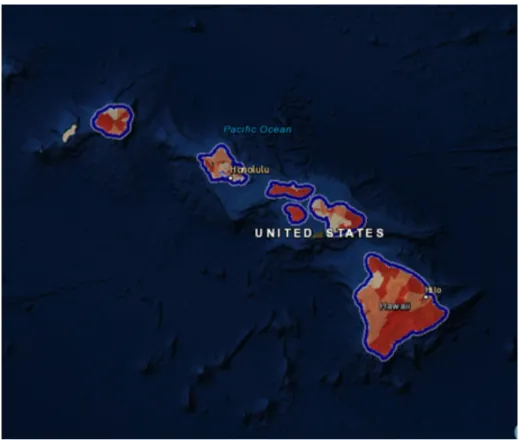
Since 1950, the sea level in Hawaii has seen a ten-inch rise, and the rate of sea
level rise in the waters surrounding Hawaii has begun rapidly accelerating since
2010; the regular pace now lies at one inch every four years21. Every person living
in every city on every island of the Hawaiian island chain is considered
“vulnerable” by the National Oceanic and Atmospheric Administration22
(henceforth referred to as “the NOAA”). The NOAA calculates that six feet of sea
level rise would nearly swallow the island whole, leaving only its highest peaks
above the water’s surface. Currently, the most conservative predictions have the sea level rising to just above three feet by the year 2100; however, the NOAA and
United States Army Corp. of Engineers have independently come to the conclusion
that a more possible trajectory sees sea level rise reaching nearly two feet by the
year 2050. If this—or a worse—trajectory proves to be the correct one, that means
that we are currently living at the time of one of the last generations of indigenous
Hawaiian peoples, and that Hawaiians will start facing displacement or threats to
their health due to climate change in the near future.
Fig. 10: Map of Hawaii coded according to social vulnerability due to sea level rise. Map from
the NOAA website.
Imagining this future, wherein our sins against this world have literally washed
this piece of it away, is a disturbing and upsetting thought—especially considering
its part in the legacy of American colonization. However, in imagining this future, I
take a sort of morbid solace in the fact that it takes place in the future, as opposed to now, under the leadership of President Donald Trump. Knowing how President
Trump has responded to the needs of people of color in the United States, as well
Hurricane Maria, it is hard to imagine how he would handle a crisis as huge as the
one Hawaii has been presented with.
I began work on the piece 49 (fig. 11) in August of 2019. Over the course of several weeks I took a 1959 United States flag—the last iteration of the flag before
Hawaii gained statehood and brought us the contemporary 50-star iteration—and
began the slow process of unraveling it one thread at a time. The performative
aspect of this work was perhaps more important than the final object; the act of
removing the threads was a slow, tedious,
and often exhausting one. For a while there
appeared to be little (or no) progress made
as I slowly advanced up the flag, but there
was always irreparable damage being done.
This act felt much to me like a metaphor for
the violence that I mentioned before when
speaking about the harm done by
capitalism, by plastic consumption, and by
carbon emissions: it was a violence that
happened gradually, and out of sight; it was
the creeping destruction of our lands and
people caused by manmade climate change. Eventually, having removed enough of
the threads, the flag reached a point of visible destruction; it was lost. When I
reached that point I asked myself, “What would President Trump do now?” What
would he do with the problem of sea level rise in Hawaii—a problem that grew as a
result of going ignored, of being denied, of being inconvenient to deal with? How
would he respond to the suffering and possible extinction of Hawaiians, a group of
people who—despite being American citizens—do not look like the American citizens he values? My assumption was that his response would be similar to the
one he had to Puerto Rico: that he would, in effect, worsen the situation by trying
to “help,” that he would declare things fine while the damage was not even yet done
being tallied, and that he would find a way to reduce it to a nonissue to the public.
It doesn’t actually have to be better as long as it looks better seems to often be his mindset and so, in response to that, I took the remaining threads of the flag and
tied them into a neat, tight braid—imagining that, in the end, it would be the kind
of thing President Trump would consider “good as new.”
Fig. 12: Memo from Science Advisor Frank Press to President Jimmy Carter, 1977. Image from the Jimmy Carter Archives.
The American legacy of inappropriate response to the climate crisis does not
begin with, and likely will not end with, Donald Trump. In the course of my
research, Amy Westervelt’s article The Case for Climate Rage introduced me to a 1977 memo delivered by Frank Press, Science Advisor to President Jimmy Carter,
in which Press outlined with much detail the extent of knowledge of carbon
the amount known in 1977 was not much different at all than what was known and
expected in 2019 when I first read the memo. The first time I viewed this message,
my heart sank. How could we have known for so long? How could we have known
it was this bad for so long, and not done anything to stop it? My research pivoted here: I fell into a rabbit hole of digging through the Jimmy Carter archives and
through various archive databases including those of NASA22, the Reagan
administration23, and the Sierra Club24 determined to reveal just how long the
climate crisis had been understood and voluntarily participated in rather than
prevented. Only during this search did the gravity of our situation truly dawn on
me; we had known about the human effects on the climate, and been warning
against the “greenhouse effect” and manmade climate change for over a century.
The more I learned, the angrier I got, which in turn made me look even further; I
was caught in a cycle of research, rage, and research, all triggered by the Press
memo. I wondered: could the memo have the same effect on others?
A year prior to this research journey, California recorded the deadliest and most
destructive wildfire season ever before25. Over 8,000 fires raged across California
in 2018, claiming over one hundred lives and burning nearly two million acres of
land—all exacerbated by the state’s record-breaking number of dead trees26, caused
by extreme droughts linked to rising temperatures. The images that circulated in
the media during the fires were eerie, often nearly apocalyptic in appearance.
22NASA, along with the Intergovernmental Panel on Climate Change, has compiled a comprehensive
list of scientific evidence relating to climate change; available on the NASA website.
23“Environmental Policy in the Reagan Presidency” Political Science Quarterly, Fall 1984
24Full history of the Sierra Club and archival materials connected to it can be found at their website. 25California Department of Forestry and Fire Protection data, 2019
26Joint analysis by the United States Department of Agriculture Tree Mortality Task Force and the
Struck by how haunting and devastating these images were, I began working on the
piece Various Small Fires (fig. 13.1, 13.2, 13.3), wherein I appropriated an
Associated Press photograph of the Baja wildfire, and digitally modified it to create
a silkscreen pattern. I screen printed this image and used wheat paste to apply it to
a mural wall; the distortion of the image combined with the repetition of the
pattern created a “just right” space for viewing the image: too far away and the
pattern did not read as images; too close, and the image was murky and
indiscernible. Capitalizing on this need for viewers to approach the piece to view it
most clearly, I framed a typewritten copy of the Frank Press memo and placed it in
the center of the wallpaper installation. This combination helped to lure in
passers-by, curious to know the
importance of the framed
document. The resulting
experience for the viewer was
the slow realization that they
were looking at a disaster that
was both natural and
manmade, alongside its
causes.
Fig. 13.1 (top, left) and 13.2 (top, right): Detail images of the installation Various Small Fires
III. Bargaining
“I have a very vested interest in this because I own substantial holdings fifteen miles inland of the coast, and any beachfront property appreciates in
value.”
– Tom McPherson, Florida State Representative
I did not find the bottom of the research hole I fell into while creating the
work Various Small Fires upon its completion, but rather, I felt an urgent need to dig further and start chronologically sorting out
scientific discoveries and global events related to
climate change in order construct a timeline of the
climate crisis. In the making of Various Small Fires, I borrowed the title from a 1964 book by Ed Ruscha,
Various Small Fires and Milk (fig. 14.1, 14.2), in which Ruscha compiled a group of photographs
taken of small fires: lit matches, a cigarette being
smoked, a stovetop burner, and other seemingly
innocuous fires, culminating in a photograph of a
glass of milk. In the appropriation of this title for the
mural installation, the name referred to the repeated
image of the Californian wildfires that comprised
the wallpaper pattern. However, as I continued my Fig. 14.1 (top): Cover page of Ed Ruscha’s Various Small Fires and Milk
research and began to build a timeline, the title came to mean something entirely
different to me.
In the fall of 2019 I was approached to participate in The Solastalgia Project, a
student-led interdisciplinary symposium on climate change and on the global
experience of solastalgia—the emotional or existential distress caused by
environmental change and its effects. For the
symposium, I wanted to create a physical
version of my research into this timeline of the
climate crisis. The work I made for the
symposium took the form of a zine, in an
edition of thirty, for ease of distribution. The
idea of distribution, of making this knowledge
easily accessible and giving it the physicality of
a shareable object—one that may be passed
from person to person once they have
completed reading it—became critically
important to the work, and influential on the
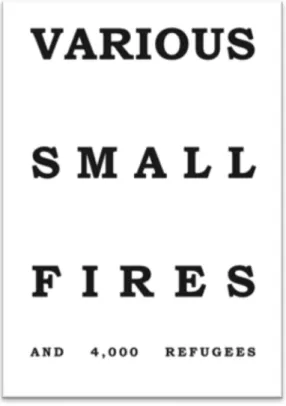
growing need for approaches that addressed the public in my practice. The zine I
created was entitled Various Small Fires and 4,000 Refugees (fig. 15), borrowing once again from Ruscha’s work but with an update to address the ongoing crisis of
the bushfires that were in the process of razing southeast Australia.
Having begun in July of 2019 and lasting until March of 2020, Australia’s
“Black Summer” was one of the most devastating bushfire seasons the nation has
ever seen, and was an unprecedented ecological crisis, immediately recognized as
being directly worsened by the effects of climate change27. The fires destroyed 46
million acres of land, thousands of homes and structures, and killed dozens of
people28. There were profound environmental consequences of the fires: over a
billion animals were estimated to have perished in the fires, including many
endangered species feared to be pushed to near or total extinction—including
koalas, one of the National Symbols of Australia29. The fires alone were also
responsible for the release of over 300 million tonnes of CO2 into the atmosphere.
This level of CO2 emissions is equivalent to over half of Australia’s total CO2
emissions for the year prior, and is unlikely to be naturally reabsorbed due to the
massive number of tree and plant-life casualties30.
Fig. 16: A wallaby licks its burn wounds as a bushfire rages nearby in November 2019. Photograph from Vox
27“Media Reaction: Australia’s Bushfires and Climate Change” Carbon Brief, January 2020 28“The Numbers Behind Australia’s Catastrophic Bushfire Season” SBS News, January 2020 29“A Billion Animals Have Been Caught in Australia’s Fires. Some May Go Extinct.” The Washington
Post, January 2020.
It occurred to me that I was witnessing the worst environmental catastrophe of
my life up to that point; this realization came paired with the harrowing
understanding that it surely will not be the last, or worst, environmental crisis I am
likely to witness. The catastrophe worsened with each passing day while I worked
on Various Small Fires and 4,000 Refugees, and the need to call attention to it and link the bushfires
to their contributing factors and
causes became increasingly
imperative. “Various small fires”
took hold in my mind as the
metaphorical stepping-stone to
a massive fire in two ways:
literally, to the Australian
bushfires, and also
symbolically, to the greater
climate crisis. With this analogy
in mind, I took Ruscha’s
photographs of small fires and
paired them with points along
the timeline that I had built of
climate knowledge and events (fig. 17.1). Rather than finishing with
Ruscha’s photograph of a glass of milk, I took an image published by the
Associated Press of Australians stranded on a beach in Mallacoota, watching their
homes and communities burn (fig. 17.2). The result was a narrative across the text and images of the zine that illustrated the slow burn of manmade climate change,
the dire ramifications of allowing the climate crisis to go unchecked—ramifications
that were happening at that moment, and that are happening right now. By placing
them in this timeline format, the need for urgency becomes emphasized; the work
is a motion to beg the viewer to act now: now, because we did not act yesterday;
now, because the crisis is upon us already; and now, for a chance at reducing the
IV. Depression
“The question is fundamental to being a human being: Do we care?”
— Thomas Waltz, Economist, National Climate Program
Climate change is, of course, not a secret. Even in 1977 when Frank Press wrote
his memo to President Carter, he began one paragraph with the statement “As you
know, this is not a new issue.” Regardless of their political interpretation of the
climate crisis, most Americans are at least aware of the idea of global warming, and a deeper awareness of the issue comes at great cost. As I mentioned before, an
understanding of climate change includes the recognition that each of us has
contributed to it; for some, this revelation begins a path of habit-correction.
However, the fashions in which we choose to habit-correct are frequently borne of
the same reasons we contributed so heavily to landfills and carbon emissions in
the first place: comfort and convenience. Some of the most frequently
recommended ways of reducing one’s own carbon footprint are by practicing
vegan, vegetarian, or reduced-meat diets, carpooling or taking public transit (or, if
you must drive, driving a hybrid or electric vehicle), composting, and using
reusable cups, bottles, and shopping bags31. However, when we take the easiest
and most obvious approach to these solutions, the end result is often far from the
intended outcome.
31In lieu of a specific source I point to the dozens of pages of search results for “how to live an
Some staples of meat-free lifestyles cannot be sustainably made at the scale to
which we demand them (soy32 being one culprit, and almondshaving one of the
worst environmental impacts of any crop grown in the U.S.33). When opting to
carpool rather than take public transit, those who do so by ridesharing (e.g., taking
an Uber or Lyft) actually leave a drastically higher carbon footprint than if they
were to drive their own vehicle34. Consequently, if one’s vehicle of choice is a
hybrid, it will emit far less CO2 than a conventional vehicle, but about a fifth of the
total emissions from hybrid vehicles actually occur during the manufacturing and
charging of the vehicle—worsened if the energy supply for the charge comes from
coal-powered electricity—and hybrid cars only have a net positive impact starting
around 160,000 miles driven35. As far as replacing disposable items in our routines
with reusable ones, the net positive environmental impact of one canvas bag only occurs after 7100 uses36. All of this is not to say that it is foolish or bad to adjust our
personal habits to address the climate crisis. What these numbers do illustrate,
rather, is the myth of a “grassroots” solution for climate change—a myth that
discreetly fuels climate change as a class struggle by placing blame and
responsibility on consumers, rather than those most guilty. Over a third of all CO2
emissions that have ever been produced have come from just twenty corporate entities37, eight of which are privately held, and twelve of which are owned by their
32“To Bean or Not to Bean: Soy is the Question” Stanford Magazine, March 2012
33“Almond Milk — Quite Good For You, Very Bad For The Planet” The Guardian, October 2015 34“Environmental Repercussions of Rideshares” Resources Magazine, February 2020
35“Does Hybrid Car Production Waste Offset Hybrid Benefits?” David Roos for HowStuffWorks,
December 2010
36Data provided by the Ministry of Environment and Food of Denmark
governing states. This means that virtually no amount of individual lifestyle
changes will even begin to approach a solution for global warming and the climate
crisis, and that it is a problem that will require fundamental and radical changes to
our cultural and economic systems.
Nevertheless, we should continue to
modify our habits and strive towards
more positive individual impacts on the
environment, if for no other reason than
to lay the groundwork for the shifts in
cultural attitudes needed to demand and
implement the kind of changes we must
make at the level of our governing
bodies. Because of this, it is imperative
to look at the problem of the climate
crisis from a broad perspective.
In late 2019 and early 2020, my work became focused on the possibility of
voluntary engagement—that is, that the works may be available to viewers and
would potentially interact differently with each viewer, with a potential possibility
inherent to each of the works that they may go totally unseen at all. The first work
that I produced using this approach, BREAK GLASS (fig. 18), was comprised of a Greenpeace donation form, displayed in a red frame with red vinyl text reading “IN
CASE OF CLIMATE EMERGENCY BREAK GLASS” and all hung above a red
hammer leaning against the base of the wall. This work was intended, in many
ways, to disappear; for the planned exhibition at Lump Gallery in Raleigh,
PLEASURE, VOID, I intended to install BREAK GLASS in a hallway outside of the gallery rooms. This placement would have removed it from the exhibition space
and ushered it into the realm of the objects it was created to imitate—glass
emergency cases, such as those for fires or emergency lockdowns. I welcomed the
possibility of destruction being the endpoint of the work; presumably, if one were
to break the glass it would communicate that the viewer acknowledged and
accepted the reality that we are living in the time of a climate emergency, and
responded with action to that fact. In the event that the work went observed but
unbroken, there were several possible explanations: first, that the work retained its
status as an “art object” to the viewer, leading them to feel that breaking it would
be forbidden; second, that the viewer did not agree with the message because they
did not believe that we are in the midst of a climate emergency; or third, that they
acknowledge the message and accept the reality of a climate emergency but view it
as impending rather than occurring. Of course, there was further still the possibility that the work would go ignored or wholly unseen, existing only as a
warning or a call to action in the periphery of the viewer’s experience—much like
global warming being a constantly present threat that often resides only in the
backs of our minds. In the event that a viewer did break the glass, after having acknowledged the current emergency and taken an action to attempt to combat the
situation (breaking the glass), they would be met with a Greenpeace donation
form—the kind of solution that only acts as a bandage for our conscience by giving
us an action to point to and say, “Look! I helped!” regardless of how
antagonizes the idea of small, individual actions as the solution to a cause that
requires massive structural change.
In speaking to the idea of depression, it not only felt necessary to explore
futility, but also to the accompanying desperation that comes with facing imminent
loss. This emerged as a regular routine of ‘foraging,’ wherein I began taking walks
into undeveloped areas like forests and fields near my home and my studio, or state
and national parks, and collecting the abandoned pieces of trash and human
detritus that I find along these walks. When collecting these items I would
photograph the spaces in which I found them, as well as produce rubbings of the
objects once I brought them back to my home or my studio (fig. 19, fig. 20). The act of photographing and documenting these objects through the making of rubbings
was, in many ways, an effort to produce a sort of memento mori; these pieces of
litter were direct, tangible evidence of human impact on our environment. Despite
physical human waste not being the sole cause of our climate crisis, it certainly
exists as a symptom and, in many ways, is the most shamefully avoidable aspect of
our human interference.
Fig. 19 (right): Photo documenting a site where I found trash while foraging.
All parts of my approach to this project were
focused on emphasizing the connection of trash and
nature; this is why I strictly use the word “foraging” in
reference to the collecting process. These concerns also
lead me to combining the rubbings with the process of
cyanography—historically connected to exposure to the
sun—in an effort to reintroduce elements of nature to
the objects once they had been removed from their
natural settings. Rather than printing these images onto
high-quality papers or fabrics, I opted to instead print
the images onto other foraged pieces of trash as well (fig. 21.1, fig. 21.2), creating a somewhat cyclical lifespan for the objects wherein they were introduced to nature,
removed from nature, reintroduced to nature, and reclaimed by trash. The result of
this process is the production of works that function both as a commentary on this
trash cycle, and also as a complication to the idea of archival methods and
preciousness of art objects and the materials that constitute them.
V. Acceptance
“Someone who identifies with the suffering of a person who falls cannot laugh at the fall, even if the fall is intended to generate comedy.”
— Todd McGowan, “Only A Joke Can Save Us”
In the summer of 2019—around the same time as the dinner party that helped
to trigger this entire chain of events—I began regularly performing standup
comedy, giving myself a medium of performative escapism during a stressful and
difficult time. Initially my comedy practice and visual arts practice were kept
separate, and I intended for them to stay that way. I found a certain equilibrium
in this: when I felt stuck or exhausted in one, I would shift my creative energy
and my focus to the other, and vice versa. However, over the course of the fall and
winter of 2019, humor slowly began to creep into my work (see Plastic Grass and
BREAK GLASS) in ways that had a peculiar effect on viewers. When viewing works that contained a sense of irony or humor, I observed that viewers more
frequently responded to what they perceived as the ‘joke’ rather than responding
to the distressing truths of the content. Of course, why shouldn’t they? After all,
humor is one of the most well documented coping mechanisms for dealing with
pain and tragedy38, especially when the tragedy is somehow spatially separate
from the audience of the joke—whether by physical or temporal distance. Steve
Allen, the creator and the first host of the long-running program The Tonight
Show, famously reduced this idea to a simple mathematical equation: COMEDY = TIME + TRAGEDY39. This equation is particularly interesting to me in
considering the initial role of comedy in my work (which was, effectively, a
subconscious inclusion) because of the importance of the role of “time.” In
applying the equation to the climate crisis—an issue that has been, is, and
perhaps will always be ongoing—from where do we glean our relationship with it
in terms of time? There are arguments to be made for the climate crisis being of
the past (e.g., we have already passed the point of no return), in which case we
are separate from the issue because the time to address it with action has already
come and gone; there are arguments to be made for the climate crisis being of the
future (e.g., threats such as sea level rise or agricultural death leading to
extinction events are too far in the future to feel like current issues), in which case
we struggle to empathize with the problem because it exists to us only as a distant
abstract possibility; and, of course, there are arguments to be made that the
climate crisis is occurring right now (e.g., observable trend of rising global
temperatures, recurring droughts, strengthened catastrophic weather events,
etc.), in which case many people—as is particularly the case with many
Americans—are fortunate to be geographically separate from most of these
issues.
Noticing that an audience was willing to laugh at these issues illustrated to me
the mental space between the viewers and the climate crisis. This prompted me to
begin using, and weaponizing, the space where comedy lives: between the viewers
and the tragedy. In order to instill humor in my work, I embraced an absurdist
approach. In Only A Joke Can Save Us: A Theory of Comedy, Todd McGowan highlights the intersections wherein comedy lives: lack and excess, tragedy and
pathos, distance and proximity, outside and inside. When we are lacking we find
excess ridiculous, and when we possess an excess of something we find a lack of it
humorous; this is not true for all things, but only things from which we are
spatially separated (a person living in abject poverty likely does not find
extravagant wealth funny because a lack of wealth is immediate to them). Lack,
in general, is far more common than excess. Thinking of what we—culturally, in
the United States—lack, and what we possess to excess, brought my mind back to
the conversation from the previous summer and reminded me of the statement
“plastic is the perfect material for things that need to last forever.” Placing that
idea within the framework of “lack vs. excess” brought up the question of “what
are, or will we be, lacking?” In its simplest form, the drastic ecological answer is
“everything.” If the climate crisis poses a threat to our futures, our lives, our
cultural histories, and our delicately interwoven ecosystems and all of the flora
and fauna that inhabit our world, then we are simply at risk for losing—lacking—
everything. Of course, if these things could last forever, we would risk no loss; this became the vision of the Plastic Planet.
The idea of the Plastic Planet emerged from a simple proposition: if we need
the planet (and all of its organic matter) to last forever, perhaps that would be
most easily achievable by replacing each part of our planet with plastic to help
reality by reimagining what a
traditional still life image may
appear as on the Plastic Planet.
Nothing in the photograph is as it
seems: all of the fruits and flowers
are artificial and displayed in vessels
(complete with resin acting as the
flowers’ “water”), with a plastic
“THANK YOU” grocery bag serving
as the scene’s “tablecloth.” The
setting of the still life is grass on all
sides; however, the grass is an image
printed on a plastic tarp. To further
explore the idea of presenting an
artificial reality, the image is digitally
altered in various places. In some, to embolden the colors to an unnatural and
surreal point, while in others to insert fruits and flowers that were never actually
there. In some areas still this alteration occurs to create visible digital
interventions within the image that help clue the viewer in that something about
the photograph is uncanny. Alone, none of these items would seem particularly
strange or out of place in our daily lives, but they become a grotesque portrait of
artificiality, waste, and excess when placed together to create a scene that will far
outlive any viewer who sees it.
The Plastic Planet series of works continued with this approach of being near,
but not, reality. Exciting Real Estate Opportunities! 1 (fig. 23) was the first work I made with the intention of only being shown publicly, as opposed to within the walls of any institutional, gallery, or museum spaces. Removing this work, and the
rest of the Plastic Planet series, from these spaces was a critical turning point for
the way the work was to be delivered to viewers. Exciting Real Estate Opportunities! 1, which was to be displayed on the front of Lump Gallery in
downtown Raleigh, North Carolina, would have been visible to hundreds—perhaps
more—of people each day, many of whom might be unlikely to ever actually enter
the gallery space. On the front of the gallery, the image would appear at a glance to
be a generic real estate advertisement, ensuring that many passersby would do just
that: pass by. This was, in my mind, the ideal response to the work—that someone
might walk or drive by and not spare the advertisement a second glance, only to
realize after the fact that the text (“Beautiful beachfront properties… Coming soon
to Raleigh!”) alludes to a vague threat by proposing a currently impossible
property investment. Raleigh, being near the center of North Carolina, is at least
two hours away from the closest beach—however, if the current accelerated rate of
sea level rise continues, the Atlantic Ocean’s shore could reach the eastern suburbs
of Raleigh at the end of this century40. By suggesting the ridiculous idea of buying
beachfront real estate in a landlocked city, I aimed to entice viewers into
participating with the work through curiosity, whether by calling the telephone
number included on the advertisement or by visiting the website listed. If one were
to call the telephone number, they would reach a voicemail where a “realtor” would
quickly explain the timeline for acquiring beachfront property in Raleigh, and the
reasoning behind why it was suddenly possible to invest in those properties: global
warming and sea level rise.
Fig. 23: Exciting Real Estate Opportunities! 1, 2020
Exciting Real Estate Opportunities! 1 was the beginning of the Plastic Planet Properties project. Initially, the advertisement contained the telephone number of
a related local environmental organization. For the advertisement to better strike
the balance between real and surreal, I felt that it needed to be connected directly
to a specific “business” as opposed to a cause. To bring the work further into the
capitalize upon the death of our planet as an investment opportunity. Plastic Planet
Properties was the result: a company that not only sees fortune in the suffering and
harm done to our planet and all living things on it, but also takes pride in it and
celebrates the failings that brought us to this catastrophic point. In order to help
establish Plastic Planet Properties as a “legitimate business,” I created the website
www.plasticplanetproperties.net (fig. 24.1, 24.2, 24.3).
The website contains the type of language and phrases one might find on
similar real-estate or rental property sites, motivated by the idea of viewing the
planet as a product—one to be consumed, and one begging to be sold. One section,
speaking about the only available property listed on the website (Earth), reads
“There's no better place to come for fabulous food and dining than Earth! Whether
you are looking for gourmet international cuisines, street food, or just precious,
privatized water, Earth has what you need. Most places will even package it for you
in a tidy plastic container so that you can enjoy it on the go!” In the appropriation
of advertising language, I sought both to connect to viewers by using the familiar
cheery tone of advertisements to harken back to the uncanny balance between the
real and the artificial, and to encourage a tone of lightheartedness or silliness
despite the horrific implications of the offers and images shown. By contrasting
peppy and optimistic sales speech with facts that indicate the terrifying story of a
planet engulfed in plastic and pollution, a dark and discomforting sense of humor
is created: the viewer may laugh at the ridiculous premise, but doing so will come
alongside a confrontation of what exactly it is that they are laughing at: a saccharine dystopia.
The Plastic Planet Properties project was conceived as a sort of performative
trompe l’oeil, with a goal of making each part of the project imitate reality just
enough to seem benign, but also to deviate from reality ever so slightly—as to
surprise, confuse, and entice viewers into further exploring the company. I placed
myself within plasticplanetproperties.net and Exciting Real Estate Opportunities! 1 as the sole realtor of the company. Included on plasticplanetproperties.net was a headshot of my realtor persona
(fig. 25), an alternate version of myself, poised as a sensible and
professional salesperson—yet
containing an indicator that
something is amiss in the form of
an unacknowledged pollution
mask. The mask in question is a
Vogmask VMCV; the brand is one
of a growing number of mask
companies geared towards
producing fashion accessories that
help combat airborne pollutants41—combining a contemporary idea of beauty with
the growing necessity of protection against our own environment. To help build
and establish this version of myself, as well as the branding of Plastic Planet
Properties, I produced business cards to go along with the body of work (fig. 26). The business cards were to be included in the planned exhibitions In Vulnerability
at the Ackland Museum of Art and PLEASURE, VOID at Lump Gallery in Raleigh; however, much like BREAK GLASS and Exciting Real Estate Opportunities! 1, the business cards would not be displayed in a traditional manner within the museum
and gallery. Instead, the cards (along with an artificial bouquet of flowers and a
plastic card holder) would be left on the desk in the lobby of the museum and
reception area of the gallery, appearing to have been left there by a sponsor.
41Vogmask lists its history and mission on its website, vogmask.com
I envisioned each work created as a part of the Plastic Planet Properties
series as a puzzle piece for the viewer, leading to a larger picture of a disturbing
reality not so far or different from our own. By giving the work an intentional
absence from the physical gallery space, viewers of the work had to find it
themselves, initiating a personal investment of effort on the part of the audience
which would—hopefully—drive them to explore the project fully; if one were to call
the telephone number listed, they would be greeted with the singsong voice of a
corporate hotline and given the opportunity to leave any sort of message. If viewers
were to explore the website, they would be greeted with facts about plastic’s history
and proliferation, as well as a shocking combination of cheery text and disturbing
images. The full project itself highlights, and joins, the cycle of consumption-driven
climate change. If viewers are interested in the idea of owning beachfront
properties in Raleigh, they must hold that interest through the ignorance of (or
apathy to) the destructive measures that would have to be taken to make such
properties possible. In the world of Plastic Planet Properties, the fact that the Earth
is heavily damaged and contaminated is not the focus; the focus is the fact that it is
up for grabs and that you could have your own everlasting share of it. Here, I raise a question about the morality of imagining the buying and selling of our planet:
Conclusion
It would be an oversimplification to say that the research and body of work
produced for my thesis—titled in its entirety Envisioning the Plastic Planet—is about
climate change. The climate crisis itself may be the impetus for the work, but the
focus has shifted as the work evolved to cover materiality, language and semiotics,
economic structures, psychological responses, cultural approaches, performativity,
and much, much more. In using the framework of the Kübler-Ross Model of Grief
to discuss my thesis, my aim is to explore both my own processing of the
knowledge I gained through my research and the ways in which I believe
humanity is subconsciously processing the climate crisis worldwide. Of course, it
is important to say that while I have listed my the works I produced mostly
chronologically within this format, the model is not intended to be read as a
chronological sequence—where some people may experience denial as an initial
step, others may experience depression or anger—and, of course, the model is a
speculative psychological framework: some people may grieve in ways that are
not a part of this model at all.
I chose the Kübler-Ross Model because I felt I could see clear associations
between the steps included and what I experienced first- and second-hand. With
denial, the clear and obvious association appears to be cultural climate change
denial and science denial; however, I believe that we each experience this denial.
At the outset of producing this body of work, excess was an early idea. I wanted to
implicate the viewer (see COMPLICIT, where the focus of the work falls to the
center print, which reads “YOU HAVE BEEN COMPLICIT IN THE DEATH OF
THIS PLANET”). What I did not realize at the time was that these strategies were
carefully planned to rid myself of guilt, of the possibility of criticism, by making
an effort to be radically obvious about the gross overuse of harmful materials in
my work. Anger was perhaps the easiest connection to make; likely the most
famous environmental activist of the moment, Greta Thunberg, captured the
widespread sentiment of anger at the climate crisis (and the world leaders
responsible for it) that has taken hold of millennials and the younger generations
alike in an address to the United Nations in September of 2019:
“You have stolen my dreams and my childhood with your empty words. And yet I'm one of the lucky ones. People are suffering. People are dying. Entire
ecosystems are collapsing. We are in the beginning of a mass extinction, and all you can talk about is money, and fairy tales of eternal economic growth. How dare you!42”
Thunberg’s remarks here encapsulate a feeling known all too well by young
individuals around the world: that we have inherited a broken, and failing, system;
that we have been born only to suffer and die; that, by and large, we are powerless.
This rings true for me, as well. While I found myself struggling with the guilt of my
participation in the climate crisis, I also found that none of my anger was directed
at myself but was instead directed at those who came before me and carelessly
created mass destruction unlike any humankind has ever seen before.
Bargaining and depression both appeared to me in the form of the ways we
assuage our consciences about the climate crisis: small changes and adjustments in
our lives here or there, perhaps supporting a cause financially or online through
public acts of “slacktivism.” It also seemed apparent to me that the arguments of
myself, and of those desperately attempting to get someone—anyone—to listen and
respond to our global cries for help, were also an act of bargaining. Bargaining has
been a fundamental tool of the environmental movement, as environmentalists
have always prioritized illustrating that it is our planet; that it is important to all who live on it, and that weare hurting ourselves by hurting it. The flower children of the 20th century bargained with language geared towards a peaceful utopia, the
children of today bargain with images of the havoc actively being wreaked in
faraway places—images of pollution, statistics of dying animals, images of
environmental disasters. The power this holds as a bargaining chip lies in the
ability to say, “Look what is happening! Don’t let this happen to you!”
With depression I respond here mostly to the overwhelming sensations of
futility and sadness that I experience and witness others experiencing as a result of
facing climate the climate crisis—often imagined as an “event” of some sort,
occurring at some ambiguous point in the near, or far, future. My generation is
having fewer children than those who came before us, listing uncertainty about the
explanations given by couples who have decided not to have children43. Referring
once again to the article “Ecological Grief as a Mental Health Response to
Climate-Change Related Loss,” I will point out that young people report a widespread
feeling of deep existential dread linked to environmental issues. The uncertainty of
the future leaves us feeling foggy, anxious, and sometimes nihilistic or defeated.
Acceptance, on the other hand, is the one step from the Kübler-Ross Model
that I have difficulty applying to the culture at large; perhaps this stems from my
own struggle to get to a place of acceptance. I feel that I am still very much in the
process of reaching this point. How can one accept not just her own mortality, but
the mortality of all things, including those things which she has spent her life
thinking of as permanent? How does one accept the potential death of all known
flora and fauna? How does one accept the death of our oceans? Of all known
history? I approached the idea of acceptance by acknowledging to myself that it is
indeed very likely I may have reached a state of acceptance yet—and, in fact, it is
possible that I never will—but it is also likely that I have come closer to acceptance
than many others. In that, I believe that it is an act of activism, of kinship, of love,
and of faith to attempt to bring others into a state of understanding and
consciousness in approaching the climate crisis.
ACKNOWLEDGMENTS
Works Cited
1. “Glass Recycling Facts.” Glass Recycling Facts - Glass Packaging Institute, www.gpi.org/glass-recycling-facts.
2. Dufour, Fred. “A Whopping 91% of Plastic Isn't Recycled.” National Geographic, 20 Dec. 2018,
www.nationalgeographic.com/news/2017/07/plastic-produced-recycling-waste-ocean-trash-debris-environment/#close.
3. Gabrys, Jennifer, et al. Accumulation: The Material Politics of Plastic. Routledge, Taylor & Francis Group, 2017.
4. Davis, Heather, and Etienne Turpin. Art in the Anthropocene: Encounters among Aesthetics, Politics, Environments and Epistemologies. Open Humanities Press, 2015.
5. Meikle, Jeffrey L. American Plastic: a Cultural History. Rutgers University Press, 1997.
6. Board, Editorial. “Opinion | Plastic Is Everywhere. We Can No Longer Ignore
That.” The Washington Post, WP Company, 6 July 2019,
www.washingtonpost.com/opinions/plastic-is-everywhere-we-can-no-longer-ignore-that/2019/07/06/7929f3dc-9142-11e9-b58a-a6a9afaa0e3e_story.html.
7. Semuels, Alana. “Is This the End of Recycling?” The Atlantic, Atlantic Media Company, 6 Mar. 2019,
www.theatlantic.com/technology/archive/2019/03/china-has-stopped-accepting-our-trash/584131/.
9. Cunsolo, Ashlee, and Neville R. Ellis. “Ecological Grief as a Mental Health
Response to Climate Change-Related Loss.” Nature Climate Change, vol. 8, no. 4, 2018, pp. 275–281., doi:10.1038/s41558-018-0092-2.
10. Gregory, Christina. “Five Stages Of Grief - Understanding the Kubler-Ross
Model.” Psycom.net - Mental Health Treatment Resource Since 1986, www.psycom.net/depression.central.grief.html.
11. Wallace-Wells, David. The Uninhabitable Earth: Life after Warming. CELA, 2020.
12. Collomb, Jean-Daniel. “The Ideology of Climate Change Denial in the United
States.” European Journal of American Studies, vol. 9, no. 1, Feb. 2014, doi:10.4000/ejas.10305.
13. Reckdahl, Katy. “Do You Know What It Means to Myth New
Orleans?” NOLA.com, 22 Aug. 2006,
www.nola.com/gambit/news/article_76ac9279-22e8-58dd-b572-f99c7d644690.html.
14. Whiteman, Doug. “The Most Expensive Natural Disasters in US
History.” MoneyWise, MoneyWise, 17 Apr. 2020, moneywise.com/a/the-most-expensive-natural-disasters.
15. Levitt, Daniel, and Niko Kommenda. “Is Climate Change Making Hurricanes
Worse?” The Guardian, Guardian News and Media,
www.theguardian.com/weather/ng-interactive/2018/sep/11/atlantic-hurricanes-are-storms-getting-worse.