THE ECONOMICS OF BANK CROSS-FIRM SELLING: THE VALUE OF
BORROWER BOARD CONNECTEDNESS AND OPACITY
Jianxin Zhao
A dissertation submitted to the faculty at the University of North Carolina at Chapel Hill in partial fulfillment of the requirements for the degree of Doctor of Philosophy in the
Kenan-Flagler Business School.
Chapel Hill 2017
Approved by:
William H. Beaver
Robert M. Bushman
Jennifer S. Conrad
Wayne R. Landsman
ii
iii ABSTRACT
Jianxin Zhao: The Economics of Bank Cross-Firm Selling: The Value of Borrower Board Connectedness and Opacity
(Under the direction of Wayne R. Landsman)
This study provides evidence that banks value their existing borrowers’ board network
because it can give banks an advantage in cross-selling services to other firms in the network. I
posit that banks gain an informational advantage from a common shared director between the
existing borrower and firms in the borrower's network. I find that if a bank has a lending
relationship with a well-connected borrower, then the bank’s likelihood of winning loan business
from a firm in the borrower’s board network increases. I also find that banks are willing to
compensate well-connected borrowers with larger board networks by offering lower loan spreads
because these borrowers provide greater opportunities for their bank lenders to sell loans to firms
in their networks. Moreover, consistent with board networks providing connected banks with an
informational advantage over other de novo lenders, I find that the probability of a connected
bank winning loan business from a firm in its existing borrower’s network is higher if the firm is
more informationally opaque. As further evidence of a network-based information advantage, I
also find that banks offer lower loan spreads to a well-connected borrower if firms in that
borrower’s board network are on average more opaque. This finding indicates that a borrower
iv
v
ACKNOWLEDGEMENTS
I am grateful for the invaluable guidance of my dissertation committee: Wayne
Landsman (chair), William Beaver, Robert Bushman, Jennifer Conrad, and Ed Maydew. I am
also appreciative for helpful comments from Jeff Abarbanell, Dan Amiram, Travis Dyer, John
Hand, Bradley Hendricks, Eva Labro, Mark Lang, James Omartian, Francisco Pena Romera,
Christina Synn, Lorien Stice-Lawrence, Ed Sul and workshop participants at the 2016 AAA
vi
TABLE OF CONTENTS
LIST OF TABLES ... viii
CHAPTER 1: INTRODUCTION ...1
CHAPTER 2: RELATED LITERATURE AND PREDICTIONS ...9
2.1 Borrower board connectedness and bank cross-firm selling ...9
2.2 Bank cross-firm selling, borrower board connectedness and borrower opacity ...12
CHAPTER 3: RESEARCH DESIGN ...16
3.1 Connection measures ...16
3.2 The effect of prior lending relationship with borrower’s connected firm on likelihood of being chosen as the lead bank ...17
3.3 The effect of board connectedness on loan pricing ...20
3.4 The effect of borrower information opacity on a connected bank’s likelihood of winning a loan ...22
3.5 The effect of information opacity and loan pricing ...23
CHAPTER 4: DATA AND SAMPLE ...25
CHAPTER 5: RESULTS ...28
5.1 The effect of prior lending relationship with a borrower’s connected firm on a bank’s likelihood of being chosen as the lead bank ...28
5.2 The effect of board connectedness on loan pricing ...29
5.3 The information intermediation role of common directors ...31
vii
5.5 Endogeneity ...33
5.6. Loan pricing for firms in a well-connected borrower’s board network ...36
CHAPTER 6: SUMMARY AND CONCLUDING REMARKS ...39
TABLES ...41
APPENDIX: VARIABLE DEFINITIONS...53
viii
LIST OF TABLES
Table 1: Summary Statistics ...41
Table 2: The effect of prior lending relationship with a borrower’s connected firm
on a bank’s likelihood of being chosen as the lead arranger ...43
Table 3: The effect of board connectedness on loan spread ...44
Table 4: The effect of prior lending relationship with a borrower’s connected firm
on a bank’s likelihood of being chosen as the lead arranger, does the borrower’s
financial reporting opacity matter ...46
Table 5: The effect of borrower’s board connectedness on loan spread, does
informational opacity of firms in the borrower’s board network matter ...47
Table 6: The effect of prior lending relationship with a borrower’s connected firm
on a bank’s likelihood of being chosen as the lead arranger, tenured directors and borrower-bank fixed effects ...49
Table 7: The effect of connected lending on loan spread ...51
1
CHAPTER 1: INTRODUCTION
Firms are connected through complex social and economic networks. One important
source of connectedness is board networks formed by shared board directorates across firms.
Individuals who are executives or directors at two or more companies become conduits for
information, knowledge, and experiences that travel across the active links in the board network
(e.g., Stuart and Yim, 2010; Chiu, Teoh, and Tian, 2012; Larcker, So, and Wang, 2013).
Whereas recent studies suggest that board networks can function as a means for information
transmission and play an important role in the financial markets, there is little research
examining whether information flows through board networks can affect relative information
asymmetries across potential lenders and thereby influence competition among bank lenders in
the private lending market. I investigate the extent to which bank lenders are able to exploit their
existing borrowers’ board networks to increase their chances of winning loan business from
firms in such networks (hereafter connected firms). Further, I examine whether banks
compensate well-connected borrowers for access to the cross-firm selling opportunities provided
by their board networks, and whether the value of a borrower’s board network to a bank is
increasing in the opacity of firms in the network.
Bank lenders potentially have multiple advantages over other de novo lenders when
competing for making loans to firms in their existing borrower’s board network, including access
to the connected firms’ boards and managers and better information about the connected firms’
2
connected firms, can act as informal financial intermediaries between the borrower’s bank and
these connected firms, which provide banks with information that enhances their competitive
advantage relative to other potential lenders. In this regard, Garmaise and Moskowitz (2003)
analyzes a model in which informal financial intermediaries (e.g., brokers) and lenders play a
cooperative repeated game. Lenders cooperate with informal financial intermediaries by
expending effort to expedite the evaluation of loan applications made by the intermediaries’
clients, which results in more service fees to the intermediaries. In return, the informal financial
intermediary advises its clients to seek a loan from the lender.
Building on the cooperation theory in Garmaise and Moskowitz (2003), I posit that there
is a form of cooperation between a bank and a borrower with a well-connected board (i.e., a
board with directors that sit on the boards of many other firms). Specifically, the borrower’s
directors, who also serve as board members in its connected firms, can help the bank win future
lending business from its connected firms because they can act as informal financial
intermediaries. In return, the bank lender cooperates with the borrower by offering better loan
contract terms. Hence, I predict that if a bank has a lending relationship with a well-connected
borrower, then the bank’s likelihood of winning the loan business from a firm in the borrower’s
board network increases. State differently, if a bank has made a loan to a potential borrower’s
connected firm before, then the bank becomes a connected bank of that borrower and thus the
bank’s chances of winning the loan business from that borrower increases. In addition, I predict
that the well-connected borrower is rewarded with more favorable loan contract terms as
reflected by a lower cost of debt.
To illustrate, Barbara Bass served on the board of both Starbucks Corp and Bebe Stores
3
in years 2005–2011 (but not 2000–2004), Wells Fargo may have a connection with Bebe Stores
because Wells Fargo is connected to Bebe Stores via a common director. In other words, Wells
Fargo becomes a connected bank of Bebe. Director Bass may act as an informal financial
intermediary between Wells Fargo and Bebe Stores, which could increase Wells Fargo’s
likelihood of winning loan business from Bebe Stores during 2005–2011. In return, Starbucks
may have received a lower cost of debt or other favorable loan terms from Wells Fargo on its
2005 syndicated loan.
To analyze empirically whether having made a loan to a borrower’s connected firm
increases a bank’s likelihood of winning loan business from that borrower when competing with
other banks, I use and augment data from Boardex to retrieve all the connections between firms
through shared common directors and Dealscan to retrieve loan information for the sample
period between 2000 and 2015. Following prior studies such as Bharath et al. (2008) and
Hellmann et al. (2008), I directly model a firm’s lender-choice problem in which a firm selects
its lender from a pool of potential banks. Specifically, in my lender choice model, for each loan,
a borrower has a choice set of all possible bank lenders. My empirical model examines whether
a potential bank lender’s likelihood of winning the loan business depends on whether the
potential bank lender has made previous loans to a firm connected to the borrower, controlling
for other determinants of lender choices, including the potential bank lender’s prior lending
relationship with the borrower, the bank’s market power and reputation, the bank’s industry
specialization, and the geographic proximity between the bank and the borrower.
I find that having a prior lending relationship with a borrower’s connected firm
significantly increases a bank’s chance of becoming the lender for that borrower. Specifically,
4
granting a loan to that borrower more than doubles from approximately 1.6% to 4.5%. I include
loan fixed effects in the regressions as controls for various sources of observed and unobserved
heterogeneity in lender choice and to minimize correlated omitted variable (and related
endogeneity) concerns. This fixed effect structure implies that my analysis provides within-loan
estimates for the key variables of interest, eliminating all common determinants of lender choice
within a loan, including firms’ and actual/realized lenders’ characteristics.
Next, I examine whether borrowers with well-connected boards are compensated by bank
lenders for their role in facilitating the bank’s efforts to win loan business from other firms in the
borrowers’ board network. Analogous to the cooperation game in Garmaise and Moskowitz
(2003), a bank can curry favor with a well-connected borrower by offering favorable loan
contracts in return for their cooperation in increasing the bank’s likelihood of subsequently
winning loan business from the borrower’s connected firms. I test this prediction by
constructing a measure of board connectedness for each borrower and by comparing loan spreads
between borrowers with a well-connected board and borrowers with a less well-connected board.
I find that borrowers with a well-connected board have a lower cost of debt, even after
controlling for credit risk and past and future performance. Specifically, loan spreads decrease
by approximately 10% when the firm’s board connectedness ranking moves from the bottom
quintile to the top quintile. This finding is consistent with well-connected borrowers being
rewarded with better loan contracts because they provide greater potential for cross-firm selling.
Next, I analyze the mechanism through which a bank that previously made a loan to a
potential borrower’s connected firm is more likely to win the loan from that new borrower. One
important mechanism is that common directors, who link the new borrower and its connected
5
of the common directors can improve information flow and communication between the new
borrower and the bank, and allow the bank to gain private information that provides the bank
with a comparative advantage when competing with other de novo banks. The private
information can include hard information, such as borrowers’ financial projections and plans for
acquisitions or dispositions, as well as softer information, such as observations about a
management team’s abilities and honesty (Petersen, 2004; Bushman, Williams, and
Wittenberg-Moerman, forthcoming). Such private information would plausibly have higher value to a bank
in situations where borrower opacity obscures the firm’s fundamentals and makes it more
difficult for other de novo lenders to assess the borrower’s creditworthiness.
This analysis builds on Rajan (1992) and Hauswald and Marquez (2006), which model
the competition between an informed bank and less informed banks to supply loan business to a
risky borrower. The models show that informed banks have a competitive advantage in winning
the loan by virtue of their information advantage. In my setting, I designate as informed lenders
banks that have a lending relationship with the borrower’s connected firm, where common
directors can serve as information channels for private information about the borrower. Less
informed banks are those without privileged access to the borrower. The greater is opacity in the
borrowing firm’s activities, the greater is the relative information advantage of the informed
lenders, which in turn implies a greater competitive advantage. As a result, I predict that an
informed bank’s probability of winning the loan increases with a borrower’s informational
opacity. I find evidence consistent with this prediction: the probability of a connected bank
lender winning the loan from a new borrower is higher when the borrower’s financial reporting
6
Building on this result, I next examine whether the average opacity of firms in a
well-connected borrower’s board network increases the value of the network to a well-connected bank by
increasing cross-firm selling potential. If the value of a board network is increasing in opacity, I
expect banks to compensate well-connected borrowers that have opaque networks by offering
lower loan spreads. Consistent with this expectation, I find that the loan spread discount for an
existing well-connected borrower is greater if firms in that borrower’s board network are on
average more opaque. Overall, these findings are consistent with common directors serving as
information intermediaries between the connected bank and the borrower and allowing the
connected bank to gain an information advantage when competing for the borrower’s loans.
One caveat regarding the inferences I draw from my findings is that, as with much of the
work on social networks, it is difficult to definitively establish causality. Directors and firms do
not match randomly. Prior studies suggest that because board members are chosen, board
characteristics therefore are endogenously related to firm outcomes (e.g., Hermalin and
Weisbach, 2003). As a result, a concern for my analysis is that the presence of a director on two
firms’ boards could reflect an underlying similarity between the two firms, and it could be this
commonality that causes each to select the same bank lenders. This is effectively a correlated
omitted variable problem, in which a potentially omitted factor is anything that both determines
director matching to firms and is correlated with a firm’s propensity to select certain bank
lenders. To address this problem, I explicitly include controls for time-variant firm
heterogeneity through loan fixed effects, time-invariant bank heterogeneity through bank fixed
effects and time-varying bank characteristics through observable control variables (e.g., market
power) in my lender-choice model. However, even after including these controls, an omitted
7
in the same geographic region. To mitigate this concern, I exploit my data structure and include
firm-bank fixed effects in the lender-choice model. In addition, I include controls for industry-
and geography-proximity effects because these are two dimensions along which bank lending
activities can cluster and board service is determined. My inferences are robust to using these
fixed effects structure and control variables. Further, although I cannot fully rule out similarity
between two connected firms as an alternative explanation for my findings, findings from the
cross-sectional tests mitigate this concern. That is, the findings showing that borrower opacity
increases the probability of a connected bank winning the loan and that connected banks offer
lower loan spreads to well-connected borrowers with more opaque networks are inconsistent
with this alternative explanation.
This study makes several contributions to the literature. First, prior research on board
networks suggests that a board’s social network is beneficial (e.g., Larcker et al., 2013; Houston
et al., 2015). However, the mechanism through which the board network creates value is not yet
well understood. This study complements this literature by documenting one mechanism for
value creation—cross-firm selling potential for the firm’s bank lenders provided by board
connectedness. My findings suggest that board connectedness benefits not only borrowers, but
also their bank lenders. In addition, although prior studies suggest that board networks can
function as a means of information transmission, this paper is among the first to provide direct
evidence on the information intermediation role of common directors. Second, this paper
extends the extant accounting literature relating the quality of accounting information to debt
contracting (e.g., Armstrong, Guay, and Weber, 2010; Dechow, Ge, and Schrand, 2010).
Although much of this literature suggests that the quality of a firm’s financial reporting
8
the issue by considering the possibility that the opacity of a well-connected borrowers’ network
can be valuable to a bank and that the borrower can benefit from the opacity of its connected
firms via lower loan spreads.
The remainder of the paper is organized as follows. Section 2 presents prior research that
motivates my analyses and the hypotheses development. Section 3 presents the research design,
section 4 describes the sample and data, and section 5 presents the results. Section 6 provides
9
CHAPTER 2: RELATED LITERATURE AND PREDICTIONS
2.1. Borrower board connectedness and bank cross-firm selling
Sociologists have long viewed each company’s board as a node in a firm-to-firm network
that arises because a large fraction of public company directors are either directors or executives
of other firm (e.g., Stuart and Yim, 2010). Individuals who are executives or directors at two or
more companies become conduits for information, knowledge, and experiences that travel across
the active links in the board network. Recent studies suggest that board networks play an
important role in the financial markets. Larcker, So, and Wang (2013) documents a positive
association between board connectedness and firm performance, and posits that the positive
relation is attributable to networks providing better access to information. Several studies
suggest that board networks function as the transmission route for the diffusion of financial
practices. For example, board networks contribute to the dissemination of the stock option
backdating practice (Bizjak et al., 2009) and earnings management (Chiu et al., 2012). Board
members and their social networks influence which companies become targets in
change-of-control transactions in the private equity market (Stuart and Yim, 2010). I build on these insights
and investigate the extent to which bank lenders are able to exploit their existing borrowers’
board networks to increase their chances of winning loan business from firms in such networks.
When a bank makes a syndicated loan to a firm, the ongoing interactions between the
bank and the firm during the syndication process and over the life of the loan provide the bank
10
directors also simultaneously serve as board members in other firms, their relationship with a
bank allows these directors to act as informal financial intermediaries between the bank and
other firms in the directors’ networks. The role of these directors as an informal financial
intermediary can increase the bank’s likelihood of winning the loan business.1 This line of
reasoning is closely related to Garmaise and Moskowitz (2003), which presents a model of a
general informal financial network that demonstrates that informal financial intermediaries, who
do not supply loans, can facilitate their clients’ access to financing through informal relationships
with lenders. In the study’s model, informal financial intermediaries and lenders play a
cooperative repeated game. Lenders cooperate with informal financial intermediaries by
expending effort to expedite the evaluation of loan applications made by the informal financial
intermediary’s clients, this results in more service fees to the intermediaries. In return, the
informal financial intermediary advises its clients to seek a loan from the lender.
Building on the cooperation theory in Garmaise and Moskowitz (2003), I posit that there
is a form of cooperation between a bank and a firm with a well-connected board, i.e., a board
with directors that sit on the boards of many other firms. Specifically, when a bank syndicates a
loan to a firm with a well-connected board, the bank cooperates with the firm by offering better
loan contract terms. In return, the firm’s directors, who also sit on other firms’ boards, can help
the bank win future lending business from those firms because these common directors act as
informal financial intermediaries between the bank and the connected firms. In section 2.2, I
investigate the mechanism through which the bank can win the loan business from the connected
firms. Specifically, I analyze whether the bank gains privileged information about the connected
firms, which gives the bank comparative advantage over other de novo lenders when competing
11
for winning loans from these connected firms. One important reason that the well-connected
firm’ directors are willing to act in the interest of the firm and thus help the firm’s bank is their
reputational concern. Ample evidence suggests that directors seek to develop their reputation to
gain more board seats and thereby obtain prestige, power, and compensation (e.g., Coles and
Hoi, 2003; Lel and Miller, 2015; Levit and Malenko, 2016).2 To sum up, if a bank has made a
loan to a new borrower’s connected firm before, then the bank’s chance of winning the loan
business from that borrower increases. My first hypothesis is the following:
H1: Having a prior lending relationship with a borrower’s connected firm increases a
bank’s likelihood of providing a loan to that borrower.
My next prediction considers whether banks compensate well-connected borrowers for
their role in facilitating the banks’ efforts to win loan business from other firms in the borrowers’
board network. As part of the cooperation game in Garmaise and Moskowitz (2003), a bank can
curry favor with a well-connected borrower by offering favorable loan contracts in return for
their cooperation in increasing the bank’s likelihood of subsequently winning loan business from
the borrower’s connected firms. Accordingly, my second hypothesis is:
H2: Borrowers with a well-connected board (i.e., well-connected borrowers) can obtain
loans at a lower spread.
This prediction is consistent with Ivashina and Kovner (2008), which examines the
impact of leveraged buyout firms’ bank relationships on the terms of their syndicated loans. The
study suggests that bank pricing decisions take fees across all products into account and thus the
potential for additional business from the leveraged buyout firms’ other investments would
12
improve the terms for any given loan. My study complements Ivashina and Kovner (2008) by
examining whether banks offer favorable loan terms to a well-connected borrower to curry favor
with the borrower to help the bank sell loans to the borrower’s connected firms.
Whereas my study focuses on bank cross-firm selling, there is an extensive banking
literature that focuses on banks’ incentives to cross-sell different products to the same firm. For
example, a number of studies examine how a bank’s past lending relationships with a firm affect
the bank’s chance of becoming underwriter of the firm’s debt and equity. Yasuda (2005)
examines the impact of prior lending relationships on the choice of debt underwriter and finds
that past lending relationships are associated with a significantly higher probability of securing
the debt underwriting business. Drucker and Puri (2005) focuses exclusively on seasoned equity
offerings and reports that concurrent lending—a loan six months before or six months after the
issue—is associated with a higher likelihood of winning the underwriting business. Bharath et
al. (2007) finds that prior lending relationships are associated with a significantly higher
probability of winning underwriting business for initial public offerings. Instead of examining
the relation between prior lending relationship and the choice of underwriter, Hellmann Lindsey
and Puri (2008) considers the relation between a bank’s venture capital investments and its
subsequent lending. The study finds that having a prior relationship with a firm in the venture
capital market increases a bank’s chance of subsequently granting a loan to that firm. My study
builds on this literature by investigating the extent to which the bank lenders exploit their
existing borrowers’ board networks to sell loans to other firms in such networks.
2.2. Bank cross-firm selling, borrower board connectedness and borrower opacity
In section 2.1, I predict that a bank’s chance of winning a loan from a borrower increases
13
connected banks. An explanation for this prediction is that common directors, who link the
borrower and its connected firms, act as informal financial intermediaries for the bank. The
question arises as to whether the intermediation role of common directors is associated with the
ability of the connected bank to gain privileged information regarding the borrower, which
provides the bank a comparative advantage when competing with other lenders. I analyze this
question in this section.
Building relationships with common directors potentially enables a bank to gain
extensive inside knowledge of the borrowers operations and to develop private channels of
communication with the managers.3 The inside information gained by the bank can include hard
information, such as financial projections and plans for acquisitions or dispositions, as well as
softer information, such as observations about a management team’s abilities and honesty
(Petersen, 2004). In addition, the inside information can be new information not available to the
bank from other sources, or it could be a signal that confirms, corroborates, or substantiates noisy
information that the bank received from a different source (Bushman, Williams, and
Wittenberg-Moerman, forthcoming). In the latter case, the common directors can, for example, confirm soft
information the bank obtained elsewhere about the borrower, or allow the bank to filter noise
from signals received from other sources.
Because of this informational advantage, the bank has a comparative advantage over
outside lenders without such connections. Thus, when the connected bank lenders compete with
other lenders to arrange a loan for the borrower, de novo unconnected lenders face higher
adverse selection risk than connected bank lenders because of their pre-bidding informational
14
disadvantage. This line of reasoning is motivated by Rajan (1992) and Hauswald and Marquez
(2006), which provide the theoretical underpinning for the tests that follow.4
Rajan (1992) and Hauswald and Marquez (2006) model competitive dynamics in private
lending markets in a setting where an informed (inside) bank competes for a borrower’s loan
with less informed (outside) banks. The models assume that the informed bank acquires private
information through its privileged access to the borrower, whereas an uninformed bank does not
have such access. 5 The models assume that the informed bank has superior (or perfect)
information about whether the firm will succeed or fail, and that an uninformed bank has no
private information. The informed bank can use its ability to distinguish good from bad credit
risks to adjust its lending strategy accordingly and thus to subject less informed lenders to
problems of adverse selection. As a result, an uninformed bank will bid for the loan less
aggressively by offering loans less frequently.
Hauswald and Marquez (2006) also shows that the probability that a borrower receives a
loan offer from an uninformed bank decreases in the informational advantage of the informed
bank. Specifically, because the improved informational advantage increases the threat of adverse
selection to the uninformed bank, the uninformed bank will bid less aggressively and thus is less
likely to win the loan contract. This theory leads to the prediction that the probability of an
informed bank winning the loan from the borrower is higher when the informed bank’s
informational advantage is higher. Assuming that the informed bank would have a greater
informational advantage relative to the uninformed bank if the borrower’s information
4 These models are used by Bushman, Williams, and Wittenberg-Moerman (forthcoming) to examine the informational role of the media in private lending.
5 In Rajan (1992), the informed bank is a relationship bank that has made loans to the borrower and thus can acquire private information. In Hauswald and Marquez (2006), the informed bank is a bank that is located in close
15
environment is more opaque, the probability of the informed bank granting a loan is increasing in
the borrower’s information opacity. In my context, I designate as informed lenders banks that
have a lending relationship with the borrower’s connected firm where common directors can
serve as information channels for private information about the borrower. Therefore I predict
that the effect of the bank’s prior lending relationship with the borrower’s connected firm on the
likelihood of granting a loan to the borrower is stronger if the borrower is more opaque.
I further predict that the loan spread discount for an existing well-connected borrower is
greater if firms in that borrower’s board network are more informationally opaque. As discussed
above, if firms in the borrower’s board network are more opaque, then the borrower’s bank
would have higher probability of winning the loan business from these firms in the network.
Therefore, the board network of the borrower would be more valuable to the bank lender, and the
bank would compensate the well-connected borrower with lower spreads.
This prediction is related to the literature on the role of financial reporting quality in debt
contracting. Prior studies primarily show that a firm’s information quality is positively related to
its debt contracting outcomes such as cost of debt (e.g., Ball et al., 2008; Bharath et al., 2008;
Graham et al., 2008; Zhang, 2008). 6 My paper adopts a contrasting perspective on the issue by
considering the possibility that a well-connected borrower’s cost of debt is related to the
information quality of firms in its board network and that the borrower can benefit from the
opacity of firms in its board network. The underlying mechanism for the benefit is that the
opacity of the connected firms provides greater cross-firm selling potential for the borrower’s
bank and therefore is valuable to the bank. This mechanism is distinct from those studied in the
extant literature, including agency costs and renegotiation costs (e.g., Armstrong et al., 2010).
16
CHAPTER 3: RESEARCH DESIGN
I organize the discussion of research design into three subsections. Section 3.1 describes
the network measures used in empirical tests. Section 3.2 discusses the regression model that I
use to examine whether having a prior lending relationship with a borrower’s connected firms
increases a bank’s probability of granting a loan to that borrower. Section 3.3 explains the
regression model for testing whether a borrower with a well-connected board is rewarded with a
lower cost of debt. Section 3.4 presents the regression model for analyzing whether the
connected bank’s likelihood of granting a loan to a new borrower is higher if the borrower is
more informationally opaque. Section 3.5 explains the regression model for testing whether the
loan pricing discount for a well-connected borrower is higher if firms in the borrower’s board
network are more informationally opaque.
3.1. Connection measures
In my study, two firms are linked or connected if they share at least one common
director. To conduct my tests, I create two different types of connection measures based on
director network or experience. My first connection measure relates to board connectedness. I
define Aggregate_Connectedness, which is the total number of links to outside firms to which a
given firm is connected by sharing its directors. For example if a firm has two directors, one of
which sits on 4 other firms’ boards and antoher of which sits on 3 non-overlapping firms’ boards,
then Aggregate_Connectedness equals 7. This is a general measure of firm’s connectedness in
17
larger boards, giving rise to a mechanical positive association between firm size and the board
connectedness measure. Therefore, following Larcker et al. (2013), I create a ranked version of
the connectedness measure that reduces the association with size. Specifically, for each year, I
rank all firms into quintiles based on total assets. Within each total asset quintile, I sort firms
into quintiles based on Aggregate_Connectedness, where the highest (lowest) value of
connectedness is assigned a value of four (zero). I further deflate this connectedness measure by
four, so that the range of this variable is between 0 and 1. I term this connectedness measure
Connectedness. The use of quintiles ranks reduces the influence of extreme values, eases the
interpretation of the regression results, and provides a non-parametric method to mitigate the
impact of firm size on the connectedness measure. To further mitigate the effect of size, I
include other size proxies in the regressions such as total asset and board size.
The second measure relates to whether a bank has a lending relationship with a given
borrower’s connected firms. This variable, Connected_Banki m, is an indicator variable that
equals one if any of firm i’s directors serve on the board of a second or more firm that has a
lending relationship with bank m. I use Connected_Banki m, to test H1, i.e., whether having a
prior lending relationship with a borrower’s connected firm increases a bank’s likelihood of
providing a loan to that borrower.
3.2. The effect of prior lending relationship with borrower’s connected firm on likelihood of
being chosen as the lead bank
In this section, I develop the empirical analysis I use to test the hypothesis that having a
prior lending relationship with a borrower’s connected firm increases a bank’s likelihood of
providing a loan to that borrower. Following prior research such as Hellmann, Lindsey, and Puri
18
for its syndicated loans and evaluate the effect of prior lending relationships with connected
firms on the choice of lenders. I focus on syndicated loans because they are the dominant way in
which firms obtain loans from banks and other financial institutions.7 Because the lead arranger
bank is the key lender in a syndicated loan, I focus on the firm’s choice of lead banks rather than
all lenders (I use the terms lead arranger and lead bank interchangeably).8
To evaluate the effect of prior lending relationships with the borrower’s connected firm,
for each loan, I focus on any bank m’s likelihood of winning the loan business as the lead
arranger from borrower i at time t. I need to consider both realized matches in the loan market
(where a specific bank grants a loan to a specific firm), and unrealized matches (where a specific
bank does not grant a loan to a specific firm). This implies that the unit of analysis is the
potential pairing between a firm and a bank at a specific time. That is, I need to consider not
only the realized pairs of firms and banks but also those cases in which there is potential to pair
even if the pairing does not actually happen. The number of potential lead banks is quite large,
and a handful of banks account for the bulk of lending. Therefore, following Sufi (2007) and Cai
et al. (2016), I limit the analysis to the top 100 lead banks in my sample because such banks
account for 99% of the aggregate market share. For each loan I create a choice set of 100
potential lead banks, thereby creating 100 loan-bank pairs. I estimate the following linear
probability regression model:
7 Syndicated loans are large deals that typically require board approval. The average loan size in my sample is approximately $500 million.
19
, , , 1 , ,
_ i m k t _ i m t
Realized Lender = +α βConnected Bank +Controls+LoanFE+ε (1)
, , ,
_ i m k t
Realized Lender is an indicator variable that equals one if borrower i selects bank m as the
lead arranger/bank in loan k that is originated in month t and zero otherwise. My central
independent variable is Connected_Banki m t, , , which is an indicator variable that equals one if
bank m has originated a loan to the borrower’s connected firm prior to the month t andduring the
period in which the connection is active, and zero otherwise. As noted earlier, a borrower’s
connected firms are other firms that share directorates with firm i at time t.9 If a bank’s prior
lending relationship with a borrower’s connected firm is associated with an increase (decrease,
no change) in the bank’s likelihood of originating a loan to the borrower, then I predict β >1 0
(β1<0, 0β1= ).
Based on prior literature, I also include controls for other variables that determine bank
m’s likelihood of originating a loan to a borrower (e.g., Cai et al., 2016). The first control,
, ,
_ _ i m t
Prior lending relationship , a proxy for direct bank to borrower relationships, is an
indicator variable for whether bank m has originated any loans to the borrower prior to month t.
Inclusion of Prior lending_ _relationshipi m t, , serves as a control for effects of prior relationships
between the borrower and bank m.10 Market_Share is the market share of bank m as a lead
arranger in the US syndicated loan market during the twelve months prior to month t, and is a
proxy for the bank’s reputation and market size or power. Industry_Specialization is the loan
portfolio weights for each bank m in each industry specialization category, which I measure
20
based on 2-digit SIC. I include it as a proxy for bank m specialization in the borrower’s industry.
Same_Region is an indicator variable that equals one if the headquarters of borrower and bank m
are located in the same region (i.e., the same 3-digit Zip code), and zero otherwise. I use this
variable as a proxy for the geographic proximity between bank m and the borrower. LoanFE is a
vector of loan fixed effects, which are included as controls for various sources of observed and
unobserved heterogeneity in lender choice and to minimize correlated omitted variable (and
related endogeneity) concerns. This fixed effect structure implies that my analysis provides
within-loan estimates for the key variable of interest, Connected_Bank. That is, the loan fixed
effects eliminate all common determinants of lender choice within a loan. For a given loan, all
variables that do not vary across observations (loan-bank pairs) are subsumed by the fixed
effects. As a result, I omit all firm-specific, loan-specific and lead bank specific variables and
time fixed effects in the regression. Standard errors are heteroscedasticity robust and clustered at
the firm level.
3.3. The effect of board connectedness on loan pricing
In this section, I develop the empirical analysis I use to test the hypothesis of whether
banks compensate firms with a well-connected board by offering better loan contract terms as
reflected by lower loan spreads. To examine the effect of board connectedness on loan pricing, I
estimate the following regression model:
1 1
it it
LoanSpread = +α βConnectedness − +Controls+FirmFE YearFE+ +ε (2)
The dependent variable, LoanSpread, is loan spread based on the all-in-drawn spreads over
LIBOR at issue date for loans issued to firm i in year t. Because loan spreads are highly skewed,
following prior studies (e.g., Graham et al., 2008; Chava et al., 2009), I measure LoanSpread as
21
Connectedness.11 If board connectedness is associated with lower (higher, no change) loan
spreads, then I predict β <1 0(β1>0, 0β1= ). Since larger board and older firms are likely to
have more aggregate connections, I also include controls for board size (Board_Size) and firm
age (Age). FirmFE and YearFE are firm and year fixed effects.
Eq. (2) also includes a set of control variables for a variety of firm- and loan-specific
characteristics suggested by prior research to affect loan spread. The firm characteristics include
return on assets, ROA; the tangibility of firm’s asset, Tangible, the debt-to asset-ratio, Leverage;
firm size as measured by the natural logarithm of total assets, Log_asset, and a set of indicator
variables corresponding to each of 22 possible credit ratings (e.g., AAA, AA+, AA, etc.).12 Loan
characteristics include revolver lines, Revolver; term loan B or below, TermLoanB; presence of
performance pricing provisions, Performance_pricing; the natural logarithm of loan dollar
amount in millions, LoanAmt; the loan term in months, Maturity; the number of financial
covenants, NCOV; an indicator variable that equals one if a loan is secured and zero otherwise,
Securdum; and a set of 30 indicator variables for loan purpose, e.g., whether a loan is used to
finance an acquisition or whether a loan is used to execute a leveraged buyout. All firm-level
variables are measured as of the most recent quarterly financial reporting date. The appendix
provides details of all variable definitions. I cluster standard errors at the firm level.
11Untabulated finings reveal that the references reported in the paper remain the same if I use Aggregate_Connectedness.
22
3.4. The effect of borrower information opacity on a connected bank’s likelihood of
winning a loan
In this section, I test the prediction that the effect of a bank’s prior lending relationship
with a borrower’s connected firm on the likelihood of granting a loan to the borrower is stronger
if the borrower is more opaque. I estimate the following regression model:
, , , 1 , , 2 ,
3 , ,
_ _
_
i m k t m i t i t
m i t
Realized Lender Connected Bank Opacity
Connected Bank Opacity Controls LoanFE
α β β
β ε
= + + +
× + + + (3)
Eq. (3) modifies Eq. (1) by including a measure of financial reporting opacity, Opacity, and its
interactions with the central independent variable, Connected_Bank. To create this financial
reporting opacity measure, I borrow from Ball, Bushman, and Vasvari (2008) and Dou (2012),
which develop a transparency measure, the debt-contracting value measure of a borrower’s
accounting information, DCV. The DCV measure reflects the inherent ability of firms’ public
accounting information to reflect credit quality. DCV is the Somers’ D-statistic derived from the
explanatory power of accounting variables (i.e., earnings, leverage, equity book value and
interest coverage) in an industry-specific probit model of firm credit ratings and ranges from
zero—low transparency—to one—high transparency. As such, DCV reflects the inherent ability
of firms’ accounting amounts to capture credit quality measured at the industry rather than the
firm level (see Appendix for details). I multiply DCV by –1 such that a high value of DCV
indicates an opaque financial reporting system. Further, I rank DCV into deciles, then divide the
resulting measure by nine to convert the decile rank to a zero to one range. This procedure
allows me to more easily interpret coefficients in my empirical tests. If a borrower’s opacity
23
predict the coefficient on the two-way interaction term, Connected_Bank Opacity, is positive (
3 0
β > ).
I use DCV, a measure of financial statement transparency, rather than equity bid-ask
spread or analysts’ coverage as our measure of transparency for several reasons. First, whereas
DCV relates specifically to the credit market, equity bid-ask spread and analysts’ coverage relate
primarily to the equity market. Second, DCV is particularly relevant to the credit markets at the
time of loan initiation because accounting information is the primary source of information
lenders use when they initiate loans. In this regard, prior studies provide consistent evidence that
accounting information plays an important role in the design of debt contracts (e.g., Ball et al.,
2008; Armstrong et al., 2010; Amiram, 2013; Amiram et al., 2016).
3.5. The effect of information opacity and loan pricing
In this section, I test the prediction that the loan spread discount for an existing
well-connected borrower is greater if firms in that borrower’s board network are more opaque. I
estimate the following regression:
1 2 ,
3 ,
_
_
it it i t
it i t
LoanSpread Connectedness Opacity Net
Connectedness Opacity Net Controls FirmFE YearFE
α β β
β ε
= + + +
× + + + + (4)
Eq. (4) modifies Eq. (2) by including a measure of network opacity for the borrower,
Opacity_Net,and its interactions with the central independent variable, Connectedness. To
create this financial reporting opacity measure for the borrower’s board network, I calculate the
average DCV value for all firms in the borrowers’ board network.13 I then multiply this average
DCV by –1 such that a high value of DCV indicates an opaque financial reporting system.
13 The calculation of Opacity_Net requires borrowers to have a least one firm in their board network. As a result, borrowers without board networks are excluding from the sample used to estimate Eq. (4).
24
Observations that are in the top quintile of this transformed average DCV value are classified as
having high network opacity. If, as I predict, the loan pricing discount is greater for borrowers
with more opaque board networks, then the coefficient on the two-way interaction term,
25
CHAPTER 4: DATA AND SAMPLE
I collect the data in this study from several sources. I obtain board connections
information from the Boardex database, which reports extensive information regarding the
characteristics of board members and executives for US public firms from 2000 onwards. The
Boardex data include board size and composition along with each board member’s complete
history of other board memberships and socio-demographics such as age, gender, education, and
nationality. Stock prices and accounting variables are from CRSP and Compustat. Using the
Dealscan database, I also collect information on bank loans made to US public firms, the
majority of which are syndicated between multiple banks that share lending risk. The unit of
observation in Dealscan is a loan facility. For each facility, Dealscan lists a number of borrower
and lender characteristics including the interest rate, the identity of the borrower and participant
banks, the stated purpose of the loan, information about covenants, loan amount, maturity, and
presence or absence of collateral. As mentioned earlier, a syndicated loan typically has multiple
lenders who are classified broadly into two categories: lead arranger (or lead bank) and
participant lenders. The lead arranger is the key lender, who originates the loan with the
borrower and is responsible for screening borrowers before loan syndication and for monitoring
borrowers throughout the life of the loans.14 To test hypothesis 1, I focus on a borrowers’ choice
26
of lead arranger for each loan facility. The sample for hypothesis 1 contains 15,974 loan
facilities from 2,868 firms over the sample period of 2000–2015.15 For each of those loan
facilities, I consider all possible matches with the top 100 banks during my sample period,
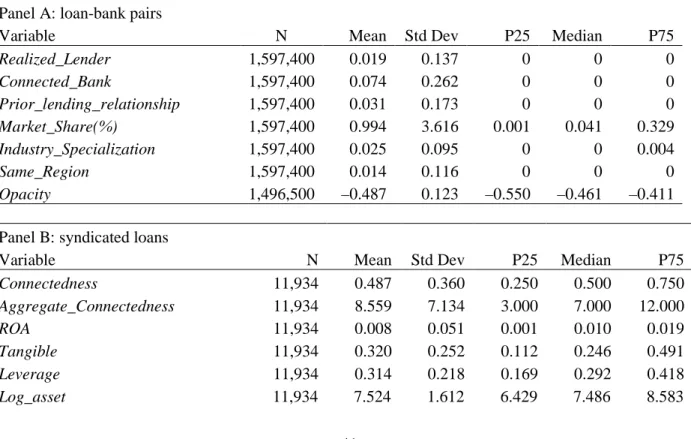
generating a total of 1,597,400 possible matches. I use this sample for hypothesis 1. Table 1,
Panel A, provides summary statistics for the potential loan-bank matches sample. The mean
value of Realized_Lender is 0.019, which indicates that the unconditional probability of being
chosen as the lead arranger is 1.9%. The mean value of Connected_Bank is 0.074, which
suggests that 7.4% of the bank lenders have made a loan to the borrower’s connected firm
before. The mean value of Prior_lending_relationship is 0.031, which indicates that 3.1% of the
bank lenders have an existing lending relationship with the borrower before the current loan.
The average market share of the bank lenders, Market_Share, is 0.99% with standard deviation
of 3.616%. The average loan portfolio weight for a lender in the borrower’s industry,
Industry_Specialization, is 2.5% with standard deviation of 9.5%. The mean value of
Same_Region is 0.014, which suggests that 1.4% of the firm-bank pair are located in the same
3-digit Zip Code region.
The sample for hypothesis 2 contains 11,934 loan facilities from 2,436 non-financial
firms over the sample period of 2000–2015. Table 1, Panel B, reports the summary statistics for
this loan sample. The mean Aggregate_Connectedness is 8.559, which implies that the average
board in this sample has 8.559 aggregate connections, and the median and standard deviation are
7 and 7.134 connections. Untabulated statistics suggests that the Pearson correlation between
Aggregate_Connectedness and the natural logarithm of assets is 0.551. The Pearson correlation
27
between Connectedness and the natural logarithm of assets is 0.084, which suggests that
Connectedness effectively mitigates the size effect associated with Aggregate_Connectedness.
The average return on asset, ROA, is 0.008 with standard deviation of 0.051. The average
proportion of tangible assets to total assets, Tangible, is 0.32. The average leverage ratio,
Leverage is 0.314. The average log of total asset, Log_asset, is about 7.524, which is larger than
average firms in Compustat. The average firm age, Age, is about 24 years. The average board in
my sample has 9 directors (Board_Size). The average loan spread, Log_spread, is 5.021 with
standard deviation of 0.808. The average natural logarithm of loan amount, LoanAmt is 19.153
with standard deviation of 1.418. Debt maturity, Maturity has a mean of 48.569 months. The
average number of financial covenants, NCOV is 1.543, and 47.3% of the loans are secured
(Securedum). Revolvers and institutional loans (term loan B or below) comprise 71.3% and
10.5% of the sample (Revolver and TermLoanB). 48.1% of the loans have performance pricing
28
CHAPTER 5: RESULTS
5.1. The effect of prior lending relationship with a borrower’s connected firm on a bank’s
likelihood of being chosen as the lead bank
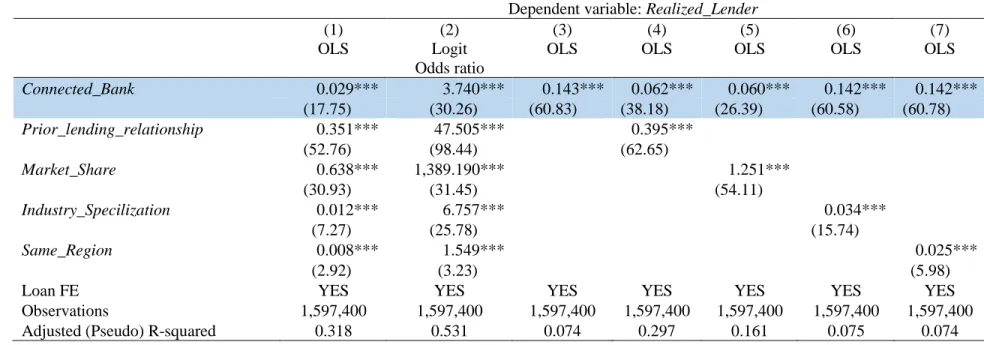
Table 2,Column 1, reports the regression summary statistics associated with estimation
of Eq. (1). The key finding is that the Connected_Bank coefficient, 0.029, is significantly
positive (t-statistic = 17.75).16 This finding indicates that having a lending relationship with a
borrower’s connected firm increases a bank’s chances of granting a loan to that borrower. In
addition to being statistically significant, the effect is also economically significant. The
conditional probability of a potential lender without such a connection to the borrower being
chosen as the lead bank, i.e., when Connected_Bank = 0, is 1.6% (evaluated at the mean of the
independent variables), whereas this probability increases by 2.9% to 4.5% if the lender has such
a connection to the borrower. This suggests that having a relationship with a borrower’s
connected firm more than doubles the probability of granting a loan to that borrower. Because
the dependent variable, Realized_Lender, is binary, I also estimate Eq. (1) using logistic
regression. Column 2 reports the odds ratio estimates from the logistic regression. As in
Column 1, Column 2 shows that the coefficient on Connected_Bank is positive and significant.
The odds ratio for Connected_Bank is 3.74, which suggests that banks that have a lending
relationship with a borrower’s connected firm are 3.7 times more likely to make a loan to that
borrower relative to banks that do not have such connection. Overall, these results confirm my
29
hypothesis about the importance of building a relationship with a borrower’s connected firm in
the syndicated loan market.
The Table 2 findings for the primary control variables are consistent with prior
research(e.g., Bharath et al., 2007; Hellmann et al., 2008; Cai et al., 2016). Having a prior
lending relationship with the borrower itself (Prior_lending_relationship) increases the
probability of subsequently granting a loan to the same borrower. Lenders with higher loan
market share or reputation in the syndicated loan market (Market_Share) have higher
probabilities of granting a loan. Bank industry specialization (Industry_Specialization) increases
a bank’s likelihood of making a loan to that specialized industry. Banks that are located in the
same region (Same_Region) as a borrower’s headquarter have higher probabilities of making a
loan to that borrower.
5.2. The effect of board connectedness on loan pricing
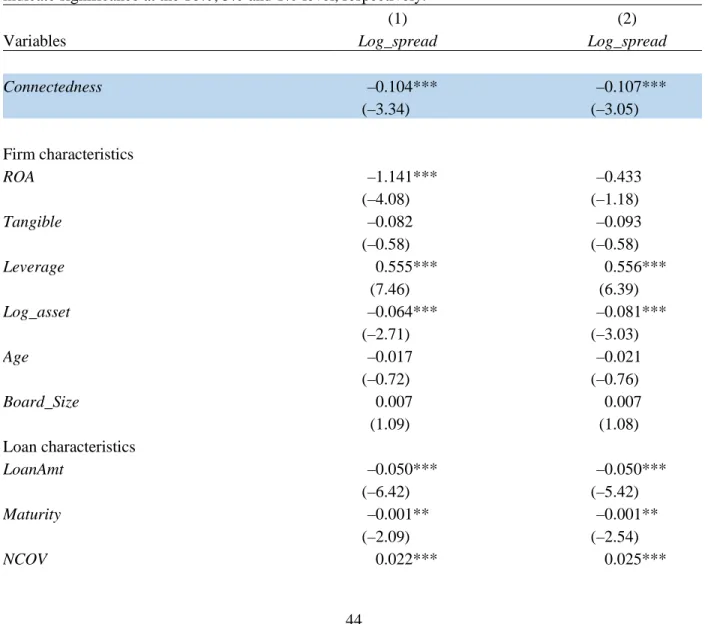
Table 3, Column 1, reports the regression summary statistics associated with estimation
of Eq. (2). The key finding is that the Connectedness coefficient is significantly negative
(coefficient = –0.104; t-statistic = –3.34). The magnitude of the coefficient is also economically
significant, implying that loan spreads decrease by approximately 10% when a firm’s board
connectedness ranking moves from the bottom quintile to the top quintile. This implies that for a
firm that faces a loan spread of 200bp when its board connectedness is in the bottom quintile,
which is the average loan spread in my sample, the loan spread decreases to180bp if the firm’s
connectedness ranking moves to the top quintile. Finding that there is a loan pricing discount for
well-connected borrowers is consistent with banks valuing board connectedness because the
30
The findings in Table 3 also reveal that the majority of the control variables’ coefficients
are significant, with signs that are largely consistent with prior research (e.g., Zhang, 2008;
Ivashina, 2009; Bushman et al., forthcoming). For example, firms with high return on assets
(ROA) and larger firms (Log_asset) on average have a lower cost of debt. More highly leveraged
firms (Leverage) pay higher spreads. Regarding the non-price loan terms, the loan amount
(LoanAmt) and loan maturity (Maturity) coefficients are statistically negative. Both collateral
(Securedum) and number of covenants (NCOV) are positively related to loan spread, which
perhaps reflects the endogenous determination of loan contractual terms. The significantly
negative coefficient on Revolver and significantly positive coefficient on TermLoanB indicate
that revolver loans and term loans B (i.e., those in which syndicate participants are non-bank
institutions) face lower and higher rates. The significantly negative coefficient on
Performance_Pricing indicates that loans with performance pricing provisions have lower
interest rates.
Larcker et al., (2013) finds that companies with boards at a more central location in the
board network tend to have better future performance. Hence one potential alternative
explanation for the loan pricing discount for well-connected borrowers is that bank lenders
anticipate better future performance of well-connected firms and thus charge lower interest rates.
To mitigate this concern, I re-estimate Eq. (2) and include ROA in the next 3 years as a control
for future performance. Table 3, Column 2, reports the regression summary statistics associated
with this estimation. As expected, coefficients on ROA in years t+1 and year t+2 are
significantly negatively related to loan spread. However, the Connectedness coefficient is
significantly negative (coefficient = –0.107; t-statistic = –3.05). In addition, the Connectedness
31
included as controls, which suggests that future growth has no impact on the relation between
loan spread and connectedness. Furthermore, my inference remains the same if I use stock
return as an alternative measure for performance.
Taken together, the findings in Table 3 indicate that borrowers with a well-connected
board obtain loans at a lower spread. These findings, together with the findings in Table 2,
portray a consistent picture: a borrower’s board connectedness creates a potential for its bank
lender to sell loan to the borrower’s connected firms. In return for this opportunity for future
growth, the lender offers a well-connected borrower favorable loan contracts.
5.3. The information intermediation role of common directors
5.3.1. The effect of borrower opacity on a connected bank’s likelihood of winning a loan
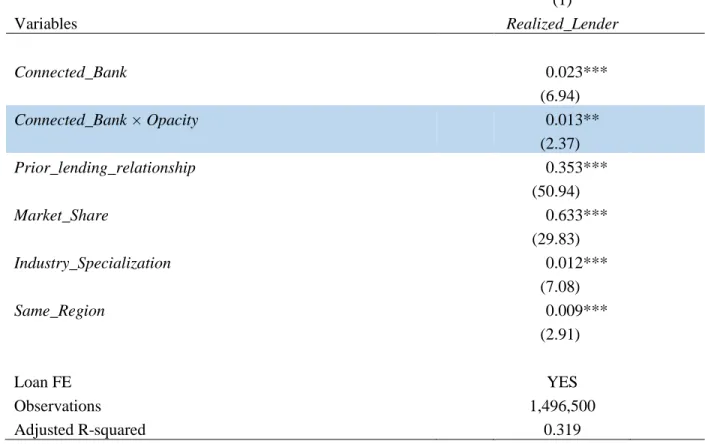
Table 4 reports summary statistics associated with estimation of Eq. (3). The key finding
is that the coefficient on the interaction term, Connected_Bank Opacity, is significantly
positive (coefficient = 0.013; t-statistic = 2.37), which is consistent with the prediction that a
connected bank’s likelihood of winning loan business from a new borrower is higher if the
borrower is more opaque. The Connected_Bank coefficient is also significantly positive
(coefficient = 0.023; t-statistic = 6.94), suggesting that a connected bank’s probability of
granting a loan to a borrower will increase by 2.3% even if the borrower is informationally
transparent. If the borrower is opaque then this probability will increase by 3.6% (= 0.023 +
0.013). Overall, this finding supports the view that a bank that has a prior lending relationship
with a borrower’s connected firm gains privileged information about that borrower and thus has
32
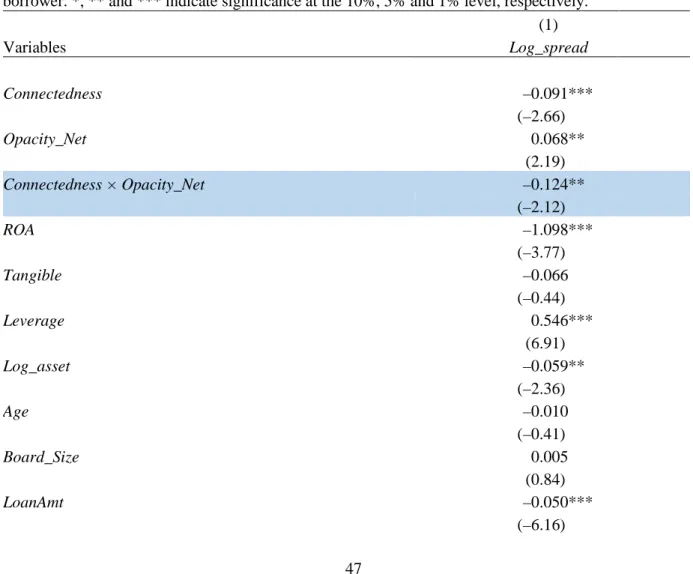
5.3.2. The effect of board network informational opacity on loan pricing
Table 5 reports regression summary statistics associated with estimation of Eq. (4). The
key finding is that the coefficient on the interaction term, Connectedness Opacity_Net, is
significantly negative (coefficient = –0.124; t-statistic = –2.12), which is consistent with the
prediction that a well-connected borrower that has more opaque firms in its board network
receives more loan pricing discount from the bank lender. The Connectedness coefficient is also
significantly negative (coefficient = – 0.091; t-statistic = –2.66), suggesting that a well-connected
borrower still receives a loan pricing discount even if firms in the borrower’s network have
transparent information. However, if firms in the borrower’s network are opaque, then the loan
pricing discount increases to 0.215 (= 0.091 + 0.124). Overall, this finding supports the view
that banks perceive the cross-firm selling potential to a borrower’s connected firms is higher if
the connected firms are more opaque and thus are willing to offer more loan pricing discount.
This finding extends the extant accounting literature relating the quality of accounting
information to debt contracting (e.g., Armstrong, Guay and Weber, 2010; Dechow, Ge and
Schrand, 2010). Although much of this literature suggests that the quality of a firm’s financial
reporting positively affects its debt contracting outcomes, this paper demonstrates that the debt
contracting outcomes of a borrower also depend on the financial reporting quality of its
connected firms and that the borrower can benefit from the opacity of its connected firms.
5.4. Robustness: bank heterogeneity
The findings in Table 2 indicate that having made a loan to a potential borrower’s
connected firm, Connected_Bank, increases a bank’s likelihood of winning loan business from
that borrower. To mitigate the effects of endogeneity, it is important that Connected_Bank does
33
loan business from a borrower. To further mitigate the effects of lender attribute heterogeneity, I
re-estimate Eq. (1) by including bank fixed effects in the regression. Untabulated findings
reveal that the Connected_Bank coefficient is significantly positive (coefficient = 0.024;
t-statistic = 15.41). The t-t-statistics and coefficient are of similar magnitudes whether or not bank
fixed effects are included as controls, which indicates that other omitted bank characteristics
have minimal impact on the relation between the probability of being selected as a lender and
being a connected bank, Connected_Bank.
For Eq. (2), the majority of the control variables are defined at the firm level and not at
the lender level. When capital providers are relatively homogeneous, lender specific attributes
are unikely to influence lending outcomes (e.g., loan pricing). However, in the syndicated loan
market, the ability to screen and monitor borrowers could differ significantly between banks. To
that extent that such differences are correlated with my board connectedness measure,
Connectedness, the coefficient I report would be biased. To further mitigate the effects of lender
attribute heterogeneity, I re-estimate Eq. (2) by including bank fixed effects in the regression.
Untabulated findings reveal that the Connectedness coefficient is significantly positive
(coefficient = 0.101; t-statistic = –3.24). The t-statistics and coefficient essentially remain
unchanged whether or not bank fixed effects are included as controls, which suggests that other
omitted bank characteristics have no effect on the relation between loan spread and board
connectedness.
5.5. Endogeneity
The findings in Table 2 indicate that a bank’s chance of winning loan business from a borrower
increases if the bank previously made loans to the borrower’s connected firm. An explanation
34
firm’s board with which the bank has an existing lending relationship, act as informal financial
intermediaries between the bank and the borrower and help the bank to win the loan business
from the borrower. However, two broad sources of endogeneity challenges the credibility of this
effect: reverse causality, as a bank lender may recommend directors to sit on their borrower’s
board, and (2) director-firm matching on an ommited attribute that determines both board
composition and lender choice.
5.5.1. Reverse causality
The first endogeneity concern is reverse causality. That is, during the loan negotiation
process and before the final loan origination date, a bank lender is selected by the new borrower,
and then the lender recommends a director with which the lender has developed a relationship in
the past to sit on the borrower’s board. One approach to address this possibility is to consider the
role of the individual director’s tenure on the new borrower. If the director has served on the
new borrower’s board for a relatively long period of time before the loan origination, for
instance, 2 or more years, then it is unlikely that the findings in Table 2 are attributable to reverse
causality. Hence, I re-estimate Eq. (1) by using observations that exclude loans where the
common directors have served on the borrower’s board for less than 2 years before loan
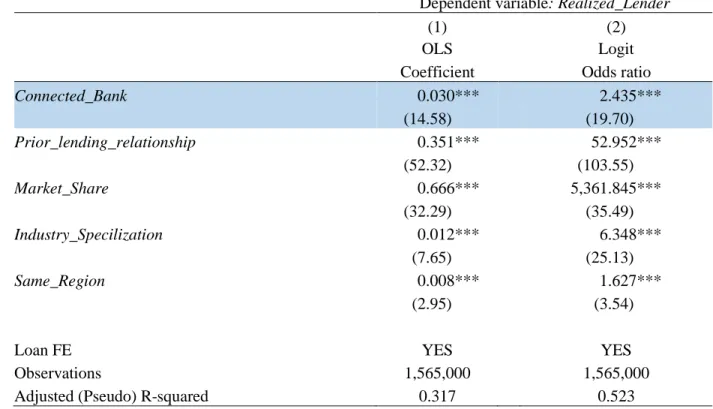
origination. Table 6,Panel A, reports the regression summary statistics associated with
estimation of Eq. (1) using the new sample. The key finding in Column (1) is that the
Connected_Bank coefficient, 0.030, is significantly positive (t-statistic = 14.58). Column 2
reports the odds ratio estimates from the logistic regression. As in Column 1, Column 2 shows
that the coefficient on Connected_Bank is positive and significant (coefficient = 2.435, t-statistic
= 19.70). Taken together, these findings provide additional support that the inferences I draw