Multi-scale model of drug induced adaptive
resistance of Gram-negative bacteria to
polymyxin B
Wojciech Krzyzanski1, Gauri G. Rao1,2*
1 Department of Pharmaceutical Sciences, School of Pharmacy Practice and Pharmaceutical Sciences, University at Buffalo, Buffalo, New York, United States of America, 2 Division of Pharmacotherapy and Experimental Therapeutics, UNC Eshelman School of Pharmacy, The University of North Carolina at Chapel Hill, Chapel Hill, North Carolina, United States of America
Abstract
The purpose of this report is to apply multi-scale modeling using the theory of physiologically structured populations (PSP) to develop a mathematical model for antimicrobial resistance based on a heterogeneous distribution of receptors and affinities among bacterial cells. The theory has been tested on data obtained from an in vitro static time-kill infection model ana-lyzing the pharmacodynamics of polymyxin B against Gram-negative bacteria. The drug binding parameter KD(dissociation equilibrium constant) is assumed to vary between the bacterial cells. The PSP model describes the time course of the density distribution of KD upon exposure to cytotoxic drug concentrations. The drug increases the hazard of cell death as a function of receptor occupancy. The initial distribution of KDis described by the Weibull function. Time-kill data were used for model qualification. In vitro static time-kill experiments to evaluate the rate and extent of killing due to polymyxin B against two Klebsiella
pneumo-niae clinical isolates with differing susceptibilities to polymyxin B were performed over 48 h.
The time-kill kinetics data of bacterial load cfu (colony forming units)/mL was used for model qualification. The resistant bacterial population is determined by the balance between growth rate and hazard of cell death controlled by polymyxin B concentrations. There exists a critical KDvalue below which cells continue to grow. Estimates of shape parameters for distributions of KDyielded unimodal distributions with the modes at 0 nM and the right tails containing approximately 25% of the bacteria. Our findings support a hypothesis that resis-tance of Klebsiella pneumoniae to polymyxin B can be at least partially attributed to a drug-induced selection of a subpopulation due to heterogeneity of polymyxin B receptor binding in the bacterial population.
Introduction
Prevalence of Gram-negative bacteria resistant to almost all currently available antibiotics is rapidly escalating at an alarming rate. This poses a serious clinical challenge as it limits our
a1111111111 a1111111111 a1111111111 a1111111111 a1111111111 OPEN ACCESS
Citation: Krzyzanski W, Rao GG (2017) Multi-scale
model of drug induced adaptive resistance of Gram-negative bacteria to polymyxin B. PLoS ONE 12(3): e0171834.https://doi.org/10.1371/journal. pone.0171834
Editor: Giuseppe Vittorio De Socio, Azienda
Ospedaliera Universitaria di Perugia, ITALY
Received: August 30, 2016
Accepted: January 26, 2017
Published: March 23, 2017
Copyright:©2017 Krzyzanski, Rao. This is an open access article distributed under the terms of the
Creative Commons Attribution License, which permits unrestricted use, distribution, and reproduction in any medium, provided the original author and source are credited.
Data Availability Statement: All relevant data are
within the paper and its Supporting Information files.
Funding: The authors received no specific funding
for this work.
Competing interests: The authors have declared
treatment options against infections due to resistant Gram-negative pathogens. Mechanisms of bacterial resistance have been classified into three categories: intrinsic, acquired, and adap-tive [1]. Intrinsic resistance comprises all the inherent mechanisms that restrain the effects of antimicrobials by reducing the intracellular drug concentration (such as Gram-negative outer membrane that is impermeable to several antimicrobial classes and the increased expression of numerous efflux pumps). Acquired resistance refers to the acquisition of new genes by the incorporation of genetic material or a result of spontaneous mutations enabling bacteria to withstand higher antibiotic concentrations. Adaptive resistance is a temporary increase in the ability of bacteria to survive drug pressure with alterations to the gene and/or protein expres-sion in response to the environmental trigger. Adaptive resistance, in contrast to intrinsic or acquired resistance, is triggered in response to the selective pressure exerted by the use of anti-biotics. Bacterial phenotype can contain a high degree of molecular heterogeneity. An example of adaptive drug resistance is a drug-induced selection of a resistant bacterial subpopulation that were present in the original bacterial population [2].
Polymyxin B is a polycationic cyclic antimicrobial peptide with a molecular mass 1,200 Da carrying five positively charged residues of diaminobutyric acid. Polymyxin B binds to lipo-polysaccharide (LPS) expressed on the outer membrane of Gram-negative bacteria such as
Escherichia coliandKlebsiella pneumoniaeby displacing divalent cations Mg2+and Ca2+that cross-bridge between adjacent negatively charged phosphate groups [3]. Upon biding to LPS, polymyxin B forms a complex with LPS that penetrates the outer membrane of the bacteria. The bactericidal effect of polymyxin B is attributed to its interaction with the cytoplasmic membrane that alters its functions such as active transport and respiration [4].
Gram-negative bacteria alter their LPSs to protect themselves against the bactericidal effects of polymyxin B. One of the most common modifications of LPS resulting in reduced binding affinity to polymyxin is the cationic substitution of its phosphate groups by 4-amino-4-deoxy-L-arabinose (L-Ara4N) causing a decrease in the net negative charge of lipid A, a constituent moiety of LPS [5–6] and hence resulting in resistance to polymyxin B. The other common method resulting in the modification of lipid A, is the addition of phosphoethanolamine (PEtN) resulting in a decrease in the net negative charge causing a shift towards cationicity with decreased binding affinity for polymyxin B, resulting in eventual resistance to polymyxins [5–6]. The synthesis and transfer of L-Ara4N and PEtN to lipid A resulting in polymyxin resis-tance is triggered by the activation of PhoP/PhoQ and PmrA/PmrB, the two-component systems (TCS) due to environmental stimuli like drug concentrations, changes in growth con-ditions or specific mutations occurring within TCS will result in the upregulation of operons that facilitate [6–8].
Most of the mathematical models to date describe the emergence of resistance in response to drug pressure as a mixture of bacterial subpopulations with differing degrees of antibiotic susceptibilities [9–10]. Drug effects depend on the degree of susceptibility of the bacterial subpopulations, and the composition of the total bacterial population exposed to the drug con-centration can change over time as bacterial subpopulations which are less susceptible can become dominant. Such models typically assume acquired resistance due to bacterial muta-tions which determine the initial (prior to drug treatment) partition of the total bacterial popu-lation into susceptible subpopupopu-lations.
population. For describingin vitrobacteria, the growth media constitutes the environment. In particular, the drug concentration is the most relevant environmental variable determining the dynamics of bacterial population. In the context of Gram-negative bacteria resistance to poly-myxin B, a structure of interest will be the expression of LPS on the outer membrane. PSP models are designed to quantify heterogeneity of the bacterial structure and the impact of the environment on the dynamics of bacterial populations.
Our leading hypothesis is that resistance ofKlebsiella pneumoniaeto polymyxin B can be at least partially attributed to a drug-induced selection of a subpopulation due to the heterogene-ity of LPS binding in the bacterial population. We apply a PSP model to describe the time-kill kinetics data for two clinical strains with differing susceptibilities to polymyxin B with infor-mation regarding the distribution of binding affinities, maximal efficacies, and critical concen-trations of polymyxin B necessary for the emergence of resistant bacterial subpopulations. First, we briefly introduce a general framework for PSP models. Next we apply the pharmaco-logical principles of receptor occupancy to introduce binding structures and define the bacteri-cidal effect of the drug. The resulting model is fitted to the experimental time-kill kinetics data and furthermore the parameter estimates were used to simulate the process of selection of resistant subpopulations by exposure to the drug.
Materials and methods
In vitro static time-kill study
Klebsiella pneumoniaeCarbapenemase (KPC) producingKlebsiella pneumoniaeclinical strains BAA1705™(obtained from ATCC1) and KP619 (obtained from a patient treated for bacterae-mia at the Kingman Regional Medical Center, Kingman, Arizona) were used. MICs (mini-mum inhibitory concentrations) were determined in triplicate by broth microdilution as per the Clinical and Laboratory Standards Institute guidelines (Clinical and Laboratory Standards Institute. 2014. Performance Standards for Antimicrobial Susceptibility Testing; Twenty-Fourth Informational Supplement. CLSI document M100-S24. Clinical and Laboratory Stan-dards Institute, Wayne, PA).
Mueller-Hinton broth (Becton, Dickinson and Company, Sparks, MD) supplemented with calcium and magnesium (CAMHB; 25.0mg/L Ca2+, 12.5mg/L Mg2+) was used for susceptibil-ity testing andin vitrotime-kill models. Stock solutions of polymyxin B (Sigma-Aldrich, St. Louis, MO, Lot. WXBB4470V) were freshly prepared in sterile water prior to each experi-ment. All drug solutions were filter sterilized using a 0.22μm filter (Fisher Scientific). Static time-kill experiments were performed over 48 h to evaluate pharmacodynamic activity of poly-myxin B monotherapy against the twoK.pneumoniaeclinical strains. The rate and extent of killing polymyxin B 0.5, 1, 2, 4, 8, and 16 mg/L was assessed. Polymyxin B was added to the logarithmic-phase broth culture prepared prior to each experiment by adding fresh bacterial colonies from overnight growth to pre-warmed CAMHB (37˚C) to achieve the desired initial inoculum of ~106cfu/mL. Serial samples were obtained at 0, 1, 2, 4, 6, 8, 24, 28, 32, and 48 h for bacterial quantification.
PSP model
of the behavior of its constituent individuals. It consists ofi-state equations:
dx
dt ¼gðE;xÞ; t>0; x2O ð1Þ
wherexis ann-dimensional vector of individual structures (i-state),Ois the space containing all individual states, andEis a vector of environmental variables influencing individual states that is described bye-state equations:
dE
dt ¼fðE;cðnð;tÞÞ;tÞ; t>0 ð2Þ
wheren(x,t)is the density distribution of the structurexat timet(p-state) andC(n(,t)) is a population characteristic (e.g. population size) defined by thep-state. For example, by defini-tion of the density funcdefini-tion, the number of subjects in the populadefini-tion at timetis
NðtÞ ¼ Z
O
nðx;tÞdx ð3Þ
P-state equations are central for the PSP model:
@nðx;tÞ
@t þdivðgðE;xÞnðx;tÞÞ ¼lðE;Cðnð;tÞ;x;tÞÞ mðE;Cðnð;tÞ;xÞÞnðx;tÞ; t>0;x2Oð4Þ
whereλ(E,C(n(,t),x,t)) is the density of production rate andμ(E,C(n(,t),x)) is the mortal-ity rate, for individuals of structurex. Thep-stateEq (4)uniquely defines the densityn(x,t)if boundary and initial conditions are specified:
vðxÞ gðE;xÞnðx;tÞ ¼aðx;tÞ; t>0; x @O ð5Þ
and
Eð0Þ ¼E0;nðx;0Þ ¼n0ðxÞ; xO ð6Þ
whereυ(x) is the unit inward-pointing normal vector atx@O, andα(x,t) andn0(x) are known functions.
Binding-structured population models of bacteriain vitro. We will consider bacteria
growing in thein vitrostatic time-kill model to be exposed to a polymyxin B concentration of
C. The drug concentration constitutes an environmental variable (e-state) that affect the status of each bacterium. Since polymyxin B is stable and the degradation is minimal for the duration of the experiment, we assume that drug concentration in the medium does not change over time:
dC
dt ¼0 ð7Þ
Eq (7)is an analog of the e-stateEq (2). Based on the pharmacological principles of drug-receptor theory, the drug effect on each bacterium is determined by the number of drug-receptors bound to the drug (b) [15]. The number of bound receptors b depends on the drug concentra-tion in medium C and the number of free receptors per bacterium r, and the number of bacte-ria N in the culture. Since the time scale for binding and receptor turnover is much smaller as compared to the time scale for the growth of bacteria we assume that the binding is at dynamic equilibrium. Then the bound receptor on each cell can be calculated as
b¼ rtotC
KD þ C
whereKDis the equilibrium disassociation constant andrtotdescribes the total number of
receptors per bacterium that is assumed to be constant:
rtot¼rþb ð9Þ
Consequently, under equilibrium assumptions, we get r¼rtotKD
KDþC, hence the number of free and bound receptors on a bacterial cell is determined byrtotandKDspecific for that cell. In
this context, a relevant structure determining the status of each bacterium is a vector (rtot,KD).
In this section we havex= (rtot,KD) andE=C. Since the bacterial cell binding parameters
are constant, the i-stateEq (1)becomes:
d
dtðrtot;KDÞ ¼ ð0;0Þ ¼gðC;rtot;KDÞ ð10Þ
Under these assumptions the p-stateEq (4)describing the receptor density n(rtot,KD,t)
simplifies to
@nðrtot;KD;tÞ
@t ¼lðC;N;rtot;KD;tÞ mðC; N;rtot;KDÞnðrtot;KD;tÞ; rtot>0;KD>0;t>0ð11Þ
with the initial condition
nðrtot;KD;0Þ ¼n0ðrtot;KDÞ; rtot>0; KD>0 ð12Þ
Cytotoxic effect. The mortality rateμ(C,N,rtot,KD) is assumed to be independent of the
bacteria population size and is stimulated by the drug:
mðC;N;rtot;KDÞ ¼m0SðbÞ ð13Þ
whereμ0is the first-order death rate constant andS(b) is the stimulatory function. We assume that the drug effects are characterized as power functions ofb
SðbÞ ¼1þkbg
ð14Þ
whereγis the power coefficient describing the steepness of the stimulatory curve andκis the coefficient.
Modeling bacteria growth. To accurately describe the dynamics of bacteria growthin vitrowe will adopt existing models [16]. The bacterial density growth rateλ(C,N,rtot,KD) is
assumed to slow down with an increasing bacteria population size:
lðC;N;rtot;KD;tÞ ¼ VGmax
NmþN
nðrtot;KD;tÞ ð15Þ
whereVGmaxis a maximal velocity of bacterial growth, andNmdenotes the bacterial count
that results in 50% of the maximal rate of growth. If the size of the bacteria population is much less thanNmi.e.
NNm ð16Þ
then the growth rate becomes linear:
whereλ0=VGmax/Nm. Integrating p-stateEq (11)one can arrive at a solution:
nðrtot;KD;tÞ ¼n0ðrtot;KDÞexpððl0 m0SðbÞÞtÞ ð18Þ
Where bound receptorbis determined byEq (8). In the case of point distribution of
rtotrtot0:
nðKD;tÞ ¼n0ðKDÞexpððl0 m0SðbÞÞtÞ ð19Þ
where
n0ðKDÞ ¼N0
b a
KD
a
b 1
exp KD
a
b!
ð20Þ
Cell count response. The bacterial cell count in the population can be calculated by
inte-gration of the densityn(rtot,KD,t) as shown inEq (3). Integrating ofEq (18)overrtotandKD
yields:
NðtÞ ¼ Z 1
0
Z 1
0
n0ðrtot;KDÞexpððl0 m0SðbÞÞtÞd rtotd KD ð21Þ
In the absence of the drug (S(b)1) the bacteria population grows exponentially:
NðtÞ ¼N0expððl0 m0ÞtÞ ð22Þ
with the half-life
t1=2¼
lnð2Þ l0 m0
ð23Þ
In the case of point distribution ofrtotrtot0:
NðtÞ ¼ Z 1
0
n0ðKDÞexp ðl0 m0S
rtot0C
KDþC
Þt
d KD ð24Þ
whereas all cells have the same affinityKDKD0:
NðtÞ ¼ Z 1
0
n0ðrtotÞexp ðl0 m0S
rtotC
KD0þC
Þt
d rtot ð25Þ
Initial distribution ofrtotandKD. The last part of the model to be defined is the initial density ofrtotandKD. Anticipating limited information fromin vitrobacteria growth data
about the expression of receptors and bacteria affinities to drug, a parsimonious approach was taken to describen0(rtot,KD). A natural assumption is independence ofrtotandKD
distribu-tions resulting in the product:
n0ðrtot;KDÞ ¼N0p0ðrtotÞq0ðKDÞ ð26Þ
wherep0(rtot) andq0(KD) are probability density functions (pdfs) forrtotandKDdistributions,
respectively. Two type of pdfs were tested to account for extreme cases: Weibull
pðxÞ ¼b a x a b 1 exp x a b
whereαis the scale parameter andβis the shape parameter, and point distribution
pðxÞ ¼dðx x0Þ ð28Þ
wherex0is the center of the distribution. The point distribution assumes all cells have the same structure value (rtotorKD).
Data analysis
The model parameters were estimated using the SAEM algorithm implemented in Monolix 4.3.3 (Lixoft). Simulations were prformed in MATLAB (R2013a, MathWorks). The numeri-cal evaluation of the integrals was done by the MATLAB functionintegralavailable to Monolix.
Results
Mechanisms of resistance for bacterial population with unrestricted
growth
The binding-structured population model offers an explanation for a mechanism of resistance of bacteria in response to treatment with a bactericidal antibiotic based on the balance between production and elimination rates that can vary between bacteria as a consequence of bacteria specific binding of the drug. For the unrestricted growth of bacteria, the time course of the density functionn(rtot,KD,t) is described by the p-state equation:
@nðrtot;KD;tÞ
@t ¼ ðl0 m0SðbÞÞnðrtot;KD;tÞ ð29Þ
which can be solved to yieldEq (11). Consequently, the curve
l0 m0SðbÞ ¼0 ð30Þ
divides the plane (rtot,KD) into two regions. Bacteria in the region for which the left hand side
ofEq (30)is negative will exponentially die, whereas bacteria in the complementary region will grow exponentially. This is a resistance mechanism where the drug selects bacteria in the initial bacterial populationn0(rtot,KD,t) for death or survival depending on their binding
characteris-tics [2]. Bacteria expressing large number of receptors or with strong binding affinity are likely to die, while the bacteria expressing few receptors or with weak binding affinity for the drug will survival forming a new more resistant bacterial population growing exponentially in time. The time for the emergence of this new more resistant bacterial population depends on the proportion of the initial distribution contained in the growing region of the (rtot,KD) plane.
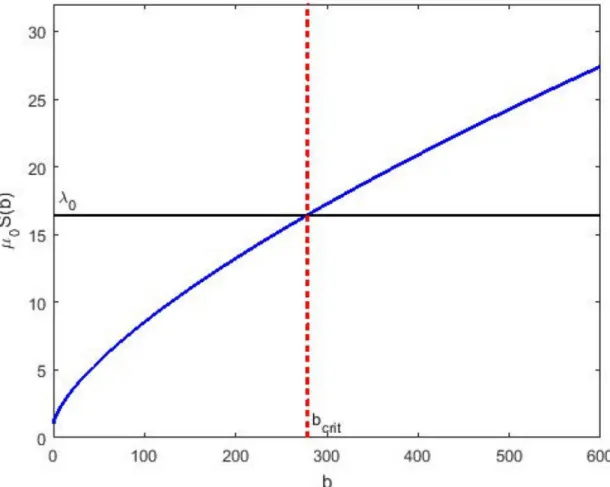
According toEq (30)there exists a critical number of bound receptors per bacteriumbcritsuch
that a subpopulation of bacteria expressing bound receptorsb<bcritwill continue to grow.
This happens as the elimination rate of bacteria is determined by the hazard of death which is less than the production rate of bacteria determined byλ0. While the subpopulation of bacteria with bound receptorsb>bcritdiminishes as the hazard of death is greater than the production
rate of bacteria.
l0 ¼m0SðbcritÞ ð31Þ
To demonstrate this mechanism we will use an example of bacteria that differ only in terms of their binding affinityKDwhile expressing the same number of receptorsrtot0. Then a two
dimensional densityn(rtot,KD,t) can be reduced to a one dimensional densityn(KD,t). Since
the number of bound receptors is uniquely determined by bacteria binding characteristicsEq (8), there exists a critical equilibrium dissociation constantKDcritsuch that a subpopulation of
bacteria withKD>KDcritcontinue to grow whereas a subpopulation of bacteriaKD<KDcritare
decreasing:
KDcrit¼C
m0krtot0 g
l0 m0
1=g
1
!
ð32Þ
Eq (32)implies that necessary and sufficient condition for existence of bacteria asKDcritis
krtot0 g
>l0
m0
1>0 ð33Þ
Fig 1. The mortality rate as a function of the number bound receptors per cell. The hazard of cell removalμ0S(b)
increases as an effect of drug action S(b) starting from the baseline valueμ0. The horizontal line marks the first-order
production rate constant for cell populationλ0. The interception of two lines determines the critical value of bound receptors bcrit. Cells with b<bcritwill continue to grow whereas cells bcrit<b are destin to die.
In particular,Eq (33)implies that if bacteria express a low number of receptors, thenKDcrit
may not exist and the original bacteria population will continue to grow exponentially, entirely resistant to drug effect.
Resistance of Gram-negative bacteria to polymyxin B
Two clinical strains of KPC producingKlebsiella pneumoniaewith differing susceptibilities to polymyxin B were grown in Mueller Hinton broth, growth media containing escalating poly-myxin B concentrations over 48 h. For the susceptible strain BAA1705 the minimum inhibi-tory concentration (MIC) for polymyxin B is 0.5 mg/L whereas for the more resistant strain KP619 MIC for polymyxin B is 64 mg/L. Time-kill kinetics for both strains are shown inFig 2. In time-kill studies, polymyxin B was bactericidal in a concentration-dependent mannerFig 2. All polymyxin B concentrations evaluated resulted in a>3 log10reduction against BAA1705
by 2–4 h and all strains regrew until they were similar to growth control or until they reached the threshold. Against KP619, a less than 1-log10reduction was seen at concentrations greater
than 4 mg/L that was not sustained beyond 4 h and regrowth was seen at all evaluated concen-trations. To ensure exponential growth the control data were used to determine a threshold of 108cfu/mL to censor the data for all treatment groups when the size of the bacteria population increases above the threshold. The rate (or initial slope of time-kill curves) was greater and extent of killing by polymyxin B for BAA1705 was more extensive as compared to that for KP619, consistent with their reported polymyxin B susceptibilities. The time-kill data imply the emergence of bacteria resistant to polymyxin beyond 4–6h of exposure to polymyxin B. According to the assumption of heterogeneity in polymyxin B affinities of the receptors expressed by the bacteria populations evaluated here, the time-kill kinetics data were fitted by the modelEq (23). The resulting fits are shown inFig 2and parameter estimates and their 95% CIs are presented inTable 1. Two model parameters could not be estimated based on the avail-able data and hence they were fixed. The bacterial natural death rate constant (baseline haz-ard),μ0was set to the value 0.3 day-1reported elsewhere [17]. The scale parameterα, for the initial distribution was set at the value of 380 nM, the equilibrium dissociation constant for polymyxin B binding to LPS [18]. The estimated shape factorsβwere<1 implying right-skewed distributions with singularity atKD= 0. Since 95% CIs corresponding to BAA1705 and
KP619 strains are disjoint, the KDdistributions are significantly different which is confirmed
byFig 3. The dimensional analysis revealed that parametersκandrtot0can be estimated only
as a part of the termvrtot0γ. The latter can be interpreted as the drug effect corresponding to
100% receptor occupancy, a maximal stimulation for the given number of receptors per bacterium.
Distribution of affinities to polymyxin B
The model structure and parameter estimates allows one to make inferences about the initial distribution ofKDamong the bacteria and the shape of the hazard function for escalating drug
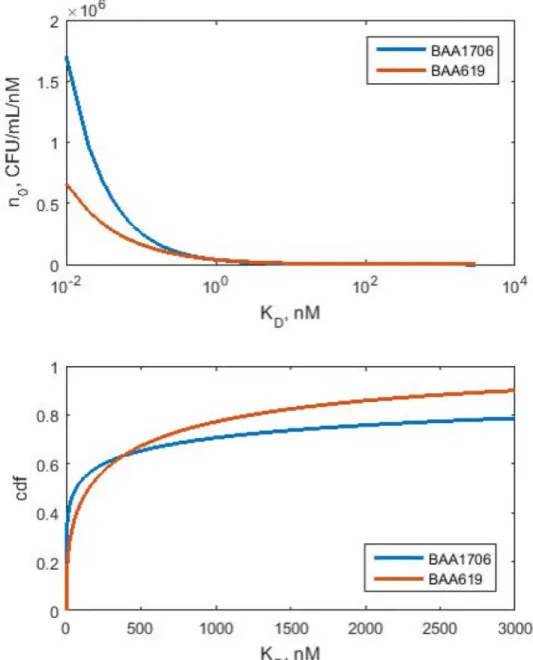
concentrations.Fig 3reveals the inferredKDdensity distributions after initiating treatment
with polymyxin B against both clinical isolates evaluated. The estimated shape factorsβ were<1 implying right-skewed distributions with singularity atKD= 0. The cumulative
dis-tribution functions yield the following quartiles Q1= 1.06 nM, Q2= 67 nM, and Q3= 1788 nM
(BAA1705), and Q1= 17.4 nM, Q2= 154 nM, and Q3= 853 nM (K619). This implies that
more than half of both bacterial isolates have stronger affinity for polymyxin B than reported 380 nM. Also, about quarter of the bacteria bind to polymyxin B in the micro molar range. As expected, BAA1705 isolate has more polymyxin B susceptible bacteria withKD<100 nM as
Fig 2. Time-kill data for BAA1709 (upper panel) and KP619 (lower panel) strain. Symbols represent the measurements and lines are model fitted curves. The dashed line marks the limit of quantification of 1 cfu/mL. The triangle symbols are measurements below limit of quantification.
Cytotoxic effect of polymyxin B
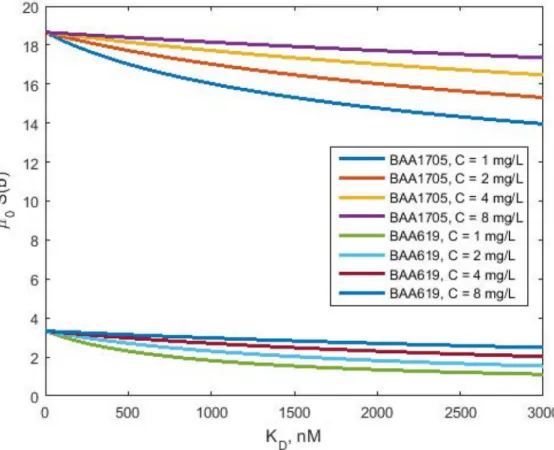
The estimates ofγandκrtot0γare sufficient to generate plots of the hazardμ0S(b) as functions KDshown inFig 4:
m0SðbÞ ¼m0 1þkrtot0
g C
KDþC
g
ð34Þ
AtKD= 0 nM the maximum hazards of bacteria death were 18.7 day-1and 3.3 day-1for
BAA1705 and KP619, respectively. The hazards decreased with increasingKDand were
depen-dent on the polymyxin B concentration. Higher polymyxin B concentrations resulted in higher hazards of death. The sensitivity of the hazard to drug concentration was higher for BAA1705 compared to that for KP619, consistent with values ofγparameter as the power of the receptor occupancyC/(KD+C).
Selection of resistant cell population
The affinity of bacteria to polymyxin B,KDcritdetermines its fate, when it is exposed to the
cytotoxic effect of drug. Bacteria withKD>KDcritwill grow, whereas bacteria withKD<KDcrit
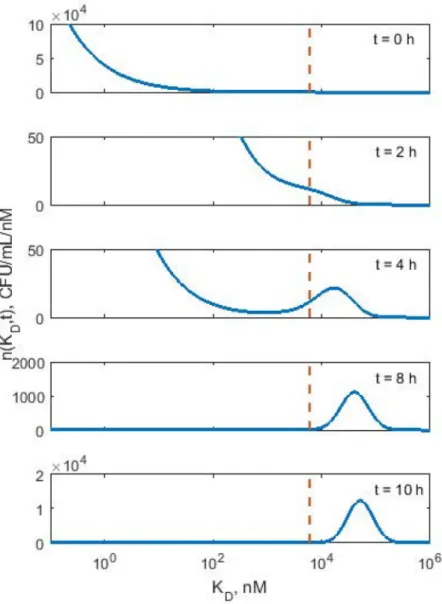
are destined to be killed by the drug. This is the basic mechanism of selection for resistant bac-teria based on their affinity to drug.Fig 5shows the densityn(KD,t) at various times for KP619
exposed to polymyxin B concentration of C = 8 mg/L to illustrate the emergence of resistant bacteria subpopulation withKD>KDcrit= 6003 nM. At timet= 0 h, only 4.7% ofN(0) = 1.2
x106cfu/mL bacteria hadKD>KDcrit. Att= 2 h, this fraction increased to 52.7% ofN(2) = 3.2
x105cfu/mL, and byt= 4 h almost the entire bacteria population 95.5% ofN(4) = 9.1x10⁵cfu/ mL became resistant, and the process of growth dominated the killing. Att= 8 h more than 99.9% ofN(8) = 7.8 x10⁷cfu/mL bacteria hadKD>KDcrit, and consequently the population
size increased exponentially with time. This suggests that bacteria with weak binding affinity to the drug become resistant, while bacteria with strong binding affinity to the drug are elimi-nated. Another observation is that the drug concentration,Cis also a determinant of the emergence of resistant bacterial population. The time scale for emergence of the resistant pop-ulation depends on the percentile of the initial distribution cut off byKDcrit. The smaller the
tail is, the longer it takes for the resistant bacteria population to emerge. Lastly, over time as the total bacteria population becomes resistant, theKDvalues shifts to higher values orKD.
val-ues tend to increase. The mode att= 8 h was 40,306 nM whereas att= 10 h it was 51,042 nM. The process of selection resistant population for BAA1705 strain was qualitatively similar to that for KP619 strain.
Table 1. Parameter estimates of modelEq (24)obtained by fitting the time-kill data for BAA1705 and KP619 strains shown inFig 2.
Parameter Estimate (%RSE) BAA1705 95% CI BAA1705 Estimate (%RSE) KP619 95% CI KP619
λ0, day-1 3.27 (22) [1.80,4.74] 2.02 (9) [1.63;2.41]
μ0, day-1 0.3* 0.3*
κrtot0 γ
61.2 (35) [18.4,104.0] 10.1 (8) [8.34,11.6]
γ 0.186 (32) [0.0657,0.306] 0.831 (29) [0.335,1.33]
log10N0,cfu/mL 5.92 (5) [5.35,6.49] 6.07 (1) [5.93,6.21]
α, nM 380* 380*
β 0.211 (13) [0.154,0.268] 0.404 (9) [0.334,0.474]
%RSE stands for percent relative standard error of the estimate. *—parameter was fixed.
Discussion
Existingin vitromodels of infection account for resistance in response to drug pressure by describing the total bacterial population by considering a discrete number of bacterial subpop-ulations with varying degrees of susceptibility to the antibiotic(s) being evaluated (see for example [9]). The approach presented here fundamentally differs from assuming a priori existence of several bacterial subpopulations as opposed to one that evolves in time upon expo-sure to drug resulting in the emergence of a resistant population eventually. The discrete sus-ceptibilities of bacteria to drug is explained by a continuous distribution of drug binding
Fig 3. Initial KDdensity distributions (upper panel) and cumulative distribution functions (lower
panel) for BAA1705 and KP619 strains. Estimated parameter values fromTable 1were used to simulate
n0(KD) and corresponding cdfs based onEq (20).
characteristics within the bacterial population. A resistant population is determined by the bal-ance between the growth and death processes altered by the drug. As such, the distribution will change in time where the concentration of the drug is the forcing function.
Since resistance emerges at low bacteria counts, our model of bacteria growth was limited to a first-order process with drug stimulating bacterial death. This simplification was inten-tional to arrive at a mathematically simpler model allowing for explicit criteria determining the critical binding characteristics necessary to define a resistant bacteria population. Conse-quently, the model can be applied to the time-kill kinetics data only within the exponential growth phase. Given the two characteristics of receptor density,rtotand affinity for drug,KD,
the model was further simplified by assuming that these characteristics do not vary between bacteria. This was necessary since the available data did not support identifiability of these parameters for a two-dimensional distribution. The model allowed for a rather flexible initial distribution of binding characteristics (Weibull function), and a relatively general model of the effect of the drug on the hazard of cell death (power function of bound receptors per cell).
The model was qualified against time-kill kinetics data for two isolates of KPC producing
Klebsiella Pneumoniaewith differing susceptibilities to polymyxin B with the assumption of the same target expression within the bacterial population. Parameter estimates revealed simi-lar qualitative characteristics but difference in numerical values. The initial distributions ofKD
for both strains were centered near the vicinity ofKD= 0 with right tails extending to infinity
with about 25% of bacteria in the micro-molar range. The drug effect on the death hazard differed in its maximal value being 6-fold stronger for the more susceptible bacteria strain,
Fig 4. Hazard as functions of KDfor BAA1709 and KP619 strains. The curvesμ0S(b) vs. KDwere simulated
usingEq (34)for indicated drug concentrations. Parameter values used for simulations are presented inTable 1.
BAA1705. Also, the sensitivity of the more susceptible bacteria strain to drug concentration was higher.
The selection of functions describing initial distributions of target within the bacteria popu-lation and drug effects on the death hazard was parsimonious. While the Weibull probability density function guaranteed sufficient flexibility, a scale parameter could not be identified. The power functionEq (20)for describing the drug effect was a reduced form of the sigmoidal Emaxmodel recommended by the operational model of agonism [19]. Such an extension
would allow for maximal saturation of the bacteria killing when the number of bound recep-tors per bacterium is high. This feature might be of importance for selection resistance mecha-nisms due to the distribution ofrtotwithin the population which have not been explored in Fig 5. Simulated density distributions of KDat various times for KP619 bacteria population exposed
to polymyxin B concentration of C = 8 mg/L. Si The vertical line indicates KDcrit= 6003 nM. The ranges of y
axes were adjusted to best illustrate the shape of distribution. At t = 0 the distribution is equal to the initial density n0(KD) described by the Weibull distributionEq (16). As time progresses the density of cells with KD< KDcritvanishes whereas cells with KD>KDcritform a new population that eventually grows exponentially. The
density distribution at KD= KDcritremains constant.
this report. This part of our modeling approach indicates limitation of time-kill kinetics data in order to make inferences about mechanisms of resistance and drug pharmacodynamics. Additional information about time courses of receptor expression on bacteria exposed to drug effect is warranted.
The mathematical framework of structured populations was applied to describe the time courses of theKDdistributions in its simplest form. Constant drug concentrations eliminated
the need of modeling the environment (pharmacokinetic model was absent). However, this assumption might be violated if the size of bacteria population is large enough to clear drug from the medium. The assumption of binding equilibrium between drug and receptors yielded a trivial bacteria level model of the receptor turnover and allowed for introducingKDas a
structure. This limited the mechanism of resistance to a passive selection of bacteria by the drug based on the distribution ofrtotandKD. A more dynamic model (i-state) would allow for
description of additional mechanisms of resistance such as down-regulation of the receptor by the bacteria in response to environmental triggers.
In summary, we applied a theory of physiologically structured populations to develop a mathematical model of bacteria resistance to antibioticsin vitrothat is based on a heteroge-neous distribution of receptors and affinities among cells. This model can account for a mech-anism of resistance due to selection of bacteria with favorable binding characteristics given particular drug concentration. The model is limited to exponential growth of bacteria with drug stimulating bacterial killing. The resistant population is determined by the balance between growth rate and hazard of cell death. Two bacterial isolates with different susceptibili-ties to polymyxin B were used for model qualification assuming similar receptor expression on all bacteria. Estimates of shape parameters for distributions of dissociation equilibrium con-stants yielded unimodal distributions with the modes at 0 nM and the right tails containing approximately 25% of the bacteria. The maximal efficacy of polymyxin B was about 6-fold higher for the more susceptible strain than for less susceptible one. Finally, we observed that the time-kill experimentalin vitrodata contained limited information about the mechanisms of resistance and drug pharmacodynamics, implying that additional experimental techniques using dynamicin vitromodels of infection might provide data that would allow for less parsi-monious models than the one presented here that can be used for analysis.
Appendix
Derivation of
Eq (18)
Despite of presence of many variables, thep-stateEq (11)is a linear ODE with respect to timet
that can be solved by the integrating factor method. Under the simplifying conditions Eqs (13) and (17), thep-stateEq (11)becomesEq (29). Multiply both sides ofEq (19)by the integrating factorexp((−λ0+μ0S(b))t) to arrive at
@
@tðnðrtot;KD;tÞexpðð l0þm0SðbÞÞtÞÞ ¼0 ð35Þ
Hence, the initial conditionEq (12)implies
nðrtot;KD;tÞexpðð l0þm0SðbÞÞtÞ ¼n0ðrtot;KDÞ ð36Þ
Supporting information
S1 Data. This is the compressed data file containing thein vitrodata for both bacterial strains used to develop the model.
(7Z)
Acknowledgments
Authors thank Dr. John Diep and Dr. Rajnikant Sharma for all their efforts with generation of thein vitroexperimental data and MIC evaluation.
Author Contributions
Conceptualization: GR WK.
Formal analysis: GR WK.
Funding acquisition: GR.
Investigation: GR WK.
Methodology: GR WK.
Project administration: GR.
Software: GR WK.
Supervision: GR WK.
Validation: GR WK.
Visualization: GR WK.
Writing – original draft: WK.
Writing – review & editing: GR.
References
1. Sandoval-Motta S, Aldana M. Adaptive resistance to antibiotics in bacteria: a systems biology perspec-tive. WIREs Syst Biol Med. 2016; 8:253–267.
2. Holohan C, Van Schaeybroeck S, Longley DB, Johnston PG. Cancer drug resistance: an evolving para-digm. Nature Rev. 2013; 13:714–726.
3. Daugelavicius R, Bakiene E, Bamford DH. Stages of polymyxin B interaction with the Escherichia col. cell envelope. Antimicrob. Agents Chemother. 2000; 44:2969–2978. PMID:11036008
4. Storm DR, Rosenthal KS, Swanson PE. Polymyxin and related peptide antibiotics. Annu. Rev. Bio-chem.1997; 46:723–763.
5. Ernst RK, Guina T, Miller SI. Salmonella Typhimurium outer membrane remodeling: role in resistance to host innate immunity. Microbes Infect. 2001; 3:1327–1334. PMID:11755422
6. Raetz CR, Reynolds CM, Trent MS, Bishop RE. Lipid A modification systems in gram-negative bacteria. Annu. Rev. Biochem. 2007; 76:295–329.https://doi.org/10.1146/annurev.biochem.76.010307.145803
PMID:17362200
7. Gunn JS. Bacterial modification of LPS and resistance to antimicrobial peptides. J. Endotoxin. Res. 2001; 7:57–62. PMID:11521084
8. Yan A, Guan Z, Raetz CR. An undecaprenyl phosphate-aminoarabinose flippase required for polymyxin resistance in Escherichia coli. J. Biol. Chem. 2007; 282:36077–36089.https://doi.org/10.1074/jbc. M706172200PMID:17928292
prevention of resistance. J Antimicrob Chemother. 2005; 70:1434–1442.https://doi.org/10.1093/jac/ dku567PMID:25712313
10. Gehring R, Schumm P, Youssef M, Scoglio C. A network-based approach for resistance transmission in bacterial populations. J Theor Biol. 2010; 262:97–106.https://doi.org/10.1016/j.jtbi.2009.09.002
PMID:19747924
11. Diekmann O, Gyllenberg M, Metz J. Physiologically structured population models: towards a general mathematical theory. In: Mathematics for Ecology and Environmental Sciences, Biological and Medical Physics, Biomedical Engineering. Springer, Berlin, Heidelberg, 2007.
12. Woot de Trixhe X, Krzyzanski W, De Ridder F, Vermeulen A. RNA structured population model for hep-atitis C virus dynamics. J. Theor. Biol. 2015; 378:1–11.https://doi.org/10.1016/j.jtbi.2015.04.017PMID:
25912382
13. Luzyanina T, Roose D, Schenkel T, Sester M, Ehl S, Meyerhans A, et al. Numerical modelling of label-structured cell population growth using CFSE distribution data Theor. Biol. Med. Model. 2007; 4:26. 14. de Roos A. A gentle introduction to physiologically structured population models. In: Tuljapurkar S,
Cas-well H (Eds.), Structured-population Models in Marine, Terrestrial, and Fresh Water Systems, Popula-tion and Community Biology Series, vol.18. Chapman and Hall, New York, 1997.
15. Kenakin TP. A Pharmacology Primer. Theory, Applications, and Methods. 3rded. Elsevier, Amster-dam, 2009.
16. Bulitta JB, Yang JC, Yohonn L, Ly NS, Brown SV, D’Hondt RE, et al. Attenuation of colistin bactericidal activity by high inoculum of Pseudomonas aeruginosa characterized by a new mechanism-based popu-lation pharmacodynamic model. Antimicrobial Agents and Chemotherapy. 2010; 54:2051–2062.
https://doi.org/10.1128/AAC.00881-09PMID:20211900
17. Meagher AK, Forrest A, Dalhoff A, Stass H, Schentag JJ. Novel pharmacokinetic-pharmacodynamic model for prediction of outcomes with an extended-release formulation of ciprofloxacin. Antimicrobial Agents and Chemotherapy. 2004; 48:2061–2068.https://doi.org/10.1128/AAC.48.6.2061-2068.2004
PMID:15155200
18. Moore RA, Bates NC, Hancock REW. Interaction of polycationic antibiotics with Pseudomonas aerugi-nosa lipopolysaccharide and lipid A studied by using dansyl-polymyxin, Antimicrobial Agents and Che-motherapy. 1986; 29:496–500. PMID:3013085