World Maritime University
The Maritime Commons: Digital Repository of the World
Maritime University
World Maritime University Dissertations
Dissertations
2001
The cyberspace education revolution : what future
for MET [Maritime Education and Training]
institutions?
Ailing Chen
World Maritime University
Follow this and additional works at:
http://commons.wmu.se/all_dissertations
Part of the
Online and Distance Education Commons
This Dissertation is brought to you courtesy of Maritime Commons. Open Access items may be downloaded for non-commercial, fair use academic
Recommended Citation
Chen, Ailing, "The cyberspace education revolution : what future for MET [Maritime Education and Training] institutions?" (2001).
WORLD MARITIME UNIVERSITY
Malmö, Sweden
The Cyberspace Education Revolution
What Future for MET Institutions?
By
Chen Ailing
The People’s Republic of China
A dissertation submitted to the World Maritime University in partial
fulfilment of the requirements for the award of degree of
MASTER OF SCIENCE
in
MARITIME AFFAIRS
(Maritime Administration)
2001
DECLARATION
I certify that all the materials in this dissertation that is not my own work has been identified, and that no material is included for which a degree has previously been conferred on me.
The contents of this dissertation reflect my own personal view, and are not necessarily endorsed by the University.
Chen Ailing ………..
Date ………...
Supervised by: Prof. Peter Muirhead
Course Professor, Maritime Education and Training World Maritime University
Assessor:
Institution/organization:
Co-assessor:
AKCNOWLEDGEMENTS
I would like to express sincere appreciation to Qingdao Ocean Shipping Mariners’ College for giving me the opportunity to study at WMU. I would like to thank my sponsor, Carl Duisberg Gesellschaft e.v. (CDG), for providing me with the scholarship during this study period.
My profound thanks specially go to my supervisor, Professor Peter Muirhead, for his kind understanding, great support and generous assistance during the preparation of this dissertation. Also, thanks to my assessors visiting professor…….and Professor Rajendra PRASAD for assessing this dissertation.
My thanks go to all those who gave me warm encouragement, in particular, Professor Shuo Ma, Professor P.K. Mukherjee and colleagues in WMU. Thanks Cecilia Denne for providing me with valuable information and advice. I am indebted for their contribution and help.
ABSTRACT
Title of dissertation: The Cyberspace Education Revolution -What Future for MET Institutions?
Degree: MSc
This dissertation is a study on cyberspace education, with the focus on revolutionary changes resulting from technology developments. Considering the special requirements in the marine industry field, the future of maritime education and training institutions is discussed.
The concepts of cyberspace education being discussed in this dissertation are clarified at the beginning with the focus on distance learning/education. An overview on basic principles, evolutionary process and practices of distance education is conducted, and provides a theoretical base of the study.
Educational developments and their impact on distance education are examined. Compared with traditional learning, the advantages and disadvantages of modern distance learning are identified. The concentration is put on how to organize and conduct learning in a virtual environment, including the course design, student assessment, and new roles of teachers and students. As a very important factor, how to assure the quality of distance education is suggested.
Global developments and applications of cyberspace education are investigated with brief reviews of typical education in leading countries and developing countries. China is the representative of the latter. As one of the main objectives, distance learning in MET is given more focus.
Based on the prediction of new developments and trends of technology, the future learning environment is envisioned. Challenges for future development of MET institutions are discussed with a special look at the Chinese aspect. A number of recommendations are made for MET institutions, which will be helpful for future development.
TABLE OF CONTENTS
Declaration ii
Acknowledgement iii
Abstract iv
Table of Contents v
List of Tables vii
List of Figures vii
List of Abbreviations viii
1 Introduction 1.1 Purpose of the study 1
1.2 The objectives 2
1.3 Scope and limitations 3
1.4 Research methodology 3
2 Cyberspace Education Systems 2.1 Terminology 4
2.2 Basic principles of distance learning
7
2.2.1 Historical view ---theoretical study of distance learning 7 2.2.2 Kinds of distance learning systems 9
2.2.3 Nature and characteristics of distance learning 11
2.3 Development and practices of cyberspace education 13
3 Technology and Education: Potential and limitation 3.1 Technology in education
17
3.1.1 Evolution of technology 17
3.1.2 Technologies used in distance learning 18
3.2 The impact of technology changes on distance learning
28
3.3 Learning in a virtual environment 33
3.4 Learning at distance: advantages and disadvantages 39
3.5 Quality Assurance Issues 43
4 Global Developments of Cyberspace Education 4.1 International scenario 48
4.2 Cyberspace education in China 53
4.3 Applications in Maritime Education and Training
57
5 Future Trends and Applications 5.1 The new development of technology 62
5.2 The future learning environment 65
5.3 Future of MET institutions 68
6 Conclusions and Recommendations 6.1 Conclusions 72
6.2 Recommendations 74
LIST OF TABLES
LIST OF FIGURES
Figure 3.1 Structure of Internet as connections of networks 21
Figure 3.2 Structure of Internet 21
LIST OF ABBREVIATIONS
AI Artificial Intelligence
AMC Australian Maritime College
BBS Bulletin Board System
BISDN Broadband Integrated Service Digital Network
BST Basic Safety Training
CAI
Computer Aided Instruction CAL Computer Assisted Learning
CAMS Centre for Advanced Maritime Studies
CBT
Computer Based Training CETV
Chinese Education TV
CMC Computer Mediated Communication
CML Computer Managed Learning
CRENET China Education and Research Network
CRTVU China Central Radio and TV University
CVN Columbia Video Network
CVU Clyde Virtual University
DSL Digital Subscriber Line
DUM Dalian Maritime University
HFC Hybrid Fibre Coax
HMD Head Mounted Display
HTML Hypertext Markup Language
ICT Information and Communication Technology
IE Internet Explore
IMM Interactive Multi Media
IRC Internet Relay Chat
ISDN Integrated Services Digital Network
LAN Local Area Network
METNET Maritime Education and Training Network
MIME Multipurpose Internet Mail Extension
MOO Multi-User Dungeon Object Oriented
MSO
Management of Ship Operation
MUD
Multi-User Dungeon
OBT On Board Training
PDA
Personal Digital Assistant POT Plain Old Telephone
PRI Primary Rate Interface
RTM Raymond T. Mckay
SMTP
Simple Mail Transfer Protocol
STAR RTM Simulation Training Assessment and Research
TAFE Technical and Further Education College
TCP/IP Transport Control Protocol/Internet Protocol
UKOU United Kingdom Open University
USQ University of Southern Queensland
VR Virtual Reality
VRML Virtual Reality Modeling Language
VSAT Very Small Aperture Terminal
WAN Wide Area Network
Chapter 1
Introduction
We are all facing a new challenge of change, for the world has entered a new history
of civilization, with information technology (IT), knowledge economy and learning
community as its global marks. With an exponential expansion of network access
world wide, coupled with the falling costs of IT products, it is a global phenomenon
that governments or institutional organisations around the world are promoting the
development of technology used in education in order to meet the challenges and
seize the opportunities.
1.1 Purpose of the study
Cyberspace technology has enhanced the efficiency of communications and data
transmission, thus renders the geographical distance obsolete. Digitisation leads to
the convergence of media, which has blurred the distinction amongst different
activities like sending and receiving email, browsing the Internet, videoconferencing
and so on, and enabled them to be operated on the same platform. These
developments are becoming the main engine to drive education to be conducted free
of place and time constraints. Moreover, the increasing global competition, the
higher demand on lifelong learning, and the rapid pace of change in what we need to
know, pose higher needs for education operated through the cyberspace. This is why
But what is cyberspace education? How is it impacted and changed by the
technology development? What is the current development situation of it in the
world? And along with the technology changes, what will it look like in the future?
Maritime education and training, as a special area of education, could not be immune
from the impact of technology changes. The increasing use of high technology and
high investment for ship operations, proposes new training demands and
requirements for MET institutions. MET institutions are facing great threats more
than before. What will be the future of MET institutions? Are they ready for
technology changes in order to meet training challenges?
As a developing country, how will China cope with the challenges coming from
these aspects? What is the situation of cyberspace education in China? For
developing countries, what kind of future will there be for MET institutions?
1.2 The objectives
The above points will be the main concerns of this study, and will be achieved
through the following objectives:
1. To conduct an overview of the principle developments and practices of
cyberspace education systems, and to provide a theoretical base of this study.
2. To study how new technology affects education and how it is applied in
education.
3. To discuss how the learning is conducted in a virtual environment. To address
some quality assurance issues.
4. To compare cyberspace education with traditional education systems, and
identify its advantages and disadvantages.
5. To review global developments and applications of cyberspace education,
including in the MET aspect. Special concerns will be given to China.
7. To make conclusions and give some recommendations for MET institutions on
future education.
1.3 Scope and limitations
As indicated in the title, this research is concentrated on the education through the
cyberspace. Specifically it will focus on distance learning/education employed in
higher education. Elementary and secondary education are beyond the interests of
this study.
The concepts and basic principles of cyberspace education are to be made clear in
chapter 2 firstly. The technology aspect will be looked after by chapter 3, together
with the comprehensive understanding of cyberspace education and the relationship
between them. Chapter 4 will investigate the current situation of cyberspace
education in the world, while the future development will be discussed in chapter 5.
The MET sector and applications in China will be integrated in these two chapters.
1.4 Research methodology
The sources of information used in this study include interviews with visiting
professors of World Maritime University (WMU), interviews and observation
conducted in China by the author during the vocation in December 2000, and
materials from lectures that the author has attended at WMU.
A literature search was conducted with focus on technology development,
cyberspace education, and maritime education and training in the world. This was
done through examining the relevant books, journals, conferences proceedings,
handouts and lecture notes, newspapers as well as Internet sources. Among these
methods, much more weight is put on the Internet sources in considering the validity
Chapter 2
Cyberspace Education Systems
The term cyberspace was invented by Gibson in his novel Neuromancer for
describing this new encompassing medium of communication and control.
McFadden and others refined it in Benedikt’s (1991) book in the way that
“cyberspace will be an inhabitable new parallel universe created and sustained by the
whole world’s computers and telecommunication networks”. This definition has
been used until today with the implication of an integrated physical space computer
and telecommunication infrastructure, plus a multi-disciplinary knowledge space
(Chang, 2000).
For millions of people some of the most important parts of cyberspace are the worlds
of online distance education institutions, which provide more opportunities for
people to learn at work. Therefore, cyberspace education implies an interactive
learning environment offering multiple disciplines of knowledge for non-liner
learning. It operates without frontiers, walls, or barriers, and is globalized by
technology links (Muirhead, 2000). Distance education, virtual universities, online
education, all fall within the scope of cyberspace education.
2.1 Terminology
During the literature research of cyberspace education, people may be confused by
over terminologies and lack of precision on what areas of education were being
discussed or what was being excluded. The confusion can be highlighted by listing
the term used in this field of education: correspondence study, external studies,
learning, open learning, and so on. In order to give readers a clear idea of cyberspace
education, which will be talked about in this paper, it is necessary to make a
thorough analysis of these terms firstly.
Correspondence education/Correspondence study
This kind of education is conducted by the postal services without face-to-face
contact between teacher and learner. Teaching is done by written or tape recorded
materials sent to the learner, whose progress is monitored through written or taped
exercise to the teacher, who corrects them and returns them to learner with criticisms
and advice (Keegan, 1990, P. 29). These terms have a long history and were widely
used in 1960s-1980s.
Distance education
Williams et al. (1999) defined distance education as that the term refers to the
teaching-learning arrangement in which the learner and teacher are separated by
geography and/or time.
External studies
It is the term most widely used in Australia and has same meaning with distance
education.
Independent study
This term is often used in the US for distance education programmes, which mainly
include “individual study programmes containing periods of normal lectures
organized on a contract basis agreed to by a student and a faculty member” (Keegan,
Distance teaching
This term emphasises the teacher’s role in the distance education system. It indicates
the process of course development by which a distance institution prepares learning
materials for students (COL, 2000b).
Open learning
The term emphasises giving learners choices on the “four openness” of access,
curriculum and program, study organization and management, duration and flexible
timetabling (Peraya, 2001). There are many institutions use the term open in their
names: The Open University in the UK; Open Access College in Australia, Open
Learning Agency in Canada and Indira Gandhi Open University in India.
Distributed learning
The Commonwealth of Learning (2000b) defined distributed learning as a term that
has same meaning with distance learning, with the emphasis on “learning rather than
the technology used or the separation between teacher and learner”. It “makes
learning possible beyond the classroom and, when combined with classroom modes,
becomes flexible learning”.
Flexible learning
Flexible learning is often used to emphasis the creation of learning environments that
have the following characteristics (COL, 2000b):
Convergence of open and distance learning methods, media and classroom
strategies; learner-centred philosophy; recognition of diversity in learning styles
and in learners’ needs; recognition of the importance of equity in curriculum
and pedagogy; use of a variety of learning resources and media; fostering of
Online education
This term refers to “any form of learning/teaching that takes place via a computer
network”, as Kearsley (1997) indicated, “the network could be a local bulletin board
system (BBS) or it could be the global Internet and World Wide Web”, and also can
be a local network (LAN) or an intranet within a particular organization.
Distance learning
Historically the term was used as only half of the process of distance education
(Keegan, 1990, P. 31), but the vision is strongly influenced by the social and
cognitive sciences and the developments of leaning theory. This has changed the
nature of education and perception of the learner. The educational system is now
focused on learning rather than on teaching, and the term of distance education has
been more and more replaced by distance learning (Peraya, 2001). Though there are
slight differences between them, these two terms are generally used interchangablely.
Among all these terms, which in most situations indicate the same thing as distance
learning /education, correspondence study/education and distance teaching are used
to refer to subsets of distance education. Independent study is an American
equivalent of “distance education at higher education level”, with external studies
being a term suitable for the particular Australian structures. Online learning mainly
emphasises web-based environment, while distributed learning and flexible learning
are modern substitutes of distance learning. However, the term distance learning
/distance education will be preferred used in this paper when cyberspace education is
discussed.
2.2 Basic principles of distance learning
2.2.1 Historical view - theoretical study of distance learning
The history of distance education can be traced back as far as the 1830s with the
advanced information technologies and, in particular, the Internet, has profoundly
altered the character of distance education. Indeed, rapid changes in technology
continue to challenge the traditional ways in which distance education is defined. In
1960-1970s, several important definitions of distance education given by Dohmen
(1967), Peters (1973), Moore (1973) and Holmberg (1977) formulated the base of
theoretical study of this field. However, these definitions were not widely accepted
and used. It is Keegan (1990, P. 44) who brought a number of similar definitions
together and analysed them, thus proposing a synthetic definition, which has been
extensively accepted and cited until today. He defined the distance education on the
basis of the following:
• The quasi-permanent separation of teacher and learner throughout the length of the learning process.
• Quasi-permanent separation a learner from a learning group throughout the length of the learning process.
• Participation in a bureaucratised form of educational provision.
• Utilization of mechanical or electronic means of communication to carry the content of the course.
• Provision of means for two-way communication so that the learner can benefit from or initiate dialogue.
But with the exception of two types of material-based learning (Keegan, 1990, P.45):
• The use of printed, audio-based, video-based, or computer-based learning
materials in classroom, lecture theatres, seminars, tutorial, and laboratory
sessions for on-campus programmes;
• The use of printed, audio-based, video-based learning materials and
The present situation of distance education, where the term distance learning is often
used, is applied to a great variety of programs, providers, audiences and media with a
modern technology sense. According to the Commonwealth of Learning (2000a),
among many approaches defining distance learning, most of them pay attention to
the following characters:
• Separation of teacher and learner: in place and/or time.
• Institutional accreditation to learners’ learning which make it distinct from purely self-learning without any official recognition.
• Own effort without the official recognition of a learning institution.
• Use of mixed-media courseware.
• Two-way communication between learners and tutors.
• Possibility of face-to-face meetings for tutorials or practice sessions and so on.
• Use of industrialised processes in course development teams, where various staff may be assigned with different tasks and work together.
2.2.2Kinds of distance learning systems
Normally distance learning systems can be categorized in the following ways:
Distance learning delivery systems
There are two categories of distance education delivery systems, synchronous and
asynchronous (UMUC, 1999). Synchronous distance learning requires the
simultaneous participation of all students and instructors, but may from a variety of
places. The interaction is done in “real time” forms of synchronous delivery
including Interactive TV, audiographics, computer conferencing, Internet Relay Chat
(IRC), Multi-user Dungeon (MUD) object oriented (MOO), and Internet meeting.
Asynchronous distance learning frees students from both place and time constraints.
Students may choose their own instructional time frame and gather learning materials
Forms of asynchronous delivery include email, listservs, audiocassette courses,
videotaped courses, correspondence courses, and WWW-based courses.
Group-based and Individual-based distance learning systems
In order to evaluate the value of distance learning in the 21st century, one must
identify the two modes of group-based and individual-based distance learning
(Keegan, 1998).
Group-based distance education and training electronically links the teacher and the
learners on various locations by simultaneous audio, video or satellite links to a
network of remote classrooms (often called virtual classroom). It can be either for
full-time students or part-time students. The former can be fully interpreted by the
Chinese Dianda network system (Keegan, 1993), while the latter is a dominant mode
of distance education in the United States of America (Keegan, 1998).
Individual-based distance learning can be found almost all over the world. It is
characterised by the separation of teacher from learner and of the learner from the
learning group, with the interpersonal communication mediated by technology.
Correspondence schools, open universities are examples of individual-based distance
learning, and nearly all European distance education systems have been focused on
this mode of provision (Keegan, 1998). In most cases individual-based distance
learning is provided with pre-prepared materials, while in some other cases, for
example the external degree programme of the University of London, it is provided
without pre-prepared materials.
Single-mode institution and dual-model institution
With the consideration of the type of educational provision that involves some
version of distance learning approach and uses distance learning techniques to a
greater or lesser extent, institutions providing distance education and training can be
A single-mode institution is characterized by the purpose of setting up only to offer
programmes of study at a distance. There may be some face-to-face interaction
involved, but often optional. The teaching and learning process is “mediated” by
audio, video, computer or the WWW. Many of the worlds’ mega-universities, such
as United Kingdom Open University (UKOU), Indira Gandhi National Open
University in India, are single mode institutions.
A dual-mode institution offers two modes of study methods, one is using traditional
classroom-based methods and the other is using distance methods. The two modes
can be used simultaneously for the same course with common examination, with
regards to distinction between two types of learners: on-campus and external. The
University of Nairobi and the University of Zambia fall within this group.
Besides these two types of distance learning institutions, more and more institutions
are starting to have a combined characteristic of study modes provision, which can
be called mixed-mode institutions. They offer learners a wide choice of modes of
study including independent, group-based or some combination and face-to-face,
mediated or some combination. Typical examples of mixed mode institutions are
Deakin University and Murdoch Universities in Australia.
2.2.3 Nature and characteristics of distance learning
Distance learning occurs free of place and, often, time constraints. Materials and
methods of delivery are maximized so that students learn independently under
guidance from faculty. So in broad conceptual terms the nature of distance learning
can be described in a simple way of teaching and learning, which involves two
elements. The first is pre-prepared course materials having the act of teaching
embedded within them, while the second is non-contiguous (asynchronous)
communication between teachers and learners (Muirhead, 2001). Thus distance
instructionally designed learning units with built-in teaching and learning
mechanisms, which significantly increase the use of interaction, feedback,
evaluation, activities and tasks that lead the learner toward specific learning
objectives.
Currently, distance learning delivery via the Internet and the web is heavily
dependent upon digital technologies. This independence will only increase over time,
as the use of digital video becomes more wide spread and integrated into online
presentation. Designers of distance learning programmes need to consider carefully
how to make full use of the delivery technologies and select the appropriate media.
Student access to teaching staff and learning resources must also be considered and
planned. Preparation time for teachers is much greater than that for traditional
internal classes. Student support is a central pre-condition for a good “learner
centred” distance learning programme, this is also the critical point where distance
learning differs from traditional classroom-based learning.
One of the key components implied in distance learning is communication, which
bridges the gap between teacher and learner caused by the separation of time and/or
geographic distance. The development of better distance learning systems, as to
connection options, relies on communications becoming faster, more reliable, and
more flexible. Short turn-round times are very important to both students and
teachers for receipt of materials, contacts, assignment feedback and so on. Although
communication is still time-consuming for everyone for the time being, with the
rapid technology changes, all kinds of communications, including voice, video, and
fax, will be done simultaneously, fast and securely in an enjoyable way in the near
future.
There is no doubt that the characteristics of distance learning can be described as
enhanced access to resources, program delivery, outreach, and student interactivity.
means you do not learn in a vacuum.” (Muirhead, 2001) Distance learning courses in
higher education are self-contained learning environments where students can engage
in all the forms of learning: they use the Internet as a resource as well as a main
delivery vehicle; communicate via e-mail with teachers and classmates;
communicate in chat rooms, in threaded conferences or in teleconferences. Physical
and psychologic distance can be minimized by the enhanced interactions.
As well freedom from the scheduling of classes has always been considered as one of
the salient characteristics of distance learning. This is often named by non-linear
learning, which means learning process can be re-structured by the learner, allowing
for self-paced learning. The student can have great latitude in directing their own
learning in a manner compatible with their learning styles. For example, they can
pursue information by using the interactive hypertext-based systems, which enable
newly discovered concepts to be thoroughly explored, instead of only following the
traditional start-to-finish style.
Some other characteristics, which make distance learning the world’s first choice for
lifelong learning, are inherent in the nature of distance systems. Keegan (1998)
identified these characteristics of distance systems when he lectured in Hebei Radio
and TV University of China in 1998. Among these characteristics, freedom from
space/time constraints, freedom from joining learning groups in order to learn,
education for taxpayer, education for homemakers, and education for the
hospitalised, shift workers and travellers are especially suitable for lifelong learning.
2.3 Development and practices of cyberspace education
Throughout the process of technology development in history, distance
learning/education has always been the leading edge of change with technology,
During the long history starting from the middle of the 19th century, the evolution of
distance education (Taylor, 2001), which are Correspondence Model, Multi-media
Model, Telelearning Model, and Flexible Learning Model.
The Correspondence Model is widely regarded as the first generation of distance
education, which is the oldest form of distance education involving the use of print
materials distributed through the mail or the use of radio and video. This model has
been practiced worldwide and in the United States the term correspondence study
was substituted by independent study.
The second generation Multi-media Model subsumed the first one by entailing the
use of highly-developed and refined teaching-learning resources, including printed
study guides, videotapes, audiotapes, and computer-based courseware, such as
computer managed learning (CML), computer assisted learning (CAL), and
interactive video. Open Universities are typical examples of the second generation.
The UK Open University (established in 1969) was the first institution putting this
form of distance education into practice (Moore and Kearsley, 2001).
With the widespread availability of new information technologies, several new forms
of technology became viable for distance education purposes, such as two-way
interactive audio-teleconferencing, audiographic communication systems, video
conferencing and broadcast television/radio with attendant audio teleconferencing.
This stage of distance education was named as Telelearning Model (Taylor, 2001),
starting in the 90s of the 20th century.
The emerging fourth generation of distance education, the Flexible Learning Model,
as put forward by Taylor (2001), has combined the benefits of high quality
interactive multimedia, with access to an increasingly extensive range of
teaching-learning resources and enhanced interactivity through computer mediated
communication (CMC) offered by connection to the Internet. Currently many
Table 2.1 Models of Distance Education and Associated Delivery Technologies
Sources: Nipper (1989), Pelton (1991), Taylor (1997), Ding (2001), Muirhead (2001).
1st Generation 2nd Generation 3rd Generation 4th Generation
Models of distance education The Correspondence Model The Multi-Media Model The Telelearning Model The Flexible Learning Model
Timeframe 1850-1960 1960-1990 1990- 1990-
Primary Feature One technology Multiple technologies Multiple technologies – Tele-communications Multiple technologies-Internet
Types of Media Print, Radio, TV Print, TV, Fax, Audio-Visual tapes, Computers, CDs. A/V Teleconferencing Broadcast TV/Radio Satcoms, Digital TV, VOD.
Live video, E-mail, Internet, WWW, High bandwidth transmission, Interactive Multimedia (IMM) Communication Features (IT) One-way: Mail, Telephone One-way: Mail, Telephone, Fax, Computer Assisted Learning (CAL), Two-way: Interactive A/V conferencing (Audio/Video) Two-way: Realtime, Synchronous/Async hronous, Internet-based access to WWW, Computer mediated communication Student Characteristics and Goals Isolated mature, Highly motivated Primarily isolated, Highly motivated Contact through A/V-network system Contact through computer network system Educational Philosophy and Curriculum Design High structured materials, Information dissemination 95%prepackageed structured materials for independent learning, Passive learner Materials instructionally designed, More faculty support, Active learner Incorporated interactive technologies, Active learner, participant and contributor Infrastructure Components Postal service, Radio, TV
TV, A/V, Tutors, Upfront
investment
A/V conferencing network
Online services, PC Multi-media, Complex design Practices and
Applications
External Degree of London University
Based on the analysis of research of Nipper (1989), Pelton (1991) and Taylor (1997),
connecting with the work of Ding (2001) and Muirhead (2001), the author proposes
the foregoing table (Table 2.1) to summarise the characteristics of various models of
distance education that are relevant to the technology used and the quality of
Chapter 3
Technology and Education: Potential and limitation
Technology has always been the indispensable driver of educational development.
This can be proved by the four generations of distance education, which have been
discussed in chapter 2. The nature of the differences among the four generations is
development and changes of technology. The faster technology develops, the faster
education changes. There is no doubt that the potential of technology development is
unlimited, however, can education always keep up with the steps of technology
innovation? Are there any existing limitations? This will be the main theme
penetrating all the discussions in this chapter. Discussions will be focused on the
impact of technology changes on distance learning, how the learning is conducted in
a virtual environment and what are the pros and cons of learning at distance.
3.1
Technology in education
Technology is assuming an increasingly prominent role in education; thus, it is
important to know something about its evolvement, characteristics and main
applications in education. The technology being talked about here is technology in
education or educational technology, as Roblyer & Edwards (2000, P. 6) said, which
is “involved in addressing educational needs and problems, with an emphasis on
applying the most current tools: computers and their related technologies”; it is “a
combination of the processes and tools”.
3.1.1Evolution of technology
Historically speaking there are four perspectives that shaped educational technology,
audiovisual communications, as instructional systems, as vocational training tools
and as computers and computer based systems (Roblyer & Edwards, 2000, P. 6). No
matter which perspective is concerned, the evolution of technology can be
categorized into one-way communication and two-way communication two stages
(Muirhead, 2001).
One-way communication is the first stage, including radio broadcasting, television
broadcasting, audio and video recordings. Although it is not an interactive one-way
delivery when used for distance education, being cheap and easy to access, make it
widely used and still attractive for some people today.
While education is interactive in nature, two-way communication technology has
been prevalent only in the educational field through recent years. From interactive
audio-video, teleconferencing, video conferencing and synchronous/asynchronous
computer mediated communication (CMC), to Local Area Network (LAN)/Wide
Area (WAN) Networks, the Internet and the World Wide Web (WWW), and
Broadband (fibre-optic and VSAT satellite) networks, two-way communication
technology has been developed dramatically and rapidly, especially in the past five
years. If it can be said that the occurrence of microcomputers is a major turning point
in the history of technology, then the emergence of the Internet can be linked to the
invention of fire “…more important than the invention of movable type” (Remnick,
1997, P. 214). Now most computer-based distance learning applications involve
some Internet resource or activity, and many of them rely exclusively on Internet
materials. The information superhighway becomes an expressway for education.
3.1.2Technologies used in distance learning
These may involve one or more of the following: e-mail among teachers and
students, class chat room, links to resources on the WWW, live two-way interactive
audio and video, virtual reality, and even the older technologies, like
This part will give an overview of these technologies used in distance learning, and
also take a look at some infrastructure technologies behind the Internet and
information transmission.
Teleconferencing
Teleconferencing generally employs two-way audio and sometimes one-way video,
which enable two-way interaction via the telephone among all participants with
video broadcast. Like radio broadcasting or television broadcasting, teleconferencing
is delivered live (in real time), but also can be taped for later use. It works best when
the flow of information is one-way, and is not suitable for programs requiring high
levels of response or interaction.
Interactive Videoconferencing
Interactive videoconferencing is an effective distance learning tool designed to
support interactive two-way video and audio interaction between multiple locations.
Based on broadcast and land-line technologies, videoconferencing is a point-to-point
closed communication system connected by CODECs (coder-decoder)(CEUI, 2000)
that are each equipped with video. The CODEC is an electronic device that transmits
and receives the video signals that the participants will see on their television
monitors. Interactive videoconferences are often transmitted on expensive dedicated
lines.
Computer Mediated Communication (CMC)
Based on computers and networks, communications can be conducted in
synchronous manner as well as asynchronous manner. Desktop videoconferencing is
typical synchronous CMC, while asynchronous communication is represented by
Desktop videoconferencing system utilizes a personal computer equipped with a
video camera and microphone, and videoconferencing software; speakers at each
learning station allow learners to be seen and heard by the teacher or learner at the
remote site. Signals are transmitted using modems and telephone lines. These
systems are less expensive than conventional videoconferencing system, but offer
limited resolution (CEUI, 2000).
Electronic mail (e-mail) makes it possible for quick delivery of messages or other
information and is a good asynchronous method to accomplish person-to-person
communication. Normally it is written in accordance with Simple Mail Transfer
Protocol (SMTP), and users can also attach text using Multipurpose Internet Mail
Extension (MIME), which enables multimedia e-mail containing picture, video, or
audio by attachment (Yamasaki, 1996).
A shared whiteboard allows many people to write in the same cyberspace, while
Usenet News (Netnews), a bulletin board system on the Internet, provides discussion
forums on a variety of topics broken out by topic or area of special interest. Mailing
lists, usually used for announcement and discussion, allow the broadcasting of e-mail
to many subscribers.
Internet
The Internet is a worldwide system of computer networks, which has often been
called the ultimate network or “the mother of all networks” (Roblyer & Edwards,
2000, P. 208) because it is a network of networks. Various types of networks can
connect to the Internet, people at different network sites can communicate with each
other as if they were on the same local area network (LAN).
Figure 3.1 illustrates the interconnection of networks on the Internet, which is mainly
connectivity with other networks can be achieved as long as gateways interpret
between TCP/IP and protocols of various networks.
Figure 3.1 Structure of Internet as connections of networks
(Source: Yamasaki, 1996, P.23)
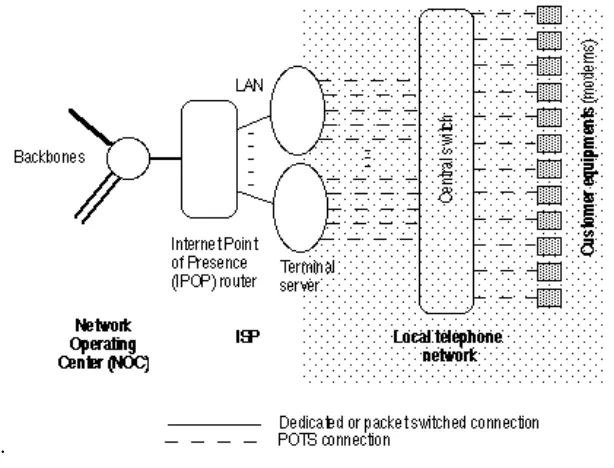
The typical dial-up connection of a personal computer to the Internet is shown in
Figure 3.2. There is also a variety of academic communications or commercial
.
Figure 3.2 Structure of Internet.
service providers who have direct connections to the Internet and allow people to use
these connections.
World Wide Web
Though most people think of World Wide Web (WWW) is synonymous with the
Internet, the WWW really is a subset of the Internet system. While the Internet is the
world´s largest, most powerful computer network connecting personal computers,
sophisticated mainframes and high speed supercomputers around the globe, the
WWW is an Internet service that links all the sites through hypertext documents and
provides users with a uniform and convenient means of accessing the vast resources
of the Internet. Some popular software tools, that are now referred to as “web
browsers”, such as Mosaic, Netscape and Internet Explore (IE), permit text, graphics,
sound and video to be hyperlinked to other pages in other sites, thus facilitate
navigation and use of the WWW.
The Hypertext Markup Language (HTML) used by the WWW solves the
incompatibility problems among different computer architectures. Anybody with a
web browser can easily access all kinds of “home pages” to get information on what
they need. Some extensions of HTML, such as Java, Virtual Reality Modeling
Language (VRML), Acrobat and Shockwave plug-in for Netscape, enhance the
WWW more advanced functions with 3-dimensional (3D) manipulation, animation
of hypertext and so forth. If applied in distance education, the WWW provides
exciting new opportunities to distance educators.
Virtual Reality
As an advanced computer technology, virtual reality (VR) attracts increasing
amounts of attention of distance educationalists because it enables non-verbal
communication like touching, shaking hands and moving. VR is defined by Chou et
al. (2001) as a “technology-based artificial world filled with
experience a mediated sense of presence”. VR is a collection of advanced computer
technology components and equipment, including high-speed computers,
head-mounted displays (HMD), and motion-sensing data gloves. Through the dynamic
display of computer-generated graphics, users can interact with virtual objects and
information in the virtual 3D environment.
When used for educational purposes, virtual-reality environments fall into three
categories according to Johnson’s (1998) proposal: networked text-based virtual
environments, desktop virtual reality, and immersible virtual environment.
Networked text-based virtual environments are well known as Multi-User Dungeons
(MUDs) and MUD Object Oriented (MOOs), with support to real-time interactive
use among distributed users. Desktop virtual reality provides 3D multimedia
simulations, which enable users to share the same virtual world through computer
networks. Immersible virtual environments can provide the greatest degree of
immersion through employing high-end laboratory equipment, such as workstation
computers, head-mounted display, and data gloves (Chou et al. 2001). However, the
high cost to implement VR limits its application.
Streaming Video
This term is specially used for “movies that have been compressed and transmitted in
the form of real time video via the Internet” (Roblyer & Edwards, 2000, P.212). An
online video player software, Real Video, can help people to see streamed video.
Normally the streamed video starts to play almost immediately after the download of
the video beginning. However the quality of playing could not always be guaranteed
because of heavy reliance on the speed and quality of the connecting line of the
computer to the Internet.
Transmission Media
Transmission media takes decisive functions for the quality and speed of
forms: telephone lines, Integrated Services Digital Network (ISDN), coaxial cable,
fibre optics, microwave links, VSAT (Very Small Aperture Terminal) links and
Broadband ISDN.
• Telephone Lines-Twisted Pair (copper)
Today’s telecommunication networks are still using twisted pair cables and coaxial
cables, although high bandwidth is in high demand.
Twisted pairs are pairs of insulated copper wires, often used to transfer signals
between modems on microcomputers. Although the frequency transmitted is
normally less than 4 Khz in analogue model of telephone networks, for purely digital
communications the transmitting frequency is up to 1.54 Mbps over short distances
(Muirhead, 2001). The drawback of using twisted pair is the noise caused by
electrical interference, which decreases the quality of digital transmissions.
• Coaxial Cable
The construction of a coaxial cable with inner and outer conductors separated by
insulated material, makes its transmitting capacity up to 50 Mbps for baseband
transmission and a few hundred Mbps for broadband transmission (Williams et al.,
1999, P. 44). Coaxial Cables have been used primarily on cable TV and certain types
of networks. They can transfer signals with minimal interference.
• ISDN: Integrated Services Digital Network
Integrated services digital network (ISDN) provides end-to-end digital connectivity
with integrating data, fax, voice, video, and data simultaneously over one line. It runs
over plain old telephone (POT) lines using existing twisted pairs, however, it can
provide clear channel capabilities and bring significantly more bandwidth to the
The transmission capability of ISDN is dependent upon different service interfaces
used today. Among three basic interfaces, 2B+D “S” Interface uses two twisted-wire
pairs to deliver two 64 Kbps B channels and one 16 Kbps data channel. 2B+D “T”
Interface is the same as 2B+D “S” Interface except only one twisted pair is used
here. The third interface is normally called primary rate interface (PRI) with 23B+D
or 30B+D, which operates on two twisted pairs. In the United States, 23B+D is used
as the standard T1 line with the delivery capability of 1.54 Mbps, while in Europe
30B+D provides 2.05 Mbps as standard E1 line (Williams et al., 1999, P. 42).
With the advantage of running over existing telecommunications networks and not
requiring more expensive fibre optics, ISDN is the best interim technology to be used
for distance education until networks having broader bandwidth are fully deployed.
An alternative for broadband implementation is broadband integrated services digital
network (BISDN), which provides services at a rate over 2 megabytes per second
with a single optical fibre (Williams et al., 1999, P. 48). The biggest advantage of
BISDN is provision of bandwidth on demand, thus it has wide applications such as
transfer of broadband video, speed unrestricted digital information and
high-speed, high-resolution facsimile and so on.
• Cable Modem
A cable modem is a device that allows high-speed connection to the Internet via a
cable TV network. A cable modem fulfils the functions of a modem, router, bridge
and Ethernet hub. Connection to the Internet using coaxial cable services is
promising, because a much faster connection speed is possible. With a modified
cable system, the download speed ranges from 3 to 10 Mbps, and upload speed is
128 Kbps-10 Mbps. The transmission speed can achieve 1.5 Mbps (Krungrt &
Gilroy, 2001). This is much more than most widely used connection speed via
Internet connection via a cable modem will have a promising potential if the Internet
has enough bandwidth to carry full-motion video to a screen size as a TV. This will
be a feasible way for distance education.
• Fibre Optics
Fibre optics is cables made of glass strands with plastic coating, plus plastic
covering. In spite of the high cost involved in installation of fibre system, fibre optics
are increasingly attractive to be used as a transmission medium in telecommunication
networks, especially suitable to meet the high demand of broad bandwidth.
Williams et al. (1999, P. 44) identified the following characteristics of fibre optics
that make it so popular:
Ø Very high bandwidth (more than 2.5Gbps) (Muirhead, 2001) and very low error rate (1bit in 1 trillion)(Williams et al., 1999, P. 44).
Ø Immune to electromagnetic and radio frequency interference.
Ø High security with very little radiation.
Ø Thin, light, easier to install than copper.
Ø Safe in hazardous environment.
Ø Wide networking applications.
• VSAT Links - Very Small Aperture Terminal
Very small aperture terminals (VSATs) are receive/transmit terminals installed at
dispersed locations connecting to remote data centres via satellite. VSAT networks
can provide two-way transmission of high-quality data, voice and video, with
acceptable cost compared with other high-quality transmission medias.
Though the bandwidth of VSATs is not so high with the receiving rate up to 512
Kbps, and transmitting rate at 63 Kbps (Williams et al., 1999, P. 48), VSATs have
wide applications in LANs, mainframes, asynchronous terminals and for transmitting
3.1.3Issues in application
The development of technology is always to meet the needs of humankind, it is by no
means an exception for educational technology. From postal mail to electronic
delivery, from text content to multi-media content, from one-way communication to
two-way communication, from low transfer speed to high transfer speed, educational
technology has continuously satisfied distance learning needs. Throughout the
development and application process of educational technology, there have always
been two key issues causing wide concern, namely information transmission speed
and cost.
Transmission speed of information is always the bottleneck problem of today’s
distance education, when it needs to achieve high quality transfer of audio, and
video, especially of real time video. Connection to the Internet via traditional
telephone line is incapable of transferring high quality videoconferences, virtual
reality and real time stream video.
Broadband technology is engaged to increase network transmission speed and
capacity with the alternative name of high-speed Internet access. Broadband is
“provided by a series of technologies that give users the ability to send and receive
data at volumes and speeds far greater than current Internet access over traditional
telephone lines” (Kruger & Gilroy, 2001), while the latter is often called
“narrowband”. Broadband high-speed Internet connection, not only offers high data
transmission rate, but also provides “always on” connection and a “two-way”
capability, which means high speed download and upload ability.
There are various transmission media or technologies to achieve broadband access.
Cable, fibre optics and BISDN are currently used examples. Among these
alternatives twisted pairs (cable) can provide 1.54 Mbps for pure data transmission
Mbps is based on today’s cable TV network, but sometimes is combined with fibre
optic, known as hybrid fibre coax (HFC).
Primary rate interface (PRI) of ISDN is separately used in the U.S. and Europe with
the capacity of 1.54 Mbps and 2.05 Mbps, but the cost is relatively high. BISDN with
fibre optics can provide high quality services at a rate of 2 Mbps, mainly deployed in
the U.S. Fibre optics is the best choice of broad bandwidth provision, with 2.5 Gbps
transmission speed and a lot of other attractive advantages, but the high cost of
installation limits its wide application today.
Each technology has its respective advantages and disadvantages, and will compete
with each other based on performance, price, quality of service, even geographical
locations. To determine which technologies are to be used, distance education
program designers need to consider the following questions:
• What is the nature of material? Is it audio, video, data, picture or graphics?
• Who will be the intended audience of the program?
• What is the volume and frequency of exchange?
• Is the speed of transmission of the technology available?
• What will be the cost of transmission of the technology? How about the budget?
• Is the type of connectivity available?
The final choice of technologies will be a balance of the above factors, especially
based on the transmission speed availability and the cost.
3.2
The impact of technology changes on distance learning
Distance learning can always take advantages of technology development. Through
incorporating new technologies into education courses and learning environment,
distance learning has been reshaped by technology changes through the years. As
discussed in chapter2, the foundations for dividing the four generations of distance
technologies, distance education programs are offering a more interactive experience
that more closely parallels face-to-face teaching in effect creating a virtual
classroom. In this virtual environment of distance learning, the following aspects can
be identified in reflection of the impacts of technology changes on distance learning:
• Levels of interactivity
One of the most significant ways in which distance education has evolved is its shift
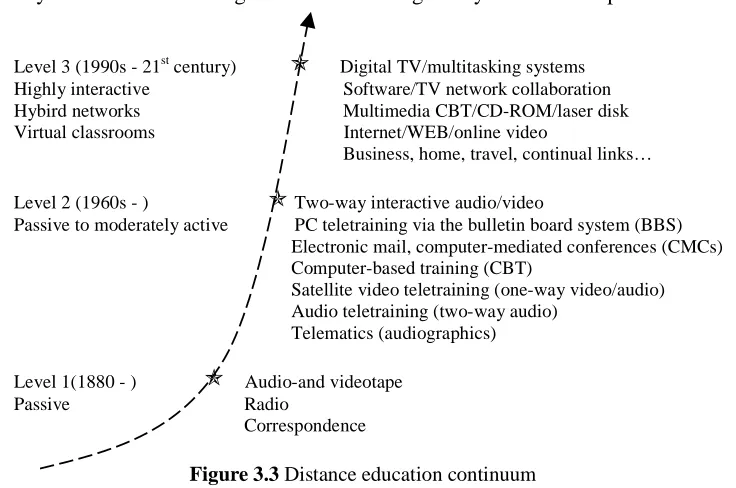
from one-way technologies to interactive technologies. As indicated in Figure 3.3,
the development of two-way interactive video delivery environments is highlighted,
the way that distance learning has evolved through the years is also represented .
Level 3 (1990s - 21st century)
ó
Digital TV/multitasking systemsHighly interactive Software/TV network collaboration Hybird networks Multimedia CBT/CD-ROM/laser disk Virtual classrooms Internet/WEB/online video
Business, home, travel, continual links…
Level 2 (1960s - )
ó
Two-way interactive audio/videoPassive to moderately active PC teletraining via the bulletin board system (BBS)
Electronic mail, computer-mediated conferences (CMCs) Computer-based training (CBT)
Satellite video teletraining (one-way video/audio) Audio teletraining (two-way audio)
Telematics (audiographics)
Level 1(1880 - )
ó
Audio-and videotape Passive RadioCorrespondence
Figure 3.3 Distance education continuum
(Source: Williams et al., 1999, P. 4)
Level 1 indicates typical asynchronous distance learning and shows one-way
communication between the learner and the instructor. The learner could not interact
with the instructor in real time and transmission of messages between them normally
has a lengthy delay, so distance learning at this level is considered as passive
Level 2 mainly consists of synchronous means of communication. For audio
teletraining, computer-mediated conferencing, bulletin board system, and other
distance learning environments listed in this level, messages can be transmitted
simultaneously between sender and receiver, and can get immediate feedback and
interaction among distance sites. Two-way interactive communications are achieved
at this level and level 2 is considered as passive to moderately active distance
learning.
Level 3 is a hybrid learning environment which combines all the previously
described synchronous and asynchronous distance learning methods, that can be used
in one virtual classroom with powerful supplement of the Internet and the WWW.
The learner can benefit from both asynchronous tools, such as e-mail, threaded
discussion and self-paced testing, and synchronous elements such as chat rooms and
online streaming video and/or audio. All the means can be used flexibly, and high
interactivity can be achieved at this level.
• More student-centred learning
Putting focus on students is a central pre-condition of good education at a distance,
many distance educators tried to enhance this but they were limited by the
technologies available to them. The traditional model for distance education, only
one-way transmission of instruction from teacher to student, could not get in-time
feedback from students. Students were “less of a voice” and passive.
The advent of digital technologies enables more teacher-to-student and
student-to-student interaction, which lead distance learning to a higher level of interactivity.
This makes student-centred learning possible. Through two-way, synchronous or
asynchronous interaction with the teacher, the student can play a more active role in
distance learning. Prompt feedback and immediate communication will help to build
student-needed course materials, while high interactivity can let students get more
needs, and communications with other students will be helpful for co-learning. All of
these form the base of student-centred learning.
Asynchronous technologies particularly promote self-paced learning and make
distance learning more individualized. In the early stages of distance learning,
through radio broadcasting or television broadcasting, students were constrained
from studying at their own pace and at their own time. While today’s technologies,
among which both synchronous and asynchronous means can be combined together
as needed, students can choose any of them for study and communication. Thus
self-paced, self-determined study is becoming the main feature of current distance
learning.
• Information delivery
Course contents are enriched. Course material contents of distance education have
been enriched dramatically along with the growing capacity and ability of delivery
technology. The emergence of radio and TV added audio and video materials to the
text-based course contents. The adventure of computers enriched the types of
delivery materials to a multi-media level, which consisted of computer based audio,
video, and animations. While the Internet and the WWW not only permit course
designers to add 3D images and animations, they also make the transfer of interactive
videoconferencing, streaming video and virtual reality possible.
Delivery speed is faster. To deliver one book of 850 pages for instance may need one
week by postal mail, but through the Internet with a high-speed cable modem it can
be finished in 2 seconds. And with broadband technology, 5 million such kinds of
books can be transferred in less than 1 minute through fibre optics (Muirhead, 2001)!
Information quantity is enlarged. Interactive videoconferences, online real time video
and other volume, compressed contents can only be transferred with
Accessible resources are increasing. Reference materials were very limited in the
past, but are amazing today in the Internet. As long as the copyright is permitted, one
can almost get all kinds of materials needed for study.
• Relationship development
Technology development has improved relationships of students with teachers, and
students with students in distance learning.
Distance learning has the nature of geographical or time separation between the
student and the teacher or other students. Nobody knows each other among them. In
early correspondence learning, the one-way communication between the teacher and
the student was far from enough to establish a good relationship and to reduce the
psychologic distance between them, not to mention the relationship between distance
learning students.
The Internet and the WWW is a powerful tool for improving the situation and
enhancing the relationship among teachers and students. Multi-means
communication, high interactivity during study, especially interactive
videoconferencing, where teachers and students can see, can hear from and can talk
with each other, makes study seem to occur in a real classroom. Thus psychologic
distance among them is shorted and even disappears.
Group collaboration for study can be managed through the Internet. Students can
learn together online, through discussion and analysis, a virtual study community is
built to shorten the distance. Therefore students can still develop a good relationship
3.3
Learning in a virtual environment
The core of distance education is to provide a virtual learning environment, which
includes a delivery mechanism, student tracking, assessment and access to resources.
This section will discuss how distance learning is organized and conducted in this
virtual environment, what kind of roles teachers and students take and how to assess
students. With the consideration almost all the distance learning being conducted
through the Internet and the WWW today, the discussions will be based on online
distance learning.
• What is a virtual learning environment?
There is no simple definition of what constitutes a virtual learning environment.
Generally speaking when used in learning at a distance, it may consist of “any
attempt to create a unified environment for learning” (Milligan, 1999), which aims to
mirror a face-to-face learning environment. This environment cannot only present
structured information, but also provides the communication medium for the
necessary interaction. Within it the students will be able to establish some form of
human relationship with the teacher.
A virtual learning environment should have a core set of features, as proposed by
Milligan (1999), which can be listed as the following:
Ø Delivery and management of course materials
Ø Access control: usually password based
Ø Administration: student tracking, collation of marks, record of progress
Ø Time-tabling facilities: some explicit means of pacing materials
Ø Assessment: usually formative (e.g. for self assessment)
Ø Communication: on various levels, one to one, one to many, synchronous and asynchronous
Ø Personal space for participant to exchange and store materials
Ø Support facilities: for instance, online help about the environment, and
Ø Maintenance tools for creating and updating the learning materials.
Besides these elements, the course delivery mode (fully online or part online), the
level of tutor support, ways of the class being structured, length of the course and
cost are vital external factors, which will greatly influence the format of a virtual
learning environment.
Currently increasing attention is put on a student centred model of virtual learning
environment. This model adopts a student centred approach, which provides a set of
tools to help the student to construct an environment for effective learning, and also
adopts constructive and collaborative methods in the learning process (Pulkkinen &
Niemi, 1997), which can foster the development of critical thinking, clarification of
ideas, and evaluation of others’ ideas.
• Learning course design
To design and organize distance education courses in a virtual environment, an
important challenge is how to build the relation between the contents and the method
of study. Since the constructive and collaborative learning method can help the
student to study effectively, guiding principles of designing distance education
courses should be focused on student centred instruction and learning needs
assessment, nurturing reflexivity and awareness of one’s own thinking and learning
process, and providing the mechanism for encouraging interaction and social
negotiation.
To make the student the centre of the learning environment, it is necessary to
construct a set of tasks, link resources, submissions, communications routes of each
individual student. Through assessment of their own learning needs, the students are
allowed to construct their own knowledge of teaching and learning. Course designers