NEURONAL ENCODING OF HABIT-LIKE ALCOHOL SELF-ADMINISTRATION IN THE RAT DORSAL STRIATUM
Rebecca Richer Fanelli
A dissertation submitted to the faculty at the University of North Carolina at Chapel Hill in partial fulfillment of the requirements for the degree of Doctor of Philosophy in the
Neurobiology Curriculum in the School of Medicine.
Chapel Hill 2014
Approved by: Donita L. Robinson Clyde W. Hodge Rita Fuchs
ii © 2014
iii ABSTRACT
Rebecca R. Fanelli: Neuronal Encoding of Habit-like Alcohol Self-administration in the Rat Dorsal Striatum
(Under the direction of Donita L. Robinson)
Alcoholism is characterized by persistent drinking that may involve a shift from goal-directed to habitual drinking as behavior becomes engrained and resistant to treatment. Recent evidence suggested these behaviors have distinct anatomical substrates, with the dorsomedial striatum (DMS) implicated in goal-directed behavior, while the dorsolateral striatum (DLS) was required for habit formation. It was unknown, however, whether these regions are differentially activated during habitual alcohol reinforcement and what role specific neurotransmitter systems in the DLS might play in habitual alcohol drinking. The studies described here investigated how DMS and DLS neurons encode cues, actions, and reward deliveries during operant
self-administration via extracellular recordings from chronically implanted electrodes. Our central hypothesis was that the expression of habitual behavior depends on parallel circuits acting in
competition, with sensorimotor processing in the DLS exhibiting greater activation and
behavioral control during habit-like alcohol self-administration. First, we characterized dorsal
iv
neuronal firing patterns were compared in rats self-administering sweetened alcohol versus sweet solutions alone. Alcohol was found to promote DMS activation, while the most habitual rats in the same model showed less DLS outcome activation. Unilateral dopamine receptor antagonism proximal to recording electrodes reduced overall baseline firing rates in the DLS, while bilateral DLS antagonism reduced habit-like reward seeking and phasic DMS neuronal activation during action selection. In sum, these studies suggest that DMS and DLS cooperatively promote reward seeking, and habitual behavior requires DLS dopaminergic activation but not a reduction in DMS activation. These innovative and mechanistic studies significantly advance our understanding of the neural substrates of habitual alcohol seeking and drinking behavior, and elucidate the
v
ACKNOWLEDGEMENTS
There are many people who contributed their time and effort to make this dissertation possible. My advisor, Donita Robinson, Ph.D., has been instrumental in every step of my
graduate education. Donita has provided guidance and encouragement with all the skills I needed to be a successful researcher, from experimental techniques to scientific communication skills. I am extremely thankful to Donita for enabling me to become a scientist. For the studies described here, Donita has guided study design, reviewed data analysis, and provided critical edits.
Experiments described in Chapter 2 began before I joined the laboratory, and were designed by Dr. Robinson and initiated by technicians Dawnya Bohager and Rebecca Reese. Jeffrey Klein, Ph.D., assisted with data analysis on this aim, and provided critical revision on the manuscript. All aims were conducted with the assistance of undergraduate students, including Ian Everitt, Hung-Yu (Hank) Chen, Victoria Burton, Lisa Bowen, Emory Wolf, and Ryan Leite. James Dunville completed an honors dissertation on a project related to Chapter 4, and
conducted some initial data analyses. I am extremely grateful to the assistance and engagement of these individuals.
I thank my dissertation committee, Clyde Hodge, Ph.D., Charlotte Boettiger, Ph.D., Rita Fuchs-Lokensgard, Ph.D., and Cort Pedersen, M.D. This committee has provided critical
vi
Research would not be possible without funding. This research was funded by NIH (R01AA018008 to D.L.R.; T32NS007431 and F31AA022563 to R.R.F., T32AA007573 to J.T.K. and R.R.F.), UNC Royster Society Paul Hardin Dissertation Fellowship, ABMRF/The Foundation for Alcohol Research, and UNC Bowles Center for Alcohol Studies. R.R.F. is a Howard Hughes Medical Institute (HHMI) Med into Grad Scholar supported in part by a grant to the University of North Carolina from HHMI through the Med into Grad Initiative.
Thank you to my parents for supporting me, despite my decision to follow in their footsteps. You taught me to love science, and importantly to find a way to enjoy my work and my life, even the non-science parts. I thank my brother for being there and challenging me; we are awesome. I love you all, thank you for making me think I could do it. Thank you to all my
vii PREFACE
Chapter 2 was previously published as:
Fanelli, R.R., Klein, J.T., Reese, R.M. & Robinson, D.L. 2013, "Dorsomedial and dorsolateral striatum exhibit distinct phasic neuronal activity during alcohol self-administration in rats", The European Journal of Neuroscience, vol. 38, no. 4, pp. 2637-2648.
Permission to include in its entirety was retained from John Wiley and Sons, Inc., license number 3503120943421.
Chapter 3 has been accepted for publication in Brain and Behavior. Publications in this journal are made available under the terms of the Creative Commons Attribution License, no
viii
TABLE OF CONTENTS
LIST OF FIGURES ... x
LIST OF TABLES ... xii
LIST OF ABBREVIATIONS ... xiii
CHAPTER 1: GENERAL INTRODUCTION ... 1
CHAPTER 2: DORSOMEDIAL AND DORSOLATERAL STRIATUM EXHIBIT DISTINCT PHASIC NEURONAL ACTIVITY DURING ALCOHOL SELF-ADMINISTRATION IN RATS ... 34
Introduction ... 34
Methods ... 36
Results ... 42
Discussion ... 60
CHAPTER 3: DOPAMINE D1 RECEPTOR BLOCKADE IMPAIRS ALCOHOL SEEKING WITHOUT REDUCING DORSAL STRIATAL ACTIVATION TO CUES OF ALCOHOL AVAILABILITY ... 71
Introduction ... 71
Methods ... 73
Results ... 77
Discussion ... 84
CHAPTER 4: DOPAMINE RECEPTOR ANTAGONISM REDUCES HABITUAL ALCOHOL SEEKING AND DORSAL STRIATAL NEURONAL ACTIVATION SPECIFIC TO ALCOHOL ... 99
ix
Methods ... 101
Results ... 108
Discussion ... 119
CHAPTER 5: GENERAL DISCUSSION ... 129
APPENDIX 2.1: NEURONAL ACTIVITY CHANGES ACROSS SESSIONS ... 148
APPENDIX 3.1: BREAKDOWN BY CUE TYPE AND TRAINING SCHEDULE ... 150
APPENDIX 4.1: SUPPLEMENTAL MATERIALS FOR CHAPTER 4 ... 153
Supplemental Methods ... 153
x
LIST OF FIGURES
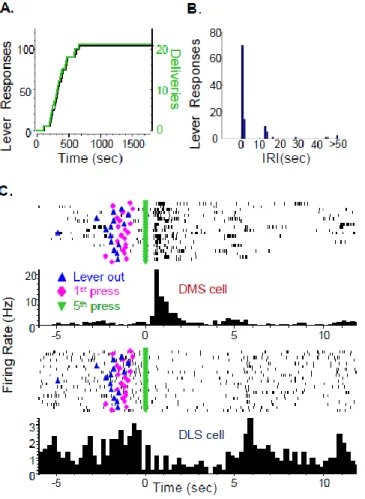
Figure 1.1: Major projections to and from the dorsal striatum. ... 12 Figure 2.1: Placement of recording electrodes in the dorsal striatum... 43 Figure 2.2: FR5-reinforcement schedule: alcohol self-administration
behavior and neuronal firing patterns from a representative rat. ... 44 Figure 2.3: Neuronal population activity in the dorsal striatum of FR5-
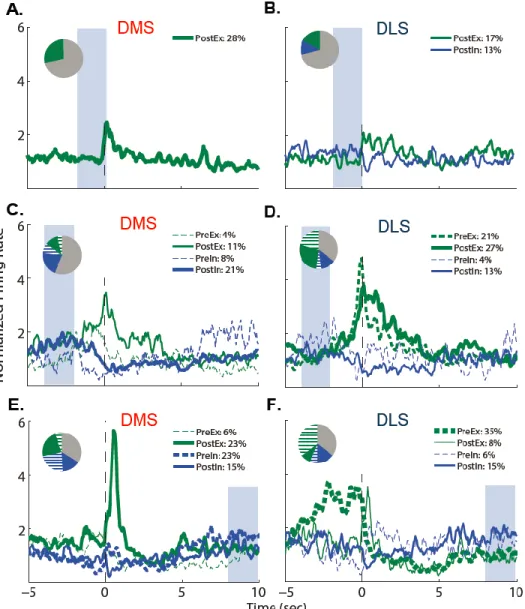
trained rats at start-of-session cues and lever responses.. ... 46 Figure 2.4: Distribution of specific firing patterns of dorsal striatal neurons
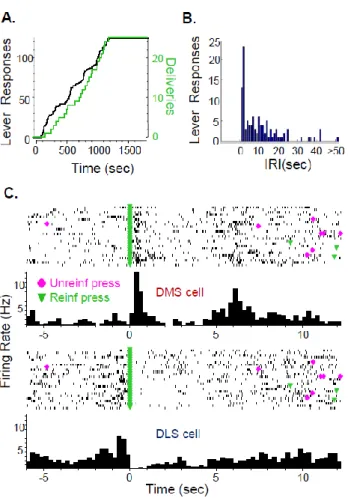
of FR5-trained rats around repeated operant events. ... 50 Figure 2.5: VI30-reinforcement schedule: alcohol self-administration
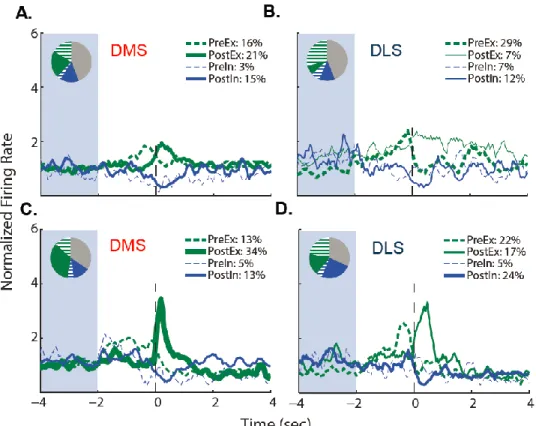
behavior and neuronal firing patterns from a representative rat. ... 53 Figure 2.6: Neuronal population activity in the dorsal striatum of VI30-
trained rats at start-of-session cues and lever responses.. ... 55 Figure 2.7: Distribution of specific firing patterns of dorsal striatal neurons
of VI30-trained rats around repeated operant events. ... 57 Figure 3.1: Neuronal firing rates (Hz) in the DMS and DLS aligned to
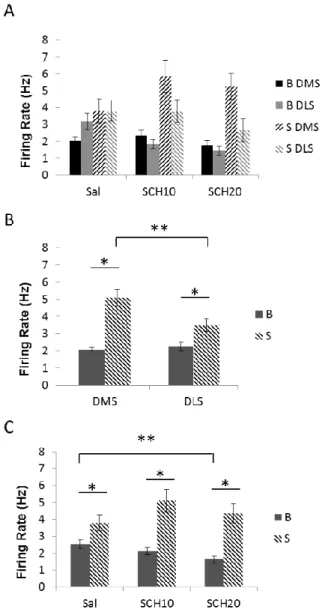
start-of-session cues and averaged across the two cues, by SCH dose ... 79 Figure 3.2: Mean neuronal firing rates during the 60s prior to cue onset and
the mean signal in the 0.5s after the two cue onsets for the DMS and DLS
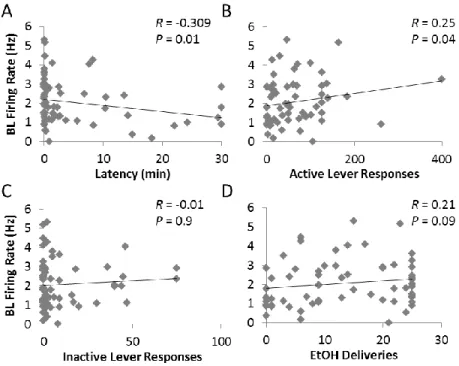
after SCH. ... 80 Figure 3.3: Baseline firing rates (averaged per rat) significantly correlated
with latency to the first lever press and the number of active lever responses
during the alcohol self-administration sessions. ... 84 Figure 4.1: Lever responses (±SEM) under extinction conditions following
1hr free access to either the reinforcer (Reinf) or maltodextrin (Malto). ... 108 Figure 4.2: Final electrode placements in Sac and Sac/E rats in the DMS
and DLS ... 109 Figure 4.3: DMS and DLS electrophysiological activity in rats self-
administering Sac or Sac/E around unreinforced or reinforced press responses. ... 110 Figure 4.4: The same electrophysiology data from Figure 4.2 are shown
xi
Figure 4.5: Effect of unilateral infusion of FLU into the DLS on
electrophysiological recordings ... 117 Figure 4.6: Effect of contingency degradation and FLU on lever responses... 117 Figure 4.7: Neuronal activity around reinforced lever press responses during
the VI30 period of sessions following extinction testing, organized by
reinforcer solution ... 119 Figure 5.1: Parallel processing of goal-directed and habitual behavior in the
dorsal striatum. DMS and DLS are both activated during alcohol drinking
behavior... 139 Supplemental figure 2.1: Neuronal firing activity in the dorsal striatum of
FR5-trained rats (Experiment 1) aligned to cues and lever responses early
versus late in the session. ... 148 Supplemental figure 2.2: Neuronal firing activity in the dorsal striatum of
VI30-trained rats (Experiment 2) aligned to lever responses early versus late
in the session.. ... 149 Supplemental figure 4.1: Mean normalized firing rates of anterior and
posterior DMS neurons around reinforced press responses. ...156 Supplemental figure 4.2: Lever presses and neuronal activity during the VI30
xii
LIST OF TABLES
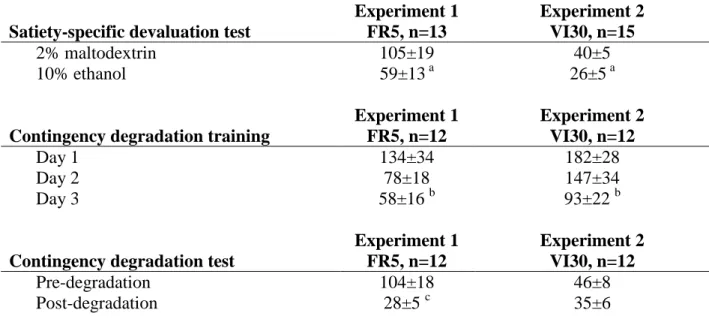
Table 2.1. Behavioral characterization of sensitivity to changes in reward value or action-outcome contingency in rats trained to self-administer 10%
ethanol on FR5- or VI30-reinforcement schedules.. ... 59 Table 3.1: Percent of individual neurons with significantly altered firing
ratesafter cue presentations.. ... 82 Table 3.2: Behavioral measures from alcohol self-administration sessions
after systemic SCH23390.. ... 82 Table 4.1. Timeline for self-administration training and all experimental
stages. ... 102 Supplemental table 3.1: Comparison of neuronal activation to the two
start-of-session cue types. ...150 Supplemental table 3.2: Comparison of the effect of SCH on neuronal
firing rates in rats trained on FR5 and VI30 schedules. ...151 Supplemental table 3.3: Effect of SCH on alcohol-seeking behavior in rats
trained to self-administer alcohol on FR5 and VI30 schedules. ...152 Supplemental table 4.1: Self-administration training schedule with
xiii
LIST OF ABBREVIATIONS
ACC Anterior cingulate cortex
AUD Alcohol use disorder
BEC Blood ethanol concentration
BLA Basolateral amygdala
DA Dopamine
DLS Dorsolateral striatum
DMS Dorsomedial striatum
DSM Diagnostic and statistical manual of mental disorders
FLU α-flupenthixol
FR5 Fixed-ratio 5
GPe Globus pallidus externa
GPi Globus pallidus interna
IRI Inter-response interval
MSN Medium spiny neuron
MWU Mann-whitney U test
NAc Nucleus accumbens
NP Non-phasic
OFC Orbitofrontal cortex
PostEx Post-excitatory
PostIn Post-inhibitory
PreEx Pre-excitatory;
xiv
Sac 0.2% saccharin in water
Sac/E 0.2% saccharin + 15% ethanol in water
SCH SCH23390
SMC somatomotor cortex
SNc Substantia nigra pars compacta
SNr Substantia nigra pars reticulata
STN Subthalamic nucleus
VI30 Variable-interval 30s
1
CHAPTER 1: GENERAL INTRODUCTION
Background on alcohol use disorders
Over 17.6 million Americans suffer from alcoholism or alcohol abuse (Grant et al. 2004). Alcohol use disorders (AUDs) disrupt performance of responsibilities at home or work, and can lead to social and legal problems (Hasin et al. 2007, NIAAA). In fact, these disorders are diagnosed when an individual’s drinking results in distress or harm (NIAAA, American
Psychiatric Association 2000). Additionally, alcoholism not only affects the individual and those who depend on him, but also society as a whole, as the economic cost of excessive drinking is estimated at $233.5 billion (Bouchery et al. 2011). AUDs result in loss of workplace productivity (72% of cost) and significant health care expenses (11%), and it also increases law enforcement expenses (9%) and costs from motor vehicle accidents (6%; CDC 2014). Most distressing, excessive alcohol consumption is known to kill about 88,000 people per year (CDC 2014). Clearly, AUD is a significant public health and economic issue, and our research aims to better understand this disorder with the eventual goal of improving treatment and reducing this harm. Alcoholism was recognized as a disease by the American Medical Association in 1956. The 5th edition of their Diagnostic and Statistical Manual of Mental Disorders (DSM V) has combined symptoms previously described as alcoholism and alcohol abuse, categorizing them as AUDs, which are described as mild, moderate, or severe (American Psychiatric Association 2013). Thus, AUDs are defined by symptoms previously associated with alcoholism: craving or urges to drink, inability to stop drinking, alcohol dependence, and tolerance (American
2
dependence, and while the DSM IV categorized the presentation of symptoms without alcohol dependence as alcohol abuse, this presentation would also be diagnosed as an AUD under DSM V. Significant progress is needed in both recognition and treatment of AUDs, with only a third of sufferers receiving any treatment, and 10% receiving medication, despite surmounting evidence that it is effective (Jonas et al. 2014). Still, only 3 medications are currently approved for the treatment of AUDs, and these treatments have modest effect sizes in clinical trials (Zindel, Kranzler 2014).
Understanding AUD as a neurobiological disorder
In order to uncover novel treatment strategies, we need to understand the etiology of AUDs and other additions. In the field of neurobiology, addiction is broadly conceptualized as a disease of maladaptive learning, in which neural mechanisms of synaptic potentiation are “hijacked” by drugs of abuse (Hyman, Malenka & Nestler 2006, Everitt, Robbins 2005). Substance abuse disorders become chronic, persistent diseases, characterized by cycles of drug taking, abstinence, and relapse. With repetition, a drug-taking behavior becomes habitual or inflexible, contributing to the difficulty of breaking the cycle (Everitt, Robbins 2005, Tiffany 1990, Hilario, Costa 2008). Of those treated for alcoholism, success rates are low, and 80-90% will relapse, even years later (Schuckit 2009).
3
demonstrated when presentation of alcohol cues produced neural activity that correlated with addiction severity (Filbey et al. 2008, Sjoerds et al. 2014). Furthermore, while additional research is necessary to demonstrate a link between reductions in cue reactivity and treatment success, craving does predict relapse (i.e. Litt, Cooney & Morse 2000).
Instead of actions driven by outcomes, as in flexible, goal-directed behavior, actions driven by stimulus-response associations are inflexible, and resistant to changes in outcome (Belin et al. 2009, Devan, Hong & McDonald 2011). Behavior that is insensitive to change in reward value is defined as habitual behavior (Dickinson 1985, Belin et al. 2009, Devan, Hong & McDonald 2011). Habitual behavior therefore constitutes a key component of alcoholism. When an alcoholic drinks despite negative consequences on his health or responsibilities, this habitual behavior would contribute to a diagnosis of alcoholism (NIAAA , American Psychiatric
Association 2000). Some current treatments produce illness upon drinking or blunt alcohol’s euphoric effects, but these may be less effective for habitual drinkers (Hay et al. 2013), who drink after arriving in a certain location, or after seeing a preferred beverage, rather than drinking motivated by a desire for alcohol (Tiffany 1990). Therefore, alcoholism is a harmful disease that can become habitual, driven by cues and stimulus-response associations, and resistant to
treatment. In this dissertation, I aim to unravel basic mechanisms of alcoholism, characterizing how alcohol drinking becomes habitual, and investigating methods to reverse these processes.
Animal models of addiction
Animal models are critical for the study of alcoholism, permitting the use of invasive techniques and novel treatments that would not be safe for human subjects. However, as
4
environment for the study of specific exposures. For example, some models employ
experimenter-controlled administration of specific amounts of alcohol (through injection, vapor, intragastrically, etc.) in adulthood or in other developmental stages (see reviews: Knapp, Breese 2012, Maurel et al. 2013, O'Leary-Moore et al. 2011, Hellemans et al. 2010, Spear,
Swartzwelder 2014). Others allow access to alcohol in the home cage, as in the two-bottle choice procedure (Richter, Campbell 1940), where the animal has access to a bottle of diluted alcohol and another of water, which have been applied to examining animals with genetic or
environmental exposure producing susceptibility for altered alcohol drinking (Crabbe et al. 1992, Bell et al. 2014). Models of instrumental behavior, where the animal performs an action to receive an alcohol reward, can be used to investigate motivation to drink (reviewed in Meisch 1982, Green, Grahame 2008). In the studies described in this dissertation, we model alcohol self-administration in rats. Rats were chosen due to their combination of sufficient cognitive abilities and larger brain size compared to mice (facilitating the use of multielectrode arrays), as well as the existence of a significant amount of prior research on rat instrumental behavior and
neurobiology.
Operant conditioning was first described as distinct from Pavlovian conditioning by Jerzy Konorsky and Stefan Miller in 1928 (Zielinski 2006). It was Thorndike who then formalized the “law of effect”, which theorized that behaviors followed by satisfying consequences are more likely to be repeated, generating the first known learning curves (Thorndike 1911). After Skinner introduced empirical examination of operant behavior with the invention of the operant
conditioning chamber (Skinner 1938), animals were trained to self-administer alcohol to assess its reinforcing properties (Meisch 1982, Myers, Tytell 1972). The basis for alcohol
5
nervous system, but also to taste preference (or aversion), or the caloric value of alcohol (Green, Grahame 2008, Cunningham, Fidler & Hill 2000). Nevertheless, two avenues of research have clarified this issue, which are discussed here. First, additional models were employed to confirm the hedonic and reinforcing properties of alcohol (Meisch 1982, Corbit, Janak 2007), and second, the role of other factors was eliminated by direct infusion of alcohol into the brain (Gatto et al. 1994) and devaluation studies (Samson et al. 2004).
The hedonic and motivating properties of alcohol have been demonstrated using Pavlovian techniques such as conditioned place preference and conditioned taste aversion demonstrating “liking” of alcohol (Cunningham, Fidler & Hill 2000, Camarini et al. 2010). Pavlovian-instrumental transfer experiments further demonstrated incentive salience properties of alcohol, as when alcohol rewards were repeatedly paired with a cue, that cue could invigorate instrumental lever-pressing for an alcohol reward (Corbit, Janak 2007). Progressive ratio
schedules, in which increasing work (i.e. number of lever presses) is required for the alcohol reward, provide another useful tool, demonstrating that rats are motivated to acquire alcohol (Meisch, Thompson 1973).
6
initial self-administration, which fell off once doses resulting in postingestive pharmacologic effects were achieved, demonstrating devaluation of alcohol self-administration through manipulation of interceptive effects (Samson et al. 2004). Therefore, maintenance of self-administration is dependent on its interoceptive effects, although initial responding for alcohol may be driven by taste factors.
While oral alcohol self-administration has long been employed to study reinforcement in rodents and monkeys (Meisch 1982, Green, Grahame 2008, McBride, Li 1998), the taste of alcohol can be aversive over 6% wt/vol, and so techniques such as food deprivation have been employed to increase drinking volumes (Meisch, Thompson 1973, Meisch, Henningfield 1977). This strategy confounds interpretation of self-administration, which could be motivated by a desire to obtain calories (Altshuler 1981, Dole, Ho & Gentry 1985). Another approach to encourage alcohol drinking is to employ sucrose substitution, e.g., reducing sucrose and
increasing ethanol concentrations in the reinforcer solution over time, without prolonged food or water deprivation (Samson 1986, Shillinglaw, Everitt & Robinson 2014). While doses achieved with self-administration (without prior alcohol experience as in vapor exposure, Gilpin et al. 2009) are typically insufficient to produce dependence even with sucrose fading, dependence is not necessary for a diagnosis of AUD, and furthermore, physical dependence is not always adequate on its own to produce sustained drinking (Freund 1969). Therefore, we utilize sucrose fading or saccharin-sweetened alcohol administration to study the effects of alcohol self-administration in the absence of dependence.
Defining habitual behavior
7
Mangieri, Cofresi & Gonzales 2012). Habitual behavior can develop with extended training, and it can be produced more quickly with variation in the contingency between the lever-press response and the reward (Dickinson, Nicholas & Adams 1983, Derusso et al. 2010). This was demonstrated when Dickinson and colleagues developed a habit model wherein rats received rewards on a variable-interval schedule, producing a non-linear relationship between the number of lever press responses and reinforcements, such that more frequent or vigorous responding would not directly impact the rate of reinforcement (Dickinson 1985, Dickinson, Nicholas & Adams 1983). Variable interval schedules therefore result in slower, more persistent behavior, with less predictable outcomes reinforcing stimulus-response over response-outcome behavioral strategies. Dickinson and colleagues defined habitual behavior as being resistant to devaluation, when the reinforcer was paired with lithium chloride. Lithium chloride causes the rats to feel ill, and will result in a taste aversion in rats with limited experience with the reinforcer, as
previously described in the study by Samson and colleagues (2004). Behavior is tested in a subsequent extinction test, where levers are available but rewards are not delivered so there is no additional learning about reward associations (Colwill, Rescorla 1990, Samson et al. 2004, Mangieri, Cofresi & Gonzales 2012). Rats who were trained on a variable-interval schedule and received lithium chloride paired with the reinforcer responded at similar levels to those who received unpaired treatments, whereas rats trained on a fixed-ratio schedule reduced responding after the lithium chloride pairing (Dickinson, Nicholas & Adams 1983).
8
et al. 2013, Fanelli et al. 2013), so multiple tests can be performed across training (Shillinglaw, Everitt & Robinson 2014, Corbit, Nie & Janak 2012). These procedures compare two sessions in counterbalanced order, one extinction session is preceded by an hour free access to the
reinforcer, while the other is preceded by an hour access to maltodextrin as a control for fullness. A significant reduction in responding in the session after access to the reinforcer is interpreted as satiety-specific devaluation, demonstrating goal-directed behavior, while a non-significant difference is interpreted as habitual behavior. In alcohol drinking studies, these satiety-specific devaluation tests may be confounded by the motor impairment subsequent to free access to alcoholic solutions, but this has not prevented habitual behavior from being observed (Corbit, Nie & Janak 2012, Fanelli et al. 2013)
Contingency degradation procedures have also been used to evaluate whether reward-seeking behavior responds flexibly to changes in the response-outcome contingency. After extended training establishing the association between a response and a reward, the animal experiences several sessions when the response is no longer paired with the reward, as rewards are delivered at random intervals (Yin et al. 2005, Shillinglaw, Everitt & Robinson 2014, Fanelli et al. 2013). Extinction sessions before and after the sessions of contingency degradation training are compared to establish whether responding was reduced, which indicates flexible
goal-directed behavior. If behavior does not differ between the pre- and post-degradation extinction sessions, behavior is defined as habitual (Yin, Knowlton 2006). While extending contingency degradation can eventually degrade a habit (Braun, Hauber 2012), demonstrating that it is not a permanent state, exposures that have been shown to promote inflexible behavior, such as
9
(Dickinson, Nicholas & Adams 1983). The advantages of contingency degradation are that it directly tests reversibility of stimulus-response associations critical for habitual behavior as would be necessary for treatment of alcoholism, and that extinction tests performed on separate days from training are not effected by intoxication. However, as contingency degradation affects stimulus-response associations, it may prevent future responding and subsequent tests may be confounded.
Does alcohol promote habitual behavior?
One theory of why alcohol addiction is so prevalent and persistent is that alcohol may promote habitual behavior, producing alcohol drinking that is resistant to change (Everitt,
Robbins 2005, Belin et al. 2009, O'Tousa, Grahame 2014). Nevertheless, the effect of alcohol on habitual behavior is somewhat unclear, as previous studies have used variable amounts of
alcohol exposure and different tests of habitual behavior. Dickinson and colleagues employed the lithium chloride devaluation test to demonstrate that alcohol may facilitate a transition to
habitual behavior more quickly than food rewards (Dickinson, Wood & Smith 2002). However, in this experiment rats consumed limited amounts of alcohol (less than 0.3mL 10% EtOH), which the authors acknowledge would not result in pharmacological effects of alcohol. Thus, habitual behavior observed here may represent a floor effect in responding on the alcohol lever, on which the rats did not frequently respond. Two other reports of alcohol’s effects on habit defined habit with LiCl devaluation, with different results. Samson and colleagues did not observe habitual drinking in their experiment (2004). However, their self-administration
10
tests, and though some responding was maintained in subsequent self-administration sessions, this behavior was only observed before alcohol consumption reached pharmacological levels (taste of alcohol had not been devalued, interoceptive effects had). Nevertheless, Mangieri et al. observed habitual behavior (resistant to LiCl pairing) after 8 sessions in rats pressing levers for access to 10% sucrose/10% ethanol from a sipper tube on a variable-interval schedule, and not in rats drinking sucrose alone or in rats trained on a variable-ratio schedule (Mangieri, Cofresi & Gonzales 2012). These animals drank 0.7-1.2g/kg alcohol and did not have access to alcohol in the home cage, demonstrating that alcohol may promote habitual behavior at sub-dependent doses.
While Corbit and colleagues (2012) used repeated satiety-specific devaluation tests and demonstrated loss of sensitivity to devaluation only in rats self-administering alcohol after 8 weeks , their rats drank alcohol in the home cage for 4 weeks prior to training (and after each self-administration session, around 0.4g/kg/session) and so this increased exposure could be responsible for habitual behavior, rather than alcohol administration per se. Indeed, rats self-administering sucrose that also had non-contingent access to alcohol in the home cage (30min access 4hrs after the session) developed more rapid habits for sucrose seeking (Corbit, Nie & Janak 2012). This suggests that long-term alcohol exposure, rather than self-administration experience with alcohol, may be necessary for promotion of habitual behavior.
11
2013). Our results using an interval schedule may differ from those of Mangieri et al. because LiCl devaluation may be less likely to detect habit-like behavior in controls, as it produces a novel aversive association rather than only reducing reward value with satiety. Additionally, 1.5% sucrose may be resistant to satiety (Shillinglaw, Everitt & Robinson 2014). Therefore, differences in drinking (our studies produced ~0.5g/kg alcohol intake) and different habit tests may explain differences in the potentiation of habitual behavior by alcohol.
Distinct neuronal circuitry for goal-directed versus habitual behavior
Not only are goal-directed and habitual behavior dissociable at the behavioral level, they can additionally be manipulated independently through interrogation of neural circuits. The dorsal striatum is known to be critical for action selection (Balleine, Delgado & Hikosaka 2007, Da Cunha, Gomez-A & Blaha 2012), and relatively recent studies have shown that lesion of the dorsomedial striatum (DMS, caudate in primates) can prevent flexible, goal-directed behavior (Yin et al. 2005, Corbit, Janak 2010), while lesion of the dorsolateral striatum (DLS, putamen in primates) prevents the formation of habitual behavior (Yin, Knowlton & Balleine 2004).
When rats were overtrained on an interval schedule such that sham operated rats
12
The dorsomedial striatum seems to show functional differences between its anterior and posterior regions, supporting the theory that learning broadens engagement of the dorsal striatum from anterior-medial regions into posterior-lateral regions (Miyachi et al. 1997, Corbit, Janak 2010). Repeated inactivation of anterior DMS during short, 3-day training, disrupted goal-directed behavior (Corbit, Janak 2010). However, pre-training excitotoxic lesions of this region did not prevent goal-directed reductions in responding in devaluation and degradation tests after 8 days of training (Yin et al. 2005). Notably, inactivation of anterior DMS following 2 weeks of training (pre-test) did inhibit goal-directed behavior (Corbit, Nie & Janak 2012). Thus, it seems that the anterior DMS is required for goal-directed behavior, unless lesioned prior to the
beginning of training, in which case the posterior DMS may compensate after extended training. Posterior DMS is also required for goal-directed behavior in tests of reward devaluation (Yin et al. 2005, Yin, Knowlton & Balleine 2005, Corbit, Janak 2010). Additionally, rats with posterior DMS inactivation during training also failed to acquire novel stimulus-outcome associations in a Pavlovian task, failing to respond less in the presence of a stimulus predicting a devalued
outcome, a result also seen after DLS inactivation and not anterior DMS inactivation or in controls (Corbit, Janak 2010). Corbit and her coauthors conclude that compared to the anterior DMS, posterior DMS mediates different aspects of reward-related learning, which are common to response-outcome and stimulus-outcome learning.
Anatomy of the dorsal striatum
The dorsal striatum functions as a component of cortico-basal ganglia circuitry, receiving input from the cortex and projecting to the basal ganglia, through the direct and indirect
13
The function of the dorsal striatum can be understood through a study of its inputs. While the DMS and DLS are not distinct in rodents, the dorsal striatum demonstrates a gradient in connectivity from anterior-medial to posterior-lateral. The more anterior and medial striatal regions receive predominant cortical input from the associative cortices including the anterior cingulate (ACC) and orbital frontal cortex (OFC; as well as the prelimbic cortex, and medial agranular area, not depicted in Figure 1.1), while the more posterior and lateral areas receive a
Figure 1.1: Major projections to and from the dorsal striatum. The DMS receives
dopaminergic inputs from the VTA (and much less from the SNc), glutamateric input from the BLA as well as from cortical inputs such as the ACC and OFC (among others). Meanwhile, the DLS receives dopaminergic input from the SNc, and cortical input from the SMC. The DMS and DLS send efferent projections through the direct (D1 receptor expressing) and indirect (D2 receptor expressing) pathway MSNs. The indirect pathway extends through the GPe, then the STN, before reaching the SNr, which finally projects to the thalamus. The direct pathway sends inputs through the GPi (or SNr, not shown), directly to the thalamus. The loops are completed as the thalamus has reciprocal connections to the cortex. The convergence between DMS and DLS pathways was unknown. (VTA, ventral tegmental area; SNc, c, substantia nigra pars compacta; BLA, baslolateral amygdala; ACC, anterior cingulate cortex; OFC, orbitofrontal cortex; SMC, somatomotor cortex, MSN, medium spiny neuron; GPe, e, globus pallidus
14
large input from the sensorimotor cortex (SMC; Alexander, Crutcher 1990, Balleine, Delgado & Hikosaka 2007). Thus, the DMS integrates information from cortical regions involved in reward value encoding and action selection, while the DLS receives information about cues and motor responses.
From the striatum, GABA-ergic medium spiny neurons (MSNs) expressing dopamine D1-receptors form the direct pathway. Projections from the striatum inhibit neurons in the internal globus pallidus (GPi) and the substantia nigra pars reticulata (SNr, projection not shown in Figure 1.1), which send inhibitory GABA-ergic inputs to the thalamus (Gerfen, Surmeier 2011). The direct pathway thus results in a net increase in thalamic output, in contrast to the indirect pathway, which reduces thalamic activation. MSNs that express the dopamine D2 receptor comprise the indirect pathway, which passes through the external globus pallidus (GPe) and subthalamic nucleus (STN), before projecting to the thalamus, which closes the loop by projecting back to the cortex (Alexander, Crutcher 1990, Gerfen 1988).
15
to the computations of the dorsal striatum through its inputs to the amygdala and nucleus accumbens (NAc; Arszovszki, Borhegyi & Klausberger 2014).
Electrophysiological evidence for functional heterogeneity in dorsal striatum
16
With inputs from sensorimotor cortex, phasic changes in DLS neuronal firing rates correlate with specific motor actions, such as lever presses (West et al. 1990, Carelli, West 1991). DLS neurons do not appear to be modulated by cues alone (Root et al. 2010), but larger modulation of motor encoding is observed when stimuli predicting reward are paired with a motor response, demonstrating the stimulus-response encoding that drives habitual behavior (Stalnaker et al. 2010, Kimchi et al. 2009). Furthermore, increased numbers of neurons are engaged in the DLS as a task is learned (Kimchi, Laubach 2009, Yin et al. 2009, Jin, Costa 2010, Thorn et al. 2010), and cocaine exposure reduces cue-related activation of ventral striatum and increases this cue modulation in the dorsolateral striatum (Takahashi et al. 2007). Thus, in agreement with the previously mentioned inactivation studies, the DMS encoding of outcome associations supports flexible, outcome-dependent behavior, and the DLS encoding of inflexible stimulus-response associations promotes habitual behavior. Overtraining may result in
consolidation and a conflicting reduction in the number of DLS-responsive neurons (Carelli, Wolske & West 1997, Tang et al. 2009), but this effect is associated with more efficient task performance rather than habit formation (Tang et al. 2009). This consolidation may not affect studies that use longer courses of treatment in which performance asymptotes, as in our protocols which require over 6 weeks of training. Nevertheless, to control for various exposure effects, including consolidation as well as pharmacological effects of alcohol, we will compare goal- and habit-directed models with equivalent training exposure by training rats on fixed-ratio and variable-interval schedules.
17
coauthors found more cue encoding in DMS and more encoding of trial start and stop in DLS, they did not find regional differences due to changing response or reward values). Possibly bridging these findings, Gremel and colleagues found similar numbers of lever-press-related neurons in DMS and DLS of mice during a habitual task (random interval self-administration) in one context and a goal-directed task (random ratio self-administration) in another context
(Gremel, Costa 2013). However, within the DLS, more neurons with firing rates related to lever presses were found later in training, while less DLS and more DMS firing rate modulation in the goal-directed task context (compared to the habit context) after outcome devaluation predicted more goal-directed behavior (Gremel, Costa 2013). Therefore, neuronal encoding of action selection in the dorsal striatum may reflect bias for goal-directed versus habitual control over actions.
18
different cell populations. Although alcohol self-administration is known to alter phasic neuronal firing patterns in the nucleus accumbens (Janak, Chang & Woodward 1999), and distinct neurons in that region have been demonstrated to respond to alcohol versus water reinforcement
(Robinson, Carelli 2008), the effect of alcohol self-administration in the dorsal striatum is unknown.
Contribution of dopamine to the functions of the dorsal striatum
The importance of dopamine in goal-directed behavior follows logically from that molecule’s demonstrated role in motivation (Salamone et al. 2007) and reward prediction (Schultz 2007). Dopamine is also positioned in the circuit to effect dorsal striatal processing, as dopaminergic neurons project to both the DMS and the DLS (Figure 1.1). These projections form tri-part synapses, joining on the same postsynaptic striatal MSNs as glutamatergic inputs from other regions such as the cortex (Surmeier, Carrillo-Reid & Bargas 2011). When dopamine receptors are activated, G-protein signaling increases intracellular calcium, promoting synaptic potentiation, potentially through increased trafficking of AMPA receptors to the membrane (Wolf, Mangiavacchi & Sun 2003, Mangiavacchi, Wolf 2004, Anderson et al. 2008, Wang et al. 2012). One hypothesis for habit formation is that repeated dopamine release and neuronal activation in the DMS may strengthen activation of the DLS, via the spiraling signaling loops through midbrain dopamine neurons, resulting in an eventual shift to habitual behavior (Yin, Knowlton 2006).
19
perform effort-related tasks to acquire a preferred reward, this work demonstrated a specific role for dopamine (Salamone et al. 1991). Similarly, dopamine in the DMS is not required for all voluntary action, but for reward modulation of actions (Nakamura, Hikosaka 2006). Lesion of dopaminergic inputs to the DLS prevents habit formation in rodent models (Faure et al. 2005). In humans, patients with Parkinson’s-induced deterioration of dopaminergic neurons show deficits in habit learning (Redgrave et al. 2010).
Furthermore, dopamine in the dorsal striatum may be particularly important in addiction. Antagonism of all dopamine receptors after learning can reverse habit-like, second-order cocaine seeking (Vanderschuren, Di Ciano & Everitt 2005, Belin, Everitt 2008), although no test of habit was conducted in these studies. Nevertheless, Belin and colleagues saw that unilateral dopamine receptor antagonism in the NAc and the contralateral DLS was also sufficient to prevent second-order cocaine taking, demonstrating the importance of the cascading inputs from ventral to dorsal striatum through the midbrain dopaminergic neurons (Belin, Everitt 2008). Cocaine-paired cues have been shown to initially evoke dopamine release in the NAc, but this effect shifts to the DLS after extended experience (Everitt, Robbins 2005, Takahashi et al. 2007, Willuhn et al. 2012). While alcohol self-administration is known to evoke dopamine release in the ventral striatum (Weiss et al. 1993, Doyon et al. 2005, Robinson et al. 2009), its effect in the dorsal striatum is unknown. To determine whether dopamine affects postsynaptic MSNs in the dorsal striatum and habitual alcohol seeking behavior, we utilized dopamine receptor antagonists delivered both systemically and locally into the DLS. This thesis, therefore, proposed to investigate the role of dorsal striatal dopamine in habitual alcohol drinking.
20
(McGeorge, Faull 1989, Gerfen, Surmeier 2011). While the D1 direct-pathway neurons seem to initiate movements, the D2 indirect-pathway neurons inhibit competing actions (Freeze et al. 2013, Isomura et al. 2013). In the primate caudate, D1-receptor antagonism reduced the ability of changing reward expectation to modulate performance in monkeys, while D2-receptor
antagonism improved this goal-directed behavior (Nakamura, Hikosaka 2006). In studies of alcohol drinking, however, systemic or ventral striatal antagonism of D1 or D2 receptors similarly prevent alcohol self-administration (Dyr et al. 1993, Hodge, Samson & Chappelle 1997; Liu & Weiss, 2002). Both systemic D1- and D2-receptor antagonism reduced alcohol drinking in high-alcohol-drinking rats (Dyr et al. 1993), and antagonism of both receptors in the NAc also reduced alcohol self-administration in the outbred Long-Evans rat strain (Hodge, Samson & Chappelle 1997). Furthermore, both systemic D1 and D2 antagonists reduced cue-induced reinstatement of alcohol drinking (Liu, Weiss 2002). Further supporting a role for D2 receptors in behavioral flexibility, D2-receptor antagonism in the DLS was recently shown to block habitual alcohol drinking behavior after reward devaluation (Corbit, Nie & Janak 2014). Here, we examine the effect of systemic D1 receptor antagonism and local DLS non-selective dopamine receptor antagonism on alcohol drinking and its neuronal correlates. Because of their reciprocal activities, in vivo electrophysiology finds that direct and indirect pathway neurons are both active during the same operant events (Gremel, Costa 2013, Isomura et al. 2013). Therefore, electrophysiology records the contributions of both to behavior, and combination with
pharmacology can provide insight into pathway-specific dopaminergic mechanisms.
Summary of aims for current studies
21
from habitual to goal-directed alcohol drinking behavior (Corbit, Nie & Janak 2012), suggesting parallel processing through the DMS and DLS, but the activity of the DMS and DLS in habitual behavior had not been studied in the intact rat brain. While the DLS may show greater activation in rats during habit-like behavior, alternatives could be that relatively less activity in the DMS produces habitual behavior as cortical associative input is reduced, or that greater activation in both the DMS and DLS occurs in habitual behavior, with DMS remaining active. Furthermore, the specific effect of alcohol was unknown, and given its variable effect on habitual behavior, it was unclear whether this exposure would increase DLS activation. We hypothesized that
expression of habitual behavior depends on the parallel associative and sensorimotor
striato-cortical circuits acting in competition, such that the DLS would exhibit greater activation and
behavioral control during habit-like alcohol self-administration, which would be dependent on
dopamine transmission. To test our hypothesis, we characterized the patterns of
electrophysiological activity in the dorsal striatum during goal-directed versus habitual alcohol self-administration, and self-administration of alcoholic versus non-alcoholic solutions. We also examined the dependence of habit-like behavior and its neuronal correlates on dopamine
22
23
REFERENCES
Alexander, G.E. & Crutcher, M.D. 1990, "Functional architecture of basal ganglia circuits: neural substrates of parallel processing", Trends in neurosciences, vol. 13, no. 7, pp. 266-271.
Altshuler, H.L. 1981, "Animal models for alcohol research", Currents in alcoholism, vol. 8, pp. 343-357.
Amalric, M. & Koob, G.F. 1987, "Depletion of dopamine in the caudate nucleus but not in nucleus accumbens impairs reaction-time performance in rats", The Journal of neuroscience : the official journal of the Society for Neuroscience, vol. 7, no. 7, pp. 2129-2134.
American Psychiatric Association (ed) 2013, DSM-V, 5th ed. edn, American Psychiatric Publishing, Arlington, VA.
American Psychiatric Association (ed) 2000, DSM-IV-TR. American Psychiatric Publishing, Arlington, VA.
Anderson, S.M., Famous, K.R., Sadri-Vakili, G., Kumaresan, V., Schmidt, H.D., Bass, C.E., Terwilliger, E.F., Cha, J.H. & Pierce, R.C. 2008, "CaMKII: a biochemical bridge linking accumbens dopamine and glutamate systems in cocaine seeking", Nature neuroscience, vol. 11, no. 3, pp. 344-353.
Arszovszki, A., Borhegyi, Z. & Klausberger, T. 2014, "Three axonal projection routes of individual pyramidal cells in the ventral CA1 hippocampus", Frontiers in neuroanatomy, vol. 8, pp. 53.
Balleine, B.W., Delgado, M.R. & Hikosaka, O. 2007, "The role of the dorsal striatum in reward and decision-making", The Journal of neuroscience : the official journal of the Society for Neuroscience, vol. 27, no. 31, pp. 8161-8165.
Belin, D. & Everitt, B.J. 2008, "Cocaine seeking habits depend upon dopamine-dependent serial connectivity linking the ventral with the dorsal striatum", Neuron, vol. 57, no. 3, pp. 432-441.
Belin, D., Jonkman, S., Dickinson, A., Robbins, T.W. & Everitt, B.J. 2009, "Parallel and interactive learning processes within the basal ganglia: relevance for the understanding of addiction", Behavioural brain research, vol. 199, no. 1, pp. 89-102.
24
Bouchery, E.E., Harwood, H.J., Sacks, J.J., Simon, C.J. & Brewer, R.D. 2011, "Economic costs of excessive alcohol consumption in the U.S., 2006", American Journal of Preventive Medicine, vol. 41, no. 5, pp. 516-524.
Braun, S. & Hauber, W. 2012, "Striatal dopamine depletion in rats produces variable effects on contingency detection: task-related influences", The European journal of neuroscience, vol. 35, no. 3, pp. 486-495.
Camarini, R., Pautassi, R.M., Mendez, M., Quadros, I.M., Souza-Formigoni, M.L. & Boerngen-Lacerda, R. 2010, "Behavioral and neurochemical studies in distinct animal models of ethanol's motivational effects", Current drug abuse reviews, vol. 3, no. 4, pp. 205-221. Carelli, R.M. & West, M.O. 1991, "Representation of the body by single neurons in the
dorsolateral striatum of the awake, unrestrained rat", The Journal of comparative neurology, vol. 309, no. 2, pp. 231-249.
Carelli, R.M., Wolske, M. & West, M.O. 1997, "Loss of lever press-related firing of rat striatal forelimb neurons after repeated sessions in a lever pressing task", The Journal of
neuroscience : the official journal of the Society for Neuroscience, vol. 17, no. 5, pp. 1804-1814.
CDC 2014, , Excessive Drinking Costs U.S. $233.5 Billion. Available: http://www.cdc.gov/features/alcoholconsumption/ [2014, 05/16].
Colwill, R.M. & Rescorla, R.A. 1990, "Effect of reinforcer devaluation on discriminative control of instrumental behavior", Journal of experimental psychology.Animal behavior processes, vol. 16, no. 1, pp. 40-47.
Corbit, L.H. & Janak, P.H. 2010, "Posterior dorsomedial striatum is critical for both selective instrumental and Pavlovian reward learning", The European journal of neuroscience, vol. 31, no. 7, pp. 1312-1321.
Corbit, L.H. & Janak, P.H. 2007, "Ethanol-associated cues produce general
pavlovian-instrumental transfer", Alcoholism, Clinical and Experimental Research, vol. 31, no. 5, pp. 766-774.
Corbit, L.H., Nie, H. & Janak, P.H. 2014, "Habitual responding for alcohol depends upon both AMPA and D2 receptor signaling in the dorsolateral striatum", Frontiers in behavioral neuroscience, vol. 8, pp. 301.
Corbit, L.H., Nie, H. & Janak, P.H. 2012, "Habitual Alcohol Seeking: Time Course and the Contribution of Subregions of the Dorsal Striatum", Biological psychiatry, .
25
Cunningham, C.L., Fidler, T.L. & Hill, K.G. 2000, "Animal models of alcohol's motivational effects", Alcohol Research & Health : The Journal of the National Institute on Alcohol Abuse and Alcoholism, vol. 24, no. 2, pp. 85-92.
Da Cunha, C., Gomez-A, A. & Blaha, C.D. 2012, "The role of the basal ganglia in motivated behavior", Reviews in the neurosciences, vol. 23, no. 5-6, pp. 747-767.
de Wit, H. & Stewart, J. 1981, "Reinstatement of cocaine-reinforced responding in the rat", Psychopharmacology, vol. 75, no. 2, pp. 134-143.
Derusso, A.L., Fan, D., Gupta, J., Shelest, O., Costa, R.M. & Yin, H.H. 2010, "Instrumental uncertainty as a determinant of behavior under interval schedules of reinforcement", Frontiers in integrative neuroscience, vol. 4, pp. 17.
Devan, B.D., Hong, N.S. & McDonald, R.J. 2011, "Parallel associative processing in the dorsal striatum: segregation of stimulus-response and cognitive control subregions", Neurobiology of learning and memory, vol. 96, no. 2, pp. 95-120.
Dickinson, A. 1985, "Actions and habits: The development of behavioral autonomy.",
Philosophical Transactions of the Royal Society of London. Series B, Biological Sciences, vol. 308, No. 1135, no. 308, pp. 67–78.
Dickinson, A., Nicholas, D.J. & Adams, C.D. 1983, "The effect of the instrumental training contingency on susceptibility to reinforcer devaluation.", Quarterly Journal of Experimental Psychology B, , no. 35, pp. 35-35-51.
Dickinson, A., Wood, N. & Smith, J.W. 2002, "Alcohol seeking by rats: action or habit?", The Quarterly journal of experimental psychology.B, Comparative and physiological
psychology, vol. 55, no. 4, pp. 331-348.
Dole, V.P., Ho, A. & Gentry, R.T. 1985, "Toward an analogue of alcoholism in mice: criteria for recognition of pharmacologically motivated drinking", Proceedings of the National
Academy of Sciences of the United States of America, vol. 82, no. 10, pp. 3469-3471.
Doyon, W.M., Anders, S.K., Ramachandra, V.S., Czachowski, C.L. & Gonzales, R.A. 2005, "Effect of operant self-administration of 10% ethanol plus 10% sucrose on dopamine and ethanol concentrations in the nucleus accumbens", Journal of neurochemistry, vol. 93, no. 6, pp. 1469-1481.
Drummond, D.C. 2001, "Theories of drug craving, ancient and modern", Addiction (Abingdon, England), vol. 96, no. 1, pp. 33-46.
26
Everitt, B.J. & Robbins, T.W. 2005, "Neural systems of reinforcement for drug addiction: from actions to habits to compulsion", Nature neuroscience, vol. 8, no. 11, pp. 1481-1489. Fanelli, R.R., Klein, J.T., Reese, R.M. & Robinson, D.L. 2013, "Dorsomedial and dorsolateral
striatum exhibit distinct phasic neuronal activity during alcohol self-administration in rats", The European journal of neuroscience, vol. 38, no. 4, pp. 2637-2648.
Faure, A., Haberland, U., Conde, F. & El Massioui, N. 2005, "Lesion to the nigrostriatal
dopamine system disrupts stimulus-response habit formation", The Journal of neuroscience : the official journal of the Society for Neuroscience, vol. 25, no. 11, pp. 2771-2780.
Filbey, F.M., Claus, E., Audette, A.R., Niculescu, M., Banich, M.T., Tanabe, J., Du, Y.P. & Hutchison, K.E. 2008, "Exposure to the taste of alcohol elicits activation of the
mesocorticolimbic neurocircuitry", Neuropsychopharmacology : official publication of the American College of Neuropsychopharmacology, vol. 33, no. 6, pp. 1391-1401.
Freeze, B.S., Kravitz, A.V., Hammack, N., Berke, J.D. & Kreitzer, A.C. 2013, "Control of basal ganglia output by direct and indirect pathway projection neurons", The Journal of
neuroscience : the official journal of the Society for Neuroscience, vol. 33, no. 47, pp. 18531-18539.
Freund, G. 1969, "Alcohol withdrawal syndrome in mice", Archives of Neurology, vol. 21, no. 3, pp. 315-320.
Gatto, G.J., McBride, W.J., Murphy, J.M., Lumeng, L. & Li, T.K. 1994, "Ethanol self-infusion into the ventral tegmental area by alcohol-preferring rats", Alcohol (Fayetteville, N.Y.), vol. 11, no. 6, pp. 557-564.
Gerfen, C.R. 1988, "Synaptic organization of the striatum", Journal of electron microscopy technique, vol. 10, no. 3, pp. 265-281.
Gerfen, C.R. & Surmeier, D.J. 2011, "Modulation of striatal projection systems by dopamine", Annual Review of Neuroscience, vol. 34, pp. 441-466.
Gilpin, N.W., Smith, A.D., Cole, M., Weiss, F., Koob, G.F. & Richardson, H.N. 2009, "Operant behavior and alcohol levels in blood and brain of alcohol-dependent rats", Alcoholism, Clinical and Experimental Research, vol. 33, no. 12, pp. 2113-2123.
Grant, B.F., Dawson, D.A., Stinson, F.S., Chou, S.P., Dufour, M.C. & Pickering, R.P. 2004, "The 12-month prevalence and trends in DSM-IV alcohol abuse and dependence: United States, 1991-1992 and 2001-2002", Drug and alcohol dependence, vol. 74, no. 3, pp. 223-234.
27
Gremel, C.M. & Costa, R.M. 2013, "Orbitofrontal and striatal circuits dynamically encode the shift between goal-directed and habitual actions", Nature communications, vol. 4, pp. 2264. Haber, S.N., Fudge, J.L. & McFarland, N.R. 2000, "Striatonigrostriatal pathways in primates
form an ascending spiral from the shell to the dorsolateral striatum", The Journal of neuroscience : the official journal of the Society for Neuroscience, vol. 20, no. 6, pp. 2369-2382.
Hasin, D.S., Stinson, F.S., Ogburn, E. & Grant, B.F. 2007, "Prevalence, correlates, disability, and comorbidity of DSM-IV alcohol abuse and dependence in the United States: results from the National Epidemiologic Survey on Alcohol and Related Conditions", Archives of General Psychiatry, vol. 64, no. 7, pp. 830-842.
Hay, R.A., Jennings, J.H., Zitzman, D.L., Hodge, C.W. & Robinson, D.L. 2013, "Specific and Nonspecific Effects of Naltrexone on Goal-Directed and Habitual Models of Alcohol Seeking and Drinking", Alcoholism, Clinical and Experimental Research.
Hellemans, K.G., Sliwowska, J.H., Verma, P. & Weinberg, J. 2010, "Prenatal alcohol exposure: fetal programming and later life vulnerability to stress, depression and anxiety disorders", Neuroscience and biobehavioral reviews, vol. 34, no. 6, pp. 791-807.
Hilario, M.R. & Costa, R.M. 2008, "High on habits", Frontiers in neuroscience, vol. 2, no. 2, pp. 208-217.
Hodge, C.W., Samson, H.H. & Chappelle, A.M. 1997, "Alcohol self-administration: further examination of the role of dopamine receptors in the nucleus accumbens", Alcoholism, Clinical and Experimental Research, vol. 21, no. 6, pp. 1083-1091.
Hyman, S.E., Malenka, R.C. & Nestler, E.J. 2006, "Neural mechanisms of addiction: the role of reward-related learning and memory", Annual Review of Neuroscience, vol. 29, pp. 565-598.
Isomura, Y., Takekawa, T., Harukuni, R., Handa, T., Aizawa, H., Takada, M. & Fukai, T. 2013, "Reward-modulated motor information in identified striatum neurons", The Journal of neuroscience : the official journal of the Society for Neuroscience, vol. 33, no. 25, pp. 10209-10220.
Janak, P.H., Chang, J.Y. & Woodward, D.J. 1999, "Neuronal spike activity in the nucleus accumbens of behaving rats during ethanol self-administration", Brain research, vol. 817, no. 1-2, pp. 172-184.
Jin, X. & Costa, R.M. 2010, "Start/stop signals emerge in nigrostriatal circuits during sequence learning", Nature, vol. 466, no. 7305, pp. 457-462.
28
with alcohol use disorders in outpatient settings: a systematic review and meta-analysis", JAMA : the journal of the American Medical Association, vol. 311, no. 18, pp. 1889-1900.
Kawagoe, R., Takikawa, Y. & Hikosaka, O. 2004, "Reward-predicting activity of dopamine and caudate neurons--a possible mechanism of motivational control of saccadic eye movement", Journal of neurophysiology, vol. 91, no. 2, pp. 1013-1024.
Kawagoe, R., Takikawa, Y. & Hikosaka, O. 1998, "Expectation of reward modulates cognitive signals in the basal ganglia", Nature neuroscience, vol. 1, no. 5, pp. 411-416.
Kimchi, E.Y. & Laubach, M. 2009, "Dynamic encoding of action selection by the medial
striatum", The Journal of neuroscience : the official journal of the Society for Neuroscience, vol. 29, no. 10, pp. 3148-3159.
Kimchi, E.Y., Torregrossa, M.M., Taylor, J.R. & Laubach, M. 2009, "Neuronal correlates of instrumental learning in the dorsal striatum", Journal of neurophysiology, vol. 102, no. 1, pp. 475-489.
Kish, L.J., Palmer, M.R. & Gerhardt, G.A. 1999, "Multiple single-unit recordings in the striatum of freely moving animals: effects of apomorphine and D-amphetamine in normal and unilateral 6-hydroxydopamine-lesioned rats", Brain research, vol. 833, no. 1, pp. 58-70. Knapp, D.J. & Breese, G.R. 2012, "Models of chronic alcohol exposure and dependence",
Methods in molecular biology (Clifton, N.J.), vol. 829, pp. 205-230.
Kobayashi, S., Kawagoe, R., Takikawa, Y., Koizumi, M., Sakagami, M. & Hikosaka, O. 2007, "Functional differences between macaque prefrontal cortex and caudate nucleus during eye movements with and without reward", Experimental brain research, vol. 176, no. 2, pp. 341-355.
Litt, M.D., Cooney, N.L. & Morse, P. 2000, "Reactivity to alcohol-related stimuli in the
laboratory and in the field: predictors of craving in treated alcoholics", Addiction (Abingdon, England), vol. 95, no. 6, pp. 889-900.
Liu, X. & Weiss, F. 2002, "Reversal of ethanol-seeking behavior by D1 and D2 antagonists in an animal model of relapse: differences in antagonist potency in previously ethanol-dependent versus nondependent rats", The Journal of pharmacology and experimental therapeutics, vol. 300, no. 3, pp. 882-889.
Mangiavacchi, S. & Wolf, M.E. 2004, "D1 dopamine receptor stimulation increases the rate of AMPA receptor insertion onto the surface of cultured nucleus accumbens neurons through a pathway dependent on protein kinase A", Journal of neurochemistry, vol. 88, no. 5, pp. 1261-1271.
29
Maurel, D.B., Jaffre, C., O'Brien, E.S., Tournier, C.C., Houchi, H., Benhamou, C.L. & Naassila, M. 2013, "Chronic and intermittent exposure to alcohol vapors: a new model of alcohol-induced osteopenia in the rat", Alcoholism, Clinical and Experimental Research, vol. 37 Suppl 1, pp. E216-20.
McBride, W.J. & Li, T.K. 1998, "Animal models of alcoholism: neurobiology of high alcohol-drinking behavior in rodents", Critical reviews in neurobiology, vol. 12, no. 4, pp. 339-369. McBride, W.J., Murphy, J.M. & Ikemoto, S. 1999, "Localization of brain reinforcement
mechanisms: intracranial self-administration and intracranial place-conditioning studies", Behavioural brain research, vol. 101, no. 2, pp. 129-152.
McGeorge, A.J. & Faull, R.L. 1989, "The organization of the projection from the cerebral cortex to the striatum in the rat", Neuroscience, vol. 29, no. 3, pp. 503-537.
Meisch, R.A. 1982, "Animal studies of alcohol intake", The British journal of psychiatry : the journal of mental science, vol. 141, pp. 113-120.
Meisch, R.A. & Henningfield, J.E. 1977, "Drinking of ethanol by rhesus monkeys: experimental strategies for establishing ethanol as a reinforcer", Advances in Experimental Medicine and Biology, vol. 85B, pp. 443-463.
Meisch, R.A. & Stewart, R.B. 1994, "Ethanol as a reinforcer: a review of laboratory studies of non-human primates", Behavioural pharmacology, vol. 5, no. 4 And 5, pp. 425-440.
Meisch, R.A. & Thompson, T. 1973, "Ethanol as a reinforcer: effects of fixed-ratio size and food deprivation", Psychopharmacologia, vol. 28, no. 2, pp. 171-183.
Miyachi, S., Hikosaka, O., Miyashita, K., Karadi, Z. & Rand, M.K. 1997, "Differential roles of monkey striatum in learning of sequential hand movement", Experimental brain
research.Experimentelle Hirnforschung.Experimentation cerebrale, vol. 115, no. 1, pp. 1-5.
Myers, R.D. & Tytell, M. 1972, "Volitional consumption of flavored ethanol solution by rats: the effects of pCPA, and the absence of tolerance", Physiology & Behavior, vol. 8, no. 3, pp. 403-408.
Nadjar, A., Brotchie, J.M., Guigoni, C., Li, Q., Zhou, S.B., Wang, G.J., Ravenscroft, P.,
Georges, F., Crossman, A.R. & Bezard, E. 2006, "Phenotype of striatofugal medium spiny neurons in parkinsonian and dyskinetic nonhuman primates: a call for a reappraisal of the functional organization of the basal ganglia", The Journal of neuroscience : the official journal of the Society for Neuroscience, vol. 26, no. 34, pp. 8653-8661.
30
NIAAA , Alcohol Use Disorders. Available: http://www.niaaa.nih.gov/alcohol-health/overview-alcohol-consumption/alcohol-use-disorders [2014, 05/16].
O'Leary-Moore, S.K., Parnell, S.E., Lipinski, R.J. & Sulik, K.K. 2011, "Magnetic resonance-based imaging in animal models of fetal alcohol spectrum disorder", Neuropsychology review, vol. 21, no. 2, pp. 167-185.
O'Tousa, D. & Grahame, N. 2014, "Habit formation: implications for alcoholism research", Alcohol (Fayetteville, N.Y.), vol. 48, no. 4, pp. 327-335.
Pavlov, I. 1927, Conditioned Reflexes, Oxford University Press, Oxford, England.
Redgrave, P., Rodriguez, M., Smith, Y., Rodriguez-Oroz, M.C., Lehericy, S., Bergman, H., Agid, Y., DeLong, M.R. & Obeso, J.A. 2010, "Goal-directed and habitual control in the basal ganglia: implications for Parkinson's disease", Nature reviews.Neuroscience, vol. 11, no. 11, pp. 760-772.
Richter, C.P. & Campbell, K.H. 1940, "Alcohol Taste Thresholds and Concentrations of Solution Preferred by Rats", Science (New York, N.Y.), vol. 91, no. 2369, pp. 507-508.
Robinson, D.L. & Carelli, R.M. 2008, "Distinct subsets of nucleus accumbens neurons encode operant responding for ethanol versus water", The European journal of neuroscience, vol. 28, no. 9, pp. 1887-1894.
Robinson, D.L., Howard, E.C., McConnell, S., Gonzales, R.A. & Wightman, R.M. 2009, "Disparity between tonic and phasic ethanol-induced dopamine increases in the nucleus accumbens of rats", Alcoholism, Clinical and Experimental Research, vol. 33, no. 7, pp. 1187-1196.
Robinson, T.E., Yager, L.M., Cogan, E.S. & Saunders, B.T. 2014, "On the motivational properties of reward cues: Individual differences", Neuropharmacology, vol. 76 Pt B, pp. 450-459.
Rolls, E.T. 1994, "Neurophysiology and cognitive functions of the striatum", Revue neurologique, vol. 150, no. 8-9, pp. 648-660.
Root, D.H., Tang, C.C., Ma, S., Pawlak, A.P. & West, M.O. 2010, "Absence of cue-evoked firing in rat dorsolateral striatum neurons", Behavioural brain research, vol. 211, no. 1, pp. 23-32.
Salamone, J.D., Correa, M., Farrar, A. & Mingote, S.M. 2007, "Effort-related functions of nucleus accumbens dopamine and associated forebrain circuits", Psychopharmacology, vol. 191, no. 3, pp. 461-482.
31
but increase free food consumption in a novel food choice procedure", Psychopharmacology, vol. 104, no. 4, pp. 515-521.
Samson, H.H. 1986, "Initiation of ethanol reinforcement using a sucrose-substitution procedure in food- and water-sated rats", Alcoholism, Clinical and Experimental Research, vol. 10, no. 4, pp. 436-442.
Samson, H.H., Cunningham, C.L., Czachowski, C.L., Chappell, A., Legg, B. & Shannon, E. 2004, "Devaluation of ethanol reinforcement", Alcohol (Fayetteville, N.Y.), vol. 32, no. 3, pp. 203-212.
Schuckit, M.A. 2009, "Alcohol-use disorders", Lancet, vol. 373, no. 9662, pp. 492-501. Schultz, W. 2007, "Behavioral dopamine signals", Trends in neurosciences, vol. 30, no. 5, pp.
203-210.
Shillinglaw, J.E., Everitt, I.K. & Robinson, D.L. 2014, "Assessing behavioral control across reinforcer solutions on a fixed-ratio schedule of reinforcement in rats", Alcohol
(Fayetteville, N.Y.), vol. 48, no. 4, pp. 337-344.
Sjoerds, Z., van den Brink, W., Beekman, A.T., Penninx, B.W. & Veltman, D.J. 2014, "Cue reactivity is associated with duration and severity of alcohol dependence: an FMRI study", PloS one, vol. 9, no. 1, pp. e84560.
Skinner, B.F. 1938, The Behavior of Organisms: An Experimental Analysis, B.F. Skinner Foundation, Cambridge, Massachusetts.
Spear, L.P. & Swartzwelder, H.S. 2014, "Adolescent alcohol exposure and persistence of adolescent-typical phenotypes into adulthood: A mini-review", Neuroscience and biobehavioral reviews, vol. 45C, pp. 1-8.
Stalnaker, T.A., Calhoon, G.G., Ogawa, M., Roesch, M.R. & Schoenbaum, G. 2010, "Neural correlates of stimulus-response and response-outcome associations in dorsolateral versus dorsomedial striatum", Frontiers in integrative neuroscience, vol. 4, pp. 12.
Surmeier, D.J., Carrillo-Reid, L. & Bargas, J. 2011, "Dopaminergic modulation of striatal neurons, circuits, and assemblies", Neuroscience, vol. 198, pp. 3-18.
Takahashi, Y., Roesch, M.R., Stalnaker, T.A. & Schoenbaum, G. 2007, "Cocaine exposure shifts the balance of associative encoding from ventral to dorsolateral striatum", Frontiers in integrative neuroscience, vol. 1, pp. 11.
32
Thorn, C.A., Atallah, H., Howe, M. & Graybiel, A.M. 2010, "Differential dynamics of activity changes in dorsolateral and dorsomedial striatal loops during learning", Neuron, vol. 66, no. 5, pp. 781-795.
Thorndike, E.L. 1911, Animal intelligence: Experimental studies, Macmillan, New York. Tiffany, S.T. 1990, "A cognitive model of drug urges and drug-use behavior: role of automatic
and nonautomatic processes", Psychological review, vol. 97, no. 2, pp. 147-168.
Vanderschuren, L.J., Di Ciano, P. & Everitt, B.J. 2005, "Involvement of the dorsal striatum in cue-controlled cocaine seeking", The Journal of neuroscience : the official journal of the Society for Neuroscience, vol. 25, no. 38, pp. 8665-8670.
Wang, J., Ben Hamida, S., Darcq, E., Zhu, W., Gibb, S.L., Lanfranco, M.F., Carnicella, S. & Ron, D. 2012, "Ethanol-mediated facilitation of AMPA receptor function in the dorsomedial striatum: implications for alcohol drinking behavior", The Journal of neuroscience : the official journal of the Society for Neuroscience, vol. 32, no. 43, pp. 15124-15132.
Watanabe, K. & Hikosaka, O. 2005, "Immediate changes in anticipatory activity of caudate neurons associated with reversal of position-reward contingency", Journal of
neurophysiology, vol. 94, no. 3, pp. 1879-1887.
Weiss, F., Lorang, M.T., Bloom, F.E. & Koob, G.F. 1993, "Oral alcohol self-administration stimulates dopamine release in the rat nucleus accumbens: genetic and motivational
determinants", The Journal of pharmacology and experimental therapeutics, vol. 267, no. 1, pp. 250-258.
West, M.O., Carelli, R.M., Pomerantz, M., Cohen, S.M., Gardner, J.P., Chapin, J.K. &
Woodward, D.J. 1990, "A region in the dorsolateral striatum of the rat exhibiting single-unit correlations with specific locomotor limb movements", Journal of neurophysiology, vol. 64, no. 4, pp. 1233-1246.
Willuhn, I., Burgeno, L.M., Everitt, B.J. & Phillips, P.E. 2012, "Hierarchical recruitment of phasic dopamine signaling in the striatum during the progression of cocaine use",
Proceedings of the National Academy of Sciences of the United States of America, vol. 109, no. 50, pp. 20703-20708.
Wolf, M.E., Mangiavacchi, S. & Sun, X. 2003, "Mechanisms by which dopamine receptors may influence synaptic plasticity", Annals of the New York Academy of Sciences, vol. 1003, pp. 241-249.
33
Yin, H.H., Knowlton, B.J. & Balleine, B.W. 2006, "Inactivation of dorsolateral striatum enhances sensitivity to changes in the action-outcome contingency in instrumental conditioning", Behavioural brain research, vol. 166, no. 2, pp. 189-196.
Yin, H.H., Knowlton, B.J. & Balleine, B.W. 2005, "Blockade of NMDA receptors in the dorsomedial striatum prevents action-outcome learning in instrumental conditioning", The European journal of neuroscience, vol. 22, no. 2, pp. 505-512.
Yin, H.H., Knowlton, B.J. & Balleine, B.W. 2004, "Lesions of dorsolateral striatum preserve outcome expectancy but disrupt habit formation in instrumental learning", The European journal of neuroscience, vol. 19, no. 1, pp. 181-189.
Yin, H.H., Mulcare, S.P., Hilario, M.R., Clouse, E., Holloway, T., Davis, M.I., Hansson, A.C., Lovinger, D.M. & Costa, R.M. 2009, "Dynamic reorganization of striatal circuits during the acquisition and consolidation of a skill", Nature neuroscience, vol. 12, no. 3, pp. 333-341. Yin, H.H., Ostlund, S.B., Knowlton, B.J. & Balleine, B.W. 2005, "The role of the dorsomedial
striatum in instrumental conditioning", The European journal of neuroscience, vol. 22, no. 2, pp. 513-523.
Zielinski, K. 2006, "Jerzy Konorski on brain associations", Acta Neurobiologiae Experimentalis, vol. 66, no. 1, pp. 75-84; discussion 85-90, 95-7.