NOT SO RADICAL AFTER ALL:
IDEOLOGICAL DIVERSITY AMONG RADICAL RIGHT VOTERS AND ITS IMPLICATIONS FOR PARTY COMPETITION
Caroline Marie Lancaster
A thesis submitted to the faculty of the University of North Carolina at Chapel Hill in partial fulfillment of the requirements for the degree Master of Arts in the Department of Political Science.
Chapel Hill 2018
Approved by:
Liesbet Hooghe
Gary Marks
©2018
ABSTRACT
Caroline Marie Lancaster: Not So Radical After All: Ideological Diversity Among Radical Right Voters and Its Implications for Party Competition
(Under the direction of Liesbet Hooghe)
ACKNOWLEDGEMENTS
Many individuals helped make this thesis possible. First, I thank Liesbet Hooghe for reading and editing my many drafts and offering excellent feedback and advice. I also thank Gary Marks, Rahsaan Maxwell, Santiago Olivella, Herbert Kitschelt, the participants of the Radical Party Challenges and Realignment in Advanced Democracies conference at Duke University in April 2018, and everyone who offered comments, criticisms, and technical help along the way. Finally, I thank Austin Bussing for the constant support and encouragement.
TABLE OF CONTENTS
LIST OF TABLES . . . vi
LIST OF FIGURES . . . vii
INTRODUCTION . . . 1
THE RADICAL RIGHT AND ITS VOTERS . . . 3
LATENT CLASS ANALYSIS . . . 8
PARTY COMPETITION . . . 15
DISCUSSION AND CONCLUSION . . . 26
APPENDIX 1: QUESTIONS . . . 28
APPENDIX 2: LATENT CLASS MODEL RESULTS . . . 29
APPENDIX 3: DESCRIPTIVE STATISTICS . . . 30
LIST OF TABLES
1 Weighted Latent Class Percentages . . . 12
2 Multilevel Logistic Regression with Country Random Effects . . . 19
3 Multilevel Logistic Regression with Country Random Effects . . . 21
4 Multinomial Logistic Regression with Country Fixed Effects . . . 23
5 Full Sample . . . 29
6 Parties and Position Distances . . . 30
7 Descriptive Statistics, Full Dataset . . . 30
8 Descriptive Statistics, Radical Right Subset . . . 31
9 Correlation Matrix . . . 32
LIST OF FIGURES
1 Social Lifestyle Position, 2002-2014 . . . 5
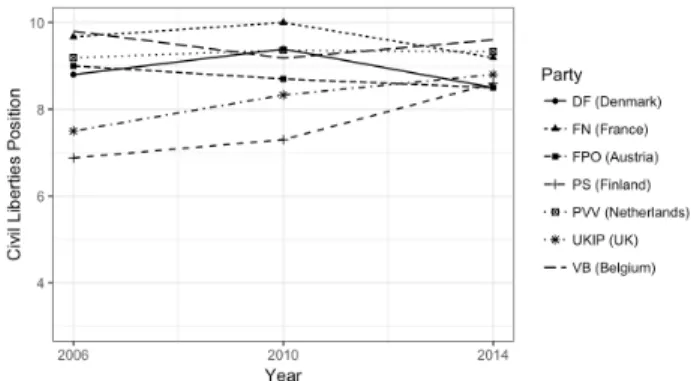
2 Civil Liberties Position, 2006-2014 . . . 5
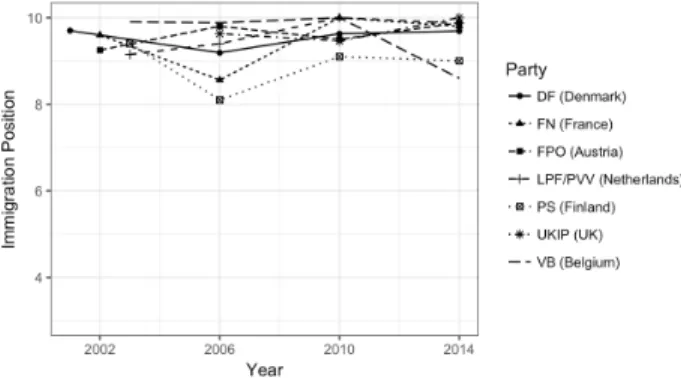
3 Immigration Position, 2002-2014 . . . 6
4 Predicted Probability of Latent Class by Age, Full Sample . . . 10
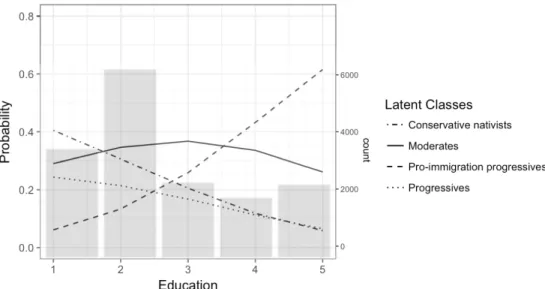
5 Predicted Probability of Latent Class by Education Level, Full Sample . . . 10
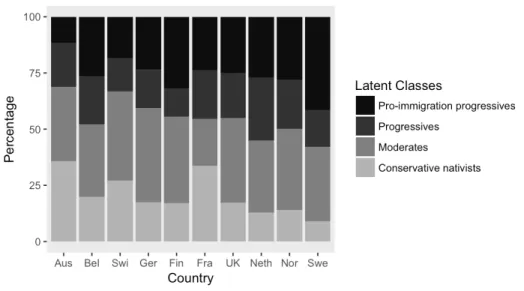
6 Latent Class Allocation by Country, Full Sample . . . 11
7 Latent Class Allocation by Gender, Radical Right Subset . . . 12
8 Latent Class Allocation by Income, Radical Right Subset. . . 13
9 Latent Class Allocation by Country, Radical Right Subset . . . 13
10 Correlation between Social Lifestyle Distance and Radical Right Vote Share . . . 16
11 Correlation between GAL-TAN Distance and Radical Right Vote Share . . . 16
12 Predicted Probability Plot – Social Lifestyle Dist.* Immigration Dist. . . 20
13 Predicted Probability Plot – Latent Class * Social Lifestyle Dist. . . 20
14 Predicted Probability of Latent Class over Values of Social Lifestyle Distance . . . 24
INTRODUCTION
Within the last few decades, radical right parties have reappeared across Western Europe with renewed vigor and popularity. Although almost every country in the region is home to at least one radical right party, their success and popularity is far from uniform. These parties bear less resemblance to one another, instead mirroring the countries within which they exist and operate. Scholars of the radical right have tended to focus on the commonalities among those in this party family, noting the xenophobia, nativism, and racism inherent to their ideologies. Fewer scholars have looked past the commonalities and considered the variety among radical right parties and voters.
In the past 10-15 years, an increasingly prevalent phenomenon has appeared among the West European radical right – parties are softening their conservative and traditionalist positions on issues of gender, sexuality, and the family. This is especially curious considering the “post-materialist” cleavage and dealignment arguments, positing that these parties developed in reaction to the extreme progressivism of green or new-left parties (Inglehart, 1977; Hooghe et al., 2002; Kriesi et al., 2006; Bornschier, 2018; Hooghe and Marks, 2018). In this, a new politics dimension referred to as “GAL-TAN” was mobilized (Hooghe et al., 2002).1 Others have labeled this cleavage variously – “libertarianism-authoritarianism” (Kitschelt, 1995), “cosmopolitanism-parochialism” (Inglehart,
1977; Inglehart and Norris, 2016; De Vries, 2017) and “demarcation-integration” (Kriesi et al., 2006). Notwithstanding this moderating phenomenon, the literature has largely continued to assume that radical right parties are simply that – radically conservative and traditionalist – and that voters are similar. Other than our perception of radical right voters as nativist, authoritarian, disaffected, and marginalized by society, we know very little about the ideology of these voters. To shed light
1
on this gap in the literature, I ask, “What are the ideological characteristics of radical right voters, and what are the implications of this for party competition?”
In the same vein as (Spierings et al., 2017) who confirm the existence of “sexually-modern nativists,” this study proposes the existence of different ideological classes of radical right voters, finding that only a minority conform to the usual archetype of “conservative nativist” and that a significant portion are indeed “progressive” on social issues other than immigration. In light of this, it is reasonable to assume that the positions parties take on these issues have implications for their success or failure, depending on the ideological makeup of their country. This article contributes not only to the literature on radical right parties, but also to that on extremist parties and electoral and ideological competition more broadly. This question is of vital importance as it will lead to a better understanding of how radical right parties are adapting to a changing electorate and behaving in ways that have been hitherto unexpected per the broader literature on this topic.
THE RADICAL RIGHT AND ITS VOTERS
Extant research on the ideology of the radical right has suffered a significant blind spot. With a few exceptions (Spierings et al., 2017; Akkerman, 2015), radical right parties are assumed to be conservative and traditionalist, as the name of the party family might suggest. These assumptions harken back to the party family’s origins. Although Lipset and Rokkan (1967) predicted a “freezing” of the West European party system in their book on cleavage theory and party system development, this prediction was not borne out by the events of the second half of the 20th Century. While previously the party system had been structured on class-based, economic – or materialist – cleavages, the 1970s and 1980s saw the development of the post-materialist cleavage, which gave rise to green, or new-left, parties (Rydgren, 2007). As (Inglehart, 1977) writes, this was a “silent revolution,” involving a ”fundamental shift from ‘materialist’ values to ‘post-materialist values ... prioritiz[ing] the expansion of individual freedom ... multiculturalism, gender and racial equality, and sexual freedom.” Subsequently, the beginnings of the radical right’s rise to prominence began to take shape, with these parties “demanding the protection of (patriarchal) family values and a nationally-oriented immigrant-free way of life” (Meguid 2005, p.384; Kitschelt 1995).
The rise of the radical right in the aftermath of this shift led many to attribute cultural backlash against this progressivism as a primary cause of the rise of the radical right (Inglehart, 1977; Kriesi et al., 2008; Inglehart and Norris, 2016; Bornschier, 2018). However, specific, empirically testable factors have also been cited including expansion of higher education, economic and cultural modernization, globalization, and electoral dealignment.
dimension of conflict. Starting in the 1980s, radical right parties began exploiting voters at the other side of this divide – those who arenot highly educated (Kriesi et al., 2008; Bornschier, 2010, 2018).
However, lack of education is not the sole reason that voters became vulnerable to radical right appeals. The process of dealignment was, according to some, a result of drastic changes to the economy in the form of modernization (Kitschelt, 1995; Betz and Immerfall, 1998; Van der Brug et al., 2005; Kriesi et al., 2006, 2008; Kitschelt and Rehm, 2014). Interestingly, proponents of this approach posit materialist concerns as the cause of this new post-materialist cleavage. According to this argument, the loss of manufacturing jobs resulting from the shift from an industrial economy to a service economy created clear “winners” and “losers” of modernization. These “losers” – primarily working class men – abandoned socialist and social democratic parties because these parties began moving to the center to appeal to the growing middle class (Kriesi and Bornschier, 2012). Similar theories include “realistic group conflict” and the “status politics” approach (for a review, see Arzheimer, 2018). The radical right’s anti-immigrant and anti-system appeals are believed to resonate with these disaffected voters. As such, many of these “losers” are assumed to support the radical right, since these parties seek to arrest the rapid change occuring in society. However, scholars have not found clear empirical evidence in support of the economic modernization argument. Globalization has also created “winners” and “losers”, but there is little evidence that “globalization losers” comprise a significant radical right support base (see Bornschier, 2018).
for both why this dimension has remained salient and why radical right parties have shifted their appeals in recent years. To illustrate how these appeals have changed, or not, overtime, in Figures 1–3, I present longitudinal radical right party positions on the three facets of TAN – social lifestyle (T, traditionalism), civil liberties (A, authoritarianism), and immigration (N, nationalism). To aid
in comparison between the three positions, the y-axes are on the same scale.2
Figure 1: Social Lifestyle Position, 2002-2014
Figure 2: Civil Liberties Position, 2006-2014
2The 2002-3 data are from (Benoit and Laver, 2006)’s expert survey (a precursor to CHES) and are measured on a
Figure 3: Immigration Position, 2002-2014
From these figures, a few main observations should be noted. First, there is little variation in immigration position overtime and across parties – these parties are strongly nativist across the board. Civil liberties position is similar, though not as striking. Notable is the parties’ relative convergence on this issue in 2014, however – perhaps related to the increased salience of immigration. In contrast, social lifestyle position exhibits notable variation not only between parties but also within parties. Party rhetoric and behavior corroborate this observation. For example, the Dutch Party for Freedom (PVV) has been committed to gender equality and LGBT rights for much of its existence, claiming this to be a bastion of Western society (Vossen, 2011). This is not unlike its defunct predecessor, the Pim Fortuyn List, founded by the eponymous Pim Fortuyn, a xenophobic, openly gay sociologist (Akkerman, 2005; Spierings et al., 2017). Further, then-leader of the Danish People’s Party, Pia Kjærsgaard, once stated, “In Denmark we adhere to liberal values. We accept and respect the choices people make. We accept homosexuality. In Iran you will be hanged for your homosexuality” (Akkerman, 2015). As a specific example of a policy shift, Marine LePen, leader of the French Front National, began to support civil partnerships during debates over the legalization of same-sex marriage in 2012 (Akkerman, 2015).
the 1980s and 1990s during the initial rise of this family, it has clearly become less of an issue in recent years. According to the transnational cleavage argument, this is largely due to the increased salience of the immigration issue. Thus, perhaps this family is moving towards “radical AN”.
LATENT CLASS ANALYSIS
In order to examine the ideological characteristics of both Western Europe’s voters at large as well as voters on the radical right, I employ a method known as latent class analysis (LCA), estimated with the poLCApackage in R. LCA is a type of structural equation modeling whereby unobserved patterns (“classes”) in the data are uncovered (Oberski, 2016). Observations are “probabilistically group[ed through maximum likelihood estimation] ... into a ‘latent class’, which in turn produces expectations about how that observation will respond on each manifest variable” (Linzer et al., 2011).3. LCA is similar to an ideal point model, such as that on which DW-NOMINATE is based, except it assumes that the latent trait is categorical, rather than continuous (Linzer et al., 2011). The number of classes the model estimates is chosen by the researcher, either through theoretical expectation or model fit criteria. I determined that my model should estimate four classes because it exhibited the lowest Baysian Information Criteria (BIC) as compared to other class number specifications.4 LCA has been frequently used in public health and psychology research but has only recently been applied to questions in political science (e.g. Blaydes and Linzer, 2008; Feldman and Johnston, 2014; Alvarez et al., 2017).
As (Feldman and Johnston, 2014) show in their study of American voters’ ideologies, it is dangerous to assume that party identification, or identification as “liberal” or “conservative”, holds the same meaning for every individual. (Ellis and Stimson, 2012) concur. Much of this conceptual confusion for voters is related to their attempts at placing themselves on a unidimensional ideological scale, despite that political competition operates on at least two dimensions – economic and sociocultural (Carmines and Stimson, 1981; Hooghe et al., 2002; Miller and Schofield, 2003; Feldman
3A manifest variable is an observed survey response. This is in contrast to a latent variable, which is unobserved.
4
and Johnston, 2014).5 Should a libertarian place herself on the left or right? What about a post-communist? Because there exist voters whose economic and social stances do not fit neatly onto a unidimensional scale, it is not unreasonable to expect fairly significant heterogeneity within broad ideological groupings or party families.
For these analyses, I utilized the 8th wave of the European Social Survey (ESS), completed in 2016 (NSD Norwegian Centre for Research Data, 2016). I included data from West European countries available in the survey with a competing radical right party, for a total of 10 countries.6 The models were estimated using four survey questions and two covariates – age and level of education. Age is a continous variable ranging from 15-100 and education was recoded to a 1-5 scale where 1 indicates an individual who has not completed high school and 5 indicates a holder of a master’s, professional, or doctoral degree. The latent classes were estimated from questions pertaining to social progressiveness and libertarianism.7 First, as an indicator of authoritarianism, should rules be followed at all times, even if no one is watching? Second, are men more entitled to jobs during an economic downturn than women? Third, should gays and lesbians be allowed to adopt children? And finally, do immigrants undermine or enrich one’s country? For the first question, respondents were asked to place themselves on a scale from 1-6, with low values indicating agreement. The second and third questions were measured on a 1-5 scale, again with low values indicating agreement. The final question asked respondents to indicate their beliefs on a 0-10 scale, with low values representing a belief that immigrants undermine one’s country. I recoded this variable to a 1-5 scale to better resemble the other three response structures. “Don’t know”s and refusals were coded as missing.
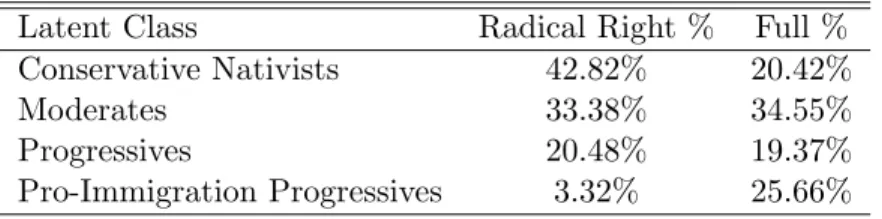
Below I present my results from a latent class analysis on the full dataset (N = 18,054).8 Four latent classes emerge from the data, the largest of which is “moderates” at 35% of the sample. These are individuals with no strong feelings regarding the four survey questions. 21% of voters are “conservative nativists,” fairly authoritarian and traditionalist and opposing immigration. The final
5
Multidimensional competition is widely recognized to exist in systems with a salient regionalism issue but appears to be more contested in other systems. However, the notion that European party competition can often not be easily reduced to unidimensionality has recently gained support. See (Elias et al., 2015; Rovny, 2015).
6Austria, Belgium (Flanders), Finland, France, Germany, Netherlands, Norway, Sweden, Switzerland, and United
Kingdom
7
See Appendix 1 for exact question wordings and Appendix 3 for descriptive statistics.
two categories are “progressives” and “pro-immigration progressives”, 19% and 25% respectively. The main difference between these two classes is that the latter believe strongly that immigrants enrich their country while the former take a more neutral stance.
Figure 4: Predicted Probability of Latent Class by Age, Full Sample
Figure 5: Predicted Probability of Latent Class by Education Level, Full Sample
probability of being in the progressive or pro-immigration progressive classes. Figure 5 indicates that at age 50 (the sample mean), those with advanced degrees are more likely to be pro-immigration progressives, while they are very unlikely to be progressives or conservative nativists. As the literature predicts, individuals with low educational attainment are more likely to be conservative nativists.
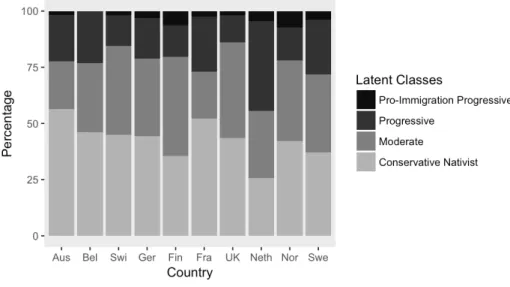
Figure 6: Latent Class Allocation by Country, Full Sample
Per Figure 6, latent class allocation varies by country. Countries such as France and Austria have the largest percentage of voters in the conservative nativist class. The fewest of this type of voter exist in the Netherlands and Sweden, where a majority of their populations fall into the two progressive classes.
Table 1: Weighted Latent Class Percentages
Latent Class Radical Right % Full %
Conservative Nativists 42.82% 20.42%
Moderates 33.38% 34.55%
Progressives 20.48% 19.37%
Pro-Immigration Progressives 3.32% 25.66%
Because the literature finds that women are more likely than men to hold progressive social stances (Dolezal, 2010), in Figure 7, I present latent class by gender for radical right voters. Most notably, a larger proportion of women are progressives than men, who are more likely to be either moderate or conservative nativist. Although women are less likely to vote for the radical right than men (Immerzeel et al., 2015), women comprise about 1/3 of the weighted sample. Thus, women are not rare in this subset, and this finding is likely not an artefact of the data.
Figure 8: Latent Class Allocation by Income, Radical Right Subset
Further, since the literature has argued that the radical right is heavily supported by working class men, Figure 8 illustrates latent class among radical right voters at various levels of household income, with 1 being the lowest value. Although conservative nativists are more likely to be found at lower levels of income, there is no clear trend.
Finally, I again present latent class allocation by country in Figure 9.9 The results largely mirror those in Figure 6 above – the Netherlands and Sweden have the fewest conservative nativists while Austria and France have the most, suggesting that the ideological distribution of radical right voters is not wholly distinct from that of voters on the whole.
9Because I include only one radical right party per country, this figure equivalently shows latent class by party. For
PARTY COMPETITION
The literature on radical right party success has heavily emphasized electoral system context. (Lubbers et al., 2002) contend that micro-level indicators such as educational attainment, gender, and anti-immigrant sentiment are fairly invariant cross-nationally and that the differences in radical right vote share stem from country-level contextual factors such as whether center-right parties have taken on nativist stances. (Van der Brug et al., 2005) concur, arguing that radical right party success “will depend on the competition they face from large (right-wing) parties” (p. 548). Since larger parties generally are more successful policy-wise, the extent to which voters will choose a smaller radical right party depends on how outspoken the center-right appears to be regarding immigration (see also Pardos-Prado, 2015).
Figure 10: Correlation between Social Lifestyle Distance and Radical Right Vote Share
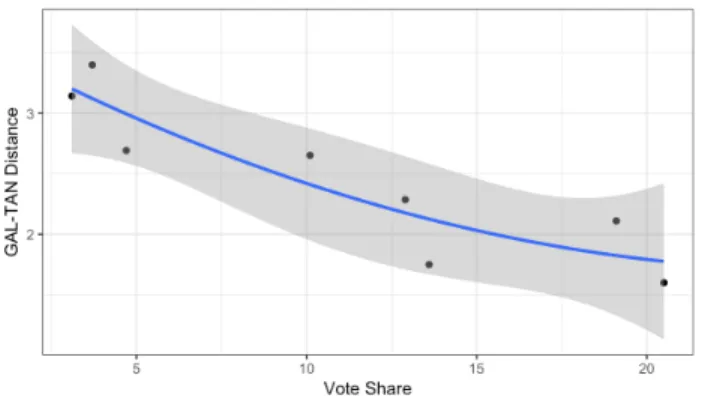
Figure 11: Correlation between GAL-TAN Distance and Radical Right Vote Share
Because a majority of radical right voters arenot conservative nativists, I argue that as a party’s ideology becomes more distant from their center-right competitor, they can expect to lose votes from moderates and progressives and gain votes from conservative nativists. I also argue that as a radical right party’s distance on immigration from their center-right competitor increases, it can expect to gain votes. Because of the increased salience of immigration in recent years (Hooghe and Marks, 2018), taking an extreme stance on this issue offers a signal to voters that the radical right is more credible on this issue than other parties, in line with the directional theory of issue voting (Rabinowitz and Macdonald, 1989). From the discussion thus far, I formulate the following hypotheses:
H1: As ideological distance on social issues between a radical right party and their center-right
H2: As ideological distance on immigration issues between a radical right party and their center-right
competitorincreases, radical right parties can be expected to win more votes.
H3a: As ideological distance on social issues between a radical right party and their
center-right competitordecreases, radical right parties can be expected to win more votes from progressives and moderates.
H3b: As ideological distance on social issues between a radical right party and their
center-right competitorincreases, radical right parties can be expected to win more votes from conservative nativists.
To test these hypotheses, I now proceed with logistic regression analyses predicting radical right vote. From the above analysis, I obtained a predicted latent class for each individual in my dataset, included as a factor variable with “progressive” as the reference category. In order to determine how a radical right party’s relative position vis-a-vis a center-right alternative affects the choice to vote radical right, I use party position variables from the 2014 CHES wave – social lifestyle, civil liberties, immigration, and GAL-TAN (Bakker et al., 2015; Polk et al., 2017). I transformed these positions into distances by subtracting a country’s center-right party’s position from that of the country’s radical right party.10 I control for gender, age, and education level (reference category is “did not complete high school”) in Models 1–4. However, because I include latent class variables in Models 5–8, I only include gender as a control because age and education were covariates in my latent class analysis and thus have already been controlled for (Linzer et al., 2011).
Several findings emerge from Table 2. First, as the literature predicts, women are less likely to vote radical right than men. Second, as education level increases, an individual becomes less and less likely to vote for a radical right party. Interestingly, moderates seem slightly less likely to vote radical right than progressives while conservative nativists, unsurprisingly, are more likely.
10
Finally, what role does party position play in vote choice? As Models 1 and 5 show, as distance on social lifestyle increases, the likelihood of voting radical right decreases. In Models 2 and 7, I find a similar, yet stronger result for GAL-TAN distance. Both of these findings provide support for H1. Contrary to expectations in H2, immigration distance is not significant and takes on opposing signs in Models 3 and 7. However, it does attain significance in Model 8 and has a positive coefficient, as hypothesized. Further corroboration for this result is found in Models 4 and 8 in the interaction between social lifestyle distance and immigration distance. Figure 12 provides an interpretation of this result. As shown, at the lowest value of social lifestyle distance (top line), parties have a greater baseline probability of receiving votes compared to at higher values (H1), and this effect is amplified as immigration distance increases (H2). However, it should be noted that the opposite effect exists at the maximum value of social lifestyle distance – vote share decreases as immigration distance increases. A cautious interpretation of the evidence undergirding the immigration distance hypothesis is that parties gain votes by taking a more distant position only when this is accompanied by more moderate positions on social lifestyle.
Figure 12: Predicted Probability Plot – Social Lifestyle Dist.* Immigration Dist.
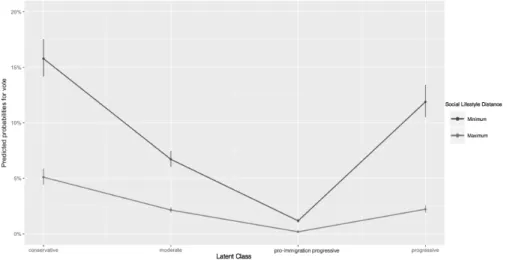
I test hypotheses H3a and H3b in Table 3. Here, I interact social lifestyle distance with latent class. As shown in Figure 13, at low social lifestyle distance (top line), there is a greater probability of radical right vote across the board. However, at higher values, conservative nativists have the highest probability of voting radical right, providing support for both of these hypotheses.
Table 3: Multilevel Logistic Regression with Country Random Effects
Dependent variable: Radical Right Vote
Model 9 Model 10 Model 11
Female −0.506∗∗∗ −0.505∗∗∗ −0.507∗∗∗
(0.076) (0.076) (0.076)
Social Lifestyle Dist. −0.782∗∗∗
(0.160)
Immigration Dist. −0.007
(0.137)
GAL-TAN Dist. −0.965∗∗∗
(0.237)
Latent Class
Conservative Nativist 0.008 0.024 −0.119 (0.306) (0.253) (0.405)
Moderate −0.985∗∗∗ −0.396 −0.991∗∗ (0.337) (0.261) (0.460)
Pro-immigration Progressive −2.392∗∗∗ −2.111∗∗∗ −1.954∗ (0.722) (0.522) (1.109)
Interactions
Soc. Life.*Con. 0.235∗ (0.139)
Soc. Life.*Mod 0.261∗ (0.149)
Soc. Life.*Pro-Im. −0.027 (0.341)
Imm.*Con. 0.142∗∗
(0.069)
Imm.*Mod. −0.008
(0.069)
Imm.*Pro-Im. −0.089
(0.137)
GAL-TAN*Con. 0.273
(0.178)
GAL-TAN*Mod 0.245
(0.197)
GAL-TAN*Pro-Im. −0.215
(0.488) Constant −0.674∗ −2.477∗∗∗ −0.161 (0.375) (0.534) (0.578)
Observations 15,096 15,096 15,096
Log Likelihood −2,797.105 −2,800.961 −2,798.439 Akaike Inf. Crit. 5,614.209 5,621.922 5,616.877 Bayesian Inf. Crit. 5,690.431 5,698.144 5,693.099
Figure 14: Predicted Probability of Latent Class over Values of Social Lifestyle Distance
Figure 15: Predicted Probability of Latent Class over Values of Immigration Distance
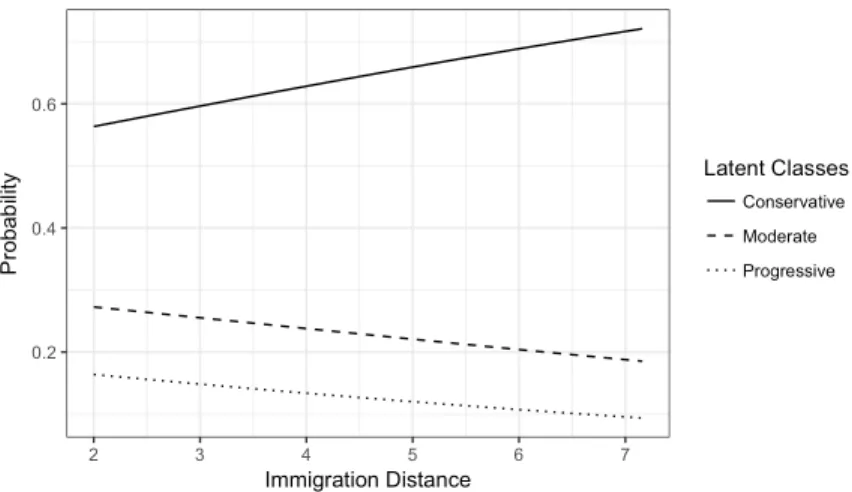
On the whole, my evidence suggests that these parties garner more votes when taking more moderate positions on social issues and more extreme positions on immigration, but this is conditioned by the ideological makeup of their countries. The three parties with the lowest social lifestyle distances are the French Front National (FN), the Party for Freedom in the Netherlands (PVV), and the Sweden Democrats (SD).11 Referring back to Figure 9, we see that these countries are also the three with the largest proportion of progressive radical right voters. Taken with the results from my full logistic regression analyses (Tables 2 and 3), it seems that radical right parties face a trade-off when deciding which constituencies to court. For example, when FN decided to support
11
DISCUSSION AND CONCLUSION
Is there ideological diversity among radical right voters? This article answers with a resounding “yes”. Across the countries examined in this study, conservative nativists comprise only a minority of radical right voters, which corroborates a previous study of the “progressive nativist” phenomenon (Spierings et al., 2017). Second, by examining latent voter ideology and party position distance, I find that radical right parties that take on more extreme ideological positions on social issues likely lose votes from all but their most conservative constituencies. I also find that extreme stances on immigration lead to more votes not in isolation but rather in the presence of moderate social stances. These results suggest that directional theory may apply more to primary issues while spatial theory applies to less important issues. Finally, I find that more moderate parties, such as the PVV and SD, are more likely to exist in countries with more moderate voters, such as the Netherlands and Sweden. In deciding whether or not to moderate, radical right parties are faced with a trade-off – is it more preferable to lose conservative voters or gain moderate and progressive ones? The answer to this question is conditioned upon the country’s ideological makeup and the way these country-level characteristics are reflected in the party landscape.
APPENDIX 1: QUESTIONS
• ESS H1 – (Now I will briefly describe some people. Please listen to each description and tell me how much each person is or is not like you.) H1G – He believes that people should do what they’re told. He thinks people should follow rules at all times, even when no-one is watching.
• ESS B33a– When jobs are scarce, men should have more right to a job than women.
• ESS B36– Gay male and lesbian couples should have the same rights to adopt children as straight couples.
APPENDIX 2: LATENT CLASS MODEL RESULTS
Table 5: Full Sample
Progressives Moderates Con. Nativists Pro-Im. Progressives Rules
1 (Strongly agree): 0.0595 0.0520 0.1550 0.0585
2: 0.1907 0.3024 0.3170 0.1685
3: 0.2134 0.2527 0.1842 0.2092
4: 0.2288 0.1894 0.1217 0.2009
5: 0.2268 0.1774 0.1514 0.2522
6: 0.0807 0.0261 0.0706 0.1108
Jobs
1 (Strongly agree): 0.0082 0.0009 0.0516 0.0043
2: 0.0049 0.0426 0.1579 0.0024
3: 0.0475 0.1190 0.1446 0.0064
4: 0.2179 0.5336 0.2480 0.1047
5: 0.7216 0.3038 0.3979 0.8823
Adoption
1 (Strongly agree): 0.5954 0.0115 0.1056 0.5834
2: 0.2908 0.4537 0.1649 0.2617
3: 0.0475 0.1190 0.1446 0.0064
4: 0.0000 0.2739 0.2417 0.0362
5: 0.0188 0.0304 0.3196 0.0382
Immigrants
1 (Undermine): 0.0674 0.0086 0.1702 0.0000
2: 0.1229 0.1067 0.2341 0.0000
3: 0.3147 0.3162 0.2927 0.0444
4: 0.2857 0.3735 0.1901 0.2623
5: 0.2093 0.1950 0.1129 0.6933
APPENDIX 3: DESCRIPTIVE STATISTICS
Table 6: Parties and Position Distances
Country Radical Right Center-Right Soc. Life. Dist. GAL-TAN Dist. Im. Dist. Civ. Lib. Dist.
Austria FP ¨O OVP¨ 2.11 1.60 3.78 2.50
Belgium VB CD&V 3.40 3.40 4.20 3.60
Finland PS KESK 2.37 2.11 3.37 2:37
France FN UMP 1.36 1.75 2.20 1.83
Germany AfD CDU 2.93 2.69 3.57 2.35
Netherlands PVV VVD 1.49 2.65 2.37 1.55
Norway FrP — — — —
Sweden SD KD 1.98 2.28 7.16 2.45
Switzerland SVP — — — — —
United Kingdom UKIP Cons. 3.64 3.14 2.00 1.43
Denmark, Italy, and Greece were excluded because they do not appear in the 8th wave of the ESS. Norway and Switzerland were excluded from the logistic regressions because they do not appear in the CHES prior to 2014. Two countries in the dataset are home to two radical right parties, as coded by CHES – Austria (BZ ¨O) and Germany (NDP). These parties received smaller vote shares than the major radical right parties (FP ¨O and AfD) and also are qualitatively different from other parties in the dataset – BZ ¨O is a moderate splinter from FP ¨O, and NPD is a neo-fascist party.
Table 7: Descriptive Statistics, Full Dataset
Variable n Min q1 Median Mean q3 Max SD IQR
Rules 15,096 1.0 2.0 3.0 3.4 5.0 6.0 1.4 3.0
Jobs 15,096 1.0 4.0 5.0 4.3 5.0 5.0 0.9 1.0
Adopt 15,096 1.0 1.0 2.0 2.4 3.0 5.0 1.3 2.0
Immigration 15,096 1.0 3.0 4.0 3.6 5.0 5.0 1.2 2.0
Gender 15,096 1.0 1.0 2.0 1.5 2.0 2.0 0.5 1.0
Education 15,096 1.0 2.0 2.0 2.6 4.0 5.0 1.3 2.0
Age 15,096 15.0 35.0 51.0 49.9 65.0 100.0 18.6 30.0
Vote 15,096 1.0 1.0 1.0 1.1 1.0 2.0 0.2 0.0
Latent Class 15,096 1.0 2.0 3.0 2.8 4.0 4.0 1.1 2.0
GAL-TAN Pos. 15,096 7.8 8.7 8.9 8.9 9.1 9.3 0.4 0.4
Civ. Lib. Pos. 15,096 8.5 8.6 8.8 8.9 9.2 9.3 0.3 0.6
Soc. Life. Pos. 15,096 3.7 8.0 8.1 7.8 8.5 9.1 1.5 0.5
Im. Pos. 15,096 9.0 9.3 9.8 9.6 9.9 10.0 0.3 0.6
GAL-TAN Dist. 15,096 1.6 1.8 2.7 2.5 2.7 3.4 0.6 0.9
Civ. Lib. Dist 15,096 1.4 1.8 2.3 2.3 2.5 3.6 0.6 0.6
Soc. Life. Dist. 15,096 1.4 1.9 2.4 2.4 2.9 3.6 0.8 1.0
Table 8: Descriptive Statistics, Radical Right Subset
Variable n Min q1 Median Mean q3 Max SD IQR
Rules 797 1.0 2.0 3.0 3.4 5.0 6.0 1.5 3.0
Jobs 797 1.0 4.0 4.0 4.1 5.0 5.0 1.1 1.0
Adopt 797 1.0 2.0 3.0 2.9 4.0 5.0 1.4 2.0
Immigration 797 1.0 1.0 2.0 2.4 3.0 5.0 1.2 2.0
Gender 797 1.0 1.0 1.0 1.4 2.0 2.0 0.5 1.0
Education 797 1.0 1.0 2.0 2.1 2.0 5.0 1.0 1.0
Age 797 15.0 35.0 50.0 49.6 63.0 95.0 17.5 28.0
Latent Class 797 1.0 2.0 2.0 2.0 3.0 3.0 0.7 1.0
GAL-TAN Pos. 797 7.8 8.7 8.8 8.8 9.1 9.3 0.4 0.4
Civ. Lib. Pos. 797 8.5 8.6 8.8 8.9 9.2 9.3 0.3 0.6
Soc. Life. Pos. 797 3.7 8.0 8.2 7.8 8.9 9.1 1.7 0.9
Im. Pos. 797 9.0 9.6 9.8 9.7 9.9 10.0 0.3 0.3
GAL-TAN Dist. 797 1.6 1.8 2.1 2.2 2.7 3.4 0.5 0.9
Im. Dist 797 2.0 2.2 3.4 3.4 3.8 7.2 1.4 1.6
Civ. Lib. Dist. 797 1.4 1.8 2.3 2.2 2.5 3.6 0.5 0.7
REFERENCES
Akkerman, T. (2005). Anti-immigration parties and the defence of liberal values: The exceptional case of the list pim fortuyn. Journal of Political Ideologies, 10(3):337–354.
Akkerman, T. (2015). Gender and the radical right in Western Europe: a comparative analysis of policy agendas. Patterns of Prejudice, 49(1-2):37–60.
Alvarez, R. M., Levin, I., and N´u˜nez, L. (2017). The four faces of political participation in argentina: Using latent class analysis to study political behavior. The Journal of Politics, 79(4):1386–1402. Arzheimer, K. (2018). Explaining electoral support for the radical right. In Rydgren, J., editor,The
Oxford Handbook of the Radical Right. Oxford University Press.
Bakker, R., De Vries, C., Edwards, E., Hooghe, L., Jolly, S., Marks, G., Polk, J., Rovny, J., Steenbergen, M., and Vachudova, M. A. (2015). Measuring party positions in europe: The chapel hill expert survey trend file, 1999–2010. Party Politics, 21(1):143–152.
Benoit, K. and Laver, M. (2006). Party policy in modern democracies. Routledge.
Betz, H.-G. and Immerfall, S. (1998). The new politics of the right: Neo-populist parties and
movements in established democracies. Macmillan.
Blaydes, L. and Linzer, D. A. (2008). The political economy of women’s support for fundamentalist islam. World Politics, 60(4):576–609.
Bornschier, S. (2010). Cleavage Politics and the Populist Right. Temple University Press.
Bornschier, S. (2018). Globalization, cleavages, and the radical right. In Rydgren, J., editor,The
Oxford Handbook of the Radical Right. Oxford University Press.
Carmines, E. G. and Stimson, J. A. (1981). Issue evolution, population replacement, and normal partisan change. American Political Science Review, 75(1):107–118.
Cutts, D., Ford, R., and Goodwin, M. J. (2011). Anti-immigrant, politically disaffected or still racist after all? examining the attitudinal drivers of extreme right support in Britain in the 2009 European elections. European Journal of Political Research, 50(3):418–440.
De Vries, C. E. (2017). The cosmopolitan-parochial divide: changing patterns of party and electoral competition in the netherlands and beyond. Journal of European Public Policy, pages 1–25. Dolezal, M. (2010). Exploring the stabilization of a political force: The social and attitudinal basis
Elias, A., Sz¨ocsik, E., and Zuber, C. I. (2015). Position, selective emphasis and framing: How parties deal with a second dimension in competition. Party Politics, 21(6):839–850.
Ellis, C. and Stimson, J. A. (2012). Ideology in America. Cambridge University Press.
Ennser, L. (2012). The homogeneity of West European party families: The radical right in comparative perspective. Party Politics, 18(2):151–171.
Feldman, S. and Johnston, C. (2014). Understanding the determinants of political ideology: Implications of structural complexity. Political Psychology, 35(3):337–358.
Hooghe, L. and Marks, G. (2018). Cleavage theory meets europes crises: Lipset, rokkan, and the transnational cleavage. Journal of European Public Policy, 25(1):109–135.
Hooghe, L., Marks, G., and Wilson, C. J. (2002). Does left/right structure party positions on european integration? Comparative political studies, 35(8):965–989.
Immerzeel, T., Coff´e, H., and Van der Lippe, T. (2015). Explaining the gender gap in radical right voting: A cross-national investigation in 12 western european countries. Comparative European
Politics, 13(2):263–286.
Inglehart, R. (1977). The silent revolution (vol. 8).
Inglehart, R. and Norris, P. (2016). Trump, brexit, and the rise of populism: Economic have-nots and cultural backlash. Working paper.
Kitschelt, H. (1995). The Radical Right in Western Europe: A Comparative Analysis.
Kitschelt, H. and Rehm, P. (2014). Occupations as a site of political preference formation.
Compar-ative Political Studies, 47(12):1670–1706.
Koedam, J. (2017). Change of heart? analyzing stability and change in European party systems.
Working paper.
Kriesi, H. and Bornschier, S. (2012). The populist right, the working class, and the changing face of class politics. InClass Politics and the Radical Right, pages 28–48. Routledge.
Kriesi, H., Grande, E., Lachat, R., Dolezal, M., Bornschier, S., and Frey, T. (2006). Globalization and the transformation of the national political space: Six european countries compared. European
Journal of Political Research, 45(6):921–956.
Kriesi, H., Grande, E., Lachat, R., Dolezal, M., Bornschier, S., Frey, T., et al. (2008). West European
politics in the age of globalization. Cambridge University Press Cambridge.
Lipset, S. M. and Rokkan, S. (1967).Party systems and voter alignments: Cross-national perspectives, volume 7. Free press.
Lubbers, M., Gijsberts, M., and Scheepers, P. (2002). Extreme right-wing voting in western europe.
European Journal of Political Research, 41(3):345–378.
Marks, G., Hooghe, L., Nelson, M., and Edwards, E. (2006). Party competition and european integration in the east and west: Different structure, same causality. Comparative Political Studies, 39(2):155–175.
Meguid, B. M. (2005). Competition between unequals: The role of mainstream party strategy in niche party success. American Political Science Review, 99(03):347–359.
Miller, G. and Schofield, N. (2003). Activists and partisan realignment in the united states. American
Political Science Review, 97(2):245–260.
Mudde, C. (1999). The single-issue party thesis: Extreme right parties and the immigration issue.
West European Politics, 22(3):182–197.
Mudde, C. (2007). The populist radical right in Europe. Cambridge (UK): Cambridge UP. Norris, P. (2005). Radical right: Voters and parties in the electoral market. Cambridge University
Press.
NSD Norwegian Centre for Research Data, N. (2016). European social survey round 8 data file edition 1.0.
Oberski, D. (2016). Mixture models: Latent profile and latent class analysis. In Modern statistical
methods for HCI, pages 275–287. Springer.
Pardos-Prado, S. (2015). How can mainstream parties prevent niche party success? center-right parties and the immigration issue. The Journal of Politics, 77(2):352–367.
Polk, J., Rovny, J., Bakker, R., Edwards, E., Hooghe, L., Jolly, S., Koedam, J., Kostelka, F., Marks, G., Schumacher, G., et al. (2017). Explaining the salience of anti-elitism and reducing political corruption for political parties in europe with the 2014 chapel hill expert survey data. Research
& Politics, 4(1):2053168016686915.
Rabinowitz, G. and Macdonald, S. E. (1989). A directional theory of issue voting. American Political
Science Review, 83(1):93–121.
Rovny, J. (2013). Where do radical right parties stand? position blurring in multidimensional competition. European Political Science Review: EPSR, 5(1):1.
Rovny, J. (2015). Riker and rokkan: Remarks on the strategy and structure of party competition.
Party Politics, 21(6):912–918.
Spierings, N., Lubbers, M., and Zaslove, A. (2017). sexually modern nativist voters: do they exist and do they vote for the populist radical right? Gender and Education, 29(2):216–237.
Van der Brug, W. and Fennema, M. (2003). Protest or mainstream? how the european anti-immigrant parties developed into two separate groups by 1999. European Journal of Political
Research, 42(1):55–76.
Van der Brug, W., Fennema, M., and Tillie, J. (2005). Why some anti-immigrant parties fail and others succeed: A two-step model of aggregate electoral support. Comparative Political Studies, 38(5):537–573.