Methodology of AA CRASH:
a prospective observational study
evaluating the incidence and
pathogenesis of adverse post-traumatic
sequelae in African-Americans
experiencing motor vehicle collision
Sarah D Linnstaedt,1,2JunMei Hu,1,2Andrea Y Liu,1,2April C Soward,1,2 Kenneth A Bollen,3,4Henry E Wang,5Phyllis L Hendry,6Erin Zimny,7 Christopher Lewandowski,7Marc-Anthony Velilla,8Kathia Damiron,9
Claire Pearson,10Robert Domeier,11Sangeeta Kaushik,12James Feldman,13 Mark Rosenberg,14Jeffrey Jones,15Robert Swor,16Niels Rathlev,17
Samuel A McLean1,2,18
To cite:Linnstaedt SD, Hu JM, Liu AY,et al. Methodology of AA CRASH: a prospective observational study evaluating the incidence and pathogenesis of adverse post-traumatic sequelae in African-Americans experiencing motor vehicle collision. BMJ Open2016;6:e012222. doi:10.1136/bmjopen-2016-012222
▸ Prepublication history for this paper is available online. To view these files please visit the journal online (http://dx.doi.org/10.1136/ bmjopen-2016-012222).
Received 8 April 2016 Revised 5 July 2016 Accepted 9 August 2016
For numbered affiliations see end of article.
Correspondence to Dr Samuel A McLean; [email protected]
ABSTRACT
Introduction:A motor vehicle collision (MVC) is one of the most common life-threatening events
experienced by individuals living in the USA. While most individuals recover following MVC, a significant proportion of individuals develop adverse post-traumatic sequelae such as post-post-traumatic stress disorder or persistent musculoskeletal pain. Adverse post-traumatic sequelae are common, morbid and costly public health problems in the USA and other industrialised countries. The pathogenesis of these disorders following MVC remains poorly understood. In the USA, available data suggest that African-Americans experience an increased burden of adverse post-traumatic sequelae after MVC compared to European Americans, but to date no studies
examining the pathogenesis of these disorders among African-Americans experiencing MVC have been performed.
Methods and analysis:The African-American CRASH (AA CRASH) study is an NIH-funded, multicentre, prospective study that enrols African-Americans (n=900) who present to the emergency department (ED) within 24 hours of MVC. Participants are enrolled at 13 ED sites in the USA. Individuals who are admitted to the hospital or who report a fracture or tissue injury are excluded. Participants complete a detailed ED interview that includes an assessment of crash history, current post-traumatic symptoms and health status prior to the MVC. Blood samples are also collected in the ED using PAXgene DNA and PAXgene RNA tubes. Serial mixed-mode assessments 6 weeks, 6 months and 1 year after MVC include an assessment of adverse sequelae, general health status and health service utilisation. The results from this study will provide insights into the incidence and pathogenesis of
persistent pain and other post-traumatic sequelae in African-Americans experiencing MVC.
Ethics and dissemination:AA CRASH has ethics approval in the USA, and the results will be published in a peer-reviewed journal.
BACKGROUND
More than 50 million motor vehicle colli-sions (MVC) occur worldwide each year,1 and more than 10 million of these MVCs occur each year in the USA.2 More than 4 million of these individuals present to US emergency departments (EDs) after the MVC for evaluation,2 and the overwhelming majority (>90%) of these individuals are dis-charged to home without fracture or other
Strengths and limitations of this study
▪ African-American CRASH enrols African-Americans, an understudied but highly burdened population, and will determine incidence and risk factors of adverse post-traumatic sequelae fol-lowing motor vehicle collision trauma in this population.
▪ Biological samples including blood tubes will be collected and analysed for pathogenic mediators of adverse post-traumatic sequelae.
identifiable injury.3 Although most of these discharged individuals recover, a substantial proportion develops persistent musculoskeletal pain and/or persistent psycho-logical sequelae such as post-traumatic stress disorder (PTSD).4–6 The development of these adverse post-traumatic sequelae after MVC constitutes a common, morbid and costly public health problem in industria-lised countries.7–9The pathogenesis of adverse sequelae after MVC remains poorly understood.
In the USA, more than 1 million African-Americans present to the ED for care after minor MVC each year,10 but to date no prospective studies of chronic musculo-skeletal pain development in African-Americans experi-encing MVC have been performed. A study evaluating the incidence and pathogenesis of persistent musculo-skeletal pain and other adverse post-traumatic sequelae in African-Americans experiencing MVC is valuable for several reasons. First, African-Americans experience an increased burden of MVCs compared to European Americans.10 Second, several lines of evidence suggest that African-Americans experience a greater burden of chronic pain development after MVC. For example, in other clinical conditions, African-Americans have been consistently shown to experience a greater burden of chronic pain than European Americans,11–20 and in laboratory settings, African-Americans have been found to have increased sensitivity to experimental pain.20–26 Some of this increased vulnerability is likely due to greater socioeconomic disadvantage;27–29 however, data from other settings demonstrate that worse health out-comes in African-Americans are not accounted for by socioeconomic differences alone.27 30–32 Third, studies of African-Americans can most effectively evaluate the influence of factors that may be particularly relevant within this ethnic group, such as discrimination. Unfortunately, discrimination is a fundamental aspect of the social structure of the USA and a daily reality for African-Americans.33–36 Discrimination has been asso-ciated with worse mental health outcomes37(eg, depres-sion38–43) and worse physical health outcomes,37 44 45 and may influence chronic pain and neuropsychologi-cal outcomes after MVC. Finally and more generally, evaluating the pathogenesis of a disorder among a high-risk population using molecular and epidemiological methods is a valuable approach to gaining new insights into disease pathogenesis.46–49 In this article, we describe the methods of a large-scale, NIH-funded, lon-gitudinal study evaluating the incidence and pathogen-esis of chronic pain and neuropsychological outcomes among African-Americans experiencing MVC.
METHODS/DESIGN Study sites
The African-American (AA) CRASH study is a prospect-ive, multicentre, observational cohort study of African-Americans who have experienced MVC. Study participants are enrolled at research network ED sites
and complete an initial interview assessment in the ED. Mixed-mode study participant follow-up assessments are performed at 6 weeks, 6 months and 1 year via phone, web or mail. The study research network (‘TRYUMPH
Research Network’) includes UAB Hospital
(Birmingham, Alabama, USA), UF Health Jacksonville ( Jacksonville, Florida, USA), Henry Ford Hospital (Detroit, Michigan, USA), Sinai-Grace Hospital (Detroit, Michigan, USA), Albert Einstein Medical Center (Philadelphia, Pennsylvania, USA), Detroit Receiving Hospital (Detroit, Michigan, USA), St. Joseph Mercy Ann Arbor Hospital (Ypsilanti, Michigan, USA), Medstar Washington Hospital Center (Washington DC, USA), Boston Medical Center (Boston, Massachusetts, USA), St. Joseph’s Regional Medical Center (Paterson, New Jersey, USA), Spectrum Health Butterworth Hospital (Grand Rapids, Michigan, USA), William Beaumont Hospital (Royal Oak, Michigan, USA) and Baystate Medical Center (Springfield, Massachusetts, USA). The study was approved by the institutional review boards of all participating hospitals. The data coordinating centre for the study is located at the University of North Carolina, Chapel Hill, North Carolina, USA, and the study’s IRB approval number is 11-1742.
Inclusion criteria
Patients aged 18–65 years who present to the ED within 24 hours after MVC and who are unlikely to be admitted to the hospital are screened for eligibility. Patients with injuries likely to require hospitalisation are excluded, as are patients with fractures (other than small bone frac-tures), major lacerations (lacerations more than 20 cm in length or more than 4 lacerations requiring sutures), intracranial injury or spinal injury (defined as vertebral fracture or dislocation, or new neurologic deficit). Patients admitted to the hospital overnight are also excluded, as are prisoners, pregnant patients, patients not alert and oriented, patients whose phone was disconnected in the past year and patients unable to read and understand English. Individuals who are certain at the time of ED presentation that they will liti-gate are also excluded, to help ensure that a proportion of individuals not engaged in litigation are enrolled. Patients are also excluded if they take opioids above a dose of 20 mg of oxycodone daily or equivalent. In add-ition, since the goal of the study is to evaluate an American sample, only non-Hispanic African-American patients, based on self-report, are evaluated for eligibility. After assessment for eligibility, the patient’s consent to participate is obtained in writing andfiled in a confidential research file. Enrolment in this ongoing study started in September 2012 and will conclude in September 2016.
Patient screening and consent
staff screening hours (generally 12–16 hours each day). The web-based screening form prompts the research assistant (RA) to complete a series of questions. If parti-cipants are eligible for participation based on these screening questionnaire responses, then the RA is auto-matically advanced to the ED assessment interview, and individuals are approached for study participation. If individuals are not eligible, the reason for ineligibility is stored by the system. Signed informed consent is obtained from all participants.
ED assessment
The ED setting represents a unique opportunity to collect detailed information from patients shortly after MVC. The proposed research protocol takes substantially
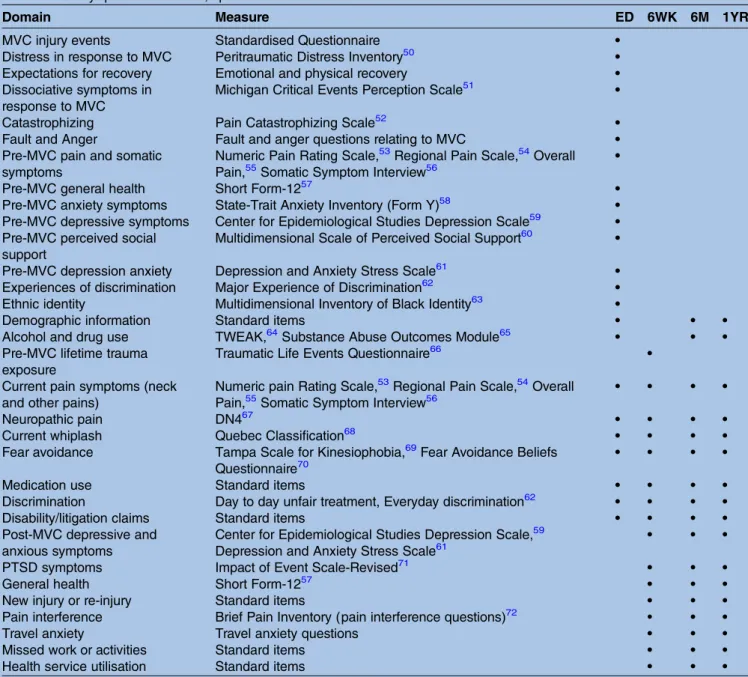
less time than patients usually spend waiting in the ED and can generally be completed within this time without prolonging a patient’s ED stay. ED assessments are con-ducted by trained RAs using a standardised web-based questionnaire on laptop computer. Back-up paper copies are used by RAs if hospital wireless internet service is unavailable. The ED interview begins with the collection of patient contact information, including information on two potential alternative contacts. Subsequent interview assessments include the collection of detailed information regarding the collision event, current and past somatic and psychological symptoms, expectations of recovery, general health and medication use (table 1). Participants are compensated $75 for completing the ED evaluation.
Table 1 Study question domains, specific measures and times of assessment
Domain Measure ED 6WK 6M 1YR
MVC injury events Standardised Questionnaire •
Distress in response to MVC Peritraumatic Distress Inventory50 •
Expectations for recovery Emotional and physical recovery •
Dissociative symptoms in response to MVC
Michigan Critical Events Perception Scale51 •
Catastrophizing Pain Catastrophizing Scale52 •
Fault and Anger Fault and anger questions relating to MVC •
Pre-MVC pain and somatic symptoms
Numeric Pain Rating Scale,53Regional Pain Scale,54Overall Pain,55Somatic Symptom Interview56
•
Pre-MVC general health Short Form-1257 •
Pre-MVC anxiety symptoms State-Trait Anxiety Inventory (Form Y)58 •
Pre-MVC depressive symptoms Center for Epidemiological Studies Depression Scale59 •
Pre-MVC perceived social support
Multidimensional Scale of Perceived Social Support60 •
Pre-MVC depression anxiety Depression and Anxiety Stress Scale61 •
Experiences of discrimination Major Experience of Discrimination62 •
Ethnic identity Multidimensional Inventory of Black Identity63 •
Demographic information Standard items • • •
Alcohol and drug use TWEAK,64Substance Abuse Outcomes Module65 • • •
Pre-MVC lifetime trauma exposure
Traumatic Life Events Questionnaire66 •
Current pain symptoms (neck and other pains)
Numeric pain Rating Scale,53Regional Pain Scale,54Overall Pain,55Somatic Symptom Interview56
• • • •
Neuropathic pain DN467 • • • •
Current whiplash Quebec Classification68 • • • •
Fear avoidance Tampa Scale for Kinesiophobia,69Fear Avoidance Beliefs
Questionnaire70
• • • •
Medication use Standard items • • • •
Discrimination Day to day unfair treatment, Everyday discrimination62 • • • •
Disability/litigation claims Standard items • • • •
Post-MVC depressive and anxious symptoms
Center for Epidemiological Studies Depression Scale,59 Depression and Anxiety Stress Scale61
• • •
PTSD symptoms Impact of Event Scale-Revised71 • • •
General health Short Form-1257 • • •
New injury or re-injury Standard items • • •
Pain interference Brief Pain Inventory (pain interference questions)72 • • •
Travel anxiety Travel anxiety questions • • •
Missed work or activities Standard items • • •
Health service utilisation Standard items • • •
ED blood collection
Blood for DNA is collected using a PAXgene DNA storage tube (8.5 cc). A barcode label is placed on the tube with a sample number, and a handheld barcode reader is used to record the sample in the web-based tracking system and to create a link with the participant’s study ID number. (The barcode reader is used to prevent human data entry error.) Each blood sample number is different from the participant’s study ID number, to increase confidentiality. DNA blood samples are then refrigerated at the study site and shipped in
batches every 2 weeks to the UNC Biospecimen
Processing Facility in Chapel Hill, North Carolina, USA. The barcode is also scanned at the time of shipment from the study site to the Biospecimen Processing Facility and at the time of receipt by the Biospecimen Processing Facility so that blood sample chain of custody procedures are maintained and sample location can be continuously monitored.
Blood for RNA are collected using a PAXgene RNA storage tube (2.5 cc). As with the PAXgene DNA tubes, PAXgene RNA storage tubes are labelled with a barcode sample number, which is linked to the participant’s study ID number using the barcode reader described above. RNA tubes are frozen immediately at −70°C and shipped in batches 2–3 times a year to the UNC Biospecimen Processing Facility. After follow-up informa-tion is collected, personally identifying informainforma-tion is stripped from the database so that banked biological data are de-identified.
Data extraction
Following the participant’s ED visit, RAs at each site complete a web-based participant data extraction form. This form collects information from the ED and hospital medical records related to the study participant’s care, including the following: ED arrival date and time, par-ticipant chief symptom, results of any radiologic evalua-tions, participant injuries by body region (eg, abrasion, contusion), discharge diagnoses, medications received in the ED and/or prescribed at discharge, patient medical history, drug and alcohol screening and ethni-city of providers. Patient injuries are scored using the Abbreviated Injury Score (AIS) and Injury Severity Score (ISS), and the nature of injury (ICD-9-CM codes) and mechanism of injury (ICD-9 E codes) are recorded. Medical record data are accessed during the course of the study to update patient contact information.
Participant follow-up evaluations at 6 weeks, 6 months and 12 months
At each follow-up evaluation time point, participants have the choice of completing follow-up evaluations online, by telephonic interview or by completing paper versions of the questionnaires and mailing them back to the study team. Questions are worded so that they can be completed by any of the above methods. Paper ver-sions of questionnaires are mailed to all participants at
the beginning of the follow-up window so that those who wish to complete the survey via telephonic interview can more easily understand questions and response options. Individuals who instead wish to complete these paper forms and mail them in may do so. Participants are com-pensated $50, $55 and $65 for completing the 6-week, 6-month and 1-year interviews, respectively.
Follow-up assessments include an evaluation of adverse post-traumatic sequelae such as pain, somatic, depressive, anger and anxiety symptoms as well as medi-cation use, pain interference, fear of movement, experi-ences of discrimination and general health (table 1). Evaluation of anxiety symptoms at each time point includes an assessment of PTSD symptoms and travel anxiety. Missed work, new or re-injury events and litiga-tion or disability claims are assessed at each follow-up time point. Demographic information and alcohol, tobacco and drug use are assessed at the 6- and 12 month time points.
Study hypotheses and primary and secondary analyses
Primary study hypotheses will evaluate whether (1) the original fear-avoidance model (FAM) of chronic pain development proposed by Vlaeyen and Linton73 pro-vides a good fit to the data regarding the pathogenesis of chronic axial pain after MVC in African-Americans, (2) past experiences of discrimination influence vulner-ability to chronic pain after MVC in African-Americans, (3) ethnic identify modifies any influence by discrimin-ation and (4) genetic varidiscrimin-ations in key enzymes and transporter molecules affecting neuro/stress/immune system function influence the development of chronic pain after MVC in African-Americans. In addition to the above analyses, the rich bounty of data from this fi
rst-ever study of chronic pain development in an
African-American sample will be available for many other analyses, including analyses evaluating hypotheses regarding genetic, molecular and epidemiologic factors influencing chronic pain and other adverse post-MVC sequelae and analyses evaluating healthcare utilisation and treatment responses.
Power calculation and proposed statistical analyses
address our specific aims. Statistical methods used to evaluate primary and secondary study aims will include structural equation modelling, latent growth curve modelling, multivariate regression modelling and various bioinformatics methods specific to the biological methods employed.76 78 79
DISCUSSION
As noted above, to date no prospective studies of chronic pain pathogenesis have been performed in an African-American population, despite evidence that African-Americans experience an increased burden of adverse post-traumatic sequelae such as chronic post-MVC pain.80 The overarching goal of the present study is to develop tools that identify individuals at high risk of adverse sequelae at the time of ED evaluation, and to develop a better understanding of risk factors and mediators of chronic pain and neuropsychological sequelae after MVC so that effective secondary prevent-ive interventions can be developed.
One aim of the study is to test a well-known cognitive– behavioural FAM of chronic pain development after MVC.73 Indirect evidence from cross-sectional and experimental studies supports the FAM;81–83 however, the FAM has been assessed only minimally in prospective cohorts. This study will test the multivariate predictive relationships in the FAM model in a large prospective cohort of individuals at increased risk of chronic pain development.
This cohort study is the sister study to a previously completed study evaluating adverse post-traumatic seque-lae, including pain outcomes, in a large cohort of European Americans (n=948) experiencing MVC.74 Both studies evaluate individuals following the same trauma/stress exposure (MVC), and use very similar methods and a very similar battery of assessments to evaluate individuals across the same follow-up time points (6 weeks, 6 months and 1 year). In the sister cohort study, we had a follow-up rate of≥90% at each of the three time points. In other studies, follow-up rates for African-Americans are generally lower than for European Americans, due to a greater degree of socio-economic disadvantage in the population. Therefore, we estimatefinal loss to follow-up of∼10–15% at each time point in the African-American sample.
Several limitations should be noted when interpreting the results of this study. Thefirst limitation is that we are using self-report to identify African-American indivi-duals, which could result in a heterogeneous population. However, this method of identification is highly valuable because ethnic identity is not only a biological variable but also a multidimensional construct encompassing an individual’s attitudes towards group membership. Second, the study is limited to patients who come to the ED after MVC and are discharged to home after evalu-ation. However, available data indicate that this popula-tion constitutes more than 90% of MVC patients who
present to the ED for evaluation after MVC.3 Finally, another limitation is that only about half of the poten-tially eligible participants are enrolled (based on pilot data analyses). The generalisability of the results among individuals who declined enrolment is not known. However, these limitations are consistent with other studies enrolling participants after an acute aftermath of trauma in an ethical manner.
Author affiliations
1TRYUMPH Research Program
2Department of Anesthesiology, University of North Carolina at Chapel Hill,
Chapel Hill, North Carolina, USA
3Department of Psychology and Neuroscience, University of North Carolina at
Chapel Hill, Chapel Hill, North Carolina, USA
4Department of Sociology, University of North Carolina at Chapel Hill,
Chapel Hill, North Carolina, USA
5Department of Emergency Medicine, University of Alabama at Birmingham,
Birmingham, Alabama, USA
6Department of Emergency Medicine, University of Florida College of
Medicine, Jacksonville, Florida, USA
7Department of Emergency Medicine, Henry Ford Hospital, Detroit,
Michigan, USA
8Department of Emergency Medicine, Sinai Grace Hospital, Detroit,
Michigan, USA
9Department of Emergency Medicine, Albert Einstein Medical Center,
Philadelphia, Pennsylvania, USA
10Department of Emergency Medicine, Detroit Receiving, Detroit,
Michigan, USA
11Department of Emergency Medicine, St Joseph Mercy Health System,
Ypsilanti, Michigan, USA
12Department of Emergency Medicine, MedStar Washington Hospital Center,
Washington District of Columbia, USA
13Department of Emergency Medicine, Boston Medical Center, Boston,
Massachusetts, USA
14Department of Emergency Medicine, St Joseph’s Regional Medical Center, Paterson, New Jersey, USA
15Department of Emergency Medicine, Spectrum Health Butterworth Campus,
Grand Rapids, Michigan, USA
16Department of Emergency Medicine, William Beaumont Hospital, Royal Oak,
Massachusetts, USA
17Department of Emergency Medicine, Baystate Health, Springfield,
Massachusetts, USA
18Department of Emergency Medicine, University of North Carolina at Chapel
Hill, Chapel Hill, North Carolina, USA
Contributors SAM developed the study concept and design. AYL, HEW, PLH, EZ, CL, M-AV, KD, CP, RD, SK, JF, MR, JJ, RS and NR contributed to the acquisition of data, and SAM and ACS supervised the study. KAB provided statistical expertise and assisted in study design. SDL, JH and SAM drafted the manuscript, and all authors made critical revisions of the manuscript for important intellectual content. SDL and SAM take responsibility for the paper as a whole. All authors read and approved the final manuscript.
Funding Research reported in this publication was supported by the National Institute of Arthritis and Musculoskeletal and Skin Diseases of the National Institutes of Health under Award Number R01AR060852. The content is solely the responsibility of the authors and does not necessarily represent the official views of the National Institutes of Health.
Competing interests None declared.
Ethics approval Institutional Review Board (IRB) approved this study.
Provenance and peer review Not commissioned; externally peer reviewed.
scientific community, and we will work with NIH programme staff to coordinate the development of a coded web-based database that can be accessed by password. Access to these databases will require a formal correspondence requesting access. This request will be reviewed and approved by the programme’s investigative team and NIH programme staff prior to granting access to the requested materials.
Open Access This is an Open Access article distributed in accordance with the Creative Commons Attribution Non Commercial (CC BY-NC 4.0) license, which permits others to distribute, remix, adapt, build upon this work non-commercially, and license their derivative works on different terms, provided the original work is properly cited and the use is non-commercial. See: http:// creativecommons.org/licenses/by-nc/4.0/
REFERENCES
1. Niska R, Bhuiya F, Xu J. National Hospital Ambulatory Medical Care Survey: 2007 emergency department summary.Natl Health Stat
Report2010:1–31.
2. Bureau UC.Statistical abstract of the United States. 131st edn. Washington DC: US Census Bureau, 2012. http://www.census.gov/ compendia/statab/
3. Platts-Mills TF, Hunold KM, Esserman DA,et al. Motor vehicle collision-related emergency department visits by older adults in the United States.Acad Emerg Med2012;19:821–7.
4. McLean SA, Ulirsch JC, Slade GD,et al. Incidence and predictors of neck and widespread pain after motor vehicle collision among US litigants and nonlitigants.Pain2014;155:309–21.
5. Sterling M, Hendrikz J, Kenardy J. Similar factors predict disability and posttraumatic stress disorder trajectories after whiplash injury.
Pain2011;152:1272–8.
6. Sterling M, McLean SA, Sullivan M,et al. Potential processes involved in the initiation and maintenance of whiplash associated disorders (WAD): discussion paper 3.Spine (Phila Pa 1976)2011;36 (25 Suppl):S322–9.
7. Committee on Advancing Pain Research C, and Education; Institute of Medicine.Relieving pain in America: a blueprint for transforming
prevention, care, education, and research. Washington (DC):
National Academies Press, 2011.
8. Sripada RK, Pfeiffer PN, Valenstein M,et al. Medical illness burden is associated with greater PTSD service utilization in a nationally representative survey.Gen Hosp Psychiatry2014;36:589–93. 9. Pacella ML, Hruska B, Delahanty DL. The physical health
consequences of PTSD and PTSD symptoms: a meta-analytic review.J Anxiety Disord2013;27:33–46.
10. McCaig LF. Emergency department visits for motor vehicle traffic injuries: United States, 2010–2011. In. NCHS Data Brief; 2015: http://www.cdc.gov/nchs/products/databriefs/db185.htm.
11. Sherwood MB, Garcia-Siekavizza A, Meltzer MI,et al. Glaucoma’s impact on quality of life and its relation to clinical indicators. A pilot study.Ophthalmology1998;105:561–6.
12. Breitbart W, McDonald MV, Rosenfeld B,et al. Pain in ambulatory AIDS patients. I: pain characteristics and medical correlates.Pain
1996;68:315–21.
13. Faucett J, Gordon N, Levine J. Differences in postoperative pain severity among four ethnic groups.J Pain Symptom Manage
1994;9:383–9.
14. Stewart WF, Lipton RB, Liberman J. Variation in migraine prevalence by race.Neurology1996;47:52–9.
15. Widmalm SE, Gunn SM, Christiansen RL,et al. Association between CMD signs and symptoms, oral parafunctions, race and sex, in 4–6-year-old African-American and Caucasian children.
J Oral Rehabil1995;22:95–100.
16. White SF, Asher MA, Lai SM,et al. Patients’perceptions of overall function, pain, and appearance after primary posterior instrumentation and fusion for idiopathic scoliosis.Spine1999;24:1693–9.
17. Lawlis GF, Achterberg J, Kenner L,et al. Ethnic and sex differences in response to clinical and induced pain in chronic spinal pain patients.Spine1984;9:751–4.
18. Nelson DV, Novy DM, Averill PM,et al. Ethnic comparability of the MMPI in pain patients.J Clin Psychol1996;52:485–97.
19. Rantanen T, Guralnik JM, Leveille S,et al. Racial differences in muscle strength in disabled older women.J Gerontol A Biol Sci Med Sci1998;53:B355–361.
20. Edwards RR, Fillingim RB. Ethnic differences in thermal pain responses.Psychosom Med1999;61:346–54.
21. Campbell CM, Edwards RR, Fillingim RB. Ethnic differences in responses to multiple experimental pain stimuli.Pain
2005;113:20–6.
22. Campbell CM, France CR, Robinson ME,et al. Ethnic differences in diffuse noxious inhibitory controls.J Pain2008;9:759–66.
23. Edwards RR, Doleys DM, Fillingim RB,et al. Ethnic differences in pain tolerance: clinical implications in a chronic pain population.
Psychosom Med2001;63:316–23.
24. Edwards RR, Ness TJ, Weigent DA,et al. Individual differences in diffuse noxious inhibitory controls (DNIC): association with clinical variables.Pain2003;106:427–37.
25. Hastie BA, Riley JL, Fillingim RB. Ethnic differences and responses to pain in healthy young adults.Pain Med2005;6:61–71.
26. Rahim-Williams FB, Riley JL III, Herrera D,et al. Ethnic identity predicts experimental pain sensitivity in African Americans and Hispanics.Pain2007;129:177–84.
27. Williams DR. Race, socioeconomic status, and health. The added effects of racism and discrimination.Ann N Y Acad Sci
1999;896:173–88.
28. Harder S, Veilleux M, Suissa S. The effect of socio-demographic and crash-related factors on the prognosis of whiplash.J Clin Epidemiol1998;51:377–84.
29. Miettinen T, Airaksinen O, Lindgren KA,et al. Whiplash injuries in Finland—the possibility of some sociodemographic and
psychosocial factors to predict the outcome after one year.Disabil Rehabil2004;26:1367–72.
30. Pamuk E, Makuk D, Heck K,et al.Socioeconomic status and health chartbook. Hyattsville (MD): National Center for Health Statistics, 1998. 31. Crimmins EM, Kim JK, Alley DE,et al. Hispanic paradox in
biological risk profiles.Am J Public Health2007;97:1305–10. 32. Williams DR, Mohammed SA. Discrimination and racial disparities
in health: evidence and needed research.J Behav Med
2009;32:20–47.
33. Jackson JS, Brown TN, Williams DR,et al. Racism and the physical and mental health status of African Americans: a thirteen year national panel study.Ethn Dis1996;6:132–47.
34. Krieger N. Embodying inequality: a review of concepts, measures, and methods for studying health consequences of discrimination.
Int J Health Serv1999;29:295–352.
35. Clark R, Anderson NB, Clark VR,et al. Racism as a stressor for African Americans. A biopsychosocial model.Am Psychol
1999;54:805–16.
36. Williams DR, Neighbors HW, Jackson JS. Racial/ethnic discrimination and health: findings from community studies.
Am J Public Health2003;93:200–8.
37. Pascoe EA, Smart Richman L. Perceived discrimination and health: a meta-analytic review.Psychol Bull2009;135:531–54.
38. Noh S, Kaspar V. Perceived discrimination and depression: moderating effects of coping, acculturation, and ethnic support.
Am J Public Health2003;93:232–8.
39. Noh S, Beiser M, Kaspar V,et al. Perceived racial discrimination, depression, and coping: a study of Southeast Asian refugees in Canada.J Health Soc Behav1999;40:193–207.
40. Beiser MN, Hou F. Ethnic identity, resettlement stress and depressive affect among Southeast Asian refugees in Canada.
Soc Sci Med2006;63:137–50.
41. Lambert SF, Herman KC, Bynum MS,et al. Perceptions of racism and depressive symptoms in African American adolescents: the role of perceived academic and social control.J Youth Adolesc
2009;38:519–31.
42. Torres L, Ong AD. A daily diary investigation of Latino ethnic identity, discrimination, and depression.Cultur Divers Ethnic Minor
Psychol2010;16:561–8.
43. Mitchell SJ, Ronzio CR. Violence and other stressful life events as triggers of depression and anxiety: what psychosocial resources protect African American mothers?Matern Child Health J
2011;15:1272–81.
44. Harrell JP, Hall S, Taliaferro J. Physiological responses to racism and discrimination: an assessment of the evidence.Am J Public Health2003;93:243–8.
45. Jones DR, Harrell JP, Morris-Prather CE,et al. Affective and physiological responses to racism: the roles of Afrocentrism and mode of presentation.Ethn Dis1996;6:109–22.
46. Institute of Medicine.The future of the public’s health in the 21st
century. Washington (DC): The National Academies Press, 2003.
47. Williams DR, Wyatt R. Racial bias in health care and health: challenges and opportunities.JAMA2015;314:555–6.
48. Khoury MJ. Why we can’t wait: a public health approach to health disparities in genomic medicine. Office of Public Health Genomics,
ed.Genomics and health impact blog. Vol. 2015. Atlanta (GA):
Centers for Disease Control and Prevention, 2013. https://blogs.cdc. gov/genomics/2013/06/27/why-we-cant-wait/
the perspective of NIH clinical trialists.Control Clin Trials
1995;16:277–85.
50. Nishi D, Matsuoka Y, Yonemoto N,et al. Peritraumatic distress inventory as a predictor of post-traumatic stress disorder after a severe motor vehicle accident.Psychiatry Clin Neurosci
2010;64:149–56.
51. Michaels AJ, Michaels CE, Moon CH,et al. Posttraumatic stress disorder after injury: impact on general health outcome and early risk assessment.J Trauma1999;47:460–6.
52. Sullivan MJ BS, Pivik J. The Pain Catastrophizing Scale: development and validation.Psychol Assess1995;7: 524–32.
53. Farrar JT, Young JP Jr, LaMoreaux L,et al. Clinical importance of changes in chronic pain intensity measured on an 11-point numerical pain rating scale.Pain2001;94:149–58.
54. Wolfe F. Pain extent and diagnosis: development and validation of the regional pain scale in 12,799 patients with rheumatic disease.
J Rheumatol2003;30:369–78.
55. Wolfe F, Clauw DJ, Fitzcharles MA,et al. The American College of Rheumatology preliminary diagnostic criteria for fibromyalgia and measurement of symptom severity.Arthritis Care Res (Hoboken)
2010;62:600–10.
56. Pennebaker JW.The psychology of physical symptoms. New York: Springer-Verlag, 1982.
57. Ware J Jr, Kosinski M, Keller SD,et al. 12-Item Short-Form Health Survey: construction of scales and preliminary tests of reliability and validity.Medical Care1996;34:220–33.
58. Spielberger CD.State-trait anxiety inventory. 2nd edn. Palo Alto, CA: Consulting Psychologists Press, 1989.
59. Radloff LS. The CES-D scale a self-report depression scale for research in the general population.Appl Psychol Meas
1977;1:385–401.
60. Zimet GD, Dahlem NW, Zimet SG,et al. The multidimensional scale of perceived social support.J Pers Assess1988;52:30–41. 61. Lovibond SH, Lovibond PF.Manual for the depression anxiety stress
scales. 2nd edn. Sydney NSW: Psychology Foundation of Australia,
1995.
62. Williams DR, Yan Y, Jackson JS,et al. Racial differences in physical and mental health: socio-economic status, stress and discrimination.
J Health Psychol1997;2:335–51.
63. Sellers RM RS, Chavous TM, Shelton JN,et al. The
multidimensional inventory of black identity: construct validity and reliability.J Soc Pers Psychol1997;73:805–15.
64. Cherpitel CJ. Screening for alcohol problems in the emergency room: a rapid alcohol problems screen.Drug Alcohol Depend
1995;40:133–7.
65. Smith GR, Ross RL, Rost KM. Psychiatric outcomes module: Substance abuse outcomes module (SAOM). In: Sederer LI, Dickey B, eds.Outcomes assessment in clinical practice. Baltimore (MD): Williams & Wilkins, 1996: 85–88.
66. Kubany ES, Haynes SN, Leisen MB,et al. Development and preliminary validation of a brief broad-spectrum measure of trauma exposure: the Traumatic Life Events Questionnaire.Psychol Assess
2000;12:210–24.
67. Bouhassira D, Attal N, Alchaar H,et al. Comparison of pain syndromes associated with nervous or somatic lesions and development of a new neuropathic pain diagnostic questionnaire (DN4).Pain2005;114:29–36.
68. Hartling L, Brison RJ, Ardern C,et al. Prognostic value of the Quebec classification of whiplash-associated disorders.Spine
2001;26:36–41.
69. Cleland JA, Fritz JM, Childs JD. Psychometric properties of the Fear-Avoidance Beliefs Questionnaire and Tampa Scale of Kinesiophobia in patients with neck pain.Am J Phys Med Rehabil
2008;87:109–17.
70. Waddell G, Newton M, Henderson I,et al. A Fear-Avoidance Beliefs Questionnaire (FABQ) and the role of fear-avoidance beliefs in chronic low back pain and disability.Pain1993;52:157–68. 71. Horowitz M, Wilner N, Alvarez W. Impact of Event Scale: a measure
of subjective stress.Psychosom Med1979;41:209–18. 72. Keller S, Bann CM, Dodd SL,et al. Validity of the brief pain
inventory for use in documenting the outcomes of patients with noncancer pain.Clin J Pain2004;20:309–18.
73. Vlaeyen JW, Linton SJ. Fear-avoidance and its consequences in chronic musculoskeletal pain: a state of the art.Pain
2000;85:317–32.
74. Platts-Mills TF, Ballina L, Bortsov AV,et al. Using emergency department-based inception cohorts to determine genetic characteristics associated with long term patient outcomes after motor vehicle collision: methodology of the CRASH study.
BMC Emerg Med2011;11:14.
75. McLean SA, Diatchenko L, Lee YM,et al. Catechol
O-methyltransferase haplotype predicts immediate musculoskeletal neck pain and psychological symptoms after motor vehicle collision.
J Pain2011;12:101–7.
76. Linnstaedt SD, Bortsov AV, Soward AC,et al. CRHBP
polymorphisms predict chronic pain development following motor vehicle collision.Pain2016;157:273–9.
77. Qadri YJ, Bortsov AV, Orrey DC,et al. Genetic polymorphisms in the dopamine receptor 2 predict acute pain severity after motor vehicle collision.Clin J Pain2014;31:768–75.
78. Linnstaedt SD, Hu J, Bortsov AV,et al. µ-Opioid receptor gene A118 G variants and persistent pain symptoms among men and women experiencing motor vehicle collision.J Pain2015;16:637–44. 79. Bortsov AV, Smith JE, Diatchenko L,et al. Polymorphisms in the
glucocorticoid receptor co-chaperone FKBP5 predict persistent musculoskeletal pain after traumatic stress exposure.Pain
2013;154:1419–26.
80. Campbell CM, Edwards RR. Ethnic differences in pain and pain management.Pain Manag2012;2:219–30.
81. Vangronsveld K, Peters M, Goossens M,et al. Applying the fear-avoidance model to the chronic whiplash syndrome.Pain
2007;131:258–61.
82. Leeuw M, Goossens ME, Linton SJ,et al. The fear-avoidance model of musculoskeletal pain: current state of scientific evidence.J Behav Med2007;30:77–94.