A Comparison of Eigencones Under Certain Diagram
Automorphisms.
Brandyn Lee
A dissertation submitted to the faculty of the University of North Carolina at Chapel Hill in partial fulfillment of the requirements for the degree of Doctor of Philosophy in the Department of Mathematics.
Chapel Hill 2012
Approved by:
Shrawan Kumar
Prakash Belkale
Richard Rimanyi
Jonathan Wahl
Abstract
BRANDYN LEE: A Comparison of Eigencones Under Certain Diagram Automorphisms.
(Under the direction of Shrawan Kumar)
In this work, we consider the eigencones (and the related saturated tensor cones) for
simple complex algebraic groups of types G2,D4,F4, andE6. We compare the cones for
two embeddingsG2 →D4andF4 →E6arising from symmetries of Dynkin diagrams. For
our comparison, we utilize the deformed product in cohomology of Belkale and Kumar
ACKNOWLEDGMENTS
I would like to thank the mathematics community at the University of North Carolina
at Chapel Hill. I am especially grateful to Shrawan, my advisor, for his mentorship,
patience, and friendship. I would also like to thank my readers of whom I regard among
my greatest teachers. My fellow graduate students deserve special thanks for many
productive hours of focused mathematical discussions in addition to many unproductive
hours of recreation and relaxation. Thank you so much Lauren, Dan, Jake, Emily B.,
Matt, and Keith.
This work would not have been possible without support from my family. In
par-ticular, I want to thank my mother and my grandparents, of whom I relied heavily for
the past six years. I cannot thank Matty enough for his support, motivation,
encourage-ment, patience and love. Lastly, I want to thank Emily V., Jim, Meredith, Meg, David,
Table of Contents
List of Figures . . . vi
List of Tables . . . vii
Chapter 1. Introduction . . . 1
1.1. Historical context . . . 2
1.2. Results . . . 7
2. Notation and Preliminaries . . . 9
2.1. Algebraic groups and their Lie algebras . . . 9
2.2. Weyl group . . . 11
2.3. Parabolic subgroups . . . 12
2.4. Generalized flag manifolds and intersection theory . . . 13
3. Details on specific groups . . . 16
3.1. Special linear groupSL(n+ 1) . . . 17
3.2. Symplectic group Sp(2n) . . . 18
3.3. Special orthogonal groupSO(2n+ 1) . . . 20
3.4. Special orthogonal groupSO(2n) . . . 21
3.5. Type G2 . . . 23
3.6. Type E6 . . . 26
3.7. Type F4 . . . 28
4. Belkale-Kumar deformed product . . . 31
5. Inequalities . . . 35
5.1. Saturated tensor cone inequalities . . . 35
5.2. Inequalities for the eigenvalue problem . . . 39
6. Comparing eigencones . . . 40
6.1. Main result . . . 41
6.2. A stronger result for G2 ,→D4 . . . 47
7. Generating cohomology tables . . . 49
7.1. Algorithm 1 . . . 49
7.2. Generating Weyl group data . . . 50
7.3. Algorithm 2 . . . 52
7.4. A full program . . . 54
7.5. A classic example . . . 58
8. Cohomology tables . . . 61
List of Figures
Figure 1. Dynkin diagram of classical types . . . 18
List of Tables
Table 1. WP˜1 →WP1 mapping for (G
2, D4) . . . 42
Table 2. WP˜2 →WP2 mapping for (G 2, D4) . . . 42
Table 3. Schubert classes for D4/P2 . . . 44
Table 4. Multiplication table for D4/P2 . . . 45
Table 5. WP2 when G=SL(4) . . . 60
Table 6. Multiplication table of H∗(Gr(2,4)) . . . 60
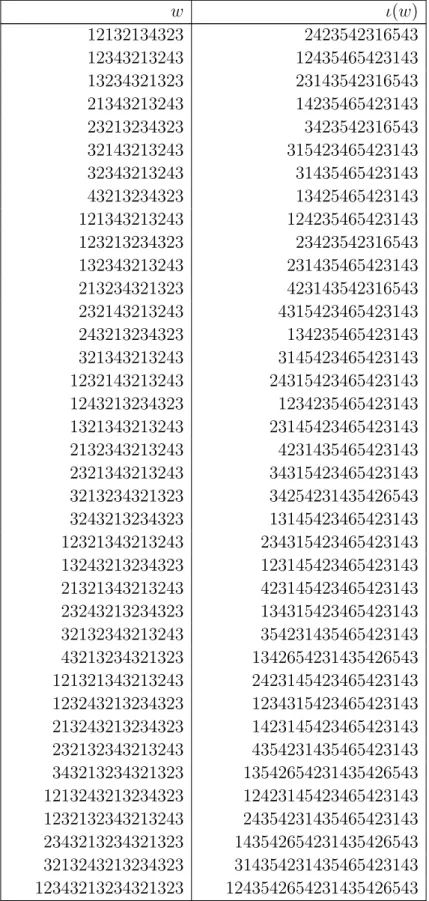
Table 7. WP˜1 →WP2 mapping for (F 4, E6) . . . 61
Table 8. WP˜2 →WP4 mapping for (F4, E6) . . . 62
Table 9. WP˜3 →WP3 mapping for (F 4, E6) . . . 64
Table 10. WP˜4 →WP1 mapping for (F 4, E6) . . . 67
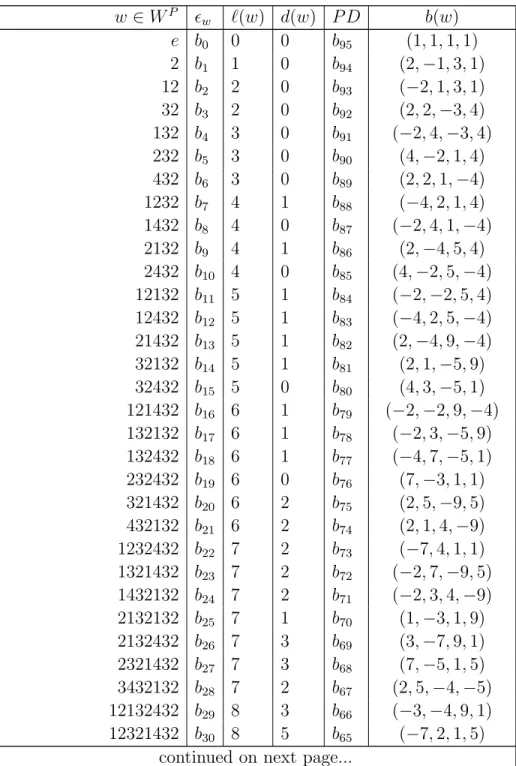
Table 11. Schubert classes for G2/P1 . . . 68
Table 12. Schubert classes for G2/P2 . . . 68
Table 13. Multiplication table for G2/P2 . . . 68
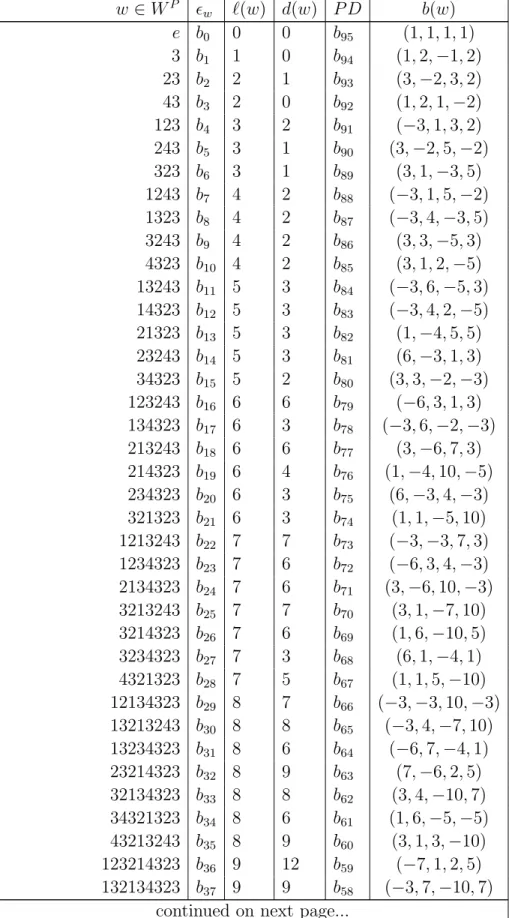
Table 14. Schubert classes for D4/P1 . . . 68
Table 15. Multiplication table for D4/P1 . . . 69
Table 16. Schubert classes for D4/P3 . . . 69
Table 18. Schubert classes for D4/P4 . . . 70
Table 19. Multiplication table for D4/P4 . . . 70
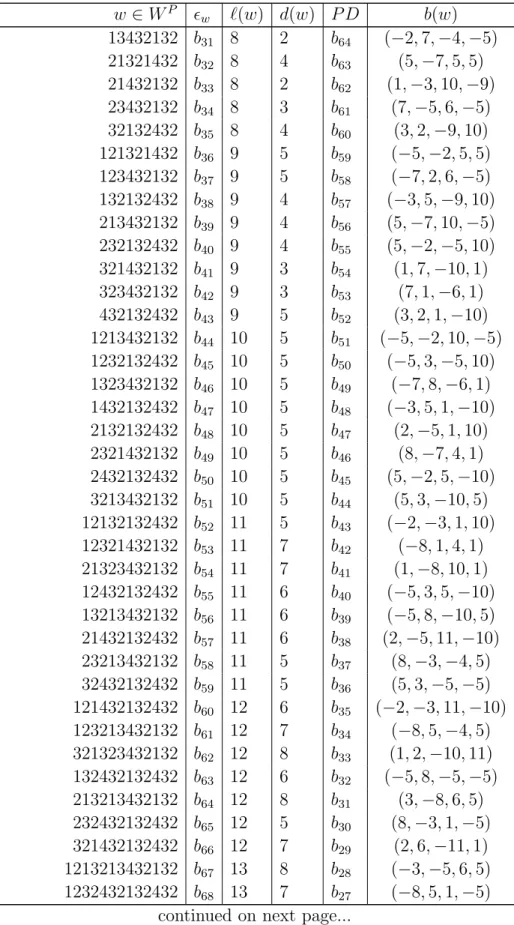
Table 20. Schubert classes for F4/P1 . . . 70
Table 21. Multiplication table for F4/P1 . . . 71
Table 22. Schubert classes for F4/P2 . . . 73
Table 23. Multiplication table for F4/P2 . . . 75
Table 24. Schubert classes for F4/P3 . . . 81
Table 25. Multiplication table for F4/P3 . . . 83
Table 26. Schubert classes for F4/P4 . . . 87
Table 27. Multiplication table for F4/P4 . . . 88
Table 28. Schubert classes for E6/P1 . . . 89
Table 29. Multiplication table for E6/P1 . . . 90
Table 30. Schubert classes for E6/P2 . . . 94
Table 31. Multiplication table for E6/P2 . . . 96
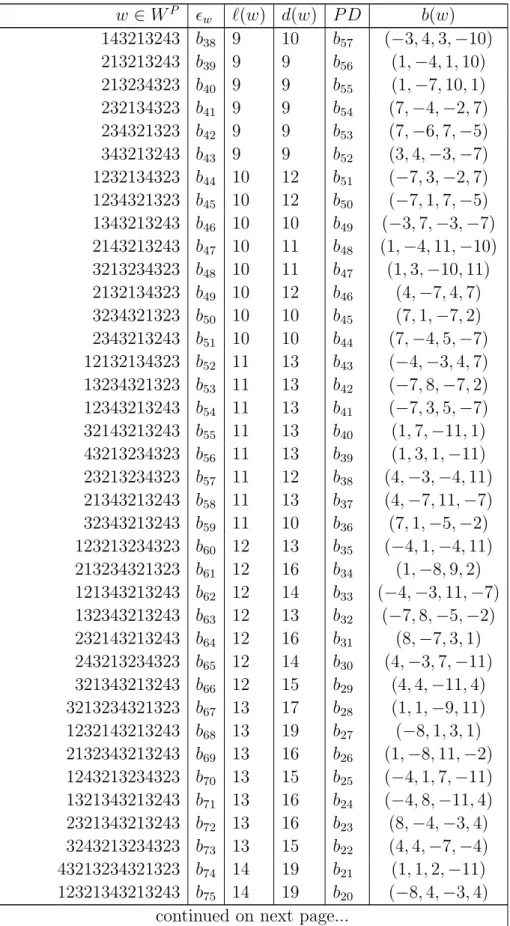
Table 32. Schubert classes for E6/P3 . . . 109
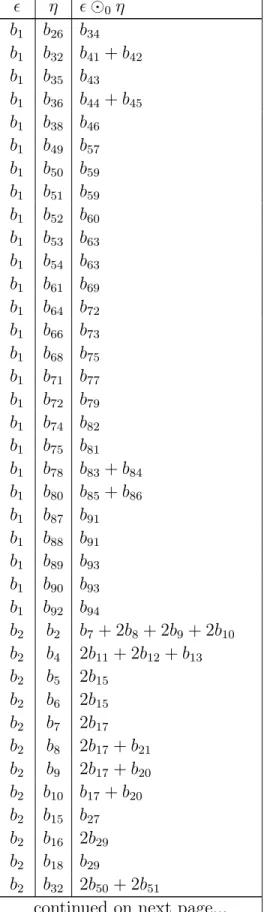
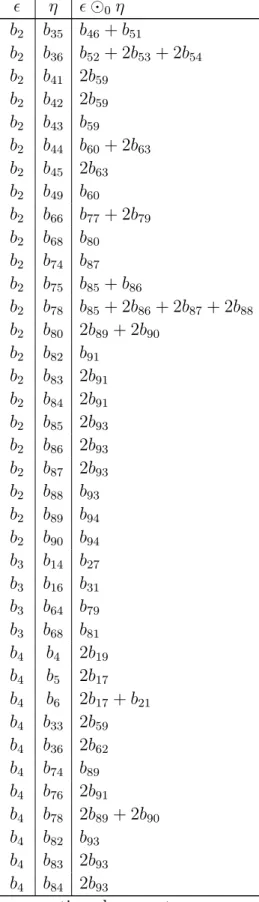
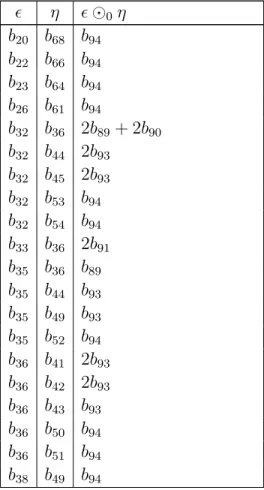
Table 33. Multiplication table for E6/P3 . . . 115
Table 34. Schubert classes for E6/P4 . . . 153
Table 35. Multiplication table for E6/P4 . . . 172
Table 37. Multiplication table for E6/P5 . . . 292
Table 38. Schubert classes for E6/P6 . . . 331
CHAPTER 1
Introduction
Let G be a connected complex semisimple algebraic group. Choose a maximal
compact subgroup K of G with Lie algebra k. There is a natural homeomorphism
c : k/K → h+, where K acts on k by the adjoint representation and h+ is the
domi-nant Weyl chamber. The inverse map c−1 takes any h ∈ h+ to the K-conjugacy class
of ih. The main aim of the generalized eigenvalue problem is to describe the eigencone
ˆ
Γ(G, K, s), which is given by:
ˆ
Γ(G, K, s) ={(h1, . . . , hs)∈h+s :∃(k1, . . . , ks)∈ks with s
X
j=1
kj = 0 andc(kj) = hj}.
For an algebraic group homomorphism ˜G→Gwhich takes ˜K →K and ˜h+→h+, where
˜
K is a maximal compact subgroup for ˜G and ˜h+ is the dominant Weyl chamber of ˜G,
there is an induced map ˆΓ( ˜G,K, s˜ )→Γ(ˆ G, K, s).
In this work, we compare the eigencones between a groupGand a certain subgroup ˜G
in two specific cases. In the first case, we consider the simply-connected simple complex
algebraic group of type D4. This group has an outer automorphism induced from the
order three symmetries of its Dynkin diagram and the resulting fixed point subgroup is of
typeG2. In the second case, we consider the simply-connected simple complex algebraic
group of type E6. Similarly, this group has an outer automorphism induced from its
Dynkin diagram symmetry and the resulting fixed point subgroup is of type F4. Under
both of these embeddings, we can take dominant chambers so that the dominant Weyl
chamber of the subgroup ˜Gmaps into the dominant Weyl chamber of the ambient group
1.1. Historical context
Determining the eigencone for the case when s = 3 and G = SL(n) is equivalent
to classical Hermitian eigenvalue problem which can be stated as follows: Given n×n
Hermitian matrices A and B with (real) eigenvalues α = (α1 ≥ . . . ≥ αn) and β = (β1 ≥ . . .≥ βn) respectively, what are the possible eigenvalues γ of a Hermitian matrix
C =A+B?
To see the equivalence, let K be the special unitary group SU(n) ⊂ SL(n) which acts on k=su(n), the Lie algebra of traceless skew-Hermitian matrices, by conjugation.
The torus H is the subgroup of diagonal matrices with determinant one and h+ is the
set of traceless diagonal matrices with decreasing real entries along the diagonal. By the
spectral theorem, any Hermitian matrix Ais diagonalizable via conjugation by a unitary
matrix. The resulting diagonal form will have real entries, it is given by −c(iA), wherec
is the homeomorphism given above. It follows that possible triples of eigenvalues (α, β, γ)
are given by the set ˆΓ(SL(n), SU(n),3). By replacing C with−C, we recover the classic problem.
We are concerned with the case where ˜G is of type G2 (resp. F4) and embedded in G which is of type D4 (resp. E6). Under this embedding, we can choose ˜h+ ,→ h+.
Therefore, we can compare the eigencones naturally.
The classical Hermitian eigenvalue problem was first considered by Hermann Weyl in
1912 [24] where he studied conditions on triples of eigenvalues (α, β, γ). However, it was
not until 1962 that Alfred Horn [11] undertook a systematic study of the inequalities
that α, β, γ must satisfy. He conjectured a system of inequalities that would give both
necessary and sufficient conditions for such a triple (α, β, γ) to arise. An immediate and
necessary condition is the trace condition:
X
i
γi =
X
i
αi+
X
i
In addition to exhibiting various necessary inequalities, he conjectured a list of sufficient
inequalities all having the same form:
(1) X
k∈K
γk ≤
X
i∈I
αi+
X
j∈J
βj
for some triple of subsetsI, J, K ⊂ {1, . . . , n} of the same cardinality.
In 1998, Alexander Klyachko [16] made crucial connections between the Hermitian
eigenvalue problem, representations of the general linear group, and the Schubert calculus
of the Grassmannian using Geometric Invariant Theory. William Fulton produced a very
nice summery of Klyachko’s work and consequences in a survey paper [10].
1.1.1. Schubert calculus. Klyachko, combined with the work of Knutson and Tao on
the ‘Saturation Conjecture’ [17], proved Horn’s original conjecture in [16]. To describe
the list, let V be an n dimensional complex vector space and fix some 1≤r < n. There is a bijection between subsets of I ⊂ {1, . . . , n} of size r and Young diagrams contained in a rectangular box with r rows and n−r columns. Given I = {i1 < · · · < ir}, let
YI denote the Young diagram with n−r+j −ij boxes in the j-th row. The diagram
YI corresponds, in the usual way [9], to a Schubert cycle sI in the cohomology ring (or
Chow ring) of the Grassmannian
Gr(r, n) ={W ⊂V :W is a subspace ofV, dimW =r}.
The following theorem of Klyachko connects the Schubert calculus of the
Grassman-nian to our desired list of inequalities.
Theorem 1 (Theorem 1.2 in [16]). For any 1≤ r < n, consider a triple of subsets
I, J, K ⊂ {1, . . . , n} of size r such that the Schubert cycle sK is a component of sI·sJ.
Then, inequality (1) holds and, in union with the trace identity, these inequalities form
a complete set of restrictions on the eigenvaluesα, β, γ of Hermitian matrices A, B, and
To determine the eigencone for an arbitrary semisimple connected complex algebraic
group G, the Grassmannian is replaced with the homogeneous spaceG/P, whereP is a
maximal parabolic subgroup. A necessary and sufficient list of inequalities for the general
case will be given by the ring structure of the cohomology ring of G/P in an analogous
fashion. The general case was proved by Berenstein and Sjamaar [4] with improvements
by Kapovich, Leeb and Millson [13] and further improvements by Belkale and Kumar
[2]; see the discussion in Chapter 5 and Theorem 22.
1.1.2. Representation theory. Klyachko’s work marks the first appearance of the
saturated tensor cone forGL(n,C) which we will describe here. Letα={α1 ≥ · · · ≥αn}, where each αi ∈Z, and associate to α the following dominant character ofGL(n,C):
ˆ
α: diag(h1, h2, . . . , hn)7→hα11h
α2 2 · · ·h
αn
n .
The irreducible finite diminensional representations of GL(n,C) are parameterized by
such dominant characters. LetV( ˆα) denote the corresponding representation. Klyachko
proved the following theorem:
Theorem 2. The irreducible representation V(Nγˆ) is a component of V(Nαˆ) ⊗
V(Nβˆ) for some positive integer N ≥ 1 if and only if α, β and γ are eigenvalues of Hermitian operators A, B, and C=A+B.
It is not clear whether one can always takeN = 1. This remark is discussed later in
the introduction and in Chapter 4. This theorem marks a deep connection between the
Hermitian eigenvalue problem and the representation theory of GL(n,C).
As mentioned earlier, determining the eigencone for a semisimple connected complex
algebraic group G is the generalization of the classic Hermitian eigenvalue problem. To
connect the eigencone to the representations of G in the general case, we recall some
facts from representation theory and introduce two new cones: the tensor cone and the
For any semisimple connected complex algebraic group G, the irreducible
finite-dimensional representations ofGare parameterized by the set X(H)+ of dominant
char-acters of H (or dominant integral weights of h), where H is a maximal torus of G. Let
V(λ) denote such a representation forλ∈X(H)+. By the complete reducibility theorem,
for any λ, µ∈X(H)+, we can decompose the tensor product
V(λ)⊗V(µ) = M ν∈X(H)+
mνλ,µV(ν)
where mν
λ,µ ∈Z≥0 denotes the multiplicity ofV(ν) in V(λ)⊗V(µ). Thetensor product
decomposition problem is to determine the numbersmν
λ,µ. Of course,mνλ,µis the dimension
of the subspace ofG-invariants inV(λ)⊗V(µ)⊗V(ν∗), whereν∗ =−w0νso thatV(ν∗) is the dual representation toV(ν), where w0 ∈W denotes the longest element in the Weyl
group W. The tensor product decomposition problem is a special case of classifying
(λ1, . . . , λs) ∈ (X(H)+)s such that [V(λ1)⊗ · · · ⊗ V(λs)]G 6= 0 and determining its dimension. Let Γ0(G, s) denote the tensor cone defined by
Γ0(G, s) = {(λ1, . . . , λs)∈(X(H)+)s: [V(λ1)⊗ · · · ⊗V(λs)]G6= 0}.
A weaker problem (the saturated tensor product decomposition problem) is to
deter-mine if V(N λ1)⊗ · · · ⊗V(N λs) has G-invariants for some N ≥ 1. Let Γ(G, s) denote the saturated tensor cone defined by
Γ(G, s) = {(λ1, . . . , λs)∈(X(H)+)s: [V(N λ1)⊗ · · · ⊗V(N λs)]G 6= 0 for some N ≥1}.
By virtue of a convexity result in symplectic geometry, there exists a (unique) convex
polyhedral cone Γ ⊂ (X(H)+ ⊗ZR)
s such that Γ(G, s) = Γ∩(X(H)
+)s, as shown by
Sjamaar in [23].
The definition of the tensor cone and saturated tensor cone are still valid for G =
GL(n,C). Theorem 2 draws a deep connection between the eigencone of GL(n,C) and
As mentioned above, it is not clear that one can take N = 1 in Theorem 2 which
would relate the eigencone and the tensor cone. However, in 1999, A. Knutson and T.
Tao [17] proved the saturation conjecture asserting that we can take N = 1.
Theorem 3 (Saturation Theorem). If V(Nγˆ) is a component of V(Nαˆ)⊗V(Nβˆ)
for some N ≥ 1, then V(ˆγ) is a component of V( ˆα)⊗V( ˆβ); that is, Γ(GL(n,C),3) = Γ0(GL(n,C),3).
In [23], Sjamaar gives an explicit connection between the saturated tensor cone and
the eigencone whenGis an arbitrary complex semisimple group, essentially proving that
they are equivalent problems. In particular, upon identifying h with h∗ via the Killing
form,
X(H)s+∩Γ(ˆ G, K, s) = Γ(G, s).
Therefore, determining the eigencone and the saturated tensor cones are essentially
equiv-alent problems.
1.1.3. Other work. The body of work mentioned above confirmed Horn’s conjecture
and resulted in a list of inequalities characterizing the saturated tensor cone and eigencone
for arbitrary complex semisimple G. As mentioned above, this list of inequalities is
parameterized by the the Schubert calculus of the generalized flag varieties G/P, where
P is any maximal parabolic subgroup.
In general, this system is overdetermined. For the original Hermitian eigenvalue
problem, P. Belkale found a simplified system of inequalities [1] which was subsequently
proved to be irredundant by Knutson, Tao, and Woodward [18]. For an arbitrary complex
semisimple G, Belkale and Kumar found a (much) smaller list of inequalities in [2] by
introducing a new product in the cohomology of G/P in 2006. Theire list of inequalities
1.2. Results
Suppose that for a simple complex algebraic group G and a connected semisimple
subgroup ˜G ,→G, we have the following:
˜
K =K∩G˜ and ˜h+ ,→h+,
where ˜K is a maximal compact subgroup in ˜G, K is a maximal compact subgroup ofG,
˜
h+ denotes the dominant chamber of ˜G, andh+denotes the dominant chamber of G. By
functorality of the eigencone, it follows that ˆΓ( ˜G,K, s˜ ) ⊂ Γ(ˆ G, K, s). Conversely, is it the case that
ˆ
Γ( ˜G,K, s˜ ) = ˆΓ(G, K, s)∩h˜s+?
Recent work by Belkale and Kumar [3] confirmed this question for the group and
subgroup pairs Sp(2n)⊂ SL(2n) and SO(2n+ 1)⊂SL(2n+ 1). The subgroup Sp(2n) (resp. SO(2n+ 1)) arises as a fixed point subgroup of an order two outer automorphism
induced from the symmetry of the Dynkin diagram of SL(2n) (resp. SL(2n+ 1)). The
details of these embeddings are given in Chapter 3.
In general, they conjectured that this would be the case for any connected
simply-connected semisimple complex algebraic group G with fixed point subgroup ˜G := Gσ
where σ is a diagram automorphism.
We consider two cases. In the first case, we will consider the simply-connected simple
complex algebraic group of typeD4. This group has an outer automorphism induced from
the order three symmetries of its Dynkin diagram and the resulting fixed point subgroup
is of type G2. In the second case, we will consider the simple connected simple complex
algebraic group of type E6. Similarly, this group has an outer automorphism of order 2
induced from its Dynkin diagram symmetry and the resulting fixed point subgroup is of
In the following theorem, ( ˜G, G) are of type (G2, D4) or (F4, E6) as described above,
with compatible maximal compact subgroups ( ˜K, K) and dominant Weyl chambers
(˜h+,h+).
Theorem 4. Let h= (h1, h2, h3)∈h˜3+. Then,
h∈Γ( ˜ˆ G,K,˜ 3) if and only if h∈Γ(ˆ G, K,3).
Since the eigencone and the saturated tensor cones are identified under the Killing
form, we have the following result:
Theorem 5. If (λ1, λ2, λ3)∈Γ(G,3), then (˜λ1,λ˜2,λ˜3)∈Γ( ˜G,3), where ˜λi =λi|˜h.
For the pair ( ˜G, G) of type (G2, D4), we can strengthen Theorem 5 by replacing the
saturated tensor cone with the tensor cone.
Theorem6. Let( ˜G, G)be the pair(G2, D4). If(λ1, λ2, λ3)∈Γ0(G,3), then(˜λ1,λ2,˜ λ3˜ )∈
Γ0( ˜G,3), where λ˜i =λi|˜h.
The proofs of the above results depend on Theorem 24, a combinatorial result on
the cohomology of certain homogeneous spaces associated to ˜G and G. For now, we
postpone stating this theorem (see Chapter 6). This theorem is proven via a computer
program which was developed to do calculations in the Schubert calculus of G/P where
CHAPTER 2
Notation and Preliminaries
2.1. Algebraic groups and their Lie algebras
Let G be a connected semisimple complex algebraic group. A Borel subgroup B is
any maximal connected, solvable subgroup; any two of which are conjugate to each other.
A torus of G is any subgroup isomorphic to (C∗)k for some k > 0. We will fix a Borel
subgroup and a maximal torusH contained inB. If H is isomorphic to (C∗)n, we call n
the rank of G. Let W =WG:=NG(H)/H be the associated Weyl group, where NG(H)
is the normalizer of H in G. Also, let X(H) denote the character group of H; that is,
X(H) is the group of all algebraic group homomorphismsH →C∗.
The Lie algebras of G, B, and H are denoted by g,b, and h. Let R ⊂h∗ denote the set of roots of g (with respect toh). That is, g decompose as follows:
g=h⊕M
α∈R gα,
where gα :={x ∈g: [h, x] =α(h)x for all h ∈h}. Our choice of B gives rise to R+, the set of positive roots, such that
b=h⊕ M
α∈R+
gα.
We let ∆ = {α1, . . . , αn} ⊂ R+ be the (unique) set of simple roots determined by
R+. All other positive roots are nonnegative integral combinations of elements in ∆. The
elements of ∆ are linearly independent and form a basis of h∗.
by conjugation and the exponential map:
Ad(g)(X) = d
dtgexp(tX)g
−1|
t=0.
When G is a matrix group then Ad(g) is just conjugation by g. The derivative of the
adjoint representation is denoted ad : g→End(g) and given by the Lie algebra bracket ad(X)(Y) = [X, Y].
The Killing form κ:g×g→Cdefined byκ(X, Y) = Tr(adX◦adY) is a symmetric bilinear form ong which is invariant in the sense that κ([X, Y], Z) +κ(X,[Y, Z]) = 0 for
all X, Y, Z ∈ g. One criteria for G being semisimple is that κ is nondegenerate. When
G is simple, κ is unique up to a scalar. Furthermore, the restriction of κ to h remains
nondegenerate and provides a natural identification of h and h∗.
Since H is abelian, W acts on H by conjugation in a natural way. Via the adjoint
representation of G on g, the action of W on H extends to an action on h. Choose
any nondegenerate W-invariant symmetric form h,i on h (e.g., the Killing form). Such a form gives an identification of h with h∗. For any element α ∈ h∗, let α∨ denote the element ofhsuch that 2α∨/hα∨, α∨iis identified withα. Whenαis a root, we callα∨ the corresponding coroot and let ∆∨ = {α∨
1, . . . , α
∨
n} ⊂ h denote the set of simple coroots. The elements of ∆∨ form a basis of h. Also, we let R∨ denote the set of coroots.
For any 1≤j ≤n, define the elementxj ∈h by
αi(xj) = δij, for any 1≤i≤n,
and define ωj ∈h∗ by
ωj(α∨i) =δij, for any 1≤i≤n.
The set {ω1, . . . , ωn} is the set of fundamental weights. Let h+ ⊂ h be the dominant
chamber defined by
h+={h∈h:αi(h)∈R≥0∀αi}=
M
i
Likewise, let D⊂h∗ be the set of dominant weights defined by
D={λ∈h∗ :λ(αi∨)∈R≥0∀α∨i}=
M
i
R≥0ωi.
Let X(H)+ denote the set of dominant characters of H. Taking derivatives, we get an
embedding X(H)+ →D. When G is simply-connected,X(H)+ can be identified with
DZ={λ∈h∗ :λ(α∨i)∈Z≥0∀α∨i}.
2.2. Weyl group
A concrete description of W can be given in terms of the simple roots and simple
coroots as a subgroup of the permutations of R or R∨. For each root α ∈ R, let sα : h∗ →h∗ denote the reflection given by
sα(β) =β−β(α∨)α.
One can show sα stabilizes R. Dual to this map issα∨ =s∗
α :h →h given by
sα∨(h) = h−α(h)α∨.
For each 1 ≤i ≤ n, let si denote the map si :=sα∨i. The set S ={s1, . . . , sn} is called the set of simple reflections (since these reflections correspond to simple roots). It is well
known that these simple reflections generate the Weyl group, when W is identified with
its action on h. When clear from the context, for each 1≤ i ≤n, we will also use si to denote sαi.
Using the fact that W = hs1, . . . , sni, we define a length function on W, denoted
` : W → Z≥0. For any w ∈ W, `(w) is defined to be the minimal k ∈ Z≥0 such that w=si1si2· · ·sik with eachsij ∈S. A decomposition w=si1si2· · ·sik is called a reduced
decomposition if `(w) =k. The unique element of greatest length is denoted w0 ∈W.
Lastly, we have the Bruhat decomposition:
G= G w∈W
BwB.
Although, w denotes a coset of NG(H)/H, the expression BwB is well defined since
H ⊂B.
2.3. Parabolic subgroups
Any subgroup ofG containing a Borel subgroup is called a parabolic subgroup. For a
fixed Borel subgroupB ⊂G, any subgroup P containingB is called astandard parabolic subgroup. The set of standard parabolic subgroups are in one-to-one correspondence with
subsets of the set [n] ={1,2, . . . , n}.
Specifically, suppose I ⊂ [n]. Define WI to be the subgroup of W generated by
{si :i∈I}. Then,
PI :=
G
w∈WI BwB
contains B and is a subgroup (hence it is a standard parabolic subgroup). Conversely, if
P is a standard parabolic subgroup, let
I ={i∈[n] : w∈P, where the coset w∈W is regarded as an element of NG(H), and w acts as si onh}.
Then, it can be shown that P =PI. For a standard parabolic subgroupP =PI, we will
denote WI by WP. See [19, Section 6.1] for more details.
From the above, when I = [n] it follows that PI = G and when I = ∅, then
PI =B. When P =PI withI obtained from [n] by deleting a single elementi∈[n], i.e.,
I ={1, . . . ,bi, . . . , n},P is called a maximal parabolic subgroup and denoted by Pi. To each standard parabolic subgroup P = PI, there is a unique Levi subgroup L of
l so that
l=h⊕M
α∈Rl gα.
Then, Rl ⊂ R contains precisely those roots spanned by ∆(P) := {αi : i ∈ I}. Let
Rl+ = R+∩Rl denote the positive roots of l with respect to the Borel subgroup BL :=
B∩L⊂L. Then,
p=h⊕ M
α∈R+
gα⊕
M
α∈R+l g−α.
Furthermore, the Weyl group of L, WL =NL(H)/H embeds in W as the subgroup WP.
The unique element of greatest length in WP is denoted w0,P.
We will also be interested in the cosets W/WP. In each coset there is a unique
representative of minimal length. Let WP denote the set of minimal length coset
repre-sentatives. If follows from the Bruhat-decompositon that
G= G
w∈WP BwP.
2.4. Generalized flag manifolds and intersection theory
For any parabolicP ⊂G, G/P is a smooth projective variety which admits a cellular decomposition. For any w∈WP, we have the Bruhat (or Schubert) cell
ΛPw =BwP/P ⊂G/P.
This is a locally closed subset of the flag varietyG/P isomorphic to affine spaceC`(w). Its
closure is denoted by XwP = ΛP
w, which is an irreducible projective variety of dimension
`(w). The closure of ΛP
w is alsoB-stable. Therefore, it is a disjoint union of Bruhat cells
and those occurring in the closure are given by the Bruhat-Chevalley ordering:
XwP = G v≤w
ΛPv = G v≤w
BvP/P.
We denote by [XP
We will use σP w ∈ H
∗(G/P) to denote cycle class of [XP
w] in the integral singular
cohomology ofG/P. That is, σP
w is the cohomology class associated to [XwP] by Poincar´e
duality. Let {P
w : w ∈ WP} denote the dual basis of H∗(G/P) to {[XwP] : w ∈ WP}. That is, under the Kronecker pairing, we have forw, u∈WP,
hP w, X
P
ui=δw,u.
One should note that σwP =Pw0ww0,P, where w0 is the longest word in W and w0,P is the longest word inWP (see Lemma 2.9 in [20]).
Before addressing the usual multiplication in the ringH∗(G/P), we make an
observa-tion. Let πP :G/B →G/P be the projection. Then the induced mapπP∗ :H∗(G/P)→
H∗(G/B) is injective with image precisely equal to theWP-invariants ofH∗(G/B).
More-over, forw∈WP,π∗
P(Pw) = w, where we are abbreviatingBw byw, andπ∗P(σwP) = σww0,P
similarly. Therefore, it suffices to address the multiplicative structure of H∗(G/B).
Since {σw :=σwB :w∈ W} is aZ-basis of H
∗(G/B), understanding the cup product
in H∗(G/B) reduces to determining the structure coefficients dwu,v ∈ Z, u, v, w ∈ W, called the Littlewood-Richardson coefficients, given by the equations:
σu ·σv =
X
w∈W
dwu,vσw.
A later section of this document will be dedicated to calculating these coefficients quickly
with the aid of a computer.
In the meantime, we have a geometric interpretation of these numbers. Letw∨ =w0w
for each w∈W. Fix some u, v, w ∈W such that
(1) codim(ΛBu) + codim(ΛBv) + codim(ΛBw∨) = dimG/B,
which implies `(u) +`(v) =`(w). Recall the following useful theorem of Kleiman:
Theorem 7 (Kleiman’s Transversality Theorem, [15]). Let a connected algebraic
closed subvarieties of X. Then, there exists a non empty open subset U ⊂Gs such that
for (g1, . . . , gs) ∈ U, the intersection
Ts
j=1gjXj is proper (possibly empty) and dense in Ts
j=1gjXj.
Moreover, if Xj, j = 1, . . . , s, are smooth varieties, we can find such a U with the
additional property that for (g1, . . . , gs) ∈ U,
Ts
j=1gjXj is transverse at each point of
intersection.
Applying this theorem to the case when G acts on G/B, it follows that for generic
(g1, g2, g3)∈G3, the intersection
g1ΛBu ∩g2ΛBv ∩g3ΛBw∨
is transverse at each point of intersection and dense ing1XuB∩g2XvB∩g3XwB∨. It follows
from equation (1) that the former intersection is a finite number of points and the density
statement implies the latter intersection is also a finite collection of points (of the same
number). Via Poincar´e duality and the identification of cohomology with the Chow ring,
σu·σv ·σw∨ =dw
u,vσe ∈H2 dimG/B(G/B,Z),
CHAPTER 3
Details on specific groups
In this section, we will review details on specific complex algebraic groups. We will
also give explicit embeddings of some groups as subgroups of others arising as the fixed
point subgroup of an outer automorphism induced by a Dynkin diagram symmetry.
We are interested inσ which arise from symmetries in the Dynkin diagrams of simple
complex algebraic groups. For example, the diagrams of type An, Dn (specifically D4)
and E6 have symmetries. Recall that the nodes of the Dynkin diagrams correspond to
simple roots (or coroots). Therefore, a symmetry in the Dynkin diagram induces an
automorphism σ : ∆∨ →∆∨. The set of simple coroots forms a basis of h, so we get an automorphism of h
Of course, σ also induces a dual transformation on h∗. There is a unique extension
σ :h →hto a Lie algebra homomorphismσ:g→gusing a suitable choice of a Chevalley basis. In particular, for eachα ∈R, whereR denotes the root system, there are elements
Xα, Yα, andα∨ which span sl2(α) :=gα⊕g−α⊕Cα∨, which is isomorphic to sl2 (see the
next subsection for information on sl2). Then, σ(Xα) := Xσ(α), σ(Yα) := Yσ(α), and α∨
should be mapped accordingly by σ. Furthermore, σ can be lifted to an algebraic group
automorphism G→G whenG is taken to be simply-connected.
Henceforth, ˜G := Gσ will denote the fixed point subgroup as described above. We
maintain the notational convention that if any symbol or structure is associated to ˜Gin
a natural way, in the same way that a symbol or structure is associated toG, then it will
be denoted with a ∼. For example, ∆ will denote the simple roots of g := Lie(G), but ˜
3.1. Special linear group SL(n+ 1)
Our discussion of the special linear group will follow Belkale and Kumar’s in [3]. If
V is a complex vector space of dimensionn+ 1, then GL(V) denotes the set of invertible
C-linear operatorsV →V. If we choose a basis, we can identify V withCn+1 andGL(V)
with GL(n+ 1), where GL(n+ 1) denotes the group of nonsingular (n + 1)×(n+ 1) complex matrices. The complex special linear group SL(n+ 1) ⊂ GL(n + 1) consists of those matrices of determine one. Our preferred Borel subgroup B ⊂ SL(n+ 1) will be the subgroup of upper triangular matrices with determinant one. Similarly, we fix a
maximal torus H consisting of diagonal matrices with determinant one.
The Lie algebra ofSL(n+ 1) is denotedsln+1and consists of (n+ 1)×(n+ 1) traceless
matrices. The Dynkin diagram An corresponding to this complex simple Lie algebra is
given in Figure 1.
Our choice of torus gives the Cartan subalgebra
h={diag(h1, . . . , hn+1) : X
i
hi = 0}
and
h+ ={h∈h :hi ∈Rand h1 ≥ · · · ≥hn+1}.
For any 1≤i≤n and h∈h,
αi(h) = hi −hi+1
α∨i = diag(0, . . . ,0,1,−1,0, . . . ,0),where the 1 is in the i-th position, ωi(h) = h1 +· · ·+hi, and
xi = diag
n+ 1−i n+ 1 , . . . ,
n+ 1−i n+ 1 ,−
i
n+ 1, . . . ,−
i n+ 1
,
where the first i terms are n+ 1−i
n+ 1 .
The Weyl group W can be identified with the symmetric group Sn+1 which acts via
1 2 3 4 5 n An
n n−1
1 2 3 4
Bn
n n−1
1 2 3 4
Cn
1 2 3 4 n−2
n−1
n Dn
Figure 1. Dynkin diagram of classical types
transpositions:
si(diag(h1, . . . , hn+1)) = diag(h1, . . . , hi+1, hi, . . . , hn+1).
3.2. Symplectic group Sp(2n)
Our discussion of the symplectic group group will follow Belkale and Kumar’s in [3].
LetV =C2n be equipped with the nondegenerate symplectic formh,i so that its matrix
E = (hvi, vji)1≤i,j≤2n in the standard basis {v1, . . . , v2n} is given by
E =
0 J
−J 0
,
where J is the n×n matrix with 1 along the anti-diagnal. Let G denoteSL(2n) and ˜G
denote the associated symplectic group
˜
G=Sp(2n) = {g ∈SL(2n) :hgv, gwi=hv, wi for all v, w∈V}.
Clearly, Sp(2n) can be realized as the fixed point subgroup ˜G = Gσ under the
from symmetry of the A2n−1 diagram given by reversing the nodes. The involution
sta-bilizes both B and H, where B and H are as in the SL(2n) case. Moreover, ˜B := Bσ
(respectively, ˜H :=Hσ) is a Borel subgroup (respectively, a maximal torus) of Sp(2n).
Let ˜g denote the Lie algebra ˜g := gσ of Sp(2n), which is simple and whose Dynkin
diagram Cn is given in Figure 1. The Lie algebra of ˜H is
˜
h ={diag(h1, . . . , hn,−hn, . . . ,−h1) :hi ∈C}.
Let ˜∆ = {α˜1, . . . ,α˜n}. Then, for any 1 ≤ i ≤ n, ˜αi = αi|˜h where {α1, . . . , α2n−1} are
the simple roots of SL(2n). The corresponding (simple) coroots ˜∆∨ ={α˜1∨, . . . ,α˜∨n} are given by
˜
α∨i =α∨i +α∨2n−i, for 1≤i < n
and ˜α∨n =αn∨.Thus,
˜
h+ ={diag(h1, . . . , hn,−hn, . . . ,−h1) :hi ∈R and h1 ≥ · · · ≥hn≥0}.
Moreover, h+ isσ-stable and hσ+ = ˜h+.
We also have that
˜
xi =xi+x2n−i, for 1≤i < n,
and ˜xi =xn. The fundamental weights are given by, for h∈˜h:
˜
ωi(h) =h1+· · ·+hi.
Note, ωi|˜h = ˜ωi.
Let {s˜1, . . . ,s˜n} be the simple reflections in the Weyl group ˜W of ˜G. Since H is
σ-stable, it follows NG(H) is σ-stable and there is an induced action of σ on the Weyl
groupW =S2n of G=SL(2n). The Weyl group ˜W can be identified with the subgroup of σ-invariants, ˜W =Wσ. Under the inclusion ˜W ⊂W, we have
˜
and ˜sn =sn.
3.3. Special orthogonal group SO(2n+ 1)
Our discussion of the odd special orthogonal group will follow Belkale and Kumar’s
in [3]. Let V = C2n+1 be equipped with the non degenerate symmetric form h,i so
that its matrixE = (hvi, vji)1≤i,j≤2n+1 in the standard basis{v1, . . . , v2n} is given by the (2n+1)×(2n+1) anti-diagonal matrix whose entries are 1 along the anti-diagonal except in the (n+ 1)×(n+ 1) position, which has a 2. Let G denoteSL(2n+ 1) and ˜Gdenote the associated special orthogonal group
˜
G=SO(2n+ 1) :={g ∈SL(2n+ 1) :hgv, gwi=hv, wi for all v, w∈V}.
Clearly, SO(2n+ 1) can be realized as the fixed point subgroup ˜G = Gσ under the
involution σ : G → G defined by σ(g) = E−1(gt)−1E. This outer automorphism is induced from symmetry of theA2ndiagram given by reversing the nodes. The involution stabilizes both B and H, where B and H are as in the SL(2n + 1) case. Moreover,
˜
B :=Bσ (respectively, ˜H :=Hσ) is a Borel subgroup (respectively, a maximal torus) of
SO(2n+ 1).
Let ˜gdenote the Lie algebra ˜g:=gσ ofSO(2n+1), which is simple and whose Dynkin
diagram Bn is given in Figure 1. The Lie algebra of ˜H is
˜
h={diag(h1, . . . , hn,0,−hn, . . . ,−h1) :hi ∈C}.
Let ˜∆ = {α˜1, . . . ,α˜n}. Then, for any 1 ≤ i ≤ n, ˜αi = αi|˜h where {α1, . . . , α2n} are the simple roots of SL(2n+ 1). The corresponding (simple) ˜∆∨ ={α˜∨1, . . . ,α˜∨n}are given by
˜
α∨i =α∨i +α∨2n+1−i, for 1≤i < n
and ˜α∨n = 2α∨n + 2α∨n+1. Thus,
˜
Moreover, h+ isσ-stable and hσ+ = ˜h+.
We also have that
˜
xi =xi+x2n+1−i, for 1≤i≤n.
The fundamental weights are given by, for h∈˜h:
˜
ωi(h) = h1+· · ·+hi, for i < n and ˜
ωn(h) = 1
2(h1+· · ·+hn). Note, ωi|˜h = ˜ωi for i < n and 12ωn|˜h = ˜ωn.
Let {s˜1, . . . ,s˜n} be the simple reflections in the Weyl group ˜W of ˜G. Since H is
σ-stable, it follows NG(H) is σ-stable and there is an induced action of σ on the Weyl
groupW =S2n of G=SL(2n). The Weyl group ˜W can be identified with the subgroup
of σ-invariants, ˜W =Wσ. Under the inclusion ˜W ⊂W, we have
˜
si =sis2n+1−i, if 1≤i < n,
and ˜sn =snsn+1sn.
3.4. Special orthogonal group SO(2n)
Let V = C2n be equipped with the nondegenerate symmetric form h,i so that the matrixJ = (hvi, vji)1≤i,j≤2nin the standard basis{v1, . . . , v2n}is the 2n×2nmatrix with 1’s along the anti-diagonal. The associated quadratic form on V is given by
Q(
2n
X
i=1
tivi) = n
X
i=1
tit2n+1−i.
Let
G=SO(2n) = {g ∈SL(2n) :g leaves the quadratic form Qinvariant}
be the associated special orthogonal group. Clearly, SO(2n) can be realized as the
fixed point subgroup SL(2n)σ under the involution σ : SL(2n) → SL(2n) defined by
Dynkin diagram. The involution still keeps both the Borel subgroup of SL(2n) (the
upper triangular matrices) and the maximal torus of SL(2n) (the diagonal matrices)
stable. Moreover, the fixed points of these groups form a Borel subgroup and a maximal
torus for SO(2n), respectively.
Let g denote the Lie algebra of SO(2n). Note that SO(2n) is not the semisimple
simply-connected complex algebraic group of type Dn, which is Spin(2n) but details
on Spin(2n) will not be needed. We only need information on the Lie algebra g =
Lie(SO(2n)), which consists of 2n×2nmatrices which satisfy the relationXtJ+J X = 0.
This Lie algebra is simple and its Dynkin diagram Dn is given in Figure 1.
The Lie algebra of H is
h ={diag(h1, . . . , hn,−hn, . . . ,−h1) :hi ∈C}.
For 1≤i≤n, let ei denote the diagonal matrix with all zeroes except for a 1 in the i-th entry and a −1 in the (2n+ 1−i)-th entry. Then, in the basis{ei}, an element of h has coordinates (h1, . . . , hn).
The simple coroots ∆∨ ={α∨
1, . . . , α
∨
n} ⊂h are given by
α∨i =ei−ei+1, for 1≤i < n, and α∨n =en−1+en.
Similarly, the simple roots ∆ ={α1, . . . , αn} ⊂h∗ are given by
αi =e∗i −e ∗
i+1, for 1≤i < n, and αn =e∗n−1+e
∗ n.
The fundamental weights {ω1, . . . , ωn} ⊂h∗ are given by
ωi = e∗1+· · ·+e
∗
i, for 1≤i < n−1,
ωn−1 =
1 2(e
∗
1+· · ·+e
∗ n−1−e
∗
n), and
ωn = 1 2(e
∗
1+· · ·+e
∗ n−1+e
Likewise, the vectors {x1, . . . , xn} ⊂h are given by
xi = e1 +· · ·+ei, for 1≤i < n−1,
xn−1 =
1
2(e1+· · ·+en−1−en), and
xn = 1
2(e1+· · ·+en−1+en).
The dominant chamber h+ is given by elements (h1, . . . , hn)∈h satisfying:
h1 ≥ · · · ≥hn−1 ≥ |hn|.
Let{s1, . . . , sn}be the simple reflections in the Weyl group W of g corresponding to the simple roots {α1, . . . , αn}. The actions of the simple reflections can be described on the coordinates (h1, . . . , hn) of h∈h (as above) by the following:
si(h1, . . . , hn) = (h1, . . . , hi+1, hi, . . . , hn), for 1≤i < n, and
sn(h1, . . . , hn) = (h1, . . . , hn−2,−hn,−hn−1).
3.5. Type G2
In this section, we will describe the complex simple Lie algebra of type G2, denoted
by ˜g, as a subalgebra of the complex simple Lie algebra of type D4, denoted by g, as in
the previous section.
Consider the diagram automorphism σ of the Dynkin diagram of type D4 which
corresponds to a 120◦ rotation. Then, σ induces a permutation on the simple roots as
follows:
α1 7→α3 7→α4 7→α1, and α2 7→α2,
and similarly on the simple coroots. Therefore, σ gives a linear transformation on both
1 2
G2
1 2 3 4
F4
3 4 5 6
1
2
E6
Figure 2. Dynkin diagrams of exceptional types
It should be noted that this automorphism can be extended to an order three
au-tomorphism σ : Spin(8) → Spin(8), which is the universal cover of SO(8). However, bothSpin(8) andSO(8) have the same Lie algebras. The fixed point subalgebra of this
automorphism, ˜g := gσ, is an isomorphic copy of the Lie algebra of type G2, which is
simple and whose Dynkin diagram is given in Figure 2. A typical element of g = so(8)
has the following form:
a1,1 a1,2 a1,3 a1,4 a1,5 a1,6 a1,7 0 a2,1 a2,2 a2,3 a2,4 a2,5 a2,6 0 −a1,7 a3,1 a3,2 a3,3 a3,4 a3,5 0 −a2,6 −a1,6 a4,1 a4,2 a4,3 a4,4 0 −a3,5 −a2,5 −a1,5 a5,1 a5,2 a5,3 0 −a4,4 −a3,4 −a2,4 −a1,4 a6,1 a6,2 0 −a5,3 −a4,3 −a3,3 −a2,3 −a1,3 a7,1 0 −a6,2 −a5,2 −a4,2 −a3,2 −a2,2 −a1,2
0 −a7,1 −a6,1 −a5,1 −a4,1 −a3,1 −a2,1 −a1,1
It can be shown that a typical element of ˜g will have the form:
h1 a c d d e f 0
a0 h2 b c c d 0 −f c0 b0 h1−h2 a a 0 −d −e d0 c0 a0 0 0 −a −c −d d0 c0 a0 0 0 −a −c −d e0 d0 0 −a0 −a0 −h
1+h2 −b −c f0 0 −d0 −c0 −c0 −b0 −h
2 −a
0 −f0 −e0 −d0 −d0 −c0 −a0 −h
1 .
The Cartan subalgebra ˜h:=hσ is given by diagonal matrices of the above form. Let
˜
∆ ={α˜1,α˜2}denote the simple roots of ˜g. Then,
˜
α1 =
1
3(α1+α3 +α4)|˜h and α˜2 =α2|˜h. The corresponding simple coroots are given by
˜
α∨1 =α∨1 +α∨3 +α∨4 and α˜∨2 =α∨2.
Thus,
˜
h+ ={diag(h1, h2, h1−h2,0,0, h2−h1,−h2,−h1) :h1 ≥h2 ≥h1−h2}.
Moreover, h+ isσ–stable and hσ+ = ˜h+.
Furthermore, if {ω˜1,ω˜2} denote the fundamental weights for ˜g, then we have the
following relations on the restrictions of the fundamental weights of g:
˜
ω1 =ω1|˜h =ω3|˜h =ω4|˜h and ω˜2 =ω2|˜h.
Let{s˜1,˜s2} be the simple reflections in the Weyl group ˜W of ˜gcorresponding to the
simple roots {α˜1,α˜2}, respectively. Under the inclusion, ˜W ⊂W, we have
˜
3.6. Type E6
In this subsection, letgdenote the Lie algebra of typeE6, which is simple and whose
Dynking diagram is given in Figure 2.
Let {e1, . . . , e8} be the standard basis for C8. The root system of type E6 can be
described via the simple roots, ∆:
α1 = e∗1
2 −
e∗2
2 −
e∗3
2 −
e∗4
2 −
e∗5
2 −
e∗6
2 −
e∗7
2 +
e∗8
2
α2 = e∗1+e
∗
2 α3 = −e∗1+e
∗
2 α4 = −e∗2+e
∗
3 α5 = −e∗3+e
∗
4 α6 = −e∗4+e∗5.
The corresponding coroots are:
α∨1 = e1 2 − e2 2 − e3 2 − e4 2 − e5 2 − e6 2 − e7 2 + e8 2
α∨2 = e1+e2
α∨3 = −e1+e2
α∨4 = −e2+e3 α∨5 = −e3+e4 α∨6 = −e4+e5.
We identify the Cartan subalgebra h of the Lie algebra of type E6 with the span of the
The fundamental weights are given by:
ω1 = −
2e∗6
3 −
2e∗7
3 +
2e∗8
3
ω2 = e∗1
2 +
e∗2
2 +
e∗3
2 +
e∗4
2 +
e∗5
2 −
e∗6
2 −
e∗7
2 +
e∗8
2
ω3 = − e∗1
2 +
e∗2
2 +
e∗3
2 +
e∗4
2 +
e∗5
2 − 5e∗6
6 −
5e∗7
6 +
5e∗8
6
ω4 = e∗3+e
∗
4+e
∗
5−e
∗
6−e
∗
7+e
∗
8 ω5 = e∗4+e
∗
5−
2e∗6
3 −
2e∗7
3 +
2e∗8
3
ω6 = e∗5− e∗6
3 −
e∗7
3 +
e∗8
3.
The dominant chamber is given by:
h+ ={h= diag(h1, h2, . . . , h8) : h5 ≥h4 ≥h3 ≥h2 ≥ |h1|,
h1+h8 ≥h2+h3+h4 +h5+h6+h7,
h6+h8 = 0, and
h7+h8 = 0.}.
Let{s1, s2, s3, s4, s5, s6} denote the simple reflections corresponding to the simple reflec-tions {α1, α2, α3, α4, α5, α6}. Then, s1 can be described via the following matrix (acting
on the column vector (h1, . . . , h8)):
1 4
3 1 1 1 1 1 1 −1
1 3 −1 −1 −1 −1 −1 1
1 −1 3 −1 −1 −1 −1 1
1 −1 −1 3 −1 −1 −1 1
1 −1 −1 −1 3 −1 −1 1
1 −1 −1 −1 −1 3 −1 1
1 −1 −1 −1 −1 −1 3 1
−1 1 1 1 1 1 1 3
The other simple reflections have easier descriptions:
s2(h1, . . . , h8) = (−h2,−h1, h3, h4, h5, h6, h7, h8) s3(h1, . . . , h8) = (h2, h1, h3, h4, h5, h6, h7, h8)
s4(h1, . . . , h8) = (h1, h3, h2, h4, h5, h6, h7, h8)
s5(h1, . . . , h8) = (h1, h2, h4, h3, h5, h6, h7, h8)
s6(h1, . . . , h8) = (h1, h2, h3, h5, h4, h6, h7, h8).
3.7. Type F4
As with the pair (G2, D4), we will describe the Lie algebra of type F4, denoted by
˜
g in this subsection, as a subalgebra of the Lie algebra of type E6, denoted by g in the
previous subsection. The Lie algebra of typeF4 is simple and its Dynkin diagram is given
in Figure 2.
Consider the diagram automorphism σ of the Dynkin diagram of type E6 which
corresponds to a horizontal flip. Then, σ induces a permutation on the simple roots ∆
of E6 as follows:
α1 7→ α6 7→ α1, α2 7→ α2,
α3 7→ α5 7→ α3, and α4 7→ α4,
and similarly on the simple coroots. Therefore, σ gives a linear transformation on both
h∗ and h. We can extend σ to a Lie algebra homomorphism using the Chevalley basis,
as before.
The fixed point subalgebra, ˜g := gσ, will be isomorphic to the Lie algebra of type
subspace. Let ˜∆ ={α˜1,α˜2,α˜3,α˜4}denote the simple roots of ˜g. Then,
˜
α1 = α2|˜h, ˜
α2 = α4|˜h, ˜
α3 =
1
2(α3+α5)|˜h, ˜
α4 =
1
2(α1+α6)|˜h. The corresponding coroot system is given by:
˜
α1∨ = α2∨,
˜
α2∨ = α4∨,
˜
α3∨ = α3∨+α∨5,
˜
α4∨ = α1∨+α∨6.
As before, ˜h+ = hσ+. Furthermore, if {ω˜1,ω˜2,ω˜3,ω˜4} denote the fundamental weights of
˜
g, we have the following relations with the restrictions of the fundamental weights of g:
˜
ω1 = ω2|˜h,
˜
ω2 = ω4|˜h, ˜
ω3 = ω3|˜h = ω5|˜h, ˜
Let {s˜1,s˜2,s˜3,s˜4} be the simple reflections in the Weyl group ˜W of ˜g corresponding to
the simple roots{α1,˜ α2,˜ α3,˜ α4}˜ , respectively. Under the inclusion, ˜W ⊂W, we have
˜
s1 = s2,
˜
s2 = s4,
˜
s3 = s3s5,
˜
CHAPTER 4
Belkale-Kumar deformed product
LetGbe a connected semisimple complex algebraic group and fixP ⊂Ga parabolic subgroup. In this section, we give the definition of the Belkale-Kumar product in the
cohomology of G/P. The results presented below can be found in [2]. We begin with a
motivating lemma:
Lemma 8 (Lemma 1 in [2]). For any g ∈G, gw−1ΛPw contains the point e∈G/P if
and only if gw−1ΛP
w =pw−1ΛPw for somep∈P.
Combining this lemma and Kleiman’s transversality theorem, we have the following
proposition:
Proposition9 (Proposition 2 in [2]). Take anys≥1and any(w1, . . . , ws)∈(WP)s
such that
s
X
j=1
codim ΛPwj = dimG/P.
Then, σwP1· · ·σwPs = 06 if and only if for generic (p1, . . . , ps)∈Ps, the intersection
p1w−11ΛPw1 ∩ · · · ∩psws−1Λ P ws
is transverse at e.
Therefore, if general translates of Schubert varieties whose codimensions sum to the
dimension of G/P intersect at a point, we can assume that the corresponding shifted
Definition 10. Let (w1, . . . , ws)∈(WP)s such that s
X
j=1
codim ΛPwj = dimG/P.
We call the s-tuple (w1, . . . , ws) Levi-movable if, for generic (l1, . . . , ls) ∈ Ls, the inter-section l1w−11ΛPw1 ∩ · · · ∩lsw
−1
s ΛPws is transverse at e.
Belkale and Kumar give a numerical criteria for Levi-movablity in the following
the-orem. Let ρdenote half the sum of the positive rootsR+ and let ρLdenote half the sum of the roots in R+l , the positive roots of L.
Theorem 11. Assume (w1, . . . , ws)∈(WP)s satisfy s
X
j=1
codim ΛPwj = dimG/P.
Then, (w1, . . . , ws) is Levi-movable if and only if σPw1· · ·σ
P
ws = dσ
P
e ∈ Htop(G/P) for
some nonzero d and for each αi ∈∆\∆(P), we have
−χe+ s
X
j=1 χwj
!
(xi) = 0,
where χw =ρ−2ρL+w−1ρ∈h∗.
Introduce indeterminatesτi for eachαi ∈∆\∆(P) and write a deformed cup product
σuP σvP = X w∈WP
Y
αi∈∆\∆(P)
τ(χw−χu−χv)(xi)
i
dwu,vσPw,
where the definition of χw is given in the previous theorem and dwu,v is defined in Section
1.4. One can show that whenever dw
u,v 6= 0, then the exponents of τi are nonnegative. Extend this to a Z[τi]-linear product structure on H∗(G/P)⊗ZZ[τi], where Z[τi] is the
polynomial ring with variables {τi : αi ∈ ∆\ ∆(P)}. This product is commutative and associative. This product should not be confused with the product in the quantum
cohomology of G/P. If we substitute each τi = 1, we recover the original cohomology
If we write the cup product in H∗(G/P) in the {P
w} basis so that
Pu ·Pv =X w
cwu,vPw,
then the deformed product in the{P
w} basis is given as follows:
Pu Pv = X w∈WP
Y
αi∈∆\∆(P)
τi(u−1ρ+v−1ρ−w−1ρ−ρ)(xi)
c
w u,v
P w.
Definition12. The cohomology ofG/P obtained by setting eachτi = 0 in (H∗(G/P)⊗
Z[τi],) is denoted by (H∗(G/P),0). As a Z-module, this is the same as the
singu-lar cohomology H∗(G/P). This degeneration essentially has the effect of ignoring all
non Levi-movable intersections. This product is associative, commutative, and Poincar´e
duality is still satisfied.
4.1. Minuscule type for maximal parabolic subgroups
In this section we will assume P = Pi is maximal and we will give an equivalent
definition of (H∗(G/P),0). Note that in this section we fix some i∈[n].
Since P is maximal, only one indeterminant is introduced for the deformed product.
Settingτi = 0, we can write the deformed product 0 by the following:
Pu 0 Pv =
X
w
cwu,vδu,vw Pw,
whereδw
u,v = 1 if (u
−1ρ+v−1ρ−w−1ρ−ρ)(x
i) = 0 andδu,vw = 0 otherwise, where ρis the
half sum of positive roots.
We will need a useful tool when studying elements of the Weyl group. Define the
inversion set of w by Φ(w) := w−1R−∩R+. It is a fact that `(w) = |Φ(w)|. Similarly,
let Φ∨(w) := w−1(R∨)−∩(R∨)+. Given a reduced decomposition of w =s
ik· · ·si1, the
inversion set Φ(w) ={β1, . . . , βk} is given by:
Furthermore, given a subset Φ(w)⊂R+, we can write a reduced decomposition of w
recursively as follows. If Φ(w) = ∅, then w is the identity. Suppose `(w) = |Φ(w)| =
k > 0. Among the elements of Φ(w) will be a simple root; denote it by αik. Then,
`(wsik) = k−1 and
Φ(wsik) = {sikβ :β ∈Φ(w) and β 6=αik}.
Repeat this procedure forwsik. It will terminate afterk iterations withwsik· · ·si1 equal
to the identity. It follows that w=si1· · ·sik.
We now specialize to the case when w ∈ WP = WPi is a minimal length coset
representative.
Lemma13. Ifw∈WP andα ∈Φ(w), then whenαis written as a linear combination
of simple roots, the coefficient of αi is positive. That is, α(xi)>0.
This lemma follows immediately from [3, Identity 2]
Definition 14. Define d(w) =
P
α∈Φ(w)α(xi)
−`(w), for w∈WP. By the above lemma, d(w)≥ 0 since `(w) = |Φ(w)|. If d=d(w), we say w ∈WP has minuscule type
d.
Lemma15. For w∈W, whereW is any Weyl group, we haveρ−w−1ρ=Pα∈Φ(w)α,
where ρ is half the sum of the positive roots corresponding to W.
Proof. Induct on the length of wand use the fact that siρ=ρ−αi. 2
It follows from this Lemma that d(w) = (ρ−w−1ρ)(x
i)−`(w). For u, v, w ∈ WP, define dδu,vw := 1 if d(u) +d(v) = d(w) and dδu,vw := 0 otherwise. In general, dδwu,v 6=δwu,v for
arbitraryu, v, w ∈WP. However, if`(u) +`(v) =`(w), they do coincide. It follows that, for any u, v, w ∈WP,
d δw
u,vc w u,v =δ
w u,vc
w u,v.
Lemma 16. In the definition of the deformed product, if suffices to replace the
CHAPTER 5
Inequalities
5.1. Saturated tensor cone inequalities
Recall for any semisimple connected complex algebraic groupG, the irreducible
finite-dimensional representations ofGare parameterized by the set X(H)+ of dominant
char-acters of H (or dominant integral weights of h if G is simply-connected), where H is a
maximal torus of G. By virtue of a convexity result in symplectic geometry [23], there
exists a (unique) convex polyhedral cone Γ⊂(X(H)+⊗ZR)
s such that
Γ(G, s) = Γ∩(X(H)+)s.
We have the following theorem due to Klyachko and Berenstein-Sjamaar which gives a
system of inequalities describing the cone Γ explicitly.
Theorem 17. For λ1, . . . , λs∈X(H)+, the following are equivalent:
a) (λ1, . . . , λs)∈Γ(G, s)
b) For any standard maximal parabolic subgroup P =Pi and any w1, . . . , ws∈WP such
that
σPw1· · ·σPws =d σeP ∈Htop(G/P)
for d >0, then the following inequality holds:
s
X
j=1
λj(wjxi)≤0.
In general, the system of inequalities given in the above theorem is overdetermined.
inequalities. The irredundancy of this list was proved by Ressayre [22]. They are
param-eterized in terms of the deformed cohomology of G/P for maximal parabolic subgroups
P. The following theorem is weaker in the ⇒ direction, but much stronger in the ⇐
direction.
Theorem 18. For λ1, . . . , λs∈X(H)+, the following are equivalent:
a) (λ1, . . . , λs)∈Γ(G, s)
b) For any standard maximal parabolic subgroup P =Pi ⊂G and any w1, . . . , ws ∈WP
such that
σwP1 0· · · 0σwPs =σ
P
e ∈(Htop(G/P),0),
the following inequality holds:
s
X
j=1
λj(wjxi)≤0.
The previous two theorems will be our primary tools for studying the saturated tensor
cones of G. Also, the previous two theorems characterize Γ(G, s), not Γ0(G, s). Clearly,
Γ0(G, s) ⊂ Γ(G, s), but these are not equal in general. When we have equality, we say
Γ0(G, s) is saturated. Recall, Knutson and Tao proved in [17] that Γ0(GL(n,C), s) is
saturated. In [12], Kapovich, Kumar, and Millson showed Γ0(Spin(8), s) is saturated.
Note, Spin(8) is of Lie typeD4 which is simply-laced; it is conjectured by Kapovich and
Millson [14] that Γ0(G, s) is saturated for all simply-laced groups.
5.1.1. Inequalities. In this section, we discuss the origin of the inequalities that appear
in Theorems 17 and 18, which follow from the Hilbert-Mumford criterion and the
Borel-Weil theorem.
First, we recall some facts from Geometric Invariant Theory. Let S be any reductive
Recall, a global section of L is an algebraic map σ : X →E such that π◦σ = idX, where idX is the identity map onX. The space of global sectionsH0(X,L) has a natural finite dimensional S-module structure given by the following action:
(s·σ)(x) = s·σ(s−1 ·x).
We call a point x∈X semistable with respect to L if for some N >0 there exists an invariant section σ ∈ H0(X,L⊗N)S such that σ(x)6= 0. The set of semistable points is open (possibly empty) and denoted Xss(L). The Hilbert-Mumford criterion allows us to determine if a point is semistable in terms of one parameter subgroups of S. We recall
the following definition due to Mumford.
Definition19. LetS be any reductive algebraic group acting on a projective variety
X and letLbe anS-equivariant line bundle onX. Take any x∈X and a one parameter subgroup ν : C∗ → S. The morphism νx : C∗ → X given by t 7→ ν(t)x extends to a morphism ˆνx : C → X. Then, following Mumford, define a number µL(x, ν) called the
Mumford index as follows: Letx0 ∈X be the point ˆνx(0). Sincex0 isC∗-invariant viaν,
the fiber over x0 is a one dimensional C∗-module; in particular, is given by a character
of C∗. This integer is defined as µL(x, ν).
There are other characterizations ofµL(x, ν) which we will not discuss here. For more
details, see [21] including a proof of the following theorem:
Theorem 20 (Hilbert-Mumford criterion). A point x∈X is semistable with respect
to L if and only if for every one parameter subgroup ν :C∗ →S, µL(x, ν)≥0.
Next, we recall the famous Borel-Weil theorem which connects representation theory
of a semisimple complex algebraic groupGwith the geometry ofG/B. For anyλ ∈X(H), a character of the maximal torus H, we define a line bundle L(λ) on G/B. Recall that
B =HnU, whereU = [B, B] is the unipotent radical. Extendλ:H →C∗toλ:B →
C∗
L(λ) is the line bundle: π : G×B C−λ → G/B. Note that λ is made negative in the definition of L(λ).
Theorem 21 (Borel-Weil theorem). If λ∈X(H)+, then
H0(G/B,L(λ))'V(λ)∗,
where V(λ) is the irreducible representation of G with highest weight λ.
Let s > 1 and let X = G/B× · · · ×G/B (s terms). Fix λ1, . . . , λs ∈ X(H)+ and
consider the G-equivariant line bundle L = L(λ1)· · ·L(λs). Here, denotes the exterior tensor product of line bundles; each line bundle L(λi) sits over its own copy of G/B and G acts diagonally. As a consequence of the Borel-Weil theorem and the
Kunneth formula, for anyN ≥1,
(1) H0(X,L⊗N)'V(N λ
1)∗⊗ · · · ⊗V(N λs)∗.
Our goal is to determine which (λ1, . . . , λs)∈X(H)s+ have the property that
[V(N λ1)⊗ · · · ⊗V(N λs)]G 6= 0
for some N ≥1. Of course, this condition is equivalent to the property that
[V(N λ1)∗⊗ · · · ⊗V(N λs)∗]G 6= 0
for someN ≥1. By equation (1), this condition is equivalent the existence of a semistable point on X with respect to L.
However, testing to see if a pointx∈Xis semistable reduces to checking ifµL(x, ν)≥
0 for all one parameter subgroups ν inG. Assuming the existence of a semistable point
and by a clever choice of ν, we can recover the inequalities in Theorem 17. Conversely,
assuming no semistable points exist, we can derive a contradiction to one of these
5.2. Inequalities for the eigenvalue problem
The eigencone and the saturated tensor cone are related by the Killing form. If we
identify h with h∗ via the Killing form, then the two cones coincide. Therefore, we have
the following theorem based on Theorem 17 and Theorem 18:
Theorem 22. Let (h1, . . . , hs)∈hs+. Then, the following are equivalent:
a) (h1, . . . , hs)∈Γ(ˆ G, K, s).
b) For any maximal parabolic subgroup P =Pi ⊂G and any w1, . . . , ws ∈WP such that
σPw 1· · ·σ
P
ws =d σ
P e ∈H
top(G/P)
for d >0, then the following inequality holds:
s
X
j=1
ωi(wj−1hj)≤0.
c) For any standard maximal parabolic subgroup P =Pi ⊂G and any w1, . . . , ws ∈WP
such that
σwP1 0· · · 0σwPs =σ
P e ∈(H
top(G/P),
0),
the following inequality holds:
s
X
j=1
CHAPTER 6
Comparing eigencones
Suppose G is a simple, simply-connected complex algebraic group, and let K be a
maximal compact subgroup of G. Let ˜G be a connected complex simple subgroup of
G with maximal compact subgroup ˜K such that ˜K ⊂ K. Furthermore, assume the maximal torus ˜H of ˜G is contained in the maximal torus H of G. Then, the embedding
˜
G → G gives rise to an embedding of ˜h → h, where ˜h is the Lie algebra of ˜H and h is the Lie algebra of H. Therefore, we can identify ˜hs ⊂hs for any s >0. Lastly, suppose ˜
h+ ,→ h+ as in the case of all the embeddings described in Chapter 2. It follows from
the functorality of the eigencone that ˆΓ( ˜G,K, s˜ )⊂Γ(ˆ G, K, s).
Under this identification, the eigencone ˆΓ( ˜G,K, s˜ ) is naturally a subset of ˜hs ∩ ˆ
Γ(G, K, s). Conversely, one could ask if there is containment in the other direction.
In other words, is it true that
ˆ
Γ( ˜G,K, s˜ ) = ˜hs∩Γ(ˆ G, K, s)?
Recent work of Belkale and Kumar confirmed this question for the following pairs of
groups ( ˜G, G) (see [3]). In Chapter 2, we described an embedding of ˜G = Sp(2n) as a
subgroup of G = SL(2n). This embedding arose as fixed point subgroup of a certain
diagram involution σ on G; that is, Gσ = ˜G. This involution coincides with the outer
automorphism of G induced from the symmetry of the type A2n−1 Dynkin diagram.
Similarly, we described an embedding of SO(2n+ 1) as a fixed point subgroup of
SL(2n+1) arising from the outer automorphism ofSL(2n+1) induced from the symmetry
Belkale and Kumar conjectured that the eigencones would coincide as above for any
fixed point subgroup which arises from a symmetry of the corresponding Dynkin diagram,
of which there are three remaining cases.
The diagram of typeDn+1 has a symmetry by interchanging the two end nodes. The
resulting embedding isBn ,→Dn+1. Emily Braley verified the Belkale-Kumar conjecture
for this case in her dissertation [5]. In this thesis we concern ourselves with the other
two cases.
The diagram of type D4 has the most symmetries and the resulting embedding is G2 ,→ D4. The diagram of type E6 has a symmetry and the resulting embedding is F4 ,→E6.
6.1. Main result
In what follows, we will let the pair of simply-connected semisimple complex algebraic
groups ( ˜G, G) denote group and subgroup pairs ˜G ⊂G of types (G2, D4) or (F4, E6) as
described previously. Key properties of the embedding ˜g,→g are given in Chapter 3. Fix a Borel subgroup B of G and fix a maximal parabolic subgroup ˜P of ˜G, which
by definition is any subgroup containing the Borel subgroup ˜B = ˜G∩B. The subgroup ˆ
P of G generated by B and ˜P will contain B. Therefore, ˆP is a parabolic subgroup of
G and contained in some maximal parabolic subgroup P of G, which we fix. It follows
that the fundamental weight ωP of P restricts to the fundamental weight ωP˜ of ˜P.
When ( ˜G, G) is of type (G2, D4), then one choice of compatible pairs of maximal
parabolic subgroups are ( ˜P , P) equal to ( ˜P1, P1) and ( ˜P2, P2). When ( ˜G, G) is of type
(F4, E6), then one possible choice of compatible pairs of maximal parabolic subgroups
are ( ˜P , P) equal to ( ˜P1, P2), ( ˜P2, P4), ( ˜P3, P3), and ( ˜P4, P1).
Furthermore, fix a maximal torusH ⊂B and let ˜H = ˜G∩H. Then, the Weyl groups ˜
W of ˜Gembeds into the Weyl group W of Gas described in Chapter 3. Given ˜w∈W˜P˜, there is a unique elements w ∈ WP and w0 ∈ W
P such that ˜w = ww0. The mapping
In these tables, a string of numbers of the formi1i2· · ·il is shorthand for the Weyl group element si1si2· · ·sil and e denotes the identity element of the Weyl group.
Table 1. WP˜1 →WP1 mapping for (G2, D4)
˜
w w=ι( ˜w)
e e
1 1
21 21
121 3421
2121 23421
12121 123421
Table 2. WP˜2 →WP2 mapping for (G 2, D4)
˜
w w=ι( ˜w)
e e
2 2
12 1342
212 21342
1212 13242132
21212 213242132
Tables for the (F4, E6) are given later in this thesis.
Lemma 23. For w˜∈W˜P˜ and w∈WP described above, if h ∈˜h, then
ωP˜( ˜w−1h) =ωP(w−1h)
Proof. Recall that ωP isWP-invariant. Then, it follows that
ωP˜( ˜w−1h) = ωP( ˜w−1h) =ωP((ww0)−1h)
= ωP((w0)−1w−1h) = (w0·ωP)(w−1h) = ωP(w−1h).