Evidence from the MBA
Labor Market
Camelia M. Kuhnen,
University of North Carolina and National Bureau of Economic ResearchPaul Oyer,
Stanford University and National Bureau of Economic ResearchWe empirically investigate the effect of uncertainty on corporate hiring. Using novel data from the labor market for MBA graduates, we show that uncertainty regarding how well job candidates fit with a firm’s industry hinders hiring and that firms value probationary work arrangements that provide the option to learn more about potential full-time employees. The detrimental effect of uncertainty on hiring is more pronounced when firms face greater firing and replacement costs and when they face less direct competition from other similar firms. These results suggest that firms faced with uncertainty use similar considerations when making hiring deci-sions as when making decideci-sions regarding investment in physical capital.
I. Introduction
Human capital is a critical asset for firms, yet the process by which com-panies decide who to hire is still not well understood. The decision to hire
We thank Bruno Biais, Nicholas Bloom, Steven Grenadier, Boyan Jovanovic, Robert McDonald, Derek Neal, Scott Schaefer, Martin Schmalz, Kelly Shue, and participants in numerous seminars and conferences for their comments and sug-gestions. Contact the corresponding author, Paul Oyer, at pauloyer@stanford. edu. Information concerning access to the data used in this article is available as supplementary material online.
[Journal of Labor Economics,2016, vol. 34, no. 2, pt. 2]
people is similar to the decision to invest in physical assets, as both types of investments are generally made under uncertainty regarding their future productivity. Here we combine insights from the investments literature in finance and from the labor and personnel economics literature to conduct
an empirical analysis of the process by which firms select employees.1
Studying the MBA hiring market, we find that uncertainty regarding the productivity of potential employees, which we capture through a lack of prior experience in a hiring firm’s industry, has a negative effect on firms’ hiring. We document that corporations value temporary employment ar-rangements that provide the option to learn about the productivity of workers before making long-term hiring decisions. The hindering effect of uncertainty on corporate hiring is more pronounced when firing and
re-placement costs are lowerðas they are in the case of summer internsÞand
when firms face less competition from other firms in their industry. The patterns in hiring that we document here are similar in many ways to those shown by the literature studying the effects of uncertainty on corporate
investment in physical assets.2
Our empirical setting is the labor market for students at a large and pres-tigious MBA program. In our sample, a large fraction of job applicants have unknown industry fit, which creates uncertainty regarding their future productivity. We find that firms prefer to make offers to candidates
char-acterized by low uncertainty—namely, those individuals who have worked
in the firm’s industry. These applicants’ odds of success at getting a job offer are 1.71 times higher than those of applicants characterized by more uncertainty regarding their industry fit.
We document that employers value the option to learn about candidates lacking industry experience by making significant use of cheap
probation-ary employment—namely, summer intern positions after the students’ first
year in the MBA program—which allow the termination of revealed poor
matches at low cost. We document that separation rates at the end of the summer are 19% higher for interns without industry expertise relative to their more experienced peers, indicating that probationary employment is used to learn about candidates’ industry fit.
Consistent with the idea that exploration of riskier workers is costlier past the probationary employment stage, we show that the preference that firms have toward hiring less uncertain applicants is significantly stronger at the full-time recruiting stage as compared to the internship stage. At the full-time stage, a low-uncertainty candidate has 2.38 times better odds of
1See Oyer and Schaeferð2011Þfor a review of the successes and limitations of the economics literature on employer-employee matching. For empirical evidence on the selection of senior executives, see Bandiera et al.ð2010Þ, Kaplan, Klebanov, and Sorensenð2012Þ, and Graham, Harvey, and Purið2013Þ.
getting an offer relative to a higher uncertainty applicant. At the intern-ship stage, the odds are only 1.66 times better for the low-uncertainty ap-plicants relative to the rest. We also document that the preference toward certainty when hiring is particularly high for firms that are less prestigious or smaller, as well as when firms face fewer competitors recruiting from the same pool of applicants.
Overall, these results suggest that uncertainty hinders hiring and that this effect is magnified by the costs that firms face for firing poor matches or finding replacements and diminished by the degree of competition for talent that they face. Probationary or temporary employment arrange-ments similar to the summer internships we consider are widespread and continue to gain importance. This type of employment has been shown to be a stepping stone to permanent employment, accounting for a signifi-cant percentage of jobs across the world: for example, 10% in the United
KingdomðBooth, Francesconi, and Frank 2002Þand 35% in SpainðGu¨ell
and Petrongolo 2007Þ. Using US survey data, Housemanð2001Þreports
that temporary and part-time workers are employed by 46% and 72% of business establishments, respectively. While providing firms with
flexi-bility to weather changes in the economic environmentðSegal and Sullivan
1997; Levin 2002Þ, temporary and contract employment is also valued for
offering firms the option to learn about the quality of workers. In the
US survey sample constructed by Housemanð2001Þ, 21% of employers
using temporary workers from agencies and 15% using part-time work-ers cite screening as an important reason for using these types of work arrangements.
In this paper,we focus on a specific form of employee uncertainty—the
unknown degree to which an individual will be a good fit for a firm’s industry. There are other characteristics of workers that may be uncertain, including general ability traits that cannot be fully determined in the hir-ing process and the degree to which a potential hire fits the specific firm that considers hiring him or her. We focus on industry fit uncertainty be-cause we can measure the degree to which a candidate’s fit with a particular industry is known by firms and because we observe significant variation in the data regarding industry fit uncertainty.
In human capital investments, concerns about the inherent heteroge-neity of human capital add to those brought by uncertainty regarding product market demand. Our data allow us to focus on firms’ option to
learn as they determine the value of these assetsði.e., the employeesÞover
time rather than on the option to wait for information revelation in the
product market.3
As documented by Oyer and Schaefer ð2011Þ, few prior papers have studied firms’ strategic choice about how much risk to take when hiring, and most of this work is theoretical. One paper in this area is Lazear
ð1998Þ, which presents a model of the option to learn in a labor market
context and states conditions under which hiring risky workers can be a profit-maximizing strategy for firms. Given the institutional context we
study empirically, our setting differs from that in Lazearð1998Þin a few
key ways. We focus on industry-specific productivity and study an envi-ronment where firms post and pay the same wage to all employees. While few empirical papers have studied how much and why firms choose to hire
workers with uncertain productivityðsee Bollinger and Hotchkiss½2003
and Hendricks, DeBrock, and Koenker½2003for examples from sports
marketsÞ, much of the extant labor literature takes it as a given that firms
take substantial risks when hiring workers. For example, our work builds on the large literatures regarding matching and employer learning. How-ever, while most prior work focuses on firms learning about an employ-ee’s ability or the quality of the match to the firm, we focus on work-ers’ match to an industry. Our work is inspired by the classic Jovanovic
ð1979Þmatching model; the learning models in Waldmanð1984Þ,
Green-wald ð1986Þ, and Farber and Gibbons ð1996Þ; and the idea in Prescott
and Visscherð1980Þthat organization capital is enhanced by the ability to
learn more about workers’ characteristics before assigning them to spe-cific production tasks by observing their performance in an apprenticeship-like endeavor.
Getting a better understanding of the matching process in high-skill en-vironments such as the one studied here is important given the increasing prevalence of graduate degrees and the significant role of high-skill and professional labor markets in the economy. The process of matching firms and employees early in their career is also particularly interesting to study in light of the strong impact of these initial matches on long-term
employ-ment and compensationðOyer 2008Þ. Our empirical results provide some
guidance on what employers are searching for in at least one high-talent
market.4
4Data on MBA graduates have recently been used in other economics and
Our paper complements the emerging finance literature regarding the role of workers on corporate decisions and outcomes. For example, the firms’ workforce characteristics have been shown to influence capital
struc-ture choices, theoretically and empiricallyðe.g., Berk, Stanton, and Zechner
2010; Agrawal and Matsa 2013; Schmalz 2015Þ, as well as the cost of
capi-talðEisfeldt and Papanikolaou 2013Þ. The acquisition of productive labor,
not just physical assets, is an important driver of merger and acquisitions
ðM&AÞdecisionsðOuimet and Zarutskie 2011Þ.
We discuss the underlying conceptual framework that motivates our empirical analysis in Section II of the paper. We describe the data set and the key features of our empirical setting in Sections III and IV. Section V contains the empirical results, and Section VI concludes.
II. Conceptual Framework
We now motivate the empirical work to follow by laying out an intu-itive conceptual framework to match the setting we analyze. Our data come from a 2-year full-time MBA program. The vast majority of students have a work history from before their time in the MBA program, do an intern-ship in the summer between the 2 years of the program, and take a full-time job upon graduation. Internships give summer employers an opportunity to learn about the students before making a commitment for full-time employment.
Following Lazear ð1998Þ, we consider a market where potential hires
vary in both predictable and unpredictable ways. Specifically, a potential hire’s productivity at a firm is increasing in each of three attributes. First, the person will be more productive if his or her general ability, which we will measure through grades, is higher. Second, the person will be more productive if his or her skills and interests are a good match for the in-dustry in which the firm operates. Finally, there is an idiosyncratic firm-worker match component driven, for example, by how well the person fits with the other workers of the firm or with the firm’s strategies. Employers can learn important things along all these dimensions during an internship. However, given that firms already have a significant amount of information about the person’s academic success, which is our proxy for general ability, internships are especially likely to be informative about industry and idio-syncratic match quality. Learning along both these dimensions during the summer internship is certainly valuable to firms. However, we only have the ability to empirically study learning about industry fit, and hence we focus
our analysis on this dimension.5Specifically, our data allow us to quantify
the uncertainty regarding the fit between a potential employee and a firm’s industry. We observe the pre-MBA jobs of the students in our sample, and hence we can measure the degree of experience that a job candidate has with the industry of the firm to which he or she is applying.
A simple way to capture this setting is to have the productivity of
can-didate i working for firm j in industry k be: Productivityijk 5 General
Abilityi1Firm-Specific Fitij1Industry Fitik, where Industry Fitik51 with
probabilitypor 0 with probabilityð12pÞ. In other words, the industry
fit of a candidate could be high or low. Upon receiving a job application
from a candidate, the firm knows the probabilitypthat the industry fit
will be high but not the actual value of Industry Fitik.
The expected value of industry fit will be increasing inp, and we will
also say that the “uncertainty” regarding a potential employee’s fit with
the industry is decreasing withp. That is, the firm is more “certain” of a
good fit aspincreases. Conditional on the applicant wanting a job and
surviving several rounds of interviews, firms will have a pretty goodðbut
far from perfectÞsense for industry fit.6
Now compare two groups of job candidates: for one group, it is unclear whether industry fit will be high or low. In other words, the firm has the least amount of information about this person’s fit. This corresponds to
pwell below 1. A natural case in which this may happen is when the job
candidate is somebody who never worked in the industry of the firm be-fore. These potential employees and their potential employers are sym-metrically uninformed regarding their industry fit and, for any given ap-plicant, the probability of fit being high will be identical and equal to the
mean in the populationðp<1Þ.
Members of the other group have worked in the industry before, and
they knowðor have a good ideaÞwhether they are a good fit for the
in-dustry. In our data, this might mean a candidate who worked in the exact narrow industry of the firm before. Given that these are all graduates of
5There is no variation in our sample in terms of the uncertainty in the
firm-specific fit of each applicant-firm pair, since for each such pair there is no prior employment relationshipði.e., there is a high level of uncertainty about the firm-specific fit for each of these pairsÞ. The variation that we can observe, and relate to hiring outcomes, comes from uncertainty in the industry fit of these candidates, as given by their industry experience. Hence, the paper focuses on the importance of learning about industry fit and documents that this aspect of the candidate’s pro-ductivity is important for firms’ hiring decisions. However, firm-specific fit could also be very important, and we leave it to future work, based on data where there is measurable variation in firm-specific fit, to cleanly identify this effect.
6An alternative framework, which would be somewhat more complicated, but
which would lead to similar predictions, is to let Industry Fitik follow a
a top business school, we expect that those who knowðor are fairly sureÞ that they have low fit with an industry will not apply for a job in that industry because they can expect to do better elsewhere. This leads to positive selection among those applicants who have prior industry expe-rience. The firm to which such a person applies can assign a very high
probability that the industry fit will be highðp∼1Þ.
Empirically, the industry experience of a candidate will be our proxy
for the probabilitypthat the person has a high value for Industry Fitik. We
label the uncertainty about the candidates’ industry fit as either low, me-dium, or high. Uncertainty is low in the case of people who have worked in the specific narrowly defined industry of the firm. For these people,
the probabilitypthat Industry Fitikis high is close to 1. For example, this
would be the case of a student previously employed by an investment bank who applies for a job with another investment bank recruiting on campus. Uncertainty is high in the case of candidates who have not worked in organizations that, broadly speaking, belong to the same industry as that
of the firm they are applying to. For these applicants,pis relatively low.
This would be the case of somebody whose entire work experience is in consulting but who is now applying to a job in investment banking. Fi-nally, uncertainty is medium when the candidate has previously worked in the same broadly defined industry. For example, this would happen when a candidate previously employed by a commercial bank now applies to an investment banking position. In other words, we can classify each appli-cant to a particular job as being characterized by either low, medium, or high uncertainty regarding their fit with the industry of the firm posting that job. The main empirical prediction we test is whether the odds that an application results in a job offer are higher for candidates characterized by low uncertainty about industry fit relative to candidates characterized by either medium or high uncertainty about industry fit.
Our predictions regarding the effect of general ability on a student’s job market prospects are straight forward: we expect students with better grades to be more attractive in the job market. This should be true at both the summer internship and permanent hiring stages. Hence, we expect better academic performance to have a positive effect on the probability of
an interested student getting a job offer from a given firm.7
As we proceed empirically, we assume that it is detrimental for a firm to hire a person who is a poor industry fit because the employee will be un-productive and firing and replacing the person will be costly. Moreover, the cost of hiring a bad fit is likely lower for summer interns than for permanent hires because the firm can simply choose not to continue the
7Some top schools have grade nondisclosure norms that likely mute the effect
employment relationship at the end of the summer. Perhaps most con-troversially, we assume that firms offer the same wage to all people to whom they offer jobs. This is a strong assumption in that it precludes the labor market clearing through wage competition. As we show below, we can justify this in our context, as employers generally offer the same wage to all new MBA hires and post these wages prior to observing the candi-date pool.
Under these assumptions, consider a firm deciding to whom it should make offers. At either the summer internship or the full-time hiring stage, the firm will always prefer higher general ability candidates and will prefer
industry stayersði.e., low-uncertainty applicantsÞto industry switchers
ði.e., higher uncertainty onesÞ. We expect firms to be less concerned about
the uncertainty in the candidate’s industry fit in situations when firing or replacing a revealed poor match is easier and when firms face the risk that waiting before making offers may lead them to face a worse pool of avail-able candidates. Hence, we expect to find that firms will take more risks in summer hiring. That is, the lack of industry experience will be less of a factor for summer hiring than for full-time hiring. Moreover, like Lazear
ð1998Þ, we expect to find firms to be less risk tolerant when they face higher
firing or replacement costs. In our setting, higher costs of this type will induce firms to value industry experience relatively highly. Since firms do not own employees’ human capital, we expect that the negative effect of uncertainty on hiring is not reduced for candidates with high levels of general ability, or redeployability. Finally, we expect that when firms face many competitors, they should be more inclined to hire riskier workers rather than wait for the resolution of uncertainty but likely face a pool of candidates of lower quality during later stages of recruiting. Our empirical analysis tests these predictions about the role of uncertainty regarding job applicants’ industry fit on the decisions of firms to hire.
III. Data
We use a novel data set describing detailed aspects of the recruiting pro-cess conducted by a large number of globally known firms at a top business school in the United States. The data span three MBA cohorts during the
period 2007–9, encompassing 1,482 job applicants and 383 firms, covering
both internship and full-time recruiting. The data include details regarding the firms’ identity and industry, job openings posted, and the candidates’ personal and work background, MBA coursework completed, applications sent during both recruiting stages, and offers received. Importantly, we
also know the grade point averagesðGPAÞof these individuals while in
business school, which provide us with a proxy for their general ability.8
Table 1 provides basic summary statistics for these job candidates and firms.
We describe firms using various measures of industry, size, and pres-tige. We use a broad breakdown of industry, putting firms into one of six
categories—consulting, finance, general corporations, technology,
govern-ment/nonprofit, and other servicesðmainly law firmsÞ, as well as a narrow
classification scheme, based on the 60-industry breakdown used by the business school providing the data. We measure firm size based on annual revenues or the number of employees. These figures are collected from Compustat in the case of publicly traded firms and from databases com-piled by Hoovers, Manta.com, and Vault.com in the case of private firms.
We classify a firm as prestigious if it is listed in theFortune MBA 100
an-nual rankings during 2007–9.9
Fortune constructs this list by asking MBA
9The rankings for 2007–9 are available at http://money.cnn.com/magazines
/fortune/mba100/2007.
Table 1
Summary Statistics for Job Candidates and Firms
Variable Statistic
A. Job candidatesðN51,482Þ:
Maleð%Þ 65.80
International studentð%Þ 39.13
Attended top 100 collegeð%Þ 48.33 GPA:
Mean 3.45
SD .28
Median 3.46
AgeðyearsÞ:
Mean 30.11
SD 2.19
Median 30.00
B. FirmsðN5383Þ: Industryð%Þ:
General corporations 33.94
Finance 29.50
Technology 17.23
Consulting 15.93
Other services 2.09
Government/nonprofit 1.31
OnFortune MBA 100listð%Þ 24.28
Publicly tradedð%Þ 58.49
Annual salesð$ billionsÞ:
Mean 22.56
SD 43.52
Median 6.03
EmployeesðthousandsÞ:
Mean 54.63
SD 135.20
Median 15.40
students at various business schools where they would most like to work. Companies that are included on this list are labeled as “Top 100 MBA Employers.”
The recruiting process at the business school providing the data for this
study is well structured. It unfolds in a series of steps.ðiÞThe recruiting
process begins during the first year of the 2-year MBA program when
students submit resumes ðat no costÞ to companies that will offer
on-campus recruiting for summer internships, indicating they would like the
company to interview them.ðiiÞEmployers select some of these students,
known as the “closed” interviewing list.ðiiiÞThen an “open” or “bidding”
phase takes place. Students bid points from their annual endowment of 800 to obtain an interview slot. Given the scarcity of bid points, getting an
open interview is costly. ðivÞThe firm interviews those chosen on the
closed list and those who bid enough points to get on the open list, and
af-ter these inaf-terviews, the firm makes offers to some students.ðvÞEach
stu-dent then accepts or rejects the offer.ðviÞAt some point after the summer
internship, the firm may make the student an offer to return to a full-time position upon graduation.
Steps i–v repeat for the second-year students applying for full-time
post-MBA positions. Those who participate in the full-time recruiting stage include most students who did not get an offer to return to their summer
employerðat least not as of the start of the on-campus recruiting seasonÞ
and those who got an offer but want to continue to explore alternatives. The data we have on this process include which students applied to which openings through both the open and closed systems, how many points each student bid when applying for an open interview, whether or not the person got an offer from each job to which they applied, which offer the student accepted, and whether each summer internship led to a full-time offer. Unfortunately, we do not see data on intermediate steps, such as whether a student was selected for a closed interview or how many rounds of interviews a student completed.
firms that post either internship or full-time positions using the on-campus recruiting system, we know the complete set of applications received for each position, as well as which applications resulted in offers. The resulting sample consists of 30,783 applications, of which 21,683 are for internships and come from 1,249 unique students and 9,100 are for full-time positions and come from 968 unique students. One hundred percent of the students in the three cohorts studied here used the on-campus recruiting process, either for internships or for full-time jobs.
IV. Key Features of the Empirical Setting A. Wages Are Set Prior to Hiring
The first key feature in the data is that firms offer a single wage for any given position. This implies that wages offered to candidates do not de-pend on individual characteristics such as general ability or industry ex-perience. An institutional detail driving this feature is that employers that recruit on campus are required to post details such as the job title, loca-tion, and salary at the very beginning of the recruiting season, before see-ing any candidates. As shown in the regression model in table 2, the data confirm that starting salaries for full-time positions, which characterize the first year of employment after graduate school, are specific to the po-sition available and do not depend on characteristics of the person who
receives the employment offer.10Specifically, controlling for class,
indus-try, job location, and company–job title fixed effects, we find no evidence
that the GPA, quality of undergraduate institution attended, industry ex-perience, age, gender, or international student status of the person
receiv-ing the full-time offer are related to the offered wageðeither in logs or
lev-elsÞ. Furthermore, in the data, only 10.8% of starting full-time wages are
renegotiated, and the corresponding figure for internships is 1.72%. As a result, it is unlikely that wages are used in this setting as a means for se-lecting, screening, or bargaining with candidates with specific
character-isticsðe.g., a high or a low level of uncertainty regarding their
productiv-ityÞ. This feature of the setting eases the interpretation of our empirical
10We only have data concerning starting salaries. The flexibility to give lower
results concerning firms’ hiring decisions and their dependence on the un-certainty regarding candidates’ industry fit.
B. Hiring Firms Face Uncertainty
The second key data feature for our analysis is that many applicants have unknown industry fit because they have not worked in the exact industry of the hiring firm, creating uncertainty regarding their future productivity. We observe that among all applications sent for jobs, the fraction coming from individuals who have not worked in the broadly defined industry of the hiring firm is 68% at the internship stage and 65% at the full-time stage. The fraction of applications that come from individuals who have
not worked in the narrowly definedði.e., using the 60-category
classifi-cation scheme created by the schoolÞindustry of the hiring firm is 89%. For
full-time jobs, the corresponding fraction is 86%.
Hence, when considering the majority of potential candidates, firms face medium or high levels of uncertainty regarding these individuals’ industry-specific fit. Importantly, while candidates lacking either
nar-Table 2
With Company and Job Characteristics Fixed, Do Salaries for Full-Time Job Offers Depend on the Ability of the Person Receiving the Offer? Ordinary Least Squares Wage Regression
Dependent Variable Wagei LnðWageÞi
GPAMBA
i –1,011.57 –.01
ð–1.01Þ ð–1.04Þ
Top_100_Undergradi 332.39 .00
ð.73Þ ð.53Þ
Low_uncertaintyi –201.90 –.01
ð–.38Þ ð–.92Þ
International_studenti –293.09 –.00
ð–.54Þ ð–.40Þ
Malei 522.53 .01
ð1.03Þ ð1.02Þ
Agei –30.89 –.00
ð–.24Þ ð–.40Þ
Constant 93,878.65 11.45
ð9.28Þ*** ð98.05Þ***
Class FEs Yes Yes
Industry FEs Yes Yes
Job source FEs Yes Yes
Job location FEs Yes Yes
Company–job title FEs Yes Yes
R2 .48 .40
NOTE.—N51,676. Keeping the company and job characteristics fixed, salaries for full-time job offers do not depend on the ability of the person receiving the offer. T-statistics are shown in parentheses.
rowly or broadly defined industry experience are not as successful in se-curing offers, as the rest of the analysis will show, they are represented in the pool of people that firms end up making offers to. Specifically, across
internships and full-time jobs, high-uncertaintyði.e., lacking even broadly
defined industry experienceÞcandidates represent 67% of the applications
pool and 58% of the offer pool. Medium-uncertainty ði.e., lacking
nar-rowly defined, but not broadly defined, industry experienceÞcandidates
represent 21% of the applicant pool and 24% of the offer pool. Finally,
low-uncertainty ði.e., possessing narrowly-defined industry experienceÞ
candidates represent 12% of the applicant pool and 18% of the offer pool.
C. Uncertainty Is Reduced by Learning during Internships We now examine whether firms learn about employees’ industry fit during summer internships by looking at which employees are offered permanent jobs at the end of the summer. If industry fit is well known ði.e.,pis relatively highÞfor those with prior industry experience, then we would expect firms, on average and holding other factors constant, to be less satisfied with interns with no prior experience. This suggests a posi-tive relationship between pre-internship industry experience and the prob-ability of receiving an offer at the end of the summer. In other words, summer internships provide the firm with information about the industry fit of potential employees and this information affects full-time offers.
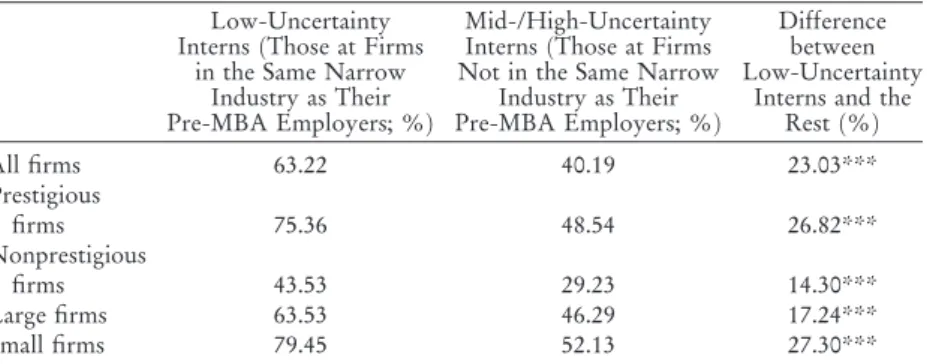
Table 3 shows that realized patterns in full-time offers are consistent with this idea. For all categories of firms in our sample, large, small, pres-tigious or nonprespres-tigious, we observe a very large difference in the prob-ability that a summer internship results in a full-time offer, depending on whether the intern is somebody with low or high levels of industry
expe-Table 3
Industry Experience and Probability That a Summer Internship Results in a Full-Time Job Offer
Low-Uncertainty InternsðThose at Firms
in the Same Narrow Industry as Their Pre-MBA Employers; %Þ
Mid-/High-Uncertainty InternsðThose at Firms Not in the Same Narrow
Industry as Their Pre-MBA Employers; %Þ
Difference between Low-Uncertainty
Interns and the Restð%Þ
All firms 63.22 40.19 23.03***
Prestigious
firms 75.36 48.54 26.82***
Nonprestigious
firms 43.53 29.23 14.30***
Large firms 63.53 46.29 17.24***
Small firms 79.45 52.13 27.30***
NOTE.—Across all firm categories, industry experience has a significant and positive impact on the probability that a summer internship results in a full-time offer.
rience. Specifically, summer interns who had worked in the narrow
in-dustry of the firm before business schoolðthese are people we referred to as
low-uncertainty candidatesÞhave between 14% and 27% higher
proba-bilities of converting the internship into a full-time job, relative to interns
with lower levels of industry experienceðthese are the people with medium
or high uncertainty about industry fitÞ. These differences—driven by
in-dustry experience—in the likelihood of having an internship resulting in
an offer for long-term employment are economically large and statistically
significantðp<.01Þ.
While this pattern is strong and fits our expectation of how uncertainty about industry fit will affect offers, we cannot completely rule out that industry-specific human capital is playing a role here. If employees with prior experience are more productive, then, even holding fit constant, we
might expect them to get offers at higher rates.11
V. Results
A. Uncertainty Hinders Hiring
We find that uncertainty hinders hiring. Figure 1 shows that the success rate of job applications decreases monotonically with the level of uncer-tainty regarding the industry fit of the candidates. The fraction of applica-tions for internships and full-time jobs that result in offers is 7.77% among low-uncertainty candidates, 5.65% among medium-uncertainty candidates, and 4.39% among high-uncertainty candidates. These sample frequencies
are different from each other atp<.001, indicating that firms’ hiring
de-cisions may differ across applicant types in a systematic way. Specifically, figure 1 suggests that employers prefer to make offers to applicants char-acterized by less uncertainty regarding their productivity, namely, those individuals with more experience in the particular industry of the hiring firm.
A natural measure of the firms’ preference toward certainty can be obtained by comparing the odds that applications result in offers across various types of candidates, where odds are defined in the usual way as
the probability of successði.e., offerÞdivided by the probability of failure
ði.e., no offerÞ. In our sample, the odds of application success are 8.42%,
5.99%, and 4.59% for applications coming from low-, medium-, and high-uncertainty candidates, respectively. Comparing these odds of success across candidate subsamples, we observe that firms’ interest in making of-fers is 1.83 times stronger among low-uncertainty candidates relative to high-uncertainty ones and 1.30 times stronger among medium-uncertainty candidates versus high-uncertainty ones. The preference for low-uncertainty
11The fact that offer rates are far from one for those with and without industry
applicants is 1.71 times stronger than for the other two categories ði.e.,
medium and high uncertaintyÞcombined. These ratios of odds of success in
getting offers are summarized in figure 2. An odds ratio equal to 1 would indicate that firms’ hiring decisions do not differ across different types of job candidates. However, Wald chi-square tests show that all these odds
ratios are significantly different from 1 at p< .001, implying that firms
prefer less uncertainty to more when they decide to whom jobs should be offered.
While these univariate results suggest that uncertainty hinders hiring decisions, other interpretations are possible and must be investigated. For example, people with less experience in the industry of the firm to which they apply, whom we have so far referred to as higher-uncertainty can-didates, may have lower general ability or other characteristics that make them less desirable to employers. It is also possible that there are more
industry-switching ði.e., higher-uncertaintyÞcandidates in particular
co-horts graduating at times when firms do not hire as much, for example, during recession years. Moreover, industry-switching candidates may tend to apply to industries with fewer jobs available, or, within an industry, to firms with a lower capacity to hire, or to those faced with a higher number of applicants.
regression showing odds ratios effects, and a generalized linear model
ðGLMÞindicating risk ratios effects, with the goal of identifying the effect
of the candidates’ uncertainty about industry fit on their likelihood of suc-cess. As control variables, we include the candidates’ GPA, which is our proxy for their general ability, as well as indicator variables for gender and
international student statusðthe latter may influence hiring decisions due
to work visa concernsÞ. We also include cohort fixed effects, as well as
industry fixed effects. Moreover, we control for the number of interview slots available to applicants for each specific job opening, as a way to account for the firms’ capacity to hire. Finally, to account for the possi-bility that different organizations may face different numbers of
appli-cants, we control for firm sizeðas measured by salesÞand prestige, as well
as for the number of competing companies in the same industry that are recruiting concurrently.
close to the univariate results shown in figure 2, and they illustrate yet again that firms prefer certainty when they make hiring decisions. These effects
are significant atp<.01 and are common across all three empirical
speci-fications in the table.
The control variables included in the model in table 4 have the expected effects. Specifically, the odds of application success are higher for
candi-Table 4
The Effect of Uncertainty Regarding Job Applicants’Industry Fit on the Firms’Decision to Make Offers: Three Models
The Dependent Variable Is an Indicator Equal to 1 for Each Application of a Candidateito JobjThat Resulted in an Offer
Linear
Probability Model Logistic Regression,Odds Ratios Effects
Generalized Linear Model, Risk Ratios Effects
Low_uncertaintyij .03 1.90 1.81
ð6.95Þ*** ð8.32Þ*** ð8.77Þ***
Medium_uncertaintyij .01 1.24 1.22
ð2.68Þ*** ð3.02Þ*** ð3.26Þ***
GPAi .05 3.19 2.96
ð9.93Þ*** ð10.23Þ*** ð10.99Þ***
International_studenti –.03 .53 .55
ð–10.27Þ*** ð–9.76Þ*** ð–10.09Þ***
Malei –.02 .69 .71
ð5.53Þ*** ð–6.24Þ*** ð–6.70Þ***
Interview_slotsj .0003 1.01 1.01
ð2.26Þ** ð2.51Þ** ð3.25Þ***
LnðFirm_salesjÞ .003 1.09 1.08
ð3.58Þ*** ð3.20Þ*** ð4.14Þ***
Prestigiousj 2.01 .78 .80
ð–2.63Þ*** ð–2.63Þ*** ð–3.20Þ***
Many_competitorsj .01 1.08 1.07
ð1.40Þ*** ð.99Þ ð1.17Þ
Internship stage .01 1.38 1.35
ð4.11Þ*** ð4.09Þ*** ð4.81Þ***
Class FEs Yes Yes Yes
Industry FEs Yes Yes Yes
R2 .02 .05 .05
NOTE.—N530,783. The three panels report the results of a linear probability model, a logistic re-gression, and a GLM model. Candidateito jobjis characterized as having low, medium, or high un-certainty regarding industry fit if he or she has worked in the same narrowly defined industry as that of the firm offering jobj, if he or she has worked in the same broadlyðbut not narrowlyÞdefined industry as that of the firm offering jobj, and, respectively, if he or she has not worked in the broadly defined industry to which the firm belongs. For example, candidates applying to a jobjin investment banking have high uncertainty regarding industry fit if they never worked in any finance-related industry before; if they previously worked in commercial banking, for example, they would have a medium level of uncertainty regarding industry fit, whereas candidates who worked in investment banking before have a low level of uncertainty regarding industry fit for jobj. The referenceðthus omittedÞcategory in all three models is High_uncertaintyij.T-statistics are shown in parentheses. Standard errors are clustered at the job level and are robust to heteroskedasticity.
dates with a higher GPA during business school, those who are not inter-national students, women, and those applying to larger or to less prestigious firms as well as to job openings with more interview slots. Applications are also significantly more likely to result in offers at the internship stage compared to the full-time recruiting stage. Specifically, the odds of an ap-plication resulting in an offer are 1.38 times higher for internships than for
full-time jobsðp<.01Þ.
The results in table 4 indicate that, controlling for other firm and ap-plicant characteristics that may be important for hiring decisions, higher uncertainty regarding the applicants’ industry fit lessens the chance that firms will hire them. In other words, uncertainty about productivity hin-ders corporate investment in people, similar to the effect previously doc-umented in the case of investment in physical assets. We now turn to an-alyzing whether differences in the adjustment costs or competition faced by firms affect uncertainty on hiring in ways that also parallel the effects documented in the context of physical investments.
B. Adjustment Costs Magnify the Effect of Uncertainty on Hiring 1. Firing Costs
To understand whether uncertainty is more detrimental to hiring when firms face higher firing costs, we analyze whether the lack of information about a candidate’s industry fit reduces the odds of success of his or her application more at the full-time recruiting stage, when the costs of dis-solving a poor match are high, than at the internship recruiting stage, when these costs are relatively small.
The logistic regression in table 5 presents evidence consistent with this hypothesis. The goal of the econometric model is to identify the differences in the odds that an application results in a job offer across different levels of uncertainty about industry fit and across the two recruiting stages.
The analysis includes the same set of firm and job applicant controls as used in table 4. The reference category refers to applications coming from individuals characterized by medium or high uncertainty about industry fit. Our prior results suggest that this category of applications should have lower odds of success compared to low-uncertainty candidates, and the results in the table confirm that this is indeed the case. At the internship stage, the odds of success of a low-uncertainty applicant are 1.66 times as
high as those of other candidatesðp<.01Þ, while at the full-time recruiting
stage, the odds of success of a low-uncertainty applicant are 2.38 times as
high as those of the other, more uncertain, candidatesðp<.01Þ. These two
effects are significantly different from each other, as well as significantly
different from 1ði.e., the indifference thresholdÞ, atp<.05. Therefore, the
when the costs of firing and replacing a poor match are much higher than at the internship stage.
Note that the estimation method in table 5 allows us to avert two po-tential confounding effects. First, perhaps there are more industry
switch-ers ði.e., less experienced and thus higher uncertainty candidatesÞin the
applicant pool at the internship stage relative to the full-time stage, so even if firms have equally strong reservations about hiring more uncertain candidates at the two stages, they would mechanically end up making more offers to such applicants at the internship stage. To account for this, the logistic models in table 5 compare at each recruiting stage the odds of application success for the subset of low-uncertainty candidates to the odds of success in the subset of more uncertain candidates, and this comparison does not depend on the difference in the prevalence of low-uncertainty
Table 5
The Effect of Uncertainty on Hiring Decisions for Each of the Two Recruiting Stages: Internship and Full-Time Hiring
The Dependent Variable Is an Indicator Equal to 1 for Each Application of a Candidateito
JobjThat Resulted in an Offer Internship Recruiting
Stage Full-Time RecruitingStage
Low_uncertaintyij 1.66 2.38
ð5.83Þ*** ð6.07Þ***
GPAi 3.31 2.88
ð9.11Þ*** ð4.76Þ***
International_studenti .57 .44
ð–7.77Þ*** ð–6.31Þ***
Malei .70 .63
ð–5.13Þ*** ð–3.78Þ***
Interview_slotsj 1.01 .99
ð3.14Þ*** ð–1.65Þ*
LnðFirm_salesjÞ 1.08 1.11
ð2.37Þ** ð2.40Þ**
Prestigiousj .78** .81
ð–2.28Þ ð–1.26Þ
Many_competitorsj 1.17 .92
ð1.87Þ** ð–.43Þ
Class FEs Yes Yes
Industry FEs Yes Yes
R2 .04 .07
Observations 21,683 9,100
NOTE.—The internship recruiting stage applications in our data set are the appli-cations sent to firms that come to campus to recruit when students are in their first year of the MBA program. The full-time recruiting stage applications are the applications sent to firms that come to campus to recruit when students are in their second year of the MBA program.T-statistics are shown in parentheses. Standard errors are clustered at the job level and are robust to heteroskedasticity.
applicants between the two recruiting stages. Second, perhaps the pool of
industry switchersði.e., higher uncertainty candidatesÞat the internship
stage is better somehow—for example, they may have higher general
ability—than the pool of switchers still looking for a job at the full-time
stage. This should lead to firms being more likely to make offers to higher uncertainty people at the internship stage compared to the full-time stage. However, this cannot drive the wedge in the firms’ preference for low-uncertainty people between these two recruiting stages that we document in table 5, since there we control for candidate characteristics, including their general ability as measured by their GPA.
Another potential confound in the interpretation of the difference in the effect of the low-uncertainty indicator on the odds of application success
at the internship and the full-time stage ð1.66 vs. 2.38Þ is that perhaps
people whom we label as low-uncertainty candidates at the full-time re-cruiting stage may in fact be characterized by lower uncertainty about their industry fit, relative to people whom we label as low-uncertainty candidates at the internship recruiting stage. This can happen if people who apply to jobs in a particular industry at the full-time stage tend to have already done internships in that same industry. In such a scenario, firms recruiting for full-time positions would assess that the probability of these industry-experienced candidates of having high industry fit is greater than the probability they would assign for a similar applicant at the internship stage.
To check whether or not this alternative mechanism explains our find-ing that the odds of success for low-uncertainty people versus the others are significantly better at the full-time stage relative to the internship stage
ði.e., 2.38 vs. 1.66Þ, in unreported analyses we estimated the same logistic
model for the probability that an application results in an offer at the full-time stage, as in the last column of table 5. We did this, however, only for full-time job applications coming from individuals who at the internship stage took a summer job in a broad industry different from that they were in before coming to business school. If the alternative account is correct, then the coefficient on the low uncertainty variable in this logistic regres-sion should be equal to that obtained in the logistic regresregres-sion estimated at
the internship stage, which is in column 1 of table 5ði.e., 1.66Þ. This is
intern-ship and the full-time stage is not related to a change in the degree of un-certainty of what we label as low unun-certainty candidates.
Overall, these results suggest that there exists a strengthening in firms’ preference to hire workers with less uncertain industry fit from the pro-bationary to the full-time recruiting stage. This is consistent with the idea that at the full-time stage it is more costly to fire an employee who has been revealed to be a poor match.
2. Replacement Costs
We now turn to examining whether firms that face lower costs of hiring a replacement for a revealed poor match will be less concerned about can-didates’ uncertainty regarding industry fit and hence more likely to hire riskier workers. Two categories of firms are likely to face relatively low replacement costs for poor matches: prestigious and large organizations. First, firms that are widely regarded as prestigious places to work are likely to receive numerous applications through many recruiting channels, and hence they can find suitable candidates with ease. Second, large firms have dedicated human resources departments and can tap into numerous
re-cruiting venuesðincluding internal staff; see Tate and Yang 2015Þto find
new candidates for a particular position. Hence, we expect that the firms that will be the least concerned about candidate uncertainty will be the prestigious and large ones.
In the logistic regressions in table 6, we estimate the effect of uncer-tainty on hiring decisions as a function of firm prestige. A firm is labeled as
prestigious if it was included in the Fortune MBA 100annual rankings
during 2007–2009. The analysis includes the same set of firm and job
ap-plicant controls as used in table 4. We find that the preference of firms for low-uncertainty candidates is stronger for nonprestigious firms compared to prestigious ones, as predicted. Specifically, low-uncertainty candidates have odds of getting an offer that are 2.58 times higher than those of riskier candidates when applying for positions at nonprestigious firms, but only 1.57 times higher when applying for positions at prestigious firms. These
odds ratio estimates are significantly different atp<.01.
A natural concern is that these differences in the odds ratios across the two different types of firms do not indicate differences across firms in their dislike for uncertainty but rather differences in the composition of the pool of applicants faced by prestigious and nonprestigious firms. Our choice to use odds ratios to measure firms’ hiring propensities allows us to alleviate this concern. Note that in a world where the uncertainty in the candidates’ fit did not matter for firms’ hiring decisions, the ratio of odds
of successðwhere odds are defined, as usual, as the probability of success,
i.e., that an application will result in an offer, divided by the probability of
failure, i.e., that the application will not result in an offerÞof the
what the data show. We consistently find this odds ratio to be significantly higher than 1, meaning that the odds of success in getting job offers are better for low-uncertainty applicants. Since the odds ratios we estimate in table 6 are 1.57 for prestigious firms and 2.58 for nonprestigious ones, the difference between these numbers indicates that, for reasons inde-pendent of the composition of the applicant pools faced by these two types of firms, low-uncertainty candidates are particularly successful in getting offers at nonprestigious firms. Or equivalently, prestigious firms are those
where higher uncertainty applicants have better odds of success.12
The discrepancy in the preference for certainty between these two types of firms is particularly large at the full-time recruiting stage. At that stage, low-uncertainty candidates have 3.57 times higher odds of getting offers, relative to the other candidates, when applying to nonprestigious firms, whereas for prestigious ones, the corresponding increase in odds is only
1.74 times. These effects are significantly different atp<.01. This suggests
that when firms face both high firing costs, as well as high replacement costs, they are particularly reluctant to make offers to candidates char-acterized by higher uncertainty about industry fit.
Turning to our other source of variation in replacement costs, in the logistic regression in table 7, we estimate the effect of uncertainty on hiring decisions as a function of firm size, measured by sales. Conducting the same analysis using the number of employees as our measure of firm size yields very similar results in terms of both magnitude and significance levels, so we omit them here for brevity. The analysis includes the same set of firm and job applicant controls as used in table 4. The results support
the idea that small firmsði.e., with below-median salesÞare more inclined
to hire low-uncertainty applicants than large firms ði.e., with
above-median salesÞ, in general as well as at each of the two recruiting stages.13
For example, across both internship and full-time recruiting, the odds of success of low-uncertainty candidates are 2.19 times higher than those of
12It is also possible that the most prestigious firms attract the best overall
can-didates, for whom prior knowledge about the firm’s industry may be less impor-tant. That is, industry switchers hired by prestigious firms may have better ability. In our analysis, we try our best to control for general ability—we use the students’ GPA while in business school as our proxy for general ability, as well as the stu-dents’ GMAT scores, in alternate specifications ðunreported here for brevityÞ. That being said, there may be complementarities between industry expertise and general ability, or nonlinear effects, that differ between prestigious and nonpres-tigious firms, which our empirical specification may not capture.
13While we argue that large firms likely face lower costs of finding a
riskier candidates in the case of small firms, but only 1.69 times higher in the case of large firms. This difference, however, is not statistically sig-nificant at conventional levels.
The estimates in table 7 show an interesting interaction of the effects of replacement costs as indicated by firm size with those of firing costs as indicated by the recruiting stage. The biggest difference in firms’ prefer-ence for certainty can be seen when comparing the relative odds of success of low-uncertainty candidates across two scenarios: when applying for full-time jobs at small firms and when applying for internships at large
firms ðodds ratio estimates of 2.71 vs. 1.55, significantly different atp<
.05Þ. In the first scenario, the recruiting firms face a high firing cost, as well
as a high replacement cost. In the second scenario, recruiting firms can easily fire a revealed bad match and also face lower costs of finding a suitable replacement for a revealed poor match. Hence, high firing and high replacement costs appear to induce firms to prefer certainty more in the first scenario relative to the second.
3. General Ability
As a final dimension of adjustment costs, we now examine the general ability of a candidate. Thinking in terms of option value, we would ex-pect people who are of higher ability to be easier to redeploy if their initial employment arrangement does not work out for some reason. Also, it is possible that high-ability candidates can compensate through on-the-job learning for lack of industry fit. This is potentially analogous to the option value of physical assets that can be more easily redeployed. Firms are not reluctant to invest in physical capital with uncertain productivity if those assets can be easily sold or put to another use. This would suggest that in the case of candidates with high general ability, the relationship between their industry expertise and their odds of receiving job offers may be weak or nonexistent.
Note, however, that there is an important difference from a company’s perspective between human capital and physical assets. Firms capture the rents of valuable physical assets whether those rents occur with the in-tended use of those assets or, if the firm finds the assets not valuable, through resale or redeployment. But, while the rents from human capital are shared between the firm and the worker if the match lasts, the worker captures all the rents if he or she leaves the firm. This suggests that, while firms are not as concerned about uncertainty regarding physical assets’ future productivity if they are characterized by higher redeployability
ðBloom et al. 2007Þ, higher general ability will not influence the negative
The data, as shown in table 8, suggest that this second mechanism may be more important than the first, as we find that the strength of the pref-erence that firms have toward low-uncertainty workers is similar across candidates with high- or low-general ability. We measure general ability using the person’s grades while in the MBA program. We characterize each student as having either a high or a low GPA, depending on whether their GPA is above or below the median. The results in table 8 show that the odds of an application resulting in an offer for low-uncertainty can-didates are 1.81 times as high as for the other applicants in the subset of low-GPA students and 1.83 times as high in the subset of high-GPA stu-dents. Hence, as predicted, in general, the strength of the preference that firms have toward low-uncertainty workers is similar across candidates with high or low general ability. The estimates in table 8 do suggest that at the full-time recruiting stage, firms’ preference for low uncertainty may be stronger among the low-GPA candidates relative to the high-GPA ones,
but the two odds ratios estimatesð3.27 vs. 1.96Þfor these subsamples are
only weakly statistically differentðp<.09Þ.
Overall, these results suggest that adjustment costs—in particular, firing
and replacement costs, and to a much lesser extent, the value of the person
in alternative jobs—strengthen the preference of hiring firms toward less
risky candidates. These effects parallel those concerning the interaction between uncertainty and adjustment costs in the context of physical in-vestments when the firm can capture the option value. However, in the
case of general ability, where employees capture the value of theðhumanÞ
capital if it is put to an alternate use, the parallel to physical capital is not as strong.
C. Competition Diminishes the Effect of Uncertainty on Hiring The investments literature has shown that firms faced with more com-petition are less concerned by project uncertainty because waiting for its resolution may lead to more limited opportunities later on. In our setting, this argument implies that we should observe a lower impact of candidate uncertainty on firms’ decisions to make offers for those firms that have more competitors recruiting at the same time from the same pool of stu-dents. We find evidence consistent with this hypothesis, as illustrated by the results in table 9. There we estimate the effect of uncertainty on the odds that applications result in offers separately for firms that face below or above median competition, as measured by the number of firms in the same industry that are concurrently recruiting in the same pool of MBA students. For the typical, narrowly defined industry in the sample, the
median number of firms recruiting on campus at any given stageð
intern-ship or full-timeÞis 10. Hence, for example, if there are 10 or more firms
point in time as facing high competition—or, for the sake of clarity, facing
many competing firms.14
The results in table 9 show that the preference for certainty is partic-ularly strong among recruiters that face few competitors. For these firms, low-uncertainty applicants have 2.49 times higher odds of getting offers compared to the riskier applicants. For firms faced with many competi-tors, the odds of success for low-uncertainty applicants are only 1.63 times
higher than for the rest. These odds ratios are significantly differentðp<
.05Þ. The estimates in table 9 also show an interesting interaction of the
effects of competition with those of firing costs. Specifically, the biggest difference in firms’ preference for certainty can be seen when comparing the relative odds of success of low-uncertainty candidates across two sce-narios: when applying for full-time jobs to firms that face few competitors and when applying for internships at firms that face many competitors
ðodds ratio estimates of 2.90 vs. 1.60, significantly different atp<.05Þ. In
the first scenarios, the recruiting firms face a high firing cost, and also they can afford to be selective since applicants do not have much choice. In the second scenario, recruiting firms can easily fire a revealed bad match and also do not have the luxury of delaying hiring, since applicants have many choices of employers in that same industry that are present on campus at the same time. Hence, both competition effects and firing costs effects lead firms to prefer certainty more in the first scenario relative to the second. These results indicate that the concerns that firms have regarding employee uncertainty indeed diminish with the intensity of competition for talent, in
a similar way as found in the context of physical investments.15
VI. Conclusion
We conduct an empirical study of the role of uncertainty in corporate hiring decisions. We find that firms are less inclined to make job offers to candidates characterized by higher uncertainty regarding their industry fit. The preference of firms for certainty when hiring is magnified when they are more likely to face higher firing and replacement costs and when
14Indicating that firms with more industry peers recruiting at the same time
indeed face more competition for talent, we find that with each additional com-petitor, the number of applications a firm receives per interview slot decreases by 0.02ðp<.05Þ. The median number of applications per interview slot in our sample is 1.42.
15A necessary condition for competition to speed up hiring and lessen the
they face less competition for talent. Our analysis is based on a unique data set covering MBA recruiting activity at a top US business school.
We should note that the data have limitations that lead to caveats about the internal and external validity of our results. First, even though the career office at the school that provided the data works hard to encourage students to report all of their offers, it is possible that students do so with some error. Second, a substantial amount of the job search by students at this school is done through channels other than on-campus recruiting. In these cases, we do not have any information about firms’ preferences be-cause we do not observe who applies to these firms. While we do not think
that these issues bias our results substantiallyðif anything, the measurement
error would imply any relationships in the data are likely to be stronger
than our analysis suggestsÞ, we do not know for sure. Third, the external
validity of our analysis is limited by the fact that our data set covers job seekers at one school and the particular firms that choose to conduct re-cruiting activities there.
While these limitations are important, high-skill labor markets such as the one we study are growing in importance worldwide. Also, there has been limited empirical work analyzing the matching process between firms and workers. Therefore, we believe our analysis makes a useful contri-bution by showing that considerations similar to those used in the context of physical investments are also significant determinants of corporate hir-ing decisions.
References
Agrawal, Ashwini K., and David A. Matsa. 2013. Labor unemployment
risk and corporate financing decisions.Journal of Financial Economics
108, no. 2:449–70.
Ahern, Kenneth R., Ran Duchin, and Tyler Shumway. 2015. Peer effects in
risk aversion and trust.Review of Financial Studies27, no. 11:3212–40.
Bandiera, Oriana, Luigi Guiso, Luigi, Andrea Prat, and Raffaella Sadun. 2010. Matching firms, managers, and incentives. NBER Working Paper no. 16691, National Bureau of Economic Research, Cambridge, MA. Berk, Jonathan B., Richard Stanton, and Josef Zechner. 2010. Human
capital, bankruptcy, and capital structure.Journal of Finance65, no. 3:
891–926.
Bertrand, Marianne, Claudia Goldin, and Lawrence F. Katz. 2010. Dy-namics of the gender gap for young professionals in the financial and
corporate sectors. American Economic Journal: Applied Economics 2,
no. 3:228–55.
Bloom, Nick, Stephen Bond, and John Van Reenen. 2007. Uncertainty and
Bollinger, Christopher R., and Julie L. Hotchkiss. 2003. The upside po-tential of hiring risky workers: Evidence from the baseball industry. Journal of Labor Economics21, no. 4:923–44.
Booth, Alison L., Marco Francesconi, and Jeff Frank. 2002. Temporary
jobs: Stepping stones or dead ends?Economic Journal112ð480Þ:F189–
F213.
Eisfeldt, Andrea L., and Dimitris Papanikolaou. 2013. Organization
capi-tal and the cross-section of expected returns.Journal of Finance68, no. 4:
1365–1406.
Farber, Henry S., and Robert Gibbons. 1996. Learning and wage dynam-ics.Quarterly Journal of Economics111, no. 4:1007–47.
Graham, John, Campbell R. Harvey, and Manju Puri. 2013. Managerial
attitudes and corporate actions. Journal of Financial Economics 109,
no. 1:103–21.
Greenwald, Bruce C. 1986. Adverse selection in the labor market.Review
of Economic Studies53, no. 3:325–47.
Grenadier, Steven R. 2002. Option exercise games: An application to the
equilibrium investment strategies of firms.Review of Financial Studies
15, no. 3:691–721.
Grenadier, Steven, and Andrei Malenko. 2010. A Bayesian approach to real options: The case of distinguishing between temporary and
per-manent shocks.Journal of Finance65, no. 5:1949–86.
Gu¨ell, Maia, and Barbara Petrongolo. 2007. How binding are legal limits?
Transitions from temporary to permanent work in Spain.Labour
Eco-nomics14, no. 2:153–83.
Hendricks, Wallace, Lawrence DeBrock, and Roger Koenker. 2003.
Un-certainty, hiring, and subsequent performance: The NFL draft.Journal of
Labor Economics21, no. 4:857–86.
Houseman, Susan N. 2001. Why employers use flexible staffing
arrange-ments: Evidence from an establishment survey. Industrial and Labor
Relations Review55, no. 1:149–70.
Jovanovic, Boyan. 1979. Job matching and the theory of turnover.Journal
of Political Economy87, no. 5:972–90.
Kahn, Lisa B., and Fabian Lange. 2014. Employer learning, productivity, and the earnings distribution: Evidence from performance measures. Review of Economic Studies81, no. 4:1575–1613.
Kaniel, Ron, Cade Massey, and David T. Robinson. 2010. The importance of being an optimist: Evidence from labor markets. NBER Working Paper no. 16328, National Bureau of Economic Research, Cambridge, MA. Kaplan, Steven, Mark M. Klebanov, and Morten Sorensen. 2012. Which
CEO characteristics and abilities matter?Journal of Finance67, no. 3:
973–1007.
Lazear, Edward P. 1998. Hiring risky workers. InInternal labour markets, incentives, and employment, ed. Isao Ohashi and Toshiaki Tachibanaki. New York: St. Martin’s.
Levin, Jonathan. 2002. Multilateral contracting and the employment
rela-tionship.Quarterly Journal of Economics117 no. 3:1075–1103.
Malmendier, Ulrike, and Josh Lerner. 2013. With a little help from my
ðrandomÞ friends: Success and failure in post–business school
entre-preneurship.Review of Financial Studies26 no. 10:2411–52.
Ouimet, Paige, and Rebecca Zarutskie. 2011. Acquiring labor. Working paper, University of North Carolina at Chapel Hill, Chapel Hill, NC, and Federal Reserve Board, Washington, DC.
Oyer, Paul. 2008. The making of an investment banker: Stock market
shocks, career choice, and lifetime income.Journal of Finance63, no. 6:
2601–28.
Oyer, Paul, and Scott Schaefer. 2011. Personnel economics: Hiring and
incentives. In The handbook of labor economics, vol. 4B, ed. Orley
Ashenfelter and David Card. Amsterdam: Elsevier.
Prescott, Edward C., and Visscher, Michael. 1980. Organization capital. Journal of Political Economy88, no. 3:446–61.
Schmalz, Martin C. 2015. Unionization, cash, and leverage, Working Paper no. 1215, Stephen M. Ross School of Business, University of Michigan, Ann Arbor.
Segal, Lewis M., and Daniel G. Sullivan. 1997. The growth of temporary
services work.Journal of Economic Perspectives11 no. 2:117–36.
Shue, Kelly. 2013. Executive networks and firm policies: Evidence from
the random assignment of MBA peers.Review of Financial Studies26,
no. 6:1401–42.
Stein, Luke C. D., and Elizabeth Stone. 2013. The effect of uncertainty on investment, hiring, and R&D: Causal evidence from equity options. Working paper, Arizona State University and Stanford University. Tate, Geoff, and Liu Yang. 2015 The bright side of corporate
diversifica-tion: Evidence from internal labor markets.Review of Financial Studies
28, no. 8:2203–49.
Waldman, Michael. 1984. Job assignments, signaling, and efficiency.RAND